
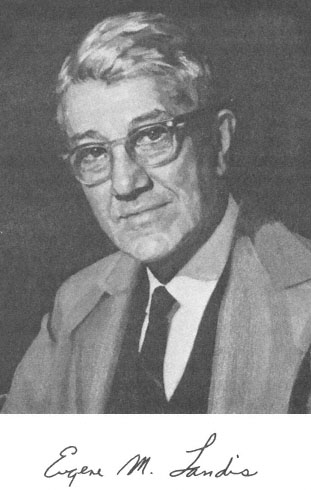
EUGENE MARKLEY LANDIS
April 4, 1901-February 14, 1987
BY JOHN R. PAPPENHEIMER
IN 1942 WALTER B. CANNON retired from the Harvard Medical School after serving more than thirty-five years as the George Higginson Professor of Physiology. Like his predecessor, Henry Pickering Bowditch, Cannon had brought extraordinary distinction to the Harvard Medical School and indeed to american medical sciences in general. His re-Burwell, a challenge that was magnified by the wartime conplacement presented a difficult challenge for Dean Sidney ditions of 1942. In November of 1941 Dean Burwell wrote as follows to James Bryant Conant, president of Harvard University:
This to report to you the situation with regard to two important pending appointments at the Medical School. Of these, much the most important is the appointment of a successor to Dr. Cannon. I have reached a solution in my mind which I believe is the best one that can be made . . . . This paragon is Dr. Eugene Landis, now Professor of Medicine at the University of Virginia . . . . Lest you misjudge the kind of fellow he is from the fact that he is Professor of Medicine let me point out that he is a Doctor of Philosophy as well as of Medicine . . . . He is a naturalist who applies to the solution of problems of bodily function the principles of physics and chemistry. It does not seem to me to be a disadvantage that he has a knowledge of the changes in function which occur during the course of disease. Aside from distinction in research he is a person of broad knowledge and understanding.
Eugene Markley Landis was born on April 14th, 1901, in New Hope, Pennsylvania. His father was a biology teacher in a Philadelphia high school and young Gene frequently accompanied his father on weekend field trips to collect the animal materials needed for the laboratory course. Protozoology and microscopy captured Gene's interest at an early stage and his first paper, entitled "An Amicronucleate Race of Paramecium caudatum," was published in The American Naturalist in 1920 while Gene was a sophomore at the University of Pennsylvania. He became an undergraduate teaching assistant in zoology while he took advanced courses in protozoology, cytology, and comparative anatomy. However, it was not until he reached medical school that he began to think in terms of function. In a recent letter to a young physiologist at Oxford, he wrote: "My first year at medical school in 1922 was a thrilling one. Oxford-trained Cuthbert Bazett and Penn-trained Merkel Jacobs taught physiology in a way that correlated morphology and microscopy with function and brought it all alive. In 1924 I asked Dr. Jacobs whether I might use spare time and summers in his laboratory at Penn and at Woods Hole to learn something about research in physiology." Dr. Jacobs, in reply, suggested that Gene investigate the permeability of capillary walls using synthetic dyes. There were three reasons for this suggestion. First, August Krogh had just published his Nobel prize-winning book, Anatomy and Physiology of the Capillaries, in which he emphasized the quantitative histology of the capillary network and pointed out how little was known about the permeability of capillary walls. Second, World War I had laid open previously secret German patents on dyestuffs, and third, Robert Chambers had just described the micro-manipulator and the feasibility of micro-injections. Jacobs made his seminal suggestion in the spring of 1924 and on October 13th, 1925, Landis—by then a third
year medical student—sent a long manuscript entitled "The Capillary Pressure in Frog Mesentery Determined by Microinjection Methods" to the editors of the American Journal of Physiology. It was the first of a series of five papers leading to quantitative characterization of the capillary wall in terms of transmural pressures on the one hand and rates of transcapillary fluid movement on the other. These papers also included the first measurements of the pressure drop along the vascular tree and localization of the separate components of the peripheral resistance to blood flow, in mammals as well as in frogs. The methods developed to measure pressures within microvessels and rates of fluid movement across capillary walls were truly elegant. With a micropipette attached to a pressure reservoir and a micrometer syringe, Landis found that he could insert the pipette into microvessels as small as 5 µM in diameter without serious injury or loss of fluid around the point of puncture. If the pressure within the tip of the pipette were slightly lower than that in the blood vessel, red cells moved into the pipette. If the pressure were then raised above intravascular pressure by means of the micrometer regulator, the red cells moved toward the vessel lumen. Using the movements of a single red cell as a guide and by skillful manipulation of the micrometer-regulator, Landis was able to determine the pressure within the pipette that exactly balanced the pressure within the microvessel. It was even possible to measure peak systolic and diastolic pressures. To measure net transcapillary fluid movement, the distal end of a single capillary was occluded by means of a blunt glass rod; transcapillary fluid movement in either direction was then estimated from the rate of movement of a single red cell towards or away from the point of occlusion. It was found that rate of net fluid movement across the capillary wall is proportional to the difference between capillary hydrostatic
pressure and the osmotic pressure of the plasma proteins, thus providing experimental proof of Ernest Starling's hypothesis of fluid exchange. The constant of proportionality was the first quantitative measurement of the hydrodynamic conductance of the capillary wall (cubic micra of fluid per second per cm H20 pressure difference per µ2 of capillary wall). With these powerful methods, Landis was able to investigate capillary permeability under a variety of physiological and pathological conditions: by August 1929 Krogh could say in the new edition of his book, that "the situation has now been wholly changed by the brilliant work of E. M. Landis, whose methods open up the possibility of an intimate understanding of capillary permeability far beyond anything to be imagined before." This intimate understanding, of which Krogh spoke, is today the basis for everyday teaching in elementary physiology and the original series of papers, including a 1934 article in Physiological Reviews, remain as models of beautiful scientific writing. Landis was the sole author of all these papers and there are no acknowledgments of financial support for the simple reason that there was none. He made the original parts of his apparatus himself, washed his own dishes, drew his own illustrations and typed his own papers—all between classes at medical school. These papers were the most important ones of his entire research career, and the lonely, frugal environment in which he produced them had a profound effect on the philosophy of science which he offered to his colleagues under very different circumstances during his subsequent career.
In 1929, after completing an internship at the hospital of the University of Pennsylvania, Landis was awarded a Guggenheim Memorial Fellowship and for the next two years he worked with August Krogh in Copenhagen and with Sir Thomas Lewis in London. This association with the elite of
experimental zoology and physiology on the one hand and clinical research on the other was no accident; indeed, it reflected most accurately the two poles of his career. With Lewis he wrote papers on Raynaud's disease and on acrocyanosis, and with Krogh he developed the pressure plethysmograph for physiological measurements of fluid exchange in human extremities.
After returning from Europe in 1931, Landis put on his clinical white coat for twelve years, first at the University of Pennsylvania and then as chairman of the Department of Medicine at the University of Virginia. During this period he made the first accurate measurements of the molecular weight of Inulin and the first renal clearance measurements of Diodrast in humans. He also verified unequivocally Tigerstedt and Bergman's discovery of renin in kidney extracts; this work was an important step in elucidating the role of renin in hypertension.
When Landis came to Harvard in 1943 to succeed Walter Cannon as the Higginson Professor of Physiology, he was faced with the difficult task of starting a new department with double-duty teaching under war-time conditions. At the same time he was president of the American Society for Clinical Investigation, and he had responsibilities for applied research on cardiovascular effects of acceleration for the Committee on Aviation Medicine in Washington. Under these circumstances academic research became a secondary consideration and almost all of his enormous energy and organizational skills went into the development of a super course in human physiology. In addition to more than sixty formal lectures, including two on Saturday mornings, there were thirty-two laboratory exercises, some of which lasted for two to four days. Many of the experiments were performed by the students on themselves—experiments on temperature regulation, syncope, renal clearances, plethys-
mography, special senses, acid-base disturbances, and metabolism. Most people who participated in this course, whether they were faculty or students, felt that it was an extremely rewarding experience, and for many students it was a crucial turning point that launched them into academic medicine. During the ten or more years that this course existed, Harvard students were always number one on the National Boards in physiology and by a wide margin. The conduct of such an elaborate course required a heavy load of teaching; during the war it was full-time and for a few years after the war it was half-time. Throughout this period, Professor Landis always made sure that he gave at least one more lecture than anyone else on his staff and he took personal charge of many of the laboratory exercises. He also did his share of correcting the several written examinations, all of which were in the form of essay questions.
The postwar period was an extraordinary one in the history of science. Academic research changed from being a joyous, spare-time privilege of a university teacher to a driving professional career. Explosive growth of government support for research enabled young investigators to create specialized research empires of their own without regard for departmental or other academic responsibilities. In this heady and inflationary atmosphere, Gene Landis retained the voice of reason, humility, and unassailable integrity. He was surrounded by prima donnas, both real and self-professed, but he was a master at controlling their inflationary tendencies while at the same time encouraging their creative ones. Indeed, he succeeded in creating an environment where prima donnas flourished without evading their responsibilities to the department or to the medical school as a whole. No less than six presidents of the American Physiological Society grew up as members of Landis's de-
partment. More important, perhaps, are the annual Bowditch Lectureships, which represent the highest honor the Physiological Society can confer on physiologists under the age of forty. Of the first fifteen Bowditch Lecturers, no less than eight were selected from the young people who had done highly original and independent work in Landis's entourage. Many chairmen of departments of physiology or medicine and at least four deans of medical schools carry with them some of the high standards of scientific excellence and unselfish ideals of service that they experienced during their apprenticeships with Gene Landis.
The changes of traditional academic customs and points of view that accompanied the rapid expansion of medical research often ran counter to Gene's sensitive and deeply ingrained ethical standards. He found it hard to adapt to the new professionalism in research with its pressures for multiple publications, rapid academic advancement, and competitive quest for money and fame. Perhaps it is for this reason that he withdrew personally from the research arena and concentrated on providing a departmental environment where talented young investigators could develop independently. Much of his time in later years was given to editorial work, including his role as editor-in-chief of Circulation Research. He himself wrote extremely well and he spent untold hours trying to bring the presentations in other people's manuscripts up to the standards he set for himself. He was indeed a superb editor—gentle and encouraging but always firm. He once remarked that ''editorial advice is like snow; the softer it falls, the longer it dwells and the deeper it sinks into the mind.''
Many honors came to Professor Landis, including memberships in foreign societies, the Phillips Medal of the American College of Physicians, the Distinguished Graduate Award of the University of Pennsylvania, and the Gold Heart Award
of the American Heart Association. He was elected to the National Academy of Sciences in 1954.
Gene and his wife had strong roots in Pennsylvania and they spent many happy, fulfilled years there after retirement in 1967. Gene became adjunct professor of biology at Lehigh University and there he resumed his microinjection studies of single capillaries without feeling under pressure to do so. His last original paper, entitled "Fluid Movement Through Walls of Single Capillaries Exposed to Hypertonic Solutions," was published in the American Journal of Physiology in 1971. Ill-health forced a second retirement and the end came on February 14th, 1987.
Gene is survived by his wife, Elizabeth; his daughter, Barbara (Mrs. Jerry Amos); and three grandchildren.
SELECTED AWARDS AND DISTINCTIONS
|
1922 |
Phi Beta Kappa, University of Pennsylvania |
|
1926-27 |
National Research Council Fellow |
|
1929-31 |
Guggenheim Research Fellow (a) London (Sir Thomas Lewis), (b) Copenhagen (August Krogh) |
|
1936 |
Phillips Medalist of the American College of Physicians |
|
1936 |
Harvey Society Lecturer |
|
1942-43 |
President, American Society for Clinical Investigation |
|
1943-67 |
George Higginson Professor of Physiology, Harvard University |
|
1944 |
American Academy of Arts and Sciences |
|
1952 |
Honorary Member, Sociedad Argentina de Biologia |
|
1952-53 |
President, American Physiological Society |
|
1954 |
National Academy of Sciences |
|
1966 |
Gold Heart Award, American Heart Association |
|
1974 |
Foreign Member, Royal Danish Academy |
|
1986 |
Distinguished Graduate Award, University of Pennsylvania |
SELECTED BIBLIOGRAPHY
1919 Drosophila and Mendel's law. School Sci. Math. 19:801-7.
1920 An amicronucleate race of Paramecium caudatum. Am. Nat. 54:453-57.
1923 A tabular account of the structural differences between the four larval instars of Culex pipiens. Trans. Am. Entomol. Soc. 69:25-42.
1924 With F. H. Adler and C. L. Jackson. The tonic effect of the sympathetic on the ocular blood vessels. Arch. Ophthalmol. 53:239-53.
1925 Conjugation of Paramecium multimicronucleata. J. Morph. Physiol. 40:111-67.
1926 The capillary pressure in frog mesentery as determined by micro-injection methods. Am J. Physiol. 75:548-70.
With W. L. Long, J. W. Dunn, C. L. Jackson, and U. Meyer. Studies on the effects of baths on man. III. Effect of hot baths on respiration, blood and urine. Am. J. Physiol. 76:35-48.
Some factors in the production of capillary stasis by concentration. Proc. Physiol. Soc. Philadelphia; Am. J. Med. Sci. 171:622-23.
Capillary permeability (Review article). Am. J. Med. Sci. 172:463-68.
1927 Micro-injection studies of capillary permeability. The passage of dyes in relation to capillary pressure and dilatation. Proc. Physiol. Soc. Philadelphia; Am. J. Med. Sci. 173:449-51.
Micro-injection studies of capillary permeability. I. Factors in the production of capillary stasis. Am. J. Physiol. 81:124-42.
Relation between capillary blood pressure and the rate of passage
of liquid through the walls of single capillaries. Proc. Physiol. Soc. Philadelphia; Am. J. Physiol. 81:492.
Micro-injection studies of capillary permeability. II. The relation between capillary pressure and the rate at which fluid passes through the walls of single capillaries. Am. J. Physiol. 82:217-38.
1928 Micro-injection studies of capillary permeability. III. The effects of lack of oxygen on the permeability of the capillary wall to fluid and to plasma proteins. Am. J. Physiol. 83:528-42.
1930 The capillary blood pressure in mammalian mesentery as determined by the micro-injection method. Am. J. Physiol. 93:353-62.
With T. Lewis, I. Haynal, W. Kerr, and E. Stern. Observations upon the reactions of the vessels of the human skin to cold. Heart 15:177-208.
With T. Lewis. Some physiological effects of sympathetic ganglionectomy in the human being and its effect in a case of Raynaud's malady. Heart 15:151-76.
Micro-injection studies of capillary blood pressure in human skin. Heart 15:209-23.
With T. Lewis. Observations upon the vascular mechanism in acrocyanosis. Heart 15:229-46.
Micro-injection studies of capillary blood pressure in Raynaud's disease. Heart 15:247-55.
Further observations upon a variety of Raynaud's disease with special reference to arteriolar defects and to sclerodema. Heart 15:329-50.
1931 Capillary pressure and hyperemia in muscle and skin of frog. Am. J. Physiol. 98:704-16.
With A. Krogh and A. H. Turner. The movement of fluid through the human capillary wall in relation to venous pressure and to the colloid osmotic pressure of the blood. J. Clin. Invest. 11:63-95.
The movement of fluid through the human capillary wall in relation to venous pressure and to the colloid osmotic pressure of the blood. Proc. Physiol. Soc. Philadelphia; Am. J. ed. Sci. 182:881.
1932 With A. Krogh and A. H. Turner. A celluloid capsule for measuring venous pressures. J. Clin. Invest. 11:357-62.
With L. Jones, M. Angevine, and W. Erb. The passage of fluid and protein through the human capillary wall during venous congestion. J. Clin. Invest. 11:717-34.
With J. H. Gibbon, Jr. Vasodilatation in the lower extremities in response to immersing the forearms in warm water. J. Clin. Invest. 11:1019-36.
1933 Factors controlling the movement of fluid through the human capillary wall. Yale J. Biol. Med. 5:201-25.
With J. H. Gibbon, Jr. The effects of temperature and tissue pressure on the movement of fluid through the human capillary wall. J. Clin. Invest. 12:105-39.
Poiseuille's law and the capillary circulation. Am. J. Physiol. 103:432-43.
With J. H. Gibbon, Jr. The effects of alternate suction and pressure on blood flow to the lower extremities. J. Clin. Invest. 12:925-61.
With J. H. Gibbon, Jr. A simple method of producing vasodilation in the lower extremities. Arch. Int. Med. 52:785-808.
1934 Capillary pressure and capillary permeability. Physiol. Rev. 14:404-81.
Observations on the diagnosis and treatment of peripheral vascular disease. Ann. Int. Med. 8:282-95.
With K. A. Elsom and P. A. Bott. Introduction by A. N. Richards. Simultaneous excretion of creatinine and certain organic compounds of iodine. Proc. Exp. Biol. Med. 32:77-79.
1935 With Lewis H. Hitzrot. The clinical value of alternate suction and pressure in the treatment of advanced peripheral vascular disease. Am. J. Med. Sci. 189:305-23.
The treatment of peripheral vascular disease by means of alternate negative and positive pressure. Penn. Med. J. 38(May):579-83.
With K. A. Elsom, P. A. Bott, and E. Shiels. Observations on so-
dium chloride restriction and urea clearance in renal insufficiency. J. Clin. Invest. 14:525-41.
With L. H. Hitzrot. Treatment of peripheral vascular disease by means of suction and pressure. Ann. Int. Med. 9:264-73.
The mechanism of edema formation. (Modern concepts of cardiovascular disease.) Am. Heart Assoc. 4:11.
1936 With K. A. Elsom, P. A. Bott, and E. Shiels. Simultaneous plasma clearances of creatinine and certain organic compounds of iodine in relation to human kidney function. J. Clin. Invest. 15:397-409.
With L. H. Hitzrot and M. Naide. Intermittent claudication studied by a graphic method. Am. Heart J. 2:513-27.
Vascular physiology and clinical medicine. Ann. Int. Med. 10:290-98.
With B. B. Westfall. The molecular weight of inulin. J. Biol. Chem. 116:727-34.
Observations on the diagnosis and treatment of peripheral vascular disease in man. Hatfield Lecture, xiv. Tr. Coll. Physicians Philadelphia 4:4-5.
1937 With Margaret Sumwalt. An automatic recording apparatus for measurement of colloid osmotic pressure. J. Lab. Clin. Med. 23:402-9.
With Kendall A. Elsom. The nephrotic syndrome in adults. Int. Clin. 1:1-16.
The passage of fluid through the capillary wall. Harvey Lecture Series, 1936-37, pp. 70-91.
Diseases of the peripheral vessels. In Cecil's Textbook of Medicine, pp. 1170-97. Philadelphia: Saunders.
Observations on acacia therapy in nephrosis. JAMA 111:2030-33.
1938 With H. Montgomery and D. Sparkman. The effects of pressor drugs and of saline kidney extracts on blood pressure and skin temperatures. J. Clin. Invest. 17:189-206.
The capillaries of the skin. J. Invest. Dermatol. 1:295-310.
1939 With W. A. Jeffers. The effects of heated heterologous kidney extracts on blood pressure. Proc. Am. Soc. Clin. Invest.; J. Clin. Invest. 18:489.
1940 The peripheral circulation. Ann. Rev. Physiol. 2:125-50.
With Hugh Montgomery. Peripheral vascular diseases. In Modern Medical Therapy in General Practice, ed. D. P. Barr, pp. 2750-2868. Baltimore: Williams & Wilkins Co.
With W. A. Jeffers and E. Shiels. The pressor effects of homologous and heterologous injections of heated kidney extracts on blood pressure. Am. J. Physiol. 128:672-82.
A comparison of certain vascular responses of normal and hypertensive rabbits. Proc. Am. Soc. Clin. Invest. 19:785.
Diseases of the peripheral vessels. In Cecil's Textbook of Medicine, Vol. II, 5th ed., pp. 1263-90. Philadelphia: Saunders.
Pathogenesis and treatment of edema. In Cardiovascular Disease, by W. Stroud, pp. 1796-1825. Philadelphia: Davis.
1941 With Frederic T. Kapp and C. K. Friedland. The skin temperature of hypertensive rabbits and the pressor effects of heated kidney extracts. Am. J. Physiol. 131:710-17.
Hypertensive and the pressor activity of heated extracts of human kidneys. Am. J. Med. Sci. 202:14-19.
With H. Goldblatt and A. W. Adson. Symposium on hypertension. Proceedings of the Bicentennial Celebration. University of Pennsylvania Press.
With C. E. McLennan and M. T. McLennan. Plethysmographic determination of capillary blood pressure in man. Proc. Am. Physiol. Soc.; Am. J. Physiol. 133:384-85.
With George C. Ham. A comparison of pituitrin and the anti-diuretic substance in human urine and placenta. Proc. Am. Soc. Clin. Invest.; J. Clin. Invest. 20(July):439.
1942 With C. E. McLennan and M. T. McLennan. The effect of external pressure on the vascular volume of the forearm and its relation
to capillary blood pressure and venous pressure. J. Clin. Invest. 21:319-38.
With George C. Ham. A comparison of pituitrin with the anti-diuretic substance found in human urine and placenta. J. Clin. Invest. 21:455-70.
With J. L. Guerrant and J. E. Wood, Jr. Avoidance of the vasoconstrictor action of shed blood in perfusion of the rabbit's ear. Proc. Am. Soc. Clin. Invest.; J. Clin. Invest. 21:635.
1943 Diseases of the peripheral vessels. In Cecil's Textbook of Medicine, 6th ed., pp. 1175-98. Philadelphia: Saunders.
With J. E. Wood Jr., and J. L. Guerrant. Effect of heparin on the vasoconstrictor action of shed blood tested by perfusion of the rabbit's ear. Am. J. Physiol. 139:26-38.
Essential hypertension. In Modern Concepts of Cardiovascular Disease, vol. 12, no. 8, 9.
1944 The capillary circulation. In Section in Colloid Chemistry, by I. Alexander, vol. 5, pp. 900-16. New York: Reinhold Publishing Corp.
The hypertension problem. Newbold Lecture. Trans. Stud. Coll. Physicians Philadelphia 12:47.
Physiology for medical students at Harvard; a description of the new course. Harv. Med. Alumni Bull. October:4-8.
1945 The peripheral circulation. Annu. Rev. Physiol. 7:201-30.
With E. D. Thomas and J. E. Wood, III. Comparative pressor activity of blood plasma removed during slow infusions of epinephrine and renin. Fed. Proc. 4:43-44.
1946 With E. Brown, M. Fauteux, and C. Wise. Central venous pressure in relation to cardiac "competence," blood volume and exercise. J. Clin. Invest. 25:237-55.
Capillary permeability and the factors affecting the composition of capillary filtrates. Symposium on Lymph. Ann. N. Y. Acad. Sci. 46:713-31.
Electrosmotic transport of fluid through the walls of injured capillaries. Fed. Proc. Am. Physiol. Soc. 5:60.
1947 With S. S. Sobin. Blood pressure of the rat during acute and chronic choline deficiency. Am. J. Physiol. 148:557-62.
Diseases of the peripheral vessels. In Cecil's Textbook of Medicine, 7th ed., pp. 1291-1318. Philadelphia: Saunders.
With Ellen Brown. Effect of local cooling on fluid movement, effective osmotic pressure and capillary permeability in the frog's mesentery. Am. J. Physiol. 149:302-15.
With M. Abrams. Choices of salts and water by hypertensive rats with and without desoxycorticosterone. Fed. Proc. 6:147.
Interdependence of physiology and medicine. Fed. Proc. 6:525-30.
1948 With A. C. Barger and G. S. Richardson. A Geiger-Müller counter system for tracer studies of gas exchanges in man. Fed. Proc. 7:5.
Effects of acceleration and their amelioration. In Science in World War II, Advances in Military Medicine, vol. 1, pp. 232-60. Boston: Atlantic, Little, Brown & Co.
How medicine grows and its relation to science. In The Role of the Hospital in Contemporary Society, pp. 187-218. Cambridge: Harvard University Press.
Recent studies on capillary permeability. Trans. Am. Clin. Climatol. Assoc. 60:161-68.
With H. Scarborough, M. Elkin, H. A. Bliss, and H. W. Park. Thermal conductance of the colonic wall; magnitude of changes during peristalsis, graded hemorrhage and reinfusion. Am. J. Physiol. 155:467.
1949 With George C. Shattuck and H. C. Trimble. Biographical memoir: William Townsend Porter . Harv. Univ. Gazette XLIV:190-92.
With M. Abrams, A. I. C. DeFreis, and D. C. Tosteson. Self-selection of salt solutions and water by normal and hypertensive rats. Am. J. Physiol. 156:233-47.
With H. Scarborough, T. B. Ferguson, and R. E. Forster. Further
observations on thermal conductance on colonic region. Am. J. Physiol. 159:578.
Preface to ''William Townsend Porter Memorial Volume.'' Am. J. Physiol. 158:5-8.
1950 With J. C. Hortenstine. Functional significance of venous blood pressure. Physiol. Rev. 30:1-32.
Pathogenesis and treatment of edema. In Cardiovascular Disease, ed. W. Stroud, 2nd ed. Philadelphia: Davis.
With C. K. Drinker. Preface to article by August Krogh entitled "Reminiscences of work on the capillary circulation." Isis 41:14-20.
With D. C. Tosteson, A. I. C. DeFreis, M. Abrams, and C. W. Gottschalk. Effects of adrenalectomy, desoxycorticosterone acetate and increased fluid intake on intake of sodium chloride and bicarbonate by hypertensive and normal rats . Am. J. Physiol. 164:369-79.
With B. Günther. Cardiac resistance to flow; pressure-flow relationships in quiescent and beating turtle heart. Am. J. Physiol. 169:412-22.
With A. Clifford Barger. Experimental cardiac failure in dogs; effects of exhausting exercise. Trans. Assoc. Am. Phys. 45:64.
1953 Human physiology for first-year medical students. Symposium on teaching physiology. J. Med. Educ. 28:33-36.
1955 With M. Fregly and F. E. Yates. Serum sodium concentration of hypertensive rats: Relation to NaCl intake, blood pressure and age. Proc. Soc. Exp. Biol. Med. 90:695-98.
1959 Preface, reprint edition of The Anatomy and Physiology of Capillaries, by August Krogh. New York: Hafner.
1963 Some a priori thoughts on editorship. Editorial. Circul. Res. 21:1.
With J. R. Pappenheimer. Exchanges of substances through the
capillary walls. In Handbook of Physiology, Section 2: Circulation, vol. II, pp. 961-1034. Washington, D.C.: American Physiological Society.
1964 The capillary circulation. In Circulation of the Blood: Men and Ideas, eds. A. P. Fishman and D. W. Richards, pp. 355-406. New York:Oxford University Press.
1971 With L. E. Sage. Fluid movement rates through walls of single capillaries exposed to hypertonic solutions. Am. J. Physiol. 221:520-34.


