
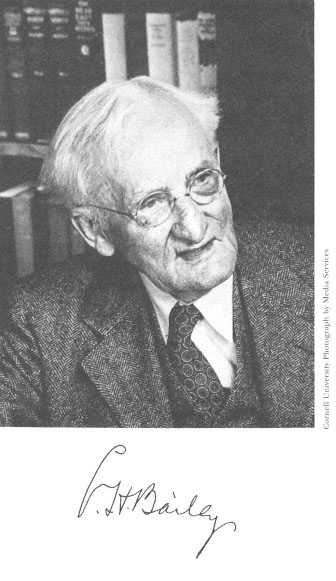
LIBERTY HYDE BAILEY
March 15, 1858-December 25, 1954
BY HARLAN P. BANKS
ON NOVEMBER 5, 1990, the American Society for Horticultural Science initiated a Hall of Fame designed to "honor distinguished persons who have made monumental and unique contributions to horticulture." Only two scientists were inducted at the initiation—Gregor Mendel, the Austrian monk who solved the riddle of heredity, and Liberty Hyde Bailey.
The career of Liberty Hyde Bailey—botanist; horticulturalist; plant breeder; teacher par excellence; visionary; astute, vigorous, successful administrator; lobbyist; prolific writer; superb editor; poet; rural sociologist; philosopher; environmentalist; traveler; and plant explorer—was remarkable for the magnitude of its accomplishments and the breadth and enduring quality of its influence. Bailey made his mark in botany with extensive publications on the systematics of sedges (Carex), palms of the new world tropics, blackberries (Rubus), grapes (Vitis), cabbages (Brassica), and pumpkins and squashes (Curcurbita), among others.
As author, editor, teacher, and frequent public speaker, Bailey helped create the science of horticulture. As an administrator, he established the New York State College of Agriculture at Cornell University, drawing on his skills as a lobbyist, and then, as dean, built it into an institution of
world renown. He labored mightily to improve the image and climate of rural life in the United States. His lifelong concern for the environment was summarized in his book The Holy Earth, which long antedated today's tardy recognition of the vital significance of its protection. To all this, Bailey added the writing of poetry and frequent philosophical musings. It is one measure of the man that, recently, thirty-five years after his death, the American Horticultural Society held a symposium, "A Salute to Liberty Hyde Bailey," in his honor. By any measure, Bailey was a man of incomparable vision and prodigious energy.
Liberty Hyde Bailey was born on March 15, 1858, in South Haven, Michigan. His father, Liberty senior, had migrated from Vermont in his twenties and married Sarah Harrison in this new community carved out of the wilderness near the eastern shore of Lake Michigan. Bailey senior proved to be an exceptional orchardist as he assembled a large variety of apples, numbering over 300 cultivars. He became one of the most respected members of his community, which included the Indians whom he permitted to continue to occupy a portion of the land he had acquired.
Young Liberty grew up in this rural atmosphere, gardened with his mother, who died when he was but five years old, and reveled in the joys of natural history as he roamed the streams and woods learning the habits of both plants and animals. One of the most striking of his experiences with wildlife was witnessing the extermination of the carrier pigeon. An industrious youth, by his early teens Bailey had become expert at grafting. Many farmers planted apple seeds because of the expense of buying named seedlings. This necessitated grafting cuttings on to the trees in order to obtain desired varieties. Young Bailey was soon in demand to do the necessary grafting in neighbors' orchards. He, himself, had one tree on which he had grafted forty varieties.
Bailey's grade school teacher, Mrs. Julia Fields, cognizant of his learning skills, challenged him by suggesting that he was growing up blind. When he protested that he was continually observing, she asked him the names of the various trees, the height they reached, and how they grew. These questions proved a remarkable stimulus. For example, when Bailey found a copy of Darwin's Origin of Species, he read it with care, marveling at Darwin's knowledge but wondering at the meaning of a priori. His teacher then agreed to teach him a little Latin, an experience that only one other classmate was willing to share.
Bailey's first public speech was an enthusiastic talk on grafting at the South Haven Pomological Society. Subsequently, he gave a paper on birds in which he made a plea for cessation of their wanton slaughter. Soon, at age fifteen, he was invited to repeat that paper at the State Pomological Society, and it was published in the society's annual report for 1873.
During his teens, Bailey saw the squeeze to which farmers were subjected, as low prices for their products were accompanied by high prices for the newly evolving mechanical equipment and for shipping by rail. He saw rural youth migrating to the cities and foreclosures on farms. He was further influenced by the Grange, as it fought for better roads, broader educational opportunities, equality for women, and dignity for rural life. He became secretary of the local Democratic committee. These influences are all reflected in the actions of his later life.
At age sixteen Bailey found a copy of Asa Gray's Field, Forest and Garden Botany, which he used avidly to identify plants. Lucy Millington, a botanist, arrived in South Haven and soon began helping Bailey identify difficult plants, but with the challenge that the sedges (Carex) were too difficult for a beginner. Naturally that remark resulted in his following through to eventual technical monographs of the
Carices. At age eighteen he invited Professor William James Beal of the Michigan Agricultural College to lecture at South Haven in the hope that he might learn more about plants. The meeting was a success. Beal told Bailey about his own mentor, Asa Gray, about Louis Agassiz, and about current developments in botany. The result was Bailey's entrance to the college in September 1878 at age twenty. It is said that on the way to college Bailey outlined his goal in life— to spend twenty-five years in preparation, twenty-five in earning a livelihood, and twenty-five in using his abilities as he chose—a goal he approached closely, although he outlived the final third by more than two decades.
On his first day in college Bailey met Annette Smith, destined to become his bride a few years later. An early paper submitted to his professor of English elicited the comment, ''That boy will either be a great man or he won't amount to shucks!''1 Bailey excelled in college and flourished under the tutelage of Dr. Beal, who taught botany with a new experimental approach using living plants and laboratory work rather than with the then-dry textbooks. In his senior year he helped organize and edit The College Speculum, a quarterly paper established to provide both scientific and general reading. He wrote many of its articles himself. Graduating in August 1882, Bailey promptly secured a post as reporter on the Springfield, Illinois, Morning Monitor. Within a few months he was offered the post of city editor. Then fate intervened. Asa Gray, then America's leading botanist, needed an assistant and Beal recommended Bailey. By February 1883 Bailey was working in Cambridge, arranging and classifying a large collection of pressed plants from Kew. He was to make a set for the Missouri Botanical Garden, one for the National Museum, and a third could be his. By June of that year he had married Annette Smith, ending their five-year courtship. They set up residence in
Cambridge, and Bailey continued to learn from long discussions with Gray about systematic and structural botany. He profited greatly from William Gilson Farlow's cryptogamic botany and George Lincoln Goodale's physiological approach to botany. No less significant to his training were the vast collections at the Arnold Arboretum, the Cambridge Botanical Garden, the greenhouses and scientific agricultural work of the Bussey Institution, and the noted market gardens in nearby Arlington.
Late in 1884 Bailey was offered a professorship of horticulture at Michigan Agricultural College. Gray told him that a botanist is a scientist, an intellectual, whereas a horticulturist is merely a gardener, a practical man. John Merle Coulter, a fellow student and later an outstanding botanist at the University of Chicago, told Bailey he would never be heard from again if he took the position. Nonetheless, Bailey accepted the offer. The point missed by Gray and Coulter was that Bailey did not leave botany. Rather, he joined forces with the study of cultivated plants and, in the end, removed the barriers between theoretical botany and horticulture, as he rose to the peak of recognition in both pure botany and the applied plant sciences.
In early 1885 Bailey started working at Michigan Agricultural College at age twenty-six. His success was immediate. Students flocked to his classes. He brought pumpkin vines to lecture to illustrate huge fruits on small plants and then pumpkin seeds to stress the small beginnings. He taught physiology graphically, as when he proclaimed that placing fertilizer close to the trunk of a tree was comparable to tying a bag of oats to a horse's leg. A lecture at the Massachusetts State Board of Agriculture expressed one of his major objectives clearly. It was entitled The Garden Fence, by which he meant the wall of prejudice that separated botanist and horticulturist. Bailey insisted that each needed
the work of the other. By the end of his first year at M.A.C. he had published his first book, Talks Afield: About Plants and the Science of Plants. The following year saw publication of another book and a 100-page article on North American Carices, his seventh article on Carex. The latter appeared in the Journal of the American Academy of Arts and Sciences. Soon he was in constant demand as a speaker all over the state of Michigan. Meanwhile, his research on the hybridizing of various plants was continuing actively. A highlight in his career was a visit to the college by Alfred Russell Wallace, who was left in Bailey's charge for the duration of his stay. Bailey had read all of Wallace's papers and the two enjoyed a profitable exchange of ideas as Bailey introduced him to the flora of Michigan.
Toward the end of 1887, Bailey was invited to give a series of lectures at Cornell University. This resulted in 1888 in an offer of a professorship of horticulture, with freedom to develop the field as he envisioned it and some support funds. He was also granted a trip to Europe to study various departments of horticulture and the important European herbaria prior to starting at Cornell.
On his return from Europe in early 1889 Bailey joined Dean Isaac P. Roberts to initiate an outstanding team for teaching, research, and dissemination of knowledge about agriculture. Bailey continued his cross-breeding experiments, his inspired teaching, and pioneering new experiments such as growing plants under electric lights because, while in Cambridge with Gray, he had observed differences in the behavior of plants that were growing near gas lamps on the streets. His paper, "Some Preliminary Studies of the Influence of the Electric Arc Lamp upon Greenhouse Plants," published in 1901, has been selected as a classic paper in horticultural science. He also worked on the effect of enhanced levels of CO2 around greenhouse plants and on the
physiology of seed germination. In 1892 he published the first American book on controlled experimental breeding Cross Breeding and Hybridizing. In this book he cited Gregor Mendel's paper. Later, Hugo DeVries wrote Bailey, giving credit to this citation for his memorable rediscovery of Mendel's work on peas. In 1893 he published the first detailed study of the growth of plants under artificial light.
Between 1889 and 1896 half of the Cornell University Experiment Station bulletins were written by Bailey. Bailey's writing skill so impressed George P. Brett, president of Macmillan and Co., that he told Bailey to send along the title whenever he had a book under way because Macmillan would publish anything he wrote. Books from his pen kept appearing, eleven of them between 1896 and 1901. All of Bailey's books sold well. Some went through twenty editions and were still selling thirty years after their first publication. It is noteworthy that all of Bailey's writing was done in longhand and that only rarely were any changes in the first draft required. It is also said that he could be interrupted in midsentence and two days later pick up his pen and effortlessly finish the sentence.
In teaching, one of Bailey's most popular courses was the evolution of cultivated plants. He summarized his views in The Survival of the Unlike (1896), in which he pointed out that modifications by horticulturists support the theory of evolution. He felt that all life stemmed from one beginning and that an evolutionist can believe in God because in the beginning there was only God. Evolution, he felt, does not attempt to explain the origin of time, space, matter, or force. As for landscape gardening, he taught from the viewpoint of creating a picture, and for him that meant natural form, not heavily pruned, formal shapes. His efforts along these lines resulted in the award of the Royal Horticultural Society of London's Veitch Memorial Silver Medal in 1897.
As early as 1893 Bailey began making impassioned pleas
for state-supported agricultural education at the university, where, among the faculty, it was regarded as "cow college stuff." Among some farmers as well it was still scorned as the ideas of those "smart college boys." However, Bailey and Roberts built up support for the new concept by providing bulletins, lectures, demonstrations, farming institutes, and even visits to farmers' homes. They listened to farmers' problems and provided valuable solutions. This gradually endeared them to their constituents on whom later they could rely for help when trying to initiate a state college of agriculture. All of this activity came eventually to be known as the Extension Program as more and more farmers realized the value of the help that was being provided. In 1894 some fruit growers pushed through the legislature a bill directing the state of New York to provide the Cornell University Experiment Station with $8,000 to conduct research on orchards in western New York. Thus, the principle of state aid was begun. By 1897 the appropriation reached $25,000. This broadening of the influence of the college had convinced the university trustees by 1896 to officially change the name of the university's Department of Agriculture to the College of Agriculture.
At some early stage, Bailey conceived the idea of a series of graded texts dealing with plants and nature, books that would attract and hold the interest of people of any age. His Lessons with Plants (1898) was followed by an elementary school book in 1890, a beginner's book in 1908, and a secondary school text in 1913. But Bailey wanted more than good books. He was concerned with the attitude and training of teachers. He wanted to see the whole broad concept of nature study presented in a way that would bring students into harmony with nature. (See The Nature Study Idea [1903], where, on p. 159, Bailey answered the query, Should I take up nature study teaching, by saying, "Yes, if
you feel the 'call' to it; otherwise no. I would not have every teacher teach nature study any more than I would have everyone teach grammar.") Bailey wanted students to be inspired by teachers who were overflowing with enthusiasm for the subject. During the first decade of the 1900s, he developed an extensive rural nature study program, guided by himself and a group of dedicated collaborators. Their rural school leaflets reached several thousand teachers and 30,000 actively participating students. For many years this program exerted a massive impact on teaching in the state.
During the late 1890s, Bailey also had been working on the compilation of a four-volume Cyclopedia of American Horticulture. This massive work appeared in 1900, to be followed in 1909 by the Cyclopedia of American Agriculture. As if all this were not enough, Bailey had become the first editor of the highly successful journal, Country Life in America, and of two book series for Macmillan—the Garden Craft Series and the Rural Science Series.
By 1900 it was clear that the College of Agriculture must have state support to erect the necessary buildings. Early in 1903 Roberts sent Bailey to Albany to secure support for a large agriculture building. This effort failed in 1903, but by rallying support from all over the state Bailey succeeded in 1904. Roberts had retired in 1903, to be replaced by Bailey, so it was as dean that Bailey's lobbying skills produced the necessary votes to win over the legislature. And he won not merely the new building but, over strong opposition from other schools, the establishment of the State College of Agriculture at Cornell University as well. This meant a new state policy of ownership and maintenance by the state but administration solely by the university. Following dedication of the new college and building by then-governor Charles Evans Hughes in April 1907, Bailey set
about expanding the faculty, adding new departments, and stimulating aggressive research and inspired teaching.
At his twenty-fifth wedding anniversary on June 6, 1908, the entire faculty gave Bailey a surprise party for which they produced a scroll reading: "Sympathetic, open-minded, always fair, you have ever been keen as an investigator, inspiring as a teacher, lecturer, and author, resourceful as an editor, masterful as an administrator."2 They also presented the Baileys with a candelabrum of five lights, one for his literary accomplishment, one for his skill as an educator, one representing his administrative ability, one for his investigative skill, and one for the warmth with which he received faculty and students into his home.
In 1907 Michigan Agricultural College celebrated its semicentennial with Bailey as its major speaker. In his address Bailey gave his views on agricultural and country life. Agriculture at that time was suffering from an economic crisis, and he suggested ways to alleviate the situation. President Theodore Roosevelt was one of the eager listeners. A year later, in 1908, he asked Bailey to chair a national commission on country life to survey the whole field of rural life in America and to suggest cures for its deficiencies. The commission sent out thousands of questionnaires and then made a giant swing around the country holding open hearings and meetings with rural leaders. Bailey wrote the report that President Roosevelt submitted to Congress in February 1909. Sometime after 1909 Roosevelt wrote, "I doubt if I should have undertaken to appoint the commission if I had not been able to get Director Bailey for its head, and no man in our country did better work for the country than he did on that commission."3 The work of the commission led to legislation establishing a U.S. Parcel Post system, a nationwide federal extension service, and the federally supported rural electrification program.
Bailey's wide-ranging activities did not obscure his technical, botanical, and horticultural skills. He became the acknowledged authority on the genus Carex by publishing twenty taxonomic papers between 1886 and 1905, one of them covering all species from Greenland to Alaska and south to Panama. He, more than any other, elevated horticulture from a craft to a science. He made botany the basis of sound horticultural research, teaching, and practice. His leadership extended farther. In 1892 he urged the foundation of a national society for the study of the pure science of botany. His genius for organization and his wise and tactful leadership energized the movement by which, in 1893, the first Botanical Society of America was founded. This society was enlarged in 1906 by the addition of two other botanical groups, and 1906 is now given as the date of the founding of the modern prestigious Botanical Society of America. In 1903 Bailey and S. A. Beach founded the American Society for Horticultural Science. Bailey served as its president during its first four years. His work and its influence were rewarded in 1900 by his election to the American Academy of Arts and Sciences.
In 1910 and again in 1912 Bailey was urged to run for governor of New York. But his mind was on retirement and he stated so at a party in his honor at the Cornell Club in New York City. So many persons present paid him tribute that he remarked, "I know now how the pancake feels when the molasses is poured over it."4 In spring 1913 he submitted his formal resignation as dean, to be effective July 31. His ten years as dean had seen his department heads become leaders in their fields, the faculty increase from 11 to over 100, the student body from 100 to 1,400, the state appropriation from $50,000 for one building to millions for a dozen buildings, and the annual budget from $35,000 to $500,000.
Following retirement Bailey converted the carriage house at his home to a herbarium, where he worked vigorously for another thirty-five years. A first project, revision of the Cyclopedia of American Horticulture, caused him to make several trips to the American tropics to observe native palms. He soon realized that here was a vast field in need of work. Thus, he came to devote a large fraction of his time to the systematics of palms. The search took him to Mexico, Brazil, New Zealand, China, Southern Asia, the West Indies, Florida, and Southern California. (When he fell and broke his hip in New York City in 1949, he had a ticket to Africa in his pocket. He had intended to study oil palms, a project that never came to pass.) The revised Cyclopedia came out between 1914 and 1917 as the Standard Cyclopedia of Horticulture; as for the palms, Bailey increased the 700 species known when he began the study to several thousand by 1947. This work produced wholly new techniques for the collection of palm specimens, one of the best herbaria of palms anywhere, and some forty-five papers between 1930 and 1947. Along with the palms, Bailey produced a 1,000-page monograph of Rubus and extensive revisions of Brassica, Vitis, and Curcurbita. To these works he added valuable contributions to the taxonomy of cultivated plants such as Hortus, Manual of Cultivated Plants, The Garden of Pinks, The Garden of Bellflowers, and other books.
During a trip to New Zealand in 1914 to deliver a series of lectures, Bailey wrote The Holy Earth, a book about man's debt to the earth and earth's goodness to man. Another trip took him to China in 1917. One of his projects on this trip was the search for prototypes of cabbages and their relatives.
In 1935, at age seventy-five, in order to provide continuity for his life's work, Bailey gave his herbarium (125,000 sheets), the building housing it, and his library (some 3,000
books) to Cornell University, specifying that the complex be called the Liberty Hyde Bailey Hortorium. The university trustees constituted the hortorium a department of the university, with Bailey as its unsalaried director, daughter Ethel as curator, and Dr. R. T. Clausen as a research taxonomist. Bailey coined the name hortorium to refer to a place for the scientific study of cultivated plants. His objective was to bring order to the nomenclature of agricultural and horticultural plants. This involved growing novelties as soon as they were introduced into the trade and adding specimens to the herbarium as well. Bailey regularly grew between 2 and 800 such a year. One example of his procedure is found in his first paper in Gentes Herbarum, a journal initiated and supported financially solely by him. In this paper, Plantae Chinenses (1920), he described twenty new species in thirteen genera and fifteen new varieties and forms, some wild, some cultivated. This orderly treatment of the names of cultivated plants was regarded by Bailey as perhaps his most significant contribution to plant sciences. Bailey continued as director of the hortorium until 1951, when George H. M. Lawrence took over and saw the move of the hortorium from Bailey's home to the then newly built Agricultural College Library, where it now resides as a department of the Division of Biological Sciences supported by the New York State College of Agriculture and Life Sciences. Its present faculty and staff number eighteen (1990), exclusive of graduate students, postdoctoral persons, and visitors.
Bailey was recognized throughout his career by the world scientific community, as his extensive list of honors shows. He was elected to the National Academy of Sciences in 1917, but the year 1926 can be considered the pinnacle of his recognition. Already president or honorary fellow of many horticultural organizations and cofounder of others,
Society of America and the American Association for the Advancement of Science. To those high honors the Fourth International Botanical Congress, held in Ithaca in August 1926, added another. He was made president and presiding chairman of the congress. The only other American who had received this worldwide recognition was his early mentor Asa Gray. A year later, in 1927, the renowned publication of Kew Gardens and the Royal Horticultural Society of England, Curtis's Botanical Magazine, dedicated volume 153 to Bailey ''in recognition of his long devotion to the scientific training of workers in horticulture and agriculture and to the increase and spread of knowledge in these branches of science.''5
Bailey's long list of honors, however, is remarkable less for its great length than for the breadth of the fields of study represented in it. Few scientists have equaled this record.
Bailey's writing, which spanned eighty-one years, is almost incredible. Between 1890 and 1940 he edited for Macmillan 117 titles by 99 authors covering subjects in agronomy, economics, botany, pomology, animal husbandry, dairy industry, soils and fertilizers, plant pathology, commercial floriculture, and home economics. Carol Woodward, editor of Outdoor Books for Macmillan, wrote that no English writer "has had that refined combination of botanical and horticultural knowledge that Bailey made his own."6 Bailey himself wrote some sixty-five books and a large number of the individual items in the several large encyclopedias that he edited. His successor as director of the Bailey Hortorium, George H. M. Lawrence, estimated that he wrote at least 1,300 articles published in the world's periodical literature and over 100 papers in pure taxonomy. Curtis Page, husband of Bailey's granddaughter, has written that
Bailey may have been most proud of a series of books referred to as the Background Books. Bailey called these books his budget of opinions. The first was The Holy Earth, referred to earlier. Others were Wind and Weather (a collection of his poems), Universal Service, What Is Democracy ?, and The Seven Stars. They illustrate his humanism, his search for social good, his respect for others, his philosophy of life. He wrote in The Holy Earth: "It is good to live. We talk of death and of lifelessness, but we know only of life. Even our prophecies of death are prophecies of more life. We know no better world: whatever else there may be is of things hoped for, not of things seen."7 That Bailey treated the plant sciences as a means for the betterment of mankind is shown by a piece that he wrote when still a student at Michigan Agricultural College: "It was not until scientific education began to manifest itself that agriculture began its ascent from the slough of contempt in which it lay."8
Surely it is a remarkable tribute to a man that words he penned seventy-five years ago in The Holy Earth should at last be creeping into the thoughts and actions of a steadily increasing number of environmentally concerned citizens in North America in the 1980s. He wrote: "If the earth is holy, then the things that grow out of the earth are also holy. They do not belong to man to do with them as he will. Dominion does not carry personal ownership. There are many generations of folk yet to come after us, who will have equal right with us to the products of the globe. It would seem that a divine obligation rests on every soul. Are we to make righteous use of the vast accumulation of knowledge of the planet? If so, we must have a new formulation. The partition of the earth among the millions who live on it is necessarily a question of morals; and a society that is founded on an unmoral partition and use cannot itself be righteous and whole."9
On March 15, 1958, the Bailey Hortorium staff sponsored a Bailey centennial. Nine distinguished speakers, whose talks were published in Baileya (vol. 6), paid tribute to his accomplishments in various disciplines. In addition, the U.S. Postal Service issued a three-cent commemorative stamp inscribed with the words "Gardening Horticulture." The first-day covers carried a photograph of Bailey with his signature and the words "Educator—Horticulturist—Author 1858-1958."
Olaf Larson spoke at the centennial on Bailey's impact on rural sociology, using an excerpt from one of Bailey's early talks to illustrate his thoughtful concern for people: "While the College of Agriculture is concerned directly with increasing the producing power of land, its activities cannot be limited narrowly to this field. It must stand bravely for rural civilization. It must include within its activities such a range of subjects as will enable it to develop an entire philosophy or scheme of rural life . . . the colleges of agriculture have three proper lines of work: the regular, or ordinary, teaching; the discovery of truth, or research; the extending of their work to all the people."10 Larson indicated that historians of rural sociology credit the Country Life Commission, chaired by Bailey, as a major influence in securing support for the "development of rural sociology as a discipline worthy of public support."11 Larson also included Bailey among the foundation builders of agricultural economics because, very early, he advocated the survey method to obtain necessary facts about economic and social conditions. Another speaker, H. B. Tukey, lauded Bailey's breadth of influence. He wrote, ''Taxonomic botanists thought of him as an authority on classification. Nurserymen considered him one of their own—an authority on ornamental plants and plant propagation. Fruit culture thought of him as a fruit man. Olericulture considered
him a vegetable man. Amateur horticulturists thought of him as their special leader. Agricultural administrators thought of him as a dean. People in South Haven, Michigan, think of him as their son. People in East Lansing, Michigan, name schools and streets after him and his portrait is kept flood-lighted day and night in the Horticulture building at Michigan State University. He was, besides this, an editor, rural sociologist, poet, and philosopher. In short, his interests were so great and his coverage so broad that he stood as a dozen men—helpful, interested, and a marvelous friend to all."12
Bailey was an indefatigable public speaker. It should be obvious that any man invited so constantly to give talks must have been eloquent. The following, related by H. B. Tukey, should prove the point. Bailey arrived late at the annual banquet of the American Society for Horticultural Science in Cleveland in 1930. "The main course had just been served. As he entered, everyone rose. He was called to the speakers' table to make a few remarks. He began gently, but grew more eloquent and meaningful as he proceeded. All sat entranced. The talk continued for upwards of an hour. No one objected-food for the mind was more important than food for the body. The dinner got cold. The waiters stood by in amazement. The management fumed. But there were no interruptions. When it was all over, one waiter, shaking his head in disbelief, was heard to mutter to himself, 'Never, never, I see nothing like this before.'"13
One often hears the question, "How could Bailey accomplish all that he did?" Of course, his own enormous capacity for work, his unflagging enthusiasm for all that relates to plants and for its transmission to others, his constant flood of new ideas, his steadfast adherence to his ideals, and his orderly handling of each idea from its conception to its final presentation in written form were crucial. But
Gould Colman, Cornell University archivist, suggested to me that equally valuable, particularly when he was dean, was Bailey's masterly delegation of authority and, more important, his ability to instruct the helpers in the precise manner in which the chore should be performed. The remaining members of the hortorium staff who worked under him testify to his prodigious memory and to his habit of constantly recording ideas, short notes, or longer paragraphs on whatever scrap of paper was available so that nothing was lost. Would that more of us were so gifted.
Liberty Hyde Bailey died on December 25, 1954. Mrs. Bailey had died in 1938. The Baileys had two children, Sara Bailey Sailor and Ethel Zoe Bailey. Ethel's career was as co-worker with her father whom she accompanied on numerous collecting expeditions. She played a substantial role in the production of the Standard Cyclopedia of Horticulture and the Manual of Cultivated Plants. She coauthored Hortus, edited the first eight volumes of Gentes Herbarum, and served as curator of the hortorium from its inception in 1935 until retirement in 1957. Subsequently, she voluntarily continued her monumental index to the world's cultivated plants almost until her death in 1983.
Notes
HONORS AND DISTINCTIONS
|
1882 |
Bachelor of Science, Michigan Agricultural College |
||
|
1885 |
Marshall P. Wilder Bronze Medal, American Pomological Society |
||
|
1886 |
Honorary Master of Science, Michigan Agricultural College |
||
|
1893 |
One of five founding members of Botanical Society of America |
||
|
1896 |
Veitch Silver Medal, Royal Horticultural Society, London |
||
|
1898 |
Diploma of Honor, Royal Botanic Gardens, Denmark |
1900 |
Member, American Academy of Arts and Sciences |
|
1902 |
Honorary member, Rhode Island Horticultural Society; honorary member, American Scenic and Historic Preservation Society |
||
|
1903 |
Founding member, American Society for Horticultural Science; president, 1903-07 |
||
|
1906 |
President, American Association of Agricultural Colleges and Experiment Stations |
||
|
1907 |
Honorary LL.D., University of Wisconsin |
||
|
1908 |
Honorary LL.D., Alfred University, New York |
||
|
1909 |
Honorary member, Philadelphia College of Pharmacy |
||
|
1910 |
Honorary member, Horticultural Society of Norway |
||
|
1914 |
President, American Nature-Study Society. Reelected in 1915; honorary member, Horticultural Society, New Zealand |
||
|
1917 |
Member, National Academy of Sciences; honorary member, Japan Agricultural Society; honorary member, Horticultural Society of Japan; honorary member, Horticultural Society of China; president, American Pomological Society, two-year term |
||
|
1919 |
Honorary Litt.D., University of Vermont |
||
|
1921 |
Marshall P. Wilder Silver Medal, American Pomological Society; honorary member, Phi Beta Kappa, Cornell University |
||
|
1923 |
Diploma of honor, Reale Academia di Agricultura di Torino (Italy) |
||
|
1924 |
Honorary member, Pi Alpha Xi honorary floriculture society |
||
|
1925 |
Honorary life member, American Rose Society |
||
|
1926 |
President, IVth International Botanical Congress, Ithaca; president, Botanical Society of America; president, American Association for the Advancement of Science |
||
|
1927 |
Veitch Gold Medal, Royal Horticultural Society, London; |
|
|
George Robert White Gold Medal, Massachusetts Horticultural Society |
|
1928 |
Grande Médaille d'Isidore Geoffroy Saint-Hilaire, Société Nationale d'Acclimation de France; honorary fellow, Royal Irish Academy of Dublin |
|
1931 |
Gold Medal, Garden Club of America; Arthur Hoyt Scott Gold Medal and Award, Swarthmore College; Distinguished Service Award, National Home Planning Bureau of the American Association of Nurserymen; president, American Country Life Association |
|
1932 |
Corresponding member, Academy of Natural Sciences of Philadelphia; honorary D.Sc., University of Puerto Rico |
|
1933 |
Honor Certificate for Distinguished Service, Epsilon Sigma Phi, national honorary extension fraternity |
|
1937 |
Distinguished Service Ruby, Epsilon Sigma Phi fraternity; honorary member, Société Lyonnaise d'Horticulture |
|
1938 |
Silver Medal, National 4-H Club Congress |
|
1939 |
President, American Society of Plant Taxonomists |
|
1940 |
Fellow, Cactus and Succulent Society of America |
|
1945 |
Honorary fellow, Botanical Society of Edinburgh; honorary member, Linnaean Society of London |
|
1946 |
Award of Honor, Ministeria Agricultura y Cria, Caracas, Venezuela |
|
1947 |
Gold Medal, "The L. H. Bailey Award," National Garden Institute, Chicago; Marshall P. Wilder Silver Medal, American Pomological Society; Gold Medal, National Institute of Social Sciences |
|
1948 |
Johnny Appleseed Bronze Medal and Certificate of Recognition, Men's Garden Club of America; Silver Medal "Green Thumb Award," National Victory Garden Institute, Washington, D.C.; National Award Scroll, American Agricultural Editors' Association; Bronze Medal, Exposition of Women's Art and Industries |
|
1949 |
Honorary member, Vegetable Growers' Association of America; Gold Medal, National Council of State Garden Clubs |
|
1950 |
Illuminated Testimonial Certificate, for seventy-five years of continuous service and contribution to horticulture, American Association of Nurserymen |
|
1951 |
Citation for Distinguished Service, Garden Club Federation |
The abundant literature on Liberty Hyde Bailey includes two books, that by Philip Dorf, which is more personal and intimate, and that by Andrew Rodgers, treating Bailey in the context of his contemporaries in science. The major sources used in the preparation of this biographical memoir are listed below. The writer especially wishes to thank Professor Emeritus John G. Seeley, Department of Floriculture and Ornamental Horticulture; Professor David M. Bates, Professor Emeritus William J. Dress, and Louella Sullivan of the Bailey Hortorium; and Gould Colman, Cornell University archivist, Department of Manuscripts and University Archives.
Dorf, Philip. 1956. Liberty Hyde Bailey, An Informal Biography. Ithaca, N.Y.: Cornell University Press.
Rodgers III, Andrew Denny. 1965. Liberty Hyde Bailey: A Story of American Plant Sciences. New York: Hafner Publishing Co.
"Liberty Hyde Bailey." Necrology of the Faculty 1954-55. Filed with the Office of the Dean, Cornell University Faculty.
Words Said About a Birthday. Addresses in recognition of the ninetieth anniversary of the natal day of Liberty Hyde Bailey, delivered at Cornell University, April 29, 1948. A printed copy is on file with photographs and memorabilia in the Bailey Hortorium.
Wilcox-Lee, Darlene. 1989. Pp. 114-19. In Classic Papers in Horticultural Science, J. Janik, ed. Englewood Cliffs, N.J.: Prentice-Hall.
Seeley, John G. 1990. Liberty Hyde Bailey—father of American horticulture. Hortic. Sci. 25(10):1204-10.
In 1958 the following nine papers were read at a celebration of the Liberty Hyde Bailey centennial at Cornell University:
Larson, Olaf F. 1958. Liberty Hyde Bailey's impact on rural life. Baileya 6:10-21.
Irving, Albert J. 1958. Liberty Hyde Bailey's impact on the amateur gardener. Baileya 6:40-46.
Tukey, Harold B. 1958. Liberty Hyde Bailey's impact on plant sciences. Baileya 6:58-68.
Munz, Philip A. 1958. The influence of Liberty Hyde Bailey on botany. Baileya 6:85-89.
Darrow, George M. 1958. The influence of Liberty Hyde Bailey on horticulture. Baileya 6:101-6.
Page, Curtis C. 1958. Liberty Hyde Bailey, the humanist. Baileya 6:111-16.
Fletcher, Harold R. 1958. Horticultural progress during Liberty Hyde Bailey's lifetime. Baileya 6:148-57.
Lawrence, George H. M. 1958. Liberty Hyde Bailey's legacy to gardeners. Baileya 6:177-83.
Woodward, Carol H. 1958. The influence of the horticultural writings of Liberty Hyde Bailey. Baileya 6:199-203.
Some other significant contributions arranged chronologically:
The Cornell Countryman. Dec. 1913, 11(3). The entire issue was devoted to Liberty Hyde Bailey on his retirement as dean, New York State College of Agriculture, Cornell University.
Lawrence, George H. M. 1955. Liberty Hyde Bailey 1858-1954. An appreciation. Baileya 3:26-40.
Lawrence, George H. M. 1955. Liberty Hyde Bailey, the botanist. Bulletin of the Torrey Botanical Club 82:300-305.
Tukey, Harold B. 1956. Liberty Hyde Bailey-horticulturist. Proc. Am. Soc. Hortic. Sci. 67:559-62.
Tukey, Harold B. 1957. Horticulture is a great green carpet that covers the earth. Am. J. Bot. 44:279-89.
Palmer, E. Laurence. 1958. Liberty Hyde Bailey, the builder. Nature Magazine 51 (3):137-39, 144-45.
Moon, Mary H. 1958. Botanical explorations of Liberty Hyde Bailey. 1. China. Baileya 6:1-9.
Moon, Mary H. 1958. Botanical explorations of Liberty Hyde Bailey. 2. The Caribbean Islands and Bermuda. Baileya 6:73-82.
Bowers, William L. 1982. Liberty Hyde Bailey's philosophy of the holy earth. Baileya 21:158-64.
SELECTED BIBLIOGRAPHY
1885 Talks Afield: About Plants and the Science of Plants. Boston: Houghton Mifflin.
1886 A preliminary synopsis of North American Carices. Proc. Am. Acad. Arts Sci. 2:59-157.
The Garden Fence. Boston: Wright and Potter.
1891 The Nursery Book. New York: Rural Publishing Co.
Some preliminary studies on the influence of the electric arc lamp upon greenhouse plants. Cornell Agricultural Experiment Station Bulletin 30:83-122.
1892 Cross Breeding and Hybridizing. New York: Rural Publishing Co.
1896 The Survival of the Unlike: A Collection of Evolution Essays Suggested by the Study of Domestic Plants. New York: Macmillan.
The Forcing Book: A Manual of the Cultivation of Vegetables in Glass Houses. New York: Macmillan.
1897 The Principles of Fruit-Growing. New York: Macmillan.
1898 The Principles of Agriculture. New York: Macmillan.
Lessons with Plants. Suggestions for Seeing and Interpreting Some of the Common Forms of Vegetation. New York: Macmillan.
The Pruning-Book. A Monograph of the Pruning and Training of Plants as Applied to American Conditions. New York: Macmillan.
First Lessons with Plants; Being an Abridgement of ''Lessons with Plants." New York: Macmillan.
Garden-Making: Suggestions for Utilizing of Home Grounds. New York: Macmillan.
Sketch of the Evolution of our Native Fruits. New York: Macmillan.
1900 Botany: An Elementary Text for Schools. New York: Macmillan.
With collaborators. Cyclopedia of American Horticulture, 4 vols. New York: Macmillan.
1901 The Principles of Vegetable-Gardening. New York: Macmillan.
1903 The Nature Study Idea; Being an Interpretation of the New School-Movement to Put the Child in Sympathy with Nature. New York: Doubleday, Page & Co.
1905 Outlook to Nature. New York: Macmillan.
1907 With collaborators. Cyclopedia of American Agriculture, 4 vols. New York: Macmillan.
1908 Beginners Botany. New York: Macmillan.
1909 The Training of Farmers. New York: Century.
1910 Manual of Gardening; A Practical Guide to the Making of Home Grounds and the Growing of Flowers, Fruits, and Vegetables for Home Use. New York: Macmillan.
1911 The Country-Life Movement in the United States. New York: Macmillan.
Farm and Garden Rule-Book. New York: Macmillan. A manual of ready rules and reference with recipes, precepts, formulas, and tabular information for use of general farmers, gardeners, fruit-growers, stockmen, dairymen, poultrymen, foresters, rural teachers, and others in the United States and Canada.
Report of the Commission on Country Life. New York: Sturgis & Walton.
1913 Botany for Secondary Schools; A Guide to the Knowledge of the Vegetation of the Neighborhood. New York: Macmillan.
1914 With collaborators. The Standard Cyclopedia of Horticulture, 6 vols., 1914-17. New York: Macmillan.
1915 The Holy Earth. Ithaca, N.Y.: Comstock Publishing Co.
1916 Wind and Weather. Ithaca, N.Y.: Comstock Publishing Co. (Collected poems)
1918 What Is Democracy? Ithaca, N.Y.: Comstock Publishing Co.
Universal Service, the Hope of Humanity. New York: Sturgis & Walton Co.
The indigen and cultigen. Science 47:306-8.
1920 The School-Book of Farming; A Text for the Elementary Schools, Homes and Clubs. New York: Macmillan.
The Nursery-Manual; A Complete Guide to the Multiplication of Plants. New York: Macmillan.
A collection of plants in China. Gentes Herbarum 1:1-49.
1922 The Apple-Tree. New York: Macmillan.
The cultivated brassicas. Gentes Herbarum 1:53-108.
With collaborators. Cyclopedia of Farm Crops. New York: Macmillan.
1923 The Seven Stars. New York: Macmillan.
Certain cultivated Rubi. Gentes Herbarum 1:139-200.
1924 Manual of Cultivated Plants; A Flora for the Identification of the Most
Common or Significant Species of Plants Grown in the Continental United States and Canada, for Food, Ornament, Utility, and General Interest, Both in the Open and Under Glass. New York: Macmillan.
1925 Rubus: Enumeration of the Eubati (dewberries and blackberries) native in North America. Gentes Herbarum 1:203-97.
1928 The Garden Lover. New York: Macmillan.
1929 The domesticated curcurbitas. Gentes Herbarum 2:63-115.
1930 Hosta: the plantain lilies. Gentes Herbarum 2:119-42.
Hemerocallis: the day lilies. Gentes Herbarum 2:143-56.
The cultivated Brassicas. Gentes Herbarum 2:211-67.
With Ethel Z. Bailey. Hortus: A Concise Dictionary of Gardening, General Horticulture and Cultivated Plants in North America. New York: Macmillan.
1932 The blackberries of North America. Gentes Herbarum 2:270-423.
1933 The Cultivated Conifers in North America, Comprising the Pine Family and the Taxads. New York: Macmillan.
How Plants Get Their Names. New York: Macmillan.
Certain palms of Panama. Gentes Herbarum 3:33-116.
Blackberries of the Lower South. Gentes Herbarum 3:119-48.
1934 Gardener's Handbook, Successor to The Gardener; Brief Indications for the Growing of Common Flowers, Vegetables and Fruits in the Garden and About the Home. New York: Macmillan.
The species of grapes peculiar to North America. Gentes Herbarum 3:151-244.
1935 The royal palms—preliminary survey. Gentes Herbarum 3:343-87.
The king palms of Australia—Archontophoenix. Gentes Herbarum 3:391-409.
Certain ptychospermate palms of horticulturists. Gentes Herbarum 3:410-37.
1936 Washingtonia. Gentes Herbarum 4:53-82.
1937 The Garden of Gourds, with Decorations. New York: Macmillan.
Erythea. Gentes Herbarum 4:85-118.
Brahea. Gentes Herbarum 4:119-25.
1938 The Garden of Pinks, with Decorations. New York: Macmillan.
Thrinax. Gentes Herbarum 4:129-49.
1939 The Garden of Larkspurs, with Decorations. New York: Macmillan.
Howea in cultivation—the sentry palms. Gentes Herbarum 4:188-98.
New Haitian genus of palms. Gentes Herbarum 4:239-46.
1940 The problem of Colpothrinax. Gentes Herbarum 4:357-60.
The generic name Corozo. Gentes Herbarum 4:373-74.
1941 Acrocomia—preliminary paper. Gentes Herbarum 4:421-76.
Rubus in North America. Gentes Herbarum 5:1-932. (Published in ten parts from 1941-45)
1942 Palms of the Seychelles Islands. Gentes Herbarum 6:3-48.
1944 Revision of the American palmettoes. Gentes Herbarum 6:367-459.
1947 Species studies in Rubus. Gentes Herbarum 7:193-349.
Rubus studies—review and additions. Gentes Herbarum 7:481-526.
1949 Manual of Cultivated Plants Most Commonly Grown in the Continental United States and Canada. New York: Macmillan.
With H. E. Moore, Jr. Palms uncertain and new. Gentes Herbarum 8:93-205.
1953 The Garden of Bellflowers in North America, with Decorations. New York: Macmillan.


