
9
Geographic Concentration, Migration, and Population Redistribution Among the Elderly
Frank D. Bean, George C. Myers, Jacqueline L. Angel, and Omer R. Galle
This chapter examines what is known about patterns of geographic distribution (and redistribution) of the elderly population, focusing mainly on the United States. At a national level, the general pattern of population aging around which spatial variations occur is relatively well known. From 1980 to 1990 the population of the United States increased by 9.8 percent, while among those aged 65 years or older, the increase was substantially greater (22.3 percent). Hence, as a result of its more rapid growth, the population aged 65 and over increased from 11.3 percent of the total U.S. population in 1980 to 12.6 percent in 1990 (Taeuber, 1992). In the future, the U.S. population is expected to continue to age slowly for the next several years and then to age more rapidly as the large birth cohorts of the ''baby-boom" years begin to reach retirement (Soldo and Agree, 1988; Uhlenberg, 1992). Bureau of the Census population projections forecast that the proportion of the population aged 65 and over will grow to 13.2 percent by 2010 and then jump to 20.2 percent in 2030 (Day, 1992: Medium variant).
The occurrence and effects of aging are not evenly experienced throughout the country. The public policy implications of population aging are felt not
The authors gratefully acknowledge the research assistance of Jiwon Jeon and Kyung Tae Park, as well as helpful comments from Glenn Fuguitt, Larry Long, William Serow, Alden Speare, and Cynthia Taeuber.
only at the national level, but are also important at the state and local levels (Zedlewski et al., 1990; Crown, 1988; Longino, 1990), where the provision and funding of many health and social service programs occur (Sternlieb, 1991; Mayer, 1991). A noteworthy example is Medicaid, the major federal and state program for providing medical care to the poor. Even though the elderly comprised only about one-seventh of Medicaid beneficiaries in fiscal year 1987, they accounted for one-third of Medicaid payments to health care providers (Kane and Kane, 1990; Ward-Simon and Glass, 1988). States whose populations are disproportionately made up of the aged will accordingly shoulder larger relative financial responsibilities for Medicaid (and other state and locally funded programs) because of their age structure.
The relative contributions of fertility, mortality, and migration to population aging differ at the subnational compared to the national levels. Although geographic variations in fertility and mortality patterns make small contributions to differential rates of aging among states and regions, patterns of internal migration seemingly account for most of the variation (Rogers, 1992a; Serow et al., 1990; Frey and Speare, 1988). And given the rising levels of immigration experienced by the United States since World War II, the age pattern of net international migration is likely to exert an increasing effect on population age composition. This factor is undoubtedly more important for explaining subnational temporal and geographic variations in population aging than it is for explaining population aging at the level of the nation as a whole. The reasons are that the postwar growth in net international migration is relatively recent (occurring mostly over the past 20 years) and that immigrants tend to concentrate in only a few states (Bean et al., 1989; Bean and Tienda, 1987).
The purpose of this review is to examine the geographic distribution of the elderly population in the United States and the factors that contribute to its change over time (especially migration). The first section of the chapter summarizes patterns of elderly geographic concentration in the country, including regional and urban/metropolitan patterns. The second section focuses on patterns of elderly and nonelderly population redistribution and on patterns of migration that contribute to redistribution at various spatial levels of analysis. The third section examines the results of research about migration, focusing on both elderly and nonelderly migration behavior, each of which holds implications for patterns of population redistribution by age. A fourth section introduces international comparisons, not only for what they reveal about migration and redistribution in other countries, but also for what they imply about U.S. patterns and their explanation. The fifth section specifies some of the major remaining gaps in knowledge about elderly migration and redistribution, and assesses the extent to which newly developed and recently available data sets might contribute to their resolution.
PATTERNS OF GEOGRAPHIC DISTRIBUTION
Examining the geographic distribution of the older U.S. population requires establishing a meaningful and useful operational definition of the elderly. Demographers typically define the elderly population as those individuals aged 65 years or older, whereas gerontologists sometimes use age 60 as the cutoff. Some agencies within the U.S. government (e.g., the Administration on Aging) and within the United Nations (e.g., the Population Division) use age 60 as a cutoff point, whereas others (e.g., the National Institute on Aging) use age 65 (Myers, 1990). Some migration researchers advocate 60 years as a boundary (Longino et al., 1984), and others argue that 65 is preferable for measuring elderly population stocks, even though acknowledging that for some purposes 60 may constitute a preferred delineation for assessing elderly migration flows (Rogers, 1992b). In this chapter we use 65 years or over, in part because it is consistent with the usage of the Bureau of the Census in recent reports on the aged population (Taeuber, 1992). In the final analysis, however, the multiple definitions used by different researchers and agencies serve as a reminder (1) that any definition of the elderly population is somewhat arbitrary and (2) that the elderly population has diverse characteristics. For example, researchers and policy makers are paying increasing attention to the so-called oldest-old, a group usually (but not always) defined as those aged 85 years or over. The importance of this group derives not only from its rapidly growing size but also from the fact that it differs substantially in a number of ways from the younger-old (65-74 years) and the middle-old (75-84) (Suzman et al., 1992; Taeuber and Rosenwaike, 1992; Binstock, 1992). In recognition of the increasing significance of the oldest-old, we also introduce data pertaining to the geographic distribution of the population aged 85 and over.
The extent of aging in different populations can be compared by calculating the proportions of individuals in those populations who have reached age 65. Calculating a mean or a median age provides an alternative method for assessing population aging (e.g., Preston et al., 1989). It is important to remember that these measures—the proportion 65 years and over and mean age—provide information about different aspects of population aging (Liao, 1993). The former provides a better measure of old-age concentration than the latter to the extent that the age distributions under comparison are differentially affected by changing age patterns of migration, which might occur as a result of substantial net international immigration to some states but not others. In general, it is increasingly important to consider both measures as the volumes of net migration and net international migration increase and as the age structures of in-migrants and out-migrants, and of immigrants and emigrants, change in relation to that of the host population. And at another level, neither the proportion of elderly nor the mean age
may suffice for some purposes. Organizations interested in social service planning or in targeting certain marketing strategies may need information about the absolute size of the elderly population living in a given geographic area (Myers, 1990). In what follows, we at times make use of each of these alternative measures.
Patterns of Regional Concentration
The geographic distribution of the elderly may be approached in either of two ways. The first, called geographic concentration (Rogers, 1992b), focuses on the share of a nation's total elderly population residing within given geographic boundaries. Viewed in this way, more than half (52.2 percent) of the elderly population of the United States in 1990 resided in just nine states (California, Florida, Illinois, Michigan, New Jersey, New York, Ohio, Pennsylvania, and Texas; see appendix to this chapter). In some respects, however, this pattern is less interesting than it might at first seem because these same states in 1990 contained 51.8 percent of the country's total population, a share nearly identical to their percentage of the elderly. For our purposes, a second approach for examining geographic distribution, termed age concentration (Rogers, 1992b), is preferable because it provides an indication of the extent of aging within an area. This approach calculates the proportion of elderly within given geographic boundaries. Thus, for example, in 1990 the elderly constituted 18.3 percent of the total population of Florida, whereas this age group made up only 4.1 percent of the population of Alaska (see appendix).
Generally speaking, in moving from smaller to larger geographic units (from counties to states to regions, for example), differences in the proportion of the elderly among areas become less pronounced (United Nations, 1992). Examining the proportion of elderly in 1990 in aggregations as large as Census Bureau regions, however, reveals several interesting patterns (Table 9-1). First, all regions of the country experienced growth rates among their elderly populations between 1980 and 1990 that exceeded their rates of population growth (see also Siegel, 1993). Thus, in all parts of the country, the number of elderly grew faster than the rest of the population. Second, although in 1980 the elderly were appreciably overrepresented only in the Northeast, in 1990 they were overrepresented in both the Northeast and the Midwest. Third, on a regional basis in 1980, the oldest-old were distributed more or less in proportion to population, whereas by 1990 the Northeast and Midwest showed disproportionately high numbers of persons in this age group. Fourth, between 1980 and 1990, the oldest-old population grew substantially and increasingly became overrepresented in the Northeast (especially in the New England states) and in the Midwest (especially in the Great Plains states). Although the rate of growth in the oldest-old popula-
TABLE 9-1 Measures of Population Aging for Regions, 1980-1990
|
|
Number of Persons 65 and Over |
|
Number of Persons 85 and Over |
|
Median Age (years) |
|
Region |
1980 |
1990 |
1980 |
1990 |
1990 |
|
U.S. total |
25,549 |
31,242 |
2,240 |
3,080 |
32.9 |
|
Northeast |
6,071 |
6,995 |
547 |
710 |
34.2 |
|
Midwest |
6,692 |
7,749 |
649 |
840 |
33.0 |
|
South |
8,488 |
10,724 |
664 |
992 |
32.8 |
|
West |
4,298 |
5,774 |
380 |
539 |
31.8 |
|
|
Percentage 65 and Over |
Percentage 85 and Over |
|
||
|
|
1980 |
1990 |
1980 |
1990 |
|
|
U.S. Total |
11.3 |
12.6 |
1.0 |
1.2 |
|
|
Northeast |
12.4 |
13.8 |
1.1 |
1.4 |
|
|
Midwest |
11.4 |
13.0 |
1.1 |
1.4 |
|
|
South |
11.3 |
12.6 |
0.9 |
1.2 |
|
|
West |
10.0 |
10.9 |
0.9 |
1.0 |
|
|
|
65 and Over |
85 and Over |
|
||
|
|
Relative Change |
Absolute Change |
Relative Change |
Absolute Change |
|
|
U.S. total |
11.5 |
22.3 |
20.0 |
37.5 |
|
|
Northeast |
11.3 |
15.2 |
27.3 |
29.9 |
|
|
Midwest |
14.0 |
15.8 |
27.3 |
29.3 |
|
|
South |
11.5 |
26.3 |
33.3 |
49.5 |
|
|
West |
9.0 |
34.3 |
11.1 |
41.6 |
|
|
SOURCES: 1980 and 1990: Bureau of the Census (1992b); median age, 1990: Bureau of the Census (1992a). |
|||||
tion was sizable, the relative and absolute size of this group is not very large in relation to the younger- and middle-old groups. But the oldest-old use a substantially disproportionate share of health and social services (Binstock, 1992). For example, those aged 85 and older are more than 20 times as likely to reside in nursing homes as persons aged 65-74 (Hing, 1987).
It is also interesting that at the level of aggregation of states the data reveal the complex nature of the processes generating patterns of elderly population distribution. For example, several of the states of the industrial midwest (e.g., Indiana, Illinois, and Michigan) show above-average rates of growth in their proportion of elderly, even though their proportions of eld-
erly and median ages are about the same as the country as a whole. The midwestern farm states, however, show high proportions of elderly but not unusually high rates of growth (see appendix). California shows a below-average rate of increase in its proportion of elderly, at the same time that its growth in the absolute number of elderly is far above average and its median age is below average. And New York reveals a quite high median age, but a proportion of elderly not much above average.
A number of different processes generate these patterns. In the case of the midwestern farm states, it is likely that outmigration of nonelderly during the 1980s contributed to population aging (Frey, 1993). In California's case, the large (in absolute numbers) aged population that grew during the 1970s in part as a result of high inmigration of the elderly is not readily discernible in either 1980 or 1990 census data in the proportion aged 65 and over. Part of the reason is that California experienced outmigration of the elderly during the 1980s that was nearly as great as inmigration (DeAre, 1992). Also, in both 1980 and 1990, substantial immigration—the age distribution for which is somewhat younger than that of the general population (Arthur and Espenshade, 1988)—masked the increase in California's large aged population, as did the high fertility of the state's large Hispanic population (Bean and Tienda, 1987). Similarly, New York's figures are also influenced by immigration, with a substantial negative net internal migration balanced by positive net international migration.
Patterns by Size and Type of Place
The elderly population is also variously distributed according to size and type of place. Since 1950, the United States population has increasingly resided in cities. In broad outline, this is true of the elderly population as well, although in part it depends on what is meant by the term "city." If the focus is only on urban versus rural residence (on whether people live in incorporated places of more than 2,500 inhabitants versus living in smaller places), then in 1990 the percentage of the elderly living in urban places is almost exactly the same (75.8 percent) as the percentage of the total population living in urban places (75.2 percent). Furthermore, both of these figures have changed by almost the same amount over the past 40 years, moving from about 64 percent urban in 1950 to about 75 percent urban in 1990 (Serow et al., 1990; Bureau of the Census, unpublished tabulations). By contrast, if the focus is on residence in metropolitan versus nonmetropolitan areas (roughly on living in localities with more than 100,000 inhabitants), the elderly are somewhat less likely to live in metropolitan areas than the total population (74.0 percent for the elderly versus 77.5 percent for the total), although both groups have become increasingly metropolitan since 1950 (Golant, 1992; Bureau of the Census, unpublished
tabulations). Thus, the elderly are somewhat more likely than the general population to live in nonmetropolitan urban places (i.e., in smaller towns and cities), a tendency that is also reflected in their migration behavior, as we note below. Within metropolitan areas, however, the elderly are about as likely as the general population to live in central cities (31.0 versus 31.3 percent, respectively, in 1990; Bureau of the Census, unpublished tabulations). However, 40 years ago the elderly were much more likely to reside in central cities, a difference that has diminished as larger proportions of the elderly have come to reside in suburbs. By 1990, for example, 43.0 percent of the elderly, as compared to 46.2 percent for the total population, were living in suburbs (Bureau of the Census, unpublished tabulations; Golant, 1992).
Broadly speaking, these patterns reflect the general urbanization and suburbanization tendencies characteristic of postindustrial societies in the post-World War II period (Champion, 1989; Frey, 1988; Hall and Hay, 1980). One of these has consisted of increasing urbanization and metropolitanization, although the latter process slowed down and in some cases slightly reversed itself during the 1970s, before reemerging in the 1980s (Frey, 1992b). The other has consisted of increasing suburbanization within metropolitan areas, as movement has occurred away from central cities outward to suburban areas (Frey, 1992a). These trends, however, are less characteristic of the elderly than of the nonelderly, thus reinforcing the point that the redistribution patterns of these groups require separate study.
Population Redistribution and Migration
Populations defined on the basis of geographic boundaries are constantly involved in the process of redistributing their members from one geographic subarea to another. When the concern is with the distribution of population characteristics and their change over time (as is the case here, given the interest in age structure), it can be somewhat misleading to speak in terms of "redistribution" because the term implies the geographic mobility of persons defined as making up the population. However, geographic mobility is only one of several mechanisms that can affect the distribution of population characteristics such as age. As noted above, the age structures of states and regions are affected by fertility, the age pattern of mortality, the age pattern of net internal migration, and the age pattern of net international migration. As a result of the former two processes acting alone, the proportion of elderly within an area can change over time without any geographic mobility occurring.
Little research on the magnitude of the contribution of each of these components to population aging at the region or state level has been carried out. Studies have been conducted that distinguish the contributions to aging
of (1) net migration and (2) natural increase (often called aging-in-place; Rogers and Woodward, 1988; Clifford et al., 1983; Lichter et al., 1981; Fuguitt and Beale, 1993; Siegel, 1993). The contribution of net migration reflects the extent to which the proportion of elderly in a given area is affected by the net geographic movement of older persons to that area, whereas that of aging-in-place reflects the extent to which the proportion of elderly in a given area is affected by persons already living in the area reaching age 65. It is important to note that this latter component, the aging-in-place component, will itself consist of fertility, mortality, internal migration, and international migration subcomponents. The latter two factors influence the size of the nonelderly population "at risk" of reaching age 65. To our knowledge, no research has sought to estimate the magnitude of each of these separate subcomponents of aging-in-place.
Despite the relative lack of research on the magnitude of these components, it seems likely that fertility and mortality differences will not account for a great deal of the contemporary variation in age structure among U.S. subnational geographic units because of recent geographic convergence over time in fertility and mortality patterns (Serow et al., 1990; Frey and Speare, 1988; Goldstein, 1976). The major determinant of both cross-sectional and dynamic geographic variations in population aging thus is probably the age pattern of net internal migration, which affects the proportion of elderly within a geographic area in two ways. As noted above, one is by virtue of the elderly themselves moving into or out of an area in sufficient numbers to change the age structure appreciably. Given that outmigration among the elderly is not nearly as location-specific as inmigration (Rogers, 1992a), the latter makes by far the greater difference. States and areas that have attracted large numbers of elderly in-migrants are Florida, Arizona, California, the lake regions of Michigan and Minnesota, the Ozarks region of Arkansas and Missouri, Oregon, and Washington (Rogers and Watkins, 1987; Rowles, 1986). By far the most significant of these in terms of the numbers involved is Florida, which has been a destination for elderly migrants for at least three decades (Rogers and Woodward, 1988).
A second way aging can occur through internal migration is as a consequence of migration of the nonelderly (Frey, 1986; Graf and Wiseman, 1978; Fuguitt and Beale, 1993). For example, states and regions that have experienced substantial outmigration of the nonelderly, often apparently seeking better employment opportunities as a result of industrial restructuring, have experienced aging as a result of this process. These include the farm states of the Midwest and the New England states of the Northeast, all of which experienced outmigration of nonelderly during the 1970s and early 1980s, as well as the industrial midwestern states which experienced increases in outmigration during the 1980s (Long, 1988). Moreover, the influence of this type of migration on U.S. population aging over the past
10 years has been much more significant than outmigration of the elderly. It has involved many more movers than is the case among the elderly, both because the numbers of nonelderly are larger and because younger persons are much more likely to move (Long, 1988; Frey, 1986). This difference in behavior by age emphasizes the need to adopt a life-course migration perspective in the assessment of the influence of migration on the aging patterns of states and regions, especially to the extent that nonelderly groups display different life-course migration patterns than the elderly (Frey, 1986).
In addition to differing in number and in the propensity to migrate, the elderly are more focused than the nonelderly on their preferred migration destinations, which has implications for population redistribution (Rogers, 1992b). In broad outline, the two major patterns of post-World War II migration consist of (1) movements away from the Northeast and Midwest toward the West and South, and (2) a tendency toward increasing metropolitanization (a pattern as we note below that was reversed for some segments of the population during the 1970s). In the case of movement to the West and South, the elderly and the nonelderly have shown similar tendencies to move to these destinations, although the elderly have been more likely to migrate to areas attractive to retirees. As the most recently available census data in Table 9-2 show, these include the states of the South Atlantic division (especially Florida) in the South and the states of the Mountain division (especially Arizona) in the West (Rogers, 1992a). Within the general postwar pattern of westward and southward movement, Longino (1985) notes a "Continental Divide" pattern involving movement south of persons originating east of the Mississippi River and movement west of persons originating west of the Mississippi River (see also Friedsam, 1951). This tendency characterizes both the elderly and the nonelderly, although it emerges in somewhat more exaggerated form among the elderly.
The greater tendency of the elderly than of the nonelderly to move to the South and the West in recent decades implies a migration on their part that is motivated more by nonlabor market factors than is the case among the working-age nonelderly. This inference is also supported when we turn to an examination of data relevant to the second major postwar pattern—increasing metropolitanization. Compiled by Frey (1992b), these data are displayed in Table 9-3, and show the percentage distribution of the elderly and nonelderly across regional and metropolitan categories from 1960-1990, as well as the percentage change in the distribution by decade. Because they show similar patterns, the Northeast and Midwest regions are combined into one (labeled North), and within regions, metropolitan residence is split into large (1 million residents or more) and other (less than 1 million residents) categories. The movement of both the elderly and the nonelderly from the North to the South and West is again evident here in the declines over the three decades in the concentration of persons residing in the North
TABLE 9-2 Division of Residence of Total and Elderly (65 and over at census year) Migrants by Division of Residence 5 Years Earlier: 1975-1980
|
|
Region of Residence in 1980 |
|||||||||
|
Region of Residence in 1975 |
New England |
Middle Atlantic |
East North Central |
West North Central |
South Atlantic |
East South Central |
West South Central |
Mountain |
Pacific |
Total |
|
New England |
||||||||||
|
Total |
— |
22.7 |
9.4 |
3.3 |
32.1 |
2.8 |
6.7 |
7.4 |
15.7 |
100.0 |
|
Elderly |
— |
10.7 |
3.1 |
1.2 |
64.4 |
1.3 |
2.5 |
6.0 |
10.6 |
100.0 |
|
Middle Atlantic |
||||||||||
|
Total |
12.2 |
— |
11.0 |
2.8 |
43.2 |
3.0 |
7.3 |
7.2 |
13.4 |
100.0 |
|
Elderly |
6.9 |
— |
4.4 |
0.9 |
68.4 |
1.9 |
2.9 |
5.5 |
9.0 |
100.0 |
|
East North Central |
||||||||||
|
Total |
3.1 |
7.5 |
— |
11.8 |
26.1 |
11.2 |
12.7 |
12.1 |
15.6 |
100.0 |
|
Elderly |
1.0 |
3.3 |
— |
6.0 |
46.2 |
8.6 |
8.7 |
13.9 |
12.4 |
100.0 |
|
West North Central |
||||||||||
|
Total |
1.9 |
3.7 |
21.6 |
— |
11.1 |
4.3 |
20.8 |
19.5 |
17.2 |
100.0 |
|
Elderly |
0.7 |
1.5 |
13.9 |
— |
14.3 |
3.4 |
22.1 |
24.1 |
20.0 |
100.0 |
|
South Atlantic |
||||||||||
|
Total |
6.3 |
17.9 |
17.5 |
5.4 |
— |
17.1 |
15.2 |
7.0 |
13.5 |
100.0 |
|
Elderly |
6.7 |
22.8 |
20.4 |
4.0 |
— |
15.8 |
9.8 |
7.4 |
13.1 |
100.0 |
|
East South Central |
||||||||||
|
Total |
1.6 |
4.1 |
22.9 |
5.3 |
33.4 |
— |
20.3 |
4.4 |
8.0 |
100.0 |
|
Elderly |
1.1 |
3.2 |
24.4 |
4.0 |
40.3 |
— |
16.4 |
4.0 |
6.6 |
100.0 |
|
West South Central |
||||||||||
|
Total |
2.2 |
4.6 |
12.2 |
13.4 |
17.1 |
12.3 |
— |
16.7 |
21.4 |
100.0 |
|
Elderly |
1.5 |
2.9 |
10.1 |
13.6 |
16.6 |
14.0 |
— |
18.3 |
23.1 |
100.0 |
|
Mountain |
||||||||||
|
Total |
2.1 |
4.3 |
9.7 |
12.9 |
8.6 |
2.6 |
18.3 |
— |
41.4 |
100.0 |
|
Elderly |
1.5 |
2.8 |
8.6 |
12.6 |
8.2 |
2.2 |
18.0 |
— |
46.0 |
100.0 |
|
Pacific |
||||||||||
|
Total |
3.7 |
6.4 |
11.0 |
9.6 |
13.9 |
4.0 |
17.8 |
33.6 |
— |
100.0 |
|
Elderly |
1.9 |
3.7 |
8.1 |
11.0 |
11.6 |
3.8 |
18.1 |
41.7 |
— |
100.0 |
|
SOURCE: Rogers (1992a). |
||||||||||
TABLE 9-3 Change in Distribution of Elderly Populations Across Region and Metropolitan Categories, 1960-1970, 1970-1980, and 1980-1990
|
Region and Metropolitan Categories |
Distribution |
Change in Distribution |
|||||
|
1960 |
1970 |
1980 |
1990 |
1960-1970 |
1970-1980 |
1980-1990 |
|
|
Elderly population North |
|||||||
|
Large metro |
30.6 |
29.8 |
26.9 |
25.5 |
-0.8 |
-2.9 |
-1.4 |
|
Other metro |
12.4 |
11.6 |
10.9 |
10.7 |
-0.8 |
-0.7 |
-0.2 |
|
Nonmetro |
14.9 |
13.3 |
12.3 |
11.2 |
-1.6 |
-11.0 |
-1.1 |
|
South |
|||||||
|
Large metro |
6.6 |
8.1 |
9.3 |
9.7 |
1.5 |
1.2 |
0.4 |
|
Other metro |
9.2 |
10.3 |
11.7 |
12.8 |
1.1 |
1.4 |
1.1 |
|
Nonmetro |
11.7 |
11.5 |
12.1 |
11.6 |
-0.2 |
0.6 |
-0.5 |
|
West |
|||||||
|
Large metro |
9.4 |
10.0 |
10.6 |
11.3 |
0.6 |
0.6 |
0.7 |
|
Other metro |
2.5 |
2.7 |
3.3 |
3.8 |
0.2 |
0.6 |
0.5 |
|
Nonmetro |
2.6 |
2.6 |
3.0 |
3.4 |
0.0 |
0.3 |
0.4 |
|
Total |
100.0 |
100.0 |
100.0 |
100.0 |
|
|
|
|
Nonelderly population North |
|||||||
|
Large metro |
30.8 |
30.4 |
27.0 |
25.3 |
-0.4 |
-3.4 |
-1.7 |
|
Other metro |
11.7 |
11.5 |
10.9 |
10.3 |
-0.2 |
-0.6 |
-0.5 |
|
Nonmetro |
11.0 |
10.0 |
9.7 |
9.1 |
-1.0 |
-0.3 |
-0.6 |
|
South |
|||||||
|
Large metro |
8.1 |
9.3 |
10.3 |
11.3 |
1.2 |
1.0 |
1.0 |
|
Other metro |
11.5 |
11.6 |
12.5 |
12.8 |
0.1 |
0.9 |
0.3 |
|
Nonmetro |
11.2 |
9.9 |
10.3 |
10.0 |
-1.3 |
0.4 |
-0.3 |
|
West |
|||||||
|
Large metro |
9.9 |
11.3 |
12.2 |
13.6 |
1.4 |
0.9 |
1.4 |
|
Other metro |
3.0 |
3.3 |
4.0 |
4.4 |
0.3 |
0.7 |
0.4 |
|
Nonmetro |
2.8 |
2.7 |
3.2 |
3.3 |
-0.1 |
0.5 |
0.1 |
|
Total |
100.0 |
100.0 |
100.0 |
100.0 |
|
|
|
|
SOURCE: Frey (1992b). |
|||||||
and in the rise of the percentages of persons residing in the South and West. Thus, the shares of both the elderly and the nonelderly living in the South and the West steadily increased over this period, while the shares of both groups living in the North declined.
When examined in terms of trends in metropolitan/nonmetropolitan distribution patterns, these data also reveal an interesting divergence in redistribution patterns between the elderly and nonelderly. The decade of the 1970s marked a lessening (and in certain instances, reversal) of a longstanding trend toward concentration of the U.S. population in metropolitan areas (Frey and Speare, 1988; Fuguitt et al., 1989). The fraction of the population living in nonmetropolitan areas (small cities, towns, and rural areas) began to increase, with most of this growth occurring in the South and West. Both the elderly and the nonelderly contributed to this change, although in the case of the elderly the break with the 1960s pattern of increasing metropolitan population concentration was not as sharp as it was for the nonelderly. The elderly in the 1960s were already showing signs of nonmetropolitan redistribution tendencies, leading to the ''nonmetropolitan turnaround" that manifested itself among both groups in the 1970s. However, the turnaround apparently lost momentum in the 1980s as tendencies toward greater metropolitan concentration reemerged. But during the 1980s the elderly once again seem to be diverging from the dominant pattern, showing less of a tendency toward metropolitan growth than the nonelderly, particularly in the case of the West region (Fuguitt and Beale, 1993).
What types of migration behavior contribute to these redistribution patterns? The increasing concentrations of both elderly and nonelderly in the South and West, and the decreasing concentrations in the Northeast and Midwest, derive by definition mostly from interstate migration. But this is not the only kind of movement measured by the Bureau of the Census in government surveys. County-to-county movement within the same state, which contributes to metropolitan redistribution, is also assessed, as is movement within the same county (usually referred to as residential rather than geographic mobility). Examination of the percentage of the population reporting a move during the previous year of each of the three types (between states, between counties within a state, and within counties) for each of three time periods (1966-1971, 1982-1983, and 1990-1991: we report averages for a 5-year interval for the first time period because this was what the Census Bureau was able to provide us) reveals two major patterns. First, a similar age pattern of mobility is evident for all three types (Figure 9-1). Regardless of type of move, the percentage reporting a move in the previous year is three to four times as large for persons in their twenties as for the elderly (Long, 1988). Thus, even though geographical redistribution is a significant phenomenon among the elderly, it involves much less movement than occurs among the nonelderly.
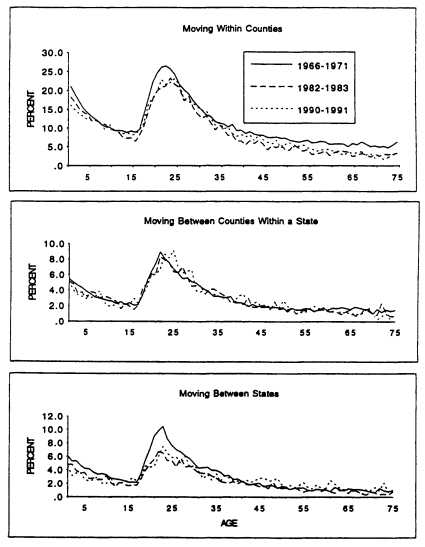
Second, the percentages reporting moves have declined over time. However, in the cases of the two types of moves with the greatest implications for regional or metropolitan population redistribution (interstate and intercounty moves within a state), the declines were concentrated among persons in their twenties. Beginning at about age 40, the graphs are virtually identical, indicating that the percentage of elderly making these kinds of moves remained relatively undisturbed between the time periods. This pattern is significant because it implies that the nature and the magnitude of forces governing the migration behavior of the elderly and the settled working-age population (ages 40-64) have remained similar over this time, while the forces affecting the migration behavior of the younger working-age population (ages 20-39) have changed. Although the propensity to migrate among the elderly is much lower than it is among the working-age nonelderly, it does not decline uniformly with age. Rather, small blips occur around age 65 (probably as a result of retirement moves) and around ages 75-79 (probably reflecting moves associated with declining health) (Rogers, 1992b; DeAre, 1992). As we note below, patterns such as this have led to the formulation of life-course conceptualizations of elderly migration that envision the likelihood of elderly movement tied to significant changes in life situation (Litwak and Longino, 1987).
MIGRATION RESEARCH
The previous sections have examined patterns of geographic distribution of the older population in the United States and how these patterns have changed over time. The migration of both the younger and the older segments of the population affects these patterns. The present section turns to the questions of why certain migration patterns have taken place and why they have changed over time. The examination begins by considering some of the factors at the aggregate or macrolevel that may induce or hinder population redistribution. Then it turns to individual-level or microfactors. Macro- and microlevel factors also interact in their effects on migration, as the following discussion points out.
The Macrolevel of Explanation: Location-Specific Amenities and Their Interactions
The demographic literature on migration is replete with discussions of factors within a given area that discourage or encourage persons to leave the area in search of residence elsewhere, such as poor economic conditions, changing technology, or ethnic/racial discrimination (see, for example, Stinner and De Jong, 1969; Greenwood, 1975, 1985). Similarly, lists of factors that may attract migrants to a specific area, or incline them to choose
one area versus another, once they have decided to leave their area of origin, have also been compiled. Earlier demographic literature refers to these as "push" and "pull" factors (Heer, 1963; Lee, 1966). More recently, especially among economists working in this area, these discussions have been framed in terms of labor market opportunities and "location-specific amenities" (Greenwood and Hunt, 1989). Often these factors are discussed in conjunction with (or matched up with) characteristics of the migrants. For example, a young adult, whose major reason for migration is tied to her or his economic situation, may leave a given area because of unemployment or because, although employed, the individual seeks a better or more desirable job (Greenwood and Hunt, 1989). Thus, for the younger population, such characteristics of an area as poor labor market conditions (including old or declining industries) may ''push" or motivate persons to move to another area where they may find a better match or fit to their specific characteristics (Da Vanzo, 1981). Prevailing conditions in land and housing markets, availability of other public goods such as education and health care, cultural amenities, climate, and other environmental aspects of an area (temperature ranges, seashores, mountains, etc.) can all enter into decisions to move or not to move (Greenwood and Hunt, 1989).
When considering characteristics of an area that may attract older migrants (or motivate them to depart), the same kinds of characteristics must be considered, but the particular combination of these factors, along with the relative weights of the factors in terms of explanatory importance, may be quite different. For example, for a young household head with high levels of human capital (e.g., good education, good employment history), a labor market with ample employment opportunities for persons seeking high-wage jobs in a variety of sectors of the work force may be very attractive. For an older couple with the household head approaching retirement and strong interests in carefully shepherding economic resources, the most attractive package of economic amenities may look rather different. An area that has a lower cost of living—including a lower wage structure, especially in the service sector (Longino, 1990), and lower taxes—may be much preferred to a higher-wage (and consequently higher cost of living) labor market (Serow et al., 1986). This older household is more likely to be paying for services to help maintain a home and a certain standard of living. Its members thus may be much less interested in seeking high wage, long-term employment (Fournier et al., 1988).
The industrial structure of a local labor market is thus not irrelevant for the migration behavior of either the young or the old; rather different sets of factors become attractions for different age sectors of the population. For example, King (1978) has found that a local labor market with an industrial structure having a relatively large number of jobs that offer part-time and/or flexible work hours has higher labor force participation rates for women,
especially those with young children at home. It may also be the case that a local labor market with an industrial composition that provides an abundance of part-time jobs of the kind that a healthy older population can compete for, could conceivably become a powerful draw for healthy retirees, especially those on fixed retirement incomes who worry about the potential loss of economic security in the future. In sum, the relationship between the economic structure of local areas and migration, which is considered to be quite strong at the young adult ages, must still be considered as a potential determinant of migration for the older population. The specific aspects of the local labor market, however, and the relative weight each factor plays in the final decision to move (as well as precisely where to move) may be quite different.
Similar considerations may apply in the cases of other location-specific amenities. The importance of climate (i.e., warmer weather) is often mentioned regarding elderly migration. (It should be clear, however, that the increase in concentration of elderly in the Midwest and New England is not due to this factor, but rather to outmigration of the nonelderly and aging-in-place as mentioned above.) Other aspects of the local area, especially the availability of health care services and facilities (including the ability to pay for these services—see Marshall et al., 1989), become increasingly important. There are also the special cases of retired military populations that often appear to concentrate in the vicinity of military bases for PX privileges and near Veterans Administration hospitals for the availability of medical services.
The discussion of push-pull factors in interregional migration in the case of the young adult (and/or economically active) population often takes place in the context of equilibrium or disequilibrium models. Within this kind of framework, when differential wage rates across regions are assumed to constitute equilibrium or compensating differentials, they presumably do not directly encourage interregional migration. Various economic factors such as income, however, may work rather differently for young adults and the elderly. A relatively high level of household income may deter migration at younger ages, but it appears to promote migration at retirement ages (Hogan, 1987; Longino, 1990). Graves and Linneman (1979) distinguish between "traded" and "nontraded" goods in their discussion of individual utility functions for migration. Changes in demand for nontraded goods cause migration, since the only way for a household to satisfy its changed demand for nontraded goods is relocation. One example of how this may affect elderly migration is that as retirement age approaches, the household's "demand" for better climatological and environmental factors may increase vis-à-vis other factors (such as a stable, well-paying job). Similarly, as a number of researchers have suggested, if the desire to be close to family, friends, and relatives is an increasingly important determinant of potential
migration with increasing age, this particular "nontraded" good (i.e., family network ties) may become a strong (and sometimes countervailing to environmental) factor in determining migration decisions (Da Vanzo, 1981).
Studies have also found an increase in elderly migration from urban to rural areas. In fact, the migration of the elderly from metropolitan areas contributed substantially to the growth of nonmetropolitan areas during the 1970s and, to a lesser extent, the 1980s (Lichter et al., 1981; Longino, 1982; Fuguitt and Beale, 1993). These long-distance moves may be motivated by the desire to return to areas of origin or to be closer to family and friends. Another trend in migration among the older population is that moves increasingly tend to cover relatively long distances (Serow and Charity, 1988). As Myers (1985:194) points out, "These developing trends in the movement of older persons are bringing a greater diversity in their patterns of residence. The result is the redistribution of the aged to areas that are more suitable environmentally, a shift that calls attention to emerging needs for new amenities and services." More research focusing specifically on the preferences and motivations of older persons from various subgroups of the population will be necessary before we begin to clearly understand how age interacts with personal and structural factors such as distance to influence different types of moves.
The changing patterns in the spatial distribution and concentration of the elderly are thus determined in large part not by what happens to the elderly but by what determines the migration and redistribution patterns of the nonelderly population. Although we have commented on factors that may promote movement of the older population from one area to another, and pointed out that the factors determining migration among the elderly are substantially different from those in the younger population, these factors are often overwhelmed by the sheer magnitude of migration streams involving the nonelderly population (Frey, 1986). Explaining migration among the elderly is a challenging task, and one in which there is still much to be accomplished. But that task is almost by definition incomplete without a consideration of migration across the entire spectrum of the age distribution.
Elderly population increase in either a relative or an absolute sense also exerts macrolevel consequences. To the extent that increasing concentrations of the elderly, and especially the oldest-old, are achieved through aging-in-place rather than migration, the demand for and provision of social and health services may be affected. Given that retirement-age elderly migrants are on average more likely to be married, have higher incomes and more education, and to be healthier than the nonmigrant segment of the elderly population (Biggar, 1980; Speare and Meyer, 1988), the areas that achieve concentrations of elderly through aging-in-place may require more health services, and concentrate a more substantial drain on local govern-
ments (on a per capita elderly basis), than areas where the concentrations of the elderly population have been achieved through inmigration.
The Microlevel of Explanation: Individual and Household Characteristics and the life-cycle
During the latter stages of the life course, migration can serve several functions, including allowing aged individuals to improve the quality of their physical and social environments, and providing them with supportive institutional care as the quality of health declines. Thus, residential moves in later life have been conceptualized as following an ideal typical sequence consisting of three stages (Litwak and Longino, 1987; Speare and Meyer, 1988). In the first stage, a typical retiree is thought to move while still relatively young in order to maximize environmental and life-style amenities. A second, later stage of change is seen as motivated by the desire to be closer to family and kin as health begins to deteriorate. Finally, a third stage of movement, often to institutions offering long-term care, is seen as dictated by increasing physical incapacities.
Such an ideal-typical sequence is useful analytically to the extent that the elderly follow similar patterns of physical decline and to the degree that the motivations and desires at the three stages are relatively homogeneous among older individuals. However, as recent data make clear, neither declines in health nor changes in living arrangements closely follow any prescribed universal sequence (Manton, 1988; Angel et al., 1992; Worobey and Angel, 1990a). As with other life-course transitions that involve school completion, employment, and fertility (e.g., Rindfuss et al., 1987), migration among the elderly is characterized by a great deal of heterogeneity in both the patterns of and the motivations for residential changes. As of yet, our understanding of the motivations for and patterns of residential changes in later life is insufficiently developed—especially in reference to subgroups of the population such as blacks, Hispanics, or those over the age of 85—to provide a firm indication of the degree to which conceptualizations of elderly migration stages correspond to actual patterns of behavior.
Empirical investigations of migration decisions in later life must also be informed by sound theoretical models of the psychological factors that motivate individuals to move and the structural factors that constrain their choices. From a simple utility-maximizing notion, or from the perspective of some hedonistic calculus that individuals seek to make themselves most comfortable, we can assume that the migration decisions of older individuals are influenced by their desire to maintain or improve the quality of their lives. Whereas younger people move for educational and occupational reasons (e.g., labor market-related reasons), older persons move because of poor health, to reduce their cost of living, to be closer to family, and to find
a more comfortable physical environment (De Jong and Fawcett, 1981; De Jong et al., 1992; Golant, 1980). Empirically, we know that migration in old age is correlated with a large array of social and demographic characteristics, including age (Golant, 1980); family structure (Bradsher et al., 1992); number of living adult children (Spitze et al., 1992); proximity to family, friends, and relatives (Cornwell et al., 1992; Lee et al., 1990); health and economic constraints (Baglioni, 1989; Speare et al., 1991; Longino et al., 1984; Burr and Mutchler, 1992; Worobey and Angel, 1990a,b); and the availability of recreational facilities (Steinnes and Hogan, 1992).
Explanations for these associations are encompassed in the theoretical or ideal-typical models noted above. Although many such models are consistent with the data, almost all have in common a distinction among different reasons for moving. A number of studies have pointed out that there are two basic kinds of elderly moves: those that are voluntary, which occur so that the elderly can improve the quality of their lives, and those that occur out of necessity. Voluntary migrants may be viewed as trying to maximize personal control over their lives in seeking an improved quality of life and amenities (Longino and Smith, 1991; Wiseman, 1980; Wiseman and Roseman, 1979). These individuals come closest to achieving the ideal image of retirement, one filled with the relaxation, freedom, and rewards earned after a lifetime of productive work. Voluntary migrants are often economically secure and move as part of the retirement process (Longino, 1990). Migrants who move out of necessity, as the phrase implies, do not exercise such autonomy. Their moves are necessitated by poverty, poor health, or the need for assistance with activities of daily living (ADLs). These individuals tend to be older, female, economically disadvantaged, poorly educated, and single (Longino, 1990). The motivations for the two types of migration are different and have important implications for understanding the migration process.
Considerable diversity thus exists not only in patterns of residential change in later life, but also in individual motivations for moves. Recent evidence from the 1990 Longitudinal Study of Aging (LSOA) confirms substantial heterogeneity in motives for migration in old age (De Jong et al., 1992). This survey contains a 6-year follow-up of persons who were 70 years and older when originally interviewed in 1984 as part of the Supplement on Aging to the National Health Interview Survey (NHIS) (Kovar et al., 1992). Between 1984 and 1990, 930 (16 percent) of the surviving residents reported making at least one move while 4,883 said they had not moved. At the follow-up, approximately one-fifth of the respondents who moved reported that they did so because of a desire to live closer to or with their family; another one-fifth moved for such amenities as better weather and neighborhood; and yet another one-fifth moved because of diminished health of the elderly person him or herself, or that of his or her spouse. Of
the remaining two-fifths, numerous reasons led to the move, including factors such as economic constraints (e.g., less expensive house to maintain), and changes in marital status.
Another group of studies has more explicitly examined the second and third types of moves noted above, also using data from the LSOA. Based on the 1984-1986 wave, Zimmerman et al. (1993) showed that individuals age 70 and older who have suffered moderate declines in instrumental activities of daily living (IADL) are more likely to change their residence than those who have not, although the perceived proximity of someone to provide assistance with household chores reduced the likelihood of a move taking place. What these data suggest, then, is that the availability of kin rather than economic resources allows the elderly to stay in their current residence in the event of a significant decline in IADL. Speare and his colleagues (1991) reach a similar conclusion in their analysis of changes in living arrangements.
Similarly, Worobey and Angel (1990a), employing the 1984-1986 wave of the LSOA, found that unmarried older individuals who experience a substantial decline in functional capacity are more likely to enter a nursing home than those who suffer no decline. At the same time, the great majority of older singles continue to live alone even when faced with significantly diminished health, suggesting substantial variations in patterns of geographic mobility. In addition, the LSOA studies demonstrate the impact of numerous other variables, including race and ethnicity, on patterns of living arrangements, suggesting that any simple typology of reasons for moving may oversimplify the reality faced by older adults. Eventually the tripartite typology of the reasons for migration in later life may become more elaborate in light of the variety of preferences and constraints faced by older people in contemplating residential changes.
INTERNATIONAL COMPARISONS
The chapter has focused, to this point, on research on the population distribution and internal migration of older persons in the United States. Although the chapter by Martin and Kinsella in this volume addresses international issues in aging research, specific attention to the extensive work on cross-national comparative research on the subject of internal migration merits separate consideration.
A major intent of comparative analyses in the field of demography is to establish whether or not commonalities exist across countries in population structures and in the forces, including underlying behavioral factors, that bring them about. Moreover, explicit efforts are often directed at conceptualizing general historical processes of cultural, societal, and developmental change, especially demographic transitions that take place through identifi-
able stages. The formulation of such models enables demographers to classify countries according to where they fall along some underlying temporal process. The theory of the demographic transition is an example of a perspective that facilitates generalizations about seemingly universal transformations in vital rates (birth and deaths) and their effects on population structures, such as population aging. The formal properties of population aging and its structural consequences are nicely formulated by Lee in this volume.
Similar efforts have been undertaken to generalize about geographic distributions and characteristic patterns of redistribution of populations within countries, notably in the case of the processes of urbanization that accompany demographic transitions. In addition, interest has been growing in examining the geographic distributions and redistributions of older persons and the forces contributing to these spatial patterns. As noted earlier in this chapter, the components of change in such areal concentrations, especially for specific subpopulations such as the elderly, are rather complex. They involve for specific geographic units not only net elderly aging-in-place and net elderly migration, but also the natural increase and net migration of the nonelderly. Empirical studies of these components on a comparative basis have been rather limited until recently by the lack of adequate time-series data, especially for developing countries. Nonetheless, several stylized depictions of transitions of changing concentrations of older persons and the mobility component have been undertaken (Law and Warnes, 1982; Myers and Clark, 1991; Rogers, 1989).
There are several fundamental processes that must be taken into account in deriving generalized temporal patterns of elderly redistribution and migration: (1) The size, growth, and relative share of any older population tend to increase during the course of the demographic transition, subject to historic fluctuations in natural increase. (2) The pace of change in levels of fertility and mortality tends to vary among geographic areas, for example, between rural and urban areas. (3) The shift from agricultural to manufacturing- or commerce-based economies leads to concentrations of these activities in cities and concomitant urbanization. (4) The propensity for internal movement tends to rise in the process of demographic transitions, but may level off or even decline as population stabilization occurs (Haag et al., 1988). Propensities to move can vary among countries, perhaps reflecting sociocultural factors. (5) There exist fairly general age patterns of geographic mobility that are largely determined by life-course transitions (Warnes, 1992). Moreover, the timing of life-course events may change due to sociodemographic and societal factors. (6) Associated with these age patterns are characteristic patterns of spatial movement and of the distance of moves (Stillwell, 1991).
Urban and Rural Patterns
Kinsella and Taeuber (1993) and Myers and Clark (1991) have noted that the share of a country's elderly population living in rural areas is greater than that in urban areas in most developing countries, with the exception of several heavily urbanized countries of Latin America. Nonetheless, the overall trends leading to increased urbanization in most countries characterize the aged population as well. Whereas two-thirds of the elderly population in developing countries currently live in rural areas, this figure is projected to be less than 50 percent by the year 2015 (United Nations, 1991). In developed countries, nearly three-fourths of the older population live in urban areas, and this is expected to reach 80 percent over the same time period.
The proportion of older persons tends to be greater in the population of rural areas than of urban areas in the developing countries of Africa and Asia, but also in some European countries. The opposite is true in Canada, the United States, Australia, New Zealand, and several Latin American countries. Time-series analyses indicate that in the process of development, the higher concentrations of older persons in rural areas gradually shift to higher concentrations in urban areas. This reflects the importance of aging-in-place that initially affects rural areas as heavy nonelderly movement to urban areas occurs, then gradually shifts toward aging-in-place in urban areas as rural-to-urban migration abates. For the most economically advanced countries, yet another reversal has been noted in which the migration of older persons from urban to rural areas occurs. These patterns suggest that a series of stages in elderly concentrations can be posited, depending both on dominant migration flows of the elderly and the nonelderly and on relative patterns of natural increase.
Another interesting feature of elderly population distribution in developing countries has been the higher concentration of older males in rural areas and older females in urban areas. This is true of most developed as well as developing countries. An explanation for this counterintuitive finding may rest in the migration of rural women, particularly widows, to urban places to rejoin children who have moved earlier in life. More extensive research is needed on this pattern because it holds profound implications for the housing and service requirements of urban areas, especially among older women. Foreign studies have also paid attention, in both developing and developed countries, to the temporary nature of moves among older persons. The periodic sharing of households with offspring of older persons has been noted in China and Indonesia (Goldstein et al., 1991; Hugo, 1987). In developed countries such as the United States, a circularity of moves may reflect temporary residence in multiple homes that older persons own. More research on temporary migration is also needed.
Developed Country Patterns
A major comparative Migration and Settlement Study conducted at the International Institute for Applied Systems Analysis between 1976 and 1982 drew attention to the general age patterns of migration that characterized 17 industrialized countries (Rogers and Willekens, 1986). Among the features of these patterns was the increased likelihood of longer-distance migration associated with the needs for support and assistance. Building on a earlier model proposed by Law and Warnes (1982) and focusing on retirement-type movement, Rogers (1989) has proposed a set of typical stages referred to as the "elderly mobility transition." A first stage reflects early industrialization characterized by low levels of retirement moves from urban areas back to widely dispersed rural areas of origin. A second stage reflects higher levels of retirement moves to selective destinations that offer attractive environmental opportunities (i.e., climatic conditions). In postindustrialized societies, a third stage emerges with more diffuse destinations in nonmetropolitan areas that may often be closer to places of origin.
An International Elderly Migration Project conducted in the late 1980s enabled Rogers and a network of international scholars to assess this model of elderly migration and population redistribution. Rogers et al. (1990) report countries classified by stages, with the United Kingdom clearly in the final stage, the United States approaching it, and Japan and Italy probably still in the first stage. Nonetheless, pervasive regularities in age-migration profiles were found to characterize the situation in all of the countries, and some spatial patterns also emerged. The studies from this project and others conducted in England and France (Noin and Warnes, 1987) have all identified amenity movement at retirement ages as a more important factor than aging-in-place in leading to spatial concentrations of aged persons in advanced industrialized countries. These concentrations are often located in nonmetropolitan areas, especially on coastlines that offer favorable climatic conditions and recreational opportunities. Important covariates have been reported in these comparative studies. In the case of older elderly persons, the unmarried are more likely to move than married persons. In particular, this is true of widowed persons, which leads to higher propensities of female than male movement at later ages. In the case of younger elderly persons, those with higher education and greater financial resources also are more likely to move.
There has also been increasing examination of the consequences of elderly movement for the older movers, their families, and the communities of origin and destination. In particular, the implications of elderly movement for areas of destination, especially areas of high concentrations, are coming to be examined more extensively with respect to such factors as housing and infrastructure (e.g., services for the elderly). Considerable
research in France and England (Noin and Warnes, 1987) on these topics should serve to stimulate similar interest in the United States.
In spite of the efforts that have been made to generate models of typical sequences of elderly population redistribution and migration flows, along with changing levels of elderly migration propensity, it is still the case that comparative research shows that considerable intercountry variability exists. Notwithstanding the difficulties inherent in studying these phenomena cross-nationally, which arise from varying geographic units of analysis and definitions of migration, the general features of the temporal model of transitions seem to hold for many industrialized countries.
KNOWLEDGE GAPS AND DATA NEEDS
As the populations of the United States and other countries have aged, it has become increasingly evident that the distribution and redistribution of the elderly population entail important public policy consequences. Jurisdictions that contain above-average concentrations of the elderly are faced with planning and policy requirements that are different from those of areas with lower concentrations of the elderly (such areas, of course, may face similar policy and planning imperatives when the absolute sizes of their elderly population are large). Substantial net inter-area transfers of the elderly have implications for population growth, age structure, and the provision of health and social benefits. Although the demographic, economic, and public policy significance of migration and population redistribution among the elderly has grown increasingly clear, this importance has yet to be matched by research output focusing on some of the issues that have emerged.
Two major gaps in knowledge in particular warrant comment. The first concerns demographic components of change in aging and their consequences. Although some empirical knowledge has been marshaled concerning the magnitude of the net migration and aging-in-place components of population aging (Fuguitt and Beale, 1993; Rogers and Woodward, 1988), little systematic empirical evidence has been assembled concerning the magnitude of the subcomponents of these, especially at the subnational (regional, state, metropolitan area) level. Geographic convergence in fertility and mortality patterns over time, together with the relatively low levels of immigration to the United States until recently, implies that the magnitude of the subcomponents will vary according to the level of analysis, with internal migration making a greater difference for the concentration of the elderly at the state level than international migration makes at the national level. But to understand better the consequences of these demographic changes, more information is needed about how much difference various
demographic factors make for population aging, especially at subnational levels of geography.
We also need to know more about the consequences of population aging for the health and social service costs of states and cities. It is evident that aging has implications for these costs, but again, to our knowledge, little research has been conducted into the quantitative impact of population aging for state- and city-level changes in health and social service costs. By the same token, research is lacking on how much difference the various components of population aging (including the age pattern of net migration) make for changes in net public benefit costs. In fact, Longino (1990) notes that many observers assume that the growing concentration of the aged in an area has negative social and economic consequences, a notion he terms the ''gray peril mythology." Recent research suggests that the growth of the aged in a given area often exerts positive benefits, especially if it results from the inmigration of affluent younger-old (aged 65-74) retirees (Biggar, 1980; Longino, 1988; Haas and Crandall, 1988). But if the nonelderly move away from an area, leaving the elderly behind, the economic implications may be more adverse. Research does not presently exist that quantifies relationships across areas in differences in the various components of population aging and differences in elderly public benefits, or relationships between changes in the demographic components of aging and changes over time in the receipt and expenditure of tax dollars on programs that benefit the elderly.
Information is also needed concerning the degree to which the magnitude of the various demographic components of aging may be changing. The effects of immigration, for example, seem unlikely to remain small as they have been in the past. At a national level, immigration has not yet contributed much to population aging (Preston et al., 1989), primarily because its volume has been relatively low (at least until recently) and because the median age of immigrants tends to be slightly lower than that of the general population and the distribution of immigrants' ages tends to be narrower (Arthur and Espenshade, 1988). However, states vary enormously in the percentages of their populations that are foreign born, with California (21.7 percent), New York (15.9 percent), and Florida (12.9 percent) showing the highest concentrations (Bureau of the Census, 1992a). As these foreign-born populations age, their health and social service needs may differ from those of other elderly. Whatever the case, it would be useful to know how relationships between the demographic components of aging and the relative balance of tax and public benefit dollars vary across locales and change over time.
The second major gap occurs at the level of individual migration behavior. The lack of detailed longitudinal data about migration, retirement, and health has prevented to this point the adequate testing of hypotheses devel-
oped within a life-course framework about linkages between migration and the occurrence of retirement and health events. The patterns that have emerged in aggregate data provide a basis for developing hypotheses that transitions in living arrangements occur because individuals seek environments that are compatible with age-influenced needs, desires, and goals. In this perspective, residential change is thought to be linked to the timing and sequencing of age-related role changes and significant life events (Lee, 1980). Individuals are more likely to move with their families prior to the teen years. Adolescent children are more residentially stable. During early adulthood, individuals move again as a normal life-course transition as they seek employment, marriage, and parenthood. After these early life transitions occur, greater residential stability characterizes the adult years between 25 and 65. Although moves occur, they are less frequent and less tied to age-related life events. Retirement, however, may again give more weight to age-related reasons for residential change. Older individuals move in response to leaving the labor force, as the result of losing a spouse, or because of declining functional capacity (Golant, 1980).
As noted earlier, the kinds of residential moves among the elderly have been arranged in a typological sequence consisting of (1) moves intended to maximize life-style and amenities, (2) moves intended to bring one closer to family, and (3) moves dictated by declining health (Litwak and Longino, 1987). Although research on the determinants of living arrangements and changes in residential patterns among the elderly has increased in recent years, hypotheses linking reasons and motives for migration to patterns of residential change among the elderly need more systematic testing at the individual level of analysis. As yet, for example, we do not know whether older persons who suffer a serious decline in functional capacity and who require assistance with ADLs are more likely to move closer to their adult children than elderly who are functionally independent. Recent analyses of the third wave of the LSOA suggest that elderly persons who move out of state may have done so in anticipation of deteriorating health. These data provide some evidence that older persons do in fact move closer to their families prior to suffering serious declines in functional capacity (Angel et al., 1991), suggesting that the availability of kin may be one of the most important predictors of migration in later life (e.g., Krout, 1988; Clark and Wolf, 1992).
Recent studies have also begun to examine the impact of changes in functional status on the likelihood of residential mobility for aged men and women, and for whites and blacks. This research should be extended to examine the interaction of race, gender, and locational factors in the probability of specific types of migration, including the likelihood of entering assisted-living facilities or nursing homes. It is hoped that the new national longitudinal Health and Retirement Survey that is currently under way will
provide the kinds of detailed life history data that will allow stronger inferences to be drawn about causal relationships between life events and migration behavior among the elderly.
REFERENCES
Angel, J.L., G.F. De Jong, G.T. Cornwell, and J.M. Wilmoth 1991 Diminished Health and Living Arrangements of Rural Elderly. Paper presented at the 44th annual meeting of the Gerontological Society of America, San Francisco, Calif.
Angel, R.J., J.L. Angel, and C.L. Himes 1992 Minority group states, health transitions, and community living arrangements among the elderly. Research on Aging 14:496-521.
Arthur, W.B., and T.J. Espenshade 1988 Immigration policy and immigrants' ages. Population and Development Review 14(2):315-326.
Baglioni, A.J. 1989 Residential relocation and health of the elderly. Pp. 119-137 in K.S. Markides and C.L. Cooper, eds., Aging, Stress, and Health. New York: John Wiley & Sons.
Bean, F.D., and M. Tienda 1987 The Hispanic Population of the United States. New York: Russell Sage.
Bean, F.D., G. Vernez, and C.B. Keely 1989 Opening and Closing the Doors: Evaluating Immigration Reform and Control. Washington, D.C.: Urban Institute Press.
Biggar, J.C. 1980 Who moved among the elderly, 1965-1970: A comparison of types of older movers. Research on Aging 2:73-91.
Binstock, R.H. 1992 The oldest old and "Intergenerational Equity." Pp. 394-417 in R.M. Suzman, D.P. Willis, and K.G. Manton, eds., The Oldest Old. New York: Oxford University Press.
Bradsher, J.E., C.F. Longino, D.J. Jackson, and R.S. Zimmerman 1992 Health and geographic mobility among the recently widowed. Journal of Gerontology: Social Sciences 47:S261-S268.
Bureau of the Census 1992a 1990 Census of Population and Housing: Summary. Social, Economic and Housing Characteristics. Washington, D.C.: U.S. Department of Commerce.
1992b Sixty-Five Plus in America. Current Population Reports, Special Studies Series, P23-178. Washington D.C.: U.S. Department of Commerce.
Burr, J.A., and J.E. Mutchler 1992 The living arrangements of unmarried elderly Hispanic females. Demography 29:93-112.
Champion, A.G., ed. 1989 Counterurbanization: The Changing Pace and Nature of Population Deconcentration. London: Edward Arnold.
Clark, R.L., and D.A. Wolf 1992 Proximity of children and elderly migration. Pp. 77-96 in A. Rogers, ed., Elderly Migration and Population Redistribution: A Comparative Perspective. London: Belhaven.
Clifford, W.B., T.B. Heaton, D.T. Lichter, and G.V. Fuguitt 1983 Components of change in the age composition of nonmetropolitan America. Rural Sociology 48(3):458-470.
Cornwell, G.T., G.F. De Jong, J.M. Wilmoth, and J.L. Angel 1992 The Implications of Changes in Health and Marital Status for Coresidence. Paper presented at the meeting of the Gerontological Society of America, Washington, D.C.
Crown, W.H. 1988 State implications of elderly interstate migration. The Gerontologist 28(4):533-539.
Da Vanzo, J. 1981 Microeconomic approaches to studying migration decisions. Pp. 90-129 in G.F. De Jong and R.W. Gardner, eds., Migration Decision Making. New York: Pergamon Press.
Day, J.C. 1992 Population Projections of the United States by Age, Sex, Race, and Hispanic Origin: 1992 to 2050. Current Population Reports, Series P-25, No. 1092. Washington, D.C.: U.S. Department of Commerce.
DeAre, D. 1992 Geographical Mobility: March 1990 to March 1991. Current Population Reports. Washington, D.C.: U.S. Department of Commerce.
De Jong, G.F., and J.T. Fawcett 1981 Motivations for migration: An assessment and a value-expectancy research model . Pp. 13-58 in G.F. De Jong and R.W. Gardner, eds., Migration Decision Making. New York: Pergamon Press.
De Jong, G.F., J.M. Wilmoth, J.L. Angel, and G.T. Cornwell 1992 Geographic Mobility of the Very Old: Motives and Explanations. Unpublished manuscript, Pennsylvania State University.
Fournier, G.M., D.W. Rasmussen, and W.J. Serow 1988 Elderly migration as a response to economic incentives. Social Science Quarterly 69:245-260.
Frey, W.H. 1986 Lifecourse migration and redistribution of the elderly across U.S. regions and metropolitan areas. Economic Outlook USA 13(2):10-16.
1988 Migration and metropolitan decline in developed countries: A Comparative Perspective. Population and Development Review 14(4):595-628.
1992a Metropolitan migration in developed countries: A cross-national data base. In C. Goldscheider, ed., Migration, Population Structure and Redistribution Policies. Boulder, Co: Westview Press.
1992b Metropolitan redistribution of the U.S elderly, 1960-70, 1970-80, 1980-90. In A. Rogers, ed., Elderly Migration and Population Redistribution: A Comparative Perspective. London: Belhaven.
1993 U.S. elderly population becoming more concentrated. Population Today 21(4):6-9.
Frey, W.H., and A. Speare, Jr. 1988 Regional and Metropolitan Growth and Decline in the United States. New York: Russell Sage.
Friedsam, H.J. 1951 Interregional migration of the aged in the U.S. Journal of Gerontology 6:237-242.
Fuguitt, G.V., and C.L. Beale 1993 The changing concentration of the older nonmetropolitan population, 1960-90. Journal of Gerontology: Social Sciences 48(6):S278-S288.
Fuguitt, G.V., D.L. Brown, and C.L. Beale 1989 Rural and Small Town America. New York: Russell Sage.
Golant, S.M. 1980 Future directions for elderly migration research. Research on Aging 2:271-280.
1992 The suburbanization of the American elderly. Pp. 163-180 in A. Rogers, ed., Elderly Migration and Population Redistribution: A Comparative Perspective. London: Belhaven.
Goldstein, A., S. Goldstein, and S. Guo 1991 Temporary migrants in Shanghai households, 1984. Demography 28(2):275-291.
Goldstein, S. 1976 Facets of redistribution: Research challenges and opportunities. Demography 13:423-434.
Graff, T.O., and R.F. Wiseman 1978 Changing concentrations of older Americans. The Geographical Review 68(4):379-393.
Graves, P.E., and P.D. Linneman 1979 Household migration: Theoretical and empirical results. Journal of Urban Economics 6:383-404.
Greenwood, M.J. 1975 Research on internal migration in the United States: A survey. Journal of Economic Literature 13:397-433.
1985 Human migration: Theory, models, and empirical studies. Journal of Regional Science 25(4):521-544.
Greenwood, M.J., and G.L. Hunt 1989 Jobs versus amenities in the analysis of metropolitan migration. Journal of Urban Economics 25:1-16.
Haag, G., M. Munz, R. Reiner, and W. Weidlich 1988 Comparative analysis of interregional migration. Pp. 285-311 in W. Weidlich and G. Haag, eds., Interregional Migration: Dynamic Theory and Comparative Analysis. Berlin: Springer-Verlag.
Haas, W.H., and L.A. Crandall 1988 Physicians' view of retirement migrants' impact on rural medical practice. The Gerontologist 28:663-666.
Hall, P., and D. Hay 1980 Growth Centres in the European Urban System. London: Heinemann.
Heer, D.M. 1963 The attractiveness of the South to whites and nonwhites: An ecological study. American Sociological Review 28:101-107.
Hing, E. 1987 Use of Nursing Homes by the Elderly: Preliminary Data from the 1985 National Nursing Home Survey. DHHS Pub. No. PHS 87-1250. Hyattsville, Md: U.S. Public Health Service.
Hogan, D.T. 1987 Determinants of the seasonal migration of the elderly to Sunbelt states. Research on Aging 9:115-133.
Hugo, G. 1987 The Changing Urban Situation in Southeast Asia and Australia: Some Implications for the Elderly. Paper presented at the United Nations Conference on Aging Populations in the Context of Urbanization, Sendai, Japan.
Kane, R.L., and R.A. Kane 1990 Health care for older people: Organizational and policy issues. Pp. 415-437 in R.H.
Binstock and L. George, eds., Handbook of Aging and the Social Sciences, 3rd ed. New York: Academic Press.
King, A.G. 1978 Industrial structure, the flexibility of working hours, and women's labor force participation. Review of Economics and Statistics 60:399-407.
Kinsella, K., and C.M. Taeuber 1993 An Aging World II. International Population Reports, Series P-95, No. 92-3. Washington, D.C.: U.S. Department of Commerce.
Kovar, M.G., J.E. Fitti, and M.M. Chyba 1992 The Longitudinal Study of Aging: 1984-90. Vital Health Statistics 1(28).
Krout, J.A. 1988 Rural versus urban differences in elderly parents' contact with their children. The Gerontologist 28:198-203.
Law, C., and A. Warnes 1982 The destination decision in retirement migration. Pp. 53-81 in A.M. Warnes, ed., Geographic Perspectives on the Elderly. New York: John Wiley & Sons.
Lee, E.S. 1966 A theory of migration. Demography 3:47-57.
1980 Migration of the aged. Research on Aging 2:131-135.
Lee, G.R., J.W. Dwyer, and R.T. Coward 1990 Residential location and proximity to children among impaired elderly parents. Rural Sociology 55:579-589.
Liao, T.F. 1993 Demographic Conditions Responsible for Population Aging as Reflected in Five Aging Measures. Paper presented at the annual meeting of the Population Association of America, Cincinnati.
Lichter, D.T., G.V. Fuguitt, T.B. Heaton, and W.B. Clifford 1981 Components of change in the residential concentration of the elderly population: 1950-1975. Journal of Gerontology: Social Sciences 36:480-489.
Litwak, E., and C.F. Longino, Jr. 1987 Migration patterns among the elderly: A developmental perspective. Gerontologist 27:266-272.
Long, L. 1988 Migration and Residential Mobility in the United States. New York: Russell Sage.
Longino, C.F. Jr. 1982 Changing aged nonmetropolitan migration patterns, 1955-1960 and 1965-1970. Journal of Gerontology: Social Sciences 37:S228-S234.
1985 Returning from the Sunbelt: Myths and realities of migratory patterns among the elderly. Pp. 7-21 in A. Monk, ed., Returning from the Sunbelt: Myths and Realities of Migration Patterns Among the Elderly. New York: Brookdale Institute on Aging and Adult Human Development, Columbia University.
1988 The gray peril mentality and the impact of retirement migration. Journal of Applied Gerontology 7:448-455.
1990 Geographical distribution and migration. Pp. 45-63 in R.H. Binstock and L. George, eds., Handbook of Aging and the Social Sciences, 3rd ed. New York: Academic Press.
Longino, C.F., Jr., and K.J. Smith 1991 Black retirement migration in the United States. Journal of Gerontology: Social Sciences 46:S125-S132.
Longino, C.F., Jr., J.C. Biggar, C.B. Flynn, and R.F. Wiseman 1984 The Retirement Migration Project: A Final Report to the National Institute on
Aging. Mimeo, University of Miami Center for Social Research in Aging, Coral Gables, Fla.
Manton, K,G. 1988 A longitudinal study of functional change and mortality in the United States. Journal of Gerontology 43:S153-S161.
Marshall, V., C.F. Longino Jr., R. Tucker, and L.G. Mullins 1989 Health care utilization of Canadian snowbirds: An example of strategic planning. Journal of Aging and Health I:150-168.
Mayer, M.J. 1991 Role of the New York City government in providing support for the elderly . Pp. 439-447 in Ageing and Urbanization. New York: United Nations.
Myers, G.C. 1985 Aging and worldwide population change. Pp. 173-198 in R.H. Binstock and E. Shanas, eds., Handbook of Aging and the Social Sciences. New York: Van Nostrand Reinhold.
1990 Demography of aging. Pp. 19-44 in L. George and R.H. Binstock, eds., Handbook of Aging and the Social Sciences, 3rd ed. New York: Academic Press.
Myers, G.C., and D.O. Clark 1991 Population Redistribution and Migration of Older Persons in Developing Countries. Paper presented at the conference on Elderly Migration Transition, Estes Park, Colo.
Noin, D., and A. Warnes, eds. 1987 Personnes agées et vieillessement/Elderly People and Ageing. Espace, Populations, Societies 1.
Preston, S.H., C. Himes, and M. Eggers 1989 Demographic conditions responsible for population aging. Demography 26:691-704.
Rindfuss, R.R., C.G. Swicegood, and R.A. Rosenfeld 1987 Disorder in the life course: How common and does it matter. American Sociological Review 52:785-801.
Rogers, A. 1988 Age patterns of elderly migration: An international comparison. Demography 25(3):355-70.
1989 The elderly migration transition: Growth, concentration, and tempo. Research on Aging 11(1):3-32.
1992a Elderly migration and population redistribution in the United States. Pp. 226-248 in A. Rogers, ed., Elderly Migration and Population Redistribution: A Comparative Perspective. London: Belhaven.
1992b Introduction. Pp. 1-15 in A. Rogers, ed., Elderly Migration and Population Redistribution: A Comparative Perspective. London: Belhaven.
Rogers, A., and J.F. Watkins 1987 General versus elderly interstate migration and population redistribution in the United States. Research on Aging 9(4):483-529.
Rogers, A., and F. Willekens, eds. 1986 Migration and Settlement: A Comparative Study. Dordrecht, Netherlands: D. Reidel.
Rogers, A., and J.A. Woodward 1988 The sources of regional elderly population growth: Migration and aging-in-place. The Professional Geographer 40(4):450-459.
Rogers, A., J.F. Watkins, and J.A. Woodward 1990 Interregional elderly migration and population redistribution in four industrialized countries: A comparative analysis. Research on Aging 12(3):251-293.
Rowles, G.D. 1986 The geography of ageing and the ages: Toward an integrated perspective. Progress in Human Geography 10(4):511-539.
Serow, W.J., and D.A. Charity 1988 Return migration of the elderly in the United States: Recent trends. Research on Aging 10:155-168.
Serow, W., D.A. Charity, G.M. Fournier, and D.W. Rasmussen 1986 Cost of living differentials and elderly interstate migration. Research on Aging 8(2):317-327.
Serow, W., D.F. Sly, and J.M. Wrigley 1990 Population Aging in the United States. New York: Greenwood Press.
Siegel, J.S. 1993 A Generation of Change: A Profile of America's Older Population, New York: Russell Sage Foundation.
Soldo, B.J., and E. Agree 1988 America's elderly. Population Bulletin 43:1-51.
Speare, A., Jr., and J.W. Meyer 1988 Types of elderly residential mobility and their determinants. Journal of Gerontology: Social Sciences 43:S74-S71.
Speare, A., R. Avery, and L. Lawton 1991 Disability, residential mobility, and changes in living arrangements. Journal of Gerontology: Social Sciences 46:S133-S142.
Spitze, G., J.R. Logan, and J. Robinson. 1992 Family structure and living arrangements among elderly nonmarried parents. Journal of Gerontology: Social Sciences 47:S289-S296.
Steinnes, D.N., and T.M. Hogan 1992 Take the money and sun: Elderly migration as a consequence of gains in unaffordable housing market. Journal of Gerontology 47:197-203.
Sternlieb, G. 1991 The elderly and municipal housing policies in the United States. Pp. 339-352 in Ageing and Urbanization. New York: United Nations.
Stillwell, J. 1991 Spatial interaction models and the propensity to migrate over distance. Pp. 34-56 in J. Stillwell and P. Congdon, eds., Migration Models: Macro and Micro Approaches. London: Belhaven Press.
Stinner, W.F., and G.F. De Jong 1969 Southern Negro migration: Social and economic components of an ecological model. Demography 6:455-471.
Suzman, R., D. Willis, and K. Manton 1992 The Oldest Old. New York: Oxford University Press.
Taueber, C.M. 1992 Sixty-Five Plus in America. Current Population Reports, Special Studies. Washington D.C.: U.S. Department of Commerce.
Taueber, C.M., and I. Rosenwaike 1992 A demographic portrait of America's oldest old. Pp. 17-49 in R.M. Suzman, D.P. Willis, and K.G. Manton, eds., The Oldest Old. New York: Oxford University Press.
Uhlenberg, P. 1992 Population aging and social policy. Annual Review of Sociology 18:449-474.
United Nations 1991 World Urbanization Prospects 1990. New York: United Nations, Department of Economic and Social Affairs.
1992 Preparing Migration Data for Subnational Population Projections. New York: United Nations.
Ward-Simon, M., and K. Glass 1988 A Statistical Report on Medical Care as Reported by the States and Territories on the HCFA 2082 Form for the 1987 State Medicaid Programs . Mimeo, Office of Medicaid Estimates and Statistics, Office of the Actuary, Health Care Financing Administration.
Warnes, T. 1992 Migration and the life course. Pp. 175-187 in A.G. Champion and A. Fielding, eds., Migration Processes and Patterns, Vol. 1. London: Belhaven Press.
Wiseman, R.F. 1980 Why older people move: Theoretical issues. Research on Aging 2:141-154.
Wiseman, R.F., and C.C. Roseman 1979 A typology of elderly migration based on the decision-making process. Economic Geography 55:324-337.
Worobey, J.L., and R.J. Angel 1990a Functional capacity and living arrangements of unmarried elderly persons. Journal of Gerontology: Social Sciences 45:S95-S 101.
1990b Poverty and health: Older minority women and the rise of the female-headed household. Journal of Health and Social Behavior 31:370-383.
Zedlewski, S.R., R.O. Barnes, M.R. Burt, T.D. McBride, and J.A. Meyer 1990 The Needs of the Elderly in the 21stCentury. Washington, D.C.: Urban Institute Press.
Zimmerman, R.S., D.J. Jackson, C.F. Longino, and J.E. Bradsher 1993 Interpersonal and economic resources as mediators of the effects of health decline on the geographic mobility of the elderly. Journal of Aging and Health 5:37-57.
APPENDIX
Number (in 1,000s), Percentage, and Percent Change of Persons 65 and Over, 85 and Over, and Median Age in the United States by Region, Division, and State, 1980-1990
|
|
65 and Over |
85 and Over |
|||||
|
Region |
1980 |
1990 |
Percent Change |
1980 |
1990 |
Percent Change |
Median Age, 1990 |
|
U.S. total |
25,549 |
31,242 |
22.3 |
2,240 |
3,080 |
37.5 |
32.9 |
|
|
(11.3) |
(12.6) |
(11.5) |
(1.0) |
(1.2) |
(20.0) |
|
|
Northeast |
6,071 |
6,995 |
15.2 |
547 |
710 |
29.9 |
34.2 |
|
|
(12.4) |
(13.8) |
(11.3) |
(1.1) |
(1.4) |
(27.3) |
|
|
New England |
1,520 |
1,770 |
16.4 |
151 |
194 |
28.3 |
33.7 |
|
|
(12.3) |
(13.4) |
(8.9) |
(1.2) |
(1.5) |
(25.0) |
|
|
Maine |
141 |
163 |
15.9 |
14 |
18 |
29.3 |
33.9 |
|
|
(12.5) |
(13.3) |
(6.4) |
(1.3) |
(1.5) |
(15.4) |
|
|
Vermont |
58 |
66 |
13.7 |
6 |
8 |
25.2 |
33.0 |
|
|
(11.4) |
(11.8) |
(3.5) |
(1.2) |
(1.3) |
(8.3) |
|
|
New Hampshire |
103 |
125 |
21.4 |
10 |
13 |
37.7 |
32.8 |
|
|
(11.2) |
(11.3) |
(0.9) |
(1.0) |
(1.2) |
(20.0) |
|
|
Massachusetts |
727 |
819 |
12.8 |
74 |
92 |
24.8 |
33.6 |
|
|
(12.7) |
(13.6) |
(7.1) |
(1.3) |
(1.5) |
(15.4) |
|
|
Rhode Island |
127 |
151 |
18.6 |
12 |
16 |
33.7 |
34.0 |
|
|
(13.4) |
(15.0) |
(11.9) |
(1.3) |
(1.6) |
(23.1) |
|
|
Connecticut |
365 |
446 |
22.2 |
36 |
47 |
31.5 |
34.4 |
|
|
(11.7) |
(13.4) |
(16.2) |
(1.1) |
(1.4) |
(27.3) |
|
|
Middle Atlantic |
4,551 |
5,225 |
14.8 |
395 |
516 |
30.5 |
34.4 |
|
|
(12.4) |
(13.9) |
(12.1) |
(1.1) |
(1.4) |
(27.3) |
|
|
New York |
2,160 |
2,364 |
9.4 |
193 |
248 |
28.6 |
33.9 |
|
|
(12.3) |
(13.1) |
(6.5) |
(1.1) |
(1.4) |
(27.3) |
|
|
New Jersey |
860 |
1,032 |
20.0 |
72 |
96 |
32.3 |
34.5 |
|
|
(11.7) |
(13.4) |
(14.5) |
(1.0) |
(1.2) |
(20.0) |
|
|
Pennsylvania |
1,531 |
1,829 |
19.5 |
130 |
172 |
32.2 |
35.0 |
|
|
(12.9) |
(15.4) |
(19.4) |
(1.1) |
(1.4) |
(27.3) |
|
|
Midwest |
6,692 |
7,749 |
15.8 |
649 |
840 |
29.3 |
33.0 |
|
|
(11.4) |
(13.0) |
(14.0) |
(1.1) |
(1.4) |
(27.3) |
|
|
East North Central |
4,493 |
5,299 |
17.9 |
415 |
539 |
29.8 |
32.9 |
|
|
(10.8) |
(12.6) |
(16.7) |
(1.0) |
(1.3) |
(30.0) |
|
|
Ohio |
1,169 |
1,407 |
20.3 |
108 |
138 |
27.3 |
33.3 |
|
|
(10.8) |
(13.0) |
(20.4) |
(1.0) |
(1.3) |
(30.3) |
|
|
Indiana |
585 |
696 |
18.9 |
54 |
72 |
31.9 |
32.8 |
|
|
(10.7) |
(12.6) |
(17.8) |
(1.0) |
(1.3) |
(30.3) |
|
|
Illinois |
1,262 |
1,437 |
13.8 |
115 |
148 |
28.7 |
32.8 |
|
|
(11.0) |
(12.6) |
(14.5) |
(1.0) |
(1.3) |
(30.0) |
|
Number (in 1,000s), Percentage, and Percent Change of Persons 65 and Over, 85 and Over, and Median Age in the United States by Region, Division, and State, 1980-1990
|
|
65 and Over |
85 and Over |
|||||
|
Region |
1980 |
1990 |
Percent Change |
1980 |
1990 |
Percent Change |
Median Age, 1990 |
|
Michigan |
912 |
1,108 |
21.5 |
82 |
107 |
30.9 |
32.6 |
|
|
(9.8) |
(11.9) |
(21.4) |
(0.9) |
(1.0) |
(33.3) |
|
|
Wisconsin |
564 |
651 |
15.4 |
56 |
74 |
33.5 |
32.9 |
|
|
(12.0) |
(13.3) |
(10.8) |
(1.2) |
(1.5) |
(25.0) |
|
|
West North Central |
2,199 |
2,450 |
11.4 |
235 |
301 |
28.5 |
33.1 |
|
|
(12.8) |
(13.9) |
(8.6) |
(1.4) |
(1.7) |
(21.4) |
|
|
Minnesota |
480 |
547 |
14.0 |
53 |
69 |
30.4 |
32.5 |
|
|
(11.8) |
(12.5) |
(5.9) |
(1.3) |
(1.6) |
(23.1) |
|
|
Iowa |
388 |
426 |
9.9 |
45 |
55 |
23.0 |
34.2 |
|
|
(13.3) |
(15.3) |
(15.0) |
(1.5) |
(2.0) |
(33.3) |
|
|
Missouri |
648 |
718 |
10.7 |
61 |
81 |
33.0 |
33.5 |
|
|
(13.2) |
(14.0) |
(6.1) |
(1.2) |
(1.6) |
(33.3) |
|
|
North Dakota |
80 |
91 |
13.2 |
8 |
11 |
38.1 |
32.4 |
|
|
(12.3) |
(14.3) |
(16.3) |
(1.2) |
(1.8) |
(33.3) |
|
|
South Dakota |
91 |
102 |
12.4 |
10 |
13 |
28.0 |
32.5 |
|
|
(13.2) |
(14.7) |
(11.4) |
(1.5) |
(1.9) |
(26.7) |
|
|
Nebraska |
206 |
223 |
8.5 |
24 |
29 |
23.0 |
33.0 |
|
|
(13.1) |
(14.1) |
(7.6) |
(1.5) |
(1.9) |
(26.7) |
|
|
Kansas |
306 |
343 |
11.9 |
33 |
42 |
26.3 |
32.9 |
|
|
(13.0) |
(13.8) |
(6.2) |
(1.4) |
(1.7) |
(21.4) |
|
|
South |
8,488 |
10,724 |
26.3 |
664 |
992 |
49.5 |
32.8 |
|
|
(11.3) |
(12.6) |
(11.5) |
(0.9) |
(1.2) |
(33.3) |
|
|
South Atlantic |
4,367 |
5,834 |
33.6 |
327 |
515 |
57.5 |
33.7 |
|
|
(11.8) |
(13.4) |
(13.6) |
(0.9) |
(1.2) |
(33.3) |
|
|
Delaware |
59 |
81 |
36.4 |
5 |
7 |
35.5 |
32.9 |
|
|
(10.0) |
(12.1) |
(21.0) |
(0.9) |
(1.1) |
(22.2) |
|
|
Maryland |
396 |
517 |
30.8 |
33 |
46 |
42.3 |
33.0 |
|
|
(9.4) |
(10.8) |
(14.9) |
(0.8) |
(1.0) |
(25.0) |
|
|
District Columbia |
74 |
78 |
4.8 |
6 |
8 |
22.9 |
33.5 |
|
|
(11.6) |
(12.8) |
(10.3) |
(1.0) |
(1.3) |
(30.0) |
|
|
Virginia |
505 |
664 |
31.5 |
41 |
60 |
45.2 |
32.6 |
|
|
(9.5) |
(10.7) |
(12.6) |
(0.8) |
(1.0) |
(25.0) |
|
|
West Virginia |
238 |
269 |
13.0 |
19 |
25 |
31.1 |
35.4 |
|
|
(12.2) |
(15.0) |
(12.6) |
(1.0) |
(1.4) |
(40.0) |
|
|
North Carolina |
603 |
804 |
33.3 |
45 |
70 |
54.8 |
33.1 |
|
|
(10.3) |
(12.1) |
(17.5) |
(0.8) |
(1.1) |
(37.5) |
|
|
South Carolina |
287 |
397 |
38.1 |
20 |
31 |
53.7 |
32.0 |
|
|
(9.2) |
(11.4) |
(24.0) |
(0.6) |
(0.9) |
(50.0) |
|
Number (in 1,000s), Percentage, and Percent Change of Persons 65 and Over, 85 and Over, and Median Age in the United States by Region, Division, and State, 1980-1990
|
|
65 and Over |
85 and Over |
|||||
|
Region |
1980 |
1990 |
Percent Change |
1980 |
1990 |
Percent Change |
Median Age, 1990 |
|
Georgia |
517 |
654 |
26.6 |
39 |
57 |
45.2 |
31.6 |
|
|
(9.5) |
(10.1) |
(6.6) |
(0.7) |
(0.9) |
(28.6) |
|
|
Florida |
1,688 |
2,369 |
40.4 |
117 |
210 |
79.1 |
36.4 |
|
|
(17.3) |
(18.3) |
(5.8) |
(1.2) |
(1.6) |
(33.3) |
|
|
East South Central |
1,657 |
1,930 |
16.5 |
134 |
186 |
38.8 |
32.9 |
|
|
(11.3) |
(12.7) |
(12.4) |
(0.9) |
(1.2) |
(33.3) |
|
|
Kentucky |
410 |
467 |
13.9 |
35 |
46 |
32.3 |
33.0 |
|
|
(11.2) |
(12.7) |
(13.4) |
(11.2) |
(12.7) |
(30.0) |
|
|
Tennessee |
518 |
619 |
19.6 |
41 |
59 |
41.9 |
33.6 |
|
|
(11.3) |
(12.7) |
(12.4) |
(11.3) |
(12.7) |
(33.3) |
|
|
Alabama |
440 |
523 |
18.9 |
34 |
49 |
42.6 |
33.0 |
|
|
(11.3) |
(12.9) |
(14.2) |
(11.3) |
(12.9) |
(33.3) |
|
|
Mississippi |
289 |
321 |
11.0 |
24 |
32 |
37.5 |
31.2 |
|
|
(11.5) |
(12.5) |
(8.7) |
(11.5) |
(12.5) |
(44.4) |
|
|
West South Central |
2,464 |
2,960 |
20.1 |
203 |
291 |
43.6 |
31.3 |
|
|
(10.4) |
(11.1) |
(6.7) |
(0.9) |
(1.1) |
(22.2) |
|
|
Arkansas |
312 |
350 |
12.0 |
26 |
35 |
33.6 |
33.8 |
|
|
(13.7) |
(14.9) |
(8.8) |
(13.7) |
(14.9) |
(25.0) |
|
|
Louisiana |
404 |
469 |
16.0 |
31 |
44 |
42.9 |
31.0 |
|
|
(9.6) |
(11.1) |
(15.6) |
(9.6) |
(11.1) |
(42.9) |
|
|
Oklahoma |
376 |
424 |
12.8 |
34 |
46 |
34.9 |
33.2 |
|
|
(12.4) |
(13.5) |
(8.9) |
(12.4) |
(13.5) |
(36.4) |
|
|
Texas |
1,371 |
1,717 |
25.2 |
112 |
167 |
48.7 |
30.8 |
|
|
(9.6) |
(10.1) |
(5.2) |
(9.6) |
(10.1) |
(25.0) |
|
|
West |
4,298 |
5,774 |
34.3 |
380 |
539 |
41.6 |
31.8 |
|
|
(10.0) |
(10.9) |
(9.0) |
(0.9) |
(1.0) |
(11.1) |
|
|
Mountain |
1,061 |
1,524 |
43.6 |
86 |
133 |
53.6 |
31.6 |
|
|
(9.3) |
(11.2) |
(20.4) |
(0.8) |
(1.0) |
(25.0) |
|
|
Montana |
85 |
106 |
25.9 |
9 |
11 |
20.8 |
33.8 |
|
|
(10.7) |
(13.3) |
(24.3) |
(10.7) |
(13.3) |
(18.2) |
|
|
Idaho |
94 |
121 |
29.4 |
8 |
11 |
34.5 |
31.5 |
|
|
(9.9) |
(12.0) |
(21.2) |
(9.9) |
(12.0) |
(22.2) |
|
|
Wyoming |
37 |
47 |
27.0 |
3 |
5 |
31.0 |
32.0 |
|
|
(7.9) |
(10.4) |
(29.1) |
(7.9) |
(10.4) |
(42.9) |
|
|
Colorado |
247 |
392 |
33.2 |
24 |
33 |
35.3 |
32.5 |
|
|
(8.6) |
(10.0) |
(16.3) |
(8.0) |
(10.0) |
(25.0) |
|
Number (in 1,000s), Percentage, and Percent Change of Persons 65 and Over, 85 and Over, and Median Age in the United States by Region, Division, and State, 1980-1990
|
|
65 and Over |
85 and Over |
|||||
|
Region |
1980 |
1990 |
Percent Change |
1980 |
1990 |
Percent Change |
Median Age, 1990 |
|
New Mexico |
116 |
163 |
40.7 |
9 |
14 |
62.0 |
31.3 |
|
|
(8.9) |
(10.8) |
(21.3) |
(8.9) |
(10.9) |
(28.6) |
|
|
Arizona |
307 |
479 |
55.8 |
20 |
38 |
89.7 |
32.2 |
|
|
(11.3) |
(13.1) |
(15.9) |
(11.3) |
(13.1) |
(42.9) |
|
|
Utah |
109 |
150 |
37.2 |
9 |
14 |
53.8 |
26.2 |
|
|
(7.5) |
(8.7) |
(16.0) |
(7.5) |
(8.7) |
(33.3) |
|
|
Nevada |
66 |
128 |
94.1 |
4 |
7 |
105.0 |
33.3 |
|
|
(8.2) |
(10.6) |
(29.3) |
(8.2) |
(10.6) |
(20.0) |
|
|
Pacific |
3,237 |
4,250 |
31.3 |
294 |
506 |
38.0 |
31.9 |
|
|
(10.2) |
(10.9) |
(6.9) |
(0.9) |
(1.0) |
(11.1) |
|
|
Washington |
432 |
575 |
33.3 |
41 |
56 |
35.7 |
33.1 |
|
|
(10.4) |
(11.8) |
(13.4) |
(10.4) |
(11.8) |
(20.0) |
|
|
Oregon |
303 |
391 |
29.0 |
28 |
39 |
36.5 |
34.5 |
|
|
(11.5) |
(13.8) |
(20.0) |
(11.5) |
(13.8) |
(27.3) |
|
|
California |
2,414 |
3,136 |
29.9 |
218 |
300 |
37.2 |
31.5 |
|
|
(10.2) |
(10.5) |
(2.9) |
(10.2) |
(10.5) |
(11.1) |
|
|
Alaska |
12 |
22 |
93.7 |
1 |
1 |
102.1 |
29.4 |
|
|
(2.9) |
(4.1) |
(41.4) |
(2.9) |
(4.1) |
(0.0) |
|
|
Hawaii |
76 |
125 |
64.2 |
6 |
10 |
87.0 |
32.6 |
|
|
(7.9) |
(11.3) |
(43.0) |
(7.9) |
(11.3) |
(50.0) |
|
|
SOURCE: 1980 and 1990: Bureau of the Census, (1992b); median age, 1990: Bureau of the Census (1992a). |
|||||||


