
EINAR HILLE
June 28, 1894–February 12, 1980
BY RALPH PHILLIPS
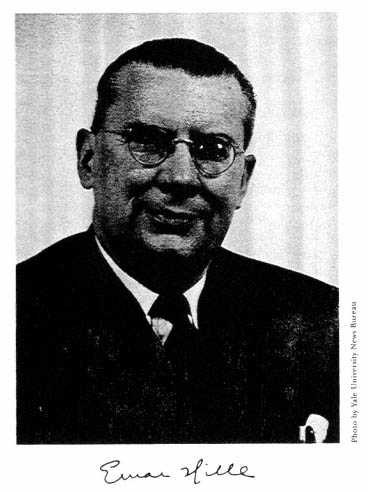
EINAR HILLE'S many achievements as a mathematician and a teacher made him a major force in the American mathematical community during most of his lifetime. He was at heart a classical analyst, yet his principal work was the creation and development of the abstract theory of semi-groups of operators, which culminated in his definitive book on Functional Analysis and Semi-Groups (1948, 2). In all, Hille authored or coauthored 175 mathematical papers and twelve books. During the twenty-five years of his tenure at Yale (1938–62), he was the director of graduate studies and as such played an important role in making the Yale Mathematics Department one of the best in the country. He was president of the American Mathematical Society (1947–48), and a member of the National Academy of Sciences, the Royal Academy of Sciences of Stockholm, and the American Academy of Arts and Sciences.
Hille was born in New York City under somewhat unfortunate circumstances in that his parents had separated before his birth and his mother was left with the task of raising him alone. Two years later they moved to Stockholm and remained there for twenty-four years, all that time within a few blocks of a parish church where an uncle of Hille's
was then the rector. He wrote of those years: "I was an only child and naturally was spoiled in many ways. That the result did not become completely unfit for human company was largely due to my mother's strong criticism. Nothing was good enough for me, but only my best was good enough for her and as often as not that did not satisfy."
About his early talent, Hille wrote: "My interest in mathematics came fairly late. I recall having had trouble with the seven table in the third grade and that I badly flunked a test on decimal fractions in the sixth grade. But from the ninth grade on mathematics was one of my best subjects and I did outside reading in this subject regularly from the tenth grade on."
Hille entered the University of Stockholm in the fall of 1911 with the aim of becoming a secondary school teacher. For this it was necessary to get a master's degree, and this involved taking three main subjects, at least two of which formed a "teachable" combination. He picked chemistry, mathematics, and physics. Hille started with chemistry but by the end of two years realized that he had little talent in this field. From the beginning, however, to relieve the tedium of the laboratory, Hille started to visit mathematics lectures and thus began his real introduction into the subject under the guidance of Professors I. Bendixson, I. Fredholm, H. von Koch, and docent M. Riesz. Hille received his master's degree in May 1914.
By this time Hille had decided to go for a Ph.D. in mathematics. Riesz suggested the topic of Hille's first mathematical paper, which had to do with properties:

where f(z) is holomorphic and f′(z) ≠ 0 in the disk (:z: <
R). Hille got the licentiate of philosophy degree in 1916 on the basis of this research.
Hille served in the Swedish Army during 1916–17, where he managed to find time to start three investigations, one of which became the basis for his Ph.D. dissertation (1918). This had to do with an integral identity (a form of Green's identity) that he used to obtain information on the distribution of zeros in the complex plane of certain second-order ordinary differential equations. Hille was awarded the Mittag-Leffler Prize for this work. He spent 1919–20 doing office work in the Swedish Civil Service and teaching on the side at the University of Stockholm.
His big break came in 1920 when a fellowship from the Swedish-American Foundation enabled him to spend the year at Harvard University; this was followed by a second year as a Benjamin Pierce Instructor. Encouraged by G. D. Birkhoff, Hille continued to work on the problems engendered in his dissertation (1921, 1; 1922, 1-3; 1923; 1924, 2-6; 1925). Of his later papers, four (1927, 1; 1933, 5; 1943, 1; 1948, 1, in part) are also concerned with the same general set of ideas.
In 1922 Hille moved on to Princeton with the rank of instructor; after his first year he was promoted to assistant professor. To begin with his research continued along the same lines as before; however, he did finish two papers (1924, 1; 1926, 1) at this time on the Dirichlet series, which he had already started in Sweden. Then in 1925 he began working on expansions in terms of Laguerre (1926, 3) and Hermite (1926, 4) polynomials. The latter paper contained results on the Abel summability of such series as well as a study of the Gauss-Weierstrass transform.
With Veblen's help, Hille got a National Research Council fellowship for the year 1926–27 during which he di-
vided his time between Stockholm, Copenhagen, and Göttingen. Three publications grew out of this period (1927, 1, 2; 1928, 1), but they were really incidental to the beginning of a close and fruitful collaboration with J. D. Tamarkin that started around this time and continued up to Tamarkin's untimely death in 1945. A touching account of this collaboration can be found in Hille's "In Retrospect."1,2
Hille and Tamarkin started with the problem of the frequency of the characteristic values of linear integral equations (1928, 3; 1931, 1) and continued on to study other phases of integral equations (1930, 2; 1934, 4). This was followed by papers on the Fourier series (1928, 4; 1929, 1; 1930, 3; 1931, 4; 1932, 1; 1933, 1, 2; 1934, 5), Fourier transforms (1933, 3, 6; 1934, 2; 1935, 1, 2) and Hausdorff means (1933, 4, 7, 8; 1934, 3). In all they wrote twenty-six joint papers during the period 1927–37.
Also while at Princeton, Hille became interested in an old problem concerning the width of the strip of uniform nonabsolute convergence of an ordinary Dirichlet series. In 1913 Bohr had shown that this width could be at most one-half and when the summation extends only over the primes that the width is zero. Using a result of Littlewood, Hille was able to prove that, if the summation extends only over those integers that are the product of n primes, the width of the strip is at most (n–1)/2n. Finally, F. Bohnenblust, who was Hille's assistant at the time, was able to construct examples for which these upper limits were attained. Two papers (1931, 2, 3; 1932, 3), written jointly with Bohnenblust, contained these results.
In 1933 Hille went to Yale, where he stayed until he reached the mandatory retirement age of sixty-eight in 1962. During all this time his primary responsibility as both teacher and administrator was with the graduate studies. He was
director of graduate studies from 1938 to 1962 and as such had a very close relationship with the students. His lectures were always very polished; in fact, he usually wrote them out in longhand in his notebook the night before. In all he had twenty-four Ph.D. students while at Yale. They were Eugene Northrup, 1934; Augustus H. Fox, 1935; William B. Cater, 1939; Irving E. Segal, 1940; Mary K. Peabody, 1944; Joseph S. Leech, 1947; Robert A. Rosenbaum, 1948; Walter J. Klimczak, 1948; Evelyn Boyd (Collins), 1949; Arthur S. Day, 1949; Joseph R. Lee, 1950; John F. L. Peck, 1950; Hai-Tsin Hsu, 1950; Arthur R. Brown, 1952; Thomas L. Saaty, 1952; James L. Howell, 1954; Stephen E. Puckette, 1957; Roger H. Geeslin, 1958; Cassius Ionescu-Tulcea, 1958; Charles A. McCarthy, 1959; Norman S. Rosenfeld, 1959; Saturnino L. Salas, 1959; Thaddeus B. Curtz, 1960; and Sister Mary Zachary Brunell, 1964.
Up to this point in this chronicle my main source has been Hille's own account of his early years published in the essay, "In Retrospect"3 and preprints entitled "Home, Schools, Avocations" and "Accomplishments." Material for the previous paragraph was taken from Jacobson's article entitled "Einar Hille, His Yale Years, A Personal Recollection."4 In what follows I have relied on my forward to Hille's selected papers5 and Yosida's article, "Some Aspects of E. Hille's Contribution to Semi-Group Theory."6
In 1936 Hille met Kirsti Ore, the sister of the Yale mathematician Oystein Ore. Einar and Kirsti were married the following year. Kirsti was a devoted wife, and they had two sons, Harald, born in 1939, and Bertil, born in 1940.
Hille's most important research was on the theory of semi-groups of operators, which he developed almost single-handedly over a twelve-year period beginning in 1936. It all started with an investigation on the Gauss-Weierstrass
and the Poisson transforms, both of which happened to satisfy the semi-group property: T (t + s) = T(t) T(s). Hille was interested in the degree of approximation to the identity of T(t) for small t, and he found that he could obtain the desired results using only the semi-group property without invoking the explicit form of the transformations (1936, 1).
Hille's next effort in this direction was somewhat tentative. Starting with a semi-group of positive self-adjoint contractions acting on a Hilbert space, he was able to derive a representation theorem and from this prove the analyticity in the semi-group parameter in the right half-plane (1938, 3). At this point he realized the true potential of the theory and he extended the previous results to general holomorphic semi-groups of operators on a Banach space (1938, 4; 1939, 1; 1942, 4). These three papers are the basis for the most beautiful chaper in Hille's book on semi-groups of operators. This chapter contains a basic generation theorem, giving necessary and sufficient conditions for an operator to generate a semi-group holomorphic in a sector, as well as a characterization of the convex hull of the spectrum of the infinitesimal generator in terms of the exponential growth of the semi-group of operators along the various rays in the sector of definition.
Hille spent 1941–42 on sabbatical at Stanford, where he became involved with G. Polya, A. C. Schaeffer, and G. Szego in the extension of certain oscillation theorems of Polya and Wiener on Fourier series to classical orthogonal polynomials (1942, 1, 2; 1943, 1). In the spring of 1942 he joined forces with Max Zorn, and together they wrote a paper on additive semi-groups of complex numbers (1943, 2).
In 1942 (starting with the paper [1942, 3]), Hille began
an attack on the larger class of semi-groups of operators that are merely strongly continuous. In this paper he discovered the representation of the resolvent of the generator in terms of the Laplace transform of the semi-group. It should be noted that Hille was mainly motivated in this by the theory of analytic functions of exponential type as developed by Polya and not, as one might expect, by the standard Laplace transform approach to the initial value problem in partial differential equations. In fact, it was not until 1949, with the research of Yosida7 on the diffusion equation, that this most important application of the theory of semi-groups of operators was considered.
In August of 1944 Hille delivered the colloquium lectures at the American Mathematical Society meeting and immediately thereafter he started in earnest writing his book,8Functional Analysis and Semi-Groups, which was finally published in 1948. It was both a textbook on functional analysis and a monograph on the theory of semi-groups of operators. As far as I know, this was the first time that functional analysis was presented as a tool for classical analysis. In addition to the usual theory of Banach spaces and linear transformations, Hille was able to organize into a unified whole the calculus of vector-valued functions, function theory for vector-valued functions, and the operational calculus. It should be noted that this book was for many years one of the principal texts on functional analysis.
The basic result, giving necessary and sufficient conditions for a closed linear operator A with dense domain to be the infinitesimal generator of a strongly continuous semi-group of contraction operators, appeared in print for the first time simultaneously in Hille's book and in a paper by Yosida.9 This result is now referred to as the Hille-Yosida generation theorem. The logarithm of the norm of a semi-
group of operators is a real-valued subadditive function on the half-line. With this in mind, Hille extended the earlier theory on subadditive functions on the positive integers to measurable subadditive functions on the half-line.
Hille's chapter on ergodic theory is based on an earlier paper (1945, 1) and deals with the Abel limit:

where R(λ) is the Laplace transform
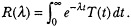
By means of Tauberian theorems, Hille was able to show that under certain auxiliary conditions Abel summability implies the stronger Cesaro summability. He also proved that the Abel limits at both 0 and ∞ were projection operators related to the semi-group.
The spectral theory chapter is outstanding. It is based on an operational calculus explicitly constructed for the generators of semi-groups of operators. The basic relation between the function f(λ) and the corresponding operator f(A) is given by

and
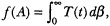
A being the infinitesimal generator of T(t); thus, both f(λ) and f(A) are Laplace-Stieltjes transforms. In earlier versions of the operational calculus, f(λ) was always taken to be holomorphic on the spectrum of A. However, Hille treated functions f(λ), which are holomorphic in the interior of the spectrum of A but may be merely continuous on those points of the spectrum that lie on the abscissa of
convergence for the Laplace-Stieltjes transform of β. A spectral mapping theorem relates the fine structure of the spectrum of A to that of T(t) by means of an ingenious argument (1942, 4). It should be remarked that Hille made no use of the theory of Banach algebras in this discussion even though his book contains an appendix on Banach algebras.
Part three of Hille's book deals with a wide variety of examples of semi-groups taken from classical analysis. The chapters on trigonometric semi-groups and translation semi-groups are related to factor sequences for Fourier series and factor functions for Lp spaces, which Hille dealt with in earlier papers ([1924, 1; 1926, 4; 1933, 1, 5]). The chapter on partial differential equations is somewhat disappointing in that it did not anticipate the most successful approach to the subject via the Hille-Yosida theorem. The concluding chapter contains a rich variety of examples taken from summability theory, Markoff chains, stochastic processes, and fractional integration. In each of these examples Hille threw new light on the subject with his semi-group theory.
In 1948 Hille gave his retiring presidential address on the theory of Lie semi-groups of operators (1950, 1) at the annual meeting of the American Mathematical Society. This work contains both a study of the underlying parameter group π and an investigation of its representation (T(p); p ∈ π) as bounded linear operators on a Banach space. Hille showed that corresponding to every canonical sub-semi-group there is an infinitesimal generator, that these generators form a positive cone, and that they satisfy the analogs of the three fundamental theorems of Lie.
In 1952 Hille asked me to collaborate with him on the second edition of his book.8 I was occupied with this task
during much of the 1952–53 academic year and all of 1953–54, which I spent at Yale. I found Hille to be a generous colleague, extremely patient, and perhaps a little too permissive for the good of the book. Although the new edition (1957, 2) is one-and-a-half times the size of the original, it is largely in fact and entirely in spirit very much like the original edition.
The 1957 edition consists of a thorough reworking of the first edition plus several new results necessary to bring it up to date. The theory of commutative Banach algebras is introduced early in the book and plays a major role in the chapters on spectral theory and holomorphic semi-groups. The influence of Yosida and, to some extent, Feller is quite evident; and of course I took advantage of my being coauthor by including my own results on extended classes of semi-groups (distinguished by their behavior at the origin) and their generating theorems, perturbation theory, the adjoint semi-group, the operational calculus, and spectral theory. There is also a new chapter on Hille's theory of Lie semi-groups of operators and an expanded section on the integration of the Kolmogoroff differential equations based mainly on two of Hille's papers (1954, 5, 6). The chapter on partial differential equations was omitted because by that time it required a book of its own. However, we did include a discussion of the abstract Cauchy problem that had been initiated by Hille and on which we had both worked.
Yosida's 1949 paper10 on the diffusion equation showed that semi-group theory was an ideal tool for studying the initial value problems in mathematical physics. It was typical of Hille that he launched into an attack on this problem on two different levels: the abstract and the concrete. On the abstract level he formulated what he called the abstract Cauchy problem (ACP): for a given Banach space
X and yo in X and linear operator U with domain D(U), find a solution to the problem y′(t) = U[y(t)], t > 0 such that limt → oy(t) = yo and y(t) is absolutely continuous and y′ (t) exists and belongs to D(U) for all t > 0. A solution is said to be of normal type if as t → ∞lim sup t–1 log 1y(t)1 < ∞.
Hille investigated the ACP in a series of papers (1951, 2; 1953, 3; 1954, 1, 4; 1957, 1). He showed that the ACP has at most one solution of normal type if U is a closed operator whose point spectrum is not dense in the right half-plane. On the other hand, if the spectrum of U covers the entire plane and X is an L-space, the ACP may have explosive solutions (1950, 3; 1954, 1). It is obvious that if U generates a semi-group of operators, then the ACP is solvable for every yo in D(U), and the solutions will be of uniform normal type for all yo of norm ≤ 1. Hille was able to prove the converse assertion (1954, 1); after reading his manuscript, I managed to prove a stronger form of the converse theorem, and this is what appears in our book.
On the concrete level, Hille began working on the forward diffusion equation:

acting on L1 (α, β). He was able to obtain new proofs (1949, 1) of Yosida's results under less restrictive conditions. These results were communicated to Feller, who suggested to Hille that he attack the backward diffusion equation.

acting on C[α, β], by the same methods. This suggestion proved very fruitful. Another effect of this interchange of ideas was to get Feller interested in the problem, and with the aid of Hille's preliminary results, Feller11 was able to
find a fairly complete solution for both the forward and the backward equations.
Hille's investigation proceeded more slowly, and it was not until 1954 that he published a comprehensive account (1954, 1); see also (1956, 2). He had given himself the problem of finding necessary and sufficient conditions on the coefficients a and b that the maximally defined operators L and C (i.e., with no boundary conditions) generate semi-groups of positive contraction operators. Although superseded in many ways by Feller, Hille's paper contains a wealth of additional information about L and C.
In 1953 Hille began working on the Kolmogoroff differential equations:

where the matrix A = (a1j) is a Kolmogoroff matrix:

and

and both Y and Z belong to the Markoff algebra M of matrices U = (uij), uij ∈ C, such that

The domain of A is defined as D(A) = (U ∈ M; AU ∈ M), and the subspace MA is the closure of D(A).
One of Hille's main results (1953, 5; 1954, 3) is the following: Suppose A is triangular, that is, aij = 0 for j > i, and define the restriction Ao of A with domain

Then Ao generates a strongly continuous semi-group of
transition operators satisfying both Kolmogoroff differential equations. Another result (1954, 6) has to do with null solutions: suppose that Z(t), satisfying the second Kolmogoroff differential equation, is differentiable in the norm topology for t > 0, that limt → o 1Z(t)1 = 0 and that Z(t) is of normal type. Then for A triangular and arbitrary B in M, the equation Q′(t) = Q(t) (A + B) has a solution with the same properties.
Hille followed this up with a series of papers (1961, 2; 1968, 2; 1966, 2) on differential equations in a Banach algebra of the form

Here z is a complex variable while f(z) and w(z) belong to a complex noncommutative Banach algebra B with unit f(z) being analytic in z. He studied the solutions of this equation in a simply connected domain of holomorphism of f(z), in a neighborhood of a simple pole of f(z), and in a partial neighborhood of a multiple pole.
Hille also became interested in transfinite diameters at about the same time, that is, 1961, and pursued this off and on for another five years. To understand the problem, we go back to Kolmogoroff's abstract definition of an averaging process A:
(i) A assigns to any finite set of positive numbers (x1,. . . , xm ) positive average A(x1, . . . , xm);
(ii) A(x1, . . . , xm) is continuous, symmetric, and strictly increasing in each argument;
(iii) A(x, . . . , x) = x;
(iv) If A(x1, . . . , xk) = y, then

Given a compact metric space E, consider sets of n points,
and for each set define the xi's to be the m = n(n–1)/2 distances between them. Then, the A(x1, . . . , xm) are bounded as a function of these sets with a maximum value δn(E). It can be shown that δn+1( E) ≤ δn(E). The transfinite diameter is defined as

In 1923 Fekete proved that for a compact set E in the plane the transfinite diameter was equal to the Chebyshev constant χ(E). It is possible to extend the notion of the Chebyshev constant to compact sets E in a metric space. Hille proved (1962, 1) that in this generality χ(E)≥δo (E). In two further papers on this subject (1965, 1; 1966, 1), he calculated the transfinite diameters of the unit spheres of some complex Banach spaces.
After retiring from Yale in 1962, Hille stayed in New Haven for two more years and then started on a nomadic existence that took him from one visiting teaching post to another for the next eight years before ending up at the University of California at San Diego. In between he worked at the University of California at Irvine, the University of Oregon in Eugene, and the University of New Mexico in Albuquerque.
During all this time he continued to be very active mathematically. Starting in 1959, he produced nine textbooks and, in addition, investigated the Thomas-Fermi equation (1969, 2; 1970, 1), Emden's equation (1970 (2), 1972 (5,6) ), and the Briot-Bouquet equations (1978, 1–4).
The last time I saw Einar was at the Laguna Beach Conference in his honor (January 8–9, 1980). At the time he was terminally ill, but he somehow managed to take leave of the hospital and attend the conference under Kirsti's gentle care. It was typical of Hille that even in his weakened condition he was able to deliver an interesting lecture—his last.
The effort that Hille put into mathematics, in all its aspects, was awesome. I suspect that deep in his subconscious was always the quote from Kipling that he inserted as the frontispiece to the first edition of Functional Analysis and Semi-Groups:
"And each man hears as the twilight nears,
to the beat of his dying heart,
The devil drum on the darkened pane:
"You did it, but was it Art?"
There is no doubt in my mind but that Hille carried the right to be satisfied on this score.
NOTES
BIBLIOGRAPHY
1917 Über die Variation der Bogenlänge bei konformer Abbilding von Kreisbereichen. Ark. Mat. Astron. Fys. 11(27):11
1918 Some problems concerning spherical harmonics. (Dissertation). Stockholm. Ark. Mat. Astron. Fys. 13(17):76.
1921 An integral equality and its applications. Proc. Natl. Acad. Sci. USA 7:303–5.
1922 Oscillation theorems in the complex domain. Trans. Am. Math. Soc. 23:350–85.
On the zeros of Sturm-Liouville functions. Ark. Mat. Astron. Fys. 16(17):20.
Convex distribution of the zeros of Sturm-Liouville functions. Bull. Am. Math. Soc. 28:261–65.
1923 On the zeros of Legendre functions. Ark. Mat. Astron. Fys. 17(22).
1924 Note on Dirichlet's series with complex exponents. Ann. Math. 25:261–78.
On the zeros of Mathieu functions. Proc. London Math. Soc. 25:185–237.
On the zeros of the functions of the parabolic cylinder. Ark. Mat. Astron. Fys. 18(26).
An existence theorem. Trans. Am. Math. Soc. 26:241–48.
On the zeros of the functions defined by linear differential equations of the second order. In Proc. Int. Math. Cong., Toronto, vol. 1, pp. 511–19.
A general type of singular point. Proc. Natl. Acad. Sci. USA 10:488–93.
1925 A note on regular singular points. Ark. Mat. Astron. Fys. 19A(2).
1926 Some remarks on Dirichlet series. Proc. London Math. Soc. 25:177–84.
Miscellaneous questions in the theory of differential equations. I. On the method of Frobenius. Ann. Math. 27:195–98.
On Laguerre's series: First-third note. Proc. Natl. Acad. Sci. USA 12:261–65, 265–69, 548–52.
A class of reciprocal functions. Ann. Math. 27:427–64.
1927 Zero point problems for linear differential equations of the second order . Mat. Tidskr. B:25–44.
On the logarithmic derivatives of the gamma function. Dan. Vid. Selsk. Mat. Fys. Medd. 8(1).
1928 With G. Rasch. Über die Nullstellen der unvollständigen Gammafunktion P(z, p). II. Geometrisches über die Nullstellen. Math. Z. 29:319–34.
Note on the behavior of certain power series on the circle of convergence with application to a problem of Carleman. Proc. Natl. Acad. Sci. USA 14:217–20.
With J. D. Tamarkin. On the characteristic values of linear integral equations. Proc. Natl. Acad. Sci. USA 14:911–14.
With J. D. Tamarkin. On the summability of Fourier series. Proc. Natl. Acad. Sci. USA 14:915–18.
1929 With J. D. Tamarkin. On the summability of Fourier series. Second note. Proc. Natl. Acad. Sci. USA 15:41–42.
With J. D. Tamarkin. Remarks on a known example of a monotone continuous function. Am. Math. Mon. 36:255–64.
Note on a power series considered by Hardy and Littlewood. J. London Math. Soc. 4:176–82.
With J. D. Tamarkin. Sur une relation entre des résultants de MM. Minetti et Valiron. C.R. Acad. Sci. Paris 188:1142.
1930 On functions of bounded deviation. Proc. London Math. Soc. 31:165–73.
With J. D. Tamarkin. On the theory of linear integral equations. I. Ann. of Math. 31:479–528.
With J. D. Tamarkin. On the summability of Fourier series. Third note. Proc. Natl. Acad. Sci. USA 16:594–98.
1931 With J. D. Tamarkin. On the characteristic values of linear integral equations. Acta Math. 57:1–76.
With H. F. Bohnenblust. Sur la convergence absolue des séries de Dirichlet. C.R. Acad. Sci. Paris 192:30–52.
With H. F. Bohnenblust. On the absolute convergence of Dirichlet series. Ann. Math., 32:600–22.
With J. D. Tamarkin. On the summability of Fourier series. Fourth note. Proc. Natl. Acad. USA 17:576–30.
1932 With J. D. Tamarkin. On the summability of Fourier series. I. Trans. Amer. Math. Soc. 34:757–83.
Summation of Fourier series. Bull. Am. Math. Soc. 38:505–28.
With H. F. Bohnenblust. Remarks on a problem of Toeplitz. Ann. Math. 33:785–86.
1933 With J. D. Tamarkin. On the summability of Fourier series. II. Ann. Math. 34:329–48, 602–5.
With J. D. Tamarkin. On the summability of Fourier series. III. Math. Ann. 108:525–77.
With J. D. Tamarkin. On a theorem of Paley and Wiener. Ann. Math. 34:606–14.
With J. D. Tamarkin. Questions of relative inclusion in the domain of Hausdorff means. Proc. Natl. Acad. Sci. USA 19:573–77.
On the complex zeros of the associated Legendre functions. J. London Math. Soc. 8:216–17.
With J. D. Tamarkin. On the theory of Fourier transforms. Bull. Am. Math. Soc. 39:768–74.
With J. D. Tamarkin. On moment functions. Proc. Natl. Acad. Sci. USA 19:902–8.
With J. D. Tamarkin. On the theory of Laplace integrals. Proc. Natl. Acad. Sci. USA 19:908–12.
1934 Über die Nullstellen der Hermiteschen Polynome. Jber. Deutsch. Math. Verein. 44:162–65.
With J. D. Tamarkin. A remark on Fourier transforms and functions analytic in a half-plane. Composit. Math. 1:98–102.
With J. D. Tamarkin. On the theory of Laplace integrals. II. Proc. Natl. Acad. Sci. USA 20:140–44.
With J. D. Tamarkin. On the theory of linear integral equations. II. Ann. Math. 35:445–55.
With J. D. Tamarkin. On the summability of Fourier series. Fifth note. Proc. Natl. Acad. Sci. USA 20:369–72.
On Laplace integrals. Att. Skand. Matematikerkong. 6:216–27.
1935 With A. C. Offord and J. D. Tamarkin. Some observations on the theory of Fourier transforms. Bull. Am. Math. Soc. 41:427–36.
With J. D. Tamarkin. On the absolute integrability of Fourier transforms. Fund. Math. 25:329–52.
1936 Notes on linear transformations. I. Trans. Am. Math. Soc. 39:151–53.
With Otto Szasz. On the completeness of Lambert functions. Bull. Am. Math. Soc. 42:411–18.
With Otto Szasz. On the completeness of Lambert functions. II. Ann. Math. 37:801–15.
A problem in "Factorisation Numerorum." Acta Arith. 2:134–44.
1937 The inversion problem of Afobius. Duke Math. J. 3:549–68.
With G. Szegö and J. D. Tamarkin. On some generalizations of a theorem of A. Markoff. Duke Math. J. 3:729–39.
1938 Bilinear formulas in the theory of the transformation of Laplace. Composit. Math. 6:93–102.
On the absolute convergence of polynomial series. Am. Math. Mon. 45:220–26.
On semi-groups of transformations in Hilbert space. Proc. Natl. Acad. Sci. USA 24:159–61.
Analytical semi-groups in the theory of linear transformations. Att. Skand. Matematikerkong. (Helsingfors) pp. 135–45.
1939 Notes on linear transformations. II. Analyticity of semi-groups. Ann. Math. 40:1–47.
Remarks concerning group spaces and vector spaces. Composit. Math. 6:375–81.
Contributions to the theory of Hermitian series. Duke Math. J. 5:875–936.
1940 Contributions to the theory of Hermitian series. II. The representation problem. Trans. Am. Math. Soc. 47:80–94.
A class of differential operators of infinite order. I. Duke Math. J. 7:458–95.
1941 With H. L. Garabedian and H. S. Wall. Formulations of the Hausdorff inclusion problem. Duke Math. J. 8:193–213.
1942 On the oscillation of differential transforms. II. Characteristic series of boundary value problems. Trans. Am. Math. Soc. 52:463–97.
Gelfond's solution of Hilbert's seventh problem. Am. Math. Mon. 49:654–61.
Representation of one-parameter semi-groups of linear transformations. Proc. Natl. Acad. Sci. USA 28:175–78.
On the analytical theory of semi-groups. Proc. Natl. Acad. Sci. USA 28:421–24.
1943 With G. Szegö. On the complex zeros of the Bessel functions. Bull. Am. Math. Soc. 49:605–10.
With M. Zorn. Open additive semi-groups of complex numbers. Ann. Math. 44:554–61.
1944 On the theory of characters of groups and semi-groups in normed vector rings. Proc. Natl. Acad. Sci. USA 30:58–60.
1945 Remarks on ergodic theorems. Trans. Am. Math. Soc. 57:246–69.
With W. B. Caton. Laguerre polynomials and Laplace integrals. Duke Math. J. 12:217–42.
1947 With N. Dunford. The differentiability and uniqueness of continuous solutions of addition formulas. Bull. Am. Math. Soc. 55:799–805.
Sur les semi-groups analytiques. C.R. Acad. Sci. Paris 225:445–47.
1948 Non-oscillation theorems. Trans. Am. Math. Soc. 64:234–52.
Functional Analysis and Semi-Groups, vol. XXXI. New York: American Mathematical Society.
1949 On the integration problem for Fokker-Planck's equation in the theory of stochastic processes. C.R. Onzième Cong. Math. Scand. (Trondheim) pp. 183–94.
1950 Lie theory of semi-groups of linear transformations. Bull. Am. Math. Soc. 56:89–114.
On the differentiability of semi-group operators. Acta Sci. Math. 12B:19–24.
"Explosive" solutions of Fokker-Planck's equation. In Proc. Int. Cong. Math., Cambridge, Massachusetts, vol. 1, p. 453.
1951 Behavior of solutions of linear second order differential equations. Ark. Mat. 2:25–41.
1952 On the generation of semi-groups and the theory of conjugate functions. Proc. R. Physiogr. Soc. Lund. 21(14).
A note on Cauchy's problem. Ann. Polon. Math. 25:56–68.
1953 Such stuff as dreams are made on—in mathematics. Am. Sci. 41:106–12.
Mathematics and mathematicians from Abel to Zermelo. Math. Mag. 26:127–46.
Une généralisation du problème de Cauchy. Ann. Inst. Fourier (Grenoble) 4:31–48.
Some external properties of Laplace transforms. Math. Scand. 1:227–36.
Quelques remarques ser les equations de Kohnogoroff. Bull. Soc. Math. Phys. R.P. Serbie 5:3–14.
1954 The abstract Cauchy problem and Cauchy's problem for parabolic differential equations. J. Anal. Math. 3:81–196.
With George Klein. Riemann's localization theorem for Fourier series. Duke Math. J. 21:587–91.
On the integration of Kolmogoroff's differential equations. Proc. Natl. Acad. Sci. USA 40:20–25.
Some aspects of Cauchy's problem. In Proc. Int. Cong. Math., Amsterdam, vol. 3, pp. 109–16.
Sur un théoréme de perturbation. Rend. Sem. Mat. Torino 13:169–84.
Perturbation methods in the study of Kolmogoroff's equations. Proc. Int. Cong. Math., Amsterdam, vol. 3, pp. 365–76.
1956 On a class of orthonormal functions. Rend. Sem. Mat. Univ. Padova 25:214–49.
Quelques remarques sur 1'équation de la chaleur. Rend. Mat. e Appl. 15:102–18.
1957 Problème de Cauchy: Existence et unicité des solutions. Bull. Math. Soc. Sci. Math. Phys. R.P. Roumanie 49(2):31–35.
1958 Remarques sur les systèmes des equations différentielles linéaires a une infinité d'inconnues. J. Math. Pures Appl. 37:575–83.
On roots and logarithms of elements of a complex Banach algebra. Math. Ann. 136:46–57.
On the inverse function theorem in Banach algebras. Calcutta Math. Soc. Golden Jubilee Commem. Vol. pp. 65–69.
1959 An application of Prüfer's method to singular boundary value problems. Math. Zeit. 72:95–106.
1961 Sur les fonctions analytiques définies par des séries d'Hermite. J. Math. Pures Appl. 40:335–42.
Linear differential equations in Banach algebras. In Proc. Int. Symp. Linear Spaces, pp. 263-73. Jerusalem: Jerusalem Academic Press.
Pathology of infinite systems of linear first order differential equations with constant coefficients. Ann. Mat. Pures Appl. 55:133–48.
1962 Remarks on transfinite diameters, general topology and its relations to modern analysis and algebra. In Proc. Symp. Prague, pp. 211-20. Czech. Acad. Sci.
Remarks on differential equations in Banach algebras, studies in mathematical analysis and related topics. In Essays in Honor of George Polya, pp. 140–45. Stanford: Stanford University Press.
1963 Green's transforms and singular boundary value problems. J. Math. Pures Appl. 42:331–49.
1965 A note on transfinite diameters. J. Anal. Math. 14:209–24 (Theorems 4 and 8 are false).
Topics in classical analysis. In Lectures on Modern Mathematics, vol. 3, ed. T. L. Saaty, pp. 1–57. New York: Wiley.
1966 Some geometric external problems. J. Austral. Math. Soc. 61:122–28.
Some aspects of differential equations in B-algebras. Functional analysis. In Proc. Conf. Univ. of Calif., Irvine, ed. B. R. Gelbaum, pp. 185–94. Washington, D.C.: Thompson Book Co.
1968 Some properties of the Jordan operator. Aequationes Math. 2:105–10.
1969 With G. L. Curme. Classical analytic representations. Q. Appl. Math. 27:185–92.
On the Thomas-Fermi equation. Proc. Natl. Acad. Sci. USA 62:7–10.
1970 Some aspects of the Thomas-Fermi equation. J. Anal. Math. 23:147–70.
Aspects of Emden's equation. J. Fac. Sci. Univ. Tokyo, Sect. I 17:11–30.
1971 On a class of non-linear second order differential equations. Rev. de la Union Mat. Argent. 25:319–34.
Mean values and functional equations. CIME, La Mendola, 1970. CIME, ciclo III. Functional equations and Inequalities. Ediz. Cremonese, Roma:153-62.
1972 Introduction to the general theory of reproducing kernels. Rocky Mountain J. of Math. 2:321–68.
On the Landau-Kallman-Rota inequality. J. Approx. 117–22.
Generalizations of Landau's inequality to linear operators. Linear Oper. Approx. 20:20–32.
Quatre Lecons sur des Chapitres Choicis d'Analyse. In Conference at the Univ. de La Laguna, Tenerife, Spain.
Pseudo-poles in the theory of Emden's equation. Proc. Natl. Acad. Sci. USA 69:1271–72.
On a class of series expansions in the theory of Emden's equation. Proc. R. Soc. Edinburgh 71:95–110.
A note on quadratic systems. Proc. R. Soc. Edinburgh 72:17–37.
1973 On a class of adjoint functional equations. Acta Sci. Math. 54:141–61.
Finiteness of the order of meromorphic solutions of some nonlinear ordinary differential equations. Proc. R. Soc. Edinburgh 72:331–36.
1975 On Lappo-Danilevskij's solution of the Riemann problem for Fuchsian equations. Aequ. Math. 12:275–76.
1976 On some generalizations of Malmquist's theorem. Math. Scand. 38:59–79.
1977 Non-linear differential equation: Questions and some answers. Acta Univ. Ups. pp. 101-8.
1978 Remarks on Briot-Bouquet differential equations. I. Commentat. Math. 21:119–31.
Some remarks on Briot-Bouquet differential equations. II. J. Math. Anal. Appl. 65:572–85.
Second order Briot-Bouquet differential equations. Acta Sci. Szegedi. 40:63–72.
Higher order Briot-Bouquet equations. Arkiv. Mat. 16:271–86.
On a special Weyl-Titchmarsh problem. Integr. Equ. Oper. Theory 1:215–25.
1979 On a class of interpolation series. Proc. R. Soc. Edinburgh 35A.
Hypergeometric functions and conformal mapping. J. Differ. Equ. 34:147–52.
1980 Contributions to the theory of Hermitian series. III. Mean values. Int. J. Math. Math. Sci. 3:407–21.
Differential operators of infinite order. Proc. R. Soc. Edinburgh 86:85–101.
1981 With Frank Cannonito. An elementary proof of the Jordan normal form theorem based on the resolvent. Intergr. Equ. Oper. Theory 4:343–49.


