
6
Evaluation of Physical Performance
James A.Vogel1
INTRODUCTION
The performance of physical tasks involves many physiological and psychological factors and processes. Many of these factors or processes are potential targets for performance-enhancing interventions, commonly referred to as ergogenic aids. Military personnel are required to perform heavy, physically demanding tasks under stressful conditions, which has stimulated the military’s interest in the identification of useful ergogenic aids. Decisions on the potential ergogenic aids that should be used will depend on appropriate evaluations of their physical performance-enhancing capabilities. This chapter discusses the methods and steps that should be taken in carrying out these physical performance evaluations.
The selection of appropriate physical performance tests for evaluating candidate ergogenic aids should start with the identification of the likely target of action. These targets of action are one or more of the components or factors
Physical performance can be evaluated at several levels, ranging from the performance of isolated in vitro nerve-muscle preparations to the performance of an actual physical task in the field, that determine physical activity. This chapter categorizes these components and then describes how each is assessed.
This chapter is limited to a discussion of the later stages of physical performance evaluation, that is, performance testing in the intact whole body and, more specifically, in controlled laboratory and field task performance testing.
PHYSICAL PERFORMANCE FACTORS AND THEIR EVALUATION
Performance of physically demanding tasks is a function of both psychological and physiological factors (Table 6–1). Psychological factors include those related to willingness and motivation to carry out the task, whereas physiological factors are concerned with the control of and energy generation for muscular contraction. The food components evaluated for their physical performance-enhancing potential could be targeted at both types of factors, but they are most often aimed at the physiological component and therefore will be the focus of this chapter. The reader is referred to Dishman (1989) for a review of the psychological factors in physical performance.
Physiological Factors
The four categories of physiological factors involved in physical task performance are (1) metabolic energy-generating system capacity, (2) neuromotor control, (3) energy substrate supply, and (4) tissue homeostasis. Each physical task may include components of each category, but the extent to which each component is involved varies greatly. The physical task of firing a rifle is predominantly determined by neuromotor control factors, whereas that of running for long distances is predominantly determined by the other three groups of factors. Potential physical performance-enhancing food additives could be targeted at any of the four categories of factors, and therefore, each category is considered below.
TABLE 6–1 Factors That Determine Physical Performance
|
Psychological factors Arousal Concentration Motivation |
|
Physiological factors Metabolic capacity Phosphagen stores Glycolytic capacity Aerobic capacity Neuromotor control Central nervous system processing Nerve impulse to muscle Inhibition and recruitment Energy substrates Carbohydrates, fatty acids Supply, utilization Tissue homeostasis Hydrogen ion concentration Osmolality Temperature |
Metabolic Capacity
The metabolic capacity to generate energy for muscular activity consists of three separate energy sources, with each source predominating in a particular duration and intensity of physical activity. These three types of muscular activity, summarized in Table 6–2, are commonly measured as muscular strength, anaerobic power, and aerobic power. Muscular strength, defined as the maximal force that can be generated in one muscular contraction, derives its energy almost exclusively from stored high-energy phosphagens, ATP, and creatinine phosphate (CP). Anaerobic power, also commonly referred to as muscular endurance, is defined as the muscular force generated during brief, intense exercise (repetitive contractions) which derives its energy primarily from phosphagens (ATP and CP) replenished from the anaerobic glycolytic metabolic pathway. Aerobic power is defined as the rate at which energy can be generated from oxygen-requiring phosphorylation of food substrates to replenish ATP and CP. The aerobic metabolic system is used primarily during prolonged physical activity of low- to moderate-level intensity.
TABLE 6–2 Sources of Energy for Muscular Contraction and Their Corresponding Types of Muscular Activity
|
Energy Source |
Type of Activity |
Measure |
|
Stored ATP-CP |
Single contraction |
Muscular strength |
|
Anaerobic glycolysis |
Brief high intensity |
Anaerobic power |
|
Aerobic metabolism |
Low-moderate intensity |
Aerobic power |
Thus, evaluation of an ergogenic aid predicted to act on energy supply delivery must be tailored to the appropriate energy system and its corresponding type of muscular activity.
Muscular Strength. The supply of stored energy for immediate muscular contractions, such as that required for lifting, pulling, or pushing, can be assessed by measuring muscular strength, or the maximal force that can be generated in a single movement. This supply is determined by both the concentration of phosphagens per unit of muscle and the amount of muscle involved, that is, the total available ATP and CP.
Muscle strength can be assessed in several modes: (1) isoinertial, which is the maximal force generated during the movement of a mass, as in lifting free weights or moving weight stacks on a weight machine (DeLorme, 1962); (2) isokinetic, which is the torque produced during maximal contraction at a constant velocity, as measured by various isokinetic devices such as the Cybex II (Sapega et al., 1983); and (3) isometric, which is the force generated during a static contraction, that is, contraction against an immovable mass (Caldwell et al., 1974). There is no single best choice among these three modes of strength measurement. Although precision and reproducibility of force quantification may be superior with isometric and isokinetic devices, the isoinertial mode more often mimics actual task performance and therefore has greater face validity (validity with actual tasks as opposed to artificial measures). It seems prudent to begin with controlled laboratory measures of isometric and isokinetic forces and then to use the more realistic isoinertial measures. If free weights, machines, or other force-measuring devices are unavailable, the maximal jump-and-reach test (Harman et al., 1991) is an example of a good means of measuring body strength that requires no equipment.
Several reports (Knapik et al., 1980; Sharp and Vogel, 1992; Sharp et al., 1980; Teves et al., 1985) contain normative strength data for U.S. Army populations.
Anaerobic Power. Measurement of anaerobic power is uniquely difficult since it cannot readily be isolated from the power provided by other energy systems. Markers of anaerobiosis, such as oxygen debt and lactic acid formation, have proven to be unsatisfactory. Measurement of anaerobic power, then, has focused on a physical performance test that measures the energy derived predominantly from the anaerobic glycolytic repletion of the high-energy phosphagens. Such performance tests measure very-high-intensity activities performed for 20 to 60 s.
Two currently accepted anaerobic power tests are the 20-s Wingate test (Patton et al., 1985), which uses a modified cycle ergometer, and the 60-s repeated contraction procedure of Thorstensson (1976), which uses an isokinetic dynamometer. The Wingate procedure records power output during a 20-s all-out effort when resistance is suddenly applied to the flywheel of the cycle ergometer. The Thorstensson test measures power output during 50 repeated maximal isokinetic contractions performed for a 60-s period. Normative Wingate data for men and women have been reported by Murphy et al. (1986). An example of Thorstensson endurance data for soldiers can be found in the report by Wright et al. (1983).
When ergometers or dynamometers are unavailable, suitable tests of anaerobic power include sprint runs and stair-climbing tests (Margaria et al. (1966).
Aerobic Power. The body’s capacity to generate energy through the metabolic pathway of oxidative phosphorylation of diet-supplied substrates includes a number of components: pulmonary ventilation, oxygen saturation of the blood, pumping action of the heart, blood flow to the muscles, oxygen diffusion into the muscle cells, and action of the oxidative enzymes of the cell mitochondria. Some of these are possible sites for ergogenic aids. Aerobic power is measured as the maximal rate of oxygen consumption during exercise, referred to as maximal oxygen uptake  . Since oxygen consumption by the muscles depends on oxygen transfer at both the alveolar-capillary and capillary-cell interfaces, measurements of
  should involve exercise bouts that last long enough for oxygen consumption to reach a steady state for that particular exercise intensity, usually 3 to 5 min. The classical procedure for determining in humans is to employ uphill running on a treadmill using progressive, rest-interrupted exercise loads until a plateau in oxygen uptake with increasing exercise loads is achieved (Mitchell et al., 1958). This procedure generally gives the highest and most reproducible
values. Other procedures (such as continuously increasing, uninterrupted loads) and other ergometric devices (cycle, rowing, arm crank ergometers) are commonly used. The primary variable leading to differences between various procedures and devices is the amount of muscle mass involved in the exercise. Stationary-cycle ergometers give values 7 to 10 percent lower than those obtained from running on a treadmill (Hermansen and Saltin, 1969; McArdle et al., 1973), whereas stationary repetitive lifting ergometry provides values approximately 22 percent below those provided by running on a treadmill (Sharp et al., 1988). Population data on the aerobic power of soldiers has been reported by Vogel et al. (1986).
Neuromotor Control
The second physiological determinant of physical performance is neuromotor control of the initiation, coordination, and maintenance of muscular activity. This is composed of central nervous system processing of afferent signals, transmission of efferent signals to the muscle, and the subsequent depolarization of the muscle myofibril to bring about muscle contraction. Neuromotor control is typically assessed by measuring reaction time, agility, and coordination. Even though these measures are more commonly applied to tasks that are not physically demanding, they can be used to assess performance of tasks that are complex and demanding, such as the repeated loading and firing of a howitzer.
Total reaction time, or the time from the recognition of a signal until a motor action takes place, can be fractionated into its components with the use of electromyography (Kroll, 1974), thereby allowing evaluation of the efficiency of each of the subcomponents of neuromotor control. Premotor time corresponds to the central processing component, while motor time represents the muscle contractile component. A typical procedure involves the presentation of a sudden visual signal to which the subject responds by hitting a target. The activity of the involved muscle is measured electromyographically (Clarkson, 1978).
A laboratory test of gross motor agility and coordination has been reported by Fitzgerald et al. (1986). For this test, a subject stands between two sets of shelves. During a 1-min time interval, the subject removes a 7.3-kg sliding drawer from a shelf at a 150-cm height on the left side, rotates 180 degrees and inserts the drawer into a shelf at a 50-cm height on the right side. The subject repeats this pattern by removing a second sliding drawer from the shelf on the upper right side and inserting this into a shelf on the lower left side. The process is then reversed, moving the shelves from the lower positions back
to the upper ones. The motion is repeated as many times as possible within the 1-min period.
Examples of fine motor control tests that assess eye-hand coordination and steadiness include the arm-hand steadiness task (Kobrick et al., 1988, p. 6), the cord and cylinder manipulation test (Johnson, 1981, pp. 166–167), and marksmanship. Marksmanship can now be quantified in the laboratory by the use of laser marksmanship systems (Noptel ST-1000, Oulu, Findland) (Tharion et al., 1992).
Substrates and Tissue Homeostasis
The last two groups of physiological factors that determine physical performance are discussed in the context of the capacity to sustain performance at a submaximal level. The previous factors were presented in terms of their influence on maximal power output or control, but in actuality, most military tasks are performed at less than maximal ability so that they can be repeated or sustained over a period of time. For muscular activity to be sustained for a prolonged or indefinite period, energy substrates must be available to the aerobic energy system for oxidation and there must be an environment that favors the action of the oxidative enzymes.
This does not mean that maximal aerobic power is not a determining factor in sustained physical activity. The intensity of a particular physical task or activity is determined by the absolute energy requirement of the task and the aerobic power of the individual; the higher the person’s , the lower the intensity of the exercise and, therefore, the lower the imposition on substrate requirements and tissue homeostasis.
Energy Substrate Supply. During prolonged muscle activity, the muscles use both carbohydrates and free fatty acids for oxidative metabolism, with the proportions of each dependent on the intensity of exercise; the higher the intensity, the higher the utilization of glycogen. Since muscle carbohydrate stores (glycogen) are limited compared with the ample stores of lipids, potential ergogenic aids may target not only substrate stores but also their relative utilization during submaximal endurance exercise. Muscle glycogen levels during controlled endurance testing can be assessed directly through biopsies or indirectly through endurance times to exhaustion (Bergstrom and Hultman, 1967). The ratio of carbohydrate to fat utilization during such testing can be assessed through measurements of respiratory quotients or isotopic labeling of the substrates.
Tissue Homeostasis. Physical exercise inevitably tends to disrupt the optimal cell environment in terms of its hydrogen ion concentration, osmolality, fluid volume, and temperature. Prevention or attenuation of debilitating changes in these variables is another target for ergogenic aids. A common example is a buffering agent to counteract metabolic acidosis. Such ergogenic aids must be evaluated, as with substrate factors, in the context of submaximal endurance exercise tests, the final topic of this chapter.
Assessment of Submaximal Endurance Capacity
Endurance capacity tests are the most common types of evaluations used to assess potential physical performance enhancing agents. This is because they more realistically mimic real tasks than maximal power tests do. They not only provide a quantifiable endpoint of performance but they also provide a situation in which the actual physiological factors can be measured in a controlled and quantifiable setting.
Endurance capacity testing is probably best conducted in the laboratory, where conditions and exercise intensity can be controlled, usually by treadmill walking/running or stationary-cycle ergometry. Task endurance tests performed in the field are possible and are also discussed here.
Laboratory Tests of Aerobic Endurance
Exercise Mode. Treadmill and cycle ergometry are both commonly used for endurance testing, and each of these has advantages and disadvantages. The advantages of cycle ergometry are the ease of quantifying and controlling the exercise load, its physical safety, and the ease of performing such procedures as drawing blood and obtaining muscle biopsies. Discomfort while on the cycle seat, local muscle fatigue, and boredom tend to be disadvantages of stationary cycling. Treadmill walking or running has greater face validity for military tasks but has the disadvantages of the complications of foot blisters, greater safety concerns and less convenience in making ancillary measurements. Exercise load during treadmill walking can be adjusted by changing the speed and grade as well as the external loads that the subject carries. It is advantageous to conduct endurance testing by using pairs of subjects who are side by side, for motivational purposes.
Exercise Intensity. The absolute or relative exercise load chosen for an endurance test depends on the physiological factor(s) that is being targeted as well as considerations of subject time and cooperation. To be able to elicit a
detectable endpoint of physical performance (exhaustion), an intensity relative to maximal aerobic power of between 70 and 90 percent is recommended. Intensities lower than this extend endurance times to the point that motivational and discomfort factors rather than physiological limitation become dominant. Intensities greater than this tend to bring in factors of strength and anaerobic power rather than the factors of substrate and tissue homeostasis that limit aerobic metabolism. Depending on the ergogenic aid being evaluated, greater intensities should be chosen if carbohydrate metabolism is of interest. Exercise intensities of about 75 percent produce endurance times of about 2 h, a convenient testing time for the laboratory setting.
Work-Rest Cycles. Although endurance tests to an exhaustion endpoint can be conducted in a continuous fashion without rest stops, short rest stops can have a motivational benefit as well as practical benefits for the ease of measurements. Gleser and Vogel (1971) demonstrated that rest periods of various lengths and work-rest ratios of 9:1, 18:2, 12:3 and 27:3 or no rest at all had no effect on endurance time during cycle ergometry at 75 percent (Figure 6–1). The work-rest ratio of 18:2 was a popular choice among the volunteers.
Endpoint Criteria. The point of “exhaustion” during treadmill or cycle endurance exercise can be problematic. Cycle ergometry has the advantage of using the inability to maintain a preset pedal rate at the prescribed exercise intensity as a well-defined endpoint. For the treadmill, a subject’s judgment of when he or she is unable to continue (e.g., for 1 more min) or when a subject continues to drift back on the treadmill belt or grab the handrails can be used as endpoints of the test. All of these suggestions assume that the subjects’ have experience in the test protocol.
An alternative to an exhaustion endpoint is the change in a physiological parameter above some preset threshold indicating that the subject has approached a physiological limit in such parameters as heart rate, core temperature, or blood lactate concentration. Such indicators may not, however, correspond well with actual exercise endurance time.
Test Experience. Gleser and Vogel (1971) also demonstrated that in endurance testing, subjects must be conditioned to or experienced with the test protocol before an asymptote in their performance is reached. They found that this was reached by the third week of weekly testing (Figure 6–2).
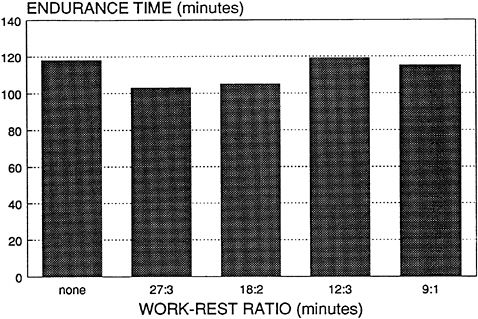
FIGURE 6–1 Influence of various work-rest ratios on endurance time on the cycle ergometer at 75 percent of . SOURCE: Adapted from Gleser and Vogel (1971).
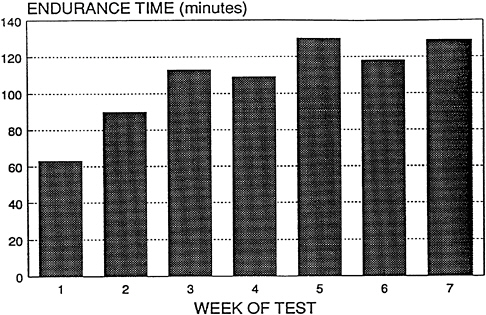
FIGURE 6–2 Effect of repeated weekly test experience on the endurance time of cycle ergometry at 75 percent of . SOURCE: Adapted from Gleser and Vogel (1971).
Field Task Tests of Aerobic Endurance
Potential ergogenic aids that show positive effects during laboratory endurance testing should be further evaluated under actual field conditions. Despite the difficulties in conducting such tests because of the lack of control of motivation and external conditions, it is an important step in the evaluation of an ergogenic aid for military use. Potential aids that show a positive benefit in the relatively sterile environment of the laboratory but that lose their effects in the “noise” of the operational environment in the field may not deserve further consideration.
Field task tests should be conducted first in an isolated setting and should then be incorporated into a realistic operational combat scenario. Such field task tests generally differ from the laboratory version in that they utilize an actual military task, are typically self-paced, and most often use an endpoint of best-effort time to completion.
An isolated setting would consist of one in which the test task is performed before and after administration of the ergogenic aid and without other activities or stresses. An example of this type of field endurance test is a road march carrying a load for a given distance, observing the time for completion after asking the subjects for a maximal best effort and with the task performed by itself, not in an operational setting. Such an example is described by Knapik et al. (1990) for a road march over 20 km with a load of 46 kg. The standard deviation of that study’s completion time (63 min, for a mean time of 304 min) demonstrates the high variability that is possible in such a test. This suggests the importance of using well-motivated subjects for this type of testing.
The final evaluation performed in a realistic operational setting would consist of a quantifiable task incorporated as part of a total operational scenario, such as a field training exercise or simulated unit combat training exercises. In this case the soldier is performing many tasks and is working under numerous demands, but with a single endurance task being used to evaluate the ergogenic aid.
It could be argued that testing under realistic operational conditions in the field is advantageous since it adds other stresses and demands on the soldier in addition to the exercise load of the task being evaluated, thereby creating a more vulnerable environment in which the potential performance-enhancing agent can exert its effect. This is more likely to be the case with psychoactive agents than with ergogenic agents.
RECOMMENDATIONS
The following steps should be taken in the evaluation of potential physical performance enhancing agents.
-
Identify the target of action as a psychological or a physiological factor. Physiological factor targets should be further identified as being related to metabolic energy capacity, neuromotor control, or substrate supply and tissue homeostasis.
-
Metabolic capacity targets should be further identified as one of the three energy-generating systems, and an appropriate measure should be selected for that system: strength, anaerobic power, or aerobic power.
-
If energy substrate supply or tissue homeostasis is the target of the agent, then an aerobic endurance test should be chosen.
-
Aerobic endurance testing should optimally be carried out in three stages: first, in a controlled laboratory setting using treadmill or other ergometric devices; second, in an isolated field setting for the task; and finally, as part of a total operational scenario setting.
REFERENCES
Bergstrom, J., and E.Hultman 1967 A study of the glycogen metabolism during exercise in man. J. Clin. Lab. Invest. 19:218–228.
Caldwell, L.S., D.B.Chaffin, F.N.Dukes-Dobos, K.H.E.Kroemer, L.L.Lauback, S.H.Snook, and D.E.Wasserman 1974 A proposed standard procedure for static muscle strength testing. Am. Ind. Hyg. Assoc. J. 35:201–206.
Clarkson, P.M. 1978 The effect of age and activity level on simple and choice fractionated response time. Eur. J. Appl. Physiol. 40:17–25.
DeLorme, T.L. 1962 Measurement and evaluation of weight training. Pp. 96–105 in Weight Training in Sports and Physical Education, F.D.Sills, L.E.Morehouse, and T.L.DeLorme, eds. Washington D.C.: American Association for Health, Physical Education, and Recreation.
Dishman, R.K. 1989 Psychology of sports competition. Pp. 129–164 in Sports Medicine, A.J.Ryan and F.L. Allman, Jr., eds. New York: Academic Press.
Fitzgerald, P.I., J.J.Knapik, W.L.Daniels, J.A.Vogel, and B.E.Joyce 1986 Influence of Atropine on Physical Performance in the Heat. Technical Report No. 16– 86. Natick, Mass: U.S. Army Research Institute of Environmental Medicine.
Gleser, M.A., and J.A.Vogel 1971 Endurance exercise: Effect of work-rest schedules and repeated testing. J. Appl. Physiol. 31:735–739.
Harman, E.A., M.T.Rosenstein, P.N.Frykman, R.M.Rosenstein, and W.J.Kraemer 1991 Estimation of human power output from vertical jump. J. Appl. Sport. Sci. Res. 5:116–120.
Hermansen, L., and B.Saltin 1969 Oxygen uptake during maximal treadmill and bicycle exercise. J. Appl. Physiol. 26:31–37.
Johnson, R.F. 1981 Effects of Explosive Ordnance Disposal (EOD) Armor on the Gross Body Mobility, Psychomotor Performance, Speech Intelligibility, and Visual Field of Men and Women. Technical Report No. 81/031. Natick, Mass.: U.S. Army Natick Research and Development Laboratories.
Knapik, J.J., J.W.Wright, D.M.Kowal, and J.A.Vogel 1980 The influence of U.S. Army basic initial entry training on the muscular strength of men and women. Aviat. Space Environ. Med. 51:1086–1090.
Knapik, J., M.Bahrke, J.Staab, K.Reynolds, J.Vogel, and J.O’Connor 1990 Frequency of Loaded Road March Training and Performance on a Loaded Road March. Technical Report No. 13–90. Natick, Mass.: U.S. Army Research Institute of Environmental Medicine.
Kobrick, J.L., R.F.Johnson, and D.J.McMenemy 1988 Nerve Agent Antidotes and Heat Exposure: Summary of Effects on Task Performance of Soldiers Wearing BDU and MOPP-IV Clothing Systems. Technical Report No. 1–89. Natick, Mass.: U.S. Army Research Institute of Environmental Medicine.
Kroll, W. 1974 Fractionated reaction and reflex time before and after fatiguing isotonic exercise. Med. Sci. Sports 6:260–266.
Margaria, R., P.Aghemo, and E.Ravelli 1966 Measurement of muscular power (anaerobic) in man. J. Appl. Physiol. 21:1662–1664.
McArdle, W.D., F.I.Katch, and G.S.Pechar 1973 Comparison of continuous and discontinuous treadmill and bicycle test for max Med. Sci. Sports 5:156–160.
Mitchell, J.H., B.J.Sproule, and C.B.Chapman 1958 The physiological meaning of the maximal oxygen intake test J. Clin. Invest. 37:538–547.
Murphy, M.M., J.F.Patton, and F.A.Frederick 1986 Comparative anaerobic power of men and women. Aviat. Space Environ. Med. 57:636–641.
Patton, J.F., M.M.Murphy, and F.A.Frederick 1985 Maximal power outputs during the Wingate anaerobic test. Int. J. Sports Med. 6:82–85.
Sapega, A.A., J.S.Torg, G.Drillings, and J.Vegso 1983 Modifications for enhanced data collection and analysis with the Cybex isokinetic dynamometer. Physician Sports Med. 11:103–110.
Sharp, D.S., J.E.Wright, J.A.Vogel, J.F.Patton, W.L.Daniels, J.Knapik, and D.M.Kowal 1980 Screening for Physical Capacity in the U.S. Army: An Analysis of Measurers Predictive of Strength and Stamina. Technical Report No. 8–80. Natick, Mass.: U.S. Army Research Institute of Environmental Medicine.
Sharp, M.A., and J.A.Vogel 1992 Maximal lifting strength in military personnel. Pp. 1261–1267 in Advances in Industrial Ergonomics and Safety IV, S.Kumar, ed. London: Taylor & Francis.
Sharp, M.A., E.Harman, J.A.Vogel, J.J.Knapik, and S.J.Legg 1988 Maximal aerobic capacity for repetitive lifting: Comparison with three standard exercise testing modes. Eur. J. Appl. Physiol. 57:753–760.
Teves, M.A., J.E.Wright, and J.A.Vogel 1985 Performance on Selected Candidate Screening Test Procedures before and after Army Basic and Advanced Individual Training. Technical Report No. 13–85. Natick, Mass.: U.S. Army Research Institute of Environmental Medicine.
Teves, M.A., J.A.Vogel, D.E.Carlson, and D.D.Schnakenberg 1986 Body Composition and Muscle Performance Aspects of the 1985 CFFS Test. Technical Report No. 12–86. Natick, Mass.: U.S. Army Research Institute of Environmental Medicine.
Tharion, W.J., R.W.Hoyt, B.E.Marlowe, and A.Cymerman 1992 Effects of high altitude and exercise on marksmanship. Aviat. Space Environ. Med. 63:114–117.
Thorstensson, A. 1976 Muscle strength, fibre types and enzyme activities in man. Acta Physiol. Scand. Suppl.: 443:1–45.
Vogel, J.A., J.F.Patton, R.P.Mello, and W.L.Daniels 1986 An analysis of aerobic capacity in a large United States population. J. Appl. Physiol. 60:494–500.
Wright, J.E., J.A.Vogel, J.B.Sampson, J.J.Knapik, J.F.Patton, and W.L.Daniels 1983 Effects of travel across time zones (jet-lag) on exercise capacity and performance. Aviat. Space Environ. Med. 54:132–137.


