
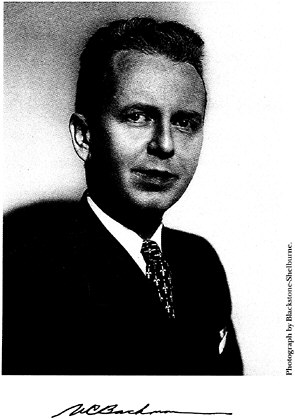
WALTER C. BACHMAN
1911–1991
PREPARED WITH THE ASSISTANCE OF THE NAE MEMBERSHIP OFFICE SUBMITTED BY THE NAE HOME SECRETARY
WALTER C. BACHMAN, who played a senior part in the performance of Gibbs and Cox, Inc. and specialized in the design of ship propulsion machinery, died March 1, 1991, at the age of seventy-nine.
Born in Pittsburgh, Pennsylvania, Bachman received a B.S. degree (cum laude) in industrial engineering in 1933 and an M.S. degree in mechanical engineering in 1935, both from Lehigh University. After working as a graduate assistant instructor of mechanical engineering at Lehigh, Bachman joined the Federal Shipbuilding and Drydock Company in 1935 as an engineer, then left in 1936 to join the naval architectural firm of Gibbs and Cox, where he spent the remainder of his professional career.
While at Gibbs and Cox, Bachman's specializations included marine engineering, ship design, ocean engineering, and power generation. In particular, he concentrated on the design of ship propulsion machinery and made important contributions to many advanced naval and merchant marine machinery installations, which included the superliner SS United States. Bachman actively engaged in all phases of the design of ship propulsion machinery. He devoted particular attention to developing and improving methods of analysis of stresses, vibration characteristics, and thermodynamic performance of marine machinery and also to organizing and refining methods for
designing and predicting the hydrodynamic performance of ships. His methods were applied to many of the naval and merchant ships designed by Gibbs and Cox, including its multiple shipbuilding programs; most destroyer types in the U.S. Navy; several advanced experimental marine power plants; the SS United States, which held the Atlantic speed record; and various other projects, including floating oil drilling platforms, the platform for the MOHOLE Project, and unusual ship types.
Bachman played a leading part in the design, engineering, and preparation of working plans for such various U.S. Naval ships as destroyers and guided missile destroyers, destroyer escorts, frigates and guided missile frigates, cruisers, aircraft carriers, landing craft, icebreakers, minesweepers, and numerous auxiliary ships such as destroyer tenders and submarine tenders. For commercial shippers, he did similar kinds of work on the SS America, SS United States, SS Santa Rosa and Santa Paula, British cargo ships, Liberty ships, and numerous other cargo ships.
In certain areas of his work on ship propulsion characteristics and machinery plants Bachman was particularly active. He developed an improved analytical method for ship propeller shaft alignment, applied the results of his extensive study of the various forms of ship vibration to many successful ship designs in both the machinery plants and the hull forms, and supervised correction of "singing" propeller vibration for a fleet of British cargo vessels in World War II. He developed a procedure for predicting the reversing characteristics required for the design of experimental diesel electric destroyer machinery for the USS Watson and made numerous studies leading to the design of an experimental reheat steam power plant that was tested full scale at the Naval Boiler and Turbine Laboratory for the USS Percival. He also took a leading part in guiding the many studies required for the development of advanced high-pressure, high-temperature steam machinery for the USS Timmerman, a design that extensively influenced all surface ship steam machinery in the U.S. Navy after World War II. In addition, he developed methods for predicting the hydrodynamic performance of ships and improved designs of
both subcavitating and supercavitating propellers; took a leading part in developing the machinery plants for the SS United States and many merchant ships; and made and guided extensive design studies of gas turbine propulsion machinery for many ships, including the GTS John Sargent, HS Victoria, and several combatant types for the U.S. and Canadian navies.
Elected to the National Academy of Engineering in 1967, Bachman served on the National Research Council's Committee on Ocean Engineering and was chairman of its Panel on Commerce and Transportation. A licensed professional engineer, he was a fellow of the American Society of Mechanical Engineers and served on many of its technical committees. He was a member of the American Society of Naval Engineers, National Society of Professional Engineers, and the Engineering Committee of the American Bureau of Shipping. Also a member of the Society of Naval Architects and Marine Engineers, he was an active participant in that society's technical and research program, serving as chairman of its Committee for Hydrodynamic Research and as a member of its Technical and Research Steering Committee. Bachman also served as a member of the Mechanical Engineering Advisory Committee of Norwich University.
The late William Francis Gibbs earlier recalled his association with Bachman. "The results of the work of this firm, as shown in the design of ships for the national defense, in vast numbers of cargo ships and passenger ships such as the SS United States, indicate better than I could describe the senior part that Mr. Bachman has played in the performance of the firm. It is the opinion of many that he is easily the best and foremost marine engineer in the world today. If modesty be a fault, he can plead guilty."
Bachman is survived by his son, Van Cleaf Bachman of Lunenberg, Nova Scotia; a daughter, Elizabeth Ramjoué of Oberhaching, Germany; six grandchildren; and three great-grandchildren.


