
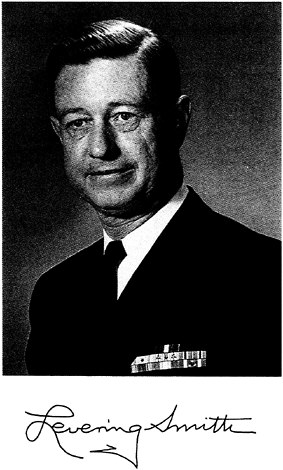
LEVERING SMITH
1910–1993
BY WILLIS M. HAWKINS AND MANY OTHERS
Unique in the World of major technical developments, especially those involving the U.S. government, is the continuing success of the nearly forty-year U.S. Navy Polaris-Poseidon-Trident program. It may have set an unattainable standard for any equally important national endeavor. The foundation of that success most certainly was the leadership and quiet vision of Levering Smith, retired vice admiral, U.S. Navy. Levering died on April 5, 1993, leaving a void among his peers that cannot adequately be described, and a legacy of lifelong accomplishment in support of his nation that history may not fully appreciate because of Levering's reasoned and humble approach to each new challenge.
There would be no lack of contributors to a chronicle of Levering's towering intellect, his respect for every person who participated in his endeavors, and the integrity of his actions and decisions. Everyone who has ever worked with, or for, Levering knows of his patient, open approach to each new goal—using, and giving credit for, every sound idea and accomplishment. Levering's leadership style was almost the antithesis of that of the textbook, dynamic, emotional leader about which stories are told. He was a leader because he respected the goals of his superiors, respected the responsibilities he had been given, and respected the capabilities of those working for and with him, and he made this apparent to everyone without ever a touch of ego.
Searching through Levering's history for clues to his ultimate development offers little insight. After graduation from the Naval Academy in 1932, he served aboard surface warships in a variety of general line assignments and completed a postgraduate course in ordnance engineering in 1940. During the war he participated in eleven major campaigns during which he survived the sinking of USS Hornet and USS Northampton.
Levering's more specialized technical contributions began with his assignment in 1944 to the Research and Development Division of the Bureau of Ordnance. This was followed by seven years at the Naval Ordnance Test Station, Inyokern, California, where he became head of the Explosives Department and then associate technical director—the only military officer to have been chosen for that position. After Inyokern Levering was assigned as head of the Explosive Department at the Naval Ordnance Missile Test Facility at White Sands, New Mexico, where he also served as navy deputy to the commanding general.
My first experience of a technical nature with Levering was during the first days of what was to become the Polaris program. Following a 1955 National Security Council recommendation that part of the intermediate range ballistic missile force be sea based, the navy joined with the army in a program to deploy the liquid-fueled Jupiter missile on surface ships and assigned then Rear Admiral William F. ''Red" Raborn as director of the new Special Projects Office, reporting directly to the secretary of the navy. Since Lockheed had won an earlier competition by the U.S. Navy Bureau of Aeronautics for a submarine-launched ballistic test vehicle, Raborn chose Lockheed to be prime contractor for a solid-fueled version of Jupiter. Raborn almost immediately drafted Levering from White Sands to lead this work because of his reputation as the navy's preeminent expert on rockets and solid propellants. It was the beginning of an assignment that ultimately produced the most convincing and effective of the nation's strategic deterrent weapon systems.
Levering's planning, which Admiral Raborn accepted, included an innovative and critically important approach to the definition of the requirements toward which everyone on the team worked. It was obvious that a true deterrent weapon had
to have enough range to reach important targets from areas of the ocean large enough to obscure potential launch points. The oceanographers and strategists didn't work in isolation. It was Red's and Levering's contention that the entire team should participate so that each member recognized the critical issues and the relative importance of the goals. A "board of directors" was formed, which was called "the steering task group." Red was the chairman, and Levering was the responsible architect of what the task group was to do. Represented were the leaders of the participating universities, the navy commands who would need to support the program, and the responsible executives of the prime contractors and the critical subcontractors. Part of the strategy was to put on the steering task group not the program directors but their bosses. It was a powerful task force, and it spent three months defining the total program including schedules, costs, performance goals, and the distribution of the task among the members. This was a revolution in management. It wasn't a "method"; it was pure Levering—understand the problem; agree on the approach and risks; and define and agree on the real requirements, the schedule relationships, and the resources required. Once the program was defined and understood, the steering task group met nearly monthly agreeing on changes, modifying plans, and adjusting resources. Everyone was focused on the total task, not an individual element. An example of early goal setting was the range of the Polaris. If the Polaris didn't go 1,200 nautical miles, it couldn't justify its existence; similarly, if its accuracy didn't meet a minimum, it shouldn't be created. However, if the accuracy was adequate and the range approached 1,500 to 2,000 nautical miles, a lot of sea room opened up to improve the invulnerability of the submarine. There were no fixed specifications, just the bottom limits to ensure a total system effectiveness—again, pure Levering. Supplementing this broad policy, Levering Smith and Red Raborn initiated and encouraged a true team effort among the military, civil service personnel, and contractors. Adversarial conditions were quickly sorted out and eliminated. In addition, the facts—failures as well as triumphs—were always available to
the world outside of the Department of Defense and Congress as needed. This concept had never penetrated normal Washington procurement mores, but it was the foundation for a monumental success. We must hope that history recognizes Levering's fine hand and mind in creating such an environment. This was real management.
In trying to encompass the essence of the man, there were many contributions from those who worked for him and knew him well. These were all consistent and nearly identical. He was what he appeared to be: a highly intelligent, rational, practical engineer with immense respect for those around him, particularly those with good ideas and a reasonable approach to developing them. And above all, he was a gentleman.
From Derald Stuart: ''I found Levering to be a true officer and a gentleman—very patriotic with a deep love for the navy and always polite. He was also quick thinking but shy and unassuming. He had a tremendous sense of humor. He was a man of great integrity, scrupulously honest with others and with himself."
From armed forces management: "In sum, say his navy backers ironically, probably the most amazing thing about Levering Smith's monumental performance, both technically and as a manager, is that he has managed to do all this while remaining virtually anonymous."
The London Daily Telegraph: "It was no small measure due to him [Levering Smith] that the British Polaris programme was completed on time and on budget—an unprecedented feat in British naval history."
C. W. Chuck Wallace: "I've often thought how I might describe Levering, whom I deeply admired. First comes to mind absolute integrity, factual, highly intelligent, patriotic, and with all that—practical."
Rear Admiral Robert A. Wertheim (retired): "Throughout the development of the Polaris family of weapons, the transition to the more potent Poseidon and the conceptual exploration that led to the present Trident system, Levering Smith led either the technical team or the entire program. Thus, he contributed over twenty years of intelligent leadership, utiliz
ing the combined assets of the country from our universities, government labs, and industry."
Dr. Werner R. Kirchner (before Admiral Smith's death): "I remember our early days of the Polaris development and your bi-weekly visits to Aerojet and Lockheed, closely monitoring the minute details of the fleet ballistic program. All of us on the navy steering task group often remarked how very fortunate not only the navy but also the country was, to have such an exceptional director of the special program office. With your keen judgement, you invariably steered us on the right course." And, "Levering Smith will always be remembered as insisting upon what was narrowly vital, not necessarily what was broadly appealing."
The navy, the country, and even our allies overseas, did recognize Levering's talents and accomplishments in spite of his unassuming personal presence. Three times he received the highest navy award for noncombat service, the Distinguished Service Medal. He was awarded the American Defense Service Medal with one star, the Asiatic-Pacific Campaign Medal with eleven stars, and many more. On January 7, 1972, Rear Admiral Smith received a high "Order of Chivalry" from Queen Elizabeth II of England. This made him "Honorary Knight Commander of the Most Excellent Order of the British Empire." His technical peers showed their respect by the L. T. E. Thompson Award (1957, Naval Ordnance Test Station). He was also awarded the C. N. Hickman Award (1957, American Rocket Society); the American Society of Naval Engineers Gold Medal (1961); the William S. Parsons Award (1961, Navy League of the United States); the Gold Knight of Management Award (1972, National Management Association); and an honorary doctor of laws degree (New Mexico State University). Levering was elected to the National Academy of Engineering in 1965.
With all of his technical and managerial accomplishments, Levering was also a complete, understanding, and gentle human being. His sense of humor was spontaneous, the sparkle never left his eyes, and his devotion to his beloved wife of over sixty years was apparent in his work and every action. "Boots"
(Beulah W. Lewis) married Levering at the very beginning of his career. Boots was his most ardent supporter as he served our nation.
In total appreciation, all of those privileged to know and work with Levering would, I am certain, agree that if this nation can maintain an environment in which leaders like Levering Smith can emerge, we should have no fears for our future.


