
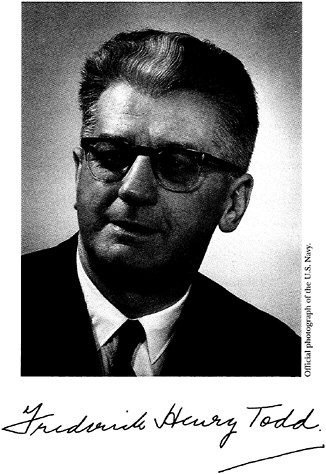
FREDERICK HENRY TODD
1903–1992
BY WILLIAM B. MORGAN
FREDERICK H. TODD, an outstanding research naval architect, died on August 20, 1992, at the age of eighty-nine. He retired in 1969 from the Naval Ship Research and Development Center (formerly the David Taylor Model Basin) and lived his last remaining years near Newcastle upon Tyne, England, where he was born on January 6, 1903.
Dr. Todd was a naval architecture student from 1919 to 1925, receiving his B.Sc. in naval architecture from the Durham University, England, in 1925. During the pursuit of his education, he served an apprenticeship with Armstrong, Whitworth and Company, Shipbuilders, in the shipyard drawing and designing office and joined that company for one year after receiving his B.Sc. degree. He subsequently won the honor of being a 1851 Exhibition Scholar at the Durham University from 1926 to 1928 and received his Ph.D. from that university in 1931.
In 1928 Dr. Todd became a scientific officer at the Model Ship Testing Tank, National Physical Laboratory, Teddington, England, where he had charge of models and research projects. In 1940 he became professor of naval architecture at Durham University and returned to the National Physical Laboratory in 1942 as deputy superintendent of the Ship Division. While at the National Physical Laboratory during World War II, he directed all model experiments and crew training in connection with the design of the artificial harbors used in the D-Day
landings of British and American forces on the beaches of France. The overall design included massive concrete structures that could be towed across the channel to form breakwaters and emplacements for artillery, portable piers that rose and fell with the tides, and floating bridges for the off-loading of men and equipment.
In 1948 Dr. Todd came to the United States to take the position of chief naval architect and technical director of the Hydromechanics Laboratory at the David Taylor Model Basin. He held this position until 1957 when he rejoined the National Physical Laboratory as director of the Ship Hydrodynamics Laboratory. He returned to the David Taylor Model Basin in 1962 as scientific adviser to the commanding officer and was later scientific adviser to the technical director. In 1967 he was assigned to the Office of Naval Research Branch Office in London from which he retired in 1969.
Dr. Todd was a prolific author of more than one hundred fifty archival technical papers. His best-known works are his papers on Series 60 hulls, first published in 1957. These works provide a compendium of ship powering and resistance data developed from methodical testing of ship models in a towing tank. This standard hull series is still actively used. His other numerous professional publications include two books: Ship Hull Vibration, published in England in 1961, and its companion volume, Ship Resistance and Propulsion. From the Society of Naval Architects and Marine Engineers, he twice received the Captain Joseph H. Linnard Prize for the best paper presented at the society's annual meetings in 1951 and 1957. He was the first awardee of the Gibbs Brothers Medal by the National Academy of Sciences, in 1965, for his outstanding contributions to naval architecture and marine engineering. He was elected a member of the National Academy of Engineering in 1965. In 1967 he received the Davidson Medal from the Society of Naval Architects and Marine Engineers for outstanding scientific accomplishment in ship research. In addition to the foregoing awards, he received the 1931 Gold Medal from the North East Coast Institution of Engineers and Shipbuilders, Newcastle upon Tyne, for work in ship vibration; premiums of
the Royal Institution of Naval Architects, London, and the Institution of Engineers and Shipbuilders in Scotland; and two medals from the Swedish Engineering Society for his work on vibration, methodical series powering experiments with models, and the seagoing qualities of ships. He was elected a fellow of the Society of Naval Architects and Marine Engineers in 1967 and an honorary member for life in 1968.
Dr. Todd was a past vice-president of the Royal Institution of Naval Architects. He was also an active participant in two main scientific associations concerned with hydrodynamic and ship research of towing tanks: the International Towing Tank Conference, of which he served as president from 1960 to 1962, and the American Towing Tank Conference, of which he was chairman from 1953 to 1956. He served the Society of Naval Architects and Marine Engineers on seven technical committees, was a member of the Council, and served on the technical committee for the 1968 Diamond Jubilee International Meeting.
Following a long and most distinguished engineering career, Dr. Todd returned to his native country, where he and his wife enjoyed several years of retirement. He felt that he had served his profession well and could devote the remaining years of his life to his family. He was preceded in death by his wife, Margaret Elizabeth (née Wilson), and one daughter, M. Allison Todd. He is survived by a daughter, Dr. Jean E. Todd of Chevy Chase, Maryland.


