
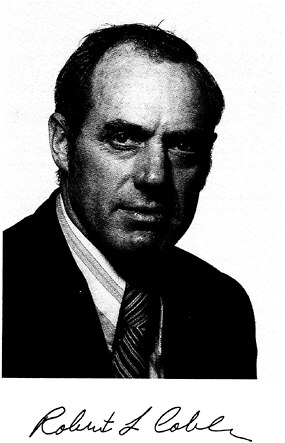
ROBERT L. COBLE
1928–1992
BY MERTON C. FLEMINGS
ROBERT L. COBLE, a leading physical ceramist, died on the island of Maui in Hawaii on August 27, 1992, at the age of sixty-four. Elected to the National Academy of Engineering in March 1978, Robert was a dedicated teacher and researcher widely recognized for his contributions to the theory of sintering of materials and to ceramic processing. He was highly esteemed by students and colleagues alike.
Professor Coble completed his graduate work at the Massachusetts Institute of Technology (MIT) in 1955 and spent the following five years at General Electric Research Laboratories. There he worked on the sintering of ceramics and made major contributions both to the analytical understanding of sintering phenomena and to the applications of this understanding to the development of a completely dense product, "Lucalox." When he returned to MIT in 1960 he had already demonstrated both the scientific capability essential for effective creativity and also the capability for applying this understanding to engineering materials.
Robert rose quickly in the ranks at MIT. He became associate professor in 1962, received tenure in 1966, and was promoted to professor in 1969.
In 1984 he received the prestigious Humboldt Research Award for U.S. Scientists to support a one-year stay in Germany; he spent most of that time at the Max Planck Institute in
Stuttgart. In 1985 he was awarded the Frenkel Prize for outstanding contributions to the theoretical base of sintering materials by the International Institute for the Science of Sintering. He authored more than one hundred technical papers, which have been published in the journals of several disciplines.
He was awarded the National Institute of Ceramic Engineers' Professional Achievement Prize in 1960 and the Raytheon Award for "Outstanding Ceramist of the Year" in 1967. From the American Ceramic Society (ACS) he received the Ross Coffin Purdy Award in 1972 and presented the ACS Sosman Memorial Lecture in 1979 after being nominated for the award by the Basic Science Division of ACS. He was a fellow of the American Ceramic Society and a member of the Ceramic Educational Council and the National Institute of Ceramic Engineers. He served as chairman, vice-chairman, and trustee of the Basic Science Division of the American Ceramic Society and held a succession of offices in the New England Section of the American Ceramic Society. He served on the Defense Advanced Research Projects Agency's Materials Research Council. He served on the advisory board of the U.S. congressional Office of Technology Assessment and on several ad hoc committees organized by the National Materials Advisory Board of the National Research Council, which addressed materials problems.
We are left with the warm memory of an accomplished, dedicated teacher and researcher who contributed much to his field and to his chosen university. We also remember the man himself—a man who spoke and lectured in a relaxed and often informal way—an accomplished sailor and skier. We will long remember his incisiveness and honesty and his friendliness and openness with both his colleagues and his students.


