
Appendix A
Data Sources
The surveys and censuses referenced in this report are described in this appendix. The numbers appearing in brackets beside the name of each source have been used to cite the sources in the text. Figure A-1 indicates the site where each of the subnational surveys was conducted. The figure also delineates the World Fertility Survey (WFS) and Demographic and Health Survey (DHS) regions used in this report (referred to in the report as the ''grand" regions).
NATIONAL-LEVEL SURVEYS
1960-1961 Demographic Survey (DS) [1]
This was the first national-level sample survey conducted in Senegal. It surveyed 5 percent of the population in urban areas and had variable sampling rates (from 1/20 to 1/60) in rural areas. (See République du Sénégal, 1964, for more information.)
1970-1971 National Demographic Survey (NDS) [2]
This was a multiround survey that had three rounds at 6-month intervals and a sample size of approximately 150,000 persons. (See République du Sénégal, 1974, for more information.)
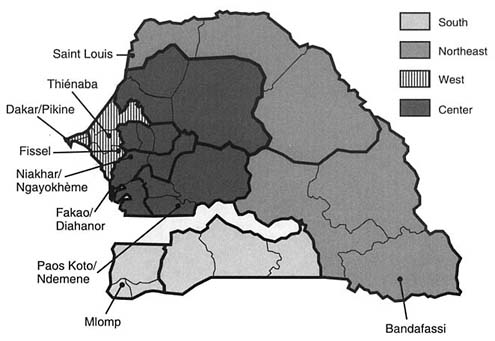
FIGURE A-1 Geographic location of subnational surveys and WFS and DHS grand regions (south, northeast, west, and center). NOTE: The other divisions shown on this map correspond to regional and departmental administrative divisions at the time of the 1988 census. See Figure 2-2 for names of administrative divisions.
1978 World Fertility Survey (WFS) [3]
This was a multistage sample survey that collected retrospective birth histories from 3,985 woman aged 15-49 years. It was conducted by the Direction de la Statistique du Ministère de l'Economie et des Finances in collaboration with the International Statistical Institute. (See République du Sénégal, 1981, for more information.)
1986 Demographic and Health Survey in Senegal (DHS-I) [4]
This was a multistage sample survey that collected complete birth histories from 4,415 women aged 15-49. It was conducted by the Direction de la Statistique du Ministère de l'Economie et des Finances in collaboration with the Institute for Resource Development/Westinghouse. (See Ndiaye et al., 1988, for more information.)
1984, 1987, and 1990 National Vaccination Coverage Surveys [5]
These were national-level surveys undertaken in 1984, 1987, and 1990 using standard World Health Organization methodologies. The target population was children aged 12-23 months and women who had given birth in the preceding year. (See Claquin et al., 1987, and OCCGE-Muraz, 1990, for more information.)
1991-1992 Enquête Sur les Priorités [6]
This survey included approximately 10,000 households and was undertaken between November 1991 and January 1992. The collection of information on the effects of structural adjustment programs on households was one of the major goals of this survey.
1992-1993 Demographic and Health Survey in Senegal (DHS-II) [7]
This was a multistage sample survey that collected complete birth histories from 6,310 women aged 15-49. It was conducted by the Direction de la Statistique du Ministère de l'Economie et des Finances in collaboration with Macro International, Inc. (See Ndiaye et al., 1994, for more information.)
REGIONAL-LEVEL SURVEYS
These surveys consist of a number of subnational studies through which accurate birth and death registers have been maintained over several years. Although the small study areas are not representative of the entire country, they yield estimates of fertility that are thought to be more accurate than those from large-scale surveys and censuses. Hence, these small-scale studies can provide a useful independent check on the accuracy of the other estimates.
Bandafassi Study Area (1970-present) [8]
This rural area has been monitored by annual rounds in Malinké villages since 1970, Peul villages since 1975, and Bedik villages since 1980. It included a population of 8,155 inhabitants as of March 1, 1991. (See Pison and Desgrées du Loû, 1993, for more information.)
Cap-Vert (Dakar) Fertility Survey (1972) [9]
This survey was a round added to the third round of the NDS. It involved
systematic sampling stratified according to age, and included complete birth histories of 1,460 women 13-54 years old. (See Ferry, 1977, for more information.)
Mlomp Demographic Monitoring (1984-present) [10]
This rural area is monitored through annual rounds. It included a population of 6,435 persons as of October 1990. (See Lagarde et al., forthcoming and Pison et al., 1993, for more information.)
Niakhar/Ngayokhème (1962-present) [11]
Niakhar-I, 1962-1967: included a population of 35,187 persons as of January 1, 1966. (See Cantrelle, 1969; Cantrelle and Léridon, 1971; and Project Niakhar, 1992, for more information.)
Niakhar-II, 1983-present: included 26,496 persons as of March 1, 1992. (See Project Niakhar, 1992, for more information.)
Ngayokhème Area (included in the Niakhar-I and Niakhar-II areas), 1963-present: included 5,947 persons as of March 1, 1991. (See Waltisperger, 1974; and Pison, 1978, for more information.)
Paos Koto/Ndemene (1963-1978) [12]
Included a population of 18,988 persons as of January 1, 1966. The Paos Koto survey was monitored from 1963-1965, and Ndemene from 1963-1978. (See Cantrelle, 1969; and Cantrelle et al., 1980, for more information.)
Fakao and Diahanor (ca 1940 - ca 1966) [13]
These studies reconstituted families by retranscribing parish certificates and surveys among resident women in 1965-1966. Diahanor included 284 persons as of June 1, 1966; Fakao included approximately 3,000 persons as of January 1, 1966. (See Lacombe, 1973, for more information.)
Sine-Saloum Demographic Survey (1982) [14]
This survey involved multistage cluster sampling of the rural population of Sine-Saloum (the current regions of Fatick and Kaolack), a retrospective survey among 1,894 women aged 15-44 having been married or had one live birth, with the birth history being cut off at 6 years. (See Goldberg et al., 1984, for more information.)
Dakar-Pikine Survey (1986) [15]
This survey collected retrospective data from 1,856 households (including 2,812 women) on infant and child mortality in Pikine during March and April 1986. (See Antoine and Diouf, 1989, 1992; and Bocquier, 1991, for more information.)
Survey on Child Mortality in the Sahel (EMIS) (1981-1984) [16]
This was a longitudinal study of women who had had children. It consisted of eight interviews between the time the children were born to age 2 years and 4 months. It was conducted in the areas of Fissel and Thiénaba in the region of Thiès between 1981 and 1984. (See Mbodji, 1988, for more information.)
NATIONAL CENSUSES
1976 Senegal Census [17]
This was the first national census, taken in April 1976. (See République du Sénégal, no date, for more information.)
1988 Senegal Census [18]
This was the second national census. It included questions on births and deaths during the preceding 12 months. The census date (May 27, 1988) was chosen to take advantage of the end of Ramadan, the Korité, as a temporal indicator for marking the beginning of the 12 month reference period. (See République du Sénégal, 1989, for more information.)


