Chapter 8
Science Education System Standards
The science education system standards provide criteria for judging the performance of the components of the science education system responsible for providing schools with necessary financial and intellectual resources.
Despite the frequent use of the term ''educational system," the meaning often is unclear. Systems in nature are composed of subsystems, and are themselves subsystems of some larger system. The educational system may be viewed as a similar hierarchy.
A view of a system requires understanding the whole in terms of interacting component subsystems, boundaries, inputs and outputs, feedback, and relationships. In the education system, the school is the central institution for public education. The school includes many components that interact, for example, teaching, administration, and finance. The school is a component subsystem of a local district, which is a subsystem of a state educational system.
States are part of a national education system. Schools are also components of a local community that can include colleges and universities, nature centers, parks and museums, businesses, laboratories, community. organizations, and various media.
The primary function of the science education system is to supply society with scientifically literate citizens. Information and resources (typically financial) energize the system. The nature of the information, the magnitude of resources, and the paths along which they flow are directed by policies that are contained in instruments such as legislation, judicial rulings, and budgets.
"Systems can be represented in a variety of ways, depending on the purpose and the information to be conveyed. For example, Figure 8.1 depicts the overlap among three systems that influence the practice of science education. This type of representation is a reminder that actions taken in one system have implications not only for science education but for other systems as well.
Coordination of action among the systems can serve as a powerful force for change. But if actions are at cross purposes, their effects can be negated and create waste and conflict. The overlap in Figure 8.1 illustrates that the
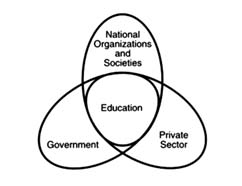
Figure 8-1.
The overlap of three systems that influence science education.
day-to-day activities of science classrooms are influenced directly and indirectly by many organizations which are themselves systems. Government agencies, national organizations and societies, and private sector special-interest groups at the local, regional, state, and national levels are three among many. Each organization has an executive officer and governing body that ultimately are responsible for the organization's
|
State education agencies generally have more direct influence on science classroom activities than federal agencies. |
activities and influence on science education.
A brief discussion of one aspect of one organization—government—contributes to the understanding of science education as a system. The power of government organizations to influence classroom science derives from two sources: (1) constitutional, legislative, or judicial authority and (2) political and economic action. Because education is not specifically mentioned as a federal power in the U.S. Constitution, authority for education resides in states or localities. Federal dollars may be targeted for specific uses, but because the dollars flow through state agencies to local districts, their use is subject to modification to meet state objectives. State education agencies generally have more direct influence on science classroom activities than federal agencies.
We can also consider the science education system as a network to facilitate thinking about the system's many interacting components.
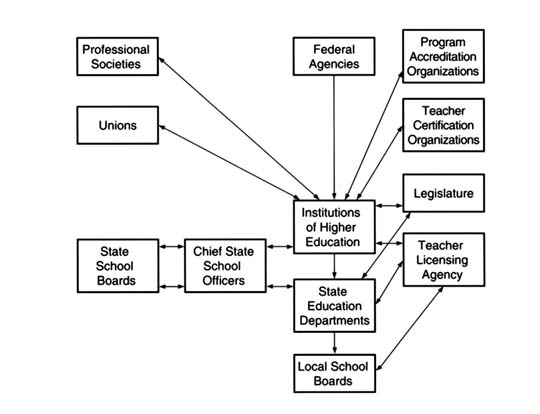
Figure 8.2.
Some organizations that affect the preparation, certification, and employment of teachers.
Components of the science education system serve a variety of functions that influence the classroom practice of science education. Functions generally decided at the state (but sometimes the local) level include the content of the school science curriculum, the characteristics of the science program, the nature of science teaching, and assessment practices. For any of these functions, many different organizations and responsible individuals interact. Figure 8.2 depicts how individuals and agencies from different systems interact in the preparation, certification, and employment of teachers of science.
Components of the science education system that have a major influence on teacher certification fit into four categories: (1) professional societies (such as the National Science Teachers Association, American Association of Physics Teachers, National Association of Biology Teachers, American Geological Institute, American Chemical Society), (2) program-accrediting agencies (such as the National Board for Professional Teaching Standards, which certifies teachers, and the National Council for Accreditation of Teacher Education, which certifies teacher education programs), (3) government agencies, and (4) institutions of higher education operating within and across national, state, and local levels.
Professional societies usually are not thought of as accrediting agencies, but their membership standards describe what it means to be a professional teacher of science. Teacher accrediting agencies certify the
quality of certain aspects of teaching, such as teacher education programs. The greatest authority and interaction around matters of teacher certification occur at the state level and involves state departments of education, state credentialing agencies, institutions of higher education, and state-level professional organizations. However, state policies are influenced by the federal government and national organizations, as well as by local districts. And ultimately, state policies are put into practice at the local level in the form of local school board employment policies and practices.
When thinking about the science education system, it is important to remember that organizations and agencies are composed of individuals who implement policies and practices.
The Standards
System Standard A
Policies that influence the practice of science education must be congruent with the program, teaching, professional development, assessment, and content standards while allowing for adaptation to local circumstances.
This standard places consistency in the foreground of science education policy and practice. If the practice of science education is to undergo radical improvement, policies must support the vision contained in the Standards.
[See Program Standard A]
State and national policies are consistent with the program standards when, as a whole, the regulations reflect the program standards. For example, state regulations for class size, for time in the school day devoted to science, and for science laboratory facilities, equipment, and safety should meet the program standards. Also, requirements of national organizations that accredit schools should be based on the program standards.
State and national policies are consistent with the teaching and professional development standards when teacher employment practices are consistent with them. State policies and practices that influence the prepara
|
If the practice of science education is to undergo radical improvement, policies must support the vision contained in the Standards. |
tion, certification, and continuing professional development of teachers should be congruent with the teaching and professional development standards. The pedagogical methods employed at institutions of higher education and the requirements of national organizations for the certification of teachers and accreditation of teacher education programs also must reflect the Standards.
State and federal assessment practices should reflect the content and assessment standards, whether to describe student achievement, to determine if a school or district is providing the opportunities for all students to learn science, to monitor the system, or to certify teachers.
State and national policies are consistent with the content standards when state curriculum frameworks reflect the content
standards adapted to state and local needs. For example, students in grades K-4 are expected to understand the characteristics of organisms. The content standards do not specify which organisms should be used as examples; states and local districts should choose organisms in the children's local environment. Schools in desert environments might achieve this outcome using one type of organism, while schools in coastal regions might use another. This kind of flexibility should be a part of state policy instruments such as curriculum frameworks.
System Standard B
Policies that influence science education should be coordinated within and across agencies, institutions, and organizations.
This standard emphasizes coordination of policies and the practices defined in them. The separation of responsibilities for education and poor communication among organizations responsible for science education are barriers to achieving coordination. Individuals and organizations must understand the vision contained in the Standards, as well as how their practices and policies influence progress toward attaining that vision.
When individuals and organizations share a common vision, there are many ways to improve coordination. For example, intra-and inter-organizational policies should be reviewed regularly to eliminate conflicting regulations and redundancy of initiatives. Significant information needs to flow freely within and across organizations. That communication should be clear and readily understandable by individuals in other organizations, as well as by the general public.
At colleges and universities, the science and education faculties need to engage in cooperative planning of courses and programs for prospective teachers. In a broader context, scientific and teaching society policies should support the integration of science content and pedagogy called for in the Standards.
One example of the need for coordination is the various state-level requirements for knowing and understanding science content. Because different agencies are involved, the content of science courses in institutions of higher education for prospective teachers could be different from the subject-matter competence required for teacher licensure, and both could be different from the science content requirements of the state curriculum framework. Other examples include coordination between those who set requirements for graduation from high school and those who set admissions requirements for colleges and universities. Likewise, coordination is needed between those who determine curricula and the needs and demands of business and industry.
System Standard C
Policies need to be sustained over sufficient time to provide the continuity necessary to bring about the changes required by the Standards.
Achieving the vision contained in the Standards will take more than a few years to accomplish. Standard C has particular implications for organizations whose policies are set by elected or politically appointed leaders. New administrations often make radical changes in policy and initiatives and this practice is detrimental to education change,
which takes longer than the typical 2- or 4- year term of elected office. Changes that will bring contemporary science education practices to the level of quality specified in the Standards will require a sustained effort.
Policies calling for changes in practice need to provide sufficient time for achieving the change, for the changes in practice to affect student learning, and for changes in student learning to affect the scientific literacy of the general public. Further, policies should include plans and resources for assessing their affects over time. If school-based educators are to work enthusiastically toward achieving the Standards, they need reassurance that organizations and individuals in the larger system are committed for the long-term.
System Standard D
Policies must be supported with resources.
[See Program Standard D]
Standard D focuses on the resources necessary to fuel science education reform. Such resources include time in the school day devoted to science, exemplary teachers, thoughtfully crafted curriculum frameworks, science facilities, and apparatus and supplies. If policies are enacted without consideration for the resources needed to implement them, schools, teachers, and students are placed in the untenable position of meeting demands without the availability of the requisite resources.
For example, state resource allocations for science education must be sufficient to meet program standards for classroom practices. Policies mandating inquiry approaches to teaching science need to contain provisions for supplying the necessary print and media materials, laboratories and laboratory supplies, scientific apparatus, technology, and time in the school day with reasonable class size required by this approach. Policies calling for improved science achievement should
|
For schools to meet the Standards, student learning must be viewed as the primary purpose of schooling, and policies must support that purpose. |
contain provisions for students with special needs. Policies requiring new teaching skills need to contain provisions for professional development opportunities and the time for teachers to meet the demands of the policy.
Resources are in short supply, and decisions about their allocation are difficult to make. Some resource-allocation questions that are regularly faced by local and state school boards include the proportion of hours in the school day to be allocated to science; the proportion of the school budget to be allocated to science education for underachieving, special-needs, or talented science students; and the assignments of the most experienced and talented teachers. The mandates contained in policies are far too often more ambitious in vision than realistic in providing the required resources.
System Standard E
Science education policies must be equitable.
[See Program Standard E]
Equity principles repeated in the introduction and in the program, teaching, professional development, assessment, and content standards follow from the well-documented barriers to learning science for
students who are economically deprived, female, have disabilities, or from populations underrepresented in the sciences. These equity principles must be incorporated into science education policies if the vision of the standards is to be achieved. Policies must reflect the principle that all students are challenged and have the opportunity to achieve the high expectations of the content standards. The challenge to the larger system is to support these policies with necessary resources.
System Standard F
All policy instruments must be reviewed for possible unintended effects on the classroom practice of science education.
Even when as many implications as possible have been carefully considered, well-intentioned policies can have unintended effects. For schools to meet the Standards, student learning must be viewed as the primary purpose of schooling, and policies must support that purpose. The potential benefits of any policy that diverts teachers and students from their essential work must be weighed against the potential for lowered achievement.
Unless care is taken, policies intended to improve science education might actually have detrimental effects on learning. For instance, policies intended to monitor the quality of science teaching can require extensive student time to take tests. And teacher time to correct them and file reports on scores can take valuable time away from learning and teaching science. To reduce unintended effects, those who actually implement science education policies, such as teachers and other educators, should be constantly involved in the review of those policies. Only in this way can the policies be continuously improved.
System Standard G
Responsible individuals must take the opportunity afforded by the standards-based reform movement to achieve the new vision of science education portrayed in the Standards.
This standard acknowledges the role that individuals play in making changes in social systems, such as the science education system. Ultimately, individuals working within and across organizations are responsible for progress. The primary responsibility for standards-based reform in science education resides with individuals in the science education and science communities.
Teachers play an active role in the formulation of science education policy, especially those policies for which they will be held accountable. They should be provided with the time to exercise this responsibility, as well as the opportunity to develop the knowledge and skill to discharge it. Teachers also work within their professional organizations to influence policy.
All members of the science education community have responsibility for communicating and moving toward the vision of school science set forth in the Standards. In whatever ways possible, they need to take an active role in formulating science education policy.
Scientists must understand the vision of science education in the Standards and their role in achieving the vision. They need to recognize the important contributions of science education to the vitality of the scientific
Implementing Standards-Based Reform:
A District Advisory Committee for Science Education
This example centers on a district-level advisory committee that has been assigned the task of implementing science education standards. The committee has completed a thorough review of the National Science Education Standards and model standards from the state department of education and has overseen the development of science standards by the district. The committee comprises the science supervisor (chair), six outstanding science teachers (two elementary, two middle school, and two high school), a principal, a parent, two scientists (one from a local university and one from a local industry), and two science educators from a nearby university. The committee is well into the process of implementing a standards-based science education program consisting of a district curriculum, a professional development plan, and a district- and school-level assessment process. They already have completed a review of the current science education program (K-12), engaged in an exercise where they created a "desired" program based on standards, and clarified the discrepancies between the desired and actual programs. This exercise identified specific aspects of their program that needed improvement. The committee had developed a shared vision as it completed the exercise of creating a program for the district, one based on science education standards. Now the committee's task was to identify activities and resources that would enable the district to begin to enact the vision.
The example illustrates the system standards by focusing on the coordinated performance of several components of the science education system—namely, the role of school district administration within the district, personnel from a regional education laboratory, scientists, and science educators. The committee understands that its mission is to work with school personnel to bring together the financial, intellectual, and material resources necessary to achieve the vision expressed in the science education standards. The committee is aware that several components of the system will need to change. Members of the committee have attended several leadership institutes that helped them realize the role of policies (formal and informal) and familiarized them with curriculum materials, staff development, and assessment examples that were aligned with the Standards.
In the example, the committee has divided into several subcommittees that have the tasks of working with different groups within and outside the district to coordinate resources and individual efforts to improve science education in the district. One subcommittee contacted the university concerning the alignment of courses with standards. Many district personnel received their initial undergraduate preservice preparation at the university and take courses there for continuing education units, and, in some cases, for advanced degrees. A second subcommittee talked with the new district superintendent. A third subcommittee periodically was assigned the task of determining teachers' needs for professional development and met with three separate teachers' groups representing elementary, middle, and high schools.
[This example illustrates System Standards A, B, C, D, F, and G; Professional Development Standards A and B; and Program Standards A, D, and F.]
COMMITTEE MEETING 1
The agenda for this meeting consisted of reports from the three subcommittees.
SCHOOL/UNIVERSITY SUBCOMMITTEE: The report was not encouraging. Subcommittee members reported that university scientists and science educators were "reluctant" to modify their courses for the district because they had degree programs that had been approved, they had incorporated what they thought would be the most up-to-date science, and they met teacher certification requirements. The subcommittee members pointed out the district need to stress science as inquiry, introduce authentic assessments, and otherwise support the standards-based district programs for preservice teachers and in professional development.
After the report, committee discussion focused on what the subcommittee might say at their next meeting at the university. The committee decided to suggest that it would seek help with their professional development from another college in the state if the university would not change. The subcommittee decided to present its plan to the Eisenhower Consortium at the nearby regional laboratory.
DISTRICT SUPERINTENDENT'S SUBCOMMITTEE: This subcommittee reported general support from the new superintendent until requests were reviewed that included (1) reallocation of funds to increase support for professional development, (2) support for the materials to implement an inquiry-based program, and (3) adoption of new assessments aligned with standards. The superintendent was reluctant to shift funds because some school personnel and parents would think that science was getting too much support, she had heard that some teachers preferred textbooks and not inquiry-oriented materials, and she had questions about the new assessment practices. The subcommittee was disappointed but encouraged that the superintendent had nevertheless approved its request to present the plan to the board of education.
TEACHER SUBCOMMITTEE: This subcommittee presented a positive and encouraging report. Most of the teachers understood the importance of science education standards and appreciated their proposed roles in designing their own professional development and the science program. The teachers felt involved and that their positions were understood because they had engaged in a "year of dialogue" on the National Science Education Standards and had participated in development of the district standards.
The meeting concluded with preparation for the presentation to the board of education. The presentation would include an overview of the National Science Education Standards and the district standards, a summary of the committee's work over the past year, and a discussion of specific requests.
COMMITTEE MEETING 2 AT THE BOARD OF EDUCATION
The committee began with introductions and a brief summary of its work. Much to the surprise of the superintendent, the presentation suddenly shifted to a hands-on science activity in which all participated. The
activity was inquiry oriented and introduced the nature of science and technology. Two middle-school teachers conducted the workshop. After the activity, other teachers joined the discussion to point out how the activity aligned with standards, how it provided ample opportunities to learn concepts and skills, and how an assessment was incorporated in the instructional sequence.
The superintendent, scientists, science educators, and school-board members present were all impressed. The superintendent and the board said they would review the committee requests at their next study sessions.
COMMITTEE MEETING 3
By the time of this meeting, everyone had learned the outcome of the board meeting and the follow up from the school/university subcommittee.
SUPERINTENDENT SUBCOMMITTEE: The board had been impressed with the nature of the presentation and the thoroughness of the committee's work. Although the board and the superintendent remained hesitant to provide the full professional development funds requested, they approved a pilot program in seven schools. In each of those schools, the staff had expressed strong interest in participating in the professional development program designed to support their desire to move their curriculum and instruction into alignment with the new standards.
The subcommittee decided that this was an almost ideal solution and one it should have presented to the board. The pilot will allow time to improve the professional development opportunities and align them with the curriculum materials being reviewed, as well as to demonstrate that the plan to move toward alignment with the standards will improve district programs. The subcommittee still has a way to go to obtain the superintendent's unqualified support, but it is making progress. "It would have been so easy with the former superintendent and before the last board election. This whole process takes time, and we need continuity as we move through the implementation. Results don't come quickly," observed one of the teachers on the subcommittee.
SCHOOL/UNIVERSITY SUBCOMMITTEE: Several events had occurred since the subcommittee's last report, and the subcommittee also had some good news. The university could not see any major changes in its undergraduate preservice program in the near future because of budget cuts and lack of familiarity with the standards by the professors in the science disciplines. But the university had been persuaded by the director of the Eisenhower Consortium at the regional educational laboratory to offer an inservice program in several of the district schools; the program would be co-led by a teacher and a university professor. The consortium director had played a part in the review of the National Science Education Standards, and as a result, he was empathetic to the subcommittee's concerns. He also was able to assist in identifying outstanding science curriculum materials for the teachers in the district to review.
The committee wrapped up the meeting with satisfaction that they had made some short-term gains but still had several major hurdles to clear in the years ahead.
SUMMARY
The importance of all individuals and groups having a common vision should be apparent from this example. The common vision made it possible for the committee, the director of the regional laboratory, and the receptive teachers and principals in the district to arrive at common solutions with relative ease. Contrast this with the new superintendent, who has not had the time to reach the same vision or goals as the others (or might have a very different vision). With common vision, coordination among people, institutions, and groups—such as that between the committee and the regional educational laboratory—becomes possible. When coordination occurs, the resources of both organizations are most effectively used,
and time is not wasted trying to reconcile differences. The ultimate indicator of coordination is the allocation of resources in support of a common vision. Consider how the effectiveness of the professional development of teachers in the district could have been improved if the faculty at the local university had shared the vision of the outstanding teachers on the committee.
None of the events in this scenario could have occurred if the individuals involved had not taken personal responsibility for working patiently toward standards-based reform. Coordination and the allocation of resources do not happen on their own; individuals acting in a distributed leadership capacity must take responsibility to work together to fulfill the vision of the Standards.
enterprise and welcome teachers of science as legitimate members of the scientific community. Scientists must take the time to become informed about what is expected in science education in schools and then take active roles in support of policies to strengthen science education in their local communities.
In higher education, 2- and 4-year college professors need to model exemplary science pedagogy and science curriculum practices. Teachers need to be taught science in college in the same way they themselves will teach science in school. Changing the pedagogical practices of higher education is a necessary condition for changing pedagogical practices in schools. The culture of higher education is such that the requisite changes will occur only if individual professors take the initiative. Concerned administrators must encourage and support such change. In addition, college and university administrators must coordinate the efforts of science and education faculty in the planning of courses and programs for prospective teachers.
Helping the ordinary citizen understand the new vision of school science is a particularly challenging responsibility for the members of the science education and scientific communities. Because the new vision of school science may be a departure from their own science experience, people outside of science education might find the new vision difficult to accept. However, their understanding and support is essential. Without it, science education will not have the consistent political and long-term economic support necessary to realize the vision.
Parents should understand the goals of school science and the resources necessary to achieve them. They must work with teachers to foster their children's science education and participate in the formulation of science education policy.
Taxpayers need to understand the benefits to larger society of a scientifically literate citizenry. They need to understand the goals of school science and the need for science facilities and apparatus to support science learning. They need to be active in schools and on school boards.
Managers in the private sector should understand the benefits to their businesses of a scientifically literate work force and bring their resources to bear on improving science education. They and their employees should promote science education in schools in whatever ways possible.
Managers and employees of industrial-and university-research laboratories, museums, nature parks, and other science-rich institutions need to understand their roles and responsibilities for the realization of the vision of science education portrayed in the Standards.
Last, but most important, students need to understand the importance of science in their present and future lives. They need to take responsiblity for developing their understanding and ability in science.
Changing Emphases
The emphasis charts for system standards are organized around shifting the emphases at three levels of organization within the education system—district, state, and federal. The three levels of the system selected for these charts are only representative of the many components of the science education system that need to change to promote the vision of science education described in the National Science Education Standards.
|
FEDERAL SYSTEM |
|
|
LESS EMPHASIS ON |
MORE EMPHASIS ON |
|
Financial support for developing new curriculum materials not aligned with the Standards |
Financial support for developing new curriculum materials aligned with the Standards |
|
Support by federal agencies for professional development activities that affect only a few teachers |
Support for professional development activities that are aligned with the Standards and promote systemwide changes |
|
Agencies working independently on various components of science education |
Coordination among agencies responsible for science education |
|
Support for activities and programs that are unrelated to Standards -based reform |
Support for activities and programs that successfully implement the Standards at state and district levels |
|
Federal efforts that are independent of state and local levels |
Coordination of reform efforts at federal, state, and local levels |
|
Short-term projects |
Long-term commitment of resources to improving science education |
|
STATE SYSTEM |
|
|
LESS EMPHASIS ON |
MORE EMPHASIS ON |
|
Independent initiatives to reform components of science education |
Partnerships and coordination of reform efforts |
|
Funds for workshops and programs having little connection to the Standards |
Funds to improve curriculum and instruction based on the Standards |
|
Frameworks, textbooks, and materials based on activities only marginally related to the Standards |
Frameworks, textbooks, and materials adoption criteria aligned with national and state standards |
|
Assessments aligned with the traditional content of science education |
Assessments aligned with the Standards and the expanded view of science content |
|
Current approaches to teacher education |
University/college reform of teacher education to include science-specific pedagogy aligned with the Standards |
|
Teacher certification based on formal, historically based requirements |
Teacher certification that is based on understanding and abilities in science and science teaching |
|
DISTRICT SYSTEM |
|
|
LESS EMPHASIS ON |
MORE EMPHASIS ON |
|
Technical, short-term, in-service workshops |
Ongoing professional development to support teachers |
|
Policies unrelated to Standards-based reform |
Policies designed to support changes called for in the Standards |
|
Purchase of textbooks based on traditional topics |
Purchase or adoption of curriculum aligned with the Standards and on a conceptual approach to science teaching, including support for hands-on science materials |
|
Standardized tests and assessments unrelated to Standards-based program and practices |
Assessments aligned with the Standards |
|
Administration determining what will be involved in improving science education |
Teacher leadership in improvement of science education |
|
Authority at upper levels of educational system |
Authority for decisions at level of implementation |
|
School board ignorance of science education program |
School board support of improvements aligned with the Standards |
|
Local union contracts that ignore changes in curriculum, instruction, and assessment |
Local union contracts that support improvements indicated by the Standards |
References for Further Reading
AAAS (American Association for the Advancement of Science). 1990. The Liberal Art of Science: Agenda for Action. Washington, DC: AAAS.
ASCD (Association for Supervision and Curriculum Development). 1992. Using Curriculum Frameworks for Systemic Reform. Alexandria, VA: ASCD.
Berryman, S.E., and T.R. Bailey. 1992. The Double Helix of Education & the Economy. New York: The Institute on Education and the Economy, Teachers College, Columbia University.
Blank, R.K., and M. Dalkilic. 1992. State Policies on Science and Mathematics Education 1992. Washington, DC: Council of Chief State School Officers, State Education Assessment Center.
The Business Roundtable. 1992. Essential Components of a Successful Education System: Putting Policy into Practice. New York: The Business Roundtable.
The Business Roundtable. 1989. Essential Components of a Successful Education System: The Business Roundtable Education Public Policy Agenda. New York: The Business Roundtable.
Carnegie Commission on Science, Technology, and Government. 1991. In the National Interest: The Federal Government in the Reform of K-12 Math and Science Education. New York: Carnegie Corporation.
Cohen, D.K., and D.L. Ball. 1990. Policy and practice: An overview. Educational Evaluation and Policy Analysis, 12 (3): 347-353.
Cohen, D.K., and D.L. Ball. 1990. Relations between policy and practice: A commentary . Educational Evaluation and Policy Analysis, 12 (3): 249-256.
The Commission on Chapter 1. 1992. Making Schools Work for Children in Poverty: A New Framework. Washington, DC: The Commission on Chapter 1.
Consortium for Policy Research in Education. 1991. Putting the Pieces Together: Systemic School Reform. CPRE Policy Brief R8-06-4/91. New Brunswick, NJ: Consortium for Policy Research in Education.
Darling-Hammond, L., and A. Wise. 1985. Beyond standardization: State standards and school improvement. Elementary School Journal, 85 (3): 315-336.
ECS (Education Commission of the States). 1991. Restructuring the Education System: A Consumer's Guide, Vol. 1. Denver, CO: ECS.
Fuhrman, S.H. 1993. The politics of coherence. In Designing Coherent Education Policy: Improving the System, S.H. Fuhrman, ed., 1-34. San Francisco: Jossey-Bass Publishers.
Fuhrman, S.H., and D. Massell. 1992. Issues and Strategies in Systemic Reform. New Brunswick, NJ: Consortium for Policy Research in Education.
Fullan, M. 1982. The Meaning of Educational Change. New York: Teachers College Press.
Madaus, G. 1985. Test scores as administrative mechanisms in educational policy. Phi Delta Kappan, 66 (9): 611-617.
Marshall, R., and M. Tucker. 1992. Thinking for a Living: Education and the Wealth of Nations. New York: Basic Books.
NBPTS (National Board for Professional Teaching Standards). 1991. Toward High and Rigorous Standards for the Teaching Profession: Initial Policies and Perspectives of the National Board for Professional Teaching Standards, 3rd edition. Washington, DC: NBPTS.
NGA (National Governors' Association, Task Force on School Leadership). 1986. Time for Results: The Governors' 1991 Report on Education. Washington, DC: NGA.
NRC (National Research Council). 1993. A Nationwide Education Support System for Teachers and Schools. Washington, DC: National Academy Press.
NSTA (National Science Teachers Association). 1992. NSTA Standards for Science Teacher Certification. Washington, DC: NSTA.
NSTA (National Science Teachers Association). 1983. NSTA Standards for Science Teacher Preparation. Washington, DC: NSTA.
Oakes, J. 1987. Improving Inner-City Schools: Current Directions in Urban District Reform. Santa Monica, CA: RAND Corporation.
O'Day, J.A., and M.S. Smith. 1993. Systemic reform and educational opportunities. In Designing Coherent Education Policy: Improving the System, S.H. Fuhrman, ed., 1-34. San Francisco: Jossey-Bass Publishers.
Rigden, D. 1992. Business and the Schools: A Guide to Effective Programs. 2nd edition. New York: Council for Aid to Education.
Sarason, S.B. 1990. The Predictable Failure of Educational Reform: Can We Change Course Before It's Too Late? San Francisco: Jossey-Bass Publishers.
Shavelson, R.J., L.M. McDonnell, and J. Oakes, eds. 1989. Indicators for Monitoring Mathematics and Science Education: A Sourcebook. Santa Monica, CA: RAND Corporation.
Sigma Xi. 1994. Scientists, Educators and National Standards: Action at the Local Level. Research Triangle Park, NC: Sigma Xi.
Tyson-Bernstein, H. 1988. America's Textbook Fiasco: A Conspiracy of Good Intentions. Washington, DC: Council for Basic Education.
Wilson, K.G., and B. Daviss. 1994. Redesigning Education. New York: Henry Holt.