Chapter 2
Principles and Definitions
The development of the National Science Education Standards was guided by certain principles. Those principles are
-
Science is for all students.
-
Learning science is an active process.
-
School science reflects the intellectual and cultural traditions that characterize the practice of contemporary science.
-
Improving science education is part of systemic education reform.
Tension inevitably accompanied the incorporation of these principles into standards. Tension also will arise as the principles are applied in school science programs and classrooms. The following discussion elaborates upon the principles and clarifies some of the associated difficulties.
[See Teaching Standard B, Assessment Standard D, Program Standard E, and System Standard E]
SCIENCE IS FOR ALL STUDENTS. This principle is one of equity and excellence. Science in our schools must be for all students: All students, regardless of age, sex, cultural or ethnic background, disabilities, aspirations, or interest and motivation in science, should have the opportunity to attain high levels of scientific literacy.
The Standards assume the inclusion of all students in challenging science learning opportunities and define levels of understanding and abilities that all should develop. They emphatically reject any situation in science education where some people—for example, members of certain populations—are discouraged from pursuing science and excluded from opportunities to learn science.
Excellence in science education embodies the ideal that all students can achieve understanding of science if they are given the opportunity. The content standards describe outcomes—what students should understand and be able to do, not the manner in which students will achieve those outcomes. Students will achieve understanding in different ways and at different depths as they answer questions about the natural world. And students will achieve the outcomes at different rates, some sooner than others. But all should have opportunities in the form of multiple experiences over several years to develop the understanding associated with the Standards.
[See Program Standard D and System Standard D]
The commitment to science for all students has implications for both program design and the education system. In particular, resources must be allocated to ensure that the Standards do not exacerbate the differences in opportunities to learn that currently exist between advantaged and disadvantaged students.
[See Teaching Standard B]
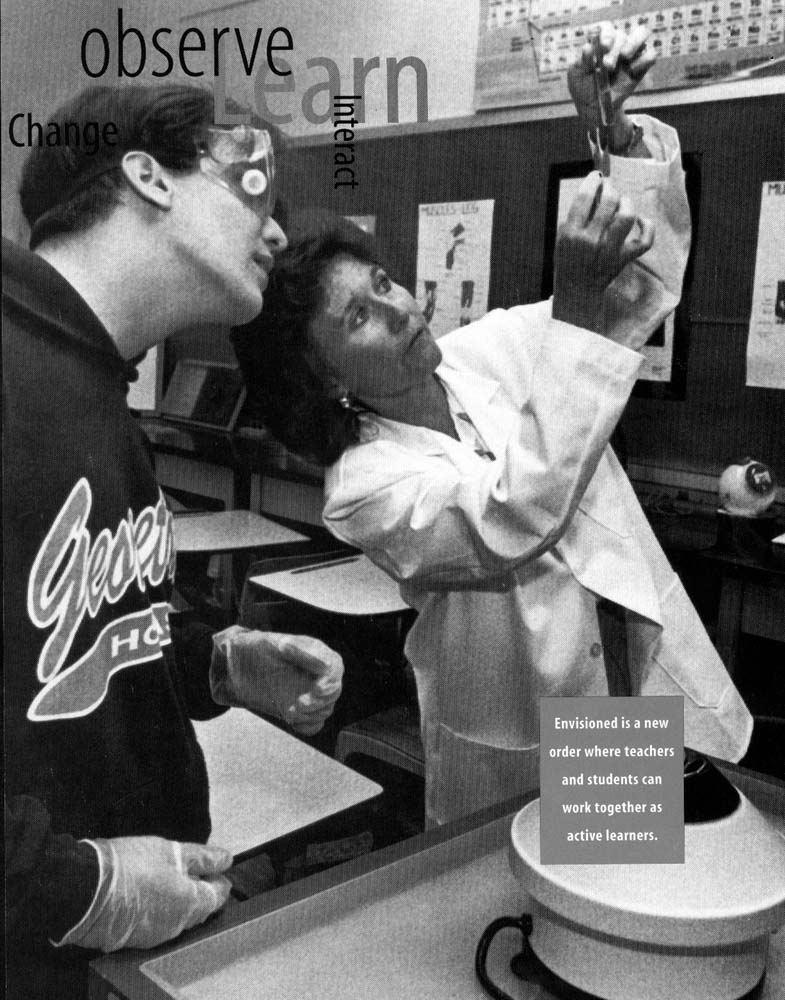
LEARNING SCIENCE IS AN ACTIVE PROCESS. Learning science is something students do, not something that is done to them. In learning science, students describe objects and events, ask questions, acquire knowledge, construct explanations of natural phenomena, test those explanations in many different ways, and communicate their ideas to others.
In the National Science Education Standards, the term "active process" implies physical and mental activity. Hands-on activities are not enough—students also must have "minds-on" experiences.
|
Learning science is something students do, not something that is done to them. |
Science teaching must involve students in inquiry-oriented investigations in which they interact with their teachers and peers. Students establish connections between their current knowledge of science and the scientific knowledge found in many sources; they apply science content to new questions; they engage in problem solving, planning, decision making, and group discussions; and they experience assessments that are consistent with an active approach to learning.
Emphasizing active science learning means shifting emphasis away from teachers presenting information and covering science topics. The perceived need to include all the topics, vocabulary, and information in
textbooks is in direct conflict with the central goal of having students learn scientific knowledge with understanding.
SCHOOL SCIENCE REFLECTS THE INTELLECTUAL AND CULTURAL TRADITIONS THAT CHARACTERIZE THE PRACTICE OF CONTEMPORARY SCIENCE. To develop a rich knowledge of science and the natural world, students must become familiar with modes of scientific inquiry, rules of evidence, ways of formulating questions, and
|
Students should develop an understanding of what science is, what science is not, what science can and cannot do, and how science contributes to culture. |
ways of proposing explanations. The relation of science to mathematics and to technology and an understanding of the nature of science should also be part of their education.
[See definition of science literacy]
An explicit goal of the National Science Education Standards is to establish high levels of scientific literacy in the United States. An essential aspect of scientific literacy is greater knowledge and understanding of science subject matter, that is, the knowledge specifically associated with the physical, life, and earth sciences. Scientific literacy also includes understanding the nature of science, the scientific enterprise, and the role of science in society and personal life. The Standards recognize that many individuals have contributed to the traditions of science and that, in historical perspective, science has been practiced in many different cultures.
Science is a way of knowing that is characterized by empirical criteria, logical argument, and skeptical review. Students should develop an understanding of what science is, what science is not, what science can and cannot do, and how science contributes to culture.
IMPROVING SCIENCE EDUCATION IS PART OF SYSTEMIC EDUCATION REFORM. National goals and standards contribute to state and local systemic initiatives, and the national and local reform efforts complement each other. Within the larger education system, we can view science education as a subsystem with both shared and unique components. The components include students and teachers; schools with principals, superintendents, and school boards; teacher education programs in colleges and universities; textbooks and textbook publishers; communities of parents and of students; scientists and engineers; science museums; business and industry; and legislators. The National Science Education Standards provide the unity of purpose and vision required to focus all of those components effectively on the important task of improving science education for all students, supplying a consistency that is needed for the long-term changes required.
Perspectives and Terms in the National Science Education Standards
Although terms such as ''scientific literacy" and "science content and curriculum" frequently appear in education discussions and in the popular press without definition, those terms have a specific meaning as used in the National Science Education Standards.
SCIENTIFIC LITERACY. Scientific literacy is the knowledge and understanding of scientific concepts and processes required for personal decision making, participation in civic and cultural affairs, and economic productivity. It also includes specific types of abilities. In the National Science Education Standards, the content standards define scientific literacy.
Scientific literacy means that a person can ask, find, or determine answers to questions derived from curiosity about everyday experiences. It means that a person has the ability to describe, explain, and predict natural phenomena. Scientific literacy entails being able to read with understanding articles about science in the popular press and to engage in social conversation about the validity of the conclusions. Scientific literacy implies that a person can identify scientific issues underlying national and local decisions and express positions that are scientifically and technologically informed. A literate citizen should be able to evaluate the quality of scientific information on the basis of its source and the methods used to generate it. Scientific literacy also implies the capacity to pose and evaluate arguments based on evidence and to apply conclusions from such arguments appropriately.
Individuals will display their scientific literacy in different ways, such as appropriately using technical terms, or applying scientific concepts and processes. And individuals often will have differences in literacy in different domains, such as more understanding of life-science concepts and words, and less understanding of physical-science concepts and words.
Scientific literacy has different degrees and forms; it expands and deepens over a lifetime, not just during the years in school. But the attitudes and values established toward science in the early years will shape a person's development of scientific literacy as an adult.
[See Program Standard B]
CONTENT AND CURRICULUM. The content of school science is broadly defined to include specific capacities, understandings, and abilities in science. The content standards are not a science curriculum. Curriculum is the way content is delivered: It includes the structure, organization, balance, and presentation of the content in the classroom.
The content standards are not science lessons, classes, courses of study, or school science programs. The components of the science content described can be organized with a variety of emphases and perspectives into many different curricula. The organizational schemes of the content standards are not intended to be used as curricula;
instead, the scope, sequence, and coordination of concepts, processes, and topics are left to those who design and implement curricula in science programs.
Curricula often will integrate topics from different subject-matter areas—such as life and physical sciences—from different content standards—such as life sciences and
|
Scientific literacy implies that a person can identify scientific issues underlying national and local decisions and express positions that are scientifically and technologically informed. |
science in personal and social perspectives—and from different school subjects—such as science and mathematics, science and language arts, or science and history.
KNOWLEDGE AND UNDERSTANDING. Implementing the National Science Education Standards implies the acquisition of scientific knowledge and the development of understanding. Scientific knowledge refers to facts, concepts, principles, laws, theories, and models and can be acquired in many ways. Understanding science requires that an individual integrate a complex structure of many types of knowledge, including the ideas of science, relationships between ideas, reasons for these relationships, ways to use the ideas to explain and predict other natural phenomena, and ways to apply them to many events. Understanding encompasses the ability to use knowledge, and it entails the ability to distinguish between what is and what is not a scientific idea. Developing understanding presupposes that students are actively engaged with the ideas of science and have many experiences with the natural world.
[See Content Standards A & G (all grade levels)]
[See Teaching Standard B]
INQUIRY. Scientific inquiry refers to the diverse ways in which scientists study the natural world and propose explanations based on the evidence derived from their work. Inquiry also refers to the activities of students in which they develop knowledge and understanding of scientific ideas, as well as an understanding of how scientists study the natural world.
Inquiry is a multifaceted activity that involves making observations; posing questions; examining books and other sources of information to see what is already known; planning investigations; reviewing what is already known in light of experimental evidence; using tools to gather, analyze, and interpret data; proposing answers, explanations, and predictions; and communicating the results. Inquiry requires identification of assumptions, use of critical and logical thinking, and consideration of alternative explanations. Students will engage in selected aspects of inquiry as they learn the scientific way of knowing the natural world, but they also should develop the capacity to conduct complete inquiries.
Although the Standards emphasize inquiry, this should not be interpreted as recommending a single approach to science teaching. Teachers should use different strategies to develop the knowledge, understandings, and abilities described in the content standards. Conducting hands-on science activities does not guarantee inquiry, nor is reading about science incompatible with inquiry. Attaining the understandings and abilities described in Chapter 6 cannot
be achieved by any single teaching strategy or learning experience.
SCIENCE AND TECHNOLOGY. As used in the Standards, the central distinguishing characteristic between science and technology is a difference in goal: The goal of science is to understand the natural world, and the goal of technology is to make modifications in the world to meet human needs. Technology as design is included in the Standards as parallel to science as inquiry.
Technology and science are closely related. A single problem often has both scientific and technological aspects. The need to answer questions in the natural world drives the development of technological products; moreover, technological needs can drive scientific research. And technological products, from pencils to computers, provide tools that promote the understanding of natural phenomena.
[See Content Standard E (all grade levels)]
The use of "technology" in the Standards is not to be confused with "instructional technology," which provides students and teachers with exciting tools—such as computers—to conduct inquiry and to understand science.
Additional terms important to the National Science Education Standards, such as "teaching," "assessment," and "opportunity to learn," are defined in the chapters and sections where they are used. Throughout, we have tried to avoid using terms that have different meanings to the many different groups that will be involved in implementing the Standards.
References for Further Reading
AAUW (American Association of University Women). 1992. How Schools Shortchange Girls. Washington, DC: AAUW.
Beane, D.B. 1988. Mathematics and Science: Critical Filters for the Future of Minority Students. Washington, DC: The Mid-Atlantic Center for Race Equity.
Brown, A.L. 1992. Design experiments: Theoretical and methodological challenges in creating complex interventions in classroom settings. The Journal of the Learning Sciences, 2: 141-178.
Brown, J.S., A. Collins, and P. Duguid. 1989. Situated cognition and the culture of learning. Educational Researcher, 18: 32-42.
Bruer, J.T. 1993. Schools for Thought: A Science of Learning in the Classroom. Cambridge, MA: The MIT Press/Bradford Books.
Bybee, R.W. 1994. Reforming Science Education: Social Perspectives and Personal Reflections. New York: Teachers College Press, Columbia University.
Bybee, R.W., and G. DeBoer. 1994. Research as goals for the science curriculum. In Handbook on Research on Science Teaching and Learning, D. Gabel, ed. New York: MacMillan Publishing Company.
Champagne, A.B., and L.E. Hornig. 1987. Practical Application of Theories About Learning. In This Year in School Science 1987: The Report of the National Forum for School Science, A.B. Champagne and L.E. Hornig, eds. Washington, DC: American Association for the Advancement of Science .
Clewell, B.C., B.T. Anderson, and M.E. Thorpe. 1992. Breaking the Barriers: Helping Female and Minority Students Succeed in Mathematics and Science. San Francisco: Jossey-Bass.
DeBoer, G. 1991. A History of Ideas in Science Education: Implications for Practice. New York: Teachers College Press.
Forman, E.A., and C.B. Cazden. 1985. Exploring Vygotskian perspectives in education: The cognitive value of peer interaction. In Culture, Communication, and Cognition: Vygotskian Perspectives, J.V. Wertsch, ed: 323-347. New York: Cambridge University Press.
Frederiksen, N. 1984. Implications of cognitive theory for instruction in problem solving. Review of Educational Research, 54: 363-407.
Greeno, J.G. 1989. Situations, mental models, and generative knowledge. In Complex Information Processing: The Impact of Herbert A. Simon. D. Klahr and K. Kotovsky eds. Hillsdale, NJ: Lawrence Erlbaum and Associates.
Gross, P.R., and N. Levitt. 1994. Higher Superstition: The Academic Left and Its Quarrels With Science. Baltimore, MD: Johns Hopkins University Press.
Holton, G. 1993. Science and Anti-science. Cambridge, MA: Harvard University Press.
Johnson, D.W., and F. Johnson. 1994. Joining Together: Group Theory and Group Skills, 5th ed. Boston: Allyn and Bacon.
Kahle, J.B. 1988. Gender and science education II. In Development and Dilemmas in Science Education, P. Fensham, ed. New York: Falmer Press.
Lee, O., and C.W. Anderson. 1993. Task engagement and conceptual change in middle school science classrooms. American Educational Research Journal, 30: 585-610.
NCTM (National Council of Teachers of Mathematics). 1989. Curriculum and Evaluation Standards for School Mathematics. Reston, VA: NCTM.
NRC (National Research Council). 1989. High-School Biology Today and Tomorrow. Washington, DC: National Academy Press.
NRC (National Research Council). 1987. Education and Learning to Think, L. Resnick, ed. Washington, DC: National Academy Press.
NSF (National Science Foundation). 1992. The Influence of Testing on Teaching Math and Science in Grades 4-12: Report of a Study. Chestnut Hill, MA: Center for the Study of Testing, Evaluation, and Educational Policy .
Oakes, J. 1990. Lost Talent: The Underparticipation of Women, Minorities, and Disabled Persons in Science. Santa Monica, CA: RAND Corporation.
Ohlsson, S. 1992. The Cognitive Skill of Theory Articulation: A Neglected Aspect of Science Education. Science & Education, 1 (2): 121-92.
Piaget, J. 1970. Genetic Epistemology. Translated by Eleanor Duckworth. New York: Columbia University Press.
Piaget, J. 1954. The Construction of Reality in the Child. Translated by M. Cook. New York: Ballantine Books.
Resnick, L.B., and L.E. Klopfer, eds. 1989. Toward the Thinking Curriculum: Current Cognitive Research. Alexandria, VA: Association for Supervision and Curriculum Development.
Shayer, M., and P. Adey. 1981. Towards a Science of Science Teaching: Cognitive Development and Curriculum Demand. London: Heinemann Educational Books.
Tyson-Bernstein, H. 1988. America's Textbook Fiasco: A Conspiracy of Good Intentions. Washington, DC: Council for Basic Education.
Vera, A.H., and H.A. Simon. 1993. Situated action: a symbolic interpretation. Cognitive Science, 17: 7-48.
White, B.Y. 1993. Thinkertools: Causal models, conceptual change, and science education. Cognition and Instruction, 10: 1-100.