Chapter 3
Science Teaching Standards
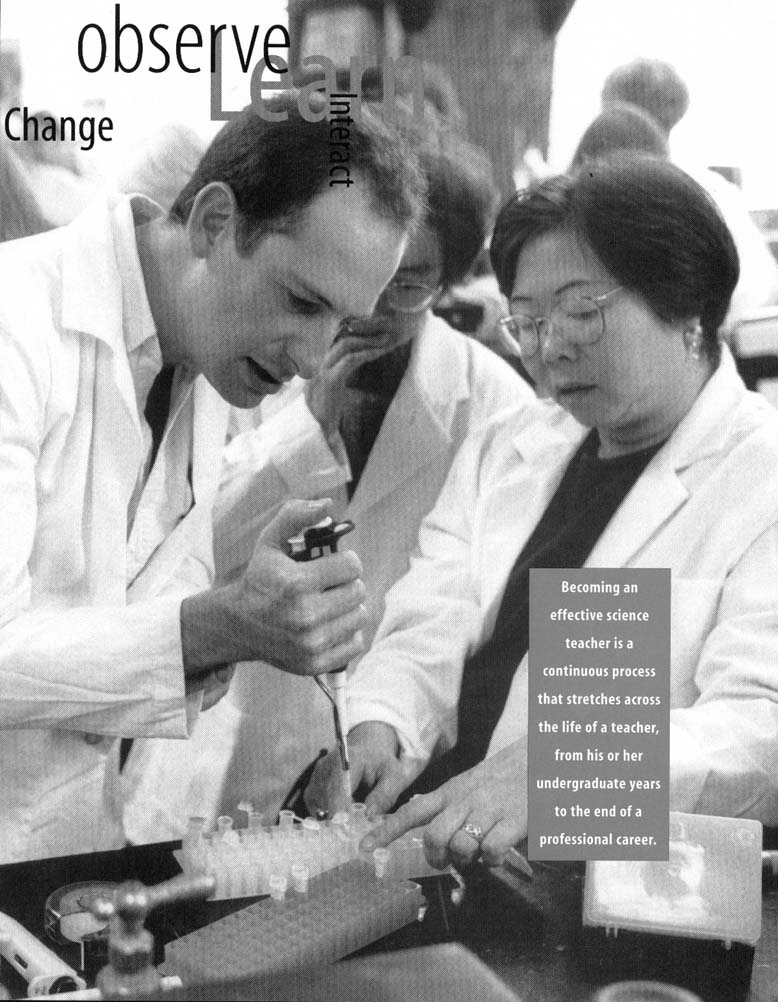
Science teaching is a complex activity that lies at the heart of the vision of science education presented in the Standards. The teaching standards provide criteria for making judgments about progress toward the vision; they describe what teachers of science at all grade levels should understand and be able to do.
To highlight the importance of teachers in science education, these standards are presented first. However, to attain the vision of science education described in the Standards, change is needed in the entire system. Teachers are central to education, but they must not be placed in the position of being solely responsible for reform. Teachers will need to work within a collegial, organizational, and policy context that is supportive of good science teaching. In addition, students must accept and share responsibility for their own learning.
In the vision of science education portrayed by the Standards, effective teachers of science create an environment in which they and students work together as active learners. While students are engaged in learning about the natural world and the scientific principles needed to understand it, teachers are working with their colleagues to expand their knowledge about science teaching. To teach science as portrayed by the Standards, teachers must have theoretical and practical knowledge and abilities about science, learning, and science teaching.
The standards for science teaching are grounded in five assumptions.
-
The vision of science education described by the Standards requires changes throughout the entire system.
-
What students learn is greatly influenced by how they are taught.
-
The actions of teachers are deeply influenced by their perceptions of science as an enterprise and as a subject to be taught and learned.
-
Student understanding is actively constructed through individual and social processes.
-
Actions of teachers are deeply influenced by their understanding of and relationships with students.
THE VISION OF SCIENCE EDUCATION DESCRIBED BY THE STANDARDS REQUIRES CHANGES THROUGHOUT THE ENTIRE SYSTEM. The educational system must act to sustain effective teaching. The routines, rewards, structures, and expectations of the system must endorse the vision of science teaching portrayed by the Standards. Teachers must be provided with resources, time, and opportunities to make change as described in the program and system standards. They must work within a framework that encourages their efforts.
The changes required in the educational system to support quality science teaching are major ones. Each component of the system will change at a different pace, and most changes will be incremental. Nonetheless, changes in teaching must begin before all of the systemic problems are solved.
WHAT STUDENTS LEARN IS GREATLY INFLUENCED BY HOW THEY ARE TAUGHT. The decisions about content and activities that teachers make, their interactions with students, the selection of assessments, the habits of mind that teacher
|
Teachers must have theoretical and practical knowledge and abilities about science, learning, and science teaching. |
demonstrate and nurture among their students, and the attitudes conveyed wittingly and unwittingly all affect the knowledge, understanding, abilities, and attitudes that students develop.
[See Professional Development Standard A]
THE ACTIONS OF TEACHERS ARE DEEPLY INFLUENCED BY THEIR PERCEPTIONS OF SCIENCE AS AN ENTERPRISE AND AS A SUBJECT TO BE TAUGHT AND LEARNED. All teachers of science have implicit and explicit beliefs about science, learning, and teaching. Teachers can be effective guides for students learning science only if they have the opportunity to examine their own beliefs, as well as to develop an understanding of the tenets on which the Standards are based.
STUDENT UNDERSTANDING IS ACTIVELY CONSTRUCTED THROUGH INDIVIDUAL AND SOCIAL PROCESSES. In the same way that scientists develop their knowledge and understanding as they seek answers to questions about the natural world, students develop an understanding of the natural world when they are actively engaged in scientific inquiry—alone and with others.
[See Teaching Standard D]
ACTIONS OF TEACHERS ARE DEEPLY INFLUENCED BY THEIR UNDERSTANDING OF AND RELATIONSHIPS WITH STUDENTS. The standards for science teaching require building strong, sustained relationships with students. These relationships are grounded in knowledge and awareness of the similarities and differences in students' backgrounds, experiences, and current views of science. The diversity of today's student population and the commitment to science education for all requires a firm belief that all students can learn science.
The Standards
Dividing science teaching into separate components oversimplifies a complex process; nevertheless, some division is required to manage the presentation of criteria for good science teaching, accepting that this leaves some overlap. In addition, the teaching standards cannot possibly address all the understanding and abilities that masterful teachers display. Therefore, the teaching standards focus on the qualities that are most closely associated with science teaching and with the vision of science education described in the Standards.
The teaching standards begin with a focus on the long-term planning that teachers do. The discussion then moves to facilitating learning, assessment, and the classroom environment. Finally, the teaching standards address the teacher's role in the school community. The standards are applicable at all grade levels, but the teaching at different grade levels will be different to reflect the capabilities and interests of students at different ages.
Teachers across the country will find some of their current practices reflected
|
A challenge to teachers of science is to balance and integrate immediate needs with the intentions of the yearlong framework of goals. |
below. They also will find criteria that suggest new and different practices. Because change takes time and takes place at the local level, differences in individuals, schools, and communities will be reflected in different pathways to reform, different rates of progress, and different emphases. For example, a beginning teacher might focus on developing skills in managing the learning environment rather than on long-term planning, whereas a more experienced group of teachers might work together on new modes for assessing student achievement. Deliberate movement over time toward the vision of science teaching described here is important if reform is to be pervasive and permanent.
Teaching Standard A
Teachers of science plan an inquiry-based science program for their students. In doing this, teachers
-
Develop a framework of yearlong and short-term goals for students.
-
Select science content and adapt and design curricula to meet the interests, knowledge, understanding, abilities, and experiences of students.
-
Select teaching and assessment strategies that support the development of student understanding and nurture a community of science learners.
-
Work together as colleagues within and across disciplines and grade levels.
DEVELOP A FRAMEWORK OF YEARLONG AND SHORT-TERM GOALS FOR STUDENTS. All teachers know that planning is a critical component of effective teaching. One important aspect of planning is setting goals. In the vision of science education described in the Standards, teachers of science take responsibility for setting yearlong and short-term goals; in doing so, they adapt school and district program goals, as well as state and national goals, to the experiences and interests of their students individually and as a group.
Once teachers have devised a framework of goals, plans remain flexible. Decisions are visited and revisited in the light of experience. Teaching for understanding requires responsiveness to students, so activities and strategies are continuously adapted and refined to address topics arising from student inquiries and experiences, as well as school, community, and national events. Teachers also change their plans based on the assessment and analysis of student achievement and the prior knowledge and beliefs students have demonstrated. Thus, an inquiry might be extended because it sparks the interest of students, an activity might be added because a particular concept has not been understood, or more group work might be incorporated into the plan to encourage communication. A challenge to teachers of science is to balance and integrate immediate needs with the intentions of the yearlong framework of goals.
[See Program Standard B]
During planning, goals are translated into a curriculum of specific topics, units, and sequenced activities that help students make sense of their world and understand the fundamental ideas of science. The content standards, as well as state, district, and school frameworks, provide guides for teachers as they select specific science topics. Some frameworks allow teachers choices in determining topics, sequences, activities, and materials. Others mandate goals, objectives, content, and materials. In either case, teachers examine the extent to which a curriculum includes inquiry and direct experimentation as methods for developing understanding. In planning and choosing curricula, teachers strive to balance breadth of topics with depth of understanding.
SELECT SCIENCE CONTENT AND ADAPT AND DESIGN CURRICULA TO MEET THE INTERESTS, KNOWLEDGE, UNDERSTANDING, ABILITIES, AND EXPERIENCES OF STUDENTS. In determining the specific science content and activities that make up a curriculum, teachers consider the students who will be learning the science. Whether working with mandated
content and activities, selecting from extant activities, or creating original activities, teachers plan to meet the particular interests, knowledge, and skills of their students and build on their questions and ideas. Such decisions rely heavily on a teacher's knowledge of students' cognitive potential, developmental level, physical attributes, affective development, and motivation—and how they learn. Teachers are aware of and understand common naive concepts in science for given grade levels, as well as the cultural and experiential background of students and the effects these have on learning. Teachers also consider their own strengths and interests and take into account available resources in the local environment. For example, in Cleveland, the study of Lake Erie, its pollution, and
|
Inquiry into authentic questions generated from student experiences is the central strategy for teaching science. |
cleanup is an important part of a science curriculum, as is the study of earthquakes in the Los Angeles area. Teachers can work with local personnel, such as those at science-rich centers (museums, industries, universities, etc.), to plan for the use of exhibits and educational programs that enhance the study of a particular topic.
[See Program Standard E and System Standard E]
SELECT TEACHING AND ASSESSMENT STRATEGIES THAT SUPPORT THE DEVELOPMENT OF STUDENT UNDERSTANDING AND NURTURE A COMMUNITY OF SCIENCE LEARNERS. Over the years, educators have developed many teaching and learning models relevant to classroom science teaching. Knowing the strengths and weaknesses of these models, teachers examine the relationship between the science content and how that content is to be taught. Teachers of science integrate a sound model of teaching and learning, a practical structure for the sequence of activities, and the content to be learned.
Inquiry into authentic questions generated from student experiences is the central strategy for teaching science. Teachers focus inquiry predominantly on real phenomena, in classrooms, outdoors, or in laboratory settings, where students are given investigations or guided toward fashioning investigations that are demanding but within their capabilities.
As more complex topics are addressed, students cannot always return to basic phenomena for every conceptual understanding. Nevertheless, teachers can take an inquiry approach as they guide students in acquiring and interpreting information from sources such as libraries, government documents, and computer databases—or as they gather information from experts from industry, the community, and government. Other teaching strategies rely on teachers, texts, and secondary sources—such as video, film, and computer simulations. When secondary sources of scientific knowledge are used, students need to be made aware of the processes by which the knowledge presented in these sources was acquired and to understand that the sources are authoritative and accepted within the scientific community.
[See Teaching Standard E]
Another dimension of planning relates to the organization of students. Science often is a collaborative endeavor, and all science
depends on the ultimate sharing and debating of ideas. When carefully guided by teachers to ensure full participation by all, interactions among individuals and groups in the classroom can be vital in deepening the understanding of scientific concepts and the nature of scientific endeavors. The size of a group depends on age, resources, and the nature of the inquiry.
Teachers of science must decide when and for what purposes to use whole-class instruction, small-group collaboration, and individual work. For example, investigating simple electric circuits initially might best be explored individually. As students move toward building complex circuits, small group interactions might be more effective to share ideas and materials, and a full-class discussion then might be used to verify experiences and draw conclusions.
The plans of teachers provide opportunities for all students to learn science. Therefore, planning is heavily dependent on the teacher's awareness and understanding of the diverse abilities, interests, and cultural backgrounds of students in the classroom. Planning also takes into account the social structure of the classroom and the challenges posed by diverse student groups. Effective planning includes sensitivity to student views that might conflict with current scientific knowledge and strategies that help to support alternative ways of making sense of the world while developing the scientific explanations.
Teachers plan activities that they and the students will use to assess the understanding and abilities that students hold when they begin a learning activity. In addition, appropriate ways are designed to monitor the development of knowledge, understanding, and abilities as students pursue their work throughout the academic year.
[See Program Standard F]
WORK TOGETHER AS COLLEAGUES WITHIN AND ACROSS DISCIPLINES AND GRADE LEVELS. Individual and collective planning is a cornerstone of science teaching; it is a vehicle for professional support and growth. In the vision of science education described in the Standards, many planning decisions are made by groups of teachers at grade and building levels to construct coherent and articulated programs within and across grades. Schools must provide teachers with time and access to their colleagues and others who can serve as resources if collaborative planning is to occur.
Teaching Standard B
Teachers of science guide and facilitate learning. In doing this, teachers
-
Focus and support inquiries while interacting with students.
-
Orchestrate discourse among students about scientific ideas.
-
Challenge students to accept and share responsibility for their own learning.
-
Recognize and respond to student diversity and encourage all students to participate fully in science learning.
-
Encourage and model the skills of scientific inquiry, as well as the curiosity, openness to new ideas and data, and skepticism that characterize science.
Coordinating people, ideas, materials, and the science classroom environment are
difficult, continual tasks. This standard focuses on the work that teachers do as they implement the plans of Standard A in the classroom.
Teachers of science constantly make decisions, such as when to change the direction of a discussion, how to engage a particular
|
At all stages of inquiry, teachers guide, focus, challenge, and encourage student learning. |
student, when to let a student pursue a particular interest, and how to use an opportunity to model scientific skills and attitudes. Teachers must struggle with the tension between guiding students toward a set of predetermined goals and allowing students to set and meet their own goals. Teachers face a similar tension between taking the time to allow students to pursue an interest in greater depth and the need to move on to new areas to be studied. Furthermore, teachers constantly strike a balance among the demands of the understanding and ability to be acquired and the demands of student-centered developmental learning. The result of making these decisions is the enacted curriculum—the planned curriculum as it is modified and shaped by the interactions of students, teachers, materials, and daily life in the classroom.
[See Content Standard A (all grade levels)]
FOCUS AND SUPPORT INQUIRIES. Student inquiry in the science classroom encompasses a range of activities. Some activities provide a basis for observation, data collection, reflection, and analysis of firsthand events and phenomena. Other activities encourage the critical analysis of secondary sources—including media, books, and journals in a library.
[See Teaching Standard E]
In successful science classrooms, teachers and students collaborate in the pursuit of ideas, and students quite often initiate new activities related to an inquiry. Students formulate questions and devise ways to answer them, they collect data and decide how to represent it, they organize data to generate knowledge, and they test the reliability of the knowledge they have generated. As they proceed, students explain and justify their work to themselves and to one another, learn to cope with problems such as the limitations of equipment, and react to challenges posed by the teacher and by classmates. Students assess the efficacy of their efforts—they evaluate the data they have collected, re-examining or collecting more if necessary, and making statements about the generalizability of their findings. They plan and make presentations to the rest of the class about their work and accept and react to the constructive criticism of others.
At all stages of inquiry, teachers guide, focus, challenge, and encourage student learning. Successful teachers are skilled observers of students, as well as knowledgeable about science and how it is learned. Teachers match their actions to the particular needs of the students, deciding when and how to guide—when to demand more rigorous grappling by the students, when to provide information, when to provide particular tools, and when to connect students with other sources.
[See Program Standard E and System Standard E]
In the science classroom envisioned by the Standards, effective teachers continually create opportunities that challenge students and promote inquiry by asking questions.
Earthworms
Ms. F. is planning and teaching a unit that provides students with the opportunity to understand the science in the K-4 Life Science Content Standard. She plans to do this through inquiry. Of the many organisms she might choose to use, she selects an organism that is familiar to the students, one that they have observed in the schoolyard. As a life-long learner, Ms. F. uses the resources in the community, a local museum, to increase her knowledge and help with her planning. She also uses the resources of the school—materials available for science and media in the school library. She models the habits and values of science by the care provided to the animals. Students write and draw their observations. Developing communication skills in science and in language arts reinforce one another.
[This example highlights some elements of Teaching Standards A, B, D, and E; Professional Development Standard C; K-4 Content Standards A and C; Program Standards B and D; and System Standard D.]
While studying a vacant lot near school, several of Ms. F.'s third-grade students became fascinated with earthworms. Although she had never used earthworms in the science classroom before, and she knew she could use any of a number of small animals to meet her goals, Ms. F. felt she could draw from her experience and knowledge working with other small animals in the classroom. She called the local museum of natural history to talk with personnel to be sure she knew enough about earthworms to care for them and to guide the children's explorations. She learned that it was relatively easy to house earthworms over long periods. She was told that if she ordered the earthworms from a biological supply house, they would come with egg cases and baby, earthworms and the children would be able to observe the adult earthworms, the egg cases, the young earthworms, and some of the animal's habits.
Before preparing a habitat for the earthworms, students spent time outdoors closely examining the environment where the worms had been found. This field trip was followed by a discussion about important aspects of keeping earthworms in the classroom: How would students create a place for the earthworms that closely resembled the natural setting? An earthworm from outside was settled into a large terrarium away from direct sun; black paper was secured over the sides of the terrarium into which the children had put soil, leaves, and grass. A week later the earthworms arrived from the supply company and were added to the habitat.
Ms. F. had been thinking about what she wanted the children to achieve and the guidance she needed to give. She wanted the students to become familiar with the basic needs of the earthworms and how to care for them. It was important that the children develop a sense of responsibility toward living things as well as enhance their skills of observation and recording. She also felt that this third grade class would be able to design simple experiments that would help the students learn about some of the behaviors of the earthworms.
In the first 2 weeks, the students began closely observing the earthworms and recording their habits. The students recorded what the earthworms looked like, how they moved, and what the students thought
the earthworms were doing. The students described color and shape; they weighed and measured the earthworms and kept a large chart of the class data, which provoked a discussion about variation. They observed and described how the earthworms moved on a surface and in the soil. Questions and ideas about the earthworms came up continually. Ms. F. recorded these thoughts on a chart, but she kept the students focused on their descriptive work. Then Ms. F. turned to what else the children might want to find out about earthworms and how they might go about doing so. Among the many questions on the chart were: How do the earthworms have babies? Do they like to live in some kinds of soil better than others? What are those funny things on the top of the soil? Do they really like the dark? How do they go through the dirt? How big can an earthworm get?
Ms. F. let all the questions flow in a discussion, and then she asked the students to divide into groups and to see if they could come up with a question or topic that they would like to explore. When the class reconvened, each group shared what they were going to explore and how they might investigate the topic. The students engaged in lively discussion as they shared their proposed explorations. Ms. F. then told the students that they should think about how they might conduct their investigations and that they would share these ideas in the next class.
A week later, the investigations were well under way. One group had chosen to investigate the life cycle of earthworms and had found egg cases in the soil. While waiting for baby earthworms to hatch, they had checked books about earthworms out of the library. They had also removed several very young (very small) earthworms from the terrarium and were trying to decide how they might keep track of the growth.
Two groups were investigating what kind of environment the earthworms liked best. Both were struggling with several variables at once—moisture, light, and temperature. Ms. F. planned to let groups struggle before suggesting that students focus on one variable at a time. She hoped they might come to this idea on their own.
A fourth group was trying to decide what the earthworms liked to eat. The students had been to the library twice and now were ready to test some foods.
The last two groups were working on setting up an old ant farm with transparent sides to house earthworms, because they were interested in observing what the earthworms actually did in the soil and what happened in different kinds of soil.
In their study of earthworms, Mrs. F.'s students learned about the basic needs of animals, about some of the structures and functions of one animal, some features of animal behavior, and about life cycles. They also asked and answered questions and communicated their understandings to one another. They observed the outdoors and used the library and a classroom well equipped to teach science.
Although open exploration is useful for students when they encounter new materials and phenomena, teachers need to intervene to focus and challenge the students, or the exploration might not lead to understanding. Premature intervention deprives students of the opportunity to confront problems and find solutions, but intervention that occurs too late risks student frustration. Teachers also must decide when to challenge students to make sense of their experiences: At these points, students should be asked to explain, clarify, and critically examine and assess their work.
ORCHESTRATE DISCOURSE AMONG STUDENTS ABOUT SCIENTIFIC IDEAS. An important stage of inquiry and of student science learning is the oral and written discourse that focuses the attention of students on how they know what they know and how their knowledge connects to larger ideas, other domains, and the world beyond the classroom. Teachers directly support and guide this discourse in two ways: They require students to record their work—teaching the necessary skills as appropriate—and they promote many different forms of communication (for example, spoken, written, pictorial, graphic, mathematical, and electronic).
Using a collaborative group structure, teachers encourage interdependency among group members, assisting students to work together in small groups so that all participate in sharing data and in developing group reports. Teachers also give groups opportunities to make presentations of their work and to engage with their classmates in explaining, clarifying, and justifying what they have learned. The teacher's role in these small and larger group interactions is to listen, encourage broad participation, and judge how to guide discussion—determining ideas to follow, ideas to question, information to provide, and connections to make. In the hands of a skilled teacher, such group work leads students to recognize the expertise that different members of the group bring to each endeavor and the greater value of evidence and argument over personality and style.
CHALLENGE STUDENTS TO ACCEPT AND SHARE RESPONSIBILITY FOR THEIR OWN LEARNING. Teachers make it clear that each student must take responsibility for his or her work. The teacher also creates opportunities for students to take responsibility for their own learning, individually and as members of groups.
Teachers do so by supporting student ideas and questions and by encouraging students to pursue them. Teachers give individual students active roles in the design and implementation of investigations, in the preparation and presentation of student work to their peers, and in student assessment of their own work.
RECOGNIZE AND RESPOND TO STUDENT DIVERSITY AND ENCOURAGE ALL STUDENTS TO PARTICIPATE FULLY IN SCIENCE LEARNING. In all aspects of science learning as envisioned by the Standards, skilled teachers recognize the diversity in their classes and organize the classroom so that all students have the opportunity to participate fully. Teachers monitor the participation of all students, carefully determining, for instance, if all
members of a collaborative group are working with materials or if one student is making all the decisions. This monitoring can be particularly important in classes of diverse students, where social issues of status and authority can be a factor.
Teachers of science orchestrate their classes so that all students have equal opportunities to participate in learning activities. Students with physical disabilities might
|
Teachers who are enthusiastic, interested, and who speak of the power and beauty of scientific understanding instill in their students some of those same attitudes. |
require modified equipment; students with limited English ability might be encouraged to use their own language as well as English and to use forms of presenting data such as pictures and graphs that require less language proficiency; students with learning disabilities might need more time to complete science activities.
ENCOURAGE AND MODEL THE SKILLS OF SCIENTIFIC INQUIRY, AS WELL AS THE CURIOSITY, OPENNESS TO NEW IDEAS, AND SKEPTICISM THAT CHARACTERIZE SCIENCE. Implementing the recommendations above requires a range of actions based on careful assessments of students, knowledge of science, and a repertoire of science-teaching strategies. One aspect of the teacher's role is less tangible: teachers are models for the students they teach. A teacher who engages in inquiry with students models the skills needed for inquiry. Teachers who exhibit enthusiasm and interest and who speak to the power and beauty of scientific understanding instill in their students some of those same attitudes toward science. Teachers whose actions demonstrate respect for differing ideas, attitudes, and values support a disposition fundamental to science and to science classrooms that also is important in many everyday situations.
The ability of teachers to do all that is required by Standard B requires a sophisticated set of judgments about science, students, learning, and teaching. To develop these judgments, successful teachers must have the opportunity to work with colleagues to discuss, share, and increase their knowledge. They are also more likely to succeed if the fundamental beliefs about students and about learning are shared across their school community in all learning domains. Successful implementation of this vision of science teaching and learning also requires that the school and district provide the necessary resources, including time, science materials, professional development opportunities, appropriate numbers of students per teacher, and appropriate schedules. For example, class periods must be long enough to enable the type of inquiry teaching described here to be achieved.
Teaching Standard C
Teachers of science engage in ongoing assessment of their teaching and of student learning. In doing this, teachers
-
Use multiple methods and systematically gather data about student understanding and ability.
-
Analyze assessment data to guide teaching.
-
Guide students in self-assessment.
-
Use student data, observations of teaching, and interactions with colleagues to reflect on and improve teaching practice.
-
Use student data, observations of teaching, and interactions with colleagues to report student achievement and opportunities to learn to students, teachers, parents, policy makers, and the general public.
The word ''assessment" is commonly equated with testing, grading, and providing feedback to students and parents. However, these are only some of the uses of assessment data. Assessment of students and of teaching—formal and informal—provides teachers with the data they need to make the many decisions that are required to plan and conduct their teaching. Assessment data also provide information for communicating about student progress with individual students and with adults, including parents, other teachers, and administrators.
USE MULTIPLE METHODS AND SYSTEMATICALLY GATHER DATA ON STUDENT UNDERSTANDING AND ABILITY. During the ordinary operation of a class, information about students' understanding of science is needed almost continuously. Assessment tasks are not afterthoughts to instructional planning but are built into the design of the teaching. Because assessment information is a powerful tool for monitoring the development of student understanding, modifying activities, and promoting student self-reflection, the effective teacher of science carefully selects and uses assessment tasks that are also good learning experiences. These assessment tasks focus on important content and performance goals and provide students with an opportunity to demonstrate their understanding and ability to conduct science. Also, teachers use many strategies to gather and interpret the large amount of information about student understanding of science that is present in thoughtful instructional activities.
Classroom assessments can take many forms. Teachers observe and listen to students as they work individually and in groups. They interview students and require formal performance tasks, investigative reports, written reports, pictorial work, models, inventions, and other creative expressions of understanding. They examine portfolios of student work, as well as more traditional paper-and-pencil tests. Each mode of assessment serves particular purposes and particular students. Each has particular strengths and weaknesses and is used to gather different kinds of information about student understanding and ability. The teacher of science chooses the form of the assessment in relationship to the particular learning goals of the class and the experiences of the students.
[See Assessment in Science Education in Chapter 5]
ANALYZE ASSESSMENT DATA TO GUIDE TEACHING. Analysis of student assessment data provides teachers with knowledge to meet the needs of each student. It gives them indicators of each student's current understanding, the nature of each student's thinking, and the origin of what each knows. This knowledge leads to decisions about individual teacher-student interactions, to modifications of learning activities to meet diverse student needs and learning approaches, and
Science Olympiad
This example illustrates the close relationship between teaching and assessment. The assessment tasks are developmentally appropriate for young children, including recognition of students' physical skills and cognitive abilities. The titles in this example (e.g., "Science Content") emphasize some important components of the assessment process. As students move from station to station displaying their understanding and ability in science, members of the community evaluate the students' science achievement and can observe that the students have had the opportunity to learn science. An Olympiad entails extensive planning, and even when the resources are common and readily available, it takes time to design and set up an Olympiad.
[This example highlights some elements of Teaching Standards A, C, and D; Assessment Standards A, B, C, and E; K-4 Content Standards A and B; Program Standards D and F; and System Standards D and G.]
SCIENCE CONTENT: The K-4 Content Standard for Science as Inquiry sets the criterion that students should be able to use simple equipment and tools to gather data. In this assessment exercise, four tasks use common materials to allow students to demonstrate their abilities.
ASSESSMENT ACTIVITY: Students make and record observations.
ASSESSMENT TYPE: Performance, public, authentic, individual.
ASSESSMENT PURPOSE: This assessment activity provides the teacher with information about student achievement. That information can be used to assign grades to students and to make promotion decisions. By involving the community, parents, and older siblings in the assessment process, the activity increases the community's understanding of and support for the elementary school science program.
DATA: Student records in science laboratory notebooks
Teachers' observations of students
Community members' observations of students
CONTEXT: Assessment activities of this general form are appropriate as an end-of-the-year activity for grades 1-4. The public performance involves students engaging in inquiry process skills at several stations located in and around the science classroom. Parents, local business persons, community leaders, and faculty from higher education act as judges of student performance. Benefits to the students and to the school and the science program, such as increased parental and community involvement, are well worth the costs of the considerable planning and organization on the part of the teacher. Planning includes 1) selecting appropriate tasks, 2) collecting necessary equipment, 3) making task cards, 4) checking the equipment, 5) obtaining and training judges, and 6) preparing students for public performance.
|
Assessment Exercise: |
|
STATION A. Measuring Wind Speed |
|
a. Equipment |
|
1. Small, battery-operated fan 2. Wind gauge 3. Table marked with a letter-by-number grid 4. Task cards with directions |
|
b. Task |
|
1. Place the wind gauge at position D-4 on the grid. 2. Place the fan at position G-6 facing the wind gauge. 3. Turn the fan on to medium speed. 4. Record the wind speed and direction in your laboratory notebook. |
|
STATION B. Rolling Cylinders |
|
a. Equipment |
|
1. Four small clear plastic cylinders—one filled with sand, one empty, one 1/4 filled with sand, and one 1/2 filled with sand 2. Adjustable incline 3. Strips of colored paper of various lengths 4. Task cards with directions |
|
b. Task 1 |
|
1. Roll each cylinder down the incline. 2. Describe the motion of the cylinders and their relation to each other. |
|
c. Task 2 |
|
1. Place the blue strip of paper at the bottom of the incline. 2. Select one of the cylinders, and adjust the angle of the incline so that the cylinder consistently rolls just to the end of the blue strip. |
|
STATION C. Comparing Weights |
|
a. Equipment |
|
1. Balance 2. Collections of objects in bags (Teachers select objects that have irregular shapes and are made of materials of different densities so that volume and mass are not correlated.) 3. Task card with directions |
|
b. Task |
|
1. Arrange the objects in one bag in order of their weights. 2. Describe how you arranged the objects. |
|
STATION D. Measuring Volumes |
|
a. Equipment |
|
1. Graduated cylinder, calibrated in half cubic centimeters. 2. Numbered stones of various colors, shapes, and sizes but small enough to fit into the cylinder. 3. Several containers marked A, B, C, and D. 4. Task cards with directions |
|
b. Task 1 |
|
1. Measure the volume of container A. 2. Record your measurement in your laboratory notebook. |
|
c. Task 2 |
|
1. Measure the volume of the stone marked 1. 2. Record your measurement in your laboratory notebook. |
|
Evaluating Student Performance |
|
|
Aspects of a student's performance and criteria for evaluation include: |
|
|
PERFORMANCE INDICATOR |
EVIDENCE |
|
Following directions |
Student follows the directions. |
|
Measuring and recording data |
Measurements are reasonably accurate and include correct units |
|
Planning |
Student organizes the work: (1) observations of the rolling cylinders are sequenced logically, (2) student selects the cylinder with the most predictable motion for Part 2 of the rolling-cylinders task, (3) student records the weights of the objects before attempting to order them in the ordering-by-weight task. |
|
Elegance of approach |
Student invents a sophisticated way of collecting, recording, or reporting observations. |
|
Evidence of reflection |
Student comments on observations in ways that indicate that he/she is attempting to find patterns and causal relationships. |
|
Quality of observations |
Observations are appropriate to the task, complete, accurate, and have some basis in experience or scientific understanding. |
|
Behavior in the face of adversity |
The student seeks help and does not panic if sand or water is spilled or glassware is broken, but proceeds to clean up, get replacements, and continue the task. |
to the design of learning activities that build from student experience, culture, and prior understanding.
[See Improving Classroom Practice in Chapter 5]
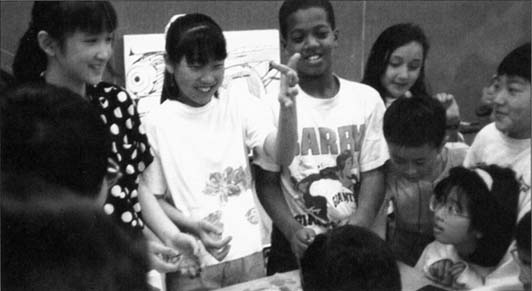
GUIDE STUDENTS IN SELF-ASSESSMENT. Skilled teachers guide students to understand the purposes for their own learning and to formulate self-assessment strategies. Teachers provide students with opportunities to develop their abilities to assess and reflect on their own scientific accomplishments. This process provides teachers with additional perspectives on student learning, and it deepens each student's
|
Skilled teachers guide students to understand the purposes for their own learning and to formulate self-assessment strategies. |
understanding of the content and its applications. The interactions of teachers and students concerning evaluation criteria helps students understand the expectations for their work, as well as giving them experience in applying standards of scientific practice to their own and others' scientific efforts. The internalization of such standards is critical to student achievement in science.
Involving students in the assessment process does not diminish the responsibilities of the teacher—it increases them. It requires teachers to help students develop skills in self-reflection by building a learning environment where students review each other's work, offer suggestions, and challenge mistakes in investigative processes, faulty reasoning, or poorly supported conclusions.
USE STUDENT DATA, OBSERVATIONS OF TEACHING, AND INTERACTIONS WITH COLLEAGUES TO REFLECT ON AND IMPROVE TEACHING PRACTICE. In the science education envisioned by the Standards, teachers of science approach their teaching in a spirit of inquiry—assessing, reflecting on, and learning from their own practice. They seek to understand which plans, decisions, and actions are effective in helping students and which are not. They ask and answer such questions as: "Why is this content important for this group of students at this stage of their development? Why did I select these particular learning activities? Did I choose good examples? How do the activities tie in with student needs and interests? How do they build on what students already know? Do they evoke the level of reasoning that I wanted? What evidence of effect on students do I expect?"
[See Program Standard F]
As teachers engage in study and research about their teaching, they gather data from classroom and external assessments of student achievement, from peer observations and supervisory evaluations, and from self-questioning. They use self-reflection and discussion with peers to understand more fully what is happening in the classroom and to explore strategies for improvement. To engage in reflection on teaching, teachers must have a structure that guides and encourages it—a structure that provides opportunities to have formal and informal dialogues about student learning and their science teaching practices in forums with peers and others; opportunities to read and discuss the research literature about science
content and pedagogy with other education professionals; opportunities to design and revise learning experiences that will help students to attain the desired learning; opportunities to practice, observe, critique, and analyze effective teaching models and the challenges of implementing exemplary strategies; and opportunities to build the skills of self-reflection as an ongoing process throughout each teacher's professional life.
USE STUDENT DATA, OBSERVATIONS OF TEACHING, AND INTERACTIONS WITH COLLEAGUES TO REPORT STUDENT ACHIEVEMENT AND OPPORTUNITIES TO LEARN TO STUDENTS, TEACHERS, PARENTS, POLICY MAKERS, AND THE GENERAL PUBLIC. Teachers have the obligation to report student achievement data to many individuals and agencies, including the students and their parents, certification agencies, employers, policy makers, and taxpayers. Although reports might include grades, teachers might also prepare profiles of student achievement. The opportunity that students have had to learn science is also an essential component of reports on student achievement in science understanding and ability.
[See Program Standard D and System Standard D]
Teaching Standard D
Teachers of science design and manage learning environments that provide students with the time, space, and resources needed for learning science. In doing this, teachers
-
Structure the time available so that students are able to engage in extended investigations.
-
Create a setting for student work that is flexible and supportive of science inquiry.
-
Ensure a safe working environment.
-
Make the available science tools, materials, media, and technological resources accessible to students.
-
Identify and use resources outside the school.
-
Engage students in designing the learning environment.
Time, space, and materials are critical components of an effective science learning environment that promotes sustained inquiry and understanding. Creating an adequate environment for science teaching is a shared responsibility. Teachers lead the way in the design and use of resources, but school administrators, students, parents,
Teachers of science need regular, adequate space for science.
and community members must meet their responsibility to ensure that the resources are available to be used. Developing a schedule that allows time for science investigations needs the cooperation of all in the school; acquiring materials requires the appropriation of funds; maintaining scientific equipment is the shared responsibility of students and adults alike; and designing appropriate use of the scientific institutions and resources in the local community requires the participation of the school and those institutions and individuals.
This standard addresses the classroom use of time, space, and resources—the ways in which teachers make decisions about
how to design and manage them to create the best possible opportunities for students to learn science.
[See Program Standard F]
STRUCTURE THE TIME AVAILABLE SO THAT STUDENTS ARE ABLE TO ENGAGE IN EXTENDED INVESTIGATIONS. Building scientific understanding takes time on a daily basis and over the long-term. Schools must restructure schedules so that teachers can use blocks of time, interdisciplinary strategies, and field experiences to give students many opportunities to engage in serious scientific investigation as an integral part of their science learning. When considering how to structure available time, skilled teachers realize that students need time to try out ideas, to make mistakes, to ponder, and to discuss with one another. Given a voice in scheduling, teachers plan for adequate blocks of time for students to set up scientific equipment and carry out experiments, to go on field trips, or to reflect and share with each other. Teachers make time for students to work in varied groupings—alone, in pairs, in small groups, as a whole class—and on varied tasks, such as reading, conducting experiments, reflecting, writing, and discussing.
CREATE A SETTING FOR STUDENT WORK THAT IS FLEXIBLE AND SUPPORTIVE OF SCIENCE INQUIRY. The arrangement of available space and furnishings in the classroom or laboratory influences the nature of the learning that takes place. Teachers of science need regular, adequate space for science. They plan the use of this space to allow students to work safely in groups of various sizes at various tasks, to maintain their work in progress, and to display their results. Teachers also provide students with the opportunity to contribute their ideas about use of space and furnishings.
[See Program Standard D]
ENSURE A SAFE WORKING ENVIRONMENT. Safety is a fundamental concern in all experimental science. Teachers of science must know and apply the necessary safety regulations in the storage, use, and care of the materials used by students. They adhere to safety rules and guidelines that are established by national organizations such as the American Chemical Society and the Occu
|
Effective science teaching depends on the availability and organization of materials, equipment, media, and technology. |
pational Safety and Health Administration, as well as by local and state regulatory agencies. They work with the school and district to ensure implementation and use of safety guidelines for which they are responsible, such as the presence of safety equipment and an appropriate class size. Teachers also teach students how to engage safely in investigations inside and outside the classroom.
[See Program Standard D and System Standard D]
MAKE THE AVAILABLE SCIENCE TOOLS, MATERIALS, MEDIA, AND TECHNOLOGICAL RESOURCES ACCESSIBLE TO STUDENTS. Effective science teaching depends on the availability and organization of materials, equipment, media, and technology. An effective science learning environment requires a broad range of basic scientific materials, as well as specific tools for particular topics and learning experiences.
Teachers must be given the resources and authority to select the most appropriate materials and to make decisions about when, where, and how to make them accessible. Such decisions balance safety, proper use, and availability with the need for students to participate actively in designing experiments, selecting tools, and constructing apparatus, all of which are critical to the development of an understanding of inquiry.
It is also important for students to learn how to access scientific information from books, periodicals, videos, databases, electronic communication, and people with expert knowledge. Students are also taught to evaluate and interpret the information they have acquired through those resources. Teachers provide the opportunity for students to use contemporary technology as they develop their scientific understanding.
IDENTIFY AND USE RESOURCES OUTSIDE THE SCHOOL. The classroom is a limited environment. The school science program must extend beyond the walls of the school to the resources of the community. Our nation's communities have many specialists, including those in transportation, health-care delivery, communications, computer technologies, music, art, cooking, mechanics, and many other fields that have scientific aspects. Specialists often are available as resources for classes and for individual students. Many communities have access to science centers and museums, as well as to the science communities in higher education, national laboratories, and industry; these can contribute greatly to the understanding of science and encourage students to further their interests outside of school. In addition, the physical environment in and around the school can be used as a living laboratory for the study of natural phenomena. Whether the school is located in a
|
The school science program must extend beyond the walls of the school to the resources of the community. |
densely populated urban area, a sprawling suburb, a small town, or a rural area, the environment can and should be used as a resource for science study. Working with others in their school and with the community, teachers build these resources into their work with students.
ENGAGE STUDENTS IN DESIGNING THE LEARNING ENVIRONMENT. As part of challenging students to take responsibility for their learning, teachers involve them in the design and management of the learning environment. Even the youngest students can and should participate in discussions and decisions about using time and space for work. With this sharing comes responsibility for care of space and resources. As students pursue their inquiries, they need access to resources and a voice in determining what is needed. The more independently students can access what they need, the more they can take responsibility for their own work. Students are also invaluable in identifying resources beyond the school.
Teaching Standard E
Teachers of science develop communities of science learners that reflect the intellectual rigor of scientific inquiry and the attitudes and social values conducive
to science learning. In doing this, teachers
-
Display and demand respect for the diverse ideas, skills, and experiences of all students.
-
Enable students to have a significant voice in decisions about the content and context of their work and require students to take responsibility for the learning of all members of the community.
-
Nurture collaboration among students.
-
Structure and facilitate ongoing formal and informal discussion based on a shared understanding of rules of scientific discourse.
-
Model and emphasize the skills, attitudes, and values of scientific inquiry.
[See Teaching Standard B and Program Standard F]
The focus of this standard is the social and intellectual environment that must be in place in the classroom if all students are to succeed in learning science and have the opportunity to develop the skills and dispositions for life-long learning. Elements of other standards are brought together by this standard to highlight the importance of the community of learners and what effective teachers do to foster its development. A community approach enhances learning: It helps to advance understanding, expand students' capabilities for investigation, enrich the questions that guide inquiry, and aid students in giving meaning to experiences.
An assumption of the Standards is that all students should learn science through full participation and that all are capable of making meaningful contributions in science classes. The nature of the community in which students learn science is critical to making this assumption a reality.
DISPLAY AND DEMAND RESPECT FOR THE DIVERSE IDEAS, SKILLS, AND EXPERIENCES OF ALL STUDENTS. Respect for the ideas, activities, and thinking of all students is demonstrated by what teachers say and do, as well as by the flexibility with which they respond to student interests, ideas, strengths, and needs. Whether adjusting an activity to reflect the cultural background of particular students, providing resources for a small group to pursue an interest, or suggesting that an idea is valuable but cannot be pursued at the moment, teachers model what it means to respect and value the views of others. Teachers teach respect explicitly by focusing on their own and students' positive interactions, as well as confronting disrespect, stereotyping, and prejudice whenever it occurs in the school environment.
[See Content Standards A & G (all grade levels)]
Science is a discipline in which creative and sometimes risky thought is important. New ideas and theories often are the result of creative leaps. For students to understand this aspect of science and be willing to express creative ideas, all of the members of the learning community must support and respect a diversity of experience, ideas, thought, and expression. Teachers work with students to develop an environment in which students feel safe in expressing ideas.
ENABLE STUDENTS TO HAVE A SIGNIFICANT VOICE IN DECISIONS ABOUT THE CONTENT AND CONTEXT OF THEIR WORK AND GIVE STUDENTS SIGNIFICANT RESPONSIBILITY FOR THE LEARNING OF ALL MEMBERS OF THE COMMUNITY. A community of science learners is one in which students develop a sense of purpose and the ability to assume
Musical Instruments
This example includes a description of teaching and an assessment task, although the assessment task is indistinguishable from the teaching activity. The example begins with the teachers at King School working as a team involved in school reform. The team naturally builds on previous efforts; for example, the technology unit is modified from an existing unit. Other indicators that King School is working toward becoming a community of learners is the availability of older students to help the younger students with tasks beyond their physical abilities and the decision for one class to give a concert for another class. In her planning, Ms. R. integrates the study of the science of sound with the technology of producing sound. Recognizing the different interests and abilities of the students, Ms. R. allows students to work alone or in groups and plans a mixture of whole-class discussions and work time. She encourages the students in planning and communicating their designs. She imposes constraints on materials and time.
[This example highlights some elements of all of the Teaching Standards; Assessment Standard A; K-4 Content Standards B, E, and F; and Program Standards A, D, and E.]
The King School was reforming its science curriculum. After considerable research into existing curriculum materials and much discussion, the team decided to build a technology piece into some of the current science studies. The third-grade teacher on the team, Ms. R., said that she would like to work with two or three of her colleagues on the third-grade science curriculum. They selected three topics that they knew they would be teaching the following year: life cycles, sound, and water.
Ms. R. chose to introduce technology as part of the study of sound. That winter, when the end of the sound study neared, Ms. R. was ready with a new culminating activity—making musical instruments. She posed a question to the entire class: Having studied sound for almost 6 weeks, could they design and make musical instruments that would produce sounds for entertainment? Ms. R. had collected a variety of materials, which she now displayed on a table, including boxes, tubes, string, wire, hooks, scrap wood, dowels, plastic, rubber, fabric, and more. The students had been working in groups of four during the sound study, and Ms. R. asked them to gather into those groups to think about the kinds of instruments they would like to make. Ms. R. asked the students to think particularly about what they knew about sound, what kind of sound they would like their instruments to make, and what kind of instrument it would be. How would the sound be produced? What would make the sound? She suggested they might want to look at the materials she had brought in, but they could think about other materials too.
Ms. R. sent the students to work in their groups. Collaborative work had been the basis of most of the science inquiry the students had done; for this phase, Ms. R. felt that the students should work together to discuss and share ideas, but she suggested that each student might want to have an instrument at the end to play and to take home.
As the students began to talk in their groups, Ms. R. added elements to the activity. They would have only the following 2 weeks to make their instruments. Furthermore, any materials they
needed beyond what was in the boxes had to be materials that were readily available and inexpensive.
Ms. R. knew that planning was a challenge for these third graders. She moved among groups, listening and adding comments. When she felt that discussions had gone as far as they could go, she asked each group to draw a picture of the instruments the children thought they would like to make, write a short piece on how they thought they would make them, and make a list of the materials that they would need. Ms. R. made a list of what was needed, noted which children and which groups might profit from discussing their ideas with one another, and suggested that the children think about their task, collect materials if they could, and come to school in the next week prepared to build their instruments.
Ms. R. invited several sixth graders to join the class during science time the following week, knowing that the third grade students might need their help in working with the materials. Some designs were simple and easy to implement; e.g., one group was making a rubber-band player by stretching different widths and lengths of rubber bands around a plastic gallon milk container with the top cut off. Another group was making drums of various sizes using some thick cardboard tubes and pieces of thin rubber roofing material. For many, the designs could not be translated into reality, and much change and trial and error ensued. One group planned to build a guitar and designed a special shape for the sound box, but after the glued sides of their original box collapsed twice, the group decided to use the wooden box that someone had added to the supply table. In a few cases, the original design was abandoned, and a new design emerged as the instrument took shape.
At the end of the second week, Ms. R. set aside 2 days for the students to reflect on what they had done individually and as a class. On Friday, they were once again to draw and write about their instruments. Where groups had worked together on an instrument, one report was to be prepared. On the next Monday, each group was to make a brief presentation of the instrument, what it could do, how the design came to be, and what challenges had been faced. As a final effort, the class could prepare a concert for the other third grades.
In making the musical instruments, students relied on the knowledge and understanding developed while studying sound, as well as the principles of design, to make an instrument that produced sound.
The assessment task for the musical instruments follows. The titles emphasize some important components of the assessment process.
SCIENCE CONTENT: The K-4 science content standard on science and technology is supported by the idea that students should be able to communicate the purpose of a design. The K-4 physical science standard is supported by the fundamental understanding of the characteristics of sound, a form of energy.
ASSESSMENT ACTIVITY: Students demonstrate the products of their design work to their peers and reflect on what the project taught them about the nature of sound and the process of design.
ASSESSMENT TYPE: This can be public, group, or individual, embedded in teaching.
ASSESSMENT PURPOSE: This activity assesses student progress toward understanding the purpose and processes of design. The information will be used to plan the next design activity. The activity also permits the teacher to gather data about understanding of sound.
DATA: Observations of the student performances.
CONTEXT: Third-grade students have just completed a design project. Their task is to present the product of their work to their peers and talk about what they learned about sound and design as a result of doing the project. This is a challenging task for third-grade students, and the teacher will have to provide considerable guidance to the groups of students as they plan their presentations. The following directions provide a framework that students can use to plan their presentations.
-
Play your instrument for the class.
-
Show the class the part of the instrument that makes the sound.
-
Describe to the class the purpose (function) that other parts of the instrument have.
-
Show the class how you can make the sound louder.
-
Show the class how you can change the pitch (how high or how low the sound is) of the sound.
-
Tell the class about how you made the instrument, including
-
-
What kind of instrument did you want to make?
-
How like the instrument you wanted to make is the one you actually made?
-
Why did you change your design?
-
What tools and materials did you use to make your instrument?
-
-
Explain why people make musical instruments.
EVALUATING STUDENT PERFORMANCE: Student understanding of sound will be revealed by understanding that the sound is produced in the instrument by the part of the instrument that vibrates (moves rapidly back and forth), that the pitch (how high or how low) can be changed by changing how rapidly the vibrating part moves, and the loudness can be changed by the force (how hard you pluck, tap, or blow the vibrating part) with which the vibrating part is set into motion. An average student performance would include the ability to identify the source of the vibration and ways to change either pitch or loudness in two directions (raise and lower the pitch of the instrument or make the instrument louder and softer) or change the pitch and loudness in one direction (make the pitch higher and the sound louder). An exemplary performance by a student would include not only the ability to identify the source of the vibration but also to change pitch and loudness in both directions.
Student understanding of the nature of technology will be revealed by the students' ability to reflect on why people make musical instruments—e.g., to improve the quality of life—as well as by their explanations of how they managed to make the instrument despite the constraints faced—that is, the ability to articulate why the conceptualization and design turned out to be different from the instrument actually made.
responsibility for their learning. Teachers give students the opportunity to participate in setting goals, planning activities, assessing work, and designing the environment. In so doing, they give students responsibility for a significant part of their own learning, the learning of the group, and the functioning of the community.
[See Improving Classroom Practice in the Assessment Standards]
[See Content Standards A & G (all grade levels)]
NURTURE COLLABORATION AMONG STUDENTS. Working collaboratively with others not only enhances the understanding of science, it also fosters the practice of many of the skills, attitudes, and values that characterize science. Effective teachers design many of the activities for learning science to require group work, not simply as an exercise, but as essential to the inquiry. The teacher's role is to structure the groups and to teach students the skills that are needed to work together.
STRUCTURE AND FACILITATE ONGOING FORMAL AND INFORMAL DISCUSSION BASED ON A SHARED UNDERSTANDING OF RULES OF SCIENTIFIC DISCOURSE. A fundamental aspect of a community of learners is communication. Effective communication requires a foundation of respect and trust among individuals. The ability to engage in the presentation of evidence, reasoned argument, and explanation comes from practice. Teachers encourage informal discussion and structure science activities so that students are required to explain and justify their understanding, argue from data and defend their conclusions, and critically assess and challenge the scientific explanations of one another.
[See Content Standard A (all grade levels)]
MODEL AND EMPHASIZE THE SKILLS, ATTITUDES, AND VALUES OF SCIENTIFIC INQUIRY. Certain attitudes, such as wonder, curiosity, and respect toward nature are vital parts of the science learning community. Those attitudes are reinforced when the adults in the community engage in their own learning and when they share positive attitudes toward science. Environments that promote the development of appropriate attitudes are supported by the school administration and a local community that
|
Effective teachers design many of the activities for learning science to require group work, not simply as an exercise, but as essential to the inquiry. |
has taken responsibility for understanding the science program and supports students and teachers in its implementation.
Communities of learners do not emerge spontaneously; they require careful support from skillful teachers. The development of a community of learners is initiated on the first day that a new group comes together, when the teacher begins to develop with students a vision of the class environment they wish to form. This vision is communicated, discussed, and adapted so that all students come to share it and realize its value. Rules of conduct and expectations evolve as the community functions and takes shape over the weeks and months of the school year.
Some students will accommodate quickly; others will be more resistant because of the responsibilities required or because of discrepancies between their perceptions of what they should be doing in school and
what is actually happening. The optimal environment for learning science is constructed by students and teachers together. Doing so requires time, persistence, and skill on everyone's part.
Teaching Standard F
Teachers of science actively participate in the ongoing planning and development of the school science program. In doing this, teachers
-
Plan and develop the school science program.
-
Participate in decisions concerning the allocation of time and other resources to the science program.
-
Participate fully in planning and implementing professional growth and development strategies for themselves and their colleagues.
[See Teaching Standard E]
PLAN AND DEVELOP THE SCHOOL SCIENCE PROGRAM. The teaching in individual science classrooms is part of a larger system that includes the school, district, state, and nation. Although some teachers might choose involvement at the district, state, and national levels, all teachers have a professional responsibility to be active in some way as members of a science learning community at the school level, working with colleagues and others to improve and maintain a quality science program for all students. Many teachers already assume these responsibilities within their schools. However, they usually do so under difficult circumstances. Time for such activities is minimal, and involvement often requires work after hours. Resources are likely to be scarce as well. Furthermore, the authority to plan and carry out necessary activities is not typically in the hands of teachers. Any improvement of science education will require that the structure and culture of schools change to support the collaboration of the entire school staff with resources in the community in planning, designing, and carrying out new practices for teaching and learning science.
Although individual teachers continually make adaptations in their classrooms, the school itself must have a coherent program of science study for students. In the vision described by the National Science Education Standards, the teachers in the school and school district have a major role in designing that program, working together across science disciplines and grade levels, as well as within levels. Teachers of science must also work with their colleagues to coordinate and integrate the learning of science understanding and abilities with learning in
|
Although individual teachers continually make adaptations in their classrooms, the school itself must have a coherent program of science study for students. |
other disciplines. Teachers working together determine expectations for student learning, as well as strategies for assessing, recording, and reporting student progress. They also work together to create a learning community within the school.
[See Program Standard D]
PARTICIPATE IN DECISIONS CONCERNING THE ALLOCATION OF TIME AND OTHER RESOURCES TO THE SCIENCE PROGRAM. Time and other resources are critical elements for effective science teaching.
Teachers of science need to have a significant role in the process by which decisions are made concerning the allocation of time and resources to various subject areas. However, to assume this responsibility, schools and districts must provide teachers with the opportunity to be leaders.
[See Professional Development Standard D]
PARTICIPATE FULLY IN PLANNING AND IMPLEMENTING PROFESSIONAL GROWTH AND DEVELOPMENT STRATEGIES FOR THEMSELVES AND THEIR COLLEAGUES. Working as colleagues, teachers are responsible for designing and implementing the ongoing professional development opportunities they need to enhance their skills in teaching science, as well as their abilities to improve the science programs in their schools. Often they employ the services of specialists in science, children, learning, curriculum, assessment, or other areas of interest. In doing so, they must have the support of their school districts.
Changing Emphases
The National Science Education Standards envision change throughout the system. The teaching standards encompass the following changes in emphases:
|
LESS EMPHASIS ON |
MORE EMPHASIS ON |
|
Treating all students alike and responding to the group as a whole |
Understanding and responding to individual student's interests, strengths, experiences, and needs |
|
Rigidly following curriculum |
Selecting and adapting curriculum |
|
Focusing on student acquisition of information |
Focusing on student understanding and use of scientific knowledge, ideas, and inquiry processes |
|
Presenting scientific knowledge through lecture, text, and demonstration |
Guiding students in active and extended scientific inquiry |
|
Asking for recitation of acquired knowledge |
Providing opportunities for scientific discussion and debate among students |
|
Testing students for factual information at the end of the unit or chapter |
Continuously assessing student understanding |
|
Maintaining responsibility and authority |
Sharing responsibility for learning with students |
|
Supporting competition |
Supporting a classroom community with cooperation, shared responsibility, and respect |
|
Working alone |
Working with other teachers to enhance the science program |
References for Further Reading
Bereiter, C., and M. Scardamalia. 1989. Intentional learning as a goal of instruction. In Knowing, Learning, and Instruction: Essays in Honor of Robert Glaser, L.B. Resnick, ed.: 361-392. Hillsdale, NJ: Lawrence Erlbaum and Associates.
Brown, A. 1994. The advancement of learning. Presidential Address, American Educational Research Association. Educational Researcher, 23: 4-12.
Brown, A.L., and J.C. Campione. 1994. Guided discovery in a community of learners. In Classroom Lessons: Integrating Cognitive Theory and Classroom Practice, K. McGilly, ed.: 229-270. Cambridge, MA: MIT Press.
Bruer, J.T. 1993. Schools for Thought: A Science of Learning in the Classroom. Cambridge, MA: MIT Press.
Carey, S. 1985. Conceptual Change in Childhood. Cambridge, MA: MIT Press.
Carey, S., and R. Gelman, eds. 1991. The Epigenesis of Mind: Essays on Biology and Cognition. Hillsdale, NJ: Lawrence Erlbaum and Associates.
Champagne, A.B. 1988. Science Teaching: Making the System Work. In This Year in School Science 1988: Papers from the Forum for School Science. Washington, DC: American Association for the Advancement of Science.
Cohen, D.K., M.W. McLaughlin, and J.E. Talbert, eds. 1993. Teaching for Understanding: Challenges for Policy and Practice. San Francisco: Jossey-Bass.
Darling-Hammond, L. 1992. Standards of Practice for Learner Centered Schools. New York: National Center for Restructuring Schools and Learning.
Harlen, W. 1992. The Teaching of Science. London: David Fulton Publishers.
Leinhardt, G. 1993. On Teaching. In Advances in Instructional Psychology, R. Glaser ed., vol.4: 1-54. Hillsdale, NJ: Lawrence Erlbaum and Associates.
Loucks-Horsley, S., J.G. Brooks, M.O. Carlson, P. Kuerbis, D.P. Marsh, M. Padilla, H. Pratt, and K.L. Smith. 1990. Developing and Supporting Teachers for Science Education in the Middle Years. Andover, MA: The National Center for Improving Science Education.
Loucks-Horsley, S., M.O. Carlson, L.H. Brink, P. Horwitz, D.P. Marsh, H. Pratt, K.R. Roy, and K. Worth. 1989. Developing and Supporting Teachers for Elementary School Science Education. Andover, MA: The National Center for Improving Science Education.
McGilly, K., ed. 1994. Classroom Lessons: Integrating Cognitive Theory and Classroom Practice. Cambridge, MA: MIT Press.
NBPTS (National Board for Professional Teaching Standards). 1991. Toward High and Rigorous Standards for the Teaching Profession: Initial Policies and Perspectives of the National Board for Professional Teaching Standards, 3rd ed. Detroit, MI: NBPTS.
NCTM (National Council of Teachers of Mathematics). 1991. Professional Standards for Teaching Mathematics. Reston, VA: NCTM.
NRC (National Research Council). 1994. Learning, Remembering, Believing: Enhancing Human Performance, D. Druckman and R.A. Bjork, eds. Washington, DC: National Academy Press.
NRC (National Research Council). 1990. Fulfilling the Promise: Biology Education in the Nation's Schools. Washington, DC: National Academy Press.
NRC (National Research Council). 1987. Education and Learning to Think, L.B. Resnick, ed. Washington, DC: National Academy Press.
Schoen, D. 1987. Educating the Reflective Practitioner: Toward a New Design for Teaching and Learning in the Professions. San Francisco: Jossey-Bass.
Shulman, L.S. 1987. Knowledge and teaching foundations of the new reform. Harvard Education Review, 57 (1): 1-22.