
The Industrial Green Game. 1997. Pp. 154–164.
Washington, DC: National Academy Press.
Europipe Development Project: Managing a Pipeline Project in a Complex and Sensitive Environment
HENNING GRANN
This paper describes steps taken by Den norske stats oljeselskap a.s. (Statoil), as operator of a group of companies, to build a 640-kilometer (km) pipeline from the Norwegian North Sea through an ecologically sensitive area to a new gas terminal in Emden, Germany.
The offshore pipeline is being landed in the Wadden Sea National Park of Lower Saxony, a unique wetland of extreme environmental importance and sensitivity. Final approval for the landfall part of the project was given in late 1993 by German authorities after detailed discussions and a thorough evaluation of several pipeline routes, construction alternatives, and comprehensive environmental impact assessments.
To ensure a high level of environmental performance and strict adherence to all regulations, permits, and requirements, Statoil prepared a detailed environmental protection plan for the pipeline project. A particularly important feature of this plan is the inclusion of a set of environmental documents in which the contractors state their commitment to environmental protection by identifying environmentally critical operations, prescribing appropriate environmental measures, and giving detailed work instructions for proper job execution, control, and verification.
BACKGROUND
The consumption of natural gas in Western Europe has gradually increased since the 1970s, and this trend is expected to continue well beyond the turn of the century. The increasing use of natural gas is a result of European governments' strategy to improve the security and flexibility of energy supplies. Moreover,
substitution of natural gas for coal and oil will contribute to environmental improvement and will be an important instrument in attempts by governments to realize their objectives of stabilizing carbon dioxide emissions, which are viewed as probable contributors to the greenhouse effect and global warming.
In the early 1970s, a consortium of continental companies purchased large volumes of gas from the Norwegian Ekofisk offshore fields with the objective of securing a long-term supply of gas to Western Europe. The resulting Statpipe/Norpipe gas pipeline from the Ekofisk Fields to Emden was operational in 1977. After the Troll gas sales agreement in 1986, a decision was made to develop the Troll and Sleipner gas fields; the Zeepipe pipeline was landed in Zeebrügge in Belgium and commissioned in 1993. The Troll and Sleipner gas fields in the Norwegian North Sea are interconnected with Ekofisk and other fields. Figure 1
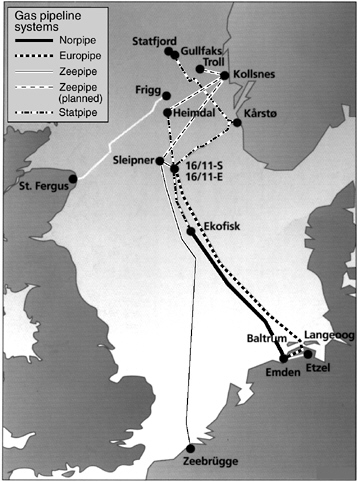
FIGURE 1 Pipelines link Norway's offshore gas fields with consumers in continental Europe and the United Kingdom. SOURCE: Statoil, 1993.
shows these pipelines, the newer Europipe line, and their connections from Norway's off-shore gas fields to continental Europe and the United Kingdom.
During 1988, it became apparent that transportation capacity to the European continent would have to be increased to meet mid-1990s demands. The increased demand would result from higher sales volumes under existing agreements and new additional gas sales agreements signed by German and Dutch buyers. To meet the increased gas supply obligations, several supply alternatives were examined, including updating the existing pipeline systems to higher operating pressures; changing gas delivery points for certain requirements; building an off-shore pipeline to Denmark and an onshore pipeline through Denmark and Germany to Emden; and building an offshore pipeline to the Netherlands or to Germany with a connecting onshore pipeline to Emden. In fall 1990, a decision was made to develop the documentation required to secure permission to land a new Europipe offshore pipeline in Germany and connect it with an onshore pipeline to Emden.
PROJECT PLANNING AND APPROVAL
The 1990 decision resulted from contacts initially made in 1985 between Statoil and the German authorities on the first feasibility study of landing an offshore pipeline in Germany. This study was followed by a preliminary evaluation of 10 alternative routes along the German North Sea coast. In the meantime, in 1986, the Wadden Sea National Park of Lower Saxony was formally established to protect a major part of the German coastline.
In accordance with the regional planning procedure, in early 1991, Statoil submitted its first formal request for permission to plan a pipeline landfall via the island of Norderney, one of the islands of the Wadden Sea and a part of the national park. The alternative originally favored by the authorities was a pipeline crossing Norderney and the Wadden Sea, but this time the political situation in Lower Saxony had changed. There was greater cooperation between the Social Democrats and the Green Party, and environmental issues gained importance as environmental organizations increased their influence in the decision process. This situation increased the difficulty of developing a pipeline project that would satisfy the interests of the general public and the authorities. Consequently, numerous alternative pipeline routes, technical solutions, and associated environmental impact assessments were developed for review by the authorities.
In November 1992, Statoil received permission to plan a Europipe landing by crossing the national park through that Accumer Ei tidal channel and a subsurface tunnel under the tidal flats. After further optimizations of this alternative, final construction permission was given on October 27, 1993.
THE TECHNICAL COMPLEXITY OF THE EUROPIPE PROJECT
Several facilities were required to bring the gas from the Norwegian North Sea to the contractual delivery point in Emden. Offshore, a new riser platform bridge (16/11-E in Figure 1) in the Norwegian North Sea connects Europipe to the Zeepipe and Statpipe/Norpipe system. It carries pressure-monitoring equipment and is intended to be a safety valve on the pipeline system. If also has equipment to launch and retrieve inspection probes and "pigs" used to clean the line.
The 640-km offshore pipeline from the riser to within 5 km of Germany's coastline is made up of 12-meter (m) lengths of steel pipe measuring about 1 m in diameter. Each section of pipe is welded and checked on the laybarge before being slid onto the seabed. The seabed is inspected by sonar and remotely operated vehicles before pipe is laid.
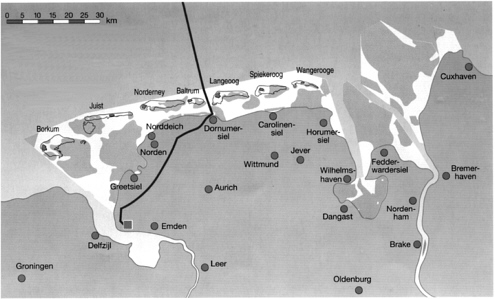
Closer to the coast, the large laybarge used in the open sea is replaced by smaller vessels better able to navigate narrow channels and shallow water. The pipeline is laid across a large sand bank and up the tidal channel between Baltrum and Langeoog Island; it continues until the coastal wetlands of the Wadden Sea are reached at the Accumersieler Balje (Figure 2), where a 12-m-diameter, 20-m-high cylindrical tie-in chamber is used to recover the tunnel boring machine and to install the pipeline tie-in connections (Figure 3). In the territorial waters up to the tunnel tie-in chamber, the pipeline is permanently buried in the sea bed. For this purpose, a trench is dredged in the seabed into which the pipeline will be laid by a special laybarge moored, as needed, to mooring piles. The trench is back-filled when the pipe laying is finished.
Extensive dredging (estimated 3.2 million cubic meters) is required in this very environmentally sensitive area. The great variations in water depths and tidal currents among individual route sections require the use of many different types of equipment and innovative construction methods. At the peak of the construction activities, more than 60 vessels will be operating simultaneously in the area. The varied geological conditions along the route, with different kinds of sand and clay, including peat, require special handling during tunnel excavation and trench dredging.
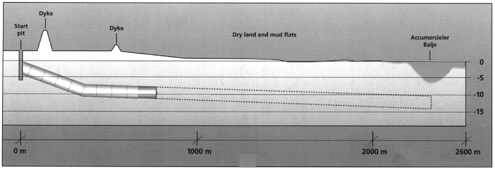
The sensitive Wattenmeer wetlands area of the Wadden Sea is crossed by a 2.6-km tunnel driven 7 m to 8 m under the seabed, between the tie-in chamber and dry land behind the dikes west of Dornumersiel (Figure 4). Beginning behind the coastal dikes, 3m-diameter concrete pipes are rammed behind the tunneling machine by hydraulic jacks. These pipe casings prevent the tunnel from collapsing. When completed, the tunnel is filled with water. The pipeline is floated through the tunnel as lengths of pipe are welded together on land. This land-originating pipeline is joined in the underground tie-in chamber to the section laid in from the sea. After construction is completed, the chamber is removed and the construction site behind the dykes is restored to its original use as farm land.
In early March 1994, Statoil was given permission by the German authorities
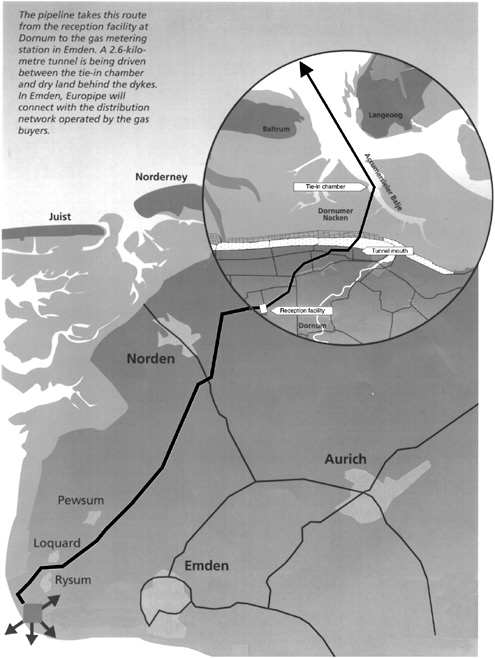
FIGURE 2 Route of pipeline on land. The pipeline goes from the reception facility at Dornum to the gas metering station in Emden. A 2.6-km tunnel is being driven between the tie-in chamber and dry land behind the dikes. In Emden, Europipe will connect with the distribution network operated by the gas buyers. SOURCE: Statoil, 1993.
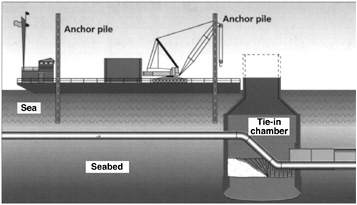
FIGURE 3 The tie-in chamber. Once the tie-in has been finished, most of the underground chamber will be removed. The rest will remain under the seabed. SOURCE: Statoil, 1993.
to lay a section of pipeline parallel with the Europipe pipeline through the tidal channel and the tunnel in anticipation of having to construct a second pipeline to meet future needs. By laying the two pipelines simultaneously through the environmentally critical area, environmental impact can be minimized.
On land, a gas-reception terminal is built close to the Europipe landfall. Norwegian gas arrives at the reception terminal under high pressure, is heated, and has its pressure adjusted. Three identical process trains are installed at the terminal. Each performs three serial functions: preliminary filtering, heating, and pressure reduction. Two of the process trains are intended to normal operations, the third is used for maintenance and other stoppages.
From the reception terminal, the gas is carried overland 50 km to Emden through a pipeline buried in a trench to a depth of at least 1 m. Several roads, railway lines, and canals are crossed. The 12-m pipe sections are welded into lengths up to 1,400 m before being lowered into the trench by a set of cranes.
SPECIAL CONSIDERATIONS OF THE WADDEN SEA
The Wadden Sea covers almost 8,000 square kilometers (km2) and stretches from Esbierg in Denmark in the north to Den Helder in Netherlands in the south. It is a complex environment comprising a network of tidal channels, sand bars, mud flats, and salt marches. Approximately half of the Wadden Sea lies exposed at low tide. The area represents the largest unbroken stretch of intertidal mud flats in the world. The Wadden Sea is protected from the open North Sea by a chain of about 50 islands and sand bars covering an area of about 1,000 km2Figure 5 shows the coastal terrain in relation to the Europipe gas line. The Wadden Sea is a unique and dynamic transition zone between the open sea and land.
The Wadden Sea ecosystem is characterized by its enormous biological productivity
and richness on all ecological levels, from algae, invertebrates, and fish to birds and seals. The Wadden Sea is a nursery for numerous species of fish. Although the fish are hatched in the North Sea, the Wadden Sea offers shelter, space, a suitable temperature, and above all an abundance of food for the young fish. Millions of birds find an important refuge in the Wadden Sea within its extensive breeding, resting, moulting, and feeding area. The area is use by migratory birds, notably waders, ducks, and geese. Most of these birds breed in the Arctic and sub-Arctic regions of Europe and Asia and use the Wadden Sea, with its vast food supply, as a temporary stop for building the fat reserves required to successfully breed and to survive the winter.
The Wadden Sea National Park of Lower Saxony was established in 1986. It comprises some 2,100 km2 divided into three zones on the basis of environmental sensitivity and subsequent need for protection. Stringent regulations apply, from a general policy in the Quiet Zone to less demanding rules in the Recreation Zone.
The Wadden Sea is well-known internationally for its great scientific, conservation, recreation, and commercial value. The ecosystem is considered to be one of the most important in the world, which means that many different interests are active in preserving the area for the future. The Wadden Sea National Park of Lower Saxony is recognized as a Wetland of International Importance under the Ramsar Convention, as a Special Protection Area under the European Union Bird Directive, and as a Biosphere Reserve by the United Nations Educational, Scientific, and Cultural Organization.
ENVIRONMENTAL PROTECTION PLAN
Because the new Europipe pipeline is being landed in a national park containing a unique wetland of extreme environmental importance and sensitivity, the project has been through a very detailed, resource-and time-consuming planning and approval process. The project continues to receive much attention from politicians, authorities, the press, environmental groups, and local communities. Very stringent environmental protection requirements have been set by the authorities and by Statoil management, including zero dumping and zero emissions of solid waste and liquid effluents. In addition, low emission levels of sulfur dioxide and nitrogen oxides have been specified.
To ensure a high level of environmental performance and strict adherence to all regulations, permits, and requirements, Statoil has prepared a comprehensive environmental protection plan. This plan covers the need for environmental studies, environmental impact assessments, ecological monitoring programs, communication with authorities, internal and external communications, information and training, ecological compensation measures, environmental management of construction activities, and environmental audits, verifications, and management reviews.
Ecological Monitoring Program
The Europipe construction permit approved by the German authorities requires Statoil to initiate a comprehensive ecological monitoring program for the landfall area of the national park. The objective of this program is to provide a description of the state of the total ecosystem before, during, and after the pipeline installation to identify any disturbances or changes to the ecosystem originating from the pipeline construction activities. The program will also permit evaluation of the assumptions of the environmental impact assessments for building this pipeline and will be used in planning future construction projects. The monitoring program covers sedimentology, hydrodynamics, morphology, benthic fauna and flora, fish and decapodes, and avifauna. The work is being carried out under the coordination of the national park authorities by a number of reputable German and Dutch institutes in cooperation with Statoil.
The program is well under way and may continue for several years after project completion. Because of the environmental precautionary measures taken, the final conclusions of the ecological monitoring program should show limited adverse environmental damage with few or no permanent effects.
Environmental Management of Construction Activities
Particularly important to the environmental protection plan are implementation, control, and verification of the specific environmental protection measures required to ensure minimum or no adverse environmental effects of the construction activities. Statoil has found the British Standard BS 7750, Specification for Environmental Management Systems, to be very useful in developing appropriate environmental planning documentation. With BS 7750 as a basis, the project contractors have been requested to prepare three levels of environmental documents.
-
Environmental management manual. In this document, the contractor states the company's commitment to a high standard of environmental performance and describes how the company intends to carry out the environmental management. The manual addresses such things as environmental policy organization, personnel qualifications, regulations and permits, environmental impacts, environmental objectives, and audits and reviews.
-
Environmental protection program. This documentation provides considerable detail based on the principles and statements outlined in the management manual. The program describes critical operations, possible adverse impacts of critical operations, protective measures, program implementation, control and verification measures, and emergency planning.
-
Operational control sheets. These documents provide instructions for execution,
-
inspections, and control of specific environmentally critical operations. The sheets cover activity definition, responsibility and authorization, plan for work instruction, description of execution, control and verification, and deviation handling.
In addition to the contractors' own control activities, Statoil is carrying out separate environmental inspections, management reviews, and environmental audits.
CONCLUSIONS
Ecological monitoring programs will continue for several years after the pipeline is constructed to determine the extent of possible long-term effects on the environment.
In landing the pipeline in the complex and sensitive environment of the Wadden Sea National Park, it has been necessary on several occasions to use new, nontraditional, and untried technology. Completing the Europipe project successfully, particularly regarding environmental protection, remains a major challenge.
Preliminary indications are that the environmental management approach chosen by Statoil is effectively managing the complex environmental challenges on the project. BS 7750 has been very useful in creating the required contractor commitments to environmental protection and as a guide in developing appropriate environmental measures.
The environmental management experience gained will undoubtedly be a major input to the development of an environmental planning model for future Statoil construction projects.
REFERENCE
Statoil. 1993. Development and Construction of the Europipe Line. Munich, Germany: Statoil.


