
The Industrial Green Game. 1997, Pp. 73–90.
Washington, DC: National Academy Press.
Energetic Concepts Drawn from Electricity Production and Consumption
GLYN ENGLAND AND DAVID R. COPE
Industrial ecology is a complex, almost labyrinthine subject. It is undoubtedly true that ''everything affects everything else" (Smart, 1992), but this hardly makes for easy exposition. Furthermore, of all the various goods, services, and systems that can be examined from an industrial ecology perspective, energy is probably the most fundamental and intricate in its characteristics.
First, this concepts paper examines electricity alone as an energy source and covers the generation of electricity from different fuels or other sources of input energy for the conversion process. The important question of the appropriate energy source for particular end purposes (such as, whether it is better to use gas rather than electricity for space heating, or electricity rather than gasoline or diesel fuel for motive power) will not be considered here.1 Excluded also is detailed discussion of many potential energy sources and delivery systems, including renewables, highly speculative high-tech systems (e.g., microwave energy from space or ocean thermal energy conversion), and the hydrogen energy economy.2
Second, industrial ecology is illustrated through use of the electricity sector of the United Kingdom: England, Wales, Scotland, and Northern Ireland. Some European countries have followed different paths in the evolution of their electricity generation, paths that in some cases could be considered more in keeping with the industrial ecology concept, particularly in the extent to which they already use significant amounts of combined heat and power (usually called cogeneration in North American).3
Third, this paper focuses on general energy and electricity use, not so much at the national level but at the level of a single building, a single production plant, or small groupings of these. This approach is taken because if the application of industrial ecology is to become widespread, it is likely to emerge from specific
initiatives at this level rather than from any broad, national policies. This paper also examines how well the industrial ecosystems of electric utilities are doing and what barriers prevent better performance.
INDUSTRIAL ECOLOGY: ANALYSIS AND PRESCRIPTION
One definition of industrial ecology is "the network of all industrial processes as they may interact with each other and live off each other, not only in the economic sense but also in the sense of the direct use of each other's energy and material wastes" (Ausubel, 1992).
Although most applications of industrial ecology are likely to be found in the manufacturing sector, it is important to consider the links in the entire production and consumption process, from the extraction of raw materials to their final use by consumers, including the transport flows involved. The use of the term industrial ecology can be misleading unless it is understood as embracing "industrial society" in all its dimensions. With electricity generation, in particular, there may be significant possibilities in linking industrial production to use and by consumers.
At one level, the study of the relationships that exist or could exist among industrial processes should be value free and thus provide a powerful analytical framework for examining the economics of production, consumption, and the processes involved (Tibbs, 1992). An analysis of the outcomes that might be realized if the barriers to better performance by electric utilities were removed should include the value judgments and the vision on which these outcomes are based.
It is axiomatic that the aim of industrial activity is to satisfy human wants. Superimposed on this are some inchoate value judgments emerging from sustainable development. One is the importance of minimizing the use of primary, nonrenewable resources and, in particular, of increasing the energy productivity of resources. Some consider this is a goal in its own right. This view maintains that there is an obligation to conserve resources for the benefit of future generations. This is a complex issue. The emphasis however, is on the need to optimize resource use, within economic constraints, so as to minimize any unavoidable associated environmental consequences.
Such optimization is likely, given the present characteristics of market economies, to be realized first at the level of the individual firm. Considerable resource use will continue to occur, even after it has been optimized within firms. The industrial ecology assessment can be used to minimize waste at all stages of production and use. Waste, in this context, is the less-than-efficient use of the resources themselves as well as any physical waste that arises in production, movement of raw materials and products, and end use.
The practical application of industrial ecology therefore is to improve efficiency, often on a scale larger than individual firms. This larger system can be
defined as a group of interrelated industrial enterprises or a geographic entity, such as an industrial estate, a science park, a city, or a region. Geographical propinquity, although not required for achieving efficiency improvements at the larger economic scale, facilitates the process in many cases by reducing the need for transporting people and materials and encouraging like-mindedness among those whose initiative is required. Like-mindedness may arise most readily from social interaction stemming from living or working close to potential collaborators, though electronic communication is already reducing the need for physical proximity in many instances.
This spatial aspect of industrial ecology has implications for land-use policy and environmental regulations. There is probably a limit to the extent to which living functions can coexist alongside producing functions. Due regard for environmental improvement may reduce the direct environmental penalties of living close to industrial activity, but a preference for some degree of segregation will probably remain.4
Environmental regulations should not needlessly constrain the potential for achieving the necessary systemic interlinkages, as controls on the movement of waste do. Waste is the intermediate material of the industrial-ecological nexus. In the United Kingdom and other parts of Europe, problems have arisen because the waste outputs of one process that are a potential raw material for another process have been classified as waste requiring handling procedures and documentation that may make its subsequent use uneconomical.
WHY ENERGY IS SPECIAL
Energy has a special place in industrial ecology for at least two reasons. First, it is an essential ingredient of almost all industrial and commercial processes and is used in large measure directly by consumers. Very few people do not benefit from processes that are pervaded by human-manufactured energy.
The boundaries of industrial ecology do not stop at the factory gate; linking industry and its products with other areas of human activity is a key consideration. Table 1 shows the energy and electricity consumption of different sectors in the United Kingdom and the importance of electricity compared with other final uses of energy sources. The picture is broadly similar in other European countries.
The second consideration is that the original extraction or harvesting of the energy source, to usable form conversion, supply to consumers, and end use usually all have significant environmental consequences. Table 2 shows contributions to national air emissions from energy use and electricity production in the United Kingdom. This pattern is not necessarily replicated in other European countries, mainly because the United Kingdom currently relies heavily on coal for electricity generation.
TABLE 1 Energy and Electricity Consumption by Final-Use Sectors, United Kingdom, 1992
TABLE 2 Emissions Originating from Energy Use and Electricity Production, Percentage by Substance, United Kingdom, 1992a
|
Substance |
From Energy Use |
From Electricity Generation |
|
Sulfur dioxide |
99 |
71 |
|
Nitrogen oxides |
97 |
26 |
|
Carbon monoxide |
97 |
1 |
|
Black smokeb |
88 |
5 |
|
Methane |
37 |
— |
|
Volatile organic compounds |
34 |
— |
|
Carbon dioxide |
97 |
33 |
|
a This table lists only certain emissions to air. There are also aspects such as the waste from coal and uranium mining, spills and leakages from oil and gas production, thermal and other water discharges from electricity generation, visual intrusion and the proportion of human-originating radioactive dosage arising from the civilian nuclear electric (and coal-burning) fuel chains. b Black smoke is fine carbonaceous particulate matter. SOURCE: Department of Trade and Industry, 1994. |
||
WHEN THE ENERGY CHAIN BEGINS WITH END USE
In examining electricity utilities, it is useful first to set them in the context of the energy chain, from the supply of the original heat or motive-power source used to generate the electricity through to the end use of the electricity generated. In doing this, industrial ecology suggests that the end use of the electricity generated is the appropriate starting point, and that one should then work backward to the power plant and the original energy source. The reasoning is essentially heuristic: This approach focuses attention on the fact that the aim of the entire system is to supply useful energy at the point of use, not to generate the maximum number of kilowatt-hours, to mine the maximum amount of coal or uranium, or extract the maximum amount of oil or gas.
Electricity utilities are located in the middle of this chain. With some integrated utilities, control of virtually all the links, apart from the final consumption, is within the ambit of one enterprise. They have their own dedicated fuel sources—mines or gasfields, for example—and generate, transmit, and distribute their electricity. (Some are also involved in supplying other energy sources.) A few sell electric appliances and therefore can influence final-use considerations. Other utility enterprises may comprise only one link—a bulk generator or a distributor that purchases its power supplies from other enterprises. The United Kingdom probably has the most complex electricity-supply chain in the world. (See Appendix 1.)
How much an individual enterprise controls the various links in the chain will almost inevitably affect the opportunities for cooperation and optimization. In a perfect market system in which the economic drivers are present, optimum coordination should occur whether one large enterprise or a plurality of smaller enterprises is involved. In reality, however, the prospects for cooperation are more favorable when elements of a supply system are controlled by one enterprise, even though the individual links may be treated as independent profit centers.
AN END-USE CASE STUDY: ENERGY IN BUILDINGS
The ultimate aims of energy use are to live comfortably, to produce goods for consumption, and to be able to move about. In the United Kingdom, the first two activities require buildings and building services that account for more than 40 percent of the total primary energy consumption, most of which goes for space heating (Littler and Thomas, 1984). Air conditioning is mainly confined to the commercial sector, where its rapid penetration has been a key factor in the sector's increasing electricity consumption.
Although some general principles relating to orientation, insulation, and fenestration have been developed, buildings are specific to location and local climate. There are now many well-documented examples of domestic, commercial, and public buildings that use substantially less energy than do more traditional structures. The Energy Efficiency Office of the U.K. government claims that
buildings that are cost effective can reduce energy use by at least 50 percent compared with conventional designs.
However, there are a number of barriers to more widespread energy reduction through building design and energy management.
Longevity of Building Stock
In the United Kingdom, building lifetime is frequently taken as 60 years for homes and between 30 and 70 years for offices. Therefore, applying new techniques to new buildings alone, necessary though it is, produces only a slow over all improvement in energy efficiency. For more significant improvements, the refurbishment and upgrading of older buildings is a priority. A study of a typical early-1970s Bristol office building (concrete construction with sealed bronzetinted glazing and an air conditioning system approaching the end of its life) concluded that passive principles could be applied even in such unpromising circumstances (Bunn, 1993). It also concluded that a life-cycle cost analysis reinforced the financial argument for avoiding air conditioning. The refurbishment did not proceed, however, due to other barriers.
Like many other commercial buildings, the building in Bristol had an owner and several long-term tenants. The interests of these parties are often not identical and inflexibilities in the market prevent the appropriate allocation of costs between the parties. Owners are reluctant to undertake capital investment that would reduce energy consumption unless the investment can be recouped from rent increases or a higher price when the property is sold. Tenants are similarly reluctant to invest because they will not own any of installed equipment and will not be able to realize their investment if they move before its payback period. The lack of commitment that occurred in this case study is duplicated frequently elsewhere.
Lack of Information
A potential home owner often has inadequate information for reaching a rational decision when balancing first costs and operating costs of energy-using equipment and energy-conservation activities. In the United Kingdom, the National Home Energy Rating Scheme provides a measure, on a scale of 0 to 10, of the energy efficiency of domestic dwellings. It takes into account the design and construction of the property, the efficiency of the heating system and its controls, the fuel used, the lighting system, and appliances. The scheme is administered by a nonprofit organization that registers organizations such as local government departments, private consultancies, home-building companies, and others as authorities competent to offer official ratings.
The scheme has several aims. In particular, it is hoped that a high rating on the scale will be reflected in the market price of a property. This may encourage
current owners to invest in energy conservation strategies, secure in the knowledge that they will achieve a return on their investment if they sell as well as incur lower costs from reduced energy consumption.
In practice, the scheme has enjoyed a higher rate of adoption by institutional providers of domestic dwellings than from owner-occupiers.5 These institutional providers have responded to various government incentives to consider the energy efficiency of their dwelling stock and through their response, hundreds of thousands of units in this housing sector have been classified. However, most of the 22 million dwelling units in the United Kingdom are owner occupied, and the adoption of energy-saving measures in this sector has not been encouraging.
Major new-house building enterprises have joined the scheme, but the hope that families moving into new homes or taking the first step of home ownership would regard an energy rating as a major consideration in their home purchase choice has not been realized. One reason is the limited budget to publicize the existence of the rating. Another factor is that home-running costs tend to be heavily discounted against first-purchase costs.
Some commentators have suggested that energy efficiency ratings should be made compulsory and that ratings should accompany the legal documents proving ownership. Another option would be for mortgage providers to make a rating a requirement for a loan, although they have no incentive to concern themselves with the energy efficiency of mortgaged properties. Such coercion is likely to be highly unpopular politically with homeowners, a key section of the U.K. electorate. If a high energy-efficiency rating was reflected in the sale price home owners might voluntarily seek to have their dwellings related, but this remains an elusive goal.
Savings Guarantees
Even when convinced of the theoretical attractiveness of an investment, potential investors need to be confident that calculated savings will actually materialize. Although there are some examples of very short payback periods, investments frequently materialize only after a considerable number of years have passed. Investors can be nervous that their investment risk may be adversely affected by regulatory, fiscal, or other fluctuations or rule changes. Capital tax allowances can be critical for industrial buildings, and property tax and mortgage interest allowances can be critical for dwellings. Such barriers primarily fall to government to remove.
The broad message is that because buildings have such diverse characteristics, there are few simple, generally applicable approaches. A growing number of well-documented case studies, however, can provide both inspiration and guidance. The bottom line is that although energy saving in buildings is often not considered as glamorous as the construction and operation of major projects for energy production or conversion, studies of novel options and lessons from prototypes
can lead to innovations with widespread applicability. Action on energy saving is fundamental to and implicit in applying industrial ecology.
Improving energy use in buildings is a challenge to electricity utilities. In the United Kingdom, particularly in the residential sector, space heating is dominated by a competing energy source: direct use of natural gas. Thus, electricity companies might be able to increase market share while, through involvement in energy conservation schemes, contributing to an overall reduction in energy consumption.
ENERGY PRODUCTION: WORST-CASE MODEL
Whatever the potential opportunities from end-use energy conservation, the focus of a utility's concern will nevertheless probably continue to be on the generation link in the electricity chain. The ideal generation process would involve no capital investment, and electricity would spring from it with no associated emissions or by-products.
Reality is somewhat different. In applying industrial ecology as it relates to the generation process, it is useful to consider a worst-case model. The worst case is defined for the purposes of this paper as the most challenging form of new power station that it would be possible to construct in the United Kingdom or other European countries, given existing environmental and other regulations. The characteristics of such a power station are given in Figure 1. In reality, it is highly unlikely that such a station would ever again be constructed, certainly not in the United Kingdom and probably not within the European Union. This statement is, in itself, a measure of how much industrial ecological or more general environmental concern has already become incorporated into economic decision making. Nevertheless, the worst case provides an environmental benchmark against which current developments and future intentions can be measured.
Such a station can be conceptualized as a 500-megawatt conventional pulverized-fuel coal-fired plant. It would be equipped with limestone-gypsum flue gas desulfurization (achieving 95-percent desulfurization) and low nitrous oxides burners, reducing unconstrained emissions by 40 percent. These requirements exist under 1988 European regulations for new-generation plants. The station would have direct or indirect river-water cooling, and its conversion efficiency would be assumed to be 35 percent. Because of the characteristics of the plant, it would almost certainly be located on a site already used for electricity generation or other industrial purposes, situated well away from residential areas, particularly growing, sought-after areas.
The challenge presented by such a station is fourfold and is encapsulated in Figure 1, which details the annual throughputs that together comprise the worst case. First, there are the considerable solid inputs (over 1 million tonnes of coal and the limestone for desulfurization). Then there are the solid by-products of the coal and the desulfurization process. Next, there is the discharge of reject heat,
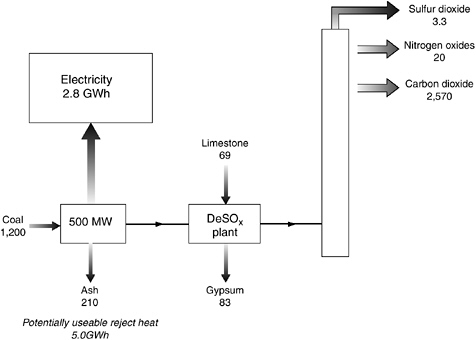
FIGURE 1 Conceptual worst case. Quantities are in tonnes (or 103 kilograms). Assumes station uses average European thermal coal (24 gigajoules per tonne, 17 percent ash and, 1.5 percent sulfur) and operates at 35 percent efficiency with 65 percent annual load factor. GWh = gigawatt hours; MW = megawatt; DeSox = desulfurization.
usually in cooling water. Water throughput is not included in the figure because this is largely unchanged in the cooling process, although some is lost by evaporation. Finally, there are the remaining gaseous emissions: some sulfur dioxide, nitrous oxides, and carbon dioxide.
ENERGY PRODUCTION IMPROVEMENTS
In the United Kingdom, the most recent response to this challenge has been a switch from coal-fired generation to gas generation, which comes as close as is possible to the generation scheme mentioned above. This fuel change has happened very rapidly, largely because nonmarket constraints have been removed, particularly an archaic European Community regulation that prevented the use of gas for electricity generation. Utilities' responses to environmental requirements have also been a driving force.
The use of gas removes, at a stroke, any need for concern with solid waste streams, such as spent flue gas desulfurizer (FGD) sorbents or ash.6 Emissions to air, including any leakage of methane that might occur in the delivery of the gas fuel from gas field to power plant are minimized partly because of the innate
characteristics of the gas and partly because the use of combined-cycle technology offers considerably higher thermal efficiency and lower emissions per kilowatt-hour generated.
The higher conversion efficiency also means that there is less reject heat per kilowatt-hour. Nevertheless, an industrial ecology consideration is whether even the smaller reject heat stream could be put to good use. In several cases, combined heat and power (cogeneration) schemes, mainly for industrial use of the heat, have been developed to exploit this possibility. One constraint on maximizing the use of reject heat streams from large-scale, gas-fired, combined-cycle plants for nonindustrial purposes is that even such benign generation systems are not generally regarded by U.K. citizens as desirable neighbors in residential areas.
A nonenvironmental consideration created by switching to gas is the question of future availability of gas supplies, which has commercial and possibly national strategic ramifications. Availability is also relevant to the question of timing regarding the development of new, environmentally acceptable, generation technologies to replace gas when it eventually becomes uneconomic. At present, however, there is little concern about imminent supply shortages and, indeed, considerable discussion of the way in which the gas "bubble" is turning into a gas "sausage," possibly of prodigious length. Eventually, when this sausage is fully consumed, the next course of the meal may be much less palatable in terms of industrial ecology considerations.
If electricity generation becomes dependent on "clean coal" technology, even the best of today's development (demonstration) technologies, such as coal-gasification combined cycle, will produce significant amounts of solid waste. This waste can be more difficult to use in secondary markets than that from conventional coal-fired plants. In addition the gaseous emissions of these so-called clean technologies are dirtier than that of natural-gas-fueled systems.
Nuclear fission may fill the void left by diminishing economic supplies of gas. In this scenario, it is difficult to think that public apprehension about the technology, although currently declining from a post-Chernobyl high, will easily reach a point where the geographical proximity often associated in the industrial ecology context would be reconcilable with nuclear-powered sources. Nuclear power, at least in the United Kingdom, shares this constraint with some other generation options (particularly waste combustion) that otherwise fit neatly into an industrial ecology perspective. Nuclear power and other resisted technologies cannot necessarily escape criticism by relocating to remote areas. Even if this were economically viable, these are invariably regions of valued landscapes and ecosystems where electricity generation facilities are also viewed with disfavor by powerful interests.
WASTE INTO ELECTRICITY
Household, commercial, industrial, and agricultural waste of various forms may lend themselves to combustion in electricity-generating plants. Although the principle approach to greener industrial ecosystems might be to minimize the creation of such waste streams in the first place, they are likely to be a permanent feature of advanced industrial societies. In addition, recognition is growing that for some fractions of the waste stream it makes more sense to use the embodied energy through combustion than through complex recycling procedures.
Constraints on the usual first-resort strategy of using such waste as landfill mean that the economic attractiveness of incineration, usually with associated electricity generation, has been growing in the United Kingdom. The economic attractiveness of burning waste has been made more attractive by government intervention in the market. Two incentives have been introduced. The first is a direct subsidy to non-fossil-fuel electricity generation in which waste fuels have been classified as nonfossil even though, as is the case with most plastics, they originally are derived from fossil sources. The second is a payment for the avoided cost of landfill, made to plant operators by the waste-disposal authorities legally responsible for handling waste. It is also proposed to introduce a tax on landfill waste.
Because of such incentives, schemes have been developed that use a variety of waste fuels, including conventional municipal waste, old tires, agricultural residues, methane from landfills, and farm slurry. For every scheme constructed, there is probably more than one other that has been abandoned in the planning process because of intense local concerns about gaseous emissions and the general negative image of waste incineration.7 This is a growing phenomenon even in countries such as Japan, where waste incineration has been a conventional waste-management strategy. It poses a potential major constraint on achieving certain industrial ecology-based goals.
REJECT HEAT INTO PRODUCTS
Although it may be desirable from an industrial ecology perspective to minimize reject-heat streams by converting as much of the original energy as possible into electricity, a back-up strategy is to convert the heat into a useful application.
Combined Heat and Power and Combined Heat and Power with District Heating
In combined heat and power (CHP), as much as 90 percent (gross) of the fuel energy input can be recovered in a useful form as electricity and heat. Case studies have demonstrated that costs are also reduced with CHP, and payback periods have frequently been shown to be about 5 years. In situations where the
heat and electricity requirements can be matched carefully to a plant's ability to switch between maximizing electricity and maximizing heat output, CHP can be particularly effective.
The recent past has seen a considerable increase in the capacity of CHP and CHP with district heating (CHP/DH) installed in the United Kingdom, mainly stimulated by the opportunities for sale of electricity to external consumers after the privatization of the electricity supply industry. Electrical output from such facilities rose 29 percent from 1991 through 1993 (Department of Trade and Industry, 1994). There are now nearly 1,000 installations, about one-third at industrial sites and the remainder at commercial, administrative, and residential locations. Over one-half of the installations are small—under 100 kilowatts—but the large facilities (over 10 megawatts) are responsible for over 80 percent of the CHP and CHP/DH generating and heat-raising capacity.
In 1993, 5 percent of the United Kingdom's electricity was generated at CHP and CHP/DH sites; in the industrial sector, this figure is 14 percent. The industrial sector accounts for 90 percent of the total CHP and CHP/DH generating capacity, with particularly significant use in the refineries and chemical industry sectors. The older CHP and CHP/DH schemes tend to be fired by coal or fuel oil but, as in conventional electricity generation, new schemes are increasingly favoring natural-gas fuel.
There is a growing interest in CHP, particularly CHP/DH, in distributed-energy production systems, leading to discussion of whether there might be a reversal of the concentration of generating capacity into fewer, higher wattage facilities over the past 100 years. In the United Kingdom, this has in part been stimulated by the greater freedom of customer choice in the electricity and gas markets resulting from the privatization of the industries. The implications of such trends, where generation of electricity and supply of heat are conducted at the scale of the individual apartment block (or even, under the most bullish scenarios, within the individual home, with automatic sell-back of surplus electricity and so on), have not yet been thought through.
More conventional CHP and CHP/DH schemes are, however, likely to show a steady growth in application (Brown, 1994). At least 10 projects with a capacity of more than 5 megawatts are under construction in the United Kingdom. The U.K. government has also made increasing the proportion of generating capacity that is CHP or CHP/DH part of its strategy for achieving year-2000 targets for reductions in carbon dioxide emissions. This indicates a conviction in official circles that the expansion of the industry will continue, thereby enabling the government to achieve its goals. The most bullish forecasts from within the electricity supply industry predict up to 25 percent of U.K. electricity derived from cogeneration by 2020 (Harvey, 1994).
Horticulture and Pisciculture
Even with conventional generating plants, there has been some experience in the United Kingdom with schemes to use reject heat for greenhouse production of vegetables or for fish farming. The size of the reject heat stream, given the low conversion factors of the stations involved, is such that the entire national demand for greenhouse heating would be met by the output of just one of the United Kingdom's 2,000 megawatt power stations (Coleman, 1993). If the overall amount of reject heat from electricity generation declines as a result of applying industrial ecology, a better match between availability and demand may result.
There will probably continue to be local opportunities for such conversion of reject heat into consumables, but it is likely to remain a minor feature of industrial ecological integration.
Barriers
A major barrier to the more widespread application of the proven technologies of small-scale, gas-fired CHP is the capital cost. Overcoming this barrier has led to the development of new relationships between equipment suppliers and energy uses. There are many variants, but often the supplier of the hardware also provides the financing, whereas the user pays over a period of time from the energy cost savings achieved. Such new energy-service companies are engineering organizations rather than finance houses. They may design, supply, erect, and operate the plant. They may purchase the fuel or the user may do so. Either may sell any surplus electricity. The contractual arrangements between the energy service company and the energy user can be as sophisticated as the parties choose. To encourage energy savings, there can be provisions to share future gains.
CONSTRAINTS
At several points in this paper, barriers have been identified—some of them formidable—that prevent better performance. Innovation is rarely easy, and the widespread introduction of industrial-ecology-based innovations into industrial and commercial life is, by any standards, a major innovative process. It is useful to review the key constraints affecting energy use and production and to explore how these barriers can be overcome.
Energy Prices
Low energy prices do not encourage productive energy use; subsidies need to be removed. In manufacturing, energy is usually a small proportion of total costs. Energy costs, therefore, receive relatively little attention from the financial managers of companies. A perception that energy prices will rise would be a valuable nudge to businesses to give energy productivity more attention.
Lack of Information
There is a pressing need for more information and the dissemination of that information on what is, or will shortly be, possible. Conferences and other discussions help, but industry and commerce are not solely composed of large firms. Small and medium-sized firms are not usually well represented at such meetings. There is a well-recognized need to target such firms with information on concepts and practices. One recognized route is through the influence of large enterprises on their supply chain. This observation does not imply that all small enterprises are unaware of the potentials of improving their energy efficiency or environmental performance. Indeed, it is often they who recognize market niches that go unnoticed by larger enterprises.
A feature of energy production and use is that the interactions and ramifications are so complex that it is not easy to arrive at or convey a straightforward message. There are also conflicting claims by protagonists, which may cause those in a position to act to be confused or dismissive.
Significance of First Cost
For many individual decision makers (especially homeowners), consideration of first cost dominates. There is often a lack of understanding of levelized cost-appraisal methods. To be interested in energy saving, the end user needs to be confident that the savings will materialize. To provide this confidence, there must be well-documented demonstration projects and substantiated indicators of performance. For commercial and industrial investors, there is always concern about the risk incurred by an early investor in an innovative system. Demonstration projects help to allay such concerns (Energy Efficiency Office, 1993).
The Legacy of Adam Smith
A Smithian perspective sees division of labor and functional specialization by enterprises as contributors to a nation's prosperity. Within a firm, the drive for competitiveness leads to pursuit of technical efficiency within the framework of costs and prices as seen by that firm.
Industrial ecology introduces a broader concept—the efficiency of an aggregate of firms within a system—which could be seen as a concept of social efficiency and a new political economy. It will involve bringing together, for mutual benefit, the objectives of individual companies and may result in partnerships between private companies or among government, public enterprises, and private enterprises.
Industrial-ecology-based systems may emerge as opportunities arise for changing the nature and purpose of a company. For example, equipment-supply companies or utilities themselves may decide to turn themselves into energy-service companies.
The Legacy of the Concept of Free Goods
A significant barrier to change has been the tendency to disregard the costs of environmental degradation. There has been a rapid development of the concept of putting a price on the environment and bringing the power of the market to bear on decision making in a way that will increase the attention given to environmental quality considerations. There have been some concrete, practical steps in this direction, particularly in the United States and especially in California. The overall objective is to take account of costs and benefits to obtain environmentally honest prices (Speth, 1992).
VISION
Vision is a key element in major innovation. Vision jumps ahead of extrapolation, freed from perceived constraints, including constraints of the mind. As Jonathan Swift noted, ''Vision is the art of seeing things invisible."
Because of the pervasiveness of energy, any vision needs to be consistent with industrial ecology concepts, including connectedness, waste minimization, and limited use of nonrenewable materials. For energy use in the developed areas of any country (regardless of whether the country is considered developed or developing), the vision should
-
focus around the needs of customers, often as an aggregation of services that customers require rather than a product, and link society and technology;
-
recognize both the contribution that energy makes to society and the need for increased energy productivity;
-
recognize the diversity of means of providing energy, including the purposeful direct use of the energy of the sun and other renewable sources, with increased emphasis on distributed production to meet local needs;
-
recognize the necessity of bringing the power of the market to bear through environmentally honest pricing;
-
include concepts of spatial planning for industry, commerce, and homes;
-
consider integrated energy use and the cascading of energy from high-grade to low-grade uses; and
-
include new partnerships between private and public enterprises to achieve all these aims.
The task is to develop this vision as an aid to applying industrial ecology in the real world, a world in which energy is political and democratic governments exercise the art of the possible, in which an enterprise working within a complex economic framework needs to satisfy the aims and ambitions of its shareholders, customers, employees, suppliers, and neighbors.
APPENDIX
The Organization of Electricity Supply in the United Kingdom
In England and Wales, there are two major private-enterprise electricity generators and a separate state nuclear-based electricity generating company. The strategic transmission system is a separate private company, currently a wholly owned subsidiary of 12 regional private electricity companies (shortly to be divested). The system takes electricity from the generators, sells it to final consumers, and operates its own distribution network. Some of the regional companies self-generate a proportion of their electricity. There are also some smaller independent generators, and these are playing an increasingly important role. For example, companies with large cogeneration plants may sell surplus electricity to the regional companies or to large private customers, using the regional companies' distribution systems. The generators may also sell directly to large consumers of electricity, using the transmission and distribution systems under the regional companies' control.
In Scotland and Northern Ireland, the electricity utilities (two in Scotland, one in Northern Ireland) handle generation, transmission, and distribution, except that in Scotland there is also a separate state-owned nuclear generating company that sells power to the other two utilities. Electricity can also be exchanged between Scotland and England and between England and France (Figure 2). An undersea transmission link will shortly be constructed between Scotland and Northern Ireland. As a consequence of the recent political developments, plans have been announced to reestablish and further develop an electricity transmission system between Northern Ireland and the Irish Republic.
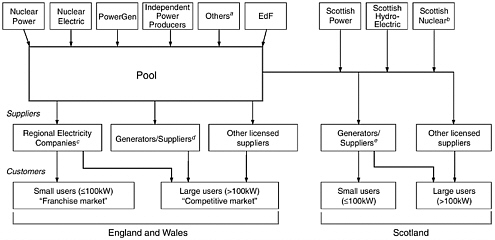
FIGURE 2 Structure of the electricity industry in the United Kingdom. Electricite de France (EDF) is present because electricity can be exchanged between England and France. a Including some autogenerators. b Other small generators also supply electricity to ScottishPower and Scotish Hydro-Electric. c Comprising East Midlands Electricity, NORWEB, Eastern Electricity, SEEBOARD, London Electricity, SWALEC, MANWEB, SWEB, MEB, Southern Electricity, Northern Electricity, Yorkshire Electricity. d Comprising National Power, Nuclear Electric, PowerGen, Scottish Power, Scottish Hydro-Electric. e Comprising ScottishPower, Scottish Hydro-Electric. SOURCE: Department of Trade and Industry, 1994.
NOTES
REFERENCES
Ausubel, J. H. 1992. Industrial ecology: Reflections on a colloquium. Proceedings of the National Academy of Sciences of the USA 89:879–884.
Brown, M. 1994. Combined heat and power—positive progress in the United Kingdom. Energy Policy February:173–177.
Bunn, R. 1993. Changing gear. Building Services May:27–30.
Coleman, D. 1993. National Power News. August.
Department of Trade and Industry. 1994. Digest of UK Energy Statistics, 1994. Appendix C. London: Her Majesty's Stationary Office.
Energy Efficiency Office. 1993. Good practice case study 62. Best Practice Program, February.
Harvey, K. 1994. The development of combined heat and power in the United Kingdom, Energy Policy February:179–181.
Littler, J. G. F., and R. Thomas. 1984. Design with Energy: The conservation and Use of Energy in Buildings. Cambridge:Cambridge University Press.
Smart, B. 1992. Industry as a metabolic activity. Proceedings of the National Academy of Sciences of the USA , 89:804–806.
Speth, J. G. 1992. The transition to a sustainable society. Proceedings of the National Academy of Sciences of the USA, 89:870–872.
Tibbs, H. B. C. 1992. Industrial ecology—an agenda for environmental management. Pollution Prevention Review Spring:167–180.


