
The Industrial Green Game. 1997. Pp. 91–100.
Washington, DC: National Academy Press.
The Functional Economy: Cultural and Organizational Change
WALTER R. STAHEL
A functional economy, as defined in this paper, is one that optimizes the use (or function) of goods and services and thus the management of existing wealth (goods, knowledge, and nature). The economic objective of the functional economy is to create the highest possible use value for the longest possible time while consuming as few material resources and energy as possible. This functional economy is therefore considerably more sustainable, or dematerialized, than the present economy, which is focused on production as its principal means to create wealth and material flow.
One aim of this paper is to sketch out a functional economy. The other is to show the social, cultural, and organizational change that may arise in shifting from a production-oriented economy toward a functional or service-oriented economy.
SUSTAINABILITY
Sustainability depends on several interrelated systems. Each is essential for the survival of humans on Earth. This means that priorities cannot be argued over nor can there be speculation about which of these systems humankind can afford to lose first. In fact, humans cannot risk losing ground in any of these areas:
-
The ecosupport system for life on the planet (e.g., biodiversity), a factor of the regional carrying capacity of nature with regard to human populations and human life styles;
-
The toxicology system (qualitative, sometimes accumulative), a direct
-
danger to man and the result increasingly of humankind's own economic activities;
-
The flows-of-matter system (quantitative), a factor of planetary change (toward a reacidification) and thus a danger to human life on Earth; and
-
The system of societal and economic structures, factors contributing to quality of life.
The last item carries the idea of sustainable economy (Coomer, 1981). It encompasses the broader objective that includes, besides the natural resource problem, the question of the longevity and sustainability of our societal and economic structures.
This insight was at the basis of the movement that coined the English term "sustainability" in the early 1970s. The emergence of the "green" movement and its use of the term sustainability missed the wider perspective of a sustainable society. The broader perspective includes considerations such as full and meaningful employment and quality of life. That perspective is necessary for understanding the importance of the social, cultural, and organizational changes needed for a more sustainable economy.
THE CONSEQUENCES OF TRADITIONAL LINEAR THOUGHT
Current human systems are the result of linear thinking. For example, the terms "added value," relating exclusively to production, and "waste" at the end of the first (and often only) use phase of goods, are notions of a linear industrial economy. Liability for waste stops at the point of sale, after production and resources are incorporated in goods. In contrast, cycles, circles, and loops have no beginning or end. In a true economy of loops there is no waste in the linear sense, and the economy is similar to natural systems, such as the water cycle.
Present national accounting systems and the use of the gross national product (GNP) measure of success is again an inheritance of the linear industrial economy. Adding income and expenses together is an indication of activity, not of wealth and well-being. Waste management, car accidents, pollution control, and remediation costs all constitute positive contributions to the GNP, at the same level as the manufacturing of goods. This shows a basic deficiency of national accounts. In this old frame of reference, waste prevention corresponds to a loss of income (i.e., it is economically undesirable). From a sustainability view, waste prevention is a reduction of costs that contributes to substantial national saving. For example, the waste management industry in Germany costs the economy (i.e., contributes to GNP) about US $45 billion per year. Waste prevention that reduces the need for this management would therefore contribute to national savings.
When discussing the benefits of moving toward a more sustainable society and metrics to gauge such change, it is important to keep the context of nonsustainable national accounting systems in mind.
RESOURCE-USE POLICIES ARE INDUSTRIAL POLICIES
The choice of the best waste-management strategy is often a self-fulfilling prophecy. The promotion of recycling strategies—closing the material loops—conserves the existing economic structures and is thus easy to implement. Unfortunately, the economic value of recycling declines as the recycling volume increases. An increase in the amount of secondary resources causes an oversupply of materials and depresses the prices of virgin and recycled resources alike. The result is a need to export waste materials and with that comes the problem of oversupply. Future technical innovation in recycling will include improvements in design for the recyclability of goods and new recycling technologies, both of which cannot overcome the basic price squeeze mentioned (Jackson, 1993). Increased recycling does not reduce the flow of material and energy through the economy but reduces resource depletion and waste volumes.
In contrast to recycling, strategies for higher resource efficiency reduce the volume and speed of resource flow through the economy. One of the keys to resource efficiency is the take-back strategy: closing the product and material responsibility loops. However, strategies of higher resource efficiency often counter the validity of the present calculus of economic optimization that ends at the point of sale. At first sight, closed responsibility loops even seem to violate traditional task definition in the economy: Industry produces efficiently, consumers use quickly, and the state disposes efficiently. Strategies to close the product responsibility loops, such as the voluntary or mandatory take-back of consumer goods, impose structural changes and are thus more difficult to implement than the recycling of materials. Because these strategies are based on innovative corporate approaches, such as Xerox's asset management program, they are highly competitive as well as sustainable. These strategies will become even more competitive as the functional economy develops and energy prices rise (Stahel, 1994). Future technical innovations that can be expected in this field are those that enable the use of remanufactured and upgraded components and goods, and commercial innovations to keep goods in use as long as possible.
Strategies to achieve a higher resource efficiency through an optimization of the use of goods are measured as resource input per unit of use over long periods of time and will cause substantial structural change within the economy.1 The change will not be easy but these strategies will also have the biggest positive impact on industrial competitiveness. Early adoption may thus give a considerable long-term advantage to companies that dare to change first. Among the strategies for a higher resource efficiency are those for a longer and more intensive use of goods, those for dematerialized goods, and those for innovative system solutions (Table 1). Among the innovations to emerge from a promotion of higher resource efficiency are new technical and commercial strategies to improve use. There have also been innovations in redesigning components, goods,
TABLE 1 Resource Efficiency and Business Strategies in the Service Economy
|
|
Implementation of Strategies |
|
|
|
Closing Material Loops (technical strategies) |
Closing Liability Loops (commercial/marketing strategies) |
|
Resource Efficiency Strategies |
|
|
|
Reduce the volume of the resource flow |
Ecoproducts •dematerialized goods •multifunctional goods |
Ecomarketing •shared utilization of goods •selling utilization instead |
|
Reduce the speed of the source flow |
Remanufacturing •long-life goods •product-life goods • cascading, cannibalizing |
Remarketing •de-curement services •away-grading of goods and components •new products from waste |
|
Reduce the volume and speed of the resource flow |
System solutions •Krauss-Maffei plane transport system |
Systemic solutions •lighthouses •selling results instead of goods •selling services instead of goods |
and systems that reduce material use in manufacturing and in reducing the costs of operating and maintaining the goods in use.
THE PROBLEM OF OVERSUPPLY
The economies of industrialized countries are characterized by several key factors (Giarini and Stahel, 1989/1993):
-
Their populations account for only 20 percent of the world population but for 80 percent of world resource consumption.
-
Their markets for goods are saturated and the stocks of goods represent a huge storage of resources. For built infrastructures, there is also an increasing financial burden with regard to operation and maintenance costs.
-
Their economies suffer from oversupply, which indicates that the old remedy of a higher economy of scale (centralization of production to reduce manufacturing costs) can no longer solve the economic problems or the sustainability issue. The reason for this is that the cost of the services that are instrumental for production are a multiple of the pure manufacturing costs; a further optimization of production therefore does not make economic sense.
-
Incremental technical progress is faster than product development; substituting new products for existing ones will increasingly restrain technological progress compared with the alternative of a faster technological upgrading of existing goods.
The trend toward a higher resource efficiency and a dematerialization of goods and systems will further increase the economic woes of the base-material production and recycling sectors, because demand and prices of many materials will continue to fall.
The situation in many developing countries, however, is radically different. These countries will continue to experience a strong demand for basic materials for the construction of their infrastructures and will continuously suffer from a shortage of affordable resources and goods, including food, shelter, and infrastructure and services for health and education. Transfering the surplus goods and materials of good quality and appropriate technology from industrialized to developing countries may be a solution to both problems.
THE GENESIS OF A SUSTAINABLE CYCLE
Several changes in how we think about economics are necessary for understanding a "life after waste" industrialized society. A critical change is to shift to a service (cycle) economy (Table 1) (Giarini and Stahel, 1989/1993). Cycles have no beginning and no end. Economically, the most interesting part of the cycle and new focal point is the stock of existing goods in the market. Economic well-being is then no longer measured by exchange value and GNP, but by the use value of a product and the wealth presented by the stock of existing goods.
Long-term ownership of goods becomes the key to the long-term (rental) income of successful companies, and with that ownership comes unlimited product responsibility. Strategies of selling the use of goods instead of the goods themselves (e.g., Xerox selling customer satisfaction) and providing incentives to customers to return goods to manufacturers become keys to long-term corporate success. The adaptability of existing and future goods to changes in users' needs (for rentable products) and to technological progress (to keep them current with technological progress) becomes the new challenge for designers and engineers. The economic structure must maximize the return from these new resources (many existing goods in a dispersed market). An adaptation of today's economic, legal, and tax structures to these new requirements may be a precondition for countries to attract and breed successful economic players for a sustainable functional society.
Several multinational companies such as Schindler and Xerox have already started to successfully implement these new strategies. Schindler sells "carefree vertical transport" instead of elevators, a strategy that provides all the services needed by customers (i.e., maintenance, remanufacturing, and technological updating of the hardware). In addition, there is a telephone connection linking every elevator 24 hours a day to a centralized emergency service center. In collaboration with the decentralized maintenance crews of the seller, this system ensures that no person ever gets stuck for more than a few minutes in a elevator that has stopped functioning.
Xerox's asset management program is focused on selling photocopying services instead of photocopies. Asset recycling is now part of a new business process that includes an asset-recycling management organization. Xerox is decoupling manufacturing volume from turnover and profits, regionalizing activities, and changing skill pools and employee responsibilities accordingly.
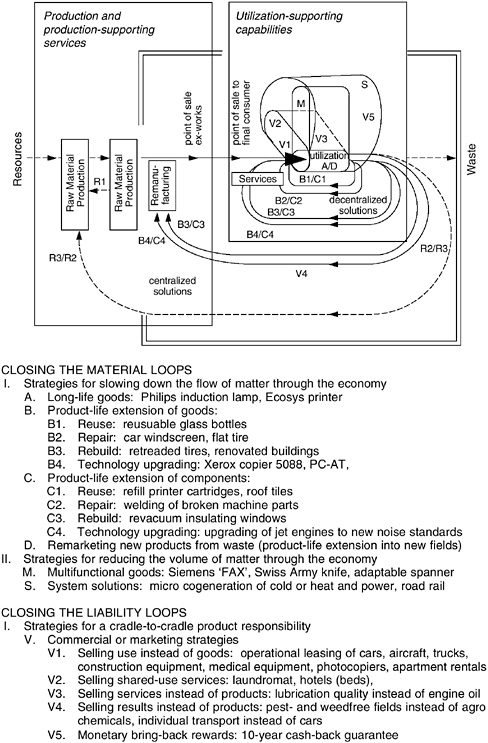
A reduction in the flows of matter through the economy can be achieved by decreasing the volume of flow (through innovative multifunctional products and a more intensive use of products and system solutions) or by slowing the speed of flow (e.g., through the remanufacturing and remarketing of goods to extend product use) (Figure 1).
Slowing the speed of flow is a feasible proposition for all countries. However, developing countries will need to increase the volume of their resource flow for economic development and to build basic infrastructure. Industrialized countries can achieve sustainability by slowing down resource flows.
STRATEGIC AND ORGANIZATIONAL CHANGES
In contrast to the manufacturing economy, economic success in the sustainable service economy does not arise from mass production but from good husbandry and stewardship. Economic rewards come from minimizing tasks needed to transfer a product from one user to the next. Local reuse after a quality check or repair by the manager's representative is the smallest possible cycle in Figure 1 and the most profitable strategy. A product that can no longer be commercialized (i.e., rented or used) will be remanufactured and upgraded, or, in the worst case, be dismantled with the aim of reusing its components for new products.
To achieve the smallest cycles, a different economic and organizational mindset is necessary in several areas:
-
The industrial structure for manufacturing and remanufacturing activities will have to be unified and regionalized. Location of these activities will have to be closer to the market assets, and this proximity means handling smaller (re-) manufacturing volumes. Appropriate methods for such purposes will have to be developed and higher-skilled labor will be required. The cost for such a change is offset by dramatic reductions in purchases of materials and the virtual elimination of disposal costs.
-
Products will have to be designed as technical systems that are part of predesigned modular master plans. Such plans will facilitate ease of maintenance and ease of out-of-sequence disassembly by workers or robots.
-
Components will have to be designed for remanufacturing and technological upgrading according to the commonality principle. This principle was first used by Brown Boveri Company in the 1920s to design its revolutionary turbocompressors. It has been perfected by Xerox in the 1990s in the design of its copiers. The commonality principle promotes standardized multiproduct function-specific components that are interchangeable
-
among different product lines. These standardized components are often maintenance free, self-protecting, and fault tolerant, which greatly reduces operating costs (such as operator and repairman training, and spare-parts management for complex products).
-
New technologies aimed at optimizing the resource efficiency and safety of products and components over long periods of time will have to be developed. These include spareless repair methods, in situ function-quality monitoring systems, and memory chips for life cycle data.
-
New professions and job qualifications will emerge, such as operation and maintenance engineers. The salespersons of the past will have to become customer advisors able to optimize generic products for the needs of specific users, and to upgrade products according to the wishes of the user as technology advances.
-
Users (exconsumers) will have to learn to take care of the rented or leased products as if they owned them, to enjoy the new flexibility in product use offered by a use-focused service economy. Whereas in the industrial economy, misuse and abuse of products lead to a punishment in the form of increased maintenance cost for the owner-user, in the service economy they may lead to the exclusion of a user from the use-focused system.
OBSTACLES, OPPORTUNITIES, AND TRENDS
Many obstacles will need to be overcome on the way to an economy optimizing use-cycles. Most of these obstacles are embodied in the logic of the present linear industrial economy. A supply definition of quality, for example, is based on warranties limited to 6 or 12 months for manufacturing defects only and on the newness of components in new goods. The logic framework of a functional economy requires a demand-side definition of quality based on unlimited customer satisfaction and the guarantee of a system functioning over longer periods of time.
The signs on the horizon clearly point to a use-focused economy:
-
The European Community-directives on product liability and more recently on product safety and the draft directive on service liability all stipulate a 10-year liability period.
-
Some car manufacturers offer a total cost guarantee over 3 or 5 years, which includes all costs except tire wear and fu el.
-
Industry shows an increasing willingness to accept unlimited product responsibility and to use it aggressively in advertising, through money-back guarantees, exchange offers, and other forms of voluntary product take-back and is learning to make product retake and remarketing a viable business division.
-
Out-sourcing is rapidly becoming a generally accepted form of selling results instead of (capital) goods or services.
Companies and regions that initiate the change toward a sustainable society rather than suffering the consequences of it through the actions of their competitors will have a head start and be able to position themselves strategically. An old, but in the age of market research somewhat forgotten, truth of economics will play its heavy hand again: Real innovation is always supply driven—the role of demand is one of selection (Giarini and Stahel, 1989/1993).
SUMMARY AND CONCLUSIONS
The shift in the economy toward a more sustainable society and functional economy began some time ago. However, most experts are unaware of the fundamental change, probably because they interpret the signs in terms of the old industrial economic thinking.
A functional society will not solve all the problems of this world, especially not the inherited problems from the past (e.g., pollution cleanup and unemployment of overspecialized production workers); nor will it make the manufacturing sector disappear. The manufacturing sector could well be transformed into a high-volume producer of global standardized components engaged in regionalized remanufacturing products.
A sustainable economy needs an appropriate structure. The characteristics include a regionalization of jobs and skills, such as minimills for material recycling, remanufacturing workshops for products, decentralized production of services (e.g., rental outlets), local upgrading and take-back (comparable with insurance supplemented by centralized design, research, and management centers). Such an economy will consume fewer resources and have a higher resource efficiency, and its production will be characterized by smaller regionalized units with a higher and more skilled labor input. Transport volumes of material goods will diminish and be increasingly replaced by transports of immaterial goods such as recipes instead of food products, software instead of spare parts.
For the first time since the beginning of the Industrial Revolution, the economy will offer workplace mobility rather than rely on worker mobility. The more that immaterial goods are transported, the greater the feasibility of telecommuting. Flexible work periods and part-time work are compatible with, and even a necessity for, providing services and results around the clock.
Because services cannot be produced in advance and stored but have to be delivered at the location of the client when needed, the economic disadvantages of peripheral suburban zones will partly disappear, as will most of the environmental burden caused by transportation flows to centralized zones.
Waste management could increasingly become a subject for historians rather than economists as large companies reach their goals of zero waste by 2000.
NOTE
|
1. |
The measure of resource input per unit of use became popular in Europe as material inputs per service unit (MIPS) after the publication of a book by Professor Friedrich Schmidt-Bleek (1994). |
REFERENCES
Coomer, J. C., ed. 1981. Quest for a Sustainable Society. Elmsford, N.Y.: Pergamon Policy Studies.
Giarini, O. and W. R. Stahel. 1989/1993. The Limits to Certainty—Facing Risks in the New Service Economy. Boston, Mass.: Kluwer Academic.
Jackson, T., ed. 1993. Clean Production Strategies, Developing Preventive Environmental Management in the Industrial Economy. Boca Raton, Fla.: Lewis.
Schmidt-Bleek, F. 1994. Wie viel Umwelt braucht der Mensch? MIPS - Das Mass fur Ökologisches Wirtschaften. Berlin: Birkhäuser Verlags AG.
Stahel, W. R. 1992. Product design and waste minimization. Pp. 91–98 in Waste Minimization and Clean Technology: Waste Management Strategies for the Future, W. A. Forester, and J. H. Skinner, eds. New York: Academic Press Harcourt Brace Jovanovich.
Stahel, W. R. 1993. Life expectancy of goods and future waste. Pp. 29–35 in International Directory of Solid Waste Management 1993/4—The International Solid Waste Association Yearbook. Kobenhavn, Denmark: International Solid Waste Association.
Stahel, W. R. 1994. The utilization-focused service economy: Resource efficiency and product-life extension. Pp. 178–190 in The Greening of Industrial Ecosystems, B. R. Allenby, and D. J. Richards, eds. Washington, D.C.: National Academy Press.


