
NOTICE: The project that is the subject of this report was approved by the Governing Board of the National Research Council, whose members are drawn from the councils of the National Academy of Sciences, the National Academy of Engineering, and the Institute of Medicine. The members of the panel responsible for the report were chosen for their special competencies and with regard for appropriate balance.
This report has been reviewed by a group other than the authors according to procedures approved by a Report Review Committee consisting of members of the National Academy of Sciences, the National Academy of Engineering, and the Institute of Medicine.
The National Academy of Sciences is a private, nonprofit, self-perpetuating society of distinguished scholars engaged in scientific and engineering research, dedicated to the furtherance of science and technology and to their use for the general welfare. Upon the authority of the charter granted to it by the Congress in 1863, the Academy has a mandate that requires it to advise the federal government on scientific and technical matters. Dr. Bruce M. Alberts is president of the National Academy of Sciences.
The National Academy of Engineering was established in 1964, under the charter of the National Academy of Sciences, as a parallel organization of outstanding engineers. It is autonomous in its administration and in the selection of its members, sharing with the National Academy of Sciences the responsibility for advising the federal government. The National Academy of Engineering also sponsors engineering programs aimed at meeting national needs, encourages education and research, and recognizes the superior achievements of engineers. Dr. Harold Liebowitz is president of the National Academy of Engineering.
The Institute of Medicine was established in 1970 by the National Academy of Sciences to secure the services of eminent members of appropriate professions in the examination of policy matters pertaining to the health of the public. The Institute acts under the responsibility given to the National Academy of Sciences by its congressional charter to be an adviser to the federal government and, upon its own initiative, to identify issues of medical care, research, and education. Dr. Kenneth I. Shine is president of the Institute of Medicine.
The National Research Council was organized by the National Academy of Sciences in 1916 to associate the broad community of science and technology with the Academy's purposes of furthering knowledge and advising the federal government. Functioning in accordance with general policies determined by the Academy, the Council has become the principal operating agency of both the National Academy of Sciences and the National Academy of Engineering in providing services to the government, the public, and the scientific and engineering communities. The Council is administered jointly by both Academies and the Institute of Medicine. Dr. Bruce M. Alberts and Dr. Harold Liebowitz are chairman and vice-chairman, respectively, of the National Research Council.
This study was supported by the Federal Aviation Administration, the National Weather Service, and the Office of the Federal Coordinator for Meteorology under contract No. DTFA01-94-C-00042 and contract No. NA94AANWG0519.
Library of Congress Catalog Card Number 95-72006
International Standard Book Number 0-309-05380-3
Additional copies of this report are available from:
National Academy Press
2101 Constitution Avenue, NW Box 285 Washington, D.C. 20055 (800) 624-6242 or (202) 334-3313 (in the Washington Metropolitan area)
Copyright 1995 by the National Academy of Sciences. All rights reserved.
Printed in the United States of America
Committee on National Aviation Weather Services
Albert J. Kaehn, Jr., Chairman, Commander,
U.S. Air Force Air Weather Service (retired)
John A. Dutton, Vice Chairman, Dean,
College of Earth & Mineral Sciences Pennsylvania State University
Grant Aufderhaar, Research and Development Panel Leader,
The Aerospace Corporation
William W. Hoover, Operations Panel Leader, Executive Vice President,
Air Transport Association (retired)
Sue Ann Bowling, Assistant Professor of Physics,
Geophysical Institute of Alaska, University of Alaska, Fairbanks
George P. Cressman, Director,
National Weather Service (retired)
Wilfred A. Jackson, Assistant Professor,
University of North Dakota
Carl R. Knable, Manager of Meteorology,
United Airlines
Peter R. Leavitt, Chairman and Chief Executive Officer,
Weather Services Corporation
Robert J. Massey, Pilot,
Delta Airlines
Paul K. Rosenwald, Principal Engineer,
NYMA Corp.
Wayne R. Sand, Aviation Weather Consultant
David N. Schramm, Louis Block Professor in the Physical Sciences,
University of Chicago
Paul H. Smith, Senior Manager,
Air Traffic Services, National Business Aircraft Association
Tom Wardleigh, Chairman of the Board,
Alaska Aviation Safety Foundation
Aeronautics and Space Engineering Board Liaison
Robert R. Lynn, Sr. Vice President,
Research & Engineering, Bell Helicopter Textron (retired), Euless, Texas
Staff
Alan C. Angleman, Study Director
JoAnn C. Clayton, Director,
Aeronautics and Space Engineering Board
Ted W. Morrison, Project Assistant
Aeronautics and Space Engineering Board
Jack L. Kerrebrock, Chairman,
Aeronautics and Space Engineering Board,
R.C. Maclaurin Professor of Aeronautics and Astronautics,
Massachusetts Institute of Technology, Cambridge
Steven Aftergood, Senior Research Analyst,
Federation of American Scientists, Washington, D.C.
Joseph P. Allen, President and Chief Executive Officer,
Space Industries International, Inc., Washington, D.C.
Guion S. Bluford, Jr., Vice President and General Manager of Engineering Services Division,
NYMA, Inc., Brook Park, Ohio
John K. Buckner, Vice President,
Lockheed Martin Tactical Aircraft Systems (Retired), Fort Worth, Texas
Raymond S. Colladay, Vice President,
Business Development & Advanced Programs, Martin Marietta Astronautics, Denver, Colorado
Ruth M. Davis, President and Chief Executive Officer,
Pymatuning Group, Inc., Alexandria, Virginia
Steven D. Dorfman, President,
Hughes Telecommunications & Space Company, Hughes Electronics Corporation, Los Angeles, California
Donald C. Fraser, Director,
Center for Photonics Research, Boston University, Boston
John M. Hedgepeth, President,
Digisim Corporation, Santa Barbara, California
Takeo Kanade, Director,
The Robotics Institute, and
U. A. and Helen Whitaker Professor of Computer Science and Robotics,
Carnegie Mellon University, Pittsburgh
Bernard L. Koff, Executive Vice President,
Engineering and Technology, Pratt & Whitney, West Palm Beach, Florida
Donald J. Kutyna, Corporate Vice President,
Advanced Space Systems, Loral Corporation, Colorado Springs, Colorado
John M. Logsdon, Director,
Space Policy Institute, George Washington University, Washington, D.C.
Robert R. Lynn, Sr. Vice President,
Research & Engineering, Bell Helicopter Textron (retired), Euless, Texas
Frank E. Marble, Richard L. Hayman and Dorothy M. Hayman Professor of Mechanical Engineering and Professor of Jet Propulsion,
California Institute of Technology, Pasadena
C. Julian May, President and Chief Operating Officer,
Tech/Ops International, Inc., Kennesaw, Georgia
Bradford W. Parkinson, Professor of Aeronautics and Astronautics,
Hansen Experimental Physics Laboratory, Stanford University, Stanford
Alfred Schock, Director,
Energy System Department, Orbital Sciences Corporation, Germantown, Maryland
John D. Warner, President,
Information and Support Services, The Boeing Company, Seattle, Washington
Duane T. McRuer, Chairman,
Systems Technology, Inc., Manhattan Beach, California,
Ex Officio
Staff Director: JoAnn Clayton
Preface
Each time we see grim pictures of aircraft wreckage on a rain-drenched crash site, or scenes of tired holiday travelers stranded in snow-covered airports, we are reminded of the harsh impact that weather can have on the flying public. Accordingly, the federal government, state governments, commercial air carriers, and a wide variety of aviation and meteorological professional and industry associations strive to improve the ability of the national airspace system to accommodate adverse weather. As part of this effort and at the request of the Federal Aviation Administration, the National Research Council established the Committee on National Aviation Weather Services during May 1994. The committee examined institutional issues that affect (1) the provision of national aviation weather services and (2) related research and technology development efforts. The committee's task statement consisted of five specific elements:
- Examine the roles played by various federal agencies in providing aviation weather services and in planning systems advances.
- Examine the roles of these agencies in research and development for those services.
- Assess the effectiveness of existing institutional arrangements to operate the current system and to plan and direct system improvements.
- Identify possible unmet needs (i.e., potential services or capabilities that may "fall through the cracks").
- Explore alternative approaches that might lead to improved weather monitoring and prediction for the aviation community ill both the Bear and long-term.
In order to assess the effectiveness of institutional arrangements, the committee first examined the adequacy of operational aviation weather services and related research. Although the committee did not focus on the effectiveness of individual aviation weather systems, it did determine how well current systems meet user needs. The committee then determined the extent to which the persistence of unmet needs and other problems could be attributed to shortcomings in institutional arrangements.
The committee concluded that user needs are well defined in earlier reports, federal documents, and interviews with knowledgeable members of the aviation and meteorological communities. In addition, the specific aviation weather functions that the Federal Aviation Administration, National Weather Service, Department of Defense, and other agencies currently provide seem to be well suited to their respective missions and capabilities. However, the committee did discover a lack of consensus and cooperation among many of the parties involved in providing and using aviation weather services. This fragmentation of responsibilities and resources leads to a significantly less-than-optimal use of available weather information. This report examines alternatives for responding to this situation. In particular, the report develops an approach whereby the federal government could provide stronger leadership to improve cooperation and coordination among aviation weather providers and users. The committee believes that stronger leadership is required for timely resolution of many key issues associated with aviation weather services and related research.1 As such, stronger leadership should be viewed as an essential element of the overall effort to improve aviation weather services.
Given its specific tasking, the committee confined its analysis to the relatively specialized field of aviation weather services. That analysis, however, raised broader issues regarding institutional effectiveness within the Federal Aviation Administration. Such issues go beyond the purview of this committee. If the Federal Aviation Administration conducts a more-comprehensive analysis of overall institutional effectiveness, the committee recognizes that this might have implications for the way in which the recommendations of this report are implemented.
The study committee met five times between July 1994 and April 1995, collecting information, assessing relevant issues, and generating appropriate recommen-
|
1 |
See Appendix A for a complete list of the committee's findings and recommendations. |
dations.2 One of the goals of the committee was to ensure that its deliberations included a broad range of perspectives. To accomplish this goal, committee members conducted numerous additional meetings individually and in small groups in order to broaden the information collection effort and to discuss relevant issues with a wide variety of users and providers of aviation weather services. Committee members visited aviation weather and air traffic control facilities operated by the Federal Aviation Administration, National Weather Service, major air carriers, and private weather services in the vicinity of Washington, D.C.; Kansas City, Missouri; Boulder and Denver, Colorado; Boston, Massachusetts; Chicago, Illinois; and Dallas, Texas; and in communities throughout the state of Alaska. As pan of these meetings, committee members discussed aviation weather operations, research, and development with a wide variety of individuals, including pilots, meteorologists, air traffic controllers, flight service specialists, and current and former government officials from the Federal Aviation Administration, National Weather Service, National Transportation Safety Board, and National Oceanic and Atmospheric Administration. The committee wishes to thank all of these individuals, who are listed in Appendix C, for their contributions to the work of the committee. Finally, the committee wishes to express special appreciation and singular recognition to the study director, Alan Angleman, for his competence and diligence in every phase of its activities. His commitment to excellence leaves an indelible mark on this report. Alan was ably assisted by Ted Morrison in this effort. Ted's attention to a myriad of administrative and logistic issues made a significant contribution to the committee's successful conclusion of its task.
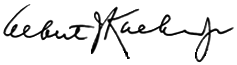
BRIG GEN ALBERT J. KAEHN, JR., USAF (RETIRED)
CHAIRMAN, COMMITTEE ON NATIONAL AVIATION WEATHER SERVICES
|
2 |
See Appendix B for a list of committee members. |
Acronyms
ACARS
Aeronautical Radio Inc. (ARINC) Communications and Reporting System
AFSS
Automated Flight Service Station
ARTCC
Air Route Traffic Control Center
ASOS
Automated Surface Observing System
AWOS
Automated Weather Observing System
COMET
Cooperative Program for Operational Meteorological Training
CWSU
Center Weather Service Unit
DoD
Department of Defense
DUATS
Direct User Access Terminal Service
FAA
Federal Aviation Administration
FAR
Federal Aviation Regulation
FSL
Forecast Systems Laboratory
FSS
Flight Service Station
GAO
General Accounting Office
IFR
Instrument Flight Rules
MDCRS
Meteorological Data Collection and Reporting System
MIT
Massachusetts Institute of Technology
NASA
National Aeronautics and Space Administration
NCAR
National Center for Atmospheric Research
NOAA
National Oceanic and Atmospheric Administration
NTSB
National Transportation Safety Board
NWS
National Weather Service
OFCM
Office of the Federal Coordinator for Meteorology
OMB
Office of Management and Budget
PDT
Prospectus Development Team
RE&D
Research, Engineering and Development
RVR
Runway Visual Range
TDWR
Terminal Doppler Weather Radar
TRACON
Terminal Radar Approach Control
USWRP
U.S. Weather Research Program
VFR
Visual Flight Rules


