
BERND THEODOR MATTHIAS
June 8, 1918-October 27, 1980
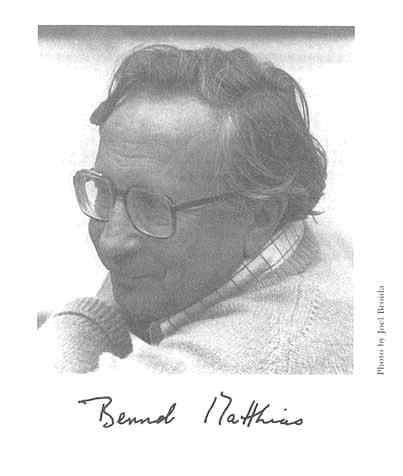
BY T. H. GEBALLE AND J. K. HULM
FOR OVER THREE DECADES, from the time of his doctoral research until his death, Bernd Matthias was a leading discoverer of cooperative phenomena in solids. He excelled in discovering superconductivity, ferroelectricity and ferromagnetism in new materials, and left a legacy of many hundreds of new superconducting and ferroelectric compounds with a wide variety of properties. Superconductivity and ferroelectricity are now regarded as common occurrences in nature rather than as exceptional, as they were when he commenced his lifelong quest. Along the way he discovered unexpected classes of ferromagnetic compounds as well. His unique creativity was based on a remarkably deep appreciation of relationships embedded in Mendeleev's periodic table of the elements. He frequently attributed his discoveries purely to intuition. His intuition was based on his eagerness to experiment with many different materials, a phenomenal memory, a quick mind, and an uninhibited belief in the simplicity of nature. His enthusiasm for science was fueled by an unabashed joy in discovering something new, particularly when it did not depend at all on theoretical input.
Anyone who knew Bernd was brought under the spell of
his powerful personality. While some were turned off by his excesses, most were turned on. He was able to communicate in many languages at a deep and personal level with almost anyone. He had scientific friends and former students scattered all over the world with whom he shared an intimate relationship and with whom he would collaborate when there was a chance to gain some new insight. Once, when returning from a trip, he told me (T.H.G.) joyfully how he replied to the taxi cab driver's query ''Where to?" with "It doesn't matter, they want me everywhere."
PERSONAL HISTORY
Bernd was born in Frankfurt during the closing days of the First World War. His father, a well-to-do merchant, died when he was very young and the family, consisting of his mother and his younger sister Judith, moved a short distance away to the small town of Koenigstein/Tanunus in 1924. He attended primary school and went three or four years to the Realgymnasium. His mother created a free, intellectual, and indulgent atmosphere. Judith remembers seeing "smoke rising from the corner of his room in which he was experimenting." Little more is known about the family history, but the imprint of those early days made a lasting impression. The first thing Bernd unpacked during his frequent traveling in later life was his mother's portrait. His mother, sensing the Third Reich, sent Bernd, at the age of fourteen, to college at the Knabeninstitute auf dem Rosenberg, St. Gallen, Switzerland. That was the end of his German family life. Every Yom Kippur Bernd would renew his heritage (of his grandparents, only his paternal grandmother was not Jewish) by fasting and attending the most orthodox synagogue he could find wherever he happened to be. During the rest of the year religion itself was only a
minimal part of his life, but his spiritual nature remained a dominant force.
Bernd entered the Federal Institute of Technology (ETH) in Zurich in 1936 after receiving his "Matur" at the Institute Montana, Zugerberg, Zug. He studied physics under the influence of Georg Wentzel, who became his friend, and teachers such as Karrer and Pauli. His mother's suicide in 1938 (he told me [T.H.G.] he heard the fatal shot over a long-distance phone line) left him on his own with no financial support. His future as a physicist took a fortunate turn when he became a graduate student of Paul Scherrer and commenced his lifelong study of cooperative phenomena, starting with piezo and ferroelectricity. He received his Ph.D. in 1943, and remained a research associate and close friend of Scherrer.
Bernd came to the United States in 1947 at the invitation of Arthur von Hippel and, even though he stayed in von Hippel's lab at MIT only one-year, they became good friends. William Shockley was instrumental in bringing him to Bell Labs in Murray Hill. He hired Joe Remeika, at the time an unknown and untrained technician, without the approval of the personnel department. Together they initiated work on BaTiO 3 before Bernd took a leave of absence to be an assistant professor (1949-51) at the University of Chicago. There he became an intimate friend of John Hulm from whom he learned techniques of experimental low temperature physics, including running the locally constructed liquefier. With encouragement from Enrico Fermi, Bernd felt that if more superconductors could be found, the patterns of occurrence might provide some essential clues, particularly since there had been little progress in developing a fundamental theory even after four decades of trying. W. H. (Willy) Zachariasen also offered encouragement plus an uncanny ability to identify new structures in complex X-ray
diffraction patterns. Willy became a close, lifelong friend and sometime father figure on whom Bernd could rely for honest, often blunt and pithy responses to ideas and opinions, whether outlandish or otherwise.
Bernd returned to Bell Labs at Murray Hill in 1951 and Remeika continued their efforts on ferroelectrics while Bernd continued searching for new superconductors. He spent almost all of his time making new materials and measuring them. He devoted almost no time to the construction of apparatus or anything else that got in the way of his finding new materials. The detection system was simply a ballistic galvanometer connected to a set of balanced coils which could be cooled to liquid helium temperatures and into which six samples could be lowered by a winch arrangement constructed by Ernest Corenzwit, who later became Bernd's principal assistant and constant chess-playing opponent. There was no ambiguity of phase or signal—if, upon lowering the sample into the coil, the galvanometer needle moved to the left it meant superconductivity, to the right it meant ferromagnetism, and no response meant "nothing." Volume fractions could be crudely estimated from the small deflections and they were carefully observed as they provided important information in identifying minority phases.
Bernd started working with Geballe in 1953 studying the superconducting transition in Nb3Sn that Bernd had just discovered and which was found to have the then highest known transition temperature. They spent many hours, typically on weekends, in the Bell library scanning newly arrived journals for recently investigated materials which showed some promise of having unusual characteristics. Typically these could be made, characterized by powder X-ray diffraction, and measured within a short time frame by a capable and involved group—Corenzwit, Vera Compton, and George Hull, and later Louis Longinotti. Members of the
staff at Bell and others outside became involved when the possibility of new physics emerged. They appear as coauthors with Bernd on many of his 364 publications. It was at Bell that Bernd made most of his major discoveries, and he remained a member of the staff there for the rest of his life.
In 1961 Bernd became a professor at the newly established La Jolla University, later the San Diego campus of the University of California and, with other distinguished physicists such as George Feher, Walter Kohn, and Harry Suhl, and later John Wheatley, built the La Jolla campus into a renowned center of condensed matter physics which attracted outstanding students and visitors. He instilled in his own students, Paul Chu, Louis Creveling, John Englehardt, Zach Fisk, David Hamilton, Hunter Hill, John Huber, Tony Jensen, David Johnston, K. S. Kim, Gordon Knapp, Angus Lawson, Brian Maple, Shaun McCarthy, Brian Sales, Al Sweedler, George Webb, Dieter Wohlleben, among others his passion for discovery using the direct approach of synthesizing, observing, and making empirical generalization. They, along with postdocs, such as Chris Raub, Fred Smith, and visiting student Tord Claeson, have continued his tradition in their own individual ways. He cared little about regular hours. Typically Bernd would come into the laboratory around midnight and the students knew if they wanted to touch base with him they had better be there with work progressing.
In 1951 Bernd married Joan Trapp, the lovely and very literate daughter of the Unitarian minister in Summit. The Trapp family to a large extent replaced the one he had lost in Europe. As with the rest of Bernd's life the marriage was unconventional. There were no children. He loved parties, and his students were always welcome and treated as equals.
The Matthiases enjoyed close relationships with accomplished friends from many walks of life.
Bernd spent his summers at Los Alamos starting in the late 1950s in the seemingly incongruous position as a consultant in the theoretical group where he was encouraged to look into anything that interested him. In 1971 he was appointed (the first) Los Alamos fellow. Bernd led overlapping but distinct research programs at La Jolla, Bell, and Los Alamos throughout the 1970s. In 1980 he was planning to extend his reach even more by returning part-time to where he started—Switzerland and Germany—when he died suddenly following a massive heart attack. As science is truly international, Bernd was truly an international scientist.
LECTURING ABILITY AND IMPACT ON THE SCIENTIFIC COMMUNITY
Matthias was in great demand as a speaker to technical or general audiences. He especially cultivated an informal style, which hardly ever included a manuscript prepared in advance or a text read to the audience directly. He used slides sparingly, but almost always utilized an up-to-date version of the periodic table of superconducting elements which he greatly enlarged in his lifetime. He would usually introduce this slide with a slightly sarcastic laugh, saying that he hoped the audience was familiar with the table. The suggestion that some people might not be was often part of a general criticism of theoretical work on superconductivity which included the message that theorists hardly ever made any useful predictions of new superconductors and therefore were not of much help to experimental works in the field. This proposition was, of course, advanced merely to promote an argument which it almost always did, but without excessive ego damage amongst Bernd's large group of theoretical friends.
Bernd was elected to the National Academy of Sciences in 1965 and to the American Academy of Arts and Sciences in the same year. He received numerous other awards, including the Oliver E. Buckley Award (1970) and the International Prize for New Materials (1979) of the American Physical Society.
SCIENTIFIC ACCOMPLISHMENTS
It is convenient to discuss Bernd's superconducting, ferroelectric, and magnetic studies separately, even though they were concurrent after his first twenty or so publications on ferro and piezoelectricity in Switzerland during his thesis and postdoctoral work. He was particularly proud of the crystal bandpass filter (with Scherrer), which is probably the only device-related work he published. During that time Vul's group in Russia and von Hippel's in the United States discovered ceramic samples of BaTiO3 to be ferroelectric. Soon thereafter, with H. Blattner and W. Merz, he succeeded in growing single crystals which led directly to the study of the electrical anomalies (1947) and also (we assume) led to von Hippel's invitation to come to the United States. It should be remembered that at that time ferroelectricity was a rare occurrence, and only three ferroelectric structures were known. Rochelle salt (potassium sodium tartrate discovered in 1920), KH2PO4 and KH2AsO4 (discovered in 1935), and the above-mentioned BaTiO3. With his colleagues J. P. Remeika, A. N. Holden, and E. A. Wood at Bell Labs, and John Hulm at Chicago, Bernd proceeded to discover new classes of oxygen octahedral ferroelectrics. With the periodic table as a guide, he was led to the alkali metal niobates and tantalates such as LiNbO3 (1951). In the midfifties the dam was broken when, with Holden, Merz, and Remeika, he found the organic salt guanidine aluminum sulfate hexahydrate, followed by simple anhydrous ammo-
nium sulfate (3), to be ferroelectric. The dielectric anomalies of (NH4)2SO4 had long been known. Bernd hypothesized that the N-H-O bond itself might be a source of ferroelectricity which is what motivated him to reinvestigate anhydrous ammonium sulfate in which there is no ambiguity due to water of hydration. He found it to become spontaneously polarized parallel to the a-axis below its transition at 223 K (1956), and thus found evidence for his hypothesis, as well as giving credibility to the idea that the many dielectric anomalies reported in the literature were actually due to ferro or antiferroelectricity. By 1957, after discovering two more ferroelectrics (glycine sulfate and calcium strontium propionate with Remeika and C. E. Miller), Bernd's interests turned to superconductivity and ferromagnetism. His only further publications on ferroelectricity were a few review articles.
The initial search for superconductivity that John Hulm and Matthias engaged in at the Institute for Metals at Chicago was motivated partly by the work of Walther Meissner who discovered some superconducting interstitial compounds of transition metals with borides, carbides, and nitrides in Berlin in the early 1930s. They used the measurement of magnetic susceptibility as described above, rather than the resistance measurement employed by Meissner, which is less reliable when it comes to identifying the phase responsible for the superconductivity in multiphase samples. They confirmed much of Meissner's work, including the 10 K transition of NbC and found MoN with a 12 K transition, second only to NbN.
Shortly after returning to Bell Bernd discovered superconductivity in CoSi2. The unexpected occurrence of superconductivity in a compound made by combining a ferromagnet with a semi conductor gave Bernd great pleasure which he shared with many audiences. Further work with
John Hulm (1953) showed that the CoSi2 had the fluorite structure which had been regarded as one of ionic semiconductors. The earlier discovery of Meissner that superconductivity could be obtained by combining nonsuperconducting Cu with sulfur to form CuS was no longer an isolated case. CeCo2, a superconductor composed of two magnetic elements discovered in England by G. F. Smith and I. R. Harris, was another of Bernd's favorites.
The discovery of superconductivity in V3Si with the beta tungsten structure in 1953 by Hardy and Hulm opened still another family of superconductors to explore, and this one proved to be the most important one for the rest of Bernd's life. He was searching for superconductors with high transition temperatures and, again using the periodic table as a guide, was able to find the first compounds of niobium in the beta tungsten structure with tin, osmium, iridium, and platinum. Of these, Nb3Sn was found to have the highest known transition temperature, just above 18 K (1954). It is perhaps not untypical that the initial interest in Nb3Sn was low. In fact, it was referred to in a Physics Today write-up as "schmutz physiks"; yet, it became the superconductor with the most challenging normal state and superconducting state properties after the discovery by J. E. Kunzler, J. H. Wernick, E. Buehler, and F. Hsu of its high-field, high-current capabilities. It remained such for the next three decades until it was replaced in 1986 by the High Tc cuprate layered perovskites of J. G. Bednorz and K. A. M. Müller.
By the end of 1954 Bernd was ready to make one of his most important generalizations which came to be widely known as the "Matthias rules." In a paper (1955) entitled "Empirical Relation between Superconductivity and the Number of Valence Electrons per Atom" he demonstrated that a simple universal curve could be drawn for Tc as a function of the average valence electron per atom ratio in
elements, alloys, and compounds with maxima at five and seven and a minimum at six. This was consistent with J. G. Daunt's observation that Tc correlated with heat capacity and magnetic susceptibility, and had the virtue of being very simple with predictive power that depended only on the periodic table. The usefulness of this Matthias rule when only a few dozen superconducting alloys and compounds were known is evident if one considers only the prediction as to what happens when Ti (valence 4) is alloyed with any or all of the transition elements to its right in the periodic table. The rule predicted that the Tc of Ti would increase upon alloying it with Nb, and that alloying with Mo would do likewise and as a function of concentration the initial rise in Tc would be twice as fast. Quantitative investigations by Hulm and Blaugher showed that the Tc maxima were at 4.7 and 6.9 average valence electrons per atom. The predictive value of the simple rule was particularly useful in the 1950s when the purity of transition metals was a major difficulty. In fact, Bernd took the apparent breakdowns in his rule as a signal that there was a materials problem, such as the presence of an unknown or unsuspected phase (1962), as was found to be the case of traces of superconducting beta uranium in alpha uranium, or traces of the superconducting compound LaRh5 in pure Rh. In a comprehensive discussion "Superconductivity in the Periodic System" (1957) Bernd concluded from the available experimental data that a necessary condition for the occurrence of superconductivity is that the average number of valence electrons per atom cannot be smaller than two or greater than eight, and that between these limits the Tc is a function of volume and mass as well as the average valence electron count. The volume and mass dependencies helped to rationalize the available data but were not of much predictive help. The universality of the valence electron per atom ratio for the
d-band transition metals with the two maxima can be understood as related to the filling of the d-band and, in retrospect, can be expected to hold very well for elements and alloys and compounds where there is not too much charge contrast and a rigid band filling model is applicable. Bernd recognized that such a simple model did not work for ternary compounds and never gave up trying to find a simple way of understanding them.
Rare-earth elements were obtained as highly purified metals as a result of the Manhattan Project work of Frank Spedding at the Ames Laboratory. As soon as they were released Bernd obtained them directly from Spedding and started exploring the relationship between the rare earths with their magnetic f-shell electrons and superconductivity. In a seminal paper "Spin Exchange in Superconductors" (1958) with Suhl and Corenzwit and input from Conyers Herring he studied the effect of dilute solutions of the rare-earth metals in superconducting lanthanum. The relevant interaction was found from the concentration dependence of the depression of the superconducting transition of lanthanum to be dependent on the spin rather than the total angular momentum of the f electrons. This work was followed by a series of important papers in which the relationship between superconductivity and ferromagnetism and their coexistence was investigated in Laves phases (1959) such as Y(1-x) GdxOs2.
The relationship between superconductivity and magnetism was extended to d-band metals in an important study of dilute solutions of Fe in transition metal alloys (1962). The work was carried out interactively with the theorists A. M. Clogston, P. A. Wolff, and P. W. Anderson. Anderson's theory of localized magnetic states, later was recognized in his Nobel Prize citation, and Wolff's theory of magnetic
states soon followed. The discovery of superconductivity in molybdenum was an experimental follow-on (1962).
Bernd believed that the strong relationship between ferromagnetism and superconductivity in transition metal alloys and compounds might lead to a kind of superconductivity beyond the phonon-induced mechanism of the BCS theory. In contrast to the rapid decrease (some tens of degrees percent of Fe) found in some of the d-band metals reported above, there was the intriguing observation that dilute solutions of Fe and Co in titanium were ten times as effective in raising the Tc of the room temperature hexagonal phase of titanium than predicted from his empirical valence electron per atom rule; however, the anomalous behavior was given a simple metallurgical explanation after a careful investigation carried out with E. Raub's group in Germany established the presence of filaments of the bcc phase of titanium in which the Fe segregated and reached a concentration of roughly ten times its normal value. The first high-field magnet was produced with Kunzler and associates using an MoRe alloy with composition adjusted to give a high Tc, and which was ductile so that it could be easily fabricated (1961).
Bernd was also aware that the phonon mediated mechanism for superconductivity had only been established for non-transition metals with energy bands derived from s and p orbitals where magnetic effects were minimal. The superconducting isotope effect (the dependence of Tc on the square root of isotopic mass) had earlier been a key result in signaling the electron-phonon mechanism. The phonon mechanism was later directly established by superconducting tunneling spectroscopy of Rowell and coworkers, but at that time, in 1961, no successful tunneling spectroscopy had been possible with d-band metals, a fact that in itself was considered significant. (Later work showed the prob-
lems were materials related.) From Oak Ridge it was possible to obtain sufficient quantities of isotopes of ruthenium to make the first investigation of the isotope effect in d-band metals. Bernd considered the finding that there was no measurable dependence of the transition on mass (1961) to be evidence for a non-phonon mechanism. This was reinforced by further work with isotopes of superconducting osmium, although the latter actually showed a small effect. The inference of a new mechanism was almost immediately challenged by P. W. Anderson and P. Morel by their extension of BCS theory which included retardation effects and could account for the reduced isotope effects. The theoretical work was carried out at the same time in Anderson's office right around the corner from the lab where the experiments were done. Subsequently, when it became possible to make good tunnel junctions with transition metal, elements such as Nb spectroscopic studies found direct evidence for the phonon mechanism.
Bernd never stopped exploring new systems, looking for higher new Tc's and mechanisms. A comprehensive review published in 1963 and still valuable today discussed superconductivity in all the then known elements, alloys, and compounds (1963) and related the occurrence and nonoccurrence to crystal structure as well as to the Matthias rules. In retrospect, the compounds were restricted to binary and pseudo-binary phases and solid solutions and Bernd's generalizations really did not encompass the subtleties of ternary and more complex structures such as the layered cuprate structures in which Bednorz and Müller discovered high temperature superconductivity and likely another mechanism in 1986, although he remarked at a La Jolla seminar that ''the ternary materials area is so fertile that even a blind chicken can find a grain."
Bernd noticed that when chemical substitutions resulted
in an increasing Tc the increase was inevitably terminated by an instability (i.e., crossing a phase boundary to a new phase in which the superconductivity was degraded or nonexistent). This was encountered in the niobium-based betatungsten structures and eventually led to raising the superconducting transition in bulk Nb3(All-xGex) to above liquid hydrogen temperatures for the first time (1967).
Bernd and his students at La Jolla took an important step in oxide superconductivity when they discovered superconductivity in the alkali metal-tungsten bronzes (1964). This, the first ternary system he studied, already violated his rule that superconductivity was favored in cubic structures, a result he later explained by invoking a weak symmetry-breaking ferroelectric-related transition in the cubic phase (1967). Bernd concluded that "it is ironic that not ferromagnetism, but ferroelectricity instead should be the phenomenon most incompatible with superconductivity" (1967); however, he was intrigued with the enhancement of superconductivity which was found at phase transitions and lattice instabilities (1967).
Bernd's interest in intermetallic boride superconductors, which started with his first work with Hulm at Chicago, continued throughout his career with studies of superconductivity and ferromagnetism in the binary hexa- and dodecaborides and culminated in the discovery of the ternary rare-earth rhodium borides with J. M. Vandenberg at Bell. The work continued at La Jolla with M. B. Maple and members of the Matthias and Maples groups and very interesting reentrant superconductivity and magnetic ordering phenomena were found (1978). This work followed the earlier discovery of superconductivity in the molybdenum-based Chevrel phases such as PbMo6S8 which Bernd considered the first high temperature ternary superconductor (1972).
Bernd's work at Los Alamos was carried on mainly dur-
ing the summers with an active group of collaborators, including R. D. Fowler, A. L. Giorgi, E. G. Szklarz,J. L. Smith, Z. Fisk, G. R. Stewart, H. H. Hill, C. E. Olsen, and N. H. Krikorian, among others. The investigations, as might be expected, included 5f and other radioactive elements, alloys and compounds, and difficult-to-handle materials such as beryllium. High melting refractory compounds were found to be superconducting. Evidence for an increase in Tc (positive isotope effect) with mass was found by investigating isotopes of alpha uranium (1967).
Over the years Bernd discovered two metallic ferromagnets in which magnetism was completely unexpected because none of the constituents were magnetic metals, namely ZrZn2 (1958) and Sc3In (1961). These became important subjects for the study of weak itinerant ferromagnetism which are still of current interest. The Los Alamos work added a related compound, TiBe2, which has an enhanced magnetic susceptibility and can be made ferromagnetic by substituting copper for some titanium.
Some of the extent and legacy of Bernd's contributions have hopefully been documented in this memoir. There is one more anecdote to add; it concerns the discovery of ferromagnetism in the important class of europium chalcogenides with the NaC1 structure. Bernd and J. H. Van Vleck were having lunch at Murray Hill one day when Bernd remarked that the EuIr2 he had prepared was ferromagnetic, and from Zachariasen's reasoning based on lattice constant considerations, the Eu had to be trivalent. Van held emphatically that there had to be a mistake because plus three europium was not magnetic. After a spirited argument Bernd went back to the laboratory and in a very short time discovered the new compound EuO simply by reacting Eu metal with the trioxide to form divalent Eu, and in so doing opened
the way to interesting phenomena in a new class of semiconducting ferromagnets.
One of the major developments of the twentieth century has been the emergence of the science of materials from the traditional disciplines of physics, chemistry, and metallurgy. Bernd Matthias will be remembered as a premier contributor.
SELECTED BIBLIOGRAPHY
1947 With H. Blattner, W. Merz, and P. Scherrer. Electrical anomalies of barium titanate single crystals. Helv. Phys. Acta 20:245.
1951 Ferroelectricity. Science 113:591.
1953 With J. K. Hulm. Properties of cobalt disilicide. Phys. Rev. 89:439.
1954 With T. H. Geballe, S. Geller, and E. Corenzwit. Superconductivity of Nb Sn. Phys. Rev. 95:1435.
1955 Empirical relations between superconductivity and the number of valence electrons per atom. Phys. Rev. 97:74.
1956 With J. P. Remeika. Ferroelectricity in ammonium sulfate. Phys. Rev. 103:262.
1957 Superconductivity in the periodic system. In Progress in Low Temperature Physics, ed. C. J. Gorter, p. 138. Amsterdam: North-Holland Publishing Co.
1958 With H. Suhl and E. Corenzwit. Spin exchange in superconductors. Phys. Rev. Lett. 1:92. Errata. Phys. Rev. Lett. 1:152.
With R. M. Bozorth. Ferromagnetism of a zirconium-zinc compound. Phys. Rev. 109:604.
1959 With V. B. Compton. Laves phase compounds of rare earths and of hafnium with noble metals. Acta Cryst. 12:651.
1961 With T. H. Geballe, G. W. Hull, Jr., and E. Corenzwit. Absence of an isotope effect in superconducting ruthenium. Phys. Rev. Lett. 6:275.
With J. E. Kunzler, E. Buehler, F. S. L. Hsu, and C. Wahl. Production of magnetic fields exceeding 15 kilogauss by a superconducting solenoid. J. Appl. Phys. 32:325.
With A. M. Clogston, H.J. Williams, E. Corenzwit, and R. C. Sherwood. Ferromagnetism in solid solutions of scandium and indium. Phys. Rev. Lett. 7:7.
1962 With A. M. Clogston, M. Peter, H. J. Williams, E. Corenzwit, and R. C. Sherwood. Logical magnetic moment associated with an iron atom dissolved in various transition metal alloys. Phys. Rev. 125:541.
Metallurgy from superconductivity. In Superconductors, eds. M. Tanenbaum and W. V. Wright, p. 1. New York: Interscience Publishers.
With T. H. Geballe, E. Corenzwit, and G. W. Hull, Jr. Superconductivity in molybdenum. Phys. Rev. Lett. 8:313.
1963 With T. H. Geballe and V. B. Compton. Superconductivity. Rev. Mod. Phys. 35:1. Errata Rev. Mod. Phys. 35:414.
1964 With C. J. Raub, A. R. Sweedler, M. A. Jensen, and S. Broadston. Superconductivity of sodium tungsten bronzes. Phys. Rev. Lett. 13:746.
1967 With T. H. Geballe, L. D. Longinotti, E. Corenzwit, G. W. Hull, R. H. Willens, and J. P. Maita. Superconductivity at 20°K. Science 156:645.
The search for new materials. In Ferroelectricity, ed. E. F. Weller, pp. 176-82. Amsterdam: Elsevier Publishing Co.
Ferroelectricity. J. Appl. Phys. 38:928.
With W. H. Zachariasen, G. W. Webb, and J. J. Engelhardt. Melting point anomalies. Phys. Rev. Lett. 18:781.
With R. D. Fowler, J. D. G. Lindsay, R. W. White, and H. H. Hill. Positive isotope effect on the superconducting transition temperature of a-uranium. Phys. Rev. Lett. 19:892
1972 With M. Marezio, E. Corenzwit, A. S. Cooper and H. E. Barz. High-temperature superconductors, the first ternary system. Science 175:1465
1978 With D. C. Johnston, W. A. Fertig, and M. B. Maple. Re-entrant superconductivity and magnetic ordering in the pseudoternary system (Er1-xHox)Rh4B4. Sol. St. Comm. 26:141.


