
HARRY LIONEL SHAPIRO
March 19, 1902-January 7, 1990
BY FRANK SPENCER
DURING THE COURSE OF his professional career, which DJ spanned the second and third quarters of the twentieth century, Harry Lionel Shapiro made a number of significant contributions to biological anthropology, most notably his inquiries into racial mixture and the role of the environment and geography in determining racial characteristics. He also contributed to the foundations of forensic anthropology in the United States and is further distinguished by being the first in an influential series of doctorates produced under the aegis of Earnest Albert Hooton (1887-1954) at Harvard between 1925 and the early 1950s, a generation that contributed significantly to the development of academic physical anthropology in the United States. Although his professional career unfolded in a museum context (namely, the American Museum of Natural History), Shapiro was nevertheless able, through an adjunct position at Columbia University, to play a modest, yet integral role in this important development after World War II. 1
PERSONAL HISTORY AND EDUCATION
Harry was the second of three sons born to Rose (Clemens) and Jacob Shapiro, both Polish Jews, who emigrated sepa-
rately to the United States in the late 1880s. Their first years in the New World were spent in New York City's Polish enclave situated on the lower east side between the Bowery and the East River. Here Rose, like many other new immigrants, eked out a living "rolling cigars" in one of the many neighborhood cigar factories. At first Jacob walked the crowded streets of lower Manhattan peddling assorted wares from a tray and later found regular employment in a shoe factory. Precisely when and under what circumstances they met is not known; however, after their marriage sometime in the mid-1890s it was decided to move to Boston, Massachusetts, where Jacob planned to open a small shoe repair shop. It was here in the Chelsea district that Harry was born and grew up. While little is known of his early childhood a yellowed photograph of a young Harry (aged four) decked out in a then fashionable "Little Lord Fauntleroy" suit suggests that his father's business had prospered; and save for the early demise of his younger brother (whose name and date of death is unknown) these early years appear to have been essentially happy ones.2
In contrast to his elder brother Barney (born in 1898), who could not wait to leave school and make his way in the world, Harry was inclined to more cerebral pursuits and enjoyed school. In 1916 his dedication to academic studies was rewarded when he successfully competed for a place at the prestigious Boston Latin School. At the Latin School Harry's intellectual sensibilities were refined and tuned by a rigorous classical education, which also generally prepared him for the eventual passage to Harvard three years later.
According to Harry3 his academic plans on entering Harvard were rather vague and remained so until his sophomore year, when he apparently first encountered Hooton. At that time Hooton was a rising star in the Department of Anthropology and had already acquired a reputation for
his lively lectures. Although he acknowledged that he too had been captivated by Hooton's charm and erudite wit, apparently what most impressed Harry and led him to choose anthropology as his major was the exciting prospects conjured up by Hooton "of the potential capacity of physical anthropology to make important and relevant contributions to the understanding of man and human populations."4
Within the broad sub-disciplinary boundaries of physical anthropology Harry was attracted to the then fledgling field of human genetics and the related study of race and racial mixture, all of which were well-aired topics in Hooton's lectures. With the probable exception of the pioneering study made by the German anthropologist Eugen Fischer (1874-1964) on the racially mixed community of Rehoboth in then German Southwest Africa5 this field of inquiry was, as Hooton made abundantly clear, still wide open for further investigation. Apparently Hooton even suggested possible populations that would be ideal research subjects, noting in particular that "if there was anywhere in the world he would want to go to do [such] research it would be Pitcairn Island."6
By the end of his senior year the die was cast. On graduating magnum cum laude in 1923 Harry remained on at Harvard and spent the next year preparing for his intended field research. To this end Hooton directed him to the Bussey Institute for Applied Biology at Harvard, where his knowledge of statistics and human genetics was augmented by William Ernest Castle (1867-1954) and Edward Murray East (1879-1934). 7 Finally in 1924, supported by a graduate fellowship, Harry embarked on his study of the Pitcairn Islanders, who were the descendants of the celebrated mutiny aboard the British naval vessel Bounty in 1789. Originally the mutineers and their Tahitian women settled on Pitcairn, a remote and deserted tropical island in the South
Pacific; but by 1856 the island was deemed too small to support its resident population of 187 and as a consequence the Pitcairners were moved en bloc to Norfolk Island, a former whaling station situated temperately between Australia and New Zealand. While several families later returned to Pitcairn, most remained on Norfolk, and it was this population that Harry made the centerpiece of his doctoral research. 8 When completed, this study represented one of the first demonstrations of "hybrid vigor" in a racially mixed population (vide infra).
Professional opportunities in physical anthropology during the 1920s were limited, to say the least, and quite naturally as his doctoral dissertation neared completion Harry began worrying about his employment prospects. As luck would have it, early in 1925 an assistant curatorship at the American Museum of Natural History (AMNH) in New York City became available as a result of the untimely death of Louis R. Sullivan (1892-1925). Prior to his death Sullivan had been conducting pioneering anthropometric research in the Hawaiian Islands.9 Hooton knew Sullivan and was an admirer of his work,10 and saw Harry as a natural replacement. Clark Wissler (1870-1947), who was at that time chairman of the museum's Department of Anthropology, concurred. Thus, in 1926 on receipt of his doctorate he moved to New York City to begin what was to become a lifelong association with the AMNH.
Harry's first decade in New York was a period of intense research the products of which served to secure his scientific reputation and also a series of promotions at the museum that began with his elevation to associate curator in 1931. In 1942 he was made curator and appointed Wissler's successor as department chairman, a position he retained until his retirement twenty-eight years later.
This same period also witnessed the beginning of his re-
lationship with Janice Sandler (1908-62), the daughter of a prominent Manhattan lawyer. Following their marriage on June 26, 1938, Harry and Janice set up home on the upper east side. From all accounts Harry was both a devoted husband and father to their three children: Thomas (1939), Harriet (1942), and James (1946). According to James, he particularly adored Janice's ''distracted mien" while cooking or drawing (she was a well-known amateur artist), and although vigorously resisting any suggestions she might make with regard to modifying something he had written, he always sought her criticism. From all accounts she regularly served as his unofficial editor until her tragic death in 1962, an event from which he never fully recovered. 11
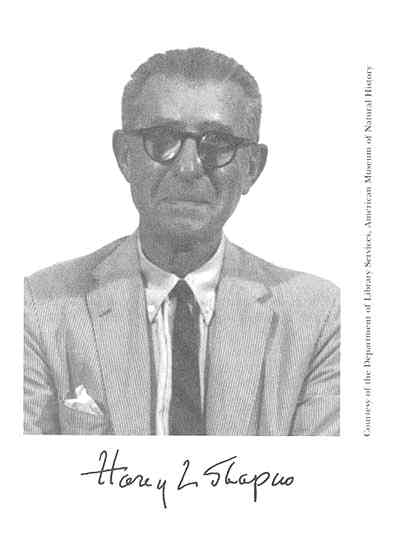
No private portrait of Harry is complete without some mention of the "second home" he helped build for his family in Pine Plains in upstate New York. Here Harry learned how to unwind tending his beloved garden (that included a French allée and a Jeffersonian serpentine wall). He also derived immense pleasure from chatting with passing neighbors "dressed in a broken straw hat, baggy khaki shirt and trousers, and leaning on his shovel—as his perpetual pipe haze stained the summer air." As revealed in the accompanying portrait, Harry's pipe was a trademark, which he carried everywhere. He was apparently introduced to the pleasures of pipe smoking sometime in late adolescence by his brother Barney—a lifelong habit sustained by regular shipments of his favorite brand from a Cantabrigian tobacconist.11
Along with these arcadian pleasures Harry also enjoyed music. With considerable perseverance he taught himself to play the cello and by the late 1950s he had become quite adept. The discovery that he and Colin M. Turnbull (1926-94), an associate curator in African ethnology in Shapiro's department from 1959 to 1969, shared a mutual interest in
music led to regular informal recitals. Turnbull would play a clavichord he had built himself and Shapiro would accompany him on the cello. Following Turnball's departure from the AMNH this routine was broken until early in 1977, when it was resuscitated with the formation of a rotating musical group consisting of Leslie F. Marcus (piano), a research associate in the Department of Invertebrates; Cook Glassgold (recorder), a volunteer worker in anthropology; Clarissa Wilbur (piano), a secretary in anthropology; and Beatrice Brewster (recorder), a senior secretary in entomology. Their repertoire included pieces by Haydn, Schubert, and Beethoven.12
PROFESSIONAL DEVELOPMENT AND CONTRIBUTIONS
Shapiro's professional career separates into three somewhat arbitrary periods or phases of development (1926-45, 1945-70, and 1970-90), each characterized by a general shift in scholarly emphasis.
During the period 1926-45 Shapiro's primary research focus was the study of various populations in Oceania as well as selected groups along the Pacific rim. This work, however, did not begin immediately. Between 1926 and 1929 Shapiro developed several in-house research projects that included a study of a large series of crania acquired by the museum in 1924 which had been collected in the early 1900s by the German anthropologist Felix von Luschan (1854-1924) from charnel houses in the Greifenberg region of western Carinthia, Austria. While these specimens could not be arranged in chronological sequence they were known to represent samples of the Greifenberg population in the seventeenth, eighteenth, and early nineteenth centuries. Shapiro (1929,1) subjected these crania to a relatively sophisticated array of statistical analyses, the results of which constituted a substantial contribution to the knowledge of the complex
racial character of central European populations. Another study was on a small series of male skeletons accidentally recovered in 1926 from a site near the Harlem River that was being excavated by the Rapid Transit System of New York City, which Shapiro (1930) subsequently discovered had been a former burial ground dating back to colonial times. Among other things this modest comparative study enabled him to confirm a basic finding of a study published in 1925 by the Smithsonian Institution anthropologist Ale Hrdlicka (1869-1943), namely, that stature had increased over time in this old American stock.13 Like Hrdlicka, Shapiro was inclined to believe that this trend could be attributed to the complex stimulus of a favorable environment—a theme that was to reverberate throughout much of his later work.
In 1928 Shapiro received an anticipated invitation from the Bernice P. Bishop Museum in Honolulu to continue Louis Sullivan's earlier research efforts. The arrangement, which he accepted, required him to spend three extended seasons (of variable length) in the field surveying various racial groups. Beginning in April 1929 he spent nine months (April to January) in Hawaii, followed by a return visit in the summer of 1930 and again in 1931-32. On this latter occasion he spent seven months (September to March) visiting various countries on the Pacific rim, most notably China and Japan. This was followed in 1933 by a three-month sojourn (September to December) in Tahiti. This intense period of activity culminated with a six-month cruise (September 1934-February 1935) through eastern and southwestern Polynesia aboard the private yacht Zaca owned and skippered by Templeton Crocker (1884-1948).14
Flowing from all of this activity was a slew of publications dealing with a variety of subjects ranging from the physical characteristics of the Society Islanders to the ruins of Angkor.
Without question the most significant and enduring productions of this period were two books, The Heritage of the Bounty (1936) and Migration and Environment (1939). In the Heritage volume Shapiro revisited his doctoral dissertation from the perspective of his more recent observations and comparisons of the populations on Norfolk and Pitcairn (which he had visited during the cruise of the Zaca). In a nutshell, this now classic work refuted the claims of such workers as Charles B. Davenport (1866-1944) and Morris Steggerda (1900-1950), who had concluded from their study of cross-breeding that Jamaican mulattoes were biologically and intellectually inferior to their ancestral groups.15 Finding no basis for such a pernicious thesis, Shapiro argued that the "dangers" of miscegenation were not only unfounded but that there was every reason to suppose that the production of racial mosaics had been an integral factor in the history of human civilization—an optimistic message that was subsequently underlined in a concise study published by UNESCO under the title Race Mixture (1954).16 Likewise, Migration and Environment assaulted another "dangerous" myth of the period: the assumed stability of hereditary characteristics. Although the fallacy of this assumption had been exposed in the early 1900s by the seminal study conducted by the Columbia University anthropologist Franz Boas (1858-1942) on the descendants of immigrants born in the United States,17 the theoretical ramifications of Boas's study had been widely resisted and criticized. This general resistance continued well into the 1920s and 1930s in spite of supporting evidence from newer studies such as the one made by the American anthropologist Leslie Spier (1893-1961), a former student of Boas.18 Convinced of the validity of the environmental hypothesis, Shapiro orchestrated, with the assistance of two graduate students, William A. Lessa (b. 1908) in New York and Frederick S. Hulse at Harvard (1906-
90), an ambitious comparative study of two oriental populations in Hawaii, the Chinese and Japanese. For reasons no longer clear Lessa's fieldwork in Hawaii and China was not utilized, whereas the anthropometric data collected by Hulse in Hawaii and Japan became the cornerstone of the Migration book.19 Shapiro's analysis of these data provided a striking and influential example of marked differences in a range of physical characteristics which he persuasively argued were unquestionably due to complex environmental influences.
Following the disruption of World War II Shapiro did not, contrary to expectations, resume an energetic research agenda in the Pacific. Although, as indicated by subsequent field trips to the French Marquesas in 1956 and Polynesia in 1970, he continued to have a professional interest in the anthropology of the Pacific, these trips were not, so it would seem, designed to address a specific research problem and, as such, did not lead to any major publications. In fact, most if not all of the articles published in this area after 1945 fall into the category either of general articles (many of which can be found in the pages of the AMNH's popular magazine Natural History) or in semi-popular summations, such as his Thomas Burke Memorial Lecture on "The Peopling of the Pacific Rim" delivered in Seattle in 1964.
Along with this continuing but clearly diminished activity in the Pacific the period between 1945 and 1970 is distinguished by a mounting interest in the developing field of forensic anthropology and the practical application of physical anthropology to medico-legal issues, as well as the publication of several notable books: Aspects of Culture (1960), The Jewish People: A Biological History (1960), and an edited volume Man, Culture, and Society (1956). Throughout this period Shapiro held the position of adjunct professor of anthropology at Columbia University and during his tenure there (1942-1973) he was not only responsible for teaching
a regular sequence of graduate courses but also sponsored several doctoral dissertations.20
Shapiro's involvement in the then nascent field of forensic anthropology began early in 1945. With victory in Europe at hand, he was asked by the quartermaster general in Washington, D.C., if he could assist in the grim task of identifying the remains of unknown American military personnel who had been killed in action. Complying with this request, Shapiro went to France in May 1946 and began a four-month tour of western Europe. From this survey he developed a detailed protocol for identifying the war dead based on established techniques in physical anthropology. His recommendations were immediately put into practice at the newly created Central Identification Point in Strasbourg, France, and subsequently were employed at a second identification laboratory established in Hawaii under the direction of another former student of Hooton, Charles E. Snow (1910-67).21 Although the actual identification work in Europe was performed by European personnel under the technical direction of a French forensic specialist,22 Shapiro was periodically consulted on problematic cases, and between the autumn of 1946 and 1948 he was a frequent visitor to the Brooklyn Naval Yard where he was called on to examine and identify skeletal material that had been shipped from Europe for repatriation and reburial. The general success of this program of recovery and identification provided an important stimulus to the subsequent development of American forensic anthropology.23
Following in the wake of this activity was an increasing number of requests from local and national law enforcement agencies anxious to employ his expertise in identifying skeletal remains—such as the time he was called to examine the charred bones of two young girls brutally murdered by a man in Brooklyn who had been dubbed by the
tabloid press as "The Black Bishop."24 Unfortunately, the corpus of this work was never summarized by Shapiro for publication and the same is largely true for the many paternity and adoption cases (cf. Shapiro 1963) he became involved in during the 1950s and 1960s, which profited from his knowledge and interest in problems related to racial mixture.
Another facet of Shapiro's professional activity during this middle-career period was his creation of several major exhibitions at the AMNH, in particular the Hall of the Biology of Man, which was praised in The New York Times as "the newest thing of value in this city" when opened to the public in 1961. He was also the principal architect of the equally successful Travelers Insurance Company exhibit, "The Triumph of Man" (a life-sized dioramic presentation of human biocultural evolution) at the 1964-65 New York World's Fair.
Coinciding with the unveiling of this latter exhibit was an invitation from the Indian Statistical Institute in Calcutta requesting his assistance in the development of a series of research studies devoted to current issues in human biology. This invitation led to two extended visits to India in 1965 and 1967, which represented his last major project prior to his retirement (cf. Shapiro 1966).
Blessed with a relatively robust constitution, Shapiro was able to continue working on projects and miscellaneous assignments until well into the latter half of the 1980s. Although several projects were never completed, such as his much anticipated biography of Hooton, this "retirement" period did witness the appearance of several publications, most notably his book Peking Man (1974). This work deals with the discovery of Homo erectus fossils in China during the late 1920s and 1930s and the mystery of their subsequent disappearance sometime early in December 1941 when
American and other westerners began a hurried retreat from China. While superficially a vehicle for an account of the fruitless search for these lost remains (dealt with essentially in the final chapters and which is not without interest) the real value of this narrative lies in the earlier chapters in which a recounting of the history of paleontology and, in particular, the events that unfolded in China between 1920 and the late 1930s is enriched with a personal knowledge of the events, as well as some occasional and tantalizing observations on individuals who figured in this history, such as Davidson Black (1884-1934) (see also Shapiro 1981), Franz Weidenreich (1873-1948), and Pierre Teilhard de Chardin (1881-1955). As this book reveals perhaps more than any other of his published works Shapiro was an inherently private and modest human being.
Towards the end of 1989 he was finally obliged to quit working. Throughout the months of November and December his health steadily deteriorated and finally on December 23 Harry L. Shapiro was admitted to Lenox Hill Hospital, where he died on Sunday, January 7, at 3.00 p.m.
POSITIONS, SERVICE, AND HONORS
Shapiro was a founding member of the American Association of Physical Anthropologists in 1930 (AAPA) and between 1935 and 1939 served a term as its secretary and subsequently as vice-president (1941-42). The AAPA and its adopted organ, the American Journal of Physical Anthropology, had been brought into existence by Hrdlicka (vide ante), who continued to watch over both of them with what the AMNH paleontologist William K. Gregory (1876-1970) called a "a fierce, almost maternal love." Like most of the AAPA's membership, Shapiro greatly admired and respected the "Old Man" for his many achievements and contributions to the discipline, he nevertheless believed, as did others from
his generation, that Hrdlicka's resistance to the introduction of papers "worshipping such strange gods as statistics, genetics, and endocrinology" was unreasonable and impeding the development of the discipline. Cognizant of the mounting dissatisfaction with Hrdlicka, Shapiro early in the summer of 1941 took this delicate problem to Gregory, who was at that time president of the AAPA. He told Gregory that unless Hrdlicka desisted from conducting the society "as if it were a class of unruly schoolboys," there was a serious threat that the "younger men" might break away. Gregory was concerned and sympathetic and promised to do whatever he could to negotiate a change. 25 In the meantime, to alleviate some of the tension, Shapiro founded the journal Anthropological Briefs, which began publication in April 1942. Soon thereafter, however, Hrdlicka passed away and with it the need for Shapiro's alternative outlet.
Along with the AAPA Shapiro was also actively involved in a large number of other professional societies and national organizations. Among others, he was a fellow of the American Anthropological Association (AAA) with which he had been affiliated since his undergraduate years at Harvard. In 1948 he served a term as president of the AAA. Similarly, he had been a member of the New York-based American Ethnological Society since 1926 and served as its president from 1942-43. During the late 1940s he joined the American Eugenics Society and served as vice-president in 1953 and then president from 1955 to 1962. In this same time period he was intimately involved with the Association for American Indian Affairs, where he was a board director from 1947 to 1955. Overlapping with these responsibilities was his election to the National Academy of Sciences (NAS) in 1949. Throughout the 1950s and 1960s he was actively engaged in the work of various NAS committees, served as chairman of the anthropology section from 1953 to 1957,
and was a council member from 1957 to 1960. He was also for a time associated with the National Research Council, where, among other things, he chaired the Division of Anthropology and Psychology from 1948 to 1953.
Shapiro's many honors and awards for his service and scientific contributions include the Theodore Rooselelt Distinguished Service Medal in 1964; a New York Academy of Sciences Distinguished Award for Contributions in Science in 1977; and the T. Dale Stewart Award for Distinguished Service, which was bestowed on him by the American Academy of Forensic Sciences in 1983.
ALONG WITH INFORMATION (CULLED) from archival sources26 in the Library of the American Museum of Natural History and a recorded interview with Shapiro made by the author in December 1976 (RI:HLS/ FS-1976), this brief memoir owes much to the generosity of William W. Howells, Eugene Giles, and James E. Shapiro. Special thanks for assistance is also extended to Stanley Freed and several others at the AMNH, in particular, Ian Tattersall, Clarissa Wilbur, Leslie F. Marcus, and Richard Milner; plus Ralph L. Holloway and Joyce Monges at Columbia University.
NOTES
SELECTED BIBLIOGRAPHY
1928 A correction for artificial deformation of skulls. Anthropol. Pap. Am. Mus. Nat. Hist. 30(pt 1):1-38. See also "Note on a correction formula for artificially deformed crania," Proc. Natl. Acad. Sci. U.S.A. 13(1927):632-35.
1929 Contributions to the craniology of Central Europe. I: (Crania from Greifenberg in Carinthia. Anthropol. Pap. Am. Mus. Nat. Hist. 31 (pt 1):1-120.
Descendants of the mutineers of the Bounty. Mem. Bernice P. Bishop Mus. 11(1): 3-106.
1930 Old New Yorkers. A series of crania from the Nagel burial ground, New York. Am. J. Phys. Anthropol. 14:379-404.
1931 Race mixture in Hawaii. Nat. Hist. 31(1):31-48.
1933 The physical characteristics of the Ontong Javanese: A contribution to the study of the non-Melanesian elements in Melanesia. Anthropol. Pap. Am. Mus. Nat. Hist. 33(pt 3):227-78.
1936 The Heritage of the Bounty: The Story of Pitcairn Island Through Six Generations. New York: Simon & Schuster.
1939 Some reflections of an anthropologist on the future of our population. Proc. Am. Philos. Soc. 80(4):587-600. Migration and Environment: A Study of the Physical Characteristics of Japanese Immigrants to Hawaii and the Effects of Environment on their Descendants. New York: Oxford University Press.
1940 The distribution of blood groups in Polynesia. Am. J. Phys. Anthropol. 26:409-16.
The physical anthropology of the Maori-Moriori. J. Polynesian Soc. 49:1-15.
1942 The anthropometry of Pukapuka. Anthropol. Pap. Am. Mus. Nat. Hist. 38:141-69.
1944 Anthropology's contribution to inter-racial understanding. Science 99:373-76. Peoples of the Pacific. Nat. Hist. 53(4):168-81.
1945 The biology of the population of the United States. Trans. N. Y. Acad. Sci. 7(ser 2):189-95. Society and biological man. In The Science of Man in the World Crisis, ed. R. Linton, pp. 5-17. New York: Funk & Wagnall.
1951 Remarques sur l'origine des Polynesiens. J. Soc. Ocean. 7(7):282-89.
1952 Revised version of UNESCO statement on race. Am. J. Phys. Anthropol . 10:1-6.
1954 Les mélange de races. Paris: UNESCO.
1956 Ed. Human beginnings. In Man, Culture and Society, pp. 3-21. New York: Oxford University Press.
1959 The history and development of physical anthropology. Am. Anthropol. 61:371-79.
1960 The Jewish People: A Biological History. Paris: UNESCO.
1963 Anthropology and adoption practice. In Readings in Adoption, ed. E. Smith, pp. 496-502. New York: Philosophical Library.
1964 The peopling of the Pacific rim. Thomas Burke Memorial Lecture. Seattle: Washington State Museum.
Anthropology and the age of discovery. In Process and Pattern in Culture. Essays in Honor of Julian H. Steward, ed. R. A. Manners, pp. 337-48. Chicago: Aldine.
1966 Race mixture and culture. J. Indian Anthropol. Soc. 1:21-26.
1974 Peking Man. New York: Simon & Schuster.
1981 Davidson Black—An Appreciation. In Papers in Honor of Davidson Black, eds. B. A. Sigmon and J. S. Cybulski, pp. 21-26. Toronto: University of Toronto Press.


