
MERLE ANTONY TUVE
June 27, 1901-May 20, 1982
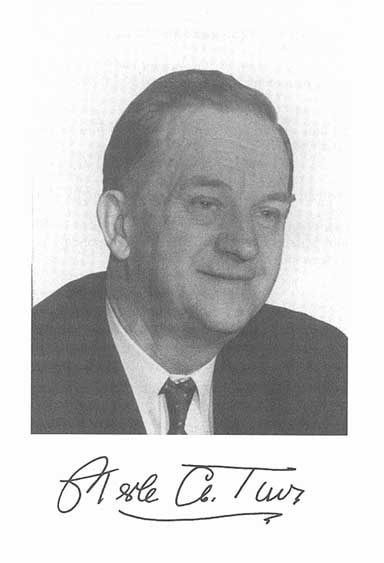
BY PHILIP H. ABELSON
MERLE ANTONY TUVE WAS a leading scientist of his times. He joined with Gregory Breit in the first use of pulsed radio waves in the measurement of layers in the ionosphere. Together with Lawrence R. Hafstad and Norman P. Heydenburg he made the first and definitive measurements of the proton-proton force at nuclear distances. During World War II he led in the development of the proximity fuze that stopped the buzz bomb attack on London, played a crucial part in the Battle of the Bulge, and enabled naval ships to ward off Japanese aircraft in the western Pacific. Following World War II he served for twenty years as director of the Carnegie Institution of Washington's Department of Terrestrial Magnetism, where, in addition to supporting a multifaceted program of research, he personally made important contributions to experimental seismology, radio astronomy, and optical astronomy.
Tuve was a dreamer and an achiever, but he was more than that. He was a man of conscience and ideals. Throughout his life he remained a scientist whose primary motivation was the search for knowledge but a person whose zeal was tempered by a regard for the aspirations of other humans.
Merle Tuve was born in Canton, South Dakota, on June
27, 1901. All four of his grandparents were born in Norway and subsequently emigrated to the United States. His father, Anthony G. Tuve, was president of Augustana College and his mother, Ida Marie Larsen Tuve, taught music there. A next-door neighbor and contemporary was Ernest Orlando Lawrence. The two boys played together and at age thirteen began to build telegraphic and later radio equipment. They were among the early radio amateurs.
After Tuve's father died in the influenza epidemic of 1918 the family moved to Minneapolis, where Merle attended the University of Minnesota, graduating in physics in 1922 and obtaining a master's degree in 1923. Following a year at Princeton, where he was an instructor, Tuve went to the Johns Hopkins University to work for his doctorate. While at Minnesota Merle developed a close friendship with Breit, a theoretical physicist who moved in 1924 to the Department of Terrestrial Magnetism of the Carnegie Institution of Washington. After Tuve's arrival at Johns Hopkins, Breit sought his collaboration in a possible effort to study the ionosphere.
At the time, the electronics equipment available was primitive and relatively insensitive. To demonstrate the existence of the ionosphere it would be necessary to find evidence that radio signals arrived over at least two paths, a ground wave and a sky wave. To take an example: if a receiver were set up 13 miles from a radio transmitter, and if the ionosphere layer were 100 miles above the receiver, two pulses should arrive, a direct pulse and then, a millisecond later, a reflected pulse. If the height of the ionized or reflecting layer were increased or decreased, then the difference in time of arrival of the two pulses would change correspondingly. Tuve devised the necessary detecting equipment and Breit and Tuve were able to use a Naval Research Laboratory oscillator for their source of radiation. They observed
delayed pulses but could not eliminate the possibility that these were reflections from the Blue Ridge Mountains. However, one evening they found that after sunset the reflecting layer moved upward from a height of about 60 miles to a height of more than 115 miles as the delayed pulses began to arrive at longer intervals. The experiment was a success. Breit persuaded Johns Hopkins to accept the work as the basis for Tuve's Ph.D. thesis, and the degree was granted in 1926. Verification of the existence of the ionosphere opened an important field of research and suggested the practicability of radar.
Throughout his life, Merle displayed excellent critical judgment in identifying the most significant challenges and opportunities of the times. In 1926 he recognized the great importance of exploration of the atomic nucleus. To implement his vision he planned to go to England to Rutherford's laboratory. However, Breit and John Fleming, then acting director of the Department of Terrestrial Magnetism, talked him into coming there. He would be given an opportunity to develop equipment for production of energetic particles.
Several years of difficult and frustrating work followed, in which Tuve achieved high voltages using Tesla coils. But the equipment was plagued with failures of glass insulators. However, Tuve learned the hard way how to distribute voltage along a column. When Van de Graaff invented his belt-charging high-voltage generator Tuve was in position to adapt it as an excellent tool for experimental nuclear physics. By February 1933 Tuve, Hafstad, and Odd Dahl were observing nuclear reactions with a 600 keV beam. Splendid voltage control and stability enabled them to discover a resonance when lithium was bombarded by protons, and gamma rays were observed. This result led to the Breit-Wigner formula. The voltage capabilities of the equipment were ex-
tended to 1.2 MeV in 1934 and a number of nuclear reactions were investigated.
The high mark in achievement came in 1935 with a series of experiments by Tuve, Hafstad, and Heydenburg on proton-proton interactions. It had long been known that like charges repel each other. Yet atomic nuclei existed that contained 92 protons and more. What held such nuclei together? Through precise measurements with high-energy protons from their Van de Graaff accelerator striking a hydrogen gas target, the experimenters were able to answer the question. At intermediate and long distances protons repel each other but at short distances, that is, of the order of 10-13 cm, an attractive force exceeds the repulsive one. Analysis of these data by Breit, Edward U. Condon, and Richard D. Present yielded a nuclear potential that was identical to that of the neutron-proton interaction which had been obtained by Goldhaber by photodisintegration of the deuteron. This discovery was immediately recognized as an historically significant milestone in nuclear physics.
In the 1930s the laboratory was one of the leading centers of nuclear physics. Prominent theoretical physicists were frequent visitors. Breit moved to New York University in 1932, but he remained a steadfast friend and consultant. A high point in scholarly exchange came in January 1939 when Niels Bohr told a conference of theoretical physicists of the discovery of uranium fission by Hahn and Meitner. Within a day the discovery was confirmed at the Department of Terrestrial Magnetism by Richard Roberts and Hafstad. Soon thereafter Roberts observed that some uranium fission events are followed by delayed emission of neutrons.
Tuve focused his efforts on nuclear physics until 1940. He supervised the design of a pressurized Van de Graaff generator, which achieved energies above 4 MeV. He also began construction of a 60-inch cyclotron designed to pro-
duce large quantities of radioactive isotopes for use on the east coast.
Events across the ocean impinged heavily on Tuve. One Sunday afternoon in August 1940 I was working in a laboratory at the department when he came in. He had been listening to accounts on the radio of terrible destruction caused by a massive Luftwaffe raid on England. He spoke intensely of the need for defensive measures. From his experience with radios and electronics Tuve could visualize that an electronically actuated proximity fuze that would increase the effectiveness of ground-based antiaircraft fire might be feasible, but such a device would require rugged vacuum tubes that could withstand the forces encountered when it was fired from an artillery piece. This crucial problem was tackled the next day by Roberts. He dropped lead-encased tubes from the top of a building to a steel plate on a concrete apron below, subjecting them to accelerations greater than 5,000 g. This crude method in turn was quickly supplanted by tests with known forces in centrifuges. Once tubes capable of withstanding 20,000 g were available the design and production of prototype proximity devices were soon accomplished. These were repeatedly tested by Tuve's group and ultimately by the Navy. In August 1942 the Navy gave the go-ahead for large-scale production. Tuve understood the importance of quality control and of guaranteeing against accidental misfiring that might injure naval personnel. Misfiring was guarded against by a superior design. Quality control required careful monitoring by a large staff. This in turn required a transfer of activities from the Department of Terrestrial Magnetism to larger quarters in the newly formed Applied Physics Laboratory administered by the Johns Hopkins University and directed by Tuve. This also took place in 1942.
By the end of the war 112 companies were engaged in
production work on fuzes. Tuve's organization oversaw the development of vacuum tubes, batteries, and other components small enough to fit into artillery shells and rugged enough to withstand being shot from a gun and spun rapidly. There were made safe enough to be stored and handled and to have a proper shelf life under military conditions.
Tuve's presence was felt throughout the vast enterprise. He assembled the personnel and established procedures. He maintained liaison with military, industrial, and civilian research leaders. By war's end 22 million proximity fuzes had been manufactured. Many variants of the original design were devised and produced. In terms of effect on the course of World War II the proximity fuze was one of two or three of the most important new military devices.
In a book published in 1980 titled The Deadly Fuze Ralph B. Baldwin described his personal role in serving under Tuve at the Applied Physics Laboratory. He also provided quotations from the Navy and Army command structure praising the effectiveness of the proximity fuzes and describing their important role in combat.
Soon after their entry into World War II the Japanese converted many of the islands of the western Pacific into what they regarded as unsinkable aircraft carriers capable of servicing long-range ground-based planes, but starting in early 1943 when the U.S. Navy began using proximity fuzes the Japanese air force incurred crippling losses. For the most part the unsinkable carriers became a liability.
In 1943 British intelligence became aware of large-scale German preparations for launching a great number of V-1 buzz bombs against London. These weapons were unmanned winged aircraft carrying loads of high explosives. The British destroyed some of the launching sites, but the Germans prepared many others. Tuve was informed of the nature of the devices. He ordered production of fuzes especially de-
signed to destroy them. A stockpile of the fuzes was available when the Germans initiated their V-1 attacks. Ultimately the proximity fuzes had a major role in destroying V-1 bombs and in stopping attacks using them.
Until late 1944 the proximity fuze was not used in land combat. This avoided capture of duds and production of devices or countermeasures by enemies. However, field artillery shells were produced that were equipped with appropriately designed proximity fuzes. These were available at the time of the Battle of the Bulge that began in December 1944. On that occasion the Germans committed their last reserves in a desperate attempt to break the Allied lines. They were met by artillery fire that inflicted enormous losses of life and morale. These losses often occurred after dark or in the presence of fog. The effectiveness of unseen fire at all times of the day and night was confirmed by later observation and prisoner-of-war reports.
After the war Tuve received the Medal of Merit from President Truman and was named an Honorary Commander of the Order of the British Empire. He also received the John Scott Award of the City of Philadelphia. On that occasion he placed his role in context, saying ''. . . the proximity fuze was not invented by any one man; it was a composite of old inventions and re-inventions both here and in Britain. It was really a development, not an invention, and many individuals contributed to it." On that same occasion Tuve revealed what must be regarded as an essential component of his success in the proximity fuze effort. He stated that the principal discovery of World War II was the efficiency of the democratic principle in dealing with people. He said:
The democratic principle is this: Tell the worker or the people of the community what the need is, invite them to contribute in the best way they can, and let them help you and help each other meet that need. Any society or any group always selects men to handle certain tasks, by elections
or by hiring them or by some other system. But notice that a boss using the democratic principle does not depend on others, he asks his men, his workers to participate. This means that they help him with the whole job, they don't just do what they are told to do. This system of asking people to help with the whole job was what I used in running the proximity fuze development. It worked so well, the whole team took hold so vigorously, that during most of the work it was a struggle to keep up with them. I often felt like a short-legged donkey trying to keep from being run down by a stampede of race horses.
It is obvious that Tuve was an excellent administrator capable of directing large enterprises. After World War II he might have chosen any one of many major managerial careers, but Tuve was a man of ideals and ideas who put research and discovery ahead of power and position. He left the Applied Physics Laboratory, where he had dominion over thousands of people, to become director of the Department of Terrestrial Magnetism, where the professional staff numbered about fifteen and where austerity was a way of life.
Vannevar Bush, president of the Carnegie Institution of Washington, had established the policy that the institution would not expand its activities in peacetime research by taking government funds. Tuve wholeheartedly agreed with this policy, but a consequence was that he deliberately foreclosed the option of spearheading activities in big science, including the development of the next generation of large accelerators for high-energy physics. Instead, he preferred to seek areas of inquiry in which tiny groups of research scientists might make significant contributions. To implement this vision it was necessary to change the thrust of the Department of Terrestrial Magnetism. Prior to 1946 the organization had for the most part conducted activities consonant with its name. Tuve changed that. He converted it into a physics department and further stated that physics is
what physicists do. Thus staff members, who in the main were physicists, had a broad license to use their imaginations in defining significant areas for interdisciplinary research. This freedom led to innovative ventures by some of the staff, including those engaged in biophysics and in the radioactive dating of rocks. Members of the Biophysics Section pioneered in molecular biology and eventually produced a book, Studies of Biosynthesis in Escherichia Coli. This represented world-class research and had wide acceptance and use. The radioactive dating group, led by L. Thomas Aldrich, also did world-class work. They perfected radioactive clocks based on uranium-lead, rubidium-strontium, and potassium-argon decay chains. In consequence they were able to date many of the world's Precambrian rocks and tectonic events affecting them. Another example of work encouraged by Tuve was studies of the effects of thunderstorms on electric charges over the earth's surface. In 1947 and 1948 two staff members, George R. Wait and Oliver H. Gish (then close to retirement age) made 65 traverses over the center of thunderstorms at altitudes of up to 48,000 feet. They found that in some storms electric current flowed in a direction opposite that noted in fair weather. Another achievement was one by Scott Forbush, who discovered the emission of cosmic rays from the sun.
During the period 1946-66, while Tuve was director, he carried out administrative functions and responded to numerous calls for public service. However, personal involvement in research was his principal activity. His fields of investigation included experiments in seismology, radio astronomy, and the development of superior optical image tubes.
The goal of Tuve's first personal research following his return to the Department of Terrestrial Magnetism in 1946 was discovery of knowledge about the interior of the earth.
At that time geophysicists were dependent on observations of earthquakes for information about the lower crust and mantle, but earthquakes are undependable with respect both to time and place, and observations lead only to approximate descriptions of the earth's interior. In 1946 geophysicists hypothesized that the structure of the earth was somewhat analogous to that of an onion, with an outer layer of granite overlying a basaltic layer, which in turn was above other concentric structures. Tuve and associates, including Howard Tatel, ultimately showed that the earlier model was oversimplified.
To obtain detailed knowledge of the crust and mantle required a more dependable probe than earthquakes. Tuve chose to use explosions to produce vibrations in the earth, and he and his group developed new sensitive seismometers which could detect the tremors at distances of hundreds of kilometers. Up to the time of the Korean War he was able to persuade his friends in the Navy to provide explosives and detonate them for him. Later he used large explosions being conducted in quarries as a source of seismic waves. All together, hundreds of experiments were done and the data analyzed. Many of the observations were made in various regions of the United States, but a substantial effort was devoted to South America, especially to the Andes.
Part of Tuve's personal attention to seismology was diverted in 1952. At that time Ewen and Purcell at Harvard had discovered radio emission from neutral hydrogen in our galaxy. Tuve went to Cambridge and obtained from them parts of the receiver they used for their discovery. A 23-foot-diameter German radar dish, borrowed from the National Bureau of Standards, was installed at the Department of Terrestrial Magnetism. Characteristically, Tuve set about improving the essential auxiliary electronic equipment and soon had what at the time was the best of its kind
in the United States. From 1953 to 1965 the Department of Terrestrial Magnetism was a leading center of radio astronomy. Ultimately others, using federal funds, were able to obtain superior equipment.
Tuve's venture into the development of image tubes was not so much a personal research effort as an exercise in guiding the production of an important tool for astronomy. Through his superb grasp of electronics he was able to visualize that an increase in the effectiveness of telescopes was attainable. Photographic plates have been rendered very sensitive, but they still convert only a fraction of the incident photons into an image. Photoelectron emitters are more sensitive, and the electrons can be accelerated and their number greatly amplified. Under Tuve's chairmanship a committee designed a tube that improved the detection of light from distant stars. The end result was that the effectiveness of dozens of the world's telescopes was improved tenfold.
One of Tuve's strengths was his ability to select and attract high-quality associates and staff members. Throughout his career most of his projects were accomplished with the cooperation of one or two close associates. Tuve served as a major source of fresh ideas, enthusiasm, and drive. Often there were more ideas than might be implemented, and the gifted associates provided discrimination and sounding boards, resulting in an enhancement of Tuve's own excellent native judgment. The careers of scientists who experienced some years of contact with Merle were fostered and many have expressed gratitude for the association.
Tuve's willingness to respond to calls for public service has already been mentioned. He participated in many such activities. He served on the first U.S. National Commission for UNESCO, on the National Research Council's Committee on Growth, and on the U.S. Committee for the Interna-
tional Geophysical Year. He was the first chairman of the Geophysical Research Board of the National Academy of Sciences and home secretary of the National Academy of Sciences.
In addition to the awards already mentioned Tuve received the American Geophysical Union's Bowie Medal for unselfish cooperation in research, the National Academy of Science's Barnard Medal for meritorious service to science, the 1948 Comstock Prize of the National Academy of Sciences (given every five years for the most important discovery or investigation in electricity, magnetism, or radiant energy), the Bolivian Order of the Condor de los Andes for efforts in advancing science in South America, and the Cosmos Club Award. He was also the recipient of seven honorary degrees.
Tuve found great satisfaction in a ceremony at Carleton College conducted by Lawrence Gould, who was then president of the college. On that occasion honorary degrees were conferred on Merle, on his two brothers, George Lewis Tuve and Richard Larsen Tuve, and on his sister, Rosemond Tuve. All had achieved distinction in their professions.
Merle was married in 1927 to Winifred Gray Whitman, M.D. In keeping with his regard and respect for his mother and sister and his strong feeling about equal rights for women, he insisted that she continue her professional work under her maiden name. Merle and Winifred had two children, Trygve, who died in 1972, and Lucy, who survives. Both earned Ph.D. degrees and pursued scientific careers.
A former president of the American Geophysical Union, George Woollard, characterized Merle Tuve with these words:
Anyone who knows Merle Tuve recognizes that he is a driver, who has never spared himself; a crusader, who has espoused the cause of science to the government and the people of this country; a patriot, who never questioned the wisdom of devoting some of his most productive years to classi-
fied military research; a leader, who had much to do with the success of the International Geophysical Year as well as with the outstanding reputation enjoyed by the Department of Terrestrial Magnetism of the Carnegie Institution of Washington; a public servant, who has devoted much of his time to the service of his fellow scientists through service on various boards and committees of the National Academy of Sciences and other groups; a diplomat, who has done much to foster both understanding and working relations between American and foreign scientists; and, finally, a warm-hearted individual, who has always been willing to help others.
Tuve carried on an extensive correspondence. The Library of Congress holds his papers in more than 400 archival boxes. His bibliography includes nearly 200 items. Of these, 25 have been selected for the bibliography that follows.
SELECTED BIBLIOGRAPHY
1925 With G. Breit. A radio method of estimating the height of the conducting layer . Nature 116(2914):357.
1928 With G. Breit. The production and application of high voltages in the laboratory. Nature 121:535-36.
With G. Breit and O. Dahl. Effective heights of the Kennelly-Heaviside layer in December 1927 and January 1928. Proc. Inst. Radio Eng. 16:1236-39.
1929 With L. R. Hafstad. An echo interference method for the study of radio wave paths. Proc. Inst. Radio Eng. 17:1786-92.
1930 With G. Breit and L. R. Hafstad. The application of high potentials to vacuum-tubes. Phys. Rev. 35:66-71.
1931 With W. G. Whitman. Biological effects of gamma-rays. Phys. Rev. 37:330-31.
1933 With L. R. Hafstad and O. Dahl. Disintegration-experiments on elements of medium atomic number. Phys. Rev. 43:942.
1934 With L. R. Hafstad. The emission of disintegration-particles from targets bombarded by protons and by deuterium ions at 1200 kilovolts . Phys. Rev. 45:651-53.
1935 With L. R. Hafstad. Resonance transmutations by protons. Phys. Rev. 47:506-507.
With O. Dahl and L. R. Hafstad. The production and focusing of intense positive ion beams. Phys. Rev. 48:241-56.
With L. R. Hafstad. Carbon radioactivity and other resonance transmutations by protons. Phys. Rev. 48:306-15.
With L. R. Hafstad and O. Dahl. High voltage technique for nuclear physics studies. Phys. Rev. 48:315-37.
With E. A. Johnson and O. R. Wulf. A new experimental method for study of the upper atmosphere. Terr. Mag. Atmos. Elec. 40:452-54.
1936 With N. P. Heydenburg and L. R. Hafstad. The scattering of protons by protons. Phys. Rev. 49:402.
With L. R. Hafstad and N. P. Heydenburg. Excitation-curves for fluorine and lithium . Phys. Rev. 50:504-14.
With N. P. Heydenburg and L. R. Hafstad. The scattering of protons by protons. Phys. Rev. 50:806-25.
1937 With E. Amaldi and L. R. Hafstad. Neutron yields from artificial sources. Phys. Rev. 51:896-912.
1953 Development of the section T pattern of research organization. In Teamwork in Research, eds. G. P. Bush and L. H. Hattery, pp. 135-42. Washington, D.C.: American University Press.
With H. E. Tatel and L. H. Adams. Studies of the earth's crust using waves from explosions. Proc. Am. Philos. Soc. 97:658-69.
1954 With H. E. Tatel. Note on the nature of a seismogram, I. J. Geophys. Res. 59:287-88.
With H. E. Tatel and P. J. Hart. Crustal structure from seismic exploration. J. Geophys. Res. 59:415-22.
1955 Introduction. Annual report of the director of the Department of Terrestrial Magnetism. Carnegie Inst. Washington, Yearb. 54:41-43.
1958 With W. K. Ford, Jr., J. S. Hall, and W. A. Baum. Results of preliminary tests of cascaded image converters. Notes from observatories. Publ. Astron. Soc. Pac. 70(417):592-94.
1959 Is science too big for the scientist? Saturday Rev. June 6, pp. 48-51.
1972 With S. Lundsager. Velocity structures in hydrogen profiles. Astron. J. 77:652-60.


