
Page 220
APPENDIX K
Deterrence-Quo Vadis?
Deterrence polemics have all but disappeared from most newspapers and television, and with each new theme for our national security strategy, we are reading, seeing, and hearing less about deterrence. This is not as it should be. We have transitioned from earlier strategies where deterrence was a centerpiece to the current national security strategy theme of "Engagement and Enlargement" with its principal references to deterrence residing in a section titled "Combating the Spread and Use of Weapons of Mass Destruction." The current national security strategy also speaks of "deterring aggression."
The main part of the "Combating . . ." section is "Nonproliferation and Counterproliferation." Strategic deterrence in the traditional sense is covered by saying that we have the need for "nuclear forces sufficient to deter any future hostile foreign leadership with access to strategic nuclear forces from acting against our vital interests and to convince it that seeking a nuclear advantage would be futile." The Chairman of the Joint Chiefs of Staff, General John Shalikashvili, is more direct. He says in his 1995 Posture Statement, "While our nuclear forces are substantially smaller than they used to be, no other part of our forces is as vital. Over the long term, both our survival, and our ability to contend with conventional threats to our interests depend on a strong and wellmaintained nuclear force."
The strategy, however, makes no mention of conventional deterrence, nor does it emphasize deterrence as a central theme. Whatever the changes are in how deterrence may be featured or discussed in our strategy, continued thoughtful exploration of means to deter all manner of conflict and armed aggression is needed. This makes definitions important.
The paradigm that "strategic deterrence" or "deterrence" alone means "nuclear deterrence" is one that should be discarded. Another paradigm to be avoided is that deterrence involves only military means. In this essay, deterrence means deterrence in a general sense; strategic deterrence means deterrence at the strategic (not nuclear or strategic nuclear) level; nuclear deterrence means what it says; and conventional deterrence is deterrence with conventional means alone. With those definitions in mind, where is deterrence headed now that it has been upstaged—at least temporarily—as the centerpiece of our national security strategy?
It is likely that most people continue to believe that deterrence is important and that they have a reasonable grasp of the "carry a big stick" kind of nuclear deterrence that has prevented the outbreak of global nuclear war for almost 50 years. The need to "deter aggression" is also probably readily accepted; however, because of the plethora of regional and ethnic adversaries and the
Page 221
vagaries of the post-Cold War era, the spectrum of what has to be deterred is much wider, and it is obviously much more complex to make deterrence work in this "new world disorder."
The problems that increase the complexity of achieving our national security objectives are not limited to proliferation of weapons of mass destruction and advanced weapons technology but are rooted in the great gulf between the "haves" and "have-nots," in the profusion of information increasingly available to the most distant corners of the world, and in our inability to understand the value structures of, and communicate clearly with, our potential adversaries. These factors make it more complicated to figure out how to make deterrence succeed.
To state it simply, deterrence theory is not substantially different from what it was in the past—although it has been broadened to include conventional means and must provide an affordable replacement for the stabilizing mechanisms that the bipolar power structure of the last four decades imposed on non-superpowers—but deterrence practice is in transition. Ashton Carter's emphasis on counterproliferation, and Paul Nitze's article discussing whether precision-guided munitions (PGM) are an alternative to nuclear weapons, illustrate some of the current thinking, as does Charles Allan's excellent Washington Quarterly 1994 article, "Extended Deterrence."
Other trends brought on by the demise of the bipolar world that bear on any new approach to the practice of deterrence include:
• Less predictability of the international scene and a recognition of the need for longer-range policy focus and better integration of the political, diplomatic, economic, and military elements of foreign policy;
• Fewer distinctions between tactical and strategic nuclear weapons;
• The insufficiency of any single conventional or nuclear system as a deterrent; and
• Self-deterrence from using nuclear weapons.
Although it continues to be necessary to maintain an appropriate level of nuclear weapons for the foreseeable future, the futility of mutual nuclear destruction appears to have been recognized by at least the major powers. For them, this has made possession of weapons of mass destruction more important than using them, and with the increasing precision and lethality of conventional weapons, some of the burden of deterrence will likely shift to conventional weapons. However, the strategic leverage and "status" associated with possessing nuclear weapons continues to attract nuclear aspirants who, through their nuclear weapons programs, seek a strategic advantage not provided to them by their geography, resources, politics, or conventional military power.
Page 222
For the future, we should take direction from the fundamentals of the past that worked:
• The fostering of an international belief that the first use of nuclear weapons will inevitably and irrevocably result in the user losing everything he/she cherishes;
• A plan of action to be used if the nuclear "threshold" is crossed;
• Possession of a demonstrated capability that is affordable, does not violate basic national tenets, and whose readiness for employment is apparent but does not interfere with international intercourse and the conduct of our nation's daily life; and
• Convincing the world that seeking a nuclear advantage would be futile.
What does this mean for the future? Deterrence is first and foremost an exercise in selecting ways to influence potential adversaries to choose to act within commonly accepted behavioral norms. If we can understand the value structures of all parties, it should be possible for us to develop the means to affect those structures; however, despite advances in intelligence collection and analysis, we remain better at determining the orders of battle rather than the orders for battle or the intentions of our potential adversaries. Choosing an action to influence a potential adversary must be derived from an understanding of the operative influence mechanisms in that individual's value structure (or psychology), and of that we have little knowledge at present. Similarly, such influencing capabilities must be affordable, ever present, and not obtrusive, and they must not routinely violate a nation's freedom to pursue economic strength and protect its citizenry.
When the goal becomes influencing leadership to choose acceptable means of behavior to attain their goals, the particular influencing action we choose can fall anywhere in the spectrum shown in Figure K. 1 and will depend on the particular state of the relationships between the countries involved. The subsequent actions required will depend on the initial results and will move as indicated in Figure K. 1 as the results of the various actions take shape.
In normal usage, deterrence generally has a negative connotation; i.e., it is an action designed to influence an adversary not to do something we don't want him to do, but it is important to understand that positive and negative measures are part of an interrelated and continuous spectrum and that the type of influencing action can shift between negative and positive, and vice versa, depending on what the objective is.
What of the adversary who may be truly irrational and devoid of both influencing mechanisms and value structures? Lacking adequate information about an adversary's intentions and influencing mechanisms may also make us misunderstand and label as irrational an adversary who is, in fact, not so.
Page 223
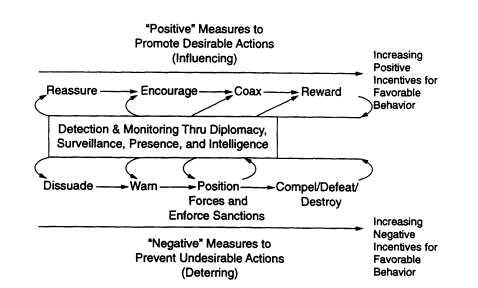
Figure K.1 A spectrum of influencing actions.
Lacking understanding, there is great risk in any action. Threats, escalation, or routine deterrence actions could prove to be provocative. Failure to act or an inadequate response could be regarded as a sign of weakness or a signal of tacit approval. Inappropriate methods and impreciseness of communications may send the wrong message. Inadequate feedback from influencing actions already taken may lead to erroneous conclusions about what the appropriate next step is. And, in the midst of such ambiguity, military actions may become the forced option, often without careful integration of the diplomatic and economic tools available.
Deterrence may be thought of as a kind of net or fabric with the warp made up of military capabilities and the weft made up of factors such as the military balance, our national principles, negotiating history and skills, recent responses to world crises, and national will to act (Figure K.2). The breakage of a few threads may weaken the overall fabric but not result in its failure, and new events or capabilities can add strength to the fabric. The failure of deterrence to achieve local deterrence objectives, such as in Bosnia and Somalia, probably frayed or broke threads in the net but did not destroy our capability to deter. North Korea is currently busy fraying a thread or two, but the Persian Gulf War and our recent response to indications of Iraqi force buildups forged strong new threads, reinforcing parts of the fabric. Such appropriate, but most assuredly different, actions in other areas will accomplish other results and over time will refine, clarify, and strengthen deterrent effectiveness (the tapestry).
Page 224
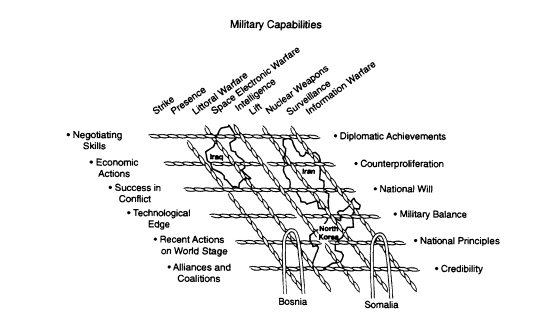
Figure K.2 The fabric of deterrence.
Any careful examination of deterrence should include an assessment of what deterrence can and cannot achieve. It is obvious to most that we cannot stop the proliferation of nuclear weapons or other weapons of mass destruction, nor can we put the nuclear genie back in the bottle, but, having taken and maintained the high ground with a strong history of responsible nuclear behavior, we have provided an example that is hard for anyone to challenge, and we have no choice but to continue to pressure and cajole as necessary to prevent or limit proliferation. The real test for us will come when another country first uses or sponsors the use of a nuclear weapon. Our responses to that event will set the deterrence "standard" for years to follow. The results of Rand's "The Day After . . ." study suggests that we are not fully prepared for such an occurrence.1
What we have done for decades and can probably continue to do is to deter global nuclear war. Although the number of nuclear weapons required to accomplish this continues to decrease through mutual agreement between the United States and Russia, the absolute lower limit of this requirement remains to be determined. The trends suggest it will be a number considerably less than
1 Millot, Marc Dean, Roger Molander, and Peter A. Wilson, 1993. "The Day After. . ." Study: Nuclear Proliferation in the Post-Cold War World Volume I, Summary Report, Rand, Santa Monica, Calif.
Page 225
START II levels. Perhaps it will be some arbitrary number, say 1,000. It would appear that even this relatively small number of weapons should be sufficient not only for overall deterrence but also for any Third World or rogue nation scenario, since it is hard to conceive of a situation where anything more than a few nuclear weapons would be required for terrorists, rogue nations, or Third World countries.
The challenge for the first part of the 21st century is to develop similar means and international "states of mind" that deter, dissuade, and influence potential adversaries from all forms of military aggression.
Over a period of more than 2 years, several deterrence seminar war games have been conducted in support of the Navy's Deterrence Joint Mission Area. These games examined various military capabilities for their deterrence potential in a variety of scenarios. This experience provided the basis for assessment reports to the Navy's Intermediate Requirements and Resources Review Board. The games have provided interesting insights into the deterrence process and produced results that focus primarily on, but also go beyond, the military component of deterrence.
In the earliest games, players were tasked with determining the various military capabilities that could be used for deterrence. In subsequent games, these capabilities were evaluated using a metrics system in a software utility that determined the "relative deterrence value" of each capability. In the most recent game, players used a modified version of the software to determine the relative deterrence priority of various military assets or systems. The cumulative results of these games have provided insights about the use of military capabilities in support of deterrence.
• The presence of forces, movement of forces, and ability to strike are important.
— The movement of forces into an area, even though some forces may already be present there, is more effective than simple presence; i.e., an adversary is particularly sensitive to changes in forces present.
— Precision weapons, stealth platforms, and hard-target kill capabilities have high deterrence value.
— Credible warfighting capability is key.
— Intelligence, targeting surveillance, and reconnaissance by themselves are not strong deterrent elements, but they are essential enablers of deterrence efforts and capabilities.
— Deterrence of proliferation of weapons of mass destruction has been largely ineffective, but inconsistent diplomacy and
Page 226
our self-deterrence from preemption, bold strokes, or ''disproportionate" responses have abetted the proliferation process.
— Systems that devalue an adversary's nuclear weapons, such as theater ballistic missile defense (TBMD), are increasing in importance.
— There is significant doubt that the United States has the will to use preemption systems.
• Information warfare, psychological operations, and deception operations are "soft," relatively low-cost, potentially high-payoff options whose deterrent value is difficult to capture quantitatively.
• Mobilization of reserves is a particularly effective deterrence action.
• Military actions can establish the conditions necessary for diplomatic and economic actions to be effective in resolving a potential conflict.
• Deterrence success is directly related to the level of understanding of a potential adversary's objectives, motivations, and perceptions.
• Most adversaries, particularly in the Third World, see our systems only at the macro level (carriers, amphibious ready groups, bombers, ground forces, etc.).
• The independence and mobility of naval forces make them the initial force of choice for influencing or deterrence actions. Forward deployment/movement to the area of ground forces, stealth aircraft, fighter aircraft, AWACS, JSTARS, and the like is also very effective, but CONUS-based forces have low deterrent value until they move toward or to the area.
• Submarine-launched ballistic missiles, Patriots, nuclear-powered submarines, and sea-based TBMD have high value for deterring use of weapons of mass destruction, but Red does not believe that the United States would preempt or use nuclear weapons in response to a conventional attack.
• Systems and capabilities that threatened Red's mobility or ability for surprise were of high deterrent value.
Page 227
• If deterrence fails in a particular place, the failure provides no relief from deterrence obligations elsewhere but does offer a substantive opportunity to establish a new benchmark of deterrence credibility by the actions taken in response to the failure.
Quo vadis, deterrence? Hopefully, back to the centerpiece where, if deterrence theory and practice are understood and used, it can ensure a structure and balance of national security forces that are optimized for a future we are only beginning to comprehend. What is needed:
• Revitalize and reaffirm a national goal of deterring all forms of aggression.
• Develop metrics that allow us to understand the capabilities needed to "destroy all that is cherished" by an aggressor.
• Construct a deterrence model to evaluate deterrence and deterrent actions.
• Define and understand the value structures of each potential adversary. Format the structure of our military toward the dual goals of both warfighting and deterrence of all forms of conflict.
• Establish closer correlation of our deterrence goals and our military force structure than currently exists.


