
B Questionnaire
To obtain input from a number of health professionals on their use of toxicology and environmental health information resources in general and their use of NLM databases specifically, the committee, in conjunction with health professional organizations, developed and disseminated a questionnaire. Several methods were used to distribute the questionnaire; however, the committee did not attempt to obtain a random scientific sample. The responses were viewed by the committee as indicative but not definitive.
Copies of the questionnaire along with background information on the IOM study were distributed to members of the American Association of Occupational Health Nurses, the American Association of Poison Control Centers, and the Association of Occupational and Environmental Clinics (AOEC).1 Individuals who attended the committee's workshop (see Appendix C) also completed the questionnaire. To broaden the respondent base, the Internet was used to distribute an online version of the questionnaire to the subscribers of two Internet list servs 2 (mailing lists)—one on occupational and environmental medicine and the other sponsored by the American College of Medical Toxicology.
A total of 247 responses were received—77 online responses, 140 responses by mail, and 30 responses from the workshop. Because of the distribution of the
questionnaire on the Internet, it was not possible to estimate the number of individuals who received a copy of the questionnaire but did not respond. Responses were received from 33 states and from 3 foreign countries.
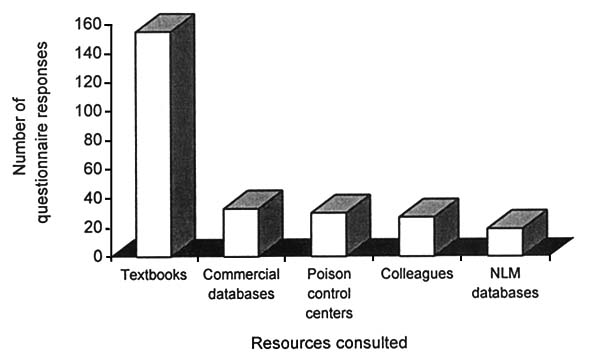
As seen in the tabulation of the responses (see below), the majority of the respondents work in the field of occupational and environmental health, function in a clinical role, and are familiar with computers. Although the respondents expressed a preference for online information (Question 12), most respondents currently consult textbooks and reference materials when locating toxicology and environmental health information (Figure B.1). Other information resources used include commercial databases, poison control centers, colleagues, and the NLM databases. The health professionals who responded to the questionnaire use toxicology and environmental health information for a variety of purposes including patient care, teaching and education, worker safety, and risk analysis (Question 15).
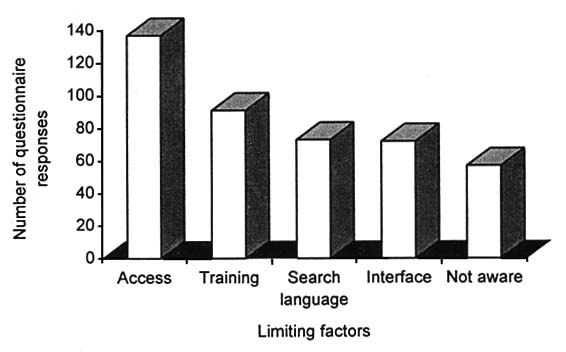
The questionnaire posed a series of questions that were specific to use of the TEHIP databases. As seen in the responses to Question 16, TOXLINE/TOXLIT (followed by RTECS and HSDB) were the most familiar to the respondents. When asked specifically what factors limited the use of NLM's toxicology and environmental health databases, respondents pinpointed access to the databases as the major barrier, followed by training, search language, and the front-end interface (Figure B.2). It is noteworthy that 57 of the 247 respondents were not aware of the databases. The final question asked respondents to choose the one area that, if changed or improved, would make the databases more useful and accessible. Respondents again chose access to the databases as the leading area needing improvement, followed by database training, front-end interface, and search language.
The committee gained a great deal of input through the responses to the questionnaire and used the information, in conjunction with the summaries of focus group discussions (see Appendix C), input from guest speakers, and discussions with colleagues, to inform the committee's deliberations and decision making.
Summary of Responses
Toxicology and Environmental Health Online Databases
The National Library of Medicine's (NLM) Toxicology and Environmental Health Information Program is comprised of factual and bibliographic databases with a wide range of information including the toxicities of numerous chemicals. The Institute of Medicine (IOM), National Academy of Sciences, is currently conducting a study on strategies for increasing and improving the accessibility and availability of those NLM databases for the work of health professionals.
This survey questionnaire is designed to collect information on your awareness and use of the NLM toxicology and environmental health databases. Your input would greatly assist the IOM committee in its deliberations and would assist the National Library of Medicine in improving its Toxicology and Environmental Health Information Program. A short synopsis of each database can be found in Question 16. Thank you for your time!
|
1. |
Age or year of completion of undergraduate education: [Average age, 42.5] |
|
|
2. |
Please check the ONE category below that best describes the work you do. |
|
|
|
Emergency medicine |
19 |
|
|
Risk analysis or policy |
1 |
|
|
Clinical/basic research |
3 |
|
|
Health professional education |
4 |
|
|
Library science/informatics |
6 |
|
|
Community level organization |
1 |
|
|
National advocacy organization |
0 |
|
|
Industrial hygiene |
17 |
|
|
Family care/primary care |
7 |
|
|
Occupational/environ, health |
147 |
|
|
Toxicology/pharmacology |
1 |
|
|
Public health |
10 |
|
|
Poison control |
12 |
|
|
Other (please specify) |
23 |
|
3. |
In what setting do you primarily work? |
|
|
|
Academic |
111 |
|
|
Private for profit |
47 |
|
|
Other (please specify) |
17 |
|
|
Government |
41 |
|
|
Private not-for-profit |
30 |
|
4. |
Do you see patients or function in a clinical role? |
|
|
|
Yes |
243 |
|
|
No |
71 |
|
|
If yes: More than 20 hours per week |
71 |
|
|
Less than 20 hours per week |
81 |
|
5. |
Please indicate your training, check all that apply. |
|
|
|
L.P.N. |
1 |
|
|
CIH |
3 |
|
|
P.A. |
4 |
|
|
M.P.H. |
69 |
|
|
R.N. |
68 |
|
|
M.S.N. |
5 |
|
|
M.D. |
100 |
|
|
Ph.D. |
33 |
|
|
Other (please specify) |
60 |
|
6. |
Do you use computers? |
|
|
|
Yes |
243 |
|
7. |
How would you describe your computer skills/literacy? |
|
|
|
None/Basic |
33 |
|
|
Intermediate |
174 |
|
|
Advanced |
39 |
|
8. |
Do you use the Internet? |
|
|
|
Yes |
192 |
|
9. |
Do you search any online databases? Please indicate the extent of your online searching experience. |
|
|
|
No online searching |
61 |
|
|
Medline primarily but occasionally other online databases |
100 |
|
|
Medline only |
27 |
|
|
Numerous online databases |
54 |
|
10. |
How often on average do you need toxicology/environmental health information? |
|
|
|
Several times a day |
55 |
|
|
Once a day |
46 |
|
|
Once a year |
9 |
|
|
Once a week |
84 |
|
|
Once a month |
50 |
|
11. |
What toxicology/environmental health information resource do you most frequently use? Please check the ONE most often consulted. |
|
|
|
Textbooks, reference materials |
155 |
|
|
NLM's toxicology/environmental health databases |
19 |
|
|
Local poison control center |
30 |
|
|
Commercial databases (e.g., Micromedex) |
33 |
|
|
Public health department |
7 |
|
|
Colleagues |
27 |
|
|
Other databases (please specify) |
11 |
|
|
Other sources (please specify) |
10 |
|
12. |
What format do you prefer for locating toxicological and environmental health information? |
|
|
|
Text |
65 |
|
|
CD-ROM |
54 |
|
|
Telephone |
18 |
|
|
Online |
98 |
|
|
Other (please specify) |
5 |
|
13. |
If you use databases to gather/find toxicological and environmental health information, which ones do you use? Please list specific databases: |
|
|
|
Medline |
54 |
|
|
NIOSHTIC |
22 |
|
|
Other |
34 |
|
|
RTECS |
18 |
|
|
TOXLINE/TOXLIT |
40 |
|
|
TOXNET |
33 |
|
|
Poisindex/TOMES |
39 |
|
14. |
Who searches for your toxicological and environmental health information? |
|
|
|
I search the databases |
173 |
|
|
The library |
25 |
|
|
Other staff members |
20 |
|
|
Other (please specify) |
13 |
|
15. |
Toxicology and environmental health information can be used in many ways. Please check the main ways you use this information. Please check all that apply. |
|
|
|
Patient care |
174 |
|
|
Clinical research |
79 |
|
|
Basic research |
49 |
|
|
Worker safety |
144 |
|
|
Community/advocacy |
47 |
|
|
Other (please specify) |
14 |
|
|
Teaching/education |
169 |
|
|
Policy decisions |
75 |
|
|
Risk analysis |
93 |
|
|
Retrieve information for others (e.g., library searching) |
36 |
|
16. |
This question is on the next page and includes a description of the NLM toxicology/environmental health databases. |
|
|
17. |
We are interested in identifying the factors that may limit your use of the NLM toxicology/environmental health databases. Please check ALL of the factors below that limit your use of the database. |
|
|
|
Access to the databases |
137 |
|
|
Search language |
73 |
|
|
Front-end interface |
72 |
|
|
Complexity of the database records |
45 |
|
|
Database information content |
31 |
|
|
Extent of peer review |
24 |
|
|
Database training |
91 |
|
|
Database documentation |
17 |
|
|
I was NOT AWARE of any of the databases. |
57 |
|
|
The databases have no application to my work. |
5 |
|
|
Other (please specify): |
20 |
|
18. |
Please check the ONE area that if changed or improved would make the NLM toxicology/environmental health databases more useful and accessible to you. Please check only ONE. |
|
|
|
Access to the databases |
91 |
|
|
Search language |
21 |
|
|
Front-end interface |
26 |
|
|
Complexity of the database records |
9 |
|
|
Database information content |
7 |
|
|
Extent of peer review |
2 |
|
|
Database training |
41 |
|
|
Database documentation |
0 |
|
|
These databases are useful to me without any changes. |
14 |
|
|
Other (please specify): |
8 |
Thank you for your input! We welcome any additional comments
16. We are interested in learning about your use of the NLM toxicology/environmental health databases and their potential usefulness in your work. For each of the databases described below, check the ''YES" box if you use or have used this database. If you have not used this database, check one of the "NO" boxes to indicate whether based on the short description this database may be USEFUL or NOT USEFUL in your work.
|
Database |
Database Information Description |
YES |
NO, but USEFUL |
NO, NOT USEFUL |
|
Chemical Carcinogenesis Research Information System (CCRIS) |
Experimental data from carcinogenicity, mutagenicity, tumor promotion and tumor inhibition testing. Includes animal and epidemiologic studies. The database is evaluated and maintained by the National Cancer Institute. |
31 |
152 |
42 |
|
Chemical Identification (ChemID) |
Chemical dictionary file providing information on over 284,000 compounds; SUPERLIST data provided. |
33 |
147 |
43 |
|
Chemical Dictionary Online (CHEMLINE) |
Chemical dictionary file for over 1 million compounds. |
47 |
139 |
37 |
|
Developmental and Reproductive Toxicology (DART) and Environmental Teratology Information Center (ETICBACK) |
Bibliographic databases covering literature on teratology and other aspects of developmental and reproductive toxicology. The database is funded by EPA and NIEHS. |
24 |
136 |
36 |
|
Directory of Information Resources (DIRLINE) |
Directory of organizations providing biomedical information; contact information is available including address and phone number. |
17 |
145 |
55 |
|
Environmental Mutagen Information Center (EMIC and EMICBACK) |
Bibliographic database on chemical, biological, and physical agents tested in vivo, in utero, or in vivo for genotoxic activity. The database is produced by Oak Ridge National Laboratory with funding from EPA and NIEHS. |
15 |
137 |
69 |
|
Database |
Database Information Description |
YES |
NO, but USEFUL |
NO, NOT USEFUL |
|
Genetic Toxicology (GENE-TOX) |
Data bank created by EPA with results from expert review of the scientific literature on chemicals tested for mutagenicity. |
17 |
132 |
66 |
|
Hazardous Substances Data Bank (HSDB) |
Factual database maintained by NLM focusing on the toxic effects, environmental fate, and safety and handling of hazardous chemicals. Includes human exposure, emergency medical treatment, and regulatory requirements data. |
68 |
140 |
16 |
|
Integrated Risk Information System (IRIS) |
EPA health risk and regulatory information on 590 chemicals; includes carcinogenic and noncarcinogenic risk assessment data. |
57 |
137 |
27 |
|
Registry of Toxic Effects of Chemical Substances (RTECS) |
NIOSH file of toxic effects data on over 130,000 chemicals. Both acute and chronic effects are described, including data on skin and eye irritation, carcinogenicity, mutagenicity, and reproductive consequences. |
90 |
125 |
12 |
|
Toxic Chemical Release Inventory Series (TRI) |
EPA files of annual estimated releases of toxic chemicals to the environment and amounts transferred to waste sites; includes information on facilities that manufacture, process, or use these chemicals |
28 |
114 |
77 |
|
Toxic Chemical Release Inventory Fact Sheets (TRIFACTS) |
Health, ecological effects, safety, and handling information on most chemicals listed in the TRI database. |
17 |
150 |
49 |
|
Toxicology Information Online (TOXLINE and TOXLIT) |
Bibliographic database with toxicology-related citations compiled from MEDLINE and 17 other sources including Chemical Abstracts, BIOSIS, and NIOSHTIC |
104 |
99 |
24 |


