
3
Spatial, Age, and Cause-of-Death Patterns of Mortality in Russia, 1988-1989
Sergei A. Vassin and Christine A. Costello
Introduction
Although the overall mortality level in the former Soviet Union and its republics has been well studied by both Western and Soviet demographers, much less is known about spatial differentials of mortality in these countries. In the European part of Russia (which is relatively homogeneous compared with Russia as a whole), differences in level of life expectancy at birth are still substantial. Even after considerable decline in the range of life expectancy at birth during the 1980s, in 1988 the range was 8.5 years for the rural male population and 4.4 years for the urban male population (Shkolnikov and Vassin, 1994:400-401). If both the European and Asian parts of Russia are considered, the range widens.
The health situation in Russia has been characterized by an unusually long, continuing crisis in adult mortality. Very high death rates from injuries and early cardiovascular disease have had a significant impact on the level of Russian mortality, but should also have a pronounced effect on its age pattern. As shown by Anderson and Silver (in this volume), the age patterns of mortality in Russia and the Baltic states are unusual and different from the widely used neutral West model life table pattern (Coale and Demeny, 1966; Coale et al., 1983). Given the size and diversity of Russia, and in particular the spatial mortality differentials noted above, the questions arise of how many different age patterns of mortality exist in Russia, and how they compare with mortality patterns found elsewhere around the world.
The question of the Russian age pattern of mortality, along with its underlying cause-of-death profile, is relevant in two contexts in this volume: in the use
of an appropriate standard pattern of mortality to assess data quality and in the use of such a pattern to establish deaths for the purpose of assessing potential years of life lost to premature mortality. Several of the chapters in the first part of this volume address quality-of-data issues. Two of the chapters—those by Kingkade and Arriaga and by Murray and Bobadilla—examine the potential years of life lost to premature mortality. Generally, potential years of life lost is calculated by comparing actual with expected deaths, where expected deaths are based on a standard age pattern of mortality appropriate to a region. To determine health priorities within the different regions of Russia, appropriate standards on which to base expected deaths must be selected, unless an arbitrary age at which all life ceases is chosen.
Previous work has investigated levels of life expectancy, spatial differentials, and age-specific components of life expectancy within European Russia (Shkolnikov and Vassin, 1994). This paper expands that spatial analysis to include both the European and Asian parts of Russia, introduces data on cause of death, and examines differentials not only in the level but also the shape (age pattern) of mortality profiles for the years 1988-1989.
Establishing the underlying age patterns of Russian mortality at the end of the 1980s is particularly pertinent in the context of long-term change within Russia. The election of Gorbachev to the position of General Secretary occurred in March 1985. Less than two months later (May 7, 1985), a resolution for ''actions against drunkenness and alcoholism" was issued. Three weeks later, the anti-alcohol campaign had begun. This campaign, which lasted to the end of 1987 (see Nemcov, 1995), had the effect of reducing regional differences in mortality as well as the characteristically high excess mortality among middle-aged Russian males. The collapse of the political and economic structure of the Soviet Union occurred over the period 1989-1991. Thus the years 1988-1989 serve as a benchmark for mortality patterns in Russia. Moreover, since the subsequent social upheaval has been suspected of disrupting the state statistical system, it is appropriate to use the years 1988-1989 as baseline data against which to measure future change. In addition, the census of 1989 provides the most reliable age structure by province, and the use of two years of death data improves the reliability of the estimates. Finally, this period preceded the accelerated mortality observed during 1992-1993.
The next section of this chapter describes the data sources and methods used for the analysis. This is followed by discussion of the variation in mortality levels in Russia in 1988-1989 by selected causes of death: injuries, cardiovascular disease, and neoplasm. The discussion addresses basic differentials in male-female and rural-urban mortality, regional and provincial variation in mortality levels, and regional variation in cause-specific mortality. Differences in underlying age patterns of mortality are then investigated through the use of cluster analysis for the mathematical grouping of provincial life tables, which results in a set of "typical" age patterns of mortality for males and females for different
regions of the country. Next, the chapter compares the Russian mortality patterns with Coale-Demeny model life tables, other standard mortality patterns, and other European and U.S. patterns. The chapter ends with a summary and conclusions.
Data Sources and Methods
The basic data for administrative units of Russia used for this analysis are numbers of deaths in 1988 and 1989 in Russia by age, sex, cause of death, urban or rural location, and administrative unit. The data are from statistical reports of the State Committee of Statistics of the former Soviet Union for provinces, special districts, and autonomous republics (respectively, oblast, krai, and autonomous republics, hereafter referred to as provinces). Population data are from the 1989 census. For the analysis, the entire data set consists of 292 observations: for each sex, 146 observations cover the urban population of 73 provinces, including Moscow and Leningrad cities; the rural population of 71 provinces; and the total urban and rural population of all of Russia.
For the analysis of spatial variation in mortality levels, we use life expectancies at birth and cause-specific death rates for three causes of death: injuries, cardiovascular disease, and neoplasm. Death rates are standardized by age to the European standard (Waterhouse et al., 1976) for each of four subpopulations: male urban and rural, and female urban and rural (Table 3-1). The underlying provincial life expectancies and age-standardized cause-specific death rates for three causes of death are included in Annex 3- 1. Percentiles for the life expectancies and cause-specific death rates were calculated and quintiles assigned. Quintiles were used to allow comparisons within a province of the rankings in different causes of death. The lowest quintile, 1, represents a situation of low mortality, while the highest, 5, represents high mortality. Quintiles of life expectancy and cause-specific death rates are also given in the annex.
For the analysis of age patterns of mortality, 2-year multiple decrement life tables for 1988-1989 were calculated. These life tables are based on the above data and were constructed by Chiang's (1978) method. 1Thus, the data set consists of 292 life tables, one for each sex and administrative unit. We examine variation in the age-sex profiles by constructing typical profiles through clustering of the provincial mortality profiles. We use a formal approach based on a generalized concept of profile structure developed a number of years ago (Cronbach and Gleser, 1953), which allows the use of cluster analysis to find mortality curves with identical shape (Wunsch, 1984). This approach is discussed more thoroughly in a later section of the chapter.
Given the data quality issues addressed by many of the authors in this volume, a word about the reliability of the data used for this analysis is in order. Certainly, provincial-level data are subject to greater error than national estimates. We note some of these problems with certain provinces in the course of
TABLE 3-1 Rural-Urban Variation in Life Expectancy and Mortality Rates from Selected Causes of Death in Russia, 1988-1989
the discussion. We find extremes in life expectancy levels to be represented by the Northern Caucasus autonomous republics, with high life expectancies, and the more isolated provinces of the Northern, Far Eastern, and Eastern Siberian autonomous republics, with low life expectancies. The age pattern of mortality in these provinces is unusual as compared with other provinces, thus raising the question of whether these unusual patterns are a consequence of unusual life conditions or of doubtful statistics. In general, however, we believe the data for a sufficient number of provinces to be of high enough quality to support the analysis undertaken herein.
Variation in Mortality Levels, 1988-1989
This section examines variation in mortality levels in Russia during 19881989, focusing first on female-male and rural-urban differentials, then on regional and provincial variation, and finally on regional variation in cause-specific mortality.
Female-Male and Rural-Urban Differentials in Mortality
One well-known feature of Russian mortality is the significant difference in life expectancy at birth [e(0)] between males and females. Among rural populations, male life expectancy is 11 years less than female e(0), and among urban populations it is 10 years less, based on the average of provincial life tables (Table 3-1). Much higher death rates among males due to neoplasm, cardiovascular disease, and injuries contribute significantly to these differentials, which are similar across all provinces and administrative units of Russia (see Annex 3-1).
Differentials in rural and urban mortality are also marked in Russia, although to a much lesser extent than those between the sexes. Rural males have a life expectancy at birth 2.6 years less than urban males. The difference in remaining life expectancy at higher ages diminishes with increasing age, but does not disappear until age 60. Rural females also have a lower life expectancy than urban females, although on average the difference is less than 1 year. The difference among females diminishes at younger ages, nearly disappearing by about age 35. At younger adult ages, rural mortality is higher, but crossover effects are somewhat evident in higher urban mortality at older adult ages. (Crossover effects are discussed by Anderson and Silver, in this volume.) Overall, higher mortality in rural areas is found consistently in nearly all provinces, particularly for males, for whom only one province shows a reversal of the differential. For females, only nine provinces show higher urban than rural mortality.
Among rural males, the absolute range in life expectancy at birth across European and Asian provinces is over 11 years; among urban males, the range is 8 years (Annex 3-1). However, the absolute range misrepresents to a certain extent the spatial differentiation in mortality in Russia. Relative measures of
variation, such as the standard deviation, demonstrate that differences in level of life expectancy are rather moderate (Table 3-1). The standard deviation in provincial levels of life expectancy at birth for both sexes is 1.2 years in urban areas and 1.8 years in rural areas. Thus, the majority of the population live in areas of fairly similar mortality levels, but variation in life expectancy is greater among the rural than the urban population.
Rural areas overwhelmingly and consistently have higher rates of death due to injury than urban areas, by a substantial margin. For males, rural morality rates due to injury are on average 38 percent higher than in urban areas. This differential is particularly marked in several European regions of Russia: the Northern, Northwestern, Central, Volga-Vyatka, Central Blackearth, and Baltic regions. For females, differentials between rural and urban morality rates due to injury are on average smaller—28 percent higher in rural than in urban areas. The differential for females is most marked in the Northwestern, Central, and Volga-Vyatka regions and in part of the Ural region.
The differential between rural and urban areas is much less marked for cardiovascular disease than for injury. Generally, mortality rates due to cardiovascular disease are on average 5 and 3 percent higher in rural than in urban areas for males and females, respectively. For males, the differentials are the greatest in the Northern and Northwestern regions and in parts of the Central Region, where rural mortality from cardiovascular disease is 10 to 20 percent higher than urban. In selected provinces of the Volga, North Caucasus, and Ural regions, the differential reverses, with higher urban than rural rates. For females, only a few provinces in high-mortality regions show high differentials. In the lower-mortality regions (Central Blackearth, Volga, and North Caucasus), urban mortality from cardiovascular disease is higher than rural in many provinces.
Neoplasm demonstrates the opposite pattern from injuries and cardiovascular disease, showing a larger rural-urban differential among females than among males. In general, urban rates of mortality from neoplasm are nearly always greater than rural rates—on average 12 percent higher for males and 23 percent higher for females. Within each region, there are single provinces where rural mortality from neoplasm is 30 to 40 percent lower than urban. In the Volga-Vatkya region, the differential among males is fairly large and consistent across provinces, with 20 to 40 percent lower mortality due to neoplasm in rural areas. For females, a larger differential is most frequent in provinces of the low-mortality regions, especially the Central Blackearth and Volga regions. In the high-mortality regions of Siberia and the Far East, the differential is small or reversed.
Regional and Provincial Variation in Mortality
Life expectancies at birth and the relevant quintiles relating to mortality levels of the 1988-1989 provincial life tables are shown for males and females in Annex 3-1 for urban and rural populations. Annex 3-1 also presents age-stan-
dardized cause-of-death rates and quintiles for injury, cardiovascular disease, and neoplasm within each of the four subpopulations.
In general, the Northern and Northwestern regions in the north of European Russia, the northern part of the Ural region, a large part of Siberia, and the Far East include the territories with the lowest life expectancies. The unusually high variation in life expectancy in an industrialized country such as Russia is due to high mortality in these more remote regions of the country. High mortality is particularly evident in the less-populated regions of the Eastern Siberian and Far Eastern regions, in both rural and urban areas, with life expectancies between 55.7 and 63.7 years for males and 65.1 and 73.5 years for females. Certain provinces in Western Siberia and in the northern part of the Ural region show moderately high mortality at quintile 4.
In most areas of the Northwestern region, mortality is high for males and moderately high for females. The notable exception is exceedingly low mortality for males, but not females, in the city of St. Petersburg. Also in this general geographic zone is the Northern region, which shows a more moderate level of overall mortality for both sexes.
A northeastern to southwestern gradient, moving from higher to lower mortality levels across regions, is evident in the 1988-1989 levels of life expectancy. This gradient is most evident for urban areas and has been described in the literature (Andreev, 1979; Shkolnikov and Vassin, 1994). In general, the high-mortality areas are sparsely populated, but because they are rich in minerals, they are territories of intensive industrial development. (These development areas are classified as urban in the present analysis.) Migrants and prisoners are an important part of the population of these regions. Certainly, the extremely severe climatic conditions, absence of an advanced social infrastructure, and housing shortages that characterize these regions are not attractive to prospective inmigrants. However, the Soviet government stimulated the flow of labor into these areas through a special system of privileges. Although absence of freedom of movement characterized the Soviet Union, migrants who worked for extremely long periods of time in difficult conditions in these areas were granted the privilege to settle in any part of the country.
As a rule, those who went to work in the Northern and Asian parts of Russia had particularly good health. Migrants had to be certified by a special state medical commission as being fit to move. Thus, the migration stream into the Northern and Far Eastern regions of the country consisted of younger, healthy in-migrants, while the return stream consisted of older, less healthy, but wealthier migrants moving to the more prosperous regions of the country. Through this exchange, the poor health of the north was spread over the more favored regions of the south. Of course, there was a prevalence of men among the migrants, and thus the composition of the Russian Northern and Far Eastern populations demonstrates significant sex disproportions.
The most favorable levels of mortality are found in the North Caucasus
region, where there are four autonomous republics. These favorable levels are questioned by some, who suggest that they are a product of underregistration of deaths rather than good health conditions, but conclusive work on this topic is not yet in the literature.
High levels of life expectancy are also found in the southern areas of the country. The Central Blackearth (Chernozem) region and much of the Volga region have life expectancies between 60.7 and 66.4 years for males and 71.3 and 75.7 years for females. Few areas in these regions have mortality levels at or above the median (with one exception). The Central Blackearth and Volga regions are the main grain regions of Russia, with the best natural and climatic conditions for agriculture (New Russia, 1994). Parts of these regions are frequently called the "granary of Russia," and "Chernozem" soils are considered the embodiment of fruitfulness. Thus, many of the provinces of these rural areas are relatively wealthy and productive.
In the remaining regions, the provinces generally exhibit intermediate levels of mortality, but within each region there are pockets of high mortality. The Central region, spread over a large area, shows numerous pockets of moderately high mortality, particularly in rural areas.
The rural population in the northern and central areas of European Russia suffers particularly high mortality, largely because of the poor living conditions of the Nechernozem zone. The Nechernozem (meaning poor agricultural conditions) zone includes 23 areas and 6 autonomous republics in the Northern, Northwestern, Central, and Volga-Vyatka economic regions; the Baltic region (Kaliningrad); and the Sverdlovsk, Perm, and Udmurt autonomous republics in the Ural region. Agriculture and living conditions in these territories deteriorated greatly during implementation of the program "Prospective Villages," begun in the 1970s at the initiative of the Central Committee of the Communist Party. Under this program, villages were divided into prospective and nonprospective groups. Prospective villages were favored for infrastructure development and were targeted to attract migrants from the nonprospective villages. However, the majority of the prospective villages were never fully developed. Rural migrants moved from both types of villages to urban areas, rather than to the prospective villages. The population left behind tended to be older and less well off. Thus the nonprospective villages were actually doomed to extinction, and the prospective villages failed to thrive. The Nechernozem zone became synonymous with a "dying" countryside and very poor living conditions of the rural population. The last days of one of these "condemned" villages are chronicled by a contemporary author in the novel Farewell to Matyora (Rasputin, 1991).
Regional Variation in Cause-Specific Mortality
In the Far Eastern region, cause-specific mortality rates are generally high from injury, cardiovascular disease, and neoplasm. However, rural males do not
exhibit as extreme rates as the other three subpopulations (urban males and rural and urban females).
In Eastern Siberia, one sees fairly high rates2 of injury at quintiles 4 or 5 among males and females in most rural and urban areas. Neoplasm rates are generally high for females and more moderate for males. Low rates of mortality from cardiovascular disease are evident among males in particular, with rates at quintiles 1 or 2 for the male-urban and male-rural populations. Rates are more moderate for the female-urban population; rural females in Eastern Siberia, however, have moderately high levels of cardiovascular disease.
Western Siberia has high rates of injury for urban females, and moderate to high neoplasm rates in more than half of the areas for all four subpopulations. In contrast, in three provinces of the Ural region, there are high levels of injury among all four subpopulations, but generally lower rates of cardiovascular disease and neoplasm.
In the Northern region, high rates of cardiovascular disease are found for all subpopulations, but injury is not predominant. In the Northwestern area, there are generally moderately high mortality rates from all three causes, with the noted exception among males in Leningrad.
In the Central Blackearth and Volga regions, there are generally low rates from injury, cardiovascular disease, and neoplasm, with selected provinces as exceptions.
In general, cause-specific mortality rates from injury, cardiovascular disease, and neoplasm vary consistently with the overall level of mortality in four regions, but the relative importance of these causes varies in the remaining regions. Correlations between life expectancy and injury levels are -.63 (urban male) and -.88 (rural male), with rural and urban females at -.74. For cardiovascular disease, the correlations with e(0) are -.45, -.61, -.70, and -.72 for urban and rural males and urban and rural females, respectively. For neoplasm, the equivalent correlations are -.57,-.45, -.62, and -.72, respectively. Correlations between causes of death are also fairly high. The relation between mortality rates from injury and cardiovascular disease is on the order of 0.45 for three of the four subpopulations studied, although for urban males, the correlation between those rates is only 0.16.
Yet given the regional variations in mortality patterns documented in this chapter, it is not sufficient to pay particular attention to areas of high mortality and assume a similar underlying cause-of-death structure. Rather, particular causes of death contributing to high mortality in a region need to be identified before regional health issues can be characterized.
Russian Age Patterns of Mortality
General Approach to Classifying of the Shape of the Mortality Curve
Many mortality studies have demonstrated that the level is the major component of "explained" variation in mortality curves (Ledermann and Breas, 1959; Bourgeois-Pichat, 1962; Messinger, 1980). Its impact is so considerable that it prevents closer inspection of weaker, but not less informative and important, differences in the shape of mortality curves. In particular, the shape of the mortality curve, or the age pattern of mortality, may reflect specific conditions of life among a population better than does the level. For example, elevated child mortality relative to other ages is a feature of the Coale-Demeny South model life table that reflects increased risk of intestinal infections produced by climatic, sanitary, dietetic, cultural, and behavioral features of the lifestyle of Southern Europeans at the end of the nineteenth and first half of the twentieth centuries (Coale and Demeny, 1966; Coale et al., 1983). Social class groupings are distinguished not only by level, but also by the shape of the mortality curve, which is thus useful for the study of social inequality in mortality (Anson, 1994). The shape of the mortality curve can also reflect peculiarities of the process of the epidemiological transition (Vassin, 1994).
The shape of the mortality curve is supposed to be more stable than the level, for even when the level varies considerably, a relative shape is maintained (Valaouras, 1974). This adherence to an underlying shape enables the construction of regional model life tables, and also emphasizes that the shape is more strongly connected to the specific character of a social situation than the level.
To analyze mortality profiles by the shape of the curve, it is necessary to eliminate differences in level and to identify the underlying typical patterns. There are different approaches to classifying life tables according to mortality profiles. A major classification effort was carried out by Coale and Demeny (1966; Coale et al., 1983), resulting in the widely used four regional families of model life tables. To find typical mortality patterns, Coale and Demeny visually analyzed several hundred mortality patterns. In this chapter, we employ a more formal approach based on a generalized concept of profile structure developed a number of years ago by Cronbach and Gleser (1953).3 This concept allows the use of cluster analysis to find mortality curves with identical shapes. According to this concept, any profile consists of three components: elevation, scatter, and shape. The level is equivalent to an average of the profile (expressed, e.g., as a simple or geometric average). Scatter is a measure of variation (like variance), whereas shape is something that remains in the profile after the first two components have been removed, similar to the product-moment of correlation between profiles. In demographic practice, the shape of a profile is understood to be all that remains after elimination of differences in level only. We have not departed
from this usual practice and have accepted the concept of shape as that which incorporates two components—scatter and shape.
To be certain that cluster analysis would be reliable for grouping of life tables, we tested the approach on the entire range of Coale-Demeny and U.N. model life tables.4 Variation in the level of mortality in such a sample of model life tables is enormously high (life expectancy varies from 20 to 80 years, with a standard deviation of 18 years and a coefficient of variation of 36 percent). If, in spite of this variation, the method manages to classify all model life tables appropriately into their own families, this means the method is able to ignore differences in the level and to classify mortality curves effectively and properly according to their shape. Results of this test were the correct classification of the entire set of male life tables and the misclassification of only 2 among 279 female life tables, proving that this method is suitable for the classification of life tables by the shape of the mortality curve.
Application of Cluster Analysis to Russian Provincial Life Tables
To determine whether there were natural clusters of age patterns of mortality in Russia, and the number of such clusters, we first used the same method of classification as that used in the test on model life tables. This searching for natural clusters showed that for males and females, there exist only two natural clusters: one urban and one rural. This means that despite its vast territory, Russia is relatively homogeneous in the shape of its mortality curves and that there are two salient patterns of mortality: rural and urban. However, moderate differences in the shape of Russian regional curves can still be reasonably important within the country. To investigate within-country differences in mortality, we took further steps to break the urban and rural patterns down into more detail by using the Ward method of cluster analysis (Wunsch, 1984). This method has two features that should be noted. First, since the method is vulnerable to outliers, we excluded 15 of the most unusual mortality curves from the analysis to get more reliable results. Second, with this method, the researcher defines an arbitrary final number of clusters. We set the number of clusters equal to six both for males and females. However, as will be shown below, the proper number of clusters is less than six.
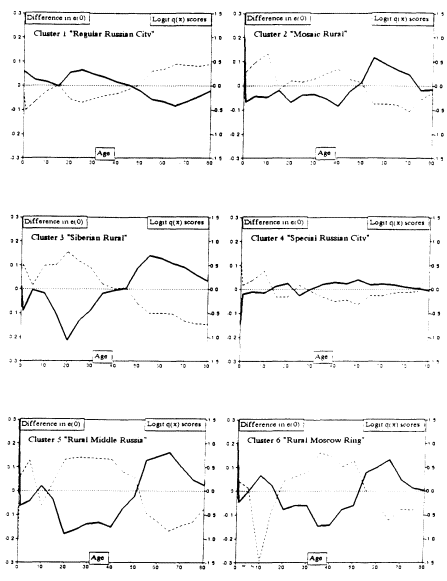
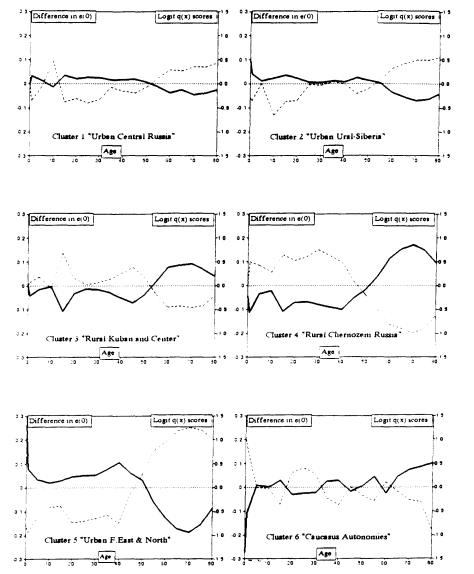
The typical age patterns of mortality resulting from the cluster analysis are shown graphically in Figures 3-1a for males and 3-1b for females. The cluster profiles shown are the average of all members of each cluster.5 Scores of the double standardized logits of the probability of death are shown as dashed lines on the right y-axis. 6 The deviations of scores specify whether mortality is higher or lower for each cluster relative to the average profile of the whole set of logit scores of q(x). Negative deviations indicate that mortality is below average, and positive, that it is higher. The sum of deviations from the average is equal to zero.7
Similarity of Cluster Mortality Patterns
Similarities and dissimilarities among the cluster profiles are evident in the graphs in Figures 3-1a and 3-1b. For males, cluster 1 represents the age pattern that predominates among the urban population of Russia, and it differs from the other clusters considerably. Rural patterns fall into two groups: Clusters 5 and 6 are very similar and geographically represent rural areas in the central part of European Russia, whereas Clusters 2 and 3 represent two other types of rural patterns, which are not closely matched. Cluster 4 is not easily grouped with the other clusters; compared with the others, it is most similar to average Russian mortality. Thus we can conclude that there were five distinct male patterns of mortality in Russia in 1988-1989—two urban and three rural.
For females, clusters 1 and 2 are very similar and can be grouped to represent the main urban profile. The same is true with respect to clusters 3 and 4, which represent the rural profile. Grouping of clusters 5 and 6 is more problematic; indeed, under stringent criteria, female patterns fall into four categories. Cluster 5 can be considered an extreme of the urban pattern, whereas cluster 6 is a ''mixed" urban and rural cluster, and has unusual features.
In the following discussion, we examine features of the age patterns of the clusters and the contribution of selected causes of death to those patterns. The rural and urban classification of the clusters is then examined.
Age and Cause-of-Death Components of Cluster Mortality Patterns
In general, health and social conditions influence the shape of the mortality curve through causes of death. It is known that violent deaths induce a "hump" on the male mortality curve, indicating excess younger adult mortality. A similar effect is observed in the shape of female mortality pattern as a result of maternal mortality.
To investigate the cause-of-death composition of the cluster mortality patterns, we used the following approach for presentation of the profiles. We analyzed each cluster pattern of mortality relative to average Russian mortality by applying a method of decomposition of differences in the level of life expectancy by age and cause of death, using the approach of Andreev (1982) and Arriaga (1984, 1988) (the same approach as that of Pressat [1985] and Shkolnikov et al. [in this volume]). Prior to the decomposition, we shifted the levels of expectation of life of the clusters to the levels of the Russian average life tables (64.0 years for males and 74.0 years for females) to eliminate differences in the level of mortality.8
Figures 3-1a and 3-1b show in bold lines the age components of the difference in e(0) between the clusters and the Russian average (left y-axes). These lines almost mirror the logit scores of age probabilities of dying, which means the
TABLE 3-2 Decomposition of the Difference Between Cluster Age Mortality Patterns and the Russian Average by Cause of Death
presentation of mortality patterns as components of the difference in e(0) corresponds well with the concepts underlying the cluster analysis.
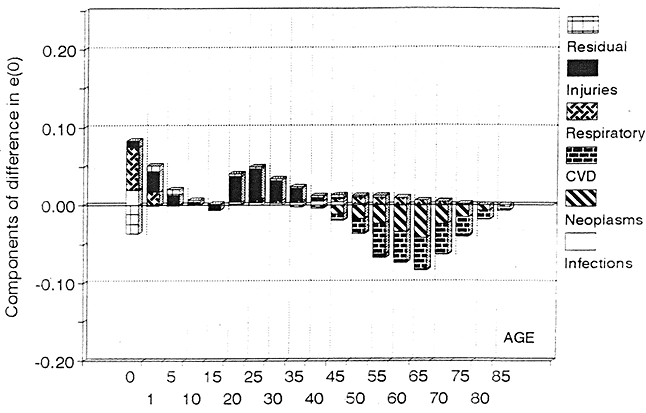
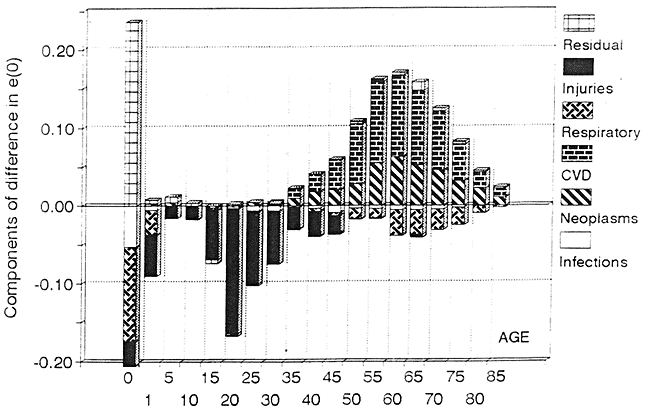
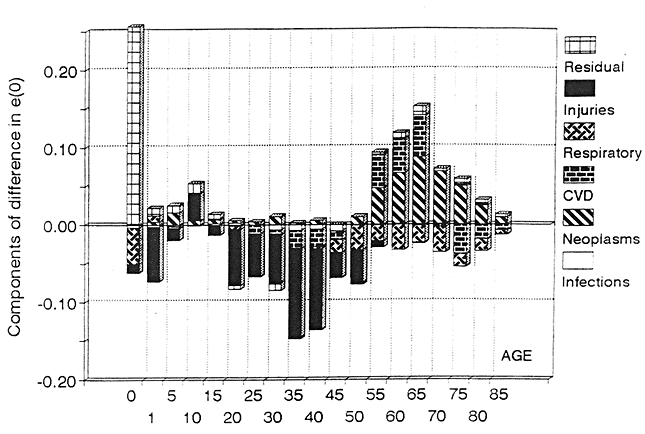
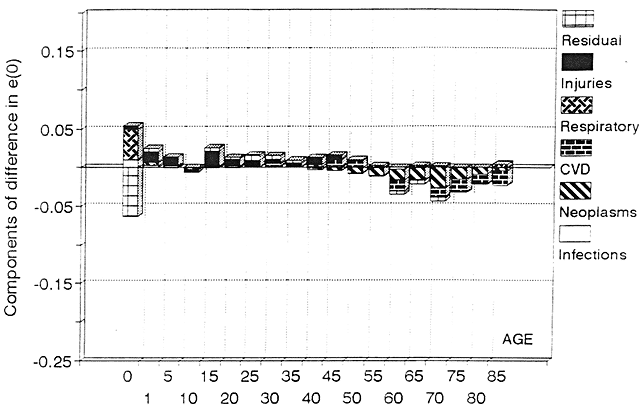
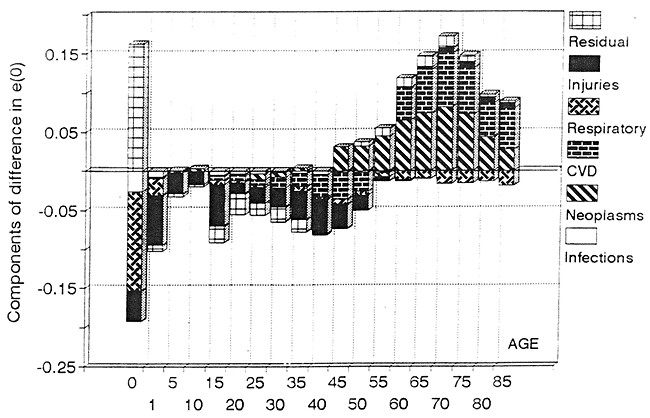
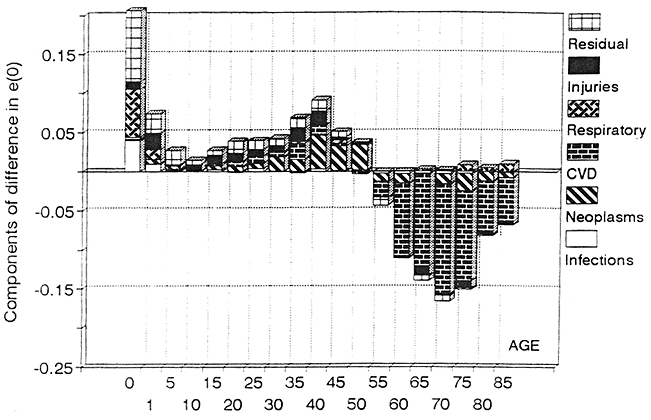
Table 3-2 shows differences between the cluster age mortality patterns and the Russian average, by cause of death. Figures 3-2a through 3-2f show the cause-of-death components of the difference in e(0) between the Russian average and three representative male and female clusters.
The contribution of cause of death to the constitution of age profiles of adult mortality is significant at ages 1 to 55 for injuries, at ages 35 and above for cardiovascular disease, at ages 45 and above for neoplasm, and at ages 45 and above for males and 50 for females for respiratory disease.
Neoplasm, injuries, and cardiovascular disease are the main contributors to the features of the shapes of the cluster mortality patterns. These three causes contribute 73 percent of the variation across clusters for males (injuries, 31 percent; cardiovascular disease, 21 percent; and neoplasms, 21 percent), and 70
|
|
Russian Life Tables |
||||||
|
|
Total Difference in e(0) |
||||||
|
|
Circulatory |
Respiratory |
Digestive |
Ill-defined |
Injuries |
Residual |
|
|
Males |
|||||||
|
Average Russia |
0.00 |
0.00 |
0.00 |
0.00 |
0.00 |
0.00 |
|
|
N1 Regular Russian City |
-0.22 |
0.13 |
0.02 |
0.04 |
0. 16 |
0.0 |
|
|
N2 Mosaic Rural |
0.07 |
-0.24 |
0.02 |
-0.01 |
-0.45 |
0.28 |
|
|
N3 Siberian Rural |
0.61 |
-0.34 |
-0.02 |
-0.17 |
-0.60 |
0.27 |
|
|
N5 Rural, Middle Russia |
0.26 |
-0.39 |
0.05 |
0.03 |
-0.79 |
0.34 |
|
|
N6 Rural, Moscow Ring |
-0.01 |
-0.26 |
0.03 |
0.08 |
-0.57 |
0.32 |
|
|
N4 Special Russian City |
0.06 |
-0.04 |
-0.01 |
0.00 |
-0.05 |
-0.08 |
|
|
Females |
|||||||
|
Average Russia |
0.00 |
0.00 |
0.00 |
0.00 |
0.00 |
0.00 |
|
|
N1 Urban, Central Russia |
-0.05 |
0.06 |
-0.00 |
0.04 |
0.09 |
-0.06 |
|
|
N2 Urban, Ural and Siberia |
-0.09 |
0.11 |
-0.01 |
-0.01 |
0.06 |
0.04 |
|
|
N3 Rural, Kuban and Center |
-0.25 |
0.03 |
-0.03 |
-0.25 |
0.13 |
|
|
|
N4 Rural, Chernozem Russia |
-0.29 |
0.04 |
-0.05 |
-0.39 |
0.11 |
|
|
|
N5 Urban, Far East and North |
-0.54 |
0.12 |
-0.05 |
0.01 |
0.09 |
0.23 |
|
|
N6 Caucasus Autonomies |
0.09 |
-0.27 |
-0.01 |
-0.07 |
0.21 |
-0.05 |
|
percent for females (17 percent, 29 percent, and 24 percent, respectively). Thus, differences in the shape of mortality curves in Russia are associated primarily with mortality due to injuries for males and with cardiovascular disease and neoplasm for females.
Infant mortality plays a minor role in the formation of the clusters, but its cause-of-death structure differs strongly from those of other ages. More than 90 percent of the variation in infant mortality is attributable to three causes: residual causes of death (68 percent for boys, 36 percent for girls), diseases of the respiratory system ( 18 percent and 34 percent, respectively), and infectious and parasitic diseases (10 percent and 21 percent, respectively). The residual causes, most probably congenital anomalies and conditions originating in the perinatal period, contribute to neonatal mortality, while infectious and parasitic and respiratory diseases contribute to postneonatal mortality
Tables 3-3a and 3-3b generalize the main findings of the cluster analysis and indicates the geographic spread of the clusters.
Rural-Urban Differentials in the Shape of Cluster Mortality Patterns
The most notable outcome of the cluster analysis is that the resulting classification does not contain largely mixed rural-urban clusters. Male life tables result in two urban and four rural clusters. Female life tables result in three urban and two rural clusters. Of the twelve clusters, only one (female cluster 6) is mixed. This indicates again that the difference in the shape of the mortality curves of the Russian rural and urban populations is principal and significant, and that any mortality profile in Russia must contain some code that distinguishes the age patterns of mortality for these two populations. Such a code must include two attributes: the slope measured by the ratio of younger adult to older adult mortality, and the shape of mortality in the younger and primary adult ages (the rise of the center hump in the age profile).
A distinctive feature of both the male and female urban mortality patterns is low mortality up to ages 50-55 and high mortality thereafter (Figures 3-1a and 3-1b). This feature can be seen in all urban clusters with the exception of male cluster 4. In female cluster 5, this feature is extreme. In the rural clusters, there is relatively high mortality up to ages 50-55 and low mortality thereafter.
A "central hump" signifying elevated mortality in the middle adult ages is a second and more universal attribute for Russian rural provinces, and compares with concavity, or no deviation, in the urban clusters. For the rural clusters, the excess mortality in intermediate adult age groups differs in size among the clusters.9
Analysis of the components of life expectancy by cause of death further defines the patterns of rural and urban mortality. The rural patterns generally differ from the urban in their low adult mortality from neoplasm and cardiovascular disease for older adults and in their high mortality from injuries and respiratory disease and early increased mortality from cardiovascular disease.
Typically urban features are seen in male and female clusters 1 (Figures 3-2a and 3-2d, respectively). Mortality from injuries and from respiratory disease in infancy and in older adult ages is lower than in average Russia. Mortality from neoplasm and cardiovascular disease at older adult ages is higher than in average Russia.
For the rural clusters, certain general features are noted at different ages (Figures 3-2b and 3-2c for males and 3-2e for females). In infancy, a distinctive rural feature is relatively low neonatal mortality (congenital anomalies and perinatal mortality) and relatively high postneonatal mortality (respiratory disease). In early childhood, injuries peak at above-average levels at ages 1-4 in rural areas and not urban areas. The middle-age excess mortality is due not only to injuries, but also to high early mortality from cardiovascular disease. At older adult ages,
TABLE 3-3a Summary of Cluster Age Patterns of Mortality, Features of Age and Cause-of-Death Components of Life Expectancy, and Regional Location of Age Patterns, Males
|
Predominant Urban (Cluster 1—see map Fig. 3-3a) |
|
|
Features: |
Moderately dispersed profile with low mortality ages at 0-44 and high at ages 45+. Moderately low mortality from injuries at ages 0-44 and from respiratory mortality at ages 0-4. Moderately high mortality from neoplasms and cardiovascular diseases at ages 45+. |
|
Regions: All regions except North Caucasus |
|
|
Marginal (Specific) Urban (Cluster 4—see map Fig. 3-3a) |
|
|
Features: |
Age profile is minimally scattered, i.e., it is very close to the average for all Russia. Like urban profiles, it has high neonatal mortality. Like rural profiles, it has low mortality from neoplasm at ages 40 and over. The contribution of any other cause of death is negligible. |
|
European Rural (Clusters 5 and 6—see map Fig. 3-3b) |
|
|
Features: |
Extremely dispersed profile with very low neonatal mortality, low mortality at ages 10-14 and 55+, and very high mortality at ages 20-49. Very high mortality from injuries at ages 1-4 and 20-54; early increased cardiovascular mortality at ages 20-44; high mortality from respiratory diseases at ages 55 and over. Very low mortality from neoplasm and mortality from cardiovascular disease contribute equally to very low mortality at ages 55 and over. |
|
Regions: |
Central,* Central Blackearth, Volga-Vyatka, Volga*(Northwestern, Ural, North Caucasus) |
|
Siberian Rural (Cluster 3—see map Fig. 3-3b) |
|
|
Features: |
Highly dispersed profile with high mortality at ages 1-4 and 15-34 (sharply peaked at 20-24) and low mortality at ages 50 and over. Infant mortality is close to average as a result of very low mortality from congenital and other causes of death in the perinatal period and very high mortality from infectious and respiratory disease and injuries. Only high mortality from injuries contributes to a sharp peak at ages 15-34; early increased cardiovascular mortality is absent: low mortality at ages 50+, which seems to be the lowest among all clusters, is mainly due to cardiovascular disease. |
|
Regions: |
Volga* (Eastern Siberia, Western Siberia,* Ural*), North Caucasus, * Far Eastern,* Central Blackearth* |
|
Male Outliers |
|
|
Regions: |
Far East (5 members), North Caucasus (4), Eastern Siberia (2) |
|
*Signifies that two or more provinces are members of a different cluster pattern or are outliers. |
|
TABLE 3-3b Summary of Cluster Age Patterns of Mortality, Features of Age and Cause-of-Death Components of Life Expectancy, and Regional Location of Age Patterns, Females
|
Predominant Urban (Clusters 1 and 2—see map Fig. 3-3c) |
|
|
Features: |
Moderately dispersed profile with low infant and early child mortality, average mortality at ages 5-49, and moderately high mortality at ages 55+. Deviations from average Russia are fairly small. Substantial negative contributions result in high mortality from cardiovascular disease and neoplasm at old ages. Positive contributions result in low mortality from injuries at ages 1-49. which are persistent but minor. |
|
Regions: |
All regions |
|
Extreme Urban (Cluster 5, ''North and Far East"—see map Fig. 3-3c) |
|
|
Features: |
Highly dispersed profile with low mortality from all causes of death at ages 054, especially from neoplasm at ages 30-49. High mortality at ages 55+ caused by extremely high mortality from cardiovascular disease. |
|
Regions: |
Northern, Far Eastern |
|
Rural (Clusters 3 and 4—see map Fig. 3-3d) |
|
|
Features: |
Highly dispersed profile with high mortality at ages 1-44, very low mortality at ages 45+. Low neonatal mortality and high infectious, respiratory disease, and injury mortality in infancy and early childhood. Heavy mortality from injuries at ages 0-54, peaking sharply at ages 1-4 and 15-19. Early increased risk of cardiovascular disease at ages 35-54, low mortality from neoplasm at ages 35+, and low cardiovascular mortality at ages 60+. Mortality from respiratory disease is high at young ages and moderately high among the elderly. |
|
Regions: |
All regions |
|
Mixed Rural-Urban (Cluster 6, "Caucasus Autonomous"—see map Figs. 3-3c and 3-3d) |
|
|
Features: |
Dispersed irregular profile with pronounced deviations from the average at young and old ages. From the point of view of cause-of-death structure, this cluster is typically rural (except for moderately low mortality from injuries at ages 15+). Very high infant mortality from infectious disease and high respiratory disease mortality ages 0-4. Cardiovascular mortality is relatively high at ages 45-64 and relatively low at 65+. Low mortality from neoplasms. |
|
Regions: |
North Caucasus (5 of 6 autonomous republics), Volga (Kalmykia is a neighbour of North Caucasus), Central (1) |
|
Female Outliers |
|
|
Regions: |
Far East (5 of 12), Eastern Siberia (3 of 12), Northern (2 of 10), North Caucasus (2 of 14), |
|
*Signifies that two or more provinces are members of a different cluster pattern or are outliers. |
|
there is a negative correlation between respiratory disease, and cardiovascular disease and neoplasm. Mortality due to respiratory disease is consistently above average, and mortality due to cardiovascular disease and neoplasm consistently below average. This fact is not visible in the analysis of differences in mortality levels.
Geographic Designation of Cluster Mortality Patterns
Geographic interpretation of the cluster age patterns is customary in an analysis of this kind. The distribution of provinces by cluster membership is mapped in Figures 3-3a, b, c, and d. Geographic labels are assigned to all six female clusters, but to only three male clusters. As the maps show, the geographical territory covered by the age clusters is often not clearcut, especially with large clusters. The geographic designation is assigned based on the area in which a cluster is dominant (e.g., female clusters 1-410).
Two small female clusters, 5 and 6, have clear geographic designations. Cluster 5, "Urban, Far East and North," represents areas situated on the frontiers of Russia with an extreme climate, poor social infrastructure, and high migration. Cluster 6 has five of seven members belonging to the autonomous republics of North Caucasus; the sixth is the neighboring Kalmytskaya autonomous republic. In fact, this cluster contains nearly all autonomous republics of southern Russia that are not clustered and therefore classified as outliers.
The most homogeneous male clusters are rural clusters 5 and 6. Since the age patterns of mortality of these clusters are similar, we can aggregate their members in one cluster stretching from northwest to southeast across the center of European Russia, and therefore labeled as "Middle European." In contrast, the aggregation of two pairs of female clusters with similar age patterns (urban clusters 1 and 2, rural clusters 3 and 4) has no clear geographic interpretation.
In general, only relatively small clusters have a distinct geographic designation. The difficulty of defining geographic identity in classifications of this sort is common rather than unusual. Problems in assigning a geographic designation to specific age patterns of mortality arose in the creation of the Coale-Demeny models (hence we have the compromise model West), as well as with the U.N. models (United Nations, 1982; Heligman, 1984); models produced by the Organization for Economic Cooperation and Development (OECD) did not even assign geographical labels (Organization for Economic Cooperation and Development, 1980; Waltisperger, 1984).
The fact that age mortality profiles are similar across a wide range of geographical areas points out that, among factors that influence the mortality patterns of Russian provinces, universal factors are more important than those linked with specific regions. This homogeneity may reflect uniformity of lifestyles, behavioral patterns, attitudes, values, and quality of life among ethnically similar Russians.
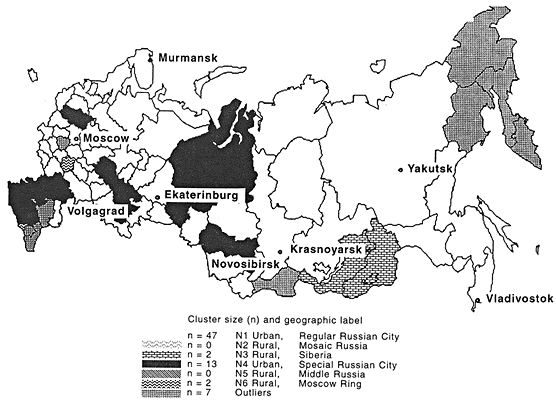
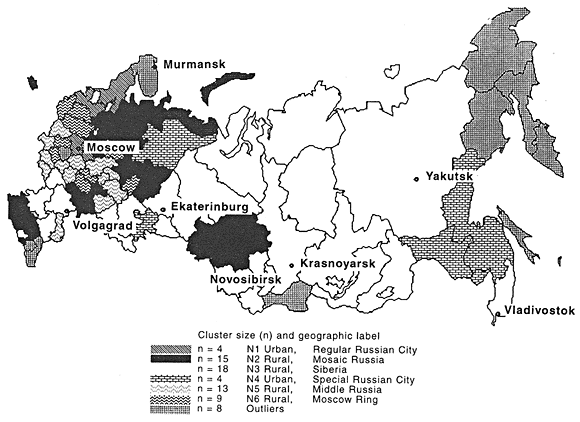
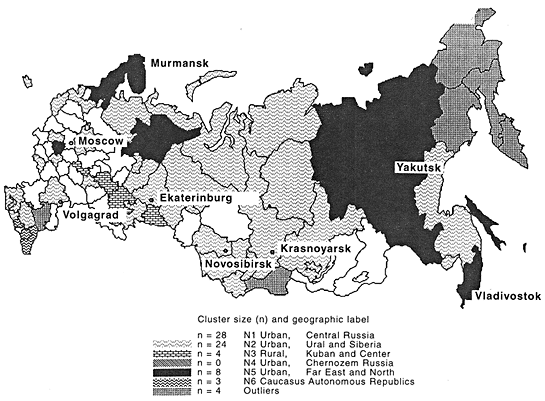
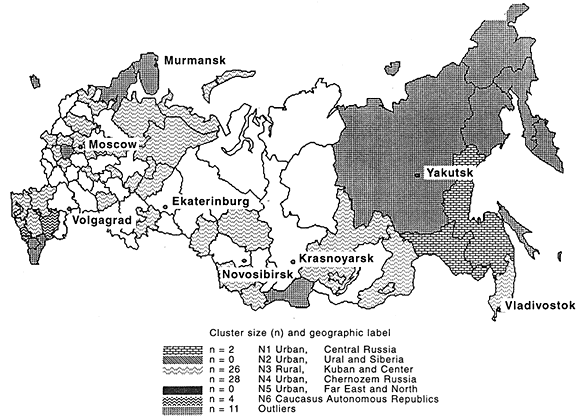
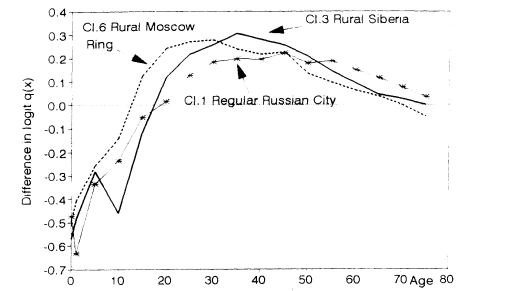
Figure 3-4a
Comparison of Russian male mortality patterns with West model life table.
Russian Regional Mortality Patterns Relative to World Mortality Experience
In the previous section, cluster profiles are compared with average Russian mortality. The analysis leaves open the question of how great the differences among mortality patterns are, whether they represent different families of mortality patterns or belong to one Russian family, and how these patterns compare with international experience. The international experience of mortality is described here in generalized form through patterns of regional model life tables. As a basis for comparison, we use the Coale-Demeny West model life table. Comparisons with the other families of Coale-Demeny, as well as with other regional models and with life tables of other areas of Europe, the United States, and developing regions, are also considered (Keyfitz and Flieger, 1968, 1971; United Nations, 1966, 1974, 1975, 1980).11 Figures 3-4a through 3-4d present the comparisons. As before, all profiles have the same level of e(0), but the differences shown are between the logits of the probability of death of selected clusters and the West model life table with the same level of e(0).12
Males
In Figure 3-4a, selected male cluster patterns are graphed against the stan-
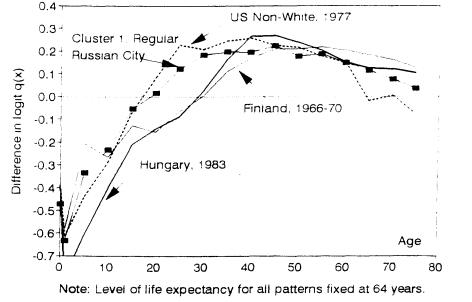
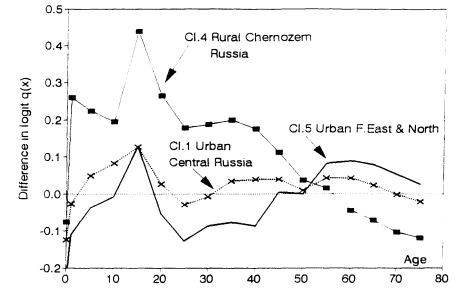
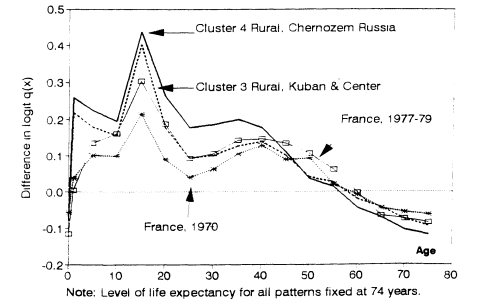
Figure 3-4d
Similarity of rural Russian and French female mortality patterns.
dard of the West model life table. In an international context, the rural and urban cluster profiles of male mortality appear as slight modifications of the same Russian profile. That which was considered an attribute of a rural type of mortality on the Russian scale now appears as an attribute of any male life table of Russia on the international scale. Both urban and rural male patterns (represented by clusters 1, and 3 and 6, respectively) show elevated mortality in the middle adult years; they differ in the length, the age location, and the sharpness of the hump of injuries and violent mortality.
The West model life table does not appear to fit the Russian experience. Rather, the distinguishing features of the latter of relatively low infant and child mortality and relatively high middle adult mortality are evident in the figure. Further investigation of the similarity of this pattern to other models reveals (figures not shown) that Russian mortality patterns do not resemble any regional family of the model life tables of Coale and Demeny, the U.N. tables, or other regional life tables, including standard life tables for developing regions (Heligman et al., 1993). The U.N. model Far East is the closest to the six Russian cluster profiles, but even it is not a very good match.
Examination of male life tables from Finland (1966-1970), Hungary (1983), France (1954-1958), and the nonwhite population of the United States (1977) reveals a greater similarity of the Russian profile to these populations than to any
of the model life tables (Figure 3-4b; France not shown). Among the life tables of European countries, those for Hungary, which, like Russia, experienced a long crisis of male mortality and has passed through similar socialist development, appear to have less of a central hump than those for Russia. We find that the male profiles for France and Finland are the most similar to the Russian mortality shape. The mortality age profiles of these European countries for the 1950s and 1960s do not fit well with any Coale-Demeny model life table. The U.N. Model Far East appeared in the 1980s and was based on a completely different sample of life tables, yet it offers the best fit for those countries during the 1960s and 1970s. For 1954 France and 1966-1974 Finland, the fit is fairly good. However, for the last 15 to 20 years, these country patterns no longer fit even this model, much less any other.
In France and Finland, as in Russia, the gaps in life expectancy between men and women are among the largest in the world and appeared long ago. Moreover, high consumption of alcohol is common among the male population of all three of these countries. Central humps make the profiles of France and Finland most similar to the profiles of two Russian urban clusters—"Regular" and "Special City."
Thus in general, the central hump of male mortality is not singularly a Russian phenomenon. The patterns found in Russia are similar to those of some other developed countries in Europe, and the direction in which Russian patterns have changed is not unique in the developed world. Differences between Russia and France or Finland are more in the level of mortality than in the shape. It appears that this mortality pattern is not represented in model life tables, even though it is a typical pattern of male mortality in a number of developed countries.
At the same time, the central hump in Russian mortality is higher and considerably younger than those in the other European tables. The profile is most similar to that of the nonwhite population of the United States (Figure 3-4b). This result may reflect commonalities in the social situations of these two male populations, which could include lifestyle, working conditions, public health services, or a number of other factors. It is beyond the scope of the present discussion to address this question. However, it seems clear that communism as a social system has no direct relation to this particular shape of mortality, contrary to the associations suggested by Eberstadt (1990).
Females
In contrast to the male patterns, Russian female cluster mortality patterns differ from one another, even on the worldwide scale of comparison (Figure 3-4c). The dissimilarities are especially evident between rural and urban patterns. However, all have the common feature of a sharp peak in mortality at ages 15-19. This trait of Russian mortality cannot be found in any regional model life table.
For the rural profiles, the sum of deviations from the West model life table is very large, signifying that these profiles have nothing in common with that model. Compared with the West model, they have lower infant and old-age mortality and elevated mortality between ages 1 and 60. These features resemble those in Figure 3-1b, so the principal characteristics of rural female mortality patterns are maintained in the worldwide comparison. The pattern of the Coale-Demeny North model life table (not shown) more closely resembles the pattern of rural mortality of Russian women. The French life tables of the 1960s and 1970s (shown in Figure 3-4d) are an even better fit to the Russian female shape than any of the model life tables and most closely replicate the early sharp peak.
On the worldwide scale of comparison, the principal characteristics of the Russian urban female mortality profiles are not unique. The deviations from model West are moderate relative to the rural patterns. The predominant urban female age pattern of mortality in Russia, represented by cluster 1, ''Urban, Central Russia," in Figure 3-4c, differs from that model only at ages 0-19.
The exaggerated urban cluster 5, "Urban, Far East and North," is the only male or female Russian profile with lower mortality in the middle ages relative to model West. This family is most similar to the patterns of Finland of the 1970s. The mixed cluster 6, "Caucasus Autonomous Republics" (not shown), could be grouped with the urban clusters and the West model, although the profile essentially differs from the urban profiles and the profile of model West in mortality for ages 0-4. Actually, this is the only profile with infant mortality higher than in model West.
Summary and Conclusions
The continuing crisis in adult mortality in Russia is characterized by very high death rates from injuries and early cardiovascular disease. These health problems have a significant impact on the overall level of mortality, but also have a pronounced effect on the age patterns of Russian mortality. Given the size and diversity of Russia, this analysis has focused on spatial variation in the level of mortality and in age patterns of mortality by major causes of death within the country. The variation within Russia has been examined in an international context by comparison with model life tables and other country age patterns of mortality.
The most prominent mortality differential in Russia is between the sexes. Males have higher mortality than females across all provinces of Russia; age-standardized rates of mortality due to injury, cardiovascular disease, and neoplasm are all substantially greater for males than for females. Higher male than female mortality is evident in both rural and urban areas. Rural and urban male life expectancies are 11 and 10 years, respectively, less than female. The age patterns of mortality are also different, and male and female patterns in any one region are not highly related. The age pattern of males is characterized by
sustained elevated mortality in the middle adult ages and that of females by a sharp peak at ages 15-19, especially for rural females.
Differentials in rural and urban mortality are also marked in Russia. Rural males have a life expectancy at birth 2.6 years less than that of urban males, and rural females have a life expectancy 1 year less than that of urban females. The differential between rural and urban areas due to deaths from injuries and neoplasm is large. Rural areas overwhelmingly and consistently have higher mortality rates due to injury, by a substantial margin. For males, rural morality rates due to injury are on average 38 percent higher than in urban areas, and for females 28 percent higher. Neoplasm demonstrates the opposite pattern. Urban rates are on average 12 percent higher for males and 23 percent higher for females than rural rates. The differential between rural and urban areas for cardiovascular disease is much smaller and more complex. On average, however, cardiovascular disease rates are higher in rural areas (5 percent higher for males and 3 percent for females).
Regional variation in mortality is large in the sense of absolute range in life expectancy, but relative variation among provinces is fairly small. The majority of provinces have relatively similar levels of life expectancy. In general, the Northern and Northwestern regions in the north of European Russia, the northern part of the Ural region, a large part of Siberia, and the Far East include the areas with the lowest life expectancies. However, patterns of cause of death within these regions are extremely diverse. Provincial variation within regions is also substantial. For example, in the Far Eastern region, cause-specific mortality rates are generally high from injury, cardiovascular disease, and neoplasm, but are less extreme for rural males than for others. In Eastern Siberia, high rates of injury are found in all four subpopulations, but very low rates of mortality from cardiovascular disease are found among males and moderately high rates among rural females. In the northern Ural region, there are high levels of injury, but generally lower rates of cardiovascular disease and neoplasm. In the Northern region, there are high rates of cardiovascular disease and moderate to low rates of injury.
Age patterns of mortality associated with each of these causes are fairly different. Consequently, the variation in age patterns of mortality across Russia does not correspond well to regional differences in level. Rather, the most outstanding feature of those patterns is their largely rural or urban character. The classification of provincial life tables into numerous clusters representing typical age patterns of mortality results in largely urban or rural clusters. This indicates that the difference in the shape of the mortality curves of these two populations is principal and significant, and that any mortality profile for Russia must contain some code that distinguishes urban from rural mortality.
The shape of the age patterns of mortality simplifies the spatial variation in mortality across Russia into predominant patterns. Within Russia, classification of provincial life tables into typical patterns results in one major urban cluster and two rural clusters for males and one major urban and one major rural cluster for
females. Distinct age patterns are also evident outside these predominant patterns. A summary of the cluster patterns and their regional affiliations is given in Tables 3-3a and 3-3b. The predominant urban clusters cover most of the urban population of both the European and Asian parts of Russia. However, there is a distinct urban age pattern for females in the Northern and Far Eastern regions. For males, there is an additional urban cluster, covering areas of the North Caucasus and Western Siberia regions, that is closest of all the profiles to the Russian average. The predominant rural cluster for females extends throughout all of Russia. Of the two male rural clusters, one is centered in a diagonal from northwest to southeast European Russia; the other includes some provinces of the above regions, as well as the majority of rural clusters in other regions of Russia.
In the predominant male and female urban mortality patterns, there is low mortality up to ages 50-55 and high mortality thereafter, relative to the Russian average. Features of typically urban age patterns are low mortality from injuries up to age 55 and from respiratory disease in infancy and in older adult ages, relative to the Russian average. Mortality from neoplasm and cardiovascular disease at older adult ages is higher than the Russian average.
The rural age pattern of mortality is characterized by high young mortality relative to older adult mortality. The shape of mortality in the younger adult ages differs across clusters. Rural mortality generally differs from urban in its low and sometimes very low adult mortality from neoplasm and in its high mortality from injuries and respiratory disease in childhood and young and middle adult ages. In two of the three rural profiles, early increased risk from cardiovascular disease is evident. However, at older adult ages, mortality due to cardiovascular disease and neoplasm is low compared with overall Russia, and mortality due to respiratory disease is high.
The two rural male clusters differ in the pattern of injuries across the middle adult ages and the presence of increased risk due to cardiovascular disease in the younger and middle adult ages. This difference is also indicated by rural-urban differentials in mortality levels due to injuries and cardiovascular disease. In the Northwestern, Central, Volga-Vyatka, and Central Blackearth regions, the rural-urban injury differential is large. These same regions contribute most to the rural pattern evident in European Russia. At the same time, the overall level of mortality is not high in these regions. This indicates that the pronounced impact of injury and cardiovascular disease on rural middle-age adult mortality is not captured by the level of mortality, since the impact is counterbalanced by relatively low mortality due to cardiovascular disease and neoplasm at older ages.
The two female urban patterns differ primarily in the excessively high risk of cardiovascular disease mortality among older females, which is found in the North and Far Eastern regions. Features of the other exceptional age patterns, and the associated regions, are given in Table 3-3. Of all the regions, provinces in the North Caucasus and Far Eastern regions contribute most to the exceptional patterns and to outliers.
A comparison of Russian age patterns of mortality on an international scale reveals the similarity of the Russian profiles to each other, whether urban or rural. At the same time, the comparison reveals the dissimilarity of the Russian male age patterns to the regional model life tables of Coale and Demeny and the United Nations, as well as to standard life tables for any developing region. Of all the models, the Russian male age pattern is most similar to the Far Eastern model life table (United Nations, 1982). However, examination of male life tables from Finland (1966-1970), Hungary (1983), France (1954-1958), and the nonwhite population of the United States (1977) reveals greater similarity of the Russian profile to the profiles of these populations, particularly the last, than to any of the model life tables. It appears that this mortality pattern is not represented in model life tables, even though it is a typical pattern of male mortality in a number of developed countries.
Among females, the predominant urban age pattern of mortality in Russia is fairly similar to the West model life table. The pattern of the Coale-Demeny model North most closely resembles the pattern of mortality of rural Russian women. However, the French life tables of the 1960s and 1970s are an even better fit to the Russian female shape than any of the model life tables and most closely replicate the early sharp peak of mortality at ages 15-19.
Thus in general, the age patterns of mortality found in Russia are not unique. They have been seen in other Western countries, and therefore cannot be explained by the political and social system of Russia of past decades. At the same time, the unique feature of Russian mortality is the unusually high level of adult male mortality, which—as our analysis has shown—dominates over all parts of Russia and results from very high mortality due to injuries and cardiovascular disease. Certainly, further investigation of factors producing the variation in the age patterns of mortality noted herein would prove valuable to our understanding of the extraordinarily high level of adult mortality in Russia.
References
Andreev, E.M. 1979 Prodolzhitelnost zhisni v SSSR: Differenzialnyi analis [Life expectancy in the USSR: analysis of differentials]. Pp. 7-30 in E.M. Andreev and A.G. Vishnevsky. eds., Prodolzhitelnost zhizni: analis i modelirovanie [Life expectancy: analysis and models]. Moscow: Statistika.
1982 Metod komponent v analize prodolzhitelnosti zhizni [Method of the components in the life expectancy analysis]. Vestnik Statistiki 3(March):42-47.
Anson, J. 1994 The shape of mortality curves: An analysis of counties in England and Wales. 1911. European Journal of Population 9:43-68.
Arriaga, E.E. 1984 Measuring and explaining the change in life expectancies. Demography 21(1):83-96.
1988 Changing trends in mortality decline during the last decades. The change in life expectancies. Pp. 105-130 in L. Ruzicka, G. Wunsch, and P. Kane, eds., Differential Mortality: Methodological Issues and Biosocial Factors. Oxford: Clarendon Press.
Bourgeois-Pichat, J. 1962 Factor analysis of sex-specific death rates. A contribution to the study of dimensions of mortality. Population Bulletin of the United Nations 6.
Brass, W. 1971 On the scale of mortality. Pp. 69-110 in W. Brass, ed.. Biological Aspects of Demography. London: Taylor and Francis Ltd.
Carrier, N.H., and J. Hobcraft 1971 Demographic Estimation for Developing Societies: A Manual of Techniques for the Detection and Reduction of Errors in Demographic Data. London: London School of Economics, Population Investigation Committee.
Chiang, C.L. 1978 The Life Table and Mortality Analysis. Geneva: World Health Organization. 1984 The Life Table and Its Applications. Malabar, Florida: Krieger Publishing.
Coale, A.J., P. Demeny 1966 Regional Model Life Tables and Stable Populations. Princeton, NJ: Princeton University Press.
Coale, A.J., P. Demeny. and B. Vaughan 1983 Regional Model Life Tables and Stable Populations. Second ed. New York: Academic Press.
Cronbach, L.J., and G.C. Gleser 1953 Assessing similarity between profiles. Psychological Bulletin 50(6):456-473.
Eberstadt, N. 1990 Health and mortality in Eastern Europe, 1965-85. Communist Economies 2(3):347-371.
Heligman L. 1984 Construction of the new United Nations model life table system. Pp. 179-202 in J. Vallin, J.H. Pollard, and L. Heligman, eds., Methodologies for the Collection and Analysis of Mortality Data. Liège: Ordina Editions.
Heligman, L., N. Chen. and O. Babakol 1993 Shifts in the structure of population and deaths in less developed regions. Pp. 9-41 in J.N. Gribble and S.H. Preston, eds., The Epidemiological Transition: Policy and Planning Implications for Developing Countries. Washington D.C.: National Academy Press.
Keyfitz, N.. and W. Flieger 1968 World Population: An Analysis of Vital Data. Chicago: University of Chicago Press.
1971 Population: Facts and Methods of Demography. San Francisco: W.H. Freeman.
Ledermann, S. and J. Breas 1959 Les dimensions de la mortalité. Population 14(4):637-682.
Messinger, H.B. 1980 The dimensions of age-specific mortality. Human Biology 52(1):93-105.
Nemcov, A.V. 1995 The Situation with Alcoholism in Russia. Moscow: Public Foundation Health and Environment (in Russian).
New Russia 1994 Information and Statistics. Moscow: All Moscow and International Academy of Informatics, pp. 172-200 (in Russian).
Organization for Economic Cooperation and Development 1980 New model life tables for use in developing countries. In Mortality in Developing Countries. Tome III, Vol. 5, Paris.
Pressat, R. 1985 Contribution des ecarts de mortalité par age à la difference des vies moyennes. Population 40(4-5):766-770.
Rasputin, V. 1991 Farewell to Matyora. Translated by A.W. Bouis. Evanston, IL: Northwestern University Press.
Shkolnikov, V., and S. Vassin 1994 Spatial differences in life expectancy in European Russia in the 1980s. Pp. 379-402 in W. Lutz, S. Scherbov, and A. Volkov, eds., Demographic Trends and Patterns in the Soviet Union Before 1991. London and New York: Routledge.
Skinner, H.A. 1978 Differentiating the contribution of elevation, scatter and shape in profile similarity. Educational and Psychological Measurement 38(2):297-308.
United Nations 1966 Demographic Yearbook. New York: United Nations.
1974 Demographic Yearbook. New York: United Nations.
1975 Demographic Yearbook. New York: United Nations.
1980 Demographic Yearbook. New York: United Nations.
1982 Model Life Tables for Developing Countries. New York: United Nations Publication.
1988 MORTPAK: The United Nations Software Package for Mortality Measurement. New York: United Nations.
Valaouras, V.G. 1974 Model life-tables as a measure of mortality. Proceedings of the International Population Conference in Liège, 1973. Liège: Ordina.
Vassin, S. 1994 Epidemiological transition of mortality curves in terms of the Brass logit system. European Journal of Population 10(1):43-68.
Waltisperger D. 1984 Standard life tables for use in developing countries: An assessment of the OECD models. Pp. 203-224 in J. Vallin, J.H. Pollard, and L. Heligman, eds., Methodologies for the Collection and Analysis of Mortality Data. Liège: Ordina Editions.
Waterhouse, J., C. Muir, P. Correa, and J. Powell, eds. 1976 Cancer Incidence in Five Continents, Vol. 3. IARC Scientific Publications No. 15. Lyon. France: International Agency for Research on Cancer.
Wunsch, G. 1984 Chapter in Jacques Vallin, J.H. Pollard, and L. Heligman, eds., Methodologies for the Collection and Analysis of Mortality Data. Liège: Ordina Editions.
Notes
-
2.
In the discussion in this section, the term "rates" refers to cause-specific mortality rates.
-
measures differences in scatter, and the third measures differences in shape (Cronbach and Gleser, 1953; Skinner, 1978).
-
5.
In other words, we averaged the outputs of cluster analysis according to Cronbach-Gleser's approach, the outputs being scores of double standardized logit q(x) for each profile.
-
6.
Classification of life tables by shape was performed on logits of q(x) (see note 3). Curves plotted in Figures 3-1a and 3-1b are the output of cluster analysis done by Ward's hierarchical method, that is, they represent scores of logits of q(x) after their transformation by Cronbach and Gleser's formula.
-
7.
Logit scores are rather abstract and inconvenient indicators. On the same graph, the results of the cluster analysis are given in terms of age components of life expectancy (bold lines, left y-axis). This type of analysis is used also by Shkolnikov et al. (in this volume). Like logit scores, the components of e(0) for each cluster sum to zero and reference the difference in e(0) level between each cluster life table and the average life table for all of Russia. The age components of e(0) mirror the deviations based on the logit scores. The former reflect survival and are in units of years of life expectancy, while the latter reflect mortality and are in abstract scores. The age and cause-of-death component analysis is used later in the identification of the underlying cause-of-death structure of each cluster profile, which is discussed in the next section and shown in Figures 3-2a through 3-2f.
-
9.
Two of the profiles do not follow this general pattern of rural-urban attributes. We can recognize female cluster 6, "Caucasus Autonomous." as rural because of the slope of its profile (high infant and child mortality to low old-age mortality), but it consists of three rural and four urban life tables. The male cluster "Special Russian City" consists mainly of urban life tables, but its profile has no distinguishing features of urban mortality; rather, it represents mixed urban-rural features. The size of its deviation in Figure 3-1a shows that it is very close to the Russian average profile, which represents mortality for both male subpopulations.
ANNEX 3-1 Provincial Variation in Life Expectancy at Birth, Selected Cause-Specific Death Rates per 100,000 (age-standardized), and Associated Quintiles (Q1-Low Mortality, Q5-High), Russia, 1988-1989
|
|
Males - Urban Areas |
|||||||
|
Province |
e(0) |
Q |
Injury |
Q |
CVD |
Q |
Neopl. |
Q |
|
Northern Region |
||||||||
|
Arhangelsk |
64.4 |
3 |
178.8 |
2 |
938.0 |
4 |
367.1 |
5 |
|
Karelia |
63.7 |
4 |
201.2 |
4 |
1059.0 |
5 |
390.5 |
5 |
|
KOMI |
63.5 |
4 |
209.1 |
4 |
953.2 |
5 |
349.4 |
4 |
|
Murmansk |
64.9 |
2 |
153.8 |
1 |
977.3 |
5 |
347.7 |
4 |
|
Vologda |
64.2 |
4 |
181.9 |
2 |
969.4 |
5 |
341.4 |
3 |
|
Northwestern Region |
||||||||
|
Lenin.Obl |
63.4 |
5 |
225.9 |
5 |
949.0 |
5 |
357.9 |
5 |
|
Leningrad |
65.5 |
1 |
148.4 |
1 |
850.4 |
2 |
382.4 |
5 |
|
Novgorod |
63.4 |
5 |
212.4 |
4 |
950.3 |
5 |
352.2 |
4 |
|
Pskov |
64.1 |
4 |
198.4 |
4 |
980.5 |
5 |
314.6 |
2 |
|
Central Region |
||||||||
|
Bryansk |
65.5 |
1 |
171.1 |
2 |
869.6 |
3 |
314.7 |
2 |
|
Ivanovo |
63.5 |
4 |
196.5 |
4 |
972.2 |
5 |
331.7 |
3 |
|
Jaroslav |
64.4 |
3 |
40.7 |
1 |
897.1 |
4 |
345.0 |
4 |
|
Kalinin |
63.9 |
4 |
206.0 |
4 |
915.8 |
4 |
323.4 |
3 |
|
Kaluga |
65.0 |
2 |
161.4 |
1 |
881.1 |
3 |
338.6 |
3 |
|
Kostroma |
64.2 |
4 |
205.3 |
4 |
949.2 |
5 |
348.2 |
4 |
|
Moscow Obl. |
64.8 |
3 |
182.1 |
3 |
876.0 |
3 |
348.2 |
4 |
|
Moscow |
65.4 |
1 |
126.9 |
1 |
836.1 |
2 |
359.8 |
5 |
|
Orlovskay |
65.5 |
1 |
193.5 |
3 |
863.7 |
3 |
295.7 |
2 |
|
Ryazan |
64.8 |
3 |
197.8 |
4 |
838.7 |
2 |
341.7 |
3 |
|
Smolensk |
64.6 |
3 |
177.9 |
2 |
869.7 |
3 |
341.7 |
3 |
|
Vladimir |
64.2 |
4 |
178.6 |
2 |
971.5 |
5 |
354.4 |
5 |
|
Volga-Vyatka Region |
||||||||
|
Chuvashia |
66.4 |
1 |
200.7 |
4 |
724.3 |
1 |
250.7 |
1 |
|
Gorkovskaya |
64.1 |
4 |
184.1 |
3 |
903.2 |
4 |
345.3 |
4 |
|
Kirovskay |
64.8 |
3 |
195.2 |
3 |
871.4 |
3 |
287.7 |
1 |
|
Maryiskay |
64.8 |
3 |
207.8 |
4 |
835.2 |
2 |
273.3 |
1 |
|
Mordva |
65.1 |
2 |
165.6 |
2 |
884.0 |
4 |
301.3 |
2 |
|
Central Blackearth Region |
||||||||
|
Belgorod |
65.8 |
1 |
160.8 |
1 |
822.1 |
2 |
288.3 |
1 |
|
Kurskay |
65.0 |
2 |
153.2 |
1 |
907.2 |
4 |
315.2 |
2 |
|
Lipezk |
65.5 |
1 |
174.4 |
2 |
873.9 |
3 |
319.5 |
2 |
|
Tambov |
64.0 |
4 |
195.5 |
3 |
863.0 |
3 |
311.8 |
2 |
|
Voronej |
66.1 |
1 |
45.7 |
1 |
772.4 |
1 |
274.3 |
1 |
|
|
Males - Rural Areas |
|||||||
|
Province |
e(0) |
Q |
Injury |
Q |
CVD |
Q |
Neopl. |
Q |
|
Northern Region |
||||||||
|
Arhangelsk |
60.9 |
4 |
273.3 |
3 |
1090.6 |
5 |
314.6 |
4 |
|
Karelia |
61.8 |
3 |
251.2 |
3 |
1115.4 |
5 |
353.4 |
5 |
|
KOMI |
60.8 |
4 |
294.9 |
4 |
1079.4 |
5 |
277.5 |
2 |
|
Murmansk |
||||||||
|
Vologda |
62.1 |
3 |
227.3 |
1 |
1057.7 |
5 |
290.2 |
3 |
|
Northwestern Region |
||||||||
|
Lenin. Obl. |
62.0 |
3 |
265.4 |
3 |
1031.6 |
5 |
351.8 |
5 |
|
Leningrad |
||||||||
|
Novgorod |
57.8 |
5 |
361.3 |
5 |
1116.6 |
5 |
345.4 |
5 |
|
Pskov |
60.2 |
5 |
297.8 |
4 |
1058.8 |
5 |
292.3 |
3 |
|
Central Region |
||||||||
|
Bryansk |
62.1 |
3 |
244.3 |
2 |
938.8 |
3 |
261.7 |
2 |
|
Ivanovo |
60.5 |
5 |
265.5 |
3 |
1126.2 |
5 |
320.4 |
4 |
|
Jaroslav |
60.1 |
5 |
298.8 |
4 |
1033.2 |
5 |
297.0 |
3 |
|
Kalinin |
58.6 |
5 |
361.1 |
5 |
1144.9 |
5 |
299.2 |
4 |
|
Kaluga |
59.8 |
5 |
289.5 |
4 |
1004.7 |
4 |
316.7 |
4 |
|
Kostroma |
61.2 |
4 |
274.2 |
3 |
1088.5 |
5 |
298.3 |
4 |
|
Moscow Obl. |
62.8 |
2 |
267.3 |
3 |
955.7 |
4 |
361.2 |
5 |
|
Moscow |
||||||||
|
Orlovskay |
61.5 |
4 |
298.8 |
4 |
892.4 |
3 |
269.1 |
2 |
|
Ryazan |
61.1 |
4 |
309.9 |
5 |
938.7 |
3 |
290.3 |
3 |
|
Smolensk |
60.6 |
4 |
289.6 |
4 |
988.0 |
4 |
299.2 |
4 |
|
Vladimir |
61.6 |
3 |
245.0 |
2 |
1027.7 |
4 |
337.9 |
5 |
|
Volga-Vyatka Region |
||||||||
|
Chuvashia |
62.4 |
2 |
320.6 |
5 |
773.5 |
1 |
172.7 |
1 |
|
Gorkovskaya |
61.7 |
3 |
258.2 |
3 |
920.1 |
3 |
273.4 |
2 |
|
Kirovskay |
61.3 |
4 |
304.4 |
5 |
893.7 |
3 |
253.4 |
2 |
|
Maryiskay |
60.7 |
4 |
345.5 |
5 |
870.0 |
2 |
185.1 |
1 |
|
Mordva |
63.7 |
1 |
204.8 |
1 |
902.6 |
3 |
234.3 |
1 |
|
Central Blackearth Region |
||||||||
|
Belgorod |
63.8 |
1 |
228.1 |
1 |
841.0 |
2 |
219.6 |
1 |
|
Kurskay |
61.7 |
3 |
265.3 |
3 |
946.8 |
4 |
254.4 |
2 |
|
Lipezk |
62.2 |
2 |
270.4 |
3 |
938.7 |
3 |
286.2 |
3 |
|
Tambov |
61.1 |
4 |
274.8 |
4 |
911.3 |
3 |
296.0 |
3 |
|
Voronej |
63.3 |
1 |
226.1 |
1 |
806.5 |
1 |
239.9 |
1 |
|
|
Males - Urban Areas |
|||||||
|
Province |
e(0) |
Q |
Injury |
Q |
CVD |
Q |
Neopl. |
Q |
|
Volga Region |
||||||||
|
Astrahan |
63.8 |
4 |
210.8 |
4 |
924.0 |
4 |
351.7 |
4 |
|
Kalmyikia |
61.2 |
5 |
233.1 |
5 |
873.3 |
3 |
314.9 |
2 |
|
Kuibyishevsk |
64.9 |
2 |
169.2 |
2 |
855.5 |
2 |
347.7 |
4 |
|
Penza |
65.2 |
2 |
184.1 |
3 |
861.8 |
3 |
315.4 |
2 |
|
Saratov |
64.5 |
3 |
175.5 |
2 |
917.7 |
4 |
333.0 |
3 |
|
Tataria |
65.6 |
1 |
183.1 |
3 |
832.4 |
2 |
288.1 |
1 |
|
Ulyanovsk |
65.2 |
2 |
175.1 |
2 |
936.8 |
4 |
326.5 |
3 |
|
Volgograd |
65.4 |
1 |
171.6 |
2 |
800.1 |
1 |
338.5 |
3 |
|
North Caucasus Region |
||||||||
|
Chechny |
64.9 |
2 |
125.9 |
1 |
820.3 |
1 |
249.3 |
1 |
|
Dagestan |
68.0 |
1 |
110.6 |
1 |
583.5 |
1 |
212.9 |
1 |
|
Kabarda |
65.8 |
1 |
136.5 |
1 |
766.8 |
1 |
242.8 |
1 |
|
Krasnodar |
64.9 |
2 |
185.6 |
3 |
851.5 |
2 |
283.7 |
1 |
|
Osetia |
66.6 |
1 |
144.7 |
1 |
821.2 |
1 |
228.6 |
1 |
|
Rostov |
65.0 |
2 |
156.0 |
1 |
855.9 |
2 |
281.4 |
1 |
|
Stavropol |
65.9 |
1 |
162.3 |
2 |
813.9 |
1 |
287.2 |
1 |
|
Ural Region |
||||||||
|
Bashkiria |
65.1 |
2 |
178.2 |
2 |
839.8 |
|
280.2 |
1 |
|
Chelyabinsk |
64.9 |
2 |
183.0 |
3 |
781.7 |
1 |
345.5 |
4 |
|
Kurganskay |
64.4 |
3 |
200.7 |
4 |
812.0 |
1 |
362.8 |
5 |
|
Orenburg |
64.9 |
2 |
190.7 |
3 |
833.6 |
2 |
330.1 |
3 |
|
Perm |
64.2 |
4 |
212.8 |
5 |
912.4 |
4 |
309.5 |
2 |
|
Sverdlovsk |
64.2 |
4 |
200.9 |
4 |
879.4 |
3 |
327.0 |
3 |
|
Udmurtia |
64.0 |
4 |
223.9 |
5 |
885.8 |
4 |
269.3 |
1 |
|
Western Siberia Region |
||||||||
|
Altai |
63.8 |
4 |
221.5 |
5 |
792.9 |
1 |
361.6 |
5 |
|
Kemerovo |
63.1 |
5 |
256.4 |
5 |
893.5 |
4 |
310.2 |
2 |
|
Novosibirsk |
64.0 |
4 |
182.9 |
3 |
873.2 |
3 |
342.5 |
4 |
|
Omsk |
64.7 |
3 |
195.7 |
3 |
782.7 |
1 |
374.6 |
5 |
|
Tomsk |
64.4 |
3 |
173.9 |
2 |
863.8 |
3 |
349.1 |
4 |
|
Tumen |
64.9 |
2 |
195.9 |
3 |
825.7 |
2 |
292.6 |
2 |
|
Eastern Siberia Region |
||||||||
|
Buryatia |
63.0 |
5 |
226.5 |
5 |
795.8 |
1 |
347.5 |
4 |
|
Chita |
63.4 |
5 |
229.4 |
5 |
788.4 |
1 |
296.4 |
2 |
|
Irkutskay |
62.8 |
5 |
244.6 |
5 |
850.2 |
2 |
326.8 |
3 |
|
Jakutia |
63.0 |
5 |
63.5 |
1 |
904.5 |
4 |
374.5 |
5 |
|
Krasnoyarsk |
63.2 |
5 |
204.1 |
4 |
830.3 |
2 |
337.5 |
3 |
|
Tuva |
59.8 |
5 |
344.9 |
5 |
756.5 |
1 |
381.9 |
5 |
|
|
Males - Rural Areas |
|||||||
|
Province |
e(0) |
Q |
Injury |
Q |
CVD |
Q |
Neopl. |
Q |
|
Volga Region |
||||||||
|
Astrahan |
63.8 |
1 |
209.4 |
1 |
940.7 |
3 |
346.2 |
5 |
|
Kalmyikia |
61.8 |
3 |
234.4 |
2 |
841.2 |
2 |
268.5 |
2 |
|
Kuibyishevsk |
62.8 |
2 |
241.1 |
2 |
903.8 |
3 |
282.8 |
3 |
|
Penza |
63.0 |
2 |
250.6 |
2 |
876.9 |
2 |
274.2 |
2 |
|
Saratov |
62.1 |
3 |
239.0 |
2 |
907.1 |
3 |
322.4 |
4 |
|
Tataria |
63.8 |
1 |
233.3 |
2 |
844.1 |
2 |
222.5 |
1 |
|
Ulyanovsk |
63.0 |
2 |
228.9 |
1 |
1008.6 |
4 |
275.4 |
2 |
|
Volgograd |
63.3 |
1 |
232.8 |
2 |
813.9 |
1 |
327.1 |
5 |
|
North Caucasus Region |
||||||||
|
Chechny |
64.6 |
1 |
128.9 |
1 |
666.1 |
1 |
230.8 |
1 |
|
Dagestan |
67.1 |
1 |
120.0 |
1 |
561.5 |
1 |
147.4 |
1 |
|
Kabarda |
65.5 |
1 |
152.0 |
1 |
711.6 |
1 |
216.8 |
1 |
|
Krasnodar |
62.9 |
2 |
253.3 |
3 |
862.6 |
2 |
266.7 |
2 |
|
Osetia |
64.1 |
1 |
193.1 |
1 |
860.0 |
2 |
224.0 |
1 |
|
Rostov |
63.6 |
1 |
216.0 |
1 |
844.0 |
2 |
256.8 |
2 |
|
Stavropol |
63.8 |
1 |
207.3 |
1 |
882.4 |
2 |
260.8 |
2 |
|
Ural Region |
||||||||
|
Bashkiria |
63.3 |
1 |
249.5 |
2 |
816.9 |
1 |
218.6 |
1 |
|
Chelyabinsk |
62.9 |
2 |
217.8 |
1 |
832.8 |
1 |
333.1 |
5 |
|
Kurganskay |
62.6 |
2 |
250.3 |
2 |
813.0 |
1 |
304.8 |
4 |
|
Orenburg |
64.5 |
1 |
195.3 |
1 |
853.1 |
2 |
254.9 |
2 |
|
Perm |
60.1 |
5 |
322.7 |
5 |
975.5 |
4 |
251.4 |
1 |
|
Sverdlovsk |
60.7 |
4 |
288.4 |
4 |
904.1 |
3 |
297.0 |
3 |
|
Udmurtia |
61.3 |
4 |
325.2 |
5 |
809.1 |
1 |
221.3 |
1 |
|
Western Siberia Region |
||||||||
|
Altai |
62.2 |
2 |
253.3 |
3 |
825.3 |
1 |
297.6 |
4 |
|
Kemerovo |
60.4 |
5 |
324.0 |
5 |
946.4 |
4 |
281.7 |
3 |
|
Novosibirsk |
62.3 |
2 |
235.1 |
2 |
885.0 |
3 |
298.4 |
4 |
|
Omsk |
62.8 |
2 |
235.0 |
2 |
869.0 |
2 |
318.2 |
4 |
|
Tomsk |
61.6 |
3 |
252.7 |
3 |
942.4 |
4 |
326.3 |
4 |
|
Tumen |
61.9 |
3 |
277.0 |
4 |
860.0 |
2 |
232.2 |
1 |
|
Eastern Siberia region |
||||||||
|
Buryatia |
61.5 |
4 |
277.1 |
4 |
827.3 |
1 |
291.4 |
3 |
|
Chita |
62.0 |
3 |
283.3 |
4 |
830.3 |
1 |
286.1 |
3 |
|
Irkutskay |
59.1 |
5 |
332.3 |
5 |
880.7 |
2 |
295.7 |
3 |
|
Jakutia |
61.1 |
4 |
263.7 |
3 |
799.1 |
1 |
379.8 |
5 |
|
Krasnoyarsk |
60.5 |
5 |
287.2 |
4 |
853.3 |
2 |
281.7 |
3 |
|
Tuva |
55.7 |
5 |
455.8 |
5 |
951.7 |
4 |
357.7 |
5 |
|
|
Males - Urban Areas |
|||||||
|
Province |
e(0) |
Q |
Injury |
Q |
CVD |
Q |
Neopl. |
Q |
|
Far Eastern Region |
||||||||
|
Amurskay |
63.7 |
4 |
216.6 |
5 |
889.3 |
4 |
311.6 |
2 |
|
Habarovsk |
62.2 |
5 |
233.2 |
5 |
1010.3 |
5 |
370.7 |
5 |
|
Kamchatka |
62.7 |
5 |
218.6 |
5 |
1376.2 |
5 |
433.8 |
5 |
|
Magadan |
63.1 |
5 |
157.6 |
1 |
1119.1 |
5 |
496.0 |
5 |
|
Primorski |
63.4 |
5 |
227.5 |
5 |
941.6 |
5 |
332.5 |
3 |
|
Sahalin |
62.5 |
5 |
233.9 |
5 |
1072.2 |
5 |
377.5 |
5 |
|
Baltic Region |
||||||||
|
Kaliningrad |
65.3 |
1 |
192.9 |
3 |
876.5 |
3 |
346.8 |
4 |
|
Summary Statistics |
||||||||
|
Mean |
62.7 |
|
183.1 |
|
870.2 |
|
323.3 |
|
|
Std Deviation |
10.5 |
|
48.8 |
|
142.5 |
|
58.2 |
|
|
|
Males - Rural Areas |
|||||||
|
Province |
e(0) |
Q |
Injury |
Q |
CVD |
Q |
Neopl. |
Q |
|
Far Eastern Region |
||||||||
|
Amurskay |
62.1 |
3 |
239.3 |
2 |
954.8 |
4 |
271.4 |
2 |
|
Habarovsk |
60.1 |
5 |
293.6 |
4 |
1009.8 |
4 |
349.4 |
5 |
|
Kamchatka |
60.2 |
5 |
249.8 |
2 |
1304.9 |
5 |
323.6 |
4 |
|
Magadan |
60.9 |
4 |
403.1 |
5 |
1105.2 |
5 |
552.0 |
5 |
|
Primorski |
60.9 |
4 |
287.7 |
4 |
1001.7 |
4 |
293.1 |
3 |
|
Sahalin |
61.9 |
3 |
276.8 |
4 |
1124.8 |
5 |
369.0 |
5 |
|
Baltic Region |
||||||||
|
Kaliningrad |
59.4 |
5 |
352.3 |
5 |
990.0 |
4 |
369.2 |
5 |
|
Summary Statistics |
||||||||
|
Mean |
61.8 |
|
266.4 |
|
927.3 |
|
289.4 |
|
|
Std Deviation |
1.8 |
|
55.2 |
|
121.5 |
|
57.3 |
|
|
|
Females - Urban Areas |
|||||||
|
Province |
e(0) |
Q |
Injury |
Q |
CVD |
Q |
Neopl. |
Q |
|
Northern Region |
||||||||
|
Arhangelsk |
74.7 |
3 |
45.9 |
3 |
619.3 |
4 |
145.5 |
3 |
|
Karelia |
74.0 |
4 |
52.6 |
3 |
667.6 |
5 |
151.6 |
4 |
|
KOMI |
73.1 |
5 |
62.5 |
5 |
667.5 |
5 |
151.9 |
4 |
|
Murmansk |
74.6 |
3 |
41.6 |
2 |
656.6 |
5 |
140.2 |
2 |
|
Vologda |
74.6 |
3 |
40.4 |
2 |
625.9 |
5 |
139.9 |
2 |
|
Northwestern Region |
||||||||
|
Lenin. Obl. |
73 .8 |
4 |
61.0 |
5 |
636.3 |
5 |
173 .4 |
5 |
|
Leningrad |
74.1 |
4 |
53.2 |
3 |
577.7 |
3 |
197.2 |
5 |
|
Novgorod |
74.1 |
4 |
53.9 |
4 |
613.5 |
4 |
146.2 |
3 |
|
Pskov |
74.2 |
4 |
47.2 |
3 |
632.5 |
5 |
154.4 |
4 |
|
Central Region |
||||||||
|
Bryansk |
75.3 |
1 |
35.8 |
1 |
586.1 |
3 |
141.6 |
2 |
|
Ivanovo |
74.1 |
4 |
41.6 |
2 |
656.6 |
5 |
139.2 |
2 |
|
Jaroslav |
75.0 |
2 |
20.3 |
1 |
579.3 |
3 |
147.6 |
3 |
|
Kalinin |
74.7 |
3 |
48.8 |
3 |
598.8 |
4 |
138.6 |
2 |
|
Kaluga |
74.8 |
2 |
38.0 |
1 |
577.5 |
3 |
150.7 |
4 |
|
Kostroma |
74.4 |
3 |
47.4 |
3 |
637.1 |
5 |
147.8 |
3 |
|
Moscow Obl. |
74.6 |
3 |
43.2 |
2 |
594.7 |
4 |
165.4 |
5 |
|
Moscow |
74.2 |
4 |
43.7 |
2 |
556.1 |
2 |
188.6 |
5 |
|
Orlovskay |
75.4 |
1 |
45.3 |
3 |
533.1 |
1 |
140.4 |
2 |
|
Ryazan |
75.5 |
1 |
39.1 |
1 |
529.1 |
1 |
145.4 |
3 |
|
Smolensk |
75.0 |
2 |
39.4 |
2 |
565.9 |
2 |
156.7 |
4 |
|
Vladimir |
75.0 |
2 |
37.2 |
1 |
597.4 |
4 |
142.3 |
2 |
|
Volga-Vyatka Region |
||||||||
|
Chuvashia |
75.6 |
1 |
60.6 |
5 |
514.2 |
1 |
121.2 |
1 |
|
Gorkovskaya |
74.8 |
2 |
39.7 |
2 |
587.6 |
3 |
149.3 |
3 |
|
Kirovskay |
74.7 |
3 |
57.5 |
4 |
598.5 |
4 |
115.0 |
1 |
|
Maryiskay |
75.1 |
2 |
56.7 |
4 |
529.6 |
1 |
124.4 |
1 |
|
Mordva |
75.7 |
1 |
39.2 |
1 |
541.7 |
1 |
130.5 |
1 |
|
Central Blackearth Region |
||||||||
|
Belgorod |
74.9 |
2 |
36.5 |
1 |
557.9 |
2 |
143.3 |
2 |
|
Kurskay |
74.9 |
2 |
41.4 |
2 |
569.9 |
2 |
135.1 |
1 |
|
Lipezk |
75.4 |
1 |
37.8 |
1 |
564.6 |
2 |
143.7 |
2 |
|
Tambov |
74.9 |
2 |
38.6 |
1 |
556.9 |
2 |
147.9 |
3 |
|
Voronej |
75.7 |
1 |
20.4 |
1 |
529.0 |
1 |
128.4 |
1 |
|
|
Females - Rural Areas |
|||||||
|
Province |
e(0) |
Q |
Injury |
Q |
CVD |
Q |
Neopl. |
Q |
|
Northern Region |
||||||||
|
Arhangelsk |
73.5 |
3 |
59.1 |
3 |
661.7 |
5 |
106.0 |
3 |
|
Karelia |
73.2 |
4 |
54.5 |
2 |
763.9 |
5 |
115.7 |
3 |
|
KOMI |
72.1 |
4 |
75.9 |
4 |
738.0 |
5 |
94.2 |
1 |
|
Murmansk |
73.7 |
3 |
51.2 |
2 |
762.6 |
5 |
115.7 |
3 |
|
Vologda |
74.5 |
2 |
48.7 |
1 |
627.6 |
4 |
100.4 |
2 |
|
Northwestern Region |
||||||||
|
Lenin. Obl. |
74.0 |
3 |
69.7 |
4 |
595.1 |
3 |
136.1 |
5 |
|
Leningrad |
||||||||
|
Novgorod |
72.9 |
4 |
79.1 |
4 |
637.2 |
4 |
114.0 |
3 |
|
Pskov |
72.5 |
4 |
81.0 |
5 |
642.3 |
4 |
116.6 |
4 |
|
Central Region |
||||||||
|
Bryansk |
74.7 |
1 |
48.3 |
1 |
569.3 |
2 |
91.5 |
1 |
|
Ivanovo |
73.5 |
3 |
53.9 |
2 |
670.9 |
5 |
106.0 |
3 |
|
Jaroslav |
74.3 |
2 |
61.8 |
3 |
581.4 |
3 |
112.7 |
3 |
|
Kalinin |
72.4 |
4 |
82.5 |
5 |
665.2 |
5 |
104.5 |
2 |
|
Kaluga |
72.7 |
4 |
62.0 |
4 |
632.9 |
4 |
118.9 |
4 |
|
Kostroma |
73.4 |
4 |
54.9 |
2 |
686.8 |
5 |
111.2 |
3 |
|
Moscow Obl. |
74.4 |
2 |
54.9 |
2 |
612.1 |
3 |
144.3 |
5 |
|
Moscow |
||||||||
|
Orlovskay |
74.1 |
3 |
60.7 |
3 |
572.8 |
2 |
99.0 |
2 |
|
Ryazan |
74.3 |
2 |
61.1 |
3 |
563.2 |
2 |
105.8 |
2 |
|
Smolensk |
73.4 |
4 |
64.5 |
4 |
616.6 |
4 |
115.9 |
4 |
|
Vladimir |
73.6 |
3 |
56.6 |
3 |
639.9 |
4 |
119.4 |
4 |
|
Volga-Vyatka Region |
||||||||
|
Chuvashia |
73.1 |
4 |
115.7 |
5 |
549.6 |
1 |
76.2 |
1 |
|
Gorkovskaya |
74.6 |
2 |
50.0 |
2 |
570.2 |
2 |
102.5 |
2 |
|
Kirovskay |
73.3 |
4 |
90.8 |
5 |
562.4 |
2 |
92.9 |
1 |
|
Maryiskay |
71.3 |
5 |
133.3 |
5 |
612.8 |
4 |
80.8 |
1 |
|
Mordva |
75.5 |
1 |
49.6 |
2 |
538.5 |
1 |
82.91 |
|
|
Central Blackearth Region |
||||||||
|
Belgorod |
75.7 |
1 |
42.7 |
1 |
537.1 |
1 |
84.2 |
1 |
|
Kurskay |
74.3 |
2 |
54.2 |
2 |
587.7 |
3 |
95.4 |
2 |
|
Lipezk |
75.1 |
1 |
60.9 |
3 |
550.8 |
1 |
92.4 |
1 |
|
Tambov |
74.6 |
2 |
51.3 |
2 |
556.2 |
2 |
104.8 |
2 |
|
Voronej |
75.0 |
1 |
42.4 |
1 |
527.5 |
1 |
96.4 |
2 |
|
|
Females - Urban Areas |
|||||||
|
Province |
e(0) |
Q |
Injury |
Q |
CVD |
Q |
Neopl. |
Q |
|
Volga Region |
||||||||
|
Astrahan |
74.4 |
3 |
48.2 |
3 |
593.0 |
3 |
158.8 |
4 |
|
Kalmyikia |
71.3 |
5 |
61.1 |
5 |
597.4 |
4 |
137.4 |
2 |
|
Kuibyishevsk |
74.6 |
3 |
44.2 |
2 |
569.8 |
2 |
158.4 |
4 |
|
Penza |
75.5 |
1 |
45.3 |
3 |
561.2 |
2 |
134.6 |
1 |
|
Saratov |
74.6 |
3 |
43.6 |
2 |
602.8 |
4 |
149.0 |
3 |
|
Tataria |
75.6 |
1 |
45.4 |
3 |
534.3 |
1 |
128.8 |
1 |
|
Ulyanovsk |
75.1 |
2 |
44.2 |
2 |
572.3 |
3 |
138.3 |
2 |
|
Volgograd |
75.1 |
2 |
43.0 |
2 |
544.6 |
1 |
162.4 |
5 |
|
North Caucasus Region |
||||||||
|
Chechny |
74.1 |
4 |
36.8 |
1 |
551.6 |
2 |
135.5 |
1 |
|
Dagestan |
77.5 |
1 |
31.0 |
1 |
383.6 |
1 |
104.9 |
1 |
|
Kabarda |
76.1 |
1 |
35.7 |
1 |
494.3 |
1 |
125.2 |
1 |
|
Krasnodar |
74.4 |
3 |
47.7 |
3 |
595.6 |
4 |
147.9 |
3 |
|
Osetia |
75.9 |
1 |
36.3 |
1 |
531.4 |
1 |
133.0 |
1 |
|
Rostov |
74.2 |
4 |
41.2 |
2 |
612.3 |
4 |
145.5 |
3 |
|
Stavropol |
75.3 |
1 |
37.5 |
1 |
557.8 |
2 |
147.0 |
3 |
|
Ural Region |
||||||||
|
Bashkiria |
74.8 |
2 |
51.8 |
3 |
546.9 |
1 |
130.0 |
1 |
|
Chelyabinsk |
74.6 |
3 |
51.3 |
3 |
544.0 |
1 |
152.4 |
4 |
|
Kurganskay |
74.9 |
2 |
54.1 |
4 |
533.8 |
1 |
152.9 |
4 |
|
Orenburg |
74.8 |
2 |
42.3 |
2 |
575.8 |
3 |
146.1 |
3 |
|
Perm |
73.9 |
4 |
62.1 |
5 |
611.0 |
4 |
136.5 |
2 |
|
Sverdlovsk |
74.1 |
4 |
58.1 |
4 |
604.1 |
4 |
143.8 |
3 |
|
Udmurtia |
74.4 |
3 |
63.3 |
5 |
587.5 |
3 |
119.1 |
1 |
|
Western Siberia Region |
||||||||
|
Altai |
74.2 |
4 |
62.8 |
5 |
559.8 |
2 |
162.3 |
5 |
|
Kemerovo |
73.2 |
5 |
78.1 |
5 |
620.7 |
5 |
142.1 |
2 |
|
Novosibirsk |
74.0 |
4 |
53.9 |
4 |
577.0 |
3 |
154.9 |
4 |
|
Omsk |
74.8 |
2 |
56.4 |
4 |
518.9 |
1 |
177.1 |
5 |
|
Tomsk |
73.7 |
4 |
57.9 |
4 |
572.9 |
3 |
168.5 |
5 |
|
Tumen |
74.6 |
3 |
57.9 |
4 |
582.4 |
3 |
130.1 |
1 |
|
Eastern Siberia Region |
||||||||
|
Buryatia |
73.5 |
5 |
54.6 |
4 |
561.5 |
2 |
166.9 |
5 |
|
Chita |
73.4 |
5 |
54.8 |
4 |
580.1 |
3 |
149.9 |
3 |
|
Irkutskay |
73.2 |
5 |
63.6 |
5 |
584.4 |
3 |
164.4 |
5 |
|
Jakutia |
72.2 |
5 |
45.3 |
3 |
619.7 |
4 |
183.9 |
5 |
|
Krasnoyarsk |
73.5 |
5 |
55.9 |
4 |
570.8 |
2 |
158.2 |
4 |
|
Tuva |
70.0 |
5 |
96.8 |
5 |
603.6 |
4 |
193.7 |
5 |
|
|
Females - Rural Areas |
|||||||
|
Province |
e(0) |
Q |
Injury |
Q |
CVD |
Q |
Neopl. |
Q |
|
Volga Region |
||||||||
|
Astrahan |
73.9 |
3 |
56.0 |
3 |
602.7 |
3 |
135.2 |
5 |
|
Kalmyikia |
72.6 |
4 |
49.2 |
1 |
581.2 |
2 |
103.7 |
2 |
|
Kuibyishevsk |
74.3 |
2 |
55.9 |
2 |
589.3 |
3 |
108.5 |
3 |
|
Penza |
75.2 |
1 |
50.8 |
2 |
536.5 |
1 |
93.0 |
1 |
|
Saratov |
74.5 |
2 |
51.6 |
2 |
559.9 |
2 |
111.4 |
3 |
|
Tataria |
75.8 |
1 |
46.7 |
1 |
504.0 |
1 |
85.0 |
1 |
|
Ulyanovsk |
74.3 |
2 |
53.1 |
2 |
616.7 |
4 |
102.1 |
2 |
|
Volgograd |
74.3 |
2 |
52.8 |
2 |
562.5 |
2 |
127.4 |
5 |
|
North Caucasus Region |
||||||||
|
Chechny |
75.5 |
1 |
27.8 |
1 |
426.5 |
1 |
94.8 |
2 |
|
Dagestan |
76.3 |
1 |
26.8 |
1 |
355.8 |
1 |
58.5 |
1 |
|
Kabarda |
76.1 |
1 |
29.1 |
1 |
469.4 |
1 |
93.5 |
1 |
|
Krasnodar |
74.2 |
2 |
56.1 |
3 |
590.5 |
3 |
122.0 |
4 |
|
Osetia |
76.2 |
1 |
30.9 |
1 |
502.7 |
1 |
113.4 |
3 |
|
Rostov |
74.8 |
1 |
45.4 |
1 |
580.7 |
2 |
107.2 |
3 |
|
Stavropol |
74.1 |
3 |
46.1 |
1 |
603.3 |
3 |
122.4 |
4 |
|
Ural Region |
||||||||
|
Bashkiria |
75.0 |
1 |
56.4 |
3 |
522.9 |
1 |
83.5 |
1 |
|
Chelyabinsk |
73.7 |
3 |
57.6 |
3 |
543.0 |
1 |
125.0 |
4 |
|
Kurganskay |
74.5 |
2 |
59.8 |
3 |
540.8 |
1 |
122.0 |
4 |
|
Orenburg |
74.9 |
1 |
49.0 |
1 |
554.8 |
2 |
101.1 |
2 |
|
Perm |
71.7 |
5 |
88.7 |
5 |
679.1 |
5 |
103.1 |
2 |
|
Sverdlovsk |
72.6 |
4 |
84.1 |
5 |
600.1 |
3 |
116.1 |
4 |
|
Udmurtia |
73.4 |
4 |
87.4 |
5 |
594.9 |
3 |
85.0 |
1 |
|
Western Siberia Region |
||||||||
|
Altai |
73.4 |
4 |
63.9 |
4 |
575.2 |
2 |
124.4 |
4 |
|
Kemerovo |
71.8 |
5 |
99.4 |
5 |
644.6 |
4 |
109.4 |
3 |
|
Novosibirsk |
73.8 |
3 |
58.8 |
3 |
580.0 |
2 |
113.0 |
3 |
|
Omsk |
73.3 |
4 |
56.1 |
3 |
604.8 |
3 |
125.2 |
4 |
|
Tomsk |
71.9 |
5 |
67.2 |
4 |
659.4 |
5 |
142.2 |
5 |
|
Tumen |
73.7 |
3 |
75.3 |
4 |
569.7 |
2 |
98.7 |
2 |
|
Eastern Siberia Region |
||||||||
|
Buryatia |
71.4 |
5 |
69.0 |
4 |
614.3 |
4 |
151.1 |
5 |
|
Chita |
71.3 |
5 |
63.3 |
4 |
642.6 |
4 |
159.7 |
5 |
|
Irkutskay |
71.2 |
5 |
79.7 |
4 |
623.6 |
4 |
127.1 |
5 |
|
Jakutia |
69.6 |
5 |
47.4 |
1 |
627.8 |
4 |
229.3 |
5 |
|
Krasnoyarsk |
72.3 |
4 |
76.2 |
4 |
584.6 |
3 |
115.6 |
3 |
|
Tuva |
65.1 |
5 |
138.4 |
5 |
764.5 |
5 |
212.2 |
5 |
|
|
Females - Urban Areas |
|||||||
|
Province |
e(0) |
Q |
Injury |
Q |
CVD |
Q |
Neopl. |
Q |
|
Far Eastern Region |
||||||||
|
Amurskay |
73.5 |
5 |
54.8 |
4 |
657.6 |
5 |
139.8 |
2 |
|
Habarovsk |
72.8 |
5 |
57.5 |
4 |
681.6 |
5 |
161.1 |
5 |
|
Kamchatka |
71.9 |
5 |
66.1 |
5 |
850.3 |
5 |
166.5 |
5 |
|
Magadan |
71.6 |
5 |
70.5 |
5 |
784.6 |
5 |
216.0 |
5 |
|
Primorski |
73.2 |
5 |
64.1 |
5 |
671.6 |
5 |
157.2 |
4 |
|
Sahalin |
72.4 |
5 |
64.2 |
5 |
755.5 |
5 |
156.5 |
4 |
|
Baltic Region |
||||||||
|
Kaliningrad |
74. 3 |
3 |
62.4 |
5 |
557.9 |
2 |
160.8 |
4 |
|
Summary Statistics |
||||||||
|
Mean |
74.3 |
|
49.6 |
|
589.9 |
|
149.2 |
|
|
Std Deviation |
1.2 |
|
12.4 |
|
63.9 |
|
18.9 |
|
|
|
Females - Rural Areas |
|||||||
|
Province |
e(0) |
Q |
Injury |
Q |
CVD |
Q |
Neopl. |
Q |
|
Far Eastern Region |
||||||||
|
Amurskay |
71.3 |
5 |
70.5 |
4 |
718.9 |
5 |
116.8 |
4 |
|
Habarovsk |
70.8 |
5 |
73.8 |
4 |
763.5 |
5 |
151.1 |
5 |
|
Kamchatka |
69.8 |
5 |
83.7 |
5 |
818.0 |
5 |
186.3 |
5 |
|
Magadan |
||||||||
|
Primorski |
71.7 |
5 |
83.7 |
5 |
719.5 |
5 |
125.6 |
4 |
|
Sahalin |
72.2 |
4 |
80.6 |
5 |
638.4 |
4 |
135.5 |
5 |
|
Baltic Region |
||||||||
|
Kaliningrad |
71.3 |
5 |
122.2 |
5 |
596.7 |
3 |
131.7 |
5 |
|
Summary Statistics |
||||||||
|
Mean |
73.4 |
|
64.4 |
|
604.3 |
|
114.6 |
|
|
Std Deviation |
1.8 |
|
21.9 |
|
78.2 |
|
27.7 |
|


