


Below is the uncorrected machine-read text of this chapter, intended to provide our own search engines and external engines with highly rich, chapter-representative searchable text of each book. Because it is UNCORRECTED material, please consider the following text as a useful but insufficient proxy for the authoritative book pages.
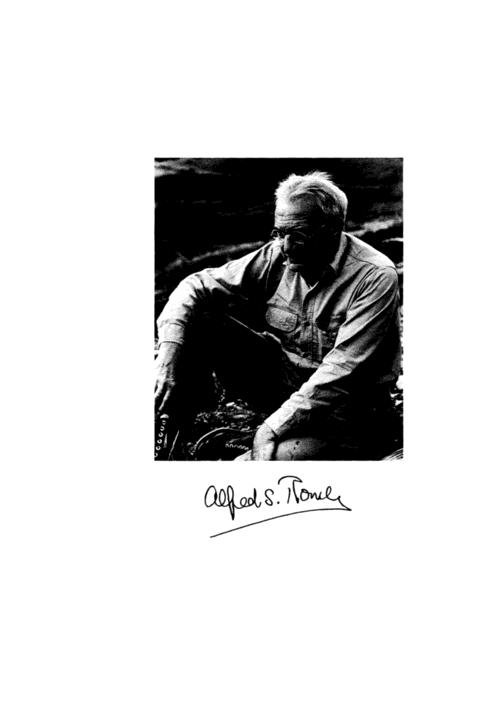
ALFRED SHERWOOD ROMER December 2S, 1894-November 5, 1973 BY EDWIN H. COLBERT AEFRED SHERWOOD ROMER was a man of many aspects: a profound scholar whose studies of vertebrate evolution based upon the comparative anatomy of fossils established him throughout the worIc} as an outstanding figure in his fielcI; a gifted teacher who trained several generations of paleontologists and anatomists; an effective administrator who never allowed the burden of office to diminish his re- search activities; a lucid writer whose books and scientific papers were and are of inestimable value; and a warm per- son, loved and admired by family, friends, and colleagues. Al, as he was universally known to his friends, livect a full and rewarding life, during which he led and influenced paleon- tologists, anatomists, and evolutionists in many lancts. His absence is keenly felt. Al Romer was born in White Plains, New York on December 2S, IS94, the son of a newspaper man who was editor, and sometimes owner, of several small-town news- papers in Connecticut and New York, ant! who later worked for the Associated Press. On the paternal side he was de- scended from Jacob Romer, an emigrant from Zurich who settled among the Dutch residents of the Hudson River Val- ley about 1725. The Sherwood from whom he clerived his mic36le name, the son of a British soldier, was brought to 265
266 BIOGRAPHICAL MEMOIRS Burlington, Vermont by his widowed mother about ~ ~ ~ 5. As for other forebears, Al has written that he hacI "a gooc! dash of Scotch-Irish- bloocI.... All the rest that ~ know of were part of the Puritan migration to New England between 1628 and 1640, whose clescenciants moved on westward to New York State."* Thus Al was a Hudson Valley New Yorker by inheri- tance and birth, but through his adult life he was a confirmed! and enthusiastic New Englancler. At about the time he was ten years oicl, his parents, who then lived in New York City, were divorced, and he remained with his father. There was a second, unhappy marriage for Al's father, during which young Alfred was, as he says, "in a somewhat miserable situation" for a time.t He was rescued by his paternal grandmother, who lived in White Plains, and there he went to high school. After high school he was en- tirely on his own; because there was no tradition of a college education in his family, he was not encourage<] to apply for entrance to any college or university. During the year after high school he worked as a railroad clerk. Perhaps this ex- perience lecl to one of his hobbies, that of a railroad! buff. In his later years he had an encyclopedic knowledge of Ameri- can railroads and couict rattle on by the hour about various railroad lines their routes, their histories, and their prime · - persona ltles. After a year of railroading he decided on college, anti he obtained a scholarship at Amherst. There he spent four very active and rewarding years, studying hard, while at the same time supporting himself with a variety of jobs. He ciecicled that since he hac! to work he wouict not get involves] in too many extra-curricular activities, but he die! join the college newspaper staff where he became the editor-in-chief. That * Alfred Romer to Hugh L. Dryden, 5 June 1961, Archives, National Academy of S. Fences. tIbid.
ALFRED SHERWOOD ROMER 267 was all to the good; he got some practical writing experience that was to be most useful to him in later years. At Amherst Al hac! a double major in history and German literature, yet in spite of the hours clevotec! to these subjects there was one course, initially taken to fulfill a requirement, that was to determine the direction of his life. He needled to have a science course, so he opted for evolution, recom- mencled to him by fellow students as "interesting ant! not too tough."* Part of the course was taught by Frederick Brewster Loomis, a vertebrate paleontologist, and soon after becoming involved in this course Al knew exactly what he wantec! to do in life. Here it may be enlightening to backtrack a bit. When Al was in gracI-e school in Connecticut, he was bitten by his fox terrier, which had become rabid. Al was taken to New York for treatments at a branch of the Pasteur Institute. It was a protracted ordeal, and when Al was not at the Institute re- ceiving injections he stayed with some aunts in Brooklyn. When he was not at either the Institute or at his aunts' house, he spent many hours at the American Museum of Natural History, where he lost his heart to the fossils on display there. When he later heard about fossil vertebrates from Professor Loomis, he understood the significance of his old museum friends. That made his decision. One of Al's delightful traits was his pixie sense of humor. To hear him tell it, everything he accomplished during his life was the result of some sort of an acciclent. One would think that he blundered through his worIct in an aimless way, every now and then bumping into good fortune. If Al could be persuaded to tell about his life history, he would generally begin by recounting how he became a vertebrate paleontolo- gist because he was bitten by a macI clog. *Ibid.
268 BIOGRAPHICAL MEMOIRS His training in his now-chosen field was necessarily delayer! for a couple of years, because during his senior year at Amherst the United States became involvecl in the First World War. Al felt the call of duty anc! joined the American Field Service. Immediately after commencement he went to France, expecting to cirive an ambulance; instead, because no ambulances were available, he strove an ammunition truck. In November of that year he joined the U.S. Air Service, where through the months he acivanced from the status of a private to the rank of second lieutenant. His service in France culminated with his appointment to a post in command of about five huncired French laclies at a special camp where they were sewing covers on the wings of airplanes. Al's hilarious account of this assignment was just one of the famous Romer stories. In 1919 he was back in New York, a graduate student at Columbia University with a teaching fellowship, all on the basis of a recommendation from Professor Loomis. There he stu(liecl under Professor William King Gregory, who taught on the graduate faculty at Columbia and who at the same time was a curator at the American Museum of Natural History. It should be explained that Professor Gregory hac3 a dual appointment in the two institutions, the result of a long- stancling arrangement that had been instituted by Henry Fairfielcl Osborn in ~ 89 ~ . Graduate students in paleontology at Columbia spent much of their time at the Museum. It was an advantageous arrangement for all con- cernecl; the students hack the use of unparalleled collections and instruction, in the case of Gregory, from a man who had a superb knowledge of all of the vertebrates, from fish to man. It was a golden opportunity to study uncler a man of Gregory's attainments, and Romer made the most of it. Pro- fessor Gregory's influence on Romer was inestimable. T have heard Al remark that in his opinion nobody ever had so
ALFRED SHERWOOD ROMER 269 complete an unclerstancling of the vertebrate skull as ctid Gregory, and certainly the young Romer benefited from that; he too hac! a marvelous understanding of the skull. At Columbia Al enjoyed the advantages not only of stucly- ing under some famous teachers W. K. Gregory, J. H. McGregor, T. H. Morgan, and E. B. Wilson but also the stimulating companionship of a talented group of fellow students and associates Charles Camp, G. K. Noble, Tames Chapin, H. H. Johnson, Franz and Sally Schracler, and A. H. Sturtevant. The following is another typical Romerian story, taken from a biographical sketch that he prepared for the Academy Archives: How I happened to take up a thesis topic is mildly amusing. As soon as I arrived at Columbia, I went to see Gregory, and discovered that I could not take his regular course because of conflict with laboratory teaching. "But," said Gregory, "a few of us are interested in comparative myology, and we're planning to have a special course in that subject. Would you care to join?" I said that I would love to take this, and then went down the hall in search of a dictionary. I thought that myology had something to do with clams, and was pleased to discover that it had to do with muscles. Within a few weeks after I took up the course, I proposed a new theory as to the classification and evolution of limb muscles (which I found held up very nicely after later work on embryology) and was embarked on a thesis which consisted of a consideration of muscle evolution and the probable muscu- lature of primitive fossil amphibians and reptiles.* This anecdote nicely illustrates one of Romer's endearing qualities; he was serious about his work, but he never took himself too seriously. It also illustrates his remarkable ability to cut through the puzzling aspect of a problem and to re- solve its difficulties with an elegant solution. His thesis emerged as a classic paper entitled "The Locomotor Ap- *Ibid.
270 BIOGRAPHICAL MEMOIRS paratus of Certain Primitive and Mammal-Like Reptiles" (see bibliography, 1922~. After the completion of his graduate course work and his thesis, all within the increclibly short span of two years, Romer was appointed an instructor in the Anatomy Depart- ment of the Bellevue Medical School at New York University. He spent two years at Bellevue, teaching histology, embry- ology, and gross anatomy~ourses to which he had never been exposed" all the while working feverishly to keep ahead of his students. During such intervals as he could find within this frenetic schedule, he was continuing his research. One result of such concentrated activity was a spastic colon, for which a regimen of chIoreton was prescribed. Next came an offer from the University of Chicago. The manner in which he obtained his appointment at Chicago is perhaps one of the most amusing of the Romerian stories, and it is here set clown in Al's words as recorded in a taped interview made on February 9, 1973. They started feeding me some sort of capsules. They probably told me what they were, but I didn't pay any attention.... Well, along came the anatomists' meetings that spring, in April. They were out at the University of Chicago, and I went out. God, I was getting sleepy. I tend to go to sleep when people read papers at me, but here, even during ones I was really interested in, I just couldn't stay awake. I was just dopey. Well, they were looking for a vertebrate paleontologist and heard I was in town. So I was invited over to lunch by the chairman of the appropriate department. I was very sleepy, and he started the propositioncould I come up for a quarter, give a course or two(yawn) I wasn't sure he went on, could I come out and give a few lectures (yawn) I wasn't too sure about that either. If I had been awake, I would have jumped at this, but dopey as I was, I didn't jump. Well this blase attitude apparently was pretty good, because I no sooner got back to New York than I got a letter offering me an assistant professorship, which is one up from instructor.... Well, I was sleepier than ever, so I wrote back, "Well, I don't know, this time of the year is pretty late for my boss to get a successor for me, and so forth. Hoping you are the same." And sent it off. Well, a few days later I came to. I had gone to sleep in the middle
ALFRED SHERWOOD ROMER 27 of the morning with my eye on a microscope barrel. I went down and saw the medicine man and said, "Look here, either I've got sleeping sickness, or else it's whatever dope I'm taking." He said, "You damn fool, don't you know what you're taking?" "No." "Chloretone." And the idea was, as you know, it's a nice anesthetic. They thought it might put my large intestine to sleep. Instead, it was putting me to sleep, and so they took me off it and I woke up, at which point arrived a telegram offering me an associate professorship. I thought, gee, this has worked out pretty well. I've made twojumps now. Could I play it still further and jump from instructor to full professor? I finally decided not, and signed on the dotted line. So chlore- tone did it. I don't know if it would work for other people or not.* While Al was a graduate student at Columbia he spent summers at the Woocls Hole Biological Laboratory, and there he met Ruth Hibbard, the younger sister of Dr. Hope Hib- barcI, a zoologist studying at Woocis Hole. When he went to Chicago in 1923 he again encountered Ruth, working as a labor statistician and living in the vicinity of the University. They became friends, they fell in love, and the next fall were married in Columbia, Missouri, where Ruth's father was a professor at the University of Missouri. It was a fortunate and a happy marriage. One cannot contemplate the career of Al Romer without giving full attention to the contribution Ruth made to that career. She was Al's devoted partner through the years, working closely with him at home and away from home. It must not be thought that Ruth was a self-sacrif~cing non- entity, subjecting herself in every way to the advancement of Al's career. She was not. Ruth was always a forceful person with her own clef~nite views about the world in which she lived. But she complemented Al in a marvelous fashion; to- gether the two of them cooperated in a mutually advan- tageous manner. Al fully appreciated Ruth's role in their * G. E. Erikson, "Alfred Sherwood Romer" (Proceedings of the Ninetieth Meeting of the American Association of Anatomists), Anatomical Record, 189 ( 1977): 3 14-24.
272 BIOGRAPHICAL MEMOIRS partnership; he wrote that their marriage was "the best thing that ever click happen, or could have happened to me."* There are three children: Sally (Mrs. Paul Evans), a librarian at Amherst College; Robert, professor of physics at Amherst College; and James, who lives and works in Providence, Rhode Island. There are seven grandchildren. Circumstances do affect the directions that our lives fol- low, a point that Al liked to emphasize in lively tales according to which he just happened, more or less by accidents to develop his career. Of course the favorable circumstances were there; but Al saw his opportunities and clevelopect them with unparalleled acumen ant! ability. One wonders what direction his life would have taken if he hacT not gone to Chicago, if he hacI stayed at Bellevue, or if he hac! gone to some institution lacking a program in vertebrate paleontol- ogy or a collection of fossil vertebrates. He certainly wouIcl have become a leacling anatomist (as indeed he was) but per- haps an anatomist working more on modern than on extinct animals. As things turned out, he went to a university that had on hand a fine collection of ancient backboned animals, par- ticularly Permian amphibians and reptiles. These fossils tract been amassed by Romer's distinguished predecessor, Samuel Wenclell Williston, with the able cooperation of his field and laboratory assistant, Paul Miller, who was still at Chicago when Romer arrived. Al Romer soon became involved with Permian tetrapocis, and this field of research remained the dominant center of his scientific effort for the remainder of his life. It is interesting to note that from 1922 through 1924 he was the author of eight anatomically oriented publications. From 1925 through 1935 (which may be taken as the years during which his contributions originated in Chicago) there * Romer to Dryden.
ALFRED SHERWOOD ROMER 273 were thirty-seven publications, most of which might be characterized as primarily paleontological. This remained true of his subsequent publications. Although Al enterer! upon a program of research based to a large clegree on the Permian collections at Chicago, at the same time he began a vigorous campaign to augment those collections by field work in the Permian sediments of Texas and New Mexico. In 1929 he extended his paleontological horizons by going to South Africa with Paul Miller and making an important collection from the famous Permo-Triassic Karroo beds. He spent eleven productive years at Chicago, studying, publishing, and teaching. Among other things, he was in- volved, together with several colleagues, in the presentation of a general education course in science for nonscience students. A text was needled, so the participating professors collaborated on a book, eclited by H. H. Newman, entitled The Nature of the World and of Man, published in ~ 926. Al's chapter in this book, "The Evolution of the Vertebrates," was ex- panclec! by him into a book, Man and the Vertebrates, published in 1933. During the same year the first edition of his invalu- able textbook, Vertebrate Paleontology, was publishecl. Both of these books have enjoyed well-deserved success in this country and abroad and have appeared during subsequent years as revised editions. Although Al enjoyed his work and his colleagues at Chicago, he declared that he "had no particular love for midwestern country."* As has been mentioned, he was an enthusiastic New Englancler, so in the summer of 1932 the Romers went to Massachusetts and began to look around in the vicinity of Amherst for a country retreat. The search continued during the following summer, when they were fortunate to find a place completely to their liking in the town *IBM.
274 BIOGRAPHICAL MEMOIRS of Pelham, near Amherst. It was a two-hundred-acre tract of abandoned farmIancl, mostly grown up into woods, occupied by a dilapidates! old house, the earliest section of which had been built in 1740. They bought the property, and through the years it was their much-belovecT second home, where they usually spent several months of each year. The house became one of AT's hobbies. Single-handecIly he began a long-term project of restoration, eventually resulting in a choice ex- ample of a New England colonial farmhouse. Al was a cledi- catec! purist and insisted that everything about the house shouIcl be as nearly authentic as possible. For example, he bought an old house that had been condemned because it was on a reservoir site, and he used the woodwork from that house in the restoration of his Pelham home. The Romers hacI contemplated a long trek each summer from Chicago to Pelham and back, but the year after they had purchased their New England place Al was offered a position at Harvard. He was to be professor of zoology and at the same time curator of vertebrate paleontology at the famous Museum of Comparative Zoology (the MCZ as it is known to museum people around the worId). It was exactly the type of situation that he hacl wanted and had never been quite able to achieve at Chicago. The Romers moved to Cambridge, where they bought a picturesque old home near the MCZ; through the years they graciously entertained hosts of visiting paleontologists and other guests visiting the MCZ. Al clivide(1 his time between an office in the Biological Laboratories and another office in the Museum. Al would be busily ant] hap- pily occupied in Cambridge and in Pelham for just short of forty years. When Al arrived at Harvarc! the program in vertebrate paleontology at the MCZ was in a state of clesuetu(le; collec- tions were available but were not being used to any great extent, nor were they being augmented. Romer changed that
ALFRED SHERWOOD ROMER 275 · . . . · ~ situation by Inaugurating a very active program ot researc n and field work on Permian tetrapocts. He continuccI his col- lecting activities in Texas, and within a few years the Permian collections at the Museum were well known and well used. A steady outflow of research, recorded in various scientific journals, emanated from the Museum research by Romer and by his students. It should be emphasized that during his years at Harvard, Professor Romer trained an outstanding cadre of vertebrate paleontologists, anatomists, and verte- brate zoologists, men and women who now hold positions in universities and museums across the land, and in some foreign countries as well. During this earlier years at Harvard, the MCZ was under the directorship of Thomas Barbour, a distinguished herpe- tologist. It is sail! that Barbour ruled the Museum as a benev- olent autocrat. He was wealthy, and he contributed con- siderable sums to the Museum from his personal fortune, particularly before the depression of the thirties. Perhaps because of his wealth he lacked understanding of the needs of his subordinates. Consequently, at the time of his death, the staff was woefully underpaid, and the Museum was insuf- ficiently financed. In the meantime, following the depression and immedi- ately after the war, Romer had attracted worldwide attention to the MCZ with his vigorous program in paleontology. Thus he was appointed director of the Museum, relinquishing his position as director of the Biological Laboratories. He directed the Museum for fifteen years. It meant much time diverted from other activities to administration, yet Al ac- ceptec] the extra burden, to become a vigorous and imagina- tive leader of the Museum. During his tenure as director, the endowment of the Museum was increased tenfoIcI, and the salaries of an enlarged staff were brought into line with other university salaries. Along with this financial improvement,
276 BIOGRAPHICAL MEMOIRS there was insistence by Al on a high standard of scientific performance anct on high stanciards for staff appointments, following the procedures in Harvarcl's regular academic departments. As has been said, Al dicI not allow this impor- tant work to submerge his research procluctivity; in the con- tinuation of his research he was ably assisted through the years by Nelcla Wright. At Harvard Romer augmented his scientific-literary out- put with revisions of the texts previously mentioned, as well as by the production of a massive source book, Osteology of the Reptiles, which appeared! in 1956. A book with this same title had been published years earlier by Romer's predecessor at Chicago, S. W. Williston. But Romer's book is more than an updating of Williston's text (which was perhaps the original intention); it is a completely new, authoritative survey of rep- tilian osteology, widely used by paleontologists throughout the world. He also wrote books for a more general audience, such as The Vertebrate Body, published in 1949, now translated into several foreign languages; an immensely popular work, The Vertebrate Story, publishes! in 1959; and The Procession of Life, publishecl in 1968. During the last decacle of his life, Al organized and con- ductecI a series of expeditions to Argentina, where he worker! in close cooperation with Dr. Rosendo Pascual of La Plata in the collection of a very significant suite of Triassic reptiles. The series of papers on these fossils, some of them published in collaboration with other paleontologists, was one of Romer's last extendect research projects. Al was active in many scientific societies. Perhaps his greatest satisfaction in this connection was his role in the organization of the Society of Vertebrate Paleontology, of which he was the first president in 1940. He was also presi- clent of the American Association for the Advancement of Science ~ ~ 966), the American Society of Zoologists ~ ~ 95 ~ ), the
ALFRED SHERWOOD ROMER 277 Society of Systematic Zoology (1952), the Society for the Study of Evolution (1953), and the Sixteenth International Zoological Congress, held in Washington in 1963. In addition to these societies he was a member of the American Philo- sophical Society and the American Academy of Arts and Sciences. He also served on the governing boards of various . . socletles. Many honors were deservedly bestowed upon Professor Romer. He was elected to the National Academy of Sciences in 1944 and was made a foreign member of the Royal Society in 1969. He was a fellow or foreign member of other British societies and also societies in Germany, Argentina, and India. He received the Thompson Medal and the Elliot Medal of the National Academy of Sciences in 1956 and 1960, re- spectively, the Penrose Medal of the Geological Society of America in ~ 962, the Hayden Geological Award of the Academy of Natural Sciences of Philadelphia in 1962, the Paleontological Society Medal in 1967, the Linnean Society Medal in 1972, and the WolIaston Medal of the Geological Society of Iondon in 1973. He received honorary degrees from Harvard (1949), Amherst (1952), Dartmouth (1959), Buffalo (1960), and Lehigh (19631. Such honors never went to Al's head. He was about the unstuffiest person who ever lived. His ebullient behavior and breezy conversations, often interspersed with comic songs, were frequently the cause of raised eyebrows among visiting European scientists, who probably expected a man of Al's eminence to act in a thoroughly formal, perhaps even a funereal manner. Romer published considerably more than two hundred papers and books on a wide variety of subjects within the general fields of vertebrate paleontology, anatomy, and evo- lution. He was especially interested in those fishes most closely related to the tetrapods, presenting, valuable papers
278 BIOGRAPHICAL MEMOIRS on the crossopterygians and lungfishes. His largest and most numerous contributions were, however, on fossil amphibians and reptiles. As has been indicated, his studies of these tetra- pocTs revolved around the Permian amphibians and reptiles found in Texas and adjacent regions. Such fossils afforciect opportunities for significant papers on the labyrinthodont amphibians, the stem reptiles known as cotylosaurs, and the early synapsid reptiles known as pelycosaurs. Particular mention should be made of his monographs, Review of the Pelycosauria (published in collaboration with L. I. Price in 1940) and Review of the Labyrinthodontia (publisher! in 19471. Among other papers on amphibians were those clevoted to the relationships of the labyrinthodonts to stem reptiles; he also published a significant paper in 1939, show- ing that the branchiosaurs, often separately cIassifie(l, repre- sentec! in fact ontogenetic stages in labyrinthodont clevelop- ment. Romer was especially interested in the relationships of the pelycosaurs to the therapsids (the higher "mammal-like reptiles"), and in 1956 he published a revised classification of the therapsids in collaboration with Professor D. M. S. Wat- son of the University of London. But it was not until the last decade of his life that he diet extensive work on the therap- sicTs, contained in his series of papers on the Chanares rep- tiles from the Triassic beds of Argentina. Romer published little on the mammals as such (except, of course, in his books), but he was interested in the transition from mammal-like reptiles to mammals. He stoutly main- tainecI at an early date that the crucial prehominicl anthro- poid, Australopithecus, was not a chimpanzee. Many of his papers were in a sense concerned with com- parative anatomy particularly the anatomy of extinct tetra- pods. There were, however, important basic anatomical studies, such as his early papers on limb musculature, his papers on crossopterygian fins and on the foot in early tetra-
ALFRED SHERWOOD ROMER 279 pods, his paper on the transformation of the hyomandibular bone into the tetrapod stapes, his studies of skull structure, his essay on the somatic and visceral duality of the vertebrate, his paper on cartilage as an embryonic adaptation, and the papers on the nature of bone in early vertebrates. Although Al never pretended to be a geologist, he com- pleted some very important papers on the stratigraphy of the Texas red beds, on the stratigraphic sequence in Argentina, and on Gondwanaland. Needless to say, the theme of evolution permeates a large proportion of his publications. It was not his practice to write essays on evolution, or to theorize on the mechanisms of evolution, but he did introduce evolutionary principles and considerations in his descriptions-and discussions of the fos- sils with which he was concerned. He felt that this was the most effective manner in which he could discuss larger evolu- tionary problems. Romer bequeathed his magnificent personal library covering the fields of vertebrate paleontology, anatomy, and embryology to the Museum of Comparative Zoology, and it is located in his old office, a spacious and comfortable room. The library, a separate facility of the Museum, is kept up to date with current publications in the fields mentioned above, and it is widely used. Alfred Romer died on November 5, 1973, after a brief illness. He is mourned by all who knew him.
280 BIOGRAPHICAL MEMOIRS B IB LIOGRAPHY 1922 The comparison of mammalian and reptilian coracoids. Anat. Rec., 24:39 - L7. The locomotor apparatus of certain primitive and mammal-like reptiles. Bull. Am. Mus. Nat. Hist., 46:517-606. 1923 The ilium in dinosaurs and birds. Bull. Am. Mus. Nat. Hist., 48: 141-45. Crocodilian pelvic muscles and their avian and reptilian homo- logues. Bull. Am. Mus. Nat. Hist., 48:533-52. The pelvic musculature of saurischian dinosaurs. Bull. Am. Mus. Nat. Hist., 48: 605-17. 1924 Pectoral limb musculature and shoulder-girdle structure in fish and tetrapods. Anat. Rec., 27:119~3. The lesser trochanter of the mammalian femur. Anat. Rec., 28: 95-102. A radial exostosis in the fossil canid Daphoenus. Am. I. Sci., 8~5~: 235-40. 1925 An ophiacodont reptile from the Permian of Kansas. }. Geol., 33: 173-82. Permian amphibian and reptilian remains described as Stephano- spondylus. ]. Geol., 33 :447-63. 1926 A Lower Miocene horse,~lnchitherium agatense (Osborn). Am. I. Sci., 12~5~:325-35. The evolution of the vertebrates. In: The Nature of the World and of Man, ed. H. H. Newman, pp.304-48. Chicago: Univ. of Chicago Press. Vertebrate faunal horizons in the Texas "red beds." Geol. Soc. Am. Prelim. List, 38:58-59.
ALFRED SHERWOOD ROMER 1927 281 The development of the thigh musculature of the chick. }. Morphol. Physiol., 43:347-85. With A. H. Sutton. A new arctoid carnivore from the Lower Mio- cene. Am. }. Sci., 14~5) :459-64. Notes on the Permo-Carboniferous reptile Dimetrodon. J. Geol., 35: 673-89. The pelvic musculature of ornithischian dinosaurs. Acta Zool., 8: 225-75. 1928 Among our ancestors. Univ. Chicago Mag., 20:322-26. A fossil camel recently living in Utah. Science, 68: 19-20. Vertebrate faunal horizons in the Texas Permo-Carboniferous red beds. Univ. Tex. Bull., 2801:67-107. The notochord in fossil vertebrates. Am. }. Sci., 15~5~:432-33. A skeletal model of the primitive reptile Seymouria, and the phylo- genetic position of that type. J. Geol., 36:247-260. Pleistocene mammals of Algeria: Fauna of the Paleolithic station of Mecha-el Arbi. Logan Mus. Bull., 2:79-163. With F. M. Fryxell. Paramiatus gurleyi, a deep-bodied amiid fish from the Eocene of Wyoming. Am. }. Sci., 16:519-27. With }. T. McCormack. A large Palaeocastor from the Lower Mio- cene. Am. J. Sci., 15: 58-60. 1929 A fresh skull of an extinct American camel. I. Geol., 37:261-67. Taxonomy and morphology of some Pennsylvanian amphibians. Bull. Geol. Soc. Am., 40:243(A). 1930 Australopithecus not a chimpanzee. Science, 71:482-83. The Pennsylvanian tetrapods of Linton, Ohio. Bull. Am. Mus. Nat. Hist., 59:77-147. Fossil hunting in the Karroo, South Africa. Sci. Mon., 31:134-44. With P. H. Nesbitt. An extinct cane-rat (Ihryonomys Logani, sp. n.) from the central Sahara. Annul Mag. Nat. Hist., 6~101:687-90.
282 BIOGRAPHICAL MEMOIRS 1931 With F. Byrne. The pes of Diadectes: Notes on the primitive tetra- pod limb. Palaeobiologica, 4: 25-48. Surveying Pleistocene fauna. Science, n.s. 74: 117(A). 1932 Treasure hunters. Univ. Chicago Mag., 24: 149-54. 1933 Pleistocene vertebrates and their bearing on the problem of human antiquity in North America. In: The American Aborigines, ed. D. ienness, pp. 49-83. Toronto: Univ. of Toronto Press. Eurypterid influence on vertebrate history. Science, n.s. 78: 114-17. Man and the Vertebrates. Chicago: Univ. of Chicago Press. vii + 427 pp. Vertebrate Paleontology. Chicago: Univ. of Chicago Press. vii + 491 pp. 1934 With B. H. Grove. Fresh versus salt water in early vertebrate evolu- tion. Proc. Geol. Soc. Am. (1933~:361~2. With H. I. Smith. American Carboniferous dipnoans. I. Geol. 42:700-719. 1935 Early history of Texas red beds vertebrates. Bull. Geol. Soc. Am., 46: 1597~58. With B. H. Grove. Environment of the early vertebrates. Am. Midl. Nat., 16:80542. Report on vertebrate paleontology. Annul Rep. Dir. Mus. Comp. Zool. Harv. Univ., 1934-1935:37-40. 1936 Studies on American Permo-Carboniferous tetrapods. Probl. Paleontol., 1:85-93. The dipnoan cranial roof. Am. J. Sci., 32~5~:241-56. Report on vertebrate paleontology. Annul Rep. Dir. Mus. Comp. Zool. Harv. Univ., 1935-1936:40 - 1. With H. J. Smith. Dipnoan skull roof. Proc. Geol. Soc. Am. (19351: 393.
ALFRED SHERWOOD ROMER 1937 283 The braincase of the Carboniferous crossopterygian Megalichthys nitidus. Bull. Mus. Comp. Zool. Harv. Univ., 82: 1-73. New genera and species of pelycosaurian reptiles. Proc. N. Engl. Zool. Club, 16: 89-96. Report on vertebrate paleontology. Annul Rep. Dir. Mus. Comp. Zool. Harv. Univ., 1936-1937:41-43. Man and the Vertebrates. 2d ed. Chicago: Univ. of Chicago Press. ix + 434 pp. Vertebrates. In: The World and Man, ed. F. R. Moulton, pp.347-96. Garden CitY. N.Y.: Doubleday, Doran, and Co. I, 1938 Mammalian remains from some Paleolithic stations in Algeria. Part II. Logan Mus. Bull., 5:165-84. Review of the Pelycosauria. Proc. Geol. Soc. Am. (1937~: 287-88. Report on vertebrate paleontology. Annul Rep. Dir. Mus. Comp. Zool. Harv. Univ., 1937-1938:40~1. Frederic Brewster Loomis (1873-1937~. Proc. Am. Acad. Arts Sci., 73: 136-37. 1939 The oldest vertebrate egg. Am. J. Sci., 237:82~29. Notes on branchiosaurs. Am. I. Sci., 237:748~1. An amphibian graveyard. Sci. Mon., 49:337-39. Report on vertebrate paleontology. Annul Rep. Dir. Mus. Comp. Zool. Harv. Univ., 1938-1939:37-39. 1940 Fossil collecting in the Texas red beds. Harv. Alum. Bull., 42: 1045-49. Mirror image comparison of upper and lower jaws in primitive tetrapods. Anat. Rec., 77:175-79. With L. I. Price. Review of the Pelycosauria. Geol. Soc. Am. Spec. Pap., 26. x + 538 pp. Report on vertebrate paleontology. Annul Rep. Dir. Mus. Comp. Zool. Harv. Univ., 1939-1940:38-40. 1941 Vertebrate paleontology. In: Geology, 1888-1939, pp. 107-35. New York: Geological Society of America.
284 BIOGRAPHICAL MEMOIRS Notes on the crossopterygian hyomandibular and braincase. Morphol. 69: 141-60. Earliest land vertebrates of this continent. Science, 94:279. The first land animals. Nat. Hist., 48:236-43. With R. V. Witter. The skin of the rhachitomous amphibian Eryops. Am. }. Sci., 239:822-24. Man and the Vertebrates. 3d ed. Chicago: Univ. of Chicago Press. viii + 405 pp. Report on vertebrate paleontology. Annul Rep. Dir. Mus. Comp. Zool. Harv. Univ., 1940-1941:30-32. 1942 Notes on certain American Paleozoic fishes. Am. }. Sci., 240: 216-28. Cartilage, an embryonic adaptation. Am. Nat., 76:394 104. The development of tetrapod limb musculature- the thigh of Lacerta. J. Morphol., 7 1 :25 1-98. With T. Edinger. Endocranial casts and brains of living and fossil Amphibia. }. Comp. Neurol., 77:355-89. With R. V. Witter. Edops, a primitive rhachitomous amphibian from the Texas red beds. I. Geol., 50:925-60. Report on vertebrate paleontology. Annul Rep. Dir. Mus. Comp. Zool. Harv. Univ., 1941-1942:31-32. 1943 Recent mounts of fossil reptiles and amphibians in the Museum of Comparative Zoology. Bull. Mus. Comp. Zool. Harv. Univ., 92:331-38. Hunting for Grandpa Bumps. Sci. Mon., 57:94-96. 1944 The Permian cotylosaur Diadectes tenuitectus. Am. I. Sci., 242: 139-44. With L. I. Price. Stahlecker~a lenzii, a giant Triassic Brazilian dicyno- dont. Bull. Mus. Comp. Zool. Harv. Univ., 93:465-91. The development of tetrapod limb musculature the shoulder region of Lacerta. J. Morphol., 74: 1-41. 1945 Vertebrate Paleontology. Ed ed. Chicago: Univ. of Chicago Press. viii + 687 pp.
ALFRED SHERWOOD ROMER 285 The late Carboniferous vertebrate fauna of Kounova (Bohemia) compared with that of the Texas red beds. Am. I. Sci., 243:417-42. 1946 The primitive reptile Limnoscelis restudied. Am. I. Sci., 244: 149-88. The early evolution of fishes. Q. Rev. Biol., 21:33-69. Thomas Barbour, 1884-1946. Soc. Vert. Paleontol. News Bull. 17:2~25. Thomas Barbour. Anat. Rec., 95:473-75. 1947 Review of the Labyrinthodontia. Bull. Mus. Comp. Zool. Harv. Univ., 99: 1-368. The relationships of the Permian reptile Protorosaurus. Am. I. Sci., 245: 19-30. The University. The Agassiz Museum. Harv. Alum. Bull., 49: 619-21. Louis Agassiz; a hundred years after his com felt. Harv. Alum. Bull., 49:628-31. 1948 ing his influence is still Relative growth in pelycosaurian reptiles. R. Soc. S. Afr. Spec. Publ., Robert Broom Commemorative vol., pp. 45-55. Ichthyosaur ancestors. Am. }. Sci., 246:109-21. Zoology at Harvard. Bios, 19: 7-20. Advances in the study of organic evolution. Bull. Am. Acad. Arts Sci., 1:2-3. With H. B. Bigelow and F. M. Carpenter. Hubert Lyman Clark. Harv. Univ. Gaz., 43: 100-101. The fossil mammals of Thomas Farm, Gilchrist County, Florida. Q. F1. Acad. Sci., 10: 1-11. Harvard portraits A. S. Romer. Harv. Alum. Bull., 9~501:390. 1949 Louis Agassiz. Sci. Am., 181:48-51. The color line in fraternities. Atl. Mon., May, pp. 27-31. Time series and trends in animal evolution. In: Genetics, Paleontology and Evolution, ed. G. L. Jepsen, E. Mayr, and G. G. Simpson, pp. 103-20. Princeton, N.J.: Princeton Univ. Press. The Vertebrate Body. Philadelphia: W. B. Saunders. vii + 643 pp.
286 BIOGRAPHICAL MEMOIRS 1950 The nature and relationships of the Paleozoic microsaurs. Am. I. Sci., 248:628-54. The Upper Paleozoic Abo Formation and its vertebrate fauna. In: Guidebook for the Fourth Field Conference of the Society of Vertebrate Paleontology in Northwestern New Mexico, ed. E. H. Colbert, S. A. Northrop, A. S. Romer, and G. G. Simpson, pp.48-55. Mimeo- graphed. 1951 Bison crassicornis in the late Pleistocene of New England. I. Mam- mal., 32:230-31. 1952 Late Pennsylvanian and early Permian vertebrates of the Pitts- burgh-West Virginia region. Ann. Carnegie Mus., 33:47-110. Discussion of "The Mesozoic tetrapods of South America," by E. H. Colbert. Bull. Am. Mus. Nat. Hist., 99:250-54. 1954 Aestivation in a Permian lungfish. Breviora, Mus. Comp. Zool., 30:1-8. 1955 Fish originsfresh or salt water? Deep-Sea Res.,3(Suppl.):261-80. Herpetichthyes, Amphibioidei, Choanichthyes or Sarcopterygii? Nature, 176: 126. I he Vertebrate Body. 2d ea., rev. Philadelphia: W. B. Saunders. viii + 644 pp. 1956 With D. M. S. Watson. A classification of therapsid reptiles. Bull. Mus. Comp. Zool. Harv. Univ., 114:37-89. The early evolution of land vertebrates. Proc. Am. Philos. Soc., 100: 157-67. Les rapports entre la paleontologie des vertebres et l'anatomie compare e. In: Colloques internationaux du Centre National de la Recherche Scientifique 60: Problemes actuels de paleontologie (Paris, 18-23 April 1955), pp. 149-59. Paris: Centre National de la Recherche Scientifique.
ALFRED SHERWOOD ROMER 287 A Shorter Version of the Second Edition of the Vertebrate Body. 2d ea., abridged. Philadelphia: W. B. Saunders. viii + 486 pp. Osteology of the Reptiles. Chicago: Univ. of Chicago Press. xxi + 772 pp. 1957 The appendicular skeleton of the Permian embolomerous amphib- ianArcheria. Contrib. Mus. Paleontol. Univ. Mich., 13:103-59. Origin of the amniote egg. Sci. Mon., 85:57-63. Amphibians. In: Treatise on Marine Ecology~and Paleoecology, vol. 2, ed. H. S. Ladd. Geol. Soc. Am. Mem., 67:1011. 1958 An embolomere jaw from the mid-Carboniferous of Nova Scotia. Breviora, Mus. Comp. Zool., 87:1-8. Darwin and the fossil record. In: A Century of Darwin, ed. S. A. Barnett, pp. 130-52. London: William Heinemann Ltd. The Texas Permian red beds and their vertebrate fauna. In: Studies on Fossil Vertebrates, ed. T. S. Westoll, pp.157-79. London: Univ. of London, The Athlone Press. The vertebrate as a dual animal visceral and somatic. Anat. Rec., 132 :496(A). Tetrapod limbs and early tetrapod life. Evolution, 12:365-69. Phylogeny and behavior with special reference to vertebrate evolu- tion. In: Behavior and Evolution, ed. A. Roe and G. G. Simpson, pp. 48-75. New Haven: Yale Univ. Press. 1959 Vergleichende Anatomie der Wirbeltiere [The Vertebrate Body], trans. H. Frick and D. Starck. Hamburg and Berlin: Paul Parey. xii + 499 pp. Louis Agassiz in America. Harv. Alum. Bull., 5~62~:209, 224-25. Ihe Vertebrate Story. Chicago: Univ. of Chicago Press. vii + 437 pp. Vertebrate paleontology, 1908-1958. l. Paleontol., 33:915-25. Darwin and the fossil record. Nat. Hist., 68:457-69. A mounted skeleton of the giant plesiosaur Kronosaurus. Breviora, Mus. Comp. Zool., 112:1-14. Fossil skeleton reconstructed after 100-million-year delay. Dis- covery, Nov., p. 464.
288 BIOGRAPHICAL MEMOIRS Centennial of the Agassiz Museum. Newsl. Harv. Found. Adv. Stud., 30 Sept., p. 3. 1960 Vertebrate-bearing continental Triassic strata in Mendoza region, Argentina. Bull. Geol. Soc. Am., 71:1279-94. lilcGraw-Hill Encyclopedia of Science and Technology, vols. 1-4, 6-14, articles on: Aistopoda, Amphibia fossils, Animal evolution, An- thracosauria, Batoidea fossils, Bradyodonti, Chimaerae, Clado- selachii, Elasmobranchii fossils, Embolomeri, Hybodontoidea, Ichthyostegalia, Labyrinthodontia, Lepospondyli, Microsauria, Nectridia, Pleuracanthodii, Rachitomi, Selachii fossils, Sey- mouriamorpha, Stereospondyli, Temnospondyli, and Tremato- sauria. New York: McGraw-Hill. Explosive evolution. Zool. Tahrb. Abt. Syst. Oekol. Geogr. Tiere, 88:79-90. The vertebrate fauna of the New Mexico Permian. In: Guidebook of Rio Chama Country, ed. E. C. Beaumont and C. B. Read, pp. 48-54. New Mexico Geol. Soc., Eleventh Field Conference. Socorro, N.M.: New Mexico Bureau of Mines and Mineral Resources. 1961 Palaeozoological evidence of climate. (l) Vertebrates. In: Descriptive Palaeoclimatology, ed. A. E. M. Nairn, pp. 183-206. London and New York: Interscience Publishers. A large ophiacodont pelycosaur from the Pennsylvanian of the Pittsburgh region. Breviora, Mus. Comp. Zool., 144: 1-7. 1962 A Cambridge triumvirate. New Engl. Q., 35: 10~9. The fossiliferous Triassic deposits of Ischigualasto, Argentina. Breviora, Mus. Comp. Zool., 156:1-7. Vertebrate evolution. Copeia, 1962:223-27. Ihe Vertebrate Body. 3d ed. Philadelphia: W. B. Saunders Co. viii + 627 pp. 7he Verteb~rate Body. 3d ea., abridged. Philadelphia: W. B. Saunders Co. vii + 475 pp. Synapsid evolution and dentition. Kon. Vlaamse Acad. Wetensch. Lett. Sch. Kunsten Belgie, Brussels, 1961 :9-56.
ALFRED SHERWOOD ROMER 289 Darwin and paleontology. Univ. Kans. Sci. Bu11.,62(Suppl.~:53-61. With N. E. Wright, T. Edinger, and R. Van Frank. Bibliography of Fossil Vertebrates Exclusive of North America, 1509-1927. 2 vols. Geol. Soc. Am. Mem. 87. 1544 pp. La evolucion explosive de los rhynchosaurios del Triasico. Rev. Mus. Argent. Cienc. Nat. Bernardino Rivadavia Inst. Nac. In- vest. Cien. Nat. Cienc. Zool., 8:1-14. 1963 The larger embolomerous amphibians of the American Carbon- iferous. Bull. Mus. Comp. Zool. Harv. Univ., 128:415-54. International Congress of Zoology, 20-27 August 1963. Science, 140:1113-16. The "ancient history" of bone. Ann. N. Y. Acad. Sci., 109: 168-76. Foreword. In: I he Intelligence of Louis Agassiz, ed. Guy Davenport, pp. vii-x. New York: Beacon. 1964 The braincase of the Paleozoic elasmobranch Tamiobatis. Bull. Mus. Comp. Zool. Harv. Univ., 131: 87-105. The skeleton of the Lower Carboniferous labyrinthodont Pholido- gaster pisciformis. Bull. Mus. Comp. Zool. Harv. Univ., 131: 129-59. Vertebrate Paleontologists Society. Geotimes, 8:22-24. Bone in early vertebrates. In: Bone Biodynamics, ed. H. M. Frost, pp. 13-40. Boston: Little, Brown. Problems in early amphibian history. }. Anim. Morphol. Physiol., 2:1-20. Memorial. Augusta Hasslock Kemp. ~. Paleontol., 38:1008. Daadectes an amphibian? Copeia, 1964:718-19. Cope versus Marsh. Syst. Zool., 13:201-7. Thomas Barbour. Syst. Zool., 13:227-34. 1965 Possible polyphylety of the vertebrate classes. Zool. ~ahrb. Abt. Syst. Oekol. Geogr. Tiere, 92:143-56. 1966 The Chanares (Argentina) Triassic reptile fauna. I. Introduction. Breviora, Mus. Comp. Zool., 247: 1-14.
290 BIOGRAPHICAL MEM OIRS With }. A. Jensen. The Chan ares (Argentina) Triassic reptile fauna. II. Sketch of the geology of the Rio Chanares-Rio Gualo region. Breviora, Mus. Comp. Zool., 252:1-20. Las capes Triasicas del "Gondwana" en la historia de la evolucion de los vertebrados. Rev. Mus. Argent. Cienc. Nat. Paleontol., 1~5~: 115-31. Vertebrate Paleontology. 3d ed. Chicago: Univ. of Chicago Press. ix + 468 pp. Vergleichende ~natonie der Wirbeltiere. 2d ea., trans. H. Frick. Ham- burg and Berlin: Paul Parey. 536 pp. Letter from the president. Bull. Am. Assoc. Adv. Sci., Sept. 1966. 2 pp. With I. W. Stovall and L. I. Price. The postcranial skeleton of the giant Permian pelycosaur Cotylorhynchus romeri. Bull. Mus. Comp. Zool. Harv. Univ., 135:1-30. 1967 The Chanares (Argentina) Triassic reptile fauna. III. Two new gomphodonts Massetognathus pascuali and M. teruggi. Breviora, Mus. Comp. Zool., 264: 1-25. Collecting Triassic fossils in Argentina. Harv. Alum. Bull., 69~131: April 22, pp. 1~18. A letter to council members. Bull. Am. Assoc. Adv. Sci., 12:3~. Early reptilian evolution re-viewed. Evolution, 21:821-33. Major steps in vertebrate evolution. Science, 158: 1629-37. George Howard Parker. In: Biographical Memoirs, 39:359-90. New York: Columbia Univ. Press for the National Academy of Sciences. Reply to presentation of Paleontological Society Medal. J. Paleon- tol. 41:818-19. With others. Galeopithecus Pallas. Bull. Zool. Nomencl., 24:190-91. 1968 The Vertebrate Body. 3d ea., abridged. Philadelphia and Tokyo: W. B. Saunders Co. 475 pp. An ichthyosaur skull from the Cretaceous of Wyoming. Contrib. Geol. Univ. Wyo., 1 (71: 27~ 1. The Procession of Life. London: Weidenfeld & Nicolson. 323 pp. Foreword. In: Bernhard Peyer, Comparative Odontology, trans., ed. Rainer Zangerl, pp. v-vi. Chicago: Univ. of Chicago Press.
ALFRED SHERWOOD ROMER 29 Notes and Comments on Vertebrate Paleontology. Chicago: Univ. of Chicago Press. 304 pp. Vertebrate animals. Summary of vertebrate paleontology. }. Pale- ontol., 6~42~: 1371-73. De Evolutie van de gewervelde Dieren. Nat. Tech., 10~361:339~7. With G. Clarke, G. Mead, and J. Welsh. Henry Bryant Bigelow. Harv. Univ. Gaz., 64:91-92. Fossils and Gondwanaland. Proc. Am. Philos. Soc., 112:335~3. 1969 A temnospondylous labyrinthodont from the Lower Carbonifer- ous. Kirtlandia, 6: 1-20. Vertebrate paleontology and zoology. Biologist, 51:49-53. Research and science teaching. Webb School Cal. Alum. Bull. (1968~: 13-15. The Brazilian Triassic cynodont reptiles Belesodon and Chiniquodon. Breviora, 332: 1-16. The cranial anatomy of the Permian amphibian Pantylus. Breviora, 314: 1-37. The Chan ares (Argentina) Triassic reptile fauna. V. A new chini- quodontid cynodont, Probelesodon lewasiicynodont ancestry. Breviora, 333:1-24. Cynodont reptile with incipient mammalian jaw articulation. Sci- ence, 166:881-82. Vertebrate history with special reference to factors related to cere- bellar evolution. In: Neurobiology of Cerebellar Evolution and Development, ed. R. Llinas, pp. 1-18. Chicago: Chicago Medical · . . Assomat~on. 1970 A new anthracosaurian labyrinthodont, Proterogyrinus scheelei, from the Lower Carboniferous. Kirtlandia, 10: 1 - 15. The Vertebrate Body. 4th ed. Philadelphia: W. B. Saunders. 601 pp. The Chan ares (Argentina) Triassic reptile fauna. VI. A chini- quodontid cynodont with an incipient squamosal-dentary jaw articulation. Breviora, 344:1-18. The Triassic faunal succession and the Gondwanaland problem. UNESCO Gondwana Stratigraphy fUGS Symposium, Buenos Aires, Oct. 1-15, 1967, pp. 375~00. Paris: UNESCO. Teaching vertebrate paleontology. In: North American Paleonto-
292 BIOGRAPHICAL MEMOIRS logical Convention, Chicago, 1969, Proc. A, pp. 39-45. Lawrence, Kans.: Allen Press. Entwicklungsgeschichte der 7iere [The Procession of Lifel, 2 volumes. Lausanne: Editions Rencontre. 630 pp. Topics in therapsid evolution and classification. Bull. Indian Geol. Assoc., 2: 15-26. Bojanus and the anatomy of the turtle. In: L. H. Bojanus, Anatome Testudinis Europaeae. Athens, Ohio: Reprinted by the Society for the Study of Amphibians and Reptiles, pp. iii-v. L'Evolution Animale [The Procession of Life], 2 volumes. Lausanne: Editions Rencontre. 630 pp. 1971 The Chanares (Argentina) Triassic reptile fauna. VIII. A fragmen- tary skull of a large thecodont Luperosuchus fractus. Breviora, 373: 1-8. The Chanares (Argentina) Triassic reptile fauna. IX. The Cha- nares Formation. Breviora, 377: 1-8. The Chan ares (Argentina) Triassic reptile fauna. X. Two new but incompletely known long-limbed pseudosuchians. Breviora, 378: 1-10. The Chanares (Argentina) Triassic reptile fauna. XI. Two new long-spouted thecodonts, Chanaresuchus and Gualosuchus. Bre- viora, 379: 1-22. Letter to Science. Curse of Russia is Intourist. Science, 172:326. Unorthodoxies in reptilian phylogeny. Evolution, 25: 103-12. The Vertebrate Body. 4th ea., abridged. Philadelphia: W. B. Saunders Co. 452 pp. La Evolucion Animal [The Procession of Life]. Barcelona: Ediciones Destino. 630 pp. 1972 The Chanares (Argentina) Triassic reptile fauna. XII. The post- cranial skeleton of the thecodont Chanaresuchus. Breviora, 385: 1-21. The Chan ares (Argentina) Triassic reptile fauna. XIII. An early ornithosuchid pseudosuchian, Gracilisuchus stripanicicorum, gen. et sp. nov. Breviora, 389: 1-24. The Chanares (Argentina) Triassic reptile fauna. XIV. Lewisuchus
ALFRED SHERWOOD ROMER 293 admixtus, gen. et sp. nov., a further thecodont from the Cha- nares beds. Breviora, 390:1-13. The Chanares (Argentina) Triassic reptile fauna, XV. Further re- mains of the thecodonts Lagerpeton and Lagosuchus. Breviora, 394: 1-7. The Chanares (Argentina) Triassic reptile fauna. XVI. Thecodont classification. Breviora, 395: 1-24. The Chanares (Argentina) Triassic reptile fauna. XVII. The Chanares gomphodonts. Breviora, 396: 1-9. Tetrapod vertebrates and Gondwanaland. In: Second Gondwana Symposium, South Africa, 1970, Proceedings and Papers, pp. 1 1 1- 24. Pretoria: Council for Scientific and Industrial Research. South American fossil reptiles as evidence of Gondwanaland. Aust. Nat. Hist., 17:206-12. Skin breathing- primary or secondary? Respir. Physiol. 14:183-92. L'Evolazione Animate [The Procession of Life], 2 vols. Milan: Garzanti Editore, 766 pp. The Procession of Life. Garden City, N.Y.: Doubleday, Anchor Books. 384 pp. A Carboniferous labyrinthodont amphibian with complete dermal armor. Kirtlandia, 16:1-8. The Vertebrate Body. 4th ed. {erusalem: Israel Program for Scientific Translations. 534 pp. (In Hebrew). The vertebrate as a dual animal- somatic and visceral. In: Evolu- tionary Biology, ed. by T. Dobzhansky, M. Hecht, and W. Steere, vol. 6, pp. 121-56. New York: Appleton-Century-Crofts. 1973 The Chanares (Argentina) Triassic reptile fauna. XVIII. Probele- sodon minor, a new species of carnivorous cynodont: family Pro- bainognathidae nov. Breviora, 401:1-4. The Chan ares (Argentina) Triassic reptile fauna. XIX. Postcranial materials of the cynodonts Probelesodon and Probainognathus. Breviora, 407: 1-26. The Chanares (Argentina) Triassic reptile fauna. XX. Summary. Breviora, 413: 1-20. Middle Triassic tetrapod faunas of South America. In: Actas IV CongresoLatinamericanodeZoologia, vol. 2, pp. 1101-17. Caracas: Univ. of Central Venezuela. L'origine des classes de vertebras. Recherche, 33:347-61.
294 BIOGRAPHICAL MEMOIRS Permian reptiles. In: Atlas of Palaeobiogeography, ed. A Hallam, pp. 159-67. Amsterdam: Elsevier. With R. O. Greep, H. A. Salhanick, W. H. Weston, and C. M. Williams. Frederick Lee Hisaw: Discerning observer known as "Pappy." Harv. Univ. Gaz., 34~68~: 10. Vertebrates and continental connections: An introduction. In: Implications of Continental Drift to the Earth Sciences, ed. D. H. Tarling and S. K. Runcorn, vol. 1, pp. 345~9. London and New York: Academic Press. The origin and evolution of life in the sea. In: Oceanography, the Last Frontier, ed. R. C. Vetter, pp. 250-65. New York: Basic Books. 1974 The stratigraphy of the Permian Wichita red beds of Texas. Breviora, 427:1-31. Aquatic adaptation in reptiles primary or secondary? Ann. S. Afr. Mus., 64:221~30. Thomas Barbour. In: Dictionary of American Biography, 4(Suppl.~: 51-53. Simpson, George Gaylord. In: Encyclopaedia Britannica, 15th ea., pp. 778-79. Chicago: Encyclopaedia Britannica. 1975 The Vertebrate Story (Sinhalese translation). London: M. D. Duna- serla and Co. 568 pp. Intercontinental correlations of Triassic Gondwana vertebrate faunas. In: Third Gondwana Symposium, Canberra, Australia, ed. K. S. W. Campbell, Canberra, A.C.T., Australia, August 1973, pp. 469-473. Canberra: Australia National Univ. Press.
