
CHAPTER 2
LIFE SCIENCE
Life Science—Core Materials
2.1 Cells: Building Blocks of Life.
3rd ed. Anthea Maton, Jean Hopkins, Susan Johnson, and others. Prentice Hall Science Integrated Learning System series. Upper Saddle River, N.J.: Prentice Hall, 1997.
Program Overview The Prentice Hall Science Integrated Learning System series is a program for middle school or junior high school students. Designed to cover all relevant areas of science, this program consists of 19 books, each in a particular topic area, such as sound and light, the planet earth, and cells—building blocks of life. Seven science themes are incorporated into the program; the themes are energy, evolution, patterns of change, scale and structure, systems and interactions, unity and diversity, and stability. For each unit, teaching materials, ancillary student materials, and some optional components are available.
Student Edition Recommended grade level: 7-8. Reading level: middle 7. Cells: Building Blocks of Life, which introduces students to the cellular basis of life, is organized in 4 chapters: (1) "The Nature of Life," (2) "Cell Structure and Function," (3) "Cell Processes," and (4) "Cell Energy." During the course, students learn about several theories of the origin of life on earth. They also identify the basic characteristics of living things, learn about the organic compounds that are the building blocks of life, and examine the important structures of cells and their functions. Students compare a typical plant cell and a typical animal cell, and they study how materials pass into and out of cells through osmosis, diffusion, and active transport. They also examine the processes of growth and reproduction of cells, find out how cells obtain and use energy, and learn about and compare respiration and photosynthesis.
Each chapter includes a lab investigation. Students analyze their school lunch menu for the presence of 3 major food nutrients (carbohydrates, fats, and proteins). They also learn how to use a microscope to observe objects, and they look at prepared slides of mitosis in animal and plant cells. Students investigate the relationship between photosynthesis and respiration using Elodea and bromthymol blue solution (an indicator) in flasks.
Each chapter contains comprehensive reading sections that introduce major science concepts. Suggestions are provided for activities in which students "find out by doing," "find out by reading," and "find out by writing." Other skills-oriented activities are also suggested—for example, observing a piece of onion tissue under a microscope and writing a brief report on Melvin Calvin's discovery of the Calvin cycle.
Other features of the textbook include problem-solving challenges, descriptions of science careers, and science connections to real-world events or issues. The student edition closes with readings on 3 topics: (1) zoologist Fernando Nottebohm and his study of neurogenesis in bird brains, (2) the uses and abuses of human-growth hormone (HGH), and (3) a fictional account of people's being given attributes of plants to allow them to survive in a space colony.
Teacher's Edition In the teacher's wraparound edition, each chapter begins with a 2-page planning guide and a 2-page preview that summarizes each section within the chapter. The teacher's edition also provides suggestions for teaching, guiding, integrating, and closing lessons, as well as enrichments, extensions, and answers to questions in the student text.
Supplementary Laboratory Manual The supplementary lab manual provides 9 investigations directly correlated with the information presented in the student textbook. Examples of the investigations include studying the space requirements of seed plants; examining the structure and function of various cells, tissues, and organs in the chicken; observing the movement of molecules through a cell membrane; and using bromthymol blue and bromthymol yellow solutions to determine how carbon dioxide is exchanged between organisms and their environments.
|
ABOUT THE ANNOTATIONS IN "LIFE SCIENCE ——CORE MATERIALS" Entry Numbers Curriculum materials are arranged alphabetically by title in each category (Core Materials, Supplementary Units, and Science Activity Books) in chapters 1 through 5 of this guide. Each curriculum annotation has a two-part entry number: the chapter number is given before the period; the number after the period locates the entry within that chapter. For example, the first entry number in chapter 1 is 1.1; the second entry in chapter 2 is 2.2; and so on. The entry numbers within each curriculum chapter run consecutively through Core Materials, Supplementary Units, and Science Activity Books. Order of Bibliographic Information Following is the arrangement of the facts of publication in the annotations in this section:
Recommended Grade Level The grade level for each piece of material was recommended by teacher evaluators during the development of this guide. In some instances, the recommended grade level may differ slightly from the publisher's advertised level. Key to Content Standard: 5-8 The key lists the content standards for grades 5-8 from the National Science Education Standards (NSES) that are addressed in depth by the item. A key is provided for core materials and supplementary units. (See appendix C.) |
|
Price and Acquisition Information Ordering information appears at the end of each entry. Included are—
Readers must contact publishers/suppliers for complete and up-to-date listings of the program resources and support materials available for a particular unit. Depending on the developer, these items may be required, optional, or both; they may be offered individually and/or in kits, packages, or boxes. Materials may change with revised editions. The prices given in this chapter for selected resources or materials are based on information from the publishers and suppliers but are not meant to represent the full range of ordering options. Indexes of Curriculum Materials The multiple indexes on pp. 449-78 allow easy access to the information in this guide. Various aspects of the curriculum materials—including titles, topics addressed in each unit, grade levels, and standards addressed—are the focus of seven separate indexes. For example, titles and entry numbers are listed in the "Title Index" on pp. 450-54. The "Index of Authors, Series, and Curriculum Projects," on pp. 455-57, provides entry numbers of any annotated titles in a particular series. Overviews of Core and Supplementary Programs Appendix D, "Overviews of Core and Supplementary Programs with Titles Annotated in This Guide," on pp. 441-48, lists, by program or series, the individual titles annotated in the sections "Core Materials" and "Supplementary Units" in the five curriculum chapters. |
Program Resources and Support Materials A variety of materials, including some optional components, is available. A teacher's resource package contains the student edition and annotated teacher's editions of both the textbook and the lab manual, as well as a test book, an activity book, a review-and-reinforcement guide, and English and Spanish audiotapes for auditory and language learners. Other available materials include interactive videodiscs, transparencies, assessment materials, English and Spanish guides for language learners, a study guide, a teacher's desk reference, and a booklet of product-testing activities.
Key to Content Standards: 5-8
(see app. C)
UNIFYING CONCEPTS AND PROCESSES: Systems, order, and organization; evolution and equilibrium; form and function.
SCIENCE AS INQUIRY: Abilities necessary to do scientific inquiry; understandings about scientific inquiry.
LIFE SCIENCE: Structure and function in living systems; regulation and behavior; diversity and adaptations of organisms.
SCIENCE IN PERSONAL AND SOCIAL PERSPECTIVES: Science and technology in society.
HISTORY AND NATURE OF SCIENCE: Science as a human endeavor; nature of science; history of science.
Prices: Student edition (ISBN 0-13-423476-6), $9.97. Teacher's edition (ISBN 0-13-423237-2), $22.97. Teacher's resource package, $112.97. (Contact publisher/supplier for complete price and ordering information.) Publisher/supplier: Prentice Hall. Materials: Available locally, or from commercial suppliers.
2.2 Ecology: Earth's Living Resources.
3rd ed. Anthea Maton, Jean Hopkins, Susan Johnson, and others. Prentice Hall Science Integrated Learning System series. Upper Saddle River, N.J.: Prentice Hall, 1997.
Program Overview The Prentice Hall Science Integrated Learning System series is a program for middle school or junior high school students. Designed to cover all relevant areas of science, this program consists of 19 books, each in a particular topic area, such as sound and light, cells—building blocks of life, and ecology—earth's living resources. Seven science themes are incorporated into the program; the themes are energy, evolution, patterns of change, scale and structure, systems and interactions, unity and diversity, and stability. For each unit, teaching materials, ancillary student materials, and some optional components are available.
Student Edition Recommended grade level: 7-8+. Reading level: early 9. Ecology: Earth's Living Resources is organized in 4 chapters: (1) "Interactions among Living Things," (2) "Cycles in Nature," (3) "Exploring Earth's Biomes," and (4) "Wildlife Conservation." Students are introduced to interactions and connections among living things as they study topics including ecosystems, populations, competition, and symbiosis. They discover the effects of daily, lunar, and annual rhythms on living things. They learn about chemical cycles. They study about ecological succession and biomes. They also learn about extinct and endangered species, the causes of wildlife endangerment, and methods of wildlife conservation.
Each chapter includes a lab investigation. Students explore the effect of lawn fertilizer on an aquatic ecosystem. They observe the life cycle of a housefly, and they discover how different plants grow in different biomes. Students also construct a miniature ecosystem with aquatic plants, guppies, and pond snails.
Each chapter contains comprehensive reading sections that introduce major science concepts. Suggestions are provided for activities in which students "find out by doing," "find out by reading," and "find out by writing." Other skills-oriented activities are also suggested—for example, organizing a debate about the destruction of the rainforests. In another activity, students compare the organisms in mowed and unmoved areas of a backyard, field, or park lawn over a period of 6 weeks.
Other features of the textbook include problem-solving challenges, descriptions of science careers, and science connections to real-world events or issues. The student edition closes with readings on 3 topics: (1) the Biosphere II project in Arizona, (2) controversies generated by current wildlife conservation efforts, and (3) a fictional account of what Africa's animal population may be like 50 years from now.
Teacher's Edition In the teacher's wraparound edition, each chapter begins with a 2-page planning guide and a 2-page preview that summarizes each section within the chapter. The teacher's edition also provides suggestions for teaching, guiding, integrating, and closing lessons, as well as enrichments, extensions, and answers to questions in the student text.
Supplementary Laboratory Manual The supplementary lab manual provides 8 additional investigations directly correlated with the information presented in the student textbook. Examples include examining an outdoor ecosystem, observing schooling behavior in fish, and conducting an investigation to determine whether mental alertness in human beings changes predictably during a 24-hour period.
Program Resources and Support Materials A variety of materials, including some optional components, is available. A teacher's resource package contains the student edition and annotated teacher's editions of both the textbook and the lab manual, as well as a test book, an activity book, a review-and-reinforcement guide, and English and Spanish audiotapes for auditory and language learners. Other available materials include interactive videodiscs, transparencies, assessment materials, English and Spanish guides for language learners, a study guide, a teacher's desk reference, and a booklet of product-testing activities.
Key to Content Standards: 5-8
(see app. C)
UNIFYING CONCEPTS AND PROCESSES: Systems, order, and organization; change, constancy, and measurement; evolution and equilibrium.
SCIENCE AS INQUIRY: Abilities necessary to do scientific inquiry; understandings about scientific inquiry.
LIFE SCIENCE: Regulation and behavior; populations and ecosystems; diversity and adaptations of organisms.
SCIENCE IN PERSONAL AND SOCIAL PERSPECTIVES: Populations, resources, and environments.
Prices: Student edition (ISBN 0-13-423443-X), $9.97. Teacher's edition (ISBN 0-13-423203-8), $22.97. Teacher's resource package, $112.97. (Contact publisher/supplier for complete price and ordering information.) Publisher/supplier: Prentice Hall. Materials: Available locally, or from commercial suppliers.
2.3 Ecosystems.
Robert C. Knott and Herbert D. Thier. Science Curriculum Improvement Study 3 (SCIS 3) series. Hudson, N.H.: Delta Education, 1993.
Program Overview The Science Curriculum Improvement Study (SCIS) series focuses on the concepts and processes of science for grades K-6. The most current version of the series—SCIS 3—consists of 13 units: a kindergarten unit and 2 sequences of 6 units each in physical-earth science and life-environmental science for grades 1 through 6. Two units are designed for grade 6. The components of a SCIS 3 unit are a teacher's guide and a kit of materials.
Teacher's Guide Recommended grade level: 6. Ecosystems introduces students to physical and biological aspects of ecosystems in the world around them. The unit consists of 22 chapters organized in 5 sections: (1) "Reviewing Concepts and Creating Classroom Ecosystems," (2) "The Water Cycle," (3) "The Oxygen-Carbon Dioxide Cycle," (4) "Cycles in an Ecosystem," and (5) "Pollution."
The unit begins with students constructing aquarium-terrarium systems. They discover evidence of the water cycle as they observe evaporation and condensation in this system and in other experimental setups. Activities include the use of snails, ladybugs, aphids, daphnia, guppies, hornwort, and algae. Students use bromthymol blue (an indicator) to explore the role of plants and animals in the oxygen-carbon dioxide cycle, and they learn about the food-mineral cycle and investigate various aspects of the water cycle and water pollution. Diagrams of the 3 cycles illustrate the exchange and cycling of materials in an ecosystem. Students also study photographs of natural ecosystems, data cards listing features of ecosystems, and maps showing the locations of 7 different ecosystems in the United States and Canada.
The teacher's guide includes an introduction to the unit, lesson plans for each of the 5 sections, a glossary, and blackline masters for a student journal. Science background information, detailed instructions on planning for and conducting each activity, an extensive assessment component, and extensions for integration and enrichment are provided.
Key to Content Standards: 5-8
(see app. C)
UNIFYING CONCEPTS AND PROCESSES: Systems, order, and organization; evidence, models, and explanation; change, constancy, and measurement.
SCIENCE AS INQUIRY: Abilities necessary to do scientific inquiry; understandings about scientific inquiry.
LIFE SCIENCE: Populations and ecosystems.
EARTH AND SPACE SCIENCE: Structure of the earth system.
SCIENCE IN PERSONAL AND SOCIAL PERSPECTIVES: Populations, resources, and environments; natural hazards; risks and benefits.
Prices: Teacher's guide (ISBN 0-87504-942-7), $39.50. Kit, $680.00. Publisher/supplier: Delta Education. Materials: Available locally, from commercial suppliers, or in kit.
2.4 Ecosystems.
Science and Technology for Children (STC) series. Developed by National Science Resources Center (Washington, D.C.). Burlington, N.C.: Carolina Biological Supply, 1996.
Program Overview The Science and Technology for Children (STC) series consists of 24 inquiry-centered curriculum units for grades 1-6, with 4 units at each grade level. Students learn about topics in the life, earth, and physical sciences. The technological applications of science and the interactions among science, technology, and society are addressed throughout the program. The STC units, each of which takes about 16 class sessions to complete, encourage participatory learning and the integration of science with mathematics, language arts, social studies, and art. The components of an STC unit are a teacher's guide, a student activity book with simple instructions and illustrations, and a kit of materials.
Teacher's Guide Recommended grade level: 5-6. Reading level: 6. In Ecosystems, students learn about the inter-dependence of organisms and the natural environment by using 2-liter soda bottles to set up, observe, and experiment with 2 miniature ecosystems—an aquarium and a terrarium. After studying the 2 separate ecosystems, students connect them and observe the ecocolumn, noting any changes that may indicate an imbalance in the system. They read about aquatic and terrestrial organisms and pollution. They study habitat changes and conduct experiments simulating the effects of acid rain, road salt, and fertilizer. As a final activity, students in small groups investigate a real ecosystem in danger—the Chesapeake Bay. They read about the problems of the bay, analyze the situation from several points of view, propose possible solutions, and begin to grapple with the trade-offs involved in various solutions.
Ecosystems is a 16-lesson unit. The teacher's guide includes a unit overview, the 16 lesson plans, an annotated bibliography of additional resources, and information on maintaining live materials. Science background information, detailed instructions on planning for and conducting
each activity, an extensive assessment component, and extensions for integration and enrichment are provided.
Key to Content Standards: 5-8
(see app. C)
UNIFYING CONCEPTS AND PROCESSES: Systems, order, and organization; evidence, models, and explanation; change, constancy, and measurement; evolution and equilibrium; form and function.
SCIENCE AS INQUIRY: Abilities necessary to do scientific inquiry; understandings about scientific inquiry.
LIFE SCIENCE: Structure and function in living systems; reproduction and heredity; regulation and behavior; populations and ecosystems.
EARTH AND SPACE SCIENCES: Structure of the earth system.
SCIENCE AND TECHNOLOGY: Abilities of technological design; understandings about science and technology.
SCIENCE IN PERSONAL AND SOCIAL PERSPECTIVES: Personal health; populations, resources, and environments; natural hazards; risks and benefits.
HISTORY AND NATURE OF SCIENCE: Science as a human endeavor; nature of science.
Prices: Teacher's guide (ISBN 0-89278-733-3), $24.95. Student activity book (ISBN 0-89278-734-1), $3.75. Unit, $389.95. Publisher/supplier: Carolina Biological Supply. Materials: Available locally, from commercial suppliers, or in kit.
2.5 Experiments with Plants.
Science and Technology for Children (STC) series. Developed by National Science Resources Center (Washington, D.C.). Burlington, N.C.: Carolina Biological Supply, 1992.
Program Overview The Science and Technology for Children (STC) series consists of 24 inquiry-centered curriculum units for grades 1-6, with 4 units at each grade level. Students learn about topics in the life, earth, and physical sciences. The technological applications of science and the interactions among science, technology, and society are addressed throughout the program. The STC units, each of which takes about 16 class sessions to complete, encourage participatory learning and the integration of science with mathematics, language arts, social studies, and art. The components of an STC unit are a teacher's guide, a student activity book with simple instructions and illustrations, and a kit of materials.
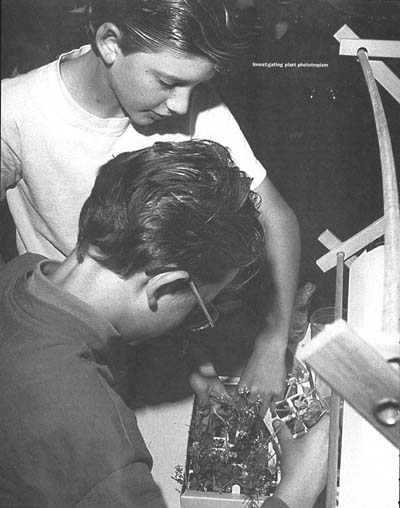
Teacher's Guide Recommended grade level: 6. Reading level: middle 7. In Experiments with Plants, students learn how to design and conduct controlled experiments by using the 40-day life cycle of a Brassica plant as a vehicle for experimentation. They learn about the variables that affect plant growth and reproduction as they design and set up an experiment to manipulate an isolated variable. Students then plant seeds according to their experiment plans; they determine the effects of their experiments on the plants' life cycle through data collection, measurement, observation, and recording. After observing the entire life cycle, they communicate the results of their experiments. The unit concludes with 2 sets of experiments involving germination, geotropism, and phototropism. Some prior study of plants and plant life cycles is helpful, but not essential, for students in Experiments with Plants.
This is a 15-lesson unit. The teacher's guide includes a unit overview, the 15 lesson plans, an annotated bibliography of additional resources, and information on maintaining live materials. Science background information, detailed instructions on planning for and conducting each activity, an extensive assessment component, and extensions for integration and enrichment are provided.
Key to Content Standards: 5-8
(see app. C)
UNIFYING CONCEPTS AND PROCESSES: Evidence, models, and explanation; change, constancy, and measurement.
SCIENCE AS INQUIRY: Abilities necessary to do scientific inquiry; understandings about scientific inquiry.
LIFE SCIENCE: Structure and function in living systems; reproduction and heredity; regulation and behavior.
HISTORY AND NATURE OF SCIENCE: Science as a human endeavor; nature of science; history of science.
Prices: Teacher's guide (ISBN 0-89278-680-9), $24.95. Student activity book (ISBN 0-89278-634-5), $3.75. Unit, $299.95. Publisher/supplier: Carolina Biological Supply. Materials: Available locally, from commercial suppliers, or in kit.
2.6 Exploring Life Science.
2nd ed. Anthea Maton, Jean Hopkins, Susan Johnson, and others. Prentice Hall Exploring Life, Earth, and Physical Science series. Upper Saddle River, N.J.: Prentice Hall, 1997.
Program Overview The Prentice Hall Exploring Life, Earth, and Physical Science series is a program for middle school students. Designed to cover all relevant areas of science, this integrated program consists of 3 textbooks (1 for each major discipline) and incorporates 7 science themes—energy, evolution, patterns of change, scale and structure, systems and interactions, unity and diversity, and stability. Each of the 3 year-long courses contains about 6 units. The units are also available, possibly with some modifications, as individual textbooks in the Prentice Hall Science Integrated Learning System series (see, e.g., 2.1). For
each course, teaching materials, ancillary student materials, and some optional components are available.
Student Edition Recommended grade level: 7-8+. Reading level: middle 11. Exploring Life Science offers a complete course in life science. The units in this textbook are entitled (1) "Characteristics of Living Things," (2) "Monerans, Protists, Fungi, and Plants," (3) "Animals," (4) "Human Biology," (5) "Heredity and Adaptation," and (6) "Ecology." During the course, students learn about cells and cell processes and about how living things are classified by scientists. They study the characteristics of viruses, monerans, protists, fungi, plants with and without seeds, and the various groups of invertebrate and vertebrate animals. They investigate plant and animal structures, adaptations, reproductive processes, and growth patterns. They study human body systems, human reproduction and development, genetics and applied genetics, evolution, cycles in nature, and the earth's biomes.
Examples of the lab investigations that students conduct during the 6 units are these: observing a slime mold over 3 days, dissecting an owl pellet, observing what effect alcohol has on the growth of microorganisms, and making a model to represent recombinant DNA.
Each of the 6 units in Exploring Life Science typically has 3 to 6 chapters. Each chapter contains comprehensive reading sections that introduce major science concepts. Also included are suggested skills-oriented activities for discovering, doing, calculating, thinking, and writing about science. The activities range from comparing down and contour feathers, to making spore prints, to writing a report on human fungal diseases. Each chapter includes a laboratory investigation as well as a review and study guide.
Other features of this textbook include problem-solving challenges, science connections to real-world events or issues, and careers in science. A "Science Gazette" feature at the end of each unit profiles prominent scientists—for example, paleontologist Jack Horner, physicist Stephen Hawking, and epidemiologist Veronica Broome. An "Activity Bank" at the back of the book provides at least one additional laboratory investigation for each chapter. Examples include using a micro-scope to observe the behavior of hydra, investigating the response of Euglena to light, growing a plant from a cutting, and exploring the process of making compost.
Teacher's Edition In the teacher's wraparound edition, each chapter begins with a 2-page planning guide and a 2-page preview that summarizes each section within the chapter. The teacher's edition also provides suggestions for teaching, guiding, integrating, and closing lessons, as well as enrichments, extensions, and answers to questions in the student text.
Supplementary Laboratory Manual The supplementary lab manual contains 70 investigations directly correlated with information presented in the student textbook. Examples include observing the movement of molecules through a cell membrane, culturing yeast cells, investigating germination inhibitors, examining bird adaptations, observing some human reflexes, and constructing a microhabitat.
Program Resources and Support Materials A variety of support materials is available, including a box of teaching resources with activities, worksheets, and assessment materials for each chapter. Other available materials are a teacher's desk reference, an integrated science activity book, a computer test bank, videos, videodiscs, transparencies, a classroom manager guide, and a book of product-testing activities.
Key to Content Standards: 5-8
(see app. C)
UNIFYING CONCEPTS AND PROCESSES: Systems, order, and organization; evidence, models, and explanation; change, constancy, and measurement; evolution and equilibrium; form and function.
SCIENCE AS INQUIRY: Abilities necessary to do scientific inquiry; understandings about scientific inquiry.
LIFE SCIENCE: Structure and function in living systems; regulation and behavior; populations and ecosystems; diversity and adaptations of organisms.
SCIENCE AND TECHNOLOGY: Understandings about science and technology.
SCIENCE IN PERSONAL AND SOCIAL PERSPECTIVES: Personal health; populations, resources, and environments; risks and benefits; science and technology in society.
HISTORY AND NATURE OF SCIENCE: Science as a human endeavor; nature of science; history of science.
Prices: Student edition (ISBN 0-13-418732-6), $41.47. Teacher's edition (ISBN 0-13-422841-3), $70.47. Lab manual, teacher's edition (1995), $24.47. Teaching resources, $306.47. (Contact publisher/supplier for complete price and ordering information.) Publisher/supplier: Prentice Hall. Materials: Available locally, or from commercial suppliers.
2.7 Food and Nutrition.
Full Option Science System (FOSS) series. Developed by Lawrence Hall of Science (Berkeley, Calif.). Hudson, N.H.: Delta Education, 1993.
Program Overview The Full Option Science System (FOSS) program is a K-6 science curriculum consisting of 27 stand-alone modules. The 8 modules for grades 5-6 are organized under topics in the life, physical, and earth sciences and in scientific reasoning and technology. They can be used in any order. The FOSS program is designed to engage students in scientific concepts through multisensory, hands-on laboratory activities. All modules of the program incorporate 5 unifying themes—(1) pattern, (2) structure, (3) interaction, (4) change, and (5) system. The components of a FOSS module are a teacher's guide and a kit of materials.
Teacher's Guide Recommended grade level: 5-6. The unit Food and Nutrition helps students understand what food is, what its chemical components are, and how several nutrient groups contribute to making food healthful. Students test foods for their acid content, as well as for their vitamin C, fat, and sugar content. Next they learn how to read nutritional information on package labels, how to calculate the caloric content of foods, and how to use their own knowledge and the nutritional information from the packaging lists of product ingredients to plan and evaluate lunch menus. Activities involve students in measuring and comparing, observing, and analyzing.
Food and Nutrition consists of 4 activities, requiring about 10 sessions of 45 to 60 minutes each. The teacher's guide includes a module overview, the 4 individual activity folios, duplication masters (in English and Spanish) for student sheets, and an annotated bibliography. Science background information, detailed instructions on planning for and conducting each activity, an extensive assessment component, and extensions for integration and enrichment are provided.
Key to Content Standards: 5-8
(see app. C)
UNIFYING CONCEPTS AND PROCESSES: Systems, order, and organization; evidence, models, and explanation; change, constancy, and measurement.
SCIENCE AS INQUIRY: Abilities necessary to do scientific inquiry; understandings about scientific inquiry.
PHYSICAL SCIENCE: Properties and changes of properties in matter.
LIFE SCIENCE: Structure and function in living systems.
SCIENCE IN PERSONAL AND SOCIAL PERSPECTIVES: Personal health.
Prices: Teacher's guide (ISBN 0-7826-0093-X), $101. Complete module, $429. Publisher/supplier: Delta Education. Materials: Available locally, from commercial suppliers, or in kit.
2.8 Glencoe Life Science.
Lucy Daniel, Ed Ortleb, and Alton Biggs. Glencoe Life, Earth, and Physical Science series. New York, N.Y.: Glencoe/McGraw-Hill, 1997.
Program Overview The Glencoe Life, Earth, and Physical Science series includes 3 full-year courses—one in life, one in earth, and one in physical science—for students in grades 8 and above. Four major themes are developed: (1) energy, (2) systems and interactions, (3) scale and structure, and (4) stability and change. An extensive set of materials and resources, including many optional components, is available for students and teachers.
Student Edition Recommended grade level: 8+. Reading level: early 7. Glencoe Life Science is divided into 7 units: (1) "Life," (2) "Heredity and Evolution," (3) "Diversity of Life," (4) "Plants," (5) "Animals," (6) "Ecology," and (7) "The Human Body." During this course, students learn about cells and cell processes and about patterns of heredity and how inherited changes can influence evolutionary trends. They learn how organisms are classified, and they examine the characteristics and life processes of monerans, protists, fungi, plants, and animals. Students are introduced to the fundamentals of ecology, including interaction of abiotic and biotic factors, characteristics of populations, the flow of energy, and the cycling of matter. They also study the systems of the human body and how they function, and they examine some basic health concepts.
Sample lab activities in this textbook include observing and comparing mitosis in plant cells and animal cells, using a dichotomous key to identify native cats of North America, designing and carrying out an experiment to determine what happens to proteins in the digestive system, and experimenting with models to observe the greenhouse effect.
Glencoe Life Science has 27 chapters in its 7 units. Each chapter begins with a self-guided activity in which students make observations and generate questions about chapter concepts and topics. Reading sections on science concepts are then interwoven with various types of activities, including open-ended activities, minilabs (activities that can be done in class or at home), and skill-building or problem-solving activities. In activities for designing their own experiments, students brainstorm hypotheses, make a decision to investigate a hypothesis that can be tested, plan procedures, and think about why their hypothesis was supported or not.
Special features of the textbook include "connect to" marginal notes that relate basic questions in
physics, chemistry, earth science, and life science to one another. The book also provides "science and society" features that invite students to confront real-life problems; profiles of people in science; and reading selections about connections between science, history, literature, and the arts.
Teacher's Edition The wraparound teacher's edition provides information on curriculum integration, assessment, planning, and meeting the diverse needs of students. Each chapter contains a 4-page planning guide; strategies for preparing, teaching, and closing lessons; answers to in-text questions; tips on connecting earth science to other sciences, disciplines, or community resources; and different assessment options.
Supplementary Laboratory Manual The supplementary lab manual offers one or more additional labs for each chapter. It has setup diagrams, data tables, and space for student responses. Examples of investigations include exploring bacterial growth, comparing seeds, observing the responses of plants to light and gravity, investigating the effects of acid rain on the germination of bean seedlings, testing for carbohydrates in foods, and comparing the effects of different caffeine products on Euglena.
Program Resources and Support Materials Glencoe Life Science offers an extensive list of support materials and program resources, including the following: activity and reinforcement worksheets, science integration activities that relate earth and life science to specific physical science chapters, a critical-thinking/problem-solving book, a concept-mapping book, chapter review masters, a study guide, enrichment worksheets, a book on multicultural connections, technology-integration masters, assessments, computer test banks, color transparencies, a Spanish resources book, and interactive CD-ROM and videodisc programs.
Key to Content Standards: 5-8
(see app. C)
UNIFYING CONCEPTS AND PROCESSES: Systems, order, and organization; evidence, models, and explanation; change, constancy, and measurement; evolution and equilibrium; form and function.
SCIENCE AS INQUIRY: Abilities necessary to do scientific inquiry; understandings about scientific inquiry.
LIFE SCIENCE: Structure and function in living systems; reproduction and heredity; regulation and behavior; populations and ecosystems; diversity and adaptations of organisms.
SCIENCE AND TECHNOLOGY: Abilities of technological design; understandings about science and technology.
SCIENCE IN PERSONAL AND SOCIAL PERSPECTIVES: Personal health; populations, resources, and environments; science and technology in society.
Prices: Student edition (ISBN 0-02-827737-6), $41.79. Teacher's edition (ISBN 0-02-827738-4), $57.86. Student lab manual, $8.25. Teacher's lab manual, $14.00. Teacher's classroom resources, $321.87. (Contact publisher/supplier for complete price and ordering information.) Publisher/supplier: Glencoe/McGraw-Hill. Materials: Available locally, or from commercial suppliers.
2.9 Heredity: The Code of Life.
3rd ed. Anthea Maton, Jean Hopkins, Susan Johnson, and others. Prentice Hall Science Integrated Learning System series. Upper Saddle River, N.J.: Prentice Hall, 1997.
Program Overview The Prentice Hall Science Integrated Learning System series is a program for middle school or junior high school students. Designed to cover all relevant areas of science, this program consists of 19 books, each in a particular topic area, such as sound and light, the planet earth, and heredity—the code of life. Seven science themes are incorporated into the program; the themes are energy, evolution, patterns of change, scale and structure, systems and interactions, unity and diversity, and stability. For each unit, teaching materials, ancillary student materials, and some optional components are available.
Student Edition Recommended grade level: 7-8+. Reading level: early 10. Heredity: The Code of Life introduces students to the science of genetics—from its beginnings in Mendel's experiments to current research in and applications of molecular genetics. The unit is organized in 4 chapters: (1) "What Is Genetics?" (2) "How Chromosomes Work," (3) "Human Genetics," and (4) "Applied Genetics." During the course, students learn about basic patterns of inheritance and principles of heredity and discover how these patterns and principles relate to probability. They learn about the chromosome theory of heredity and discover how chromosomes control the production of proteins. Students also apply the principles of genetics to understanding specific examples of heredity in humans, including the ABO blood groups, sickle-cell anemia, and Huntington disease. Finally, they are introduced to artificial methods of manipulating inheritance—such as selective breeding techniques and genetic engineering—and the application of these methods in agriculture and medicine.
Each chapter includes a lab investigation. Students complete a class survey of dominant and recessive human traits, such as hair color, hairline, and type of earlobe. They observe the growth of mutant
(albino) corn sprouts as compared with that of normal corn sprouts. Students also study a human pedigree to trace the inheritance of sickle-cell anemia through 3 generations of a family, and they make models from construction paper to represent recombinant DNA.
Each chapter contains comprehensive reading sections that introduce major science concepts. Suggestions are provided for activities in which students "find out by doing," "find out by reading," and "find out by writing." Other skills-oriented activities are also suggested—for example, calculating the incidence of Down's syndrome in the United States and discussing the pros and cons of genetically engineered food plants.
Other features of this textbook include problem-solving challenges, descriptions of science careers, and science connections to real-world events or issues. The student edition closes with readings on 3 topics: (1) biologist Barbara McClintock's discovery of "jumping" genes, (2) the effect of humans on the rate of extinction of wild animals and plants, and (3) the Human Genome Project.
Teacher's Edition In the teacher's wraparound edition, each chapter begins with a 2-page planning guide and a 2-page preview that summarizes each section within the chapter. The teacher's edition also provides suggestions for teaching, guiding, integrating, and closing lessons, as well as enrichments, extensions, and answers to questions in the student text.
Supplementary Laboratory Manual The supplementary lab manual provides 5 additional investigations directly correlated with the information presented in the student textbook. Examples of the investigations include solving heredity problems, building a model of DNA, observing how the results of different gene combinations produce certain traits, and cloning a duckweed plant.
Program Resources and Support Materials A variety of materials, including some optional components, is available. A teacher's resource package contains the student edition and annotated teacher's editions of both the textbook and the lab manual, as well as a test book, an activity book, a review-and-reinforcement guide, and English and Spanish audiotapes for auditory and language learners. Other available materials include interactive videodiscs, transparencies, assessment materials, English and Spanish guides for language learners, a study guide, a teacher's desk reference, and a booklet of product-testing activities.
Key to Content Standards: 5-8
(see app. C)
UNIFYING CONCEPTS AND PROCESSES: Systems, order, and organization; evidence, models, and explanation; change, constancy, and measurement; evolution and equilibrium.
SCIENCE AS INQUIRY: Abilities necessary to do scientific inquiry; understandings about scientific inquiry.
LIFE SCIENCE: Reproduction and heredity; diversity and adaptations of organisms.
SCIENCE AND TECHNOLOGY: Understandings about science and technology.
SCIENCE IN PERSONAL AND SOCIAL PERSPECTIVES: Science and technology in society.
HISTORY AND NATURE OF SCIENCE: Nature of science; history of science.
Prices: Student edition (ISBN 0-13-423468-5), $9.97. Teacher's edition (ISBN 0-13-423229-1), $22.97. Teacher's resource package, $112.97. (Contact publisher/supplier for complete price and ordering information.) Publisher/supplier: Prentice Hall. Materials: Available locally, or from commercial suppliers.
2.10 Human Biology and Health.
3rd ed. Anthea Maton, Jean Hopkins, Susan Johnson, and others. Prentice Hall Science Integrated Learning System series. Upper Saddle River, N.J.: Prentice Hall, 1997.
Program Overview The Prentice Hall Science Integrated Learning System series is a program for middle school or junior high school students. Designed to cover all relevant areas of science, this program consists of 19 books, each in a particular topic area, such as sound and light, the planet earth, and human biology and health. Seven science themes are incorporated into the program; the themes are energy, evolution, patterns of change, scale and structure, systems and interactions, unity and diversity, and stability. For each unit, teaching materials, ancillary student materials, and some optional components are available.
Student Edition Recommended grade level: 7-8. Reading level: early 8. Human Biology and Health introduces students to human body systems, their interactions with one another, and how disorders and other factors affect the health of body systems. Over 9 chapters, students learn about the multicellular organization of the human body. They study the various systems of the human body, including the skeletal and muscular systems, the digestive system, the circulatory system, the respiratory and excretory systems, and the nervous and endocrine systems. In addition, students learn about the male and female reproductive systems and about human reproduction and development. They also read about the immune system and diseases and learn about effects of drugs, alcohol, and tobacco on the body.
Each chapter includes a lab investigation. Students examine the shape and arrangement of cells under a microscope, measure the number of calories used in 24 hours, measure pulse rate at different levels of activity,
and determine where touch receptors are located on the body.
Each chapter contains comprehensive reading sections that introduce major science concepts. Suggestions are provided for activities in which students "find out by doing," "find out by reading," and "find out by writing." Other skills-oriented activities are also suggested—for example, calculating basal metabolic rate and constructing a chart to describe the changes that occur in the embryo and fetus during the first 3 months of pregnancy.
Other features of this textbook include problem-solving challenges, descriptions of science careers, and science connections to real-world events or issues. The student edition closes with readings on 3 topics: (1) how epidemiologist Claire Veronica Broome studies outbreaks of disease, (2) the issue of overexercising, and (3) bioengineering.
Teacher's Edition In the teacher's wraparound edition, each chapter begins with a 2-page planning guide and a 2-page preview that summarizes each section within the chapter. The teacher's edition also provides suggestions for teaching, guiding, integrating, and closing lessons, as well as enrichments, extensions, and answers to questions in the student text.
Supplementary Laboratory Manual The supplementary lab manual provides 17 additional investigations directly correlated with the information presented in the student textbook. Examples of the investigations include examining the structures of a long bone from a chicken leg and finding out how joints provide for movement of bones, determining the amount of vitamin C in fruit juice, and examining the circulation of blood in the capillaries of a goldfish's tail. Other investigations include measuring the effect of exercise on the amount of carbon dioxide released from the lungs, observing a developing frog egg, and testing the effects of alcohol and tobacco smoke on seeds.
Program Resources and Support Materials A variety of materials, including some optional components, is available. A teacher's resource package contains the student edition and annotated teacher's editions of both the textbook and the lab manual, as well as a test book, an activity book, a review-and-reinforcement guide, and English and Spanish audiotapes for auditory and language learners. Other available materials include interactive videodiscs, transparencies, assessment materials, English and Spanish guides for language learners, a study guide, a teacher's desk reference, and a booklet of product-testing activities.
Key to Content Standards: 5-8
(see app. C)
UNIFYING CONCEPTS AND PROCESSES: Systems, order, and organization; change, constancy, and measurement; form and function.
SCIENCE AS INQUIRY: Abilities necessary to do scientific inquiry; understandings about scientific inquiry.
LIFE SCIENCE: Structure and function in living systems; reproduction and heredity; regulation and behavior.
SCIENCE IN PERSONAL AND SOCIAL PERSPECTIVES: Personal health; risks and benefits.
Prices: Student edition (ISBN 0-13-423435-9), $10.47. Teacher's edition (ISBN 0-13-423195-3), $22.97. Teacher's resource package, $112.97. (Contact publisher/supplier for complete price and ordering information.) Publisher/supplier: Prentice Hall. Materials: Available locally, or from commercial suppliers.
2.11 Human Body Systems.
Insights series. Developed by Education Development Center (EDC). Dubuque, Iowa: Kendall/Hunt, 1997.
Program Overview The Insights program, for grades K-6, consists of 17 modules, several of which are appropriate for middle school. Topics in the program reflect a balance of life, physical, and earth sciences. Insights modules integrate science with the rest of the curriculum, particularly with language arts and mathematics. The activities support cultural, racial, and linguistic diversity. Each module requires about 25 class sessions to complete. The components of an Insights module are a teacher's guide and a kit of materials.
Teacher's Guide Recommended grade level: 6. Human Body Systems is designed to convey to students basic concepts about how 3 systems—the human circulatory, digestive, and respiratory systems—work together. As students explore these systems, beginning with the cell and the vital role it plays as a basic component of the body, they develop a sense of the size, location, and function of some of their internal organs. Students are introduced to the ideas that the individual parts of the body are all part of one larger system and that these parts work together to take in food, process it for energy, and get rid of waste. Students engage in a variety of activities that demonstrate how the 3 systems work interdependently to provide the cells in the body with the nutrients and energy they need.
Human Body Systems consists of 13 Learning Experiences, requiring a minimum of 24 class sessions. The teacher's guide includes an overview, the 13 Learning Experiences, reproducible masters for student sheets, and annotated lists of suggested readings and audiovisual materials. Science background information, detailed instructions on planning for
and conducting each activity, an extensive assessment component, and extensions for integration and enrichment are also included.
Key to Content Standards: 5-8
(see app. C)
UNIFYING CONCEPTS AND PROCESSES: Systems, order, and organization; form and function.
SCIENCE AS INQUIRY: Abilities necessary to do scientific inquiry; understandings about scientific inquiry.
LIFE SCIENCE: Structure and function in living systems; regulation and behavior.
SCIENCE IN PERSONAL AND SOCIAL PERSPECTIVES: Personal health.
Prices: Teacher's guide (ISBN 0-7872-3343-9), $68.90. Materials kit, $398.90. Publisher/supplier: Kendall/Hunt. Materials: Available locally, from commercial suppliers, or in kit.
2.12 Microworlds.
Science and Technology for Children (STC) series. Developed by National Science Resources Center (Washington, D.C.). Burlington, N.C.: Carolina Biological Supply, 1991.
Program Overview The Science and Technology for Children (STC) series consists of 24 inquiry-centered curriculum units for grades 1-6, with 4 units at each grade level. Students learn about topics in the life, earth, and physical sciences. The technological applications of science and the interactions among science, technology, and society are addressed throughout the program. The STC units, each of which takes about 16 class sessions to complete, encourage participatory learning and the integration of science with mathematics, language arts, social studies, and art. The components of an STC unit are a teacher's guide, a student activity book with simple instructions and illustrations, and a kit of materials.
Teacher's Guide Recommended grade level: 5-6. Reading level: 7. Microworlds develops students' observational skills and allows them to become adept at using hand lenses, microscopes, slides, and related apparatuses to view living and nonliving specimens. Students make close observations of common objects with hand lenses and learn about different lenses and how they work. They use a microscope to observe inanimate objects such as hair and magazine photographs. Students explore the concept of field of view, prepare different types of slides, and examine the cells of an onion. Then they use their new expertise to view microscopic living organisms under magnification. Throughout the unit they record their observations by writing and drawing.
Microworlds is a 16-lesson unit. The teacher's guide includes a unit overview, the 16 lesson plans, and an annotated bibliography of additional resources. Science background information, detailed instructions on planning for and conducting each activity, an extensive assessment component, and extensions for integration and enrichment are provided. The appendixes include a supplementary drawing lesson and tips on caring for live cultures.
Key to Content Standards: 5-8
(see app. C)
UNIFYING CONCEPTS AND PROCESSES: Systems, order, and organization; evidence, models, and explanation; form and function.
SCIENCE AS INQUIRY: Abilities necessary to do scientific inquiry; understandings about scientific inquiry.
LIFE SCIENCE: Structure and function in living systems; diversity and adaptations of organisms.
SCIENCE AND TECHNOLOGY: Understandings about science and technology.
SCIENCE IN PERSONAL AND SOCIAL PERSPECTIVES: Science and technology in society.
HISTORY AND NATURE OF SCIENCE: Science as a human endeavor; nature of science; history of science.
Prices: Teacher's guide, $24.95. Student activity book, $3.75. Unit, $359.95. Publisher/supplier: Carolina Biological Supply. Materials: Available locally, from commercial suppliers, or in kit.
2.13 Middle School Life Science.
Judy Capra (principal author) and Jefferson County Public Schools (Golden, Colo.). Dubuque, Iowa: Kendall/Hunt, 1991.
Program Overview Middle School Life Science is a full-year course organized around a series of learning cycles during which students work independently, with partners, and in small groups. They engage in hands-on laboratory activities to explore an idea or concept, develop the concept during class discussion and/or through readings or additional experiments, apply the concepts learned to other situations, and form connections between their new knowledge and other areas of inquiry.
Student Edition Recommended grade level: 7. Reading level: early 8. Middle School Life Science is a study of human biology, of people and the environment, and of choices people must make to stay healthy. The textbook is organized in 7 units: (1) "Ecosystems and Ecology," (2) "Body Structure," (3) "Foods and Digestion," (4) "Body Basics," (5) "Body Controls," (6) "Body Changes," and (7) "Cells and Genetics." When possible, the situations discussed relate to students' lives and involve general health topics
such as fitness, nutrition, drug use, relationships with peers, and ecological topics such as recycling and environmental responsibilities.
The textbook's 7 units consist of 23 chapters, which provide activities and readings. Each chapter includes several activities—for example, constructing and observing a terrarium with decomposers and scavengers in it; examining microscope slides of muscle cells; observing the effect of saliva on protein, fat, and carbohydrate; and designing a poster on cancer awareness. The activities are used first to introduce concepts and then to reinforce these concepts by providing opportunities for students to apply what they have learned. The readings interspersed with the activities build on students' experiences and reinforce the activities. Each activity and reading is designated as core, recommended, or optional. The extensions provided are often interdisciplinary, with opportunities for exploring careers.
Teacher's Edition The teacher's guide, in 3-ring-binder format, contains information on the Middle School Life Science program, assessment options, strategies to use with reading assignments, unit overviews and materials lists, and directions and guidelines for teaching all activities. Answer keys and transparency keys are also provided.
A separate teacher's resource book contains additional material, arranged by chapter. Included are worksheets, blackline masters for transparencies, optional lessons, additional print materials, and a test item bank.
Key to Content Standards: 5-8
(see app. C)
UNIFYING CONCEPTS AND PROCESSES: Systems, order, and organization; change, constancy, and measurement; form and function.
SCIENCE AS INQUIRY: Abilities necessary to do scientific inquiry; understandings about scientific inquiry.
LIFE SCIENCE: Structure and function in living systems; reproduction and heredity; regulation and behavior; populations and ecosystems.
SCIENCE IN PERSONAL AND SOCIAL PERSPECTIVES: Personal health; natural hazards; risks and benefits; science and technology in society.
HISTORY AND NATURE OF SCIENCE: Science as a human endeavor; nature of science.
Prices: Student edition (ISBN 0-8403-5098-8), $43.90. Teacher's edition (ISBN 0-8403-5099-6), $69.90. Teacher's resource book, $109.90. Publisher/supplier: Kendall/Hunt. Materials: Available locally, or from commercial suppliers.
2.14 Parade of Life: Animals.
3rd ed. Anthea Maton, Jean Hopkins, Susan Johnson, and others. Prentice Hall Science Integrated Learning System series. Upper Saddle River, N.J.: Prentice Hall, 1997.
Program Overview The Prentice Hall Science Integrated Learning System series is a program for middle school or junior high school students. Designed to cover all relevant areas of science, this program consists of 19 books, each in a particular topic area, such as sound and light, the planet earth, and organisms that make up the animal kingdom. Seven science themes are incorporated into the program; the themes are energy, evolution, patterns of change, scale and structure, systems and interactions, unity and diversity, and stability. For each unit, teaching materials, ancillary student materials, and some optional components are available.
Student Edition Recommended grade level: 7-8+. Reading level: middle 9. Parade of Life: Animals, which introduces students to the organisms that make up the animal kingdom, is organized in 5 chapters: (1) "Sponges, Cnidarians, Worms, and Mollusks"; (2) "Arthropods and Echinoderms"; (3) "Fishes and Amphibians"; (4) "Reptiles and Birds"; and (5) "Mammals." During the course, students briefly review the 5 kingdoms and their general characteristics, and they discuss the division of the animal kingdom into vertebrates and invertebrates. Then they study the general characteristics of the major groups of invertebrates. Students learn about the first groups of vertebrates to evolve—fishes and amphibians—and are introduced to reptiles and birds; they study the main characteristics of mammals; and they discuss the evolution of mammals into 3 distinct groups—monotremes, marsupials, and placental mammals.
Each chapter includes a lab investigation. Students observe how earthworms react to changes in moisture and light. They determine whether isopods prefer a wet or a dry environment. They observe the behavior of guppies in an aquatic environment over 2 weeks to determine the type of environment that is best suited to guppies. Also, they dissect an owl pellet and try to determine what an owl eats, and they describe the characteristics of hair seen under a microscope.
Each chapter contains comprehensive reading sections that introduce major science concepts. Suggestions are provided for activities in which students "find out by doing," "find out by reading," and "find out by writing." Other skills-oriented activities are also suggested—for example, observing the life of a mealworm over 4 weeks, and researching the effects of the accidental introduction of lampreys into the Great Lakes after the completion of the St. Lawrence Seaway.
Other features of the textbook include problem-solving challenges, descriptions of science careers, and science connections to real-world events or issues. The student edition
closes with readings on 3 topics: (1) the efforts of Kenyan wildlife advocate Michael Werikhe to preserve the rhinoceros, (2) the impact of tuna net fishing on dolphins, and (3) a fictional account of future medical or societal use of a chemical that causes hibernation.
Teacher's Edition In the teacher's wraparound edition, each chapter begins with a 2-page planning guide and a 2-page preview that summarizes each section within the chapter. The teacher's edition also provides suggestions for teaching, guiding, integrating, and closing lessons, as well as enrichments, extensions, and answers to questions in the student text.
Supplementary Laboratory Manual The supplementary lab manual provides 18 additional investigations directly correlated with the information presented in the student textbook. Examples of the investigations include examining the external and internal structure of an earthworm, observing organisms that live in the soil, identifying the external parts of a perch and an anole, and using a simple classification key to identify some vertebrates.
Program Resources and Support Materials A variety of materials, including some optional components, is available. A teacher's resource package contains the student edition and annotated teacher's editions of both the textbook and the lab manual, as well as a test book, an activity book, a review-and-reinforcement guide, and English and Spanish audiotapes for auditory and language learners. Other available materials include interactive videodiscs, transparencies, assessment materials, English and Spanish guides for language learners, a study guide, a teacher's desk reference, and a booklet of product-testing activities.
Key to Content Standards: 5-8
(see app. C)
UNIFYING CONCEPTS AND PROCESSES: Systems, order, and organization; evolution and equilibrium; form and function.
SCIENCE AS INQUIRY: Abilities necessary to do scientific inquiry; understandings about scientific inquiry.
LIFE SCIENCE: Structure and function in living systems; regulation and behavior; diversity and adaptations of organisms.
Prices: Student edition (ISBN 0-13-423484-7), $9.97. Teacher's edition (ISBN 0-13-423245-3), $22.97. Teacher's resource package, $112.97. (Contact publisher/supplier for complete price and ordering information.) Publisher/supplier: Prentice Hall. Materials: Available locally, or from commercial suppliers.
2.15 Parade of Life: Monerans, Protists, Fungi, and Plants.
2nd ed. Anthea Maton, Jean Hopkins, Susan Johnson, and others. Prentice Hall Science Integrated Learning System series. Englewood Cliffs, N.J.: Prentice Hall, 1994.
Program Overview The Prentice Hall Science Integrated Learning System series is a program for middle school or junior high school students. Designed to cover all relevant areas of science, this program consists of 19 books, each in a particular topic area, such as sound and light, the planet earth, and the classification of living things—monerans, protists, fungi, plants, and animals. Seven science themes are incorporated into the program; the themes are energy, evolution, patterns of change, scale and structure, systems and interactions, unity and diversity, and stability. For each unit, teaching materials, ancillary student materials, and some optional components are available.
Student Edition Recommended grade level: 7-8+. Reading level: middle 7. Parade of Life: Monerans, Protists, Fungi, and Plants introduces students to the ways that scientists classify living things. The unit is organized in 6 chapters: (1) "Classification of Living Things," (2) "Viruses and Monerans," (3) "Protists," (4) "Fungi," (5) "Plants without Seeds," and (6) "Plants with Seeds."
During the course, students learn about classification systems and the 7 major levels of taxonomic grouping. They study the parts of a virus and viral reproduction; they study the structures of monerans and how monerans obtain energy and reproduce; and they learn about 3 major groups of protists and the characteristics of several types of fungi. Students also analyze the adaptations necessary for plants to live on land, compare ferns to mosses and algae, learn about the process of photosynthesis, and study the patterns of growth in seed plants and the factors that affect growth.
Each chapter includes a laboratory investigation. Students develop a classification system for their shoes. They observe the growth of bacteria (monerans) in petri dishes with agar. They also observe some of the characteristics of a living slime mold over 3 days; compare the growth of mold on 3 substances (cheese, bread, and an apple slice); compare algae, mosses, and ferns using a hand lens and a microscope; and investigate how gravity affects the growth of a seed.
Each chapter contains comprehensive reading sections that introduce major science concepts. Suggestions are provided for activities in which students "find out by doing," "find out by reading," and "find out by writing." Other skills-oriented activities
are also suggested—for example, calculating the reproductive capacity of bacteria and identifying the parts of plants from which various foods originate.
Other features of the textbook include problem-solving challenges, descriptions of science careers, and science connections to real-world events or issues. The student edition closes with readings on 3 topics: (1) the research of marine biologist Colleen Cavanaugh, who studies giant tube worms; (2) the pluses and minuses of pesticide use; and (3) the possibility of farming in outer space.
Teacher's Edition In the teacher's wraparound edition, each chapter begins with a 2-page planning guide and a 2-page preview that summarizes each section within the chapter. The teacher's edition also provides suggestions for teaching, guiding, integrating, and closing lessons, as well as enrichments, extensions, and answers to questions in the student text.
Supplementary Laboratory Manual The supplementary lab manual provides 13 additional investigations directly correlated with the information presented in the student textbook. Examples include trying to grow bacteria on common vegetables; culturing some yeast cells, determining their needs for growth, and observing their reproduction; and investigating the structures and functions of a leaf.
Program Resources and Support Materials A variety of materials, including some optional components, is available. A teacher's resource package contains the student edition and annotated teacher's editions of both the textbook and the lab manual, as well as a test book, an activity book, a review-and-reinforcement guide, and English and Spanish audiotapes for auditory and language learners. Other available materials include interactive videodiscs, transparencies, assessment materials, English and Spanish guides for language learners, a study guide, a teacher's desk reference, and a booklet of product-testing activities.
Key to Content Standards: 5-8
(see app. C)
UNIFYING CONCEPTS AND PROCESSES: Systems, order, and organization; evolution and equilibrium; form and function.
SCIENCE AS INQUIRY: Abilities necessary to do scientific inquiry; understandings about scientific inquiry.
LIFE SCIENCE: Structure and function in living systems; reproduction and heredity; populations and ecosystems; diversity and adaptations of organisms.
SCIENCE IN PERSONAL AND SOCIAL PERSPECTIVES: Science and technology in society.
HISTORY AND NATURE OF SCIENCE: History of science.
Prices: Student edition (ISBN 0-13-225590-1), $9.97. Teacher's edition (ISBN 0-13-225608-8), $22.97. Teacher's resource package, $112.97. (Contact publisher/supplier for complete price and ordering information.) Publisher/supplier: Prentice Hall. Materials: Available locally, or from commercial suppliers.
Life Science—Supplementary Units
2.16 Animals in Action.
Reprinted with revisions. Katharine Barrett. Great Explorations in Math and Science (GEMS) series. Berkeley, Calif.: Lawrence Hall of Science, 1991.
Program Overview The Great Explorations in Math and Science (GEMS) series includes more than 50 teacher's guides and handbooks for preschool through grade 10. About 35 of these are appropriate for middle school. The series also includes several assembly presenter's guides and exhibit guides. New guides and handbooks continue to be developed, and current titles are revised frequently. The series is designed to teach key science and mathematics concepts through activity-based learning. The time needed to complete GEMS units varies from about 2 to 10 class sessions.
Teacher's Guide Recommended grade level: 6-8. In Animals in Action, students investigate animal behavior by observing live animals. They first observe and describe the behavior of young animals—for example, gerbils, hamsters, guinea pigs, or chicks—enclosed in a large classroom corral. Then they introduce stimulus objects, such as food or shelter, and observe how each animal responds. On the basis of information in Animals in Action, students discuss the humane treatment of animals. Teams of students then design, conduct, and evaluate their own animal-behavior experiments, using small organisms such as crayfish, isopods, crickets, or garden snails. Findings are discussed at a simulated scientific convention.
|
ABOUT THE ANNOTATIONS IN "LIFE SCIENCE—SCIENCE ACTIVITY BOOKS" Entry Numbers Curriculum materials are arranged alphabetically by title in each category (Core Materials, Supplementary Units, and Science Activity Books) in chapters 1 through 5 of this guide. Each curriculum annotation has a two-part entry number: the chapter number is given before the period; the number after the period locates the entry within that chapter. For example, the first entry number in chapter 1 is 1.1; the second entry in chapter 2 is 2.2; and so on. The entry numbers within each curriculum chapter run consecutively through Core Materials, Supplementary Units, and Science Activity Books. Order of Bibliographic Information Following is the arrangement of the facts of publication in the annotations in this section:
Recommended Grade Level The grade level for each piece of material was recommended by teacher evaluators during the development of this guide. In some instances, the recommended grade level may differ slightly from the publisher's advertised level. Key to Content Standard: 5-8 The key lists the content standards for grades 5-8 from the National Science Education Standards (NSES) that are addressed in depth by the item. A key is provided for core materials and supplementary units. (See appendix C.) |
|
Price and Acquisition Information Ordering information appears at the end of each entry. Included are—
Readers must contact publishers/suppliers for complete and up-to-date listings of the program resources and support materials available for a particular unit. Depending on the developer, these items may be required, optional, or both; they may be offered individually and/or in kits, packages, or boxes. Materials may change with revised editions. The prices given in this chapter for selected resources or materials are based on information from the publishers and suppliers but are not meant to represent the full range of ordering options. Indexes of Curriculum Materials The multiple indexes on pp. 449-78 allow easy access to the information in this guide. Various aspects of the curriculum materials—including titles, topics addressed in each unit, grade levels, and standards addressed—are the focus of seven separate indexes. For example, titles and entry numbers are listed in the "Title Index" on pp. 450-54. The "Index of Authors, Series, and Curriculum Projects," on pp. 455-57, provides entry numbers of any annotated titles in a particular series. Overviews of Core and Supplementary Programs Appendix D, "Overviews of Core and Supplementary Programs with Titles Annotated in This Guide," on pp. 441-48, lists, by program or series, the individual titles annotated in the sections "Core Materials" and "Supplementary Units" in the five curriculum chapters. |
Background information, easy-to-follow lesson plans for each of the 5 sessions, requiring 45 minutes each, and a small-animal resource guide are included in this unit.
Key to Content Standards: 5-8
(see app. C)
UNIFYING CONCEPTS AND PROCESSES: Systems, order, and organization; evidence, models, and explanation.
SCIENCE AS INQUIRY: Abilities necessary to do scientific inquiry; understandings about scientific inquiry.
LIFE SCIENCE: Regulation and behavior.
HISTORY AND NATURE OF SCIENCE: Nature of science.
Price: $10.50 (ISBN 0-912511-10-9). Publisher/supplier: LHS GEMS. Materials: Available locally, or from commercial suppliers.
2.17 Biodiversity: Understanding the Variety of Life.
Scholastic Science Place series. Developed in cooperation with Liberty Science Center (Jersey City, N.J.). New York, N.Y.: Scholastic, 1997.
Program overview The Scholastic Science Place series is a K-6 program with 42 units, 6 for each grade level. The 6 units for grade 6 are organized under topics in the life, earth, and physical sciences. Three key themes—(1) scale and structure, (2) systems and interactions, and (3) patterns of change—are incorporated into the program. For each unit, teaching materials, student materials, and some optional components are available.
Student Edition Recommended grade level: 6-8. Through the activities in Biodiversity: Understanding the Variety of Life, students learn that people make choices that affect the survival of their own and other species. The lessons are grouped under 3 subconcepts of biodiversity: (1) Scientists use various methods to measure earth's biodiversity. (2) The variety of species and habitats changes with time. (3) Knowledge of biodiversity helps people make decisions about the environment.
In this unit, students use a transect to take a sample of species in the schoolyard and discover the variety of species present. They observe soil-dwelling organisms as they explore how conditions in habitats affect diversity. Students classify unknown organisms to discover some difficulties involved in measuring biodiversity. They examine fossils to learn about extinct species. In other activities, students make a model of competition and explore how competition affects biodiversity. They investigate the effects of catastrophes, overpopulation, and pollution on a habitat.
Biodiversity is a 17-lesson unit consisting of approximately 20 class sessions, typically 60 to 95 minutes in duration.
Teacher's Edition The conceptual goals of the unit are presented in the lesson-by-lesson story line in the teacher's guide. Each lesson also includes background information; a complete lesson plan, including suggestions for assessing performance and integrating the curriculum; and a list of the materials required. For each lesson there is also a list of the relevant National Science Education Standards (developed by the National Research Council) and Project 2061 Benchmarks (developed by the American Association for the Advancement of Science).
Key to Content Standards: 5-8
(see app. C)
UNIFYING CONCEPTS AND PROCESSES: Systems, order, and organization; change, constancy, and measurement.
SCIENCE AS INQUIRY: Abilities necessary to do scientific inquiry; understandings about scientific inquiry.
LIFE SCIENCE: Regulation and behavior; populations and ecosystems; diversity and adaptations of organisms.
SCIENCE AND TECHNOLOGY: Abilities of technological design.
SCIENCE IN PERSONAL AND SOCIAL PERSPECTIVES: Populations, resources, and environments; natural hazards; risks and benefits.
HISTORY AND NATURE OF SCIENCE: History of science.
Prices: Student edition (ISBN 0-590-95536-5), $7.95. Teacher's edition (ISBN 0-590-95463-6), $27.00. Unit, $275.00. Consumable kit, $48.00. Publisher/supplier: Scholastic. Materials: Available locally, from commercial suppliers, or in kit.
2.18 Communicable Diseases.
Module 2.1. Foundations and Challenges to Encourage Technology-based Science (FACETS) series. Developed by American Chemical Society (Washington, D.C.). Dubuque, Iowa: Kendall/Hunt, 1996.
Program Overview The Foundations and Challenges to Encourage Technology-based Science (FACETS) program consists of 3 series of 8 modules each for grades 6-8. Each module focuses on a topic in the life, earth, or physical sciences. The time needed to complete FACETS modules varies from 2 to 4 weeks. Each module consists of a student book and a teacher's guide.
Student Edition Recommended grade level: 7. In the module Communicable Diseases, students design an educational package on communicable diseases for young children. In preparation for this project, they explore some of the ways in which communicable diseases are spread and controlled. Among the activities, students use various levels of magnification to view and draw small organisms, such as bacteria. They engage in a simulation to explore how communicable diseases can spread and how contact tracing sometimes works in identifying the path of communicable diseases in a population.
In other activities, students explore the conditions under which certain types of bacteria grow best. They also design an experiment to determine which of the materials used to kill bacteria in people's houses actually do so. In the final activity, students use their research findings and other information they have collected to develop the educational package for younger readers.
Communicable Diseases is a 3- to 4-week module divided into 5 activities, which each take between 1 and 5 class periods to complete. A narrative section at the end of the module provides background information for students on cells and infection, bacteria, viruses, and staying healthy.
Teacher's Guide The wraparound teacher's guide includes a unit overview, a time line for completing the module, a materials list, background
information, and teaching suggestions.
Key to Content Standards: 5-8
(see app. C)
UNIFYING CONCEPTS AND PROCESSES: Evidence, models, and explanation.
SCIENCE AS INQUIRY: Abilities necessary to do scientific inquiry; understandings about scientific inquiry.
LIFE SCIENCE: Structure and function in living systems.
SCIENCE AND TECHNOLOGY: Abilities of technological design.
SCIENCE IN PERSONAL AND SOCIAL PERSPECTIVES: Personal health; risks and benefits.
Prices: Student edition (ISBN 0-7872-1468-X), $7.90. Teacher's guide (ISBN 0-7872-1469-8), $14.90. Publisher/supplier: Kendall/Hunt. Materials: Available locally, or from commercial suppliers.
2.19 DNA—From Genes to Proteins.
Betty B. Hoskins. Delta Science Module (DSM) series. Hudson, N.H.: Delta Education, 1994.
Program Overview The Delta Science Module (DSM) series has 51 life, physical, and earth science units for grades K-8 that emphasize science concepts, science content, and process skills. The series includes 12 modules for grades 5-6 and 8 modules for grades 6-8. Each requires about 3 to 4 weeks to complete and includes a teacher's guide and materials for a class of 32 students.
Teacher's Guide Recommended grade level: 7-8. DNA—From Genes to Proteins introduces students to the structure and function of DNA. During the unit, students observe variations in the characteristics of classmates' features—for example, eye color, tongue roll, or earlobe attachment; they learn that the appearance of visible body features such as skin color depends on the types and amount of proteins in cells; and they observe a microslide image of a cheek cell. Students also construct a model to help them visualize the 3-dimensional structure of a eukaryotic (nucleus-bearing) cell.
In other activities, students use strands of yarn to model DNA; use a 2-dimensional paper model to observe that DNA is made up of paired building blocks with a backbone of sugar and phosphate; model the process of DNA replication; model transcription and translation; and learn the related concepts of genes, chromosomes, and genome. Students also use models to demonstrate DNA mutations at the base-pair level, and they examine the similarities and differences between bacteria, virus particles, and animal cells to see why bacteria and virus particles can be more easily manipulated for genetic engineering. Students learn about recombinant DNA, find out about the technique and applications of DNA fingerprinting, and learn about the Human Genome Project and discuss its implications.
The 13 activities in DNA—From Genes to Proteins take 30 to 60 minutes each and can be done by students working individually or in groups. In addition to directions for activities, the teacher's guide provides a module overview, a schedule of activities, objectives for each activity, background information, materials management and preparation tips, sample answers to discussion questions, teaching suggestions, and reinforcement activities. Also included are reproducible activity sheets for student work and a performance-based assessment. A "connections" feature at the end of each activity provides suggestions for extending or applying the concepts addressed.
Key to Content Standards: 5-8
(see app. C)
UNIFYING CONCEPTS AND PROCESSES: Systems, order, and organization; evidence, models, and explanation.
SCIENCE AS INQUIRY: Abilities necessary to do scientific inquiry; understandings about scientific inquiry.
LIFE SCIENCE: Structure and function in living systems; reproduction and heredity.
SCIENCE IN PERSONAL AND SOCIAL PERSPECTIVES: Science and technology in society.
HISTORY AND NATURE OF SCIENCE: History of science.
Prices: Teacher's guide (ISBN 0-87504-162-0), $27.95. Kit, $349.00. Refill package, $8.50. Publisher/supplier: Delta Education. Materials: Available locally, from commercial suppliers, or in kit.
2.20 Earthworms.
Reprinted with revisions. Robert C. Knott, Kimi Hosoume, and Lincoln Bergman. Great Explorations in Math and Science (GEMS) series. Berkeley, Calif.: Lawrence Hall of Science, 1991.
Program Overview The Great Explorations in Math and Science (GEMS) series includes more than 50 teacher's guides and handbooks for preschool through grade 10. About 35 of these are appropriate for
middle school. The series also includes several assembly presenter's guides and exhibit guides. New guides and handbooks continue to be developed, and current titles are revised frequently. The series is designed to teach key science and mathematics concepts through activity-based learning. The time needed to complete GEMS units varies from about 2 to 10 class sessions.
Teacher's Guide Recommended grade level: 5-7. The 3 lessons in Earthworms provide students an opportunity to develop science process skills while learning about the responses of earthworms to temperature, wetness, and soil compaction. In the first lesson, students observe how the worms move and turn themselves over and how the organism's skin looks and feels. Then students practice locating and counting the pulse rates of earthworms. In the second and third lessons, they measure the pulse rate of earthworms at different temperatures and graph the results. In discussing why earthworms respond as they do, students learn about cold-blooded animals.
Each lesson in Earthworms includes a materials list, preparation steps, and directions for activities and discussion. The guide also includes background information, summary outlines for each lesson, reproducible data sheets, and suggestions for related reading.
Key to Content Standards: 5-8
(see app. C)
UNIFYING CONCEPTS AND PROCESSES: Systems, order, and organization; evidence, models, and explanation; change, constancy, and measurement.
SCIENCE AS INQUIRY: Abilities necessary to do scientific inquiry; understandings about scientific inquiry.
LIFE SCIENCE: Structure and function in living systems; regulation and behavior.
HISTORY AND NATURE OF SCIENCE: Nature of science.
Price: $9 (ISBN 0-912511-19-2). Publisher/supplier: LHS GEMS. Materials: Available locally, or from commercial suppliers.
2.21 Epidemics: Can We Escape Them?
New York Science, Technology and Society Education Project (NYSTEP). Problem-Solving Activities for Middle-Level Science series. Albany, N.Y.: NYSTEP, 1993.
Program Overview The Problem-Solving Activities for Middle-Level Science series consists of 8 stand-alone modules. Each module contains 2 to 6 units focused on technological and/or ethical aspects of issues involving science, technology, and society. The series was designed so that teachers might select modules and units that address local needs and draw on local community resources. A module requires 3 to 8 weeks to complete, depending on the units selected. Supplies and equipment may be required that are not typically part of a school's science inventory.
Teacher's Guide Recommended grade level: 7-8. Epidemics: Can We Escape Them? introduces students to effects of epidemics in earlier and contemporary societies and to the general scientific principles related to epidemics. During the first of the 2 units in this module, students are introduced to the concept of an epidemic. They develop and conduct a survey to learn about local epidemics in the near or distant past. Then they plot data on the spread of an epidemic—using actual data from a cholera epidemic in London in the 1840s—as the basis for understanding the concepts of disease transmission, disease identification, and disease control. In the second unit, students use turnip seeds, millet seeds, a common soil plant pathogen, and a variety of procedures to investigate the effects of and to control a common plant disease. In a concluding activity, students try to relate to the problem of disease control what they have learned about epidemics in humans and about a common disease in plants.
Epidemics: Can We Escape Them? is designed to be completed over a 5- to 6-week period. The module's 2 units have a total of 7 activities. Each unit has directions for its activities, a bibliography, interdisciplinary connections (to technology, social studies, language arts, mathematics, health, home and career skills, arts, and foreign languages/cultures), and suggestions for extending classroom activities.
Key to Content Standards: 5-8
(see app. C)
UNIFYING CONCEPTS AND PROCESSES: Evidence, models, and explanation.
SCIENCE AS INQUIRY: Abilities necessary to do scientific inquiry; understandings about scientific inquiry.
LIFE SCIENCE: Regulation and behavior.
SCIENCE IN PERSONAL AND SOCIAL PERSPECTIVES: Risks and benefits; science and technology in society.
Prices: Teacher's guide: In New York State, free with attendance at workshop; outside New York, $7. Publisher/supplier: New York Science, Technology and Society Education Project. Materials: Available locally, or from commercial suppliers.
2.22 Food, Energy, and Growth.
Michigan Science Education Resources Project. New Directions Teaching Units. Lansing, Mich.: Michigan Department of Education, 1992.
Program Overview The New Directions Teaching Units focus on developing scientific literacy and conceptual understanding. They were designed to reflect the ideas about teaching, learning, and curriculum in the Michigan Essential Goals and Objectives for K-12 Science Education, which were developed by the Michigan Science Education Resources Project. Several New Directions Teaching Units can be used with middle school students.
Teacher's Guide Recommended grade level: 8+. Food, Energy, and Growth, an interdisciplinary unit, helps students understand how our bodies use food for energy, growth, and repair. The unit focuses on the importance of food, considering it at the level of the cell, the system, and the organism. During the unit, students learn what food is made of and why we need it. They explore how the digestive and the circulatory systems work together to distribute food components to the cells. They also look at what goes on inside cells and relate cell respiration and protein synthesis to energy use and growth. Students analyze their diets for nutritional adequacy, and they look at the diets of cultures that do not rely heavily on meat for protein.
In the unit's lab activities, students conduct tests to analyze the composition of foods. They test oatmeal for the presence of sugar and starch, both before and after it has been chewed, to investigate the chemical changes that occur in the mouth as food is mixed with saliva. They make a model representing the small intestine, blood vessels, and cells, and use it in simulating digestion. They also explore how their breathing and pulse rates change with exercise and relate these changes to what is happening when the body uses food for energy.
Food, Energy, and Growth has 15 lessons, which include reading sections, lab activities, and discussion questions. The annotated teacher's edition of the student book contains background information, lab preparation notes, answers to questions posed in the student text, and information about student misconceptions and how to address them. Since the student book has no space for writing answers to questions, this unit works best with the use of student journals.
Key to Content Standards: 5-8
(see app. C)
UNIFYING CONCEPTS AND PROCESSES: Systems, order, and organization; form and function.
SCIENCE AS INQUIRY: Abilities necessary to do scientific inquiry; understandings about scientific inquiry.
PHYSICAL SCIENCE: Properties and changes of properties in matter.
LIFE SCIENCE: Structure and function in living things.
SCIENCE IN PERSONAL AND SOCIAL PERSPECTIVES: Personal health.
Price: $14. Publisher/supplier: Battle Creek Area Math/Science Center. Materials: Available locally, or from commercial suppliers.
2.23 Food from Our Land.
Module 2.5. Foundations and Challenges to Encourage Technology-based Science (FACETS) series. Developed by American Chemical Society (Washington, D.C.). Dubuque, Iowa: Kendall/Hunt, 1996.
Program Overview The Foundations and Challenges to Encourage Technology-based Science (FACETS) program consists of 3 series of 8 modules each for grades 6-8. Each module focuses on a topic in the life, earth, or physical sciences. The time needed to complete FACETS modules varies from 2 to 4 weeks. Each module consists of a student book and a teacher's guide.
Student Edition Recommended grade level: 7. In the "mini-farming" module Food from Our Land, students investigate the conditions under which crop plants survive and thrive. They learn about the importance of crops as a source of food for people and animals, and they conduct experiments with crops on "modeled soil" that represents farmland.
Among the activities, students conduct research in a local grocery store to determine where locally consumed foods originated. Then they collect information about growing conditions for these crops around the world. Students investigate the basic life requirements of plants—light, carbon dioxide, water, moderate temperature, and nutrients. They set up a series of model farms that have grass or radishes growing on them, to investigate the effects of soil type, water availability, and the spacing of the seeds. In another activity, students conduct a controlled experiment to determine the optimum growing conditions for their grass and radish plants. At the end of the
experiment, they "harvest" their crops and determine the yield in terms of "wet mass" and "dry mass." They also research the factors that affect crop yields worldwide. Throughout the module, data collection is important; students depend on the accuracy of one another's data to ensure the validity of the data overall.
Food from Our Land is divided into 6 activities that each take between 2 and 11 class periods to complete. A narrative section at the end of the module provides background information for students on what plants need in order to grow, how plants make food, and how different plant parts are harvested as food.
Teacher's Guide The wraparound teacher's guide includes a unit overview, a time line for completing the module, a materials list, background information, and teaching suggestions.
Key to Content Standards: 5-8
(see app. C)
UNIFYING CONCEPTS AND PROCESSES: Systems, order, and organization.
SCIENCE AS INQUIRY: Abilities necessary to do scientific inquiry; understandings about scientific inquiry.
LIFE SCIENCE: Structure and function in living systems; populations and ecosystems.
SCIENCE IN PERSONAL AND SOCIAL PERSPECTIVES: Populations, resources, and environments; natural hazards.
Prices: Student edition (ISBN 0-7872-1464-7), $7.90. Teacher's guide (ISBN 0-7872-1465-5), $14.90. Publisher/supplier: Kendall/Hunt. Materials: Available locally, or from commercial suppliers.
2.24 From Genes to Jeans: An Activity-Based Unit on Genetic Engineering and Agriculture.
John Vogt and Mary Yale. Sacramento, Calif.: California Foundation for Agriculture in the Classroom, 1995.
Program Overview From Genes to Jeans: An Activity-Based Unit on Genetic Engineering and Agriculture is one of many individual instructional units from the California Foundation for Agriculture in the Classroom. This self-contained unit helps students learn about agriculture and its role in American society.
Teacher's Guide Recommended grade level: 7-8+. From Genes to Jeans introduces students to genetics and genetic engineering. During the unit, students examine and graph personal and family traits. They use Punnett squares to predict possible phenotypic outcomes for a variety of plant breedings. Students also role-play as birds to demonstrate survival of the fittest in a changing environment. In other activities, they build a model of a portion of a DNA molecule from a strawberry and then genetically alter it to produce a hypothetical trait change. They also role-play a design-and-production team as they select an idea for a genetically improved agricultural product and plan how they would market it. Agricultural examples are used throughout the unit.
Divided into 5 sequential lessons, From Genes to Jeans takes 20 to 22 class periods to complete. Each lesson includes background information for the teacher, procedures, and reproducible student worksheets. A short list of resources and references for the teacher is also included.
Key to Content Standards: 5-8
(see app. C)
UNIFYING CONCEPTS AND PROCESSES: Evidence, models, and explanation; evolution and equilibrium.
SCIENCE AS INQUIRY: Abilities necessary to do scientific inquiry; understandings about scientific inquiry.
LIFE SCIENCE: Structure and function in living systems; reproduction and heredity; diversity and adaptations of organisms.
SCIENCE AND TECHNOLOGY: Understandings about science and technology.
SCIENCE IN PERSONAL AND SOCIAL PERSPECTIVES: Risks and benefits; science and technology in society.
Price: $8. Publisher/supplier: California Foundation for Agriculture in the Classroom. Materials: Available locally, or from commercial suppliers.
2.25 Fungi—Small Wonders.
Delta Science Module (DSM) series. Hudson, N.H.: Delta Education, 1994.
Program Overview The Delta Science Module (DSM) series has 51 life, physical, and earth science units for grades K-8 that emphasize science concepts, science content, and process skills. The series includes 12 modules for grades 5-6 and 8 modules for grades 6-8. Each requires about 3 to 4 weeks to complete and includes a teacher's guide and materials for a class of 32 students.
Teacher's Guide Recommended grade level: 5-7. Fungi—Small Wonders introduces students to the structure and physiology of fungi. During the module, students identify the structures of seed plants and discuss their functions; they examine a mushroom and some bread mold and compare them to seed plants; and they compare
and contrast spores and seeds and make spore prints of mushrooms. Students also compare the growth rate of 2 yeast populations, 1 supplied with food and 1 without; collect and interpret data on mold cultures grown in the classroom; and experiment to observe the effects of temperature on yeast budding.
In other activities, students attempt to extract chlorophyll from seed plants and fungi and confirm that green seed plants contain chlorophyll but fungi do not. They learn about fermentation, and they confirm the presence of carbon dioxide in the gas produced from an actively growing yeast culture. Students also make pretzel dough as an example of how yeast is used in the production of breads, test different substances for their ability to retard fungal growth, and research the problems and uses of fungi.
The 12 activities in Fungi—Small Wonders are organized to be completed sequentially over 3 to 4 weeks, and generally take between 30 and 60 minutes each. In addition to directions for activities, the teacher's guide provides a module overview, objectives for each activity, a schedule of activities, background information, materials management and preparation tips, sample answers to discussion questions, teaching suggestions, and reinforcement activities. Reproducible activity sheets for student work and a performance-based assessment are also included. A "connections" feature at the end of each activity provides suggestions for extending or applying the concepts addressed.
Key to Content Standards: 5-8
(see app. C)
UNIFYING CONCEPTS AND PROCESSES: Systems, order, and organization; form and function.
SCIENCE AS INQUIRY: Abilities necessary to do scientific inquiry; understandings about scientific inquiry.
LIFE SCIENCE: Structure and function in living systems; reproduction and heredity; regulation and behavior; populations and ecosystems.
SCIENCE IN PERSONAL AND SOCIAL PERSPECTIVES: Risks and benefits.
Prices: Teacher's guide (ISBN 0-87504-109-4), $27.95. Kit, $249.00. Refill package, $45.00. Publisher/supplier: Delta Education. Materials: Available locally, from commercial suppliers, or in kit.
2.26 Growing Older.
Module 2.2. Foundations and Challenges to Encourage Technology-based Science (FACETS) series. Developed by American Chemical Society (Washington, D.C.). Dubuque, Iowa: Kendall/Hunt, 1996.
Program Overview The Foundations and Challenges to Encourage Technology-based Science (FACETS) program consists of 3 series of 8 modules each for grades 6-8. Each module focuses on a topic in the life, earth, or physical sciences. The time needed to complete FACETS modules varies from 2 to 4 weeks. Each module consists of a student book and a teacher's guide.
Student Edition Recommended grade level: 7. In Growing Older, students explore some of the biological and sociological issues involved with aging. They learn what happens to human body cells as people grow older, and they find out what effect this change has on the body's senses, mobility, memory, and other macroscopic manifestations of age. Among the activities, for example, students engage in a simulation to see what it is like to have senses such as eyesight and hearing diminished. They examine the attitudes that people can have toward the elderly and people with disabilities. They play a memory game and think about strategies that people can use to help failing memories. Students also model what happens when arteries become blocked with cholesterol and look at the effects of lifestyles on the risks of getting heart disease.
In the unit's final activity, students develop a public relations piece that provides advice on how people of all ages can prepare for a healthy older life. In many of the activities, students are encouraged to talk with an older person to obtain information. Scenarios are presented that should help students be aware of how they relate to older persons.
Growing Older is a 3-week module divided into 6 activities, which each take between 1 and 5 class periods to complete. A narrative section at the end of the module provides background information for students on cells and aging, how memory works, and society and aging.
Teacher's Guide The wraparound teacher's guide includes a unit overview, a time line for completing the module, a materials list, background information, and teaching suggestions.
Key to Content Standards: 5-8
(see app. C)
UNIFYING CONCEPTS AND PROCESSES: Systems, order, and organization; change, constancy, and measurement.
SCIENCE AS INQUIRY: Abilities necessary to do scientific inquiry; understandings about scientific inquiry.
LIFE SCIENCE: Regulation and behavior.
SCIENCE IN PERSONAL AND SOCIAL PERSPECTIVES: Personal health.
Prices: Student edition (ISBN 0-7872-1470-1), $7.90. Teacher's guide (ISBN 0-7872-1471-X), $14.90. Publisher/supplier: Kendall/Hunt. Materials: Available locally, or from commercial suppliers.
2.27 How Much Is Too Much? How Little Is Too Little? Factors That Affect Plant Growth.
Pamela Emery. Sacramento, Calif.: California Foundation for Agriculture in the Classroom, 1993.
Program Overview How Much Is Too Much? How Little Is Too Little? Factors That Affect Plant Growth is one of many individual instructional units from the California Foundation for Agriculture in the Classroom. This self-contained unit helps students learn about agriculture and its role in American society.
Teacher's Guide Recommended grade level: 6-7. In this 6- to 8-week unit on factors that affect plant growth, students learn about the nutrients required for plants, where the nutrients come from, and the effects of factors such as soil type and fertilizers on plant growth. During the activities, they learn the 6 basic parts of plants and their functions, they analyze soil samples, and they make a nutrient solution from manure. They also design an experiment to find out if too many nutrients can harm or kill a plant, analyze the contents of fertilizers, and learn to diagnose plant illnesses. Finally, students apply their knowledge to vote on mock ballot propositions that relate to agricultural and urban water issues in a community. Some of the activities require that teachers plant and grow seeds away from the classroom for 2 to 3 weeks.
Divided into 11 lessons, How Much Is Too Much? How Little Is Too Little? is composed of both classroom activities and reading and writing exercises. Activities can be completed in a variety of sequences. Each lesson includes background information, a materials list, procedures, reproducible student worksheets, and extensions. A teacher resource section provides management tips, answers to commonly asked questions, additional extension activities, references, and a list of organizations and companies such as agricultural bookstores.
Key to Content Standards: 5-8
(see app. C)
UNIFYING CONCEPTS AND PROCESSES: Systems, order, and organization; form and function.
SCIENCE AS INQUIRY: Abilities necessary to do scientific inquiry; understandings about scientific inquiry.
LIFE SCIENCE: Structure and function in living systems.
Price: $8. Publisher/supplier: California Foundation for Agriculture in the Classroom. Materials: Available locally.
2.28 The Human Body: How Can I Maintain and Care for Myself?
New York Science, Technology and Society Education Project (NYSTEP). Problem-Solving Activities for Middle-Level Science series. Albany, N.Y.: NYSTEP, 1995.
Program Overview The Problem-Solving Activities for Middle-Level Science series consists of 8 stand-alone modules. Each module contains 2 to 6 units focused on technological and/or ethical aspects of issues involving science, technology, and society. The series was designed so that teachers might select modules and units that address local needs and draw on local community resources. A module requires 3 to 8 weeks to complete, depending on the units selected. Supplies and equipment may be required that are not typically part of a school's science inventory.
Teacher's Guide Recommended grade level: 7-8. The Human Body introduces students to basic human biology and helps them learn how their own informed choices can impact their health and longevity. During the module, students research the structure and systems of the human body, determining which parts and functions can be replaced by technological devices. They work with models of the genetic code and chromosomes to understand how each person is unique. They construct growth curves for themselves and compare them to generalized growth curves. Students also investigate how the number of hours of sleep they get can affect their behavior; design and carry out experiments to see how certain substances protect skin from the harmful effects of sunlight; and participate in a student-run health fair. Several of the activities allow students to design experiments as well as do statistics (mean, median, mode, and range).
Designed to serve either as a starting point or culmination for a study of the body, the unit is built around the idea that each student plans and develops a personal manual of information about caring for his or her body. As students complete the 9 activities in the unit, they gain the information and skills they need to complete their manual.
The Human Body is divided into 3 units; the first and third units are intended to be required, and the second is intended as a set of optional activities. Each unit has directions for its activities, a bibliography, interdisciplinary connections (to technology, social studies, language arts, mathematics, health, home and career skills, arts, and foreign languages/culture), and suggestions
for extensions. A list of resources for the study of adolescence and the human body also is provided.
Key to Content Standards: 5-8
(see app. C)
UNIFYING CONCEPTS AND PROCESSES: Systems, order, and organization; change, constancy, and measurement; form and function.
SCIENCE AS INQUIRY: Abilities necessary to do scientific inquiry; understandings about scientific inquiry.
LIFE SCIENCE: Structure and function in living systems; reproduction and heredity; regulation and behavior.
SCIENCE AND TECHNOLOGY: Understandings about science and technology.
SCIENCE IN PERSONAL AND SOCIAL PERSPECTIVES: Personal health; risks and benefits.
Prices: Teacher's guide: In New York State, free with attendance at workshop; outside New York, $7. Publisher/supplier: New York Science, Technology and Society Education Project. Materials: Available locally, or from commercial suppliers.
2.29 Hydroponic Instructional Package.
Stephen Butz and Andrew Fagan. Ithaca, N.Y.: Cornell Instructional Materials Service, 1994.
Program Overview The Hydroponic Instructional Package introduces students to the history, science, and technology of hydroponics. The unit is intended to be used in conjunction with and as a supplement to textbooks in general science, introductory plant science, and technology for grades 7 through 9.
Teacher's Guide Recommended grade level: 7-8+. The Hydroponic Instructional Package introduces students to hydroponics—what it is, how it works, and what role it might play in the future of agricultural production. During the unit, students read about and discuss important points in the history and development of hydroponics. They also review the requirements of plant growth, and they construct a replica of an Aztec chinampas (a floating island) and explain how it works.
In other activities, students construct a wick hydroponic system, build a simple subaeration hydroponic unit, and observe the growth of plants in water with and without nutrients. They prepare a nutrient solution for use in a hydroponic system and monitor the pH and nutrient content of the solution. They also discuss the operation of the 7 basic hydroponic systems (subaeration, wick system, aeroponics, gravity-flow feed, nutrient-flow technique, drip system, aquaponics). They discover the importance of different growing mediums and artificial pollination in a hydroponic system, and they explore the advantages and disadvantages of using a hydroponic system for agricultural production. In the final activity, students design, and may construct, a custom hydroponic system for the classroom.
The complete instructional package for this 11-lesson unit includes a teacher's guide with color overhead transparencies, a student workbook, and a "hydrokit" for building hydroponic gardens in 3 of the lessons. The workbook and hydrokit are also available separately.
Key to Content Standards: 5-8
(see app. C)
UNIFYING CONCEPTS AND PROCESSES: Evidence, models, and explanation; form and function.
SCIENCE AS INQUIRY: Abilities necessary to do scientific inquiry; understandings about scientific inquiry.
LIFE SCIENCE: Structure and function in living systems.
SCIENCE AND TECHNOLOGY: Understandings about science and technology.
SCIENCE IN PERSONAL AND SOCIAL PERSPECTIVES: Science and technology in society.
HISTORY AND NATURE OF SCIENCE: History of science.
Prices: Teacher's guide, $45.00. Student workbook, $5.50. Complete package, $70.00. Hydrokit, $22.50. Publisher/supplier: Cornell Instructional Materials Service. Materials: Available locally, from commercial suppliers, or in kit.
2.30 The Interrelationships of Soil, Water and Fertilizers and How They Affect Plant Growth.
Pamela Emery. Sacramento, Calif.: California Foundation for Agriculture in the Classroom, 1993.
Program Overview The Interrelationships of Soil, Water and Fertilizers and How They Affect Plant Growth is one of many individual instructional units from the California Foundation for Agriculture in the Classroom. This self-contained unit helps students learn about agriculture and its role in American society.
Teacher's Guide Recommended grade level: 8+. In this unit, students learn about soils, nutrient requirements of plants, and the complexity of human interactions with the environment in a community that has limited water resources. Through the unit's experiments, students learn to use the scientific method to find out how water quality, soil quality, fertilizer content, and timing of fertilizer application affect plant growth. In the activities, they learn, for example, how to read a fertilizer label, they become familiar with the meaning of the terms "parts per million"
and "parts per billion," and they learn about the mechanics of waterflow and of pollution in groundwater.
The unit's 4 team experiments and 6 other activities, which can be done in a variety of sequences, are designed to be completed in 7 to 9 weeks and to be incorporated into the botany, earth science, or chemistry units of a general science class, or, they can be used in horticulture, earth science, and biology classes.
Each activity and experiment contains a list of materials, background information, procedures, extensions or variations, and reproducible student worksheets, and reading assignments. A teacher resource section provides management tips, answers to commonly asked questions, additional extension activities, references, and a list of organizations and companies such as agricultural bookstores.
Key to Content Standards: 5-8
(see app. C)
UNIFYING CONCEPTS AND PROCESSES: Systems, order, and organization.
SCIENCE AS INQUIRY: Abilities necessary to do scientific inquiry; understandings about scientific inquiry.
LIFE SCIENCE: Structure and function in living systems; regulation and behavior; populations and ecosystems.
EARTH AND SPACE SCIENCE: Structure of the earth system.
SCIENCE AND TECHNOLOGY: Understandings about science and technology.
SCIENCE IN PERSONAL AND SOCIAL PERSPECTIVES: Populations, resources, and environments.
Price: $8. Publisher/supplier: California Foundation for Agriculture in the Classroom. Materials: Available locally.
2.31 An Introduction to Biotechnology: Book 2.
2nd ed. Biotechnology series. Developed by Biotechnology Education Project of St. Louis Mathematics and Science Education Center (St. Louis, Mo.). Dubuque, Iowa: Kendall/Hunt, 1995.
Program Overview The Biotechnology series consists of 3 units—1 each for grades 5-6, 7-8, and 9-12. These volumes—An Introduction to Biotechnology, Book 1, Book 2, and Book 3—are designed to introduce teachers and students to the science of biotechnology through hands-on activities and analysis.
Teacher's Guide Recommended grade level: 8+. An Introduction to Biotechnology: Book 2 is structured around 5 basic themes: (1) technology, (2) proteins, (3) DNA and protein synthesis, (4) cloning, and (5) social impact. Each lesson teaches a basic concept—such as how DNA works as a code. Among the activities in the unit, students classify objects either as products of technology or as natural objects. They test food samples for the presence of protein. They spool DNA from an aqueous solution of salmon sperm, and they use paper models to transcribe RNA from DNA. Students also analyze problems in fictional situations that involve biotechnology, and, in a final activity, they play a "build-a-bacteria" game during which they review knowledge acquired in previous lessons.
This wire-bound unit includes 16 lessons; each can generally be taught in a 45-minute class period, although 3 lessons may require more class time. The reproducible student pages contain directions for the activities, readings, and laboratory lessons. The teacher's pages contain lesson overviews, an indication of the time required, lists of materials, student objectives, background information, lesson and laboratory preparation and procedures, extension activities, references and resources, and answer keys to student worksheets. Three appendixes contain additional extension activities, educational strategies and resources, and laboratory resources and notes.
Key to Content Standards: 5-8
(see app. C)
UNIFYING CONCEPTS AND PROCESSES: Evidence, models, and explanation.
SCIENCE AS INQUIRY: Abilities necessary to do scientific inquiry; understandings about scientific inquiry.
LIFE SCIENCE: Structure and function in living systems; reproduction and heredity.
SCIENCE AND TECHNOLOGY: Understandings about science and technology.
SCIENCE IN PERSONAL AND SOCIAL PERSPECTIVES: Risks and benefits; science and technology in society.
Price: $49.90 (ISBN 0-7872-1639-9). Publisher/supplier: Kendall/Hunt. Materials: Available locally, or from commercial suppliers.
2.32 Keeping Fit.
Module 1.1. Foundations and Challenges to Encourage Technology-based Science (FACETS) series. Developed by American Chemical Society (Washington, D.C.). Dubuque, Iowa: Kendall/Hunt, 1996.
Program Overview The Foundations and Challenges to Encourage Technology-based Science (FACETS) program consists of 3 series of 8 modules each for grades 6-8. Each module focuses on a topic in the life, earth, or physical sciences. The time needed to complete FACETS modules
varies from 2 to 4 weeks. Each module consists of a student book and a teacher's guide.
Student Edition Recommended grade level: 6. In the 2-week module Keeping Fit, Students consider the importance of keeping fit by investigating some of the effects that exercise has on their own heart rates and breathing rates and by learning about the human body's circulatory and respiratory systems. The activities include collecting examples of how exercise and fitness are dealt with in the mass media. Students also measure their classmates' heart rates both before and after 4 different kinds of exercises—stair-stepping, jumping rope, sit-ups, and jumping jacks. Then they record their classmates' breathing rates both before and after the same 4 exercises, and they record and then analyze what happens to their heart rates when they repeat an exercise daily for a week. In other activities, students read a research report on the state of fitness in young people, and they survey students in their school about their attitudes and knowledge regarding fitness. At the end of the unit, students communicate the results of their investigations to others.
Keeping Fit is a 3- to 4-week module divided into 8 activities, which each take between 2 and 3 class periods to complete. A narrative section at the end of the module provides brief background information for students on human systems.
Teacher's Guide The wraparound teacher's guide includes a unit overview, a time line for completing the module, a materials list, background information, and teaching suggestions.
Key to Content Standards: 5-8
(see app. C)
UNIFYING CONCEPTS AND PROCESSES: Systems, order, and organization; change, constancy, and measurement.
SCIENCE AS INQUIRY: Abilities necessary to do scientific inquiry; understandings about scientific inquiry.
LIFE SCIENCE: Structure and function in living systems.
SCIENCE IN PERSONAL AND SOCIAL PERSPECTIVES: Personal health.
Prices: Student edition (ISBN 0-7872-1439-6), $7.90. Teacher's guide (ISBN 0-7872-1440-X), $14.90. Publisher/supplier: Kendall/Hunt. Materials: Available locally, or from commercial suppliers.
2.33 Life Changes through Time.
Mary Atwater, Prentice Baptiste, Lucy Daniel, and others. Unit 41. Macmillan/McGraw-Hill Science series. New York, N.Y.: Macmillan/McGraw-Hill School Publishing, 1995.
Program Overview The Macmillan/McGraw-Hill Science series is a comprehensive, activity-based, K-8 science curriculum made up of 42 stand-alone units, 18 of which are designed for grades 6-8. The series is constructed around 7 major themes: (1) systems and interactions, (2) scale and structure, (3) stability, (4) energy, (5) evolution, (6) patterns of change, and (7) models. The subject of each unit—for example, life changes through time—is presented from the perspective of one or more of these themes. One theme is designated as the "major theme" for a unit, and any others are treated as "related themes." For each unit, a wide range of materials, including some optional components, is available for students and teachers.
Student Edition Recommended grade level: 8. Life Changes through Time contains 5 lessons that introduce students to the concept of evolution, with each lesson focusing on a particular aspect of the processes that change organisms over time. While models and examples are regularly provided, the evidence supporting these processes is the main focus of this unit. The organizing themes for the unit are evolution (major theme), patterns of change (related theme), and scale and structure (related theme).
Each of the 5 lessons in the unit typically requires 6 days to complete. During the unit, students learn about inherited characteristics and how these characteristics and their variations are passed from generation to generation. They also observe the differences between mitosis and meiosis, and they learn about DNA structure. Students study natural selection, mutation, adaptation, and speciation; and they learn the different strategies that scientists use to study the evidence and processes of evolution.
Sample activities include predicting and then confirming the ratio of color of kernels (that is, the ratio of purple to white kernels) in corn bred from 2 ears of pure purple corn. Students also conduct a classroom genetics survey to observe and record students' inherited characteristics. They observe the difference between mitosis and meiosis by looking at onion tip cells and lily anther cells. They also build a model of DNA, and they work with imaginary fossils (actually, buttons) to develop a model of evolution.
Each lesson contains narrative information and a series of sequential, hands-on activities—such as an introductory "minds-on" activity, short "try this" activities, and a longer "explore" activity. The unit's 5 "explore activities," which are lab activities, each take a class period to
complete. Students use activity logs to record ideas, observations, and results.
Special unit features include curriculum links to language arts, literature, mathematics, music, and art; information about science careers; and narrative sections highlighting science, technology, and society connections.
Teacher's Planning Guide The teacher's planning guide, a spiral-bound, wraparound edition, provides information and strategies for teaching the 5 lessons in the student edition. Each lesson is introduced by a 4-page section that offers background information, a lesson-planning guide, and assessment options. Marginal notes on the lesson pages provide discussion ideas, tips on meeting individual needs, suggestions for addressing misconceptions, assessment ideas, and curriculum connections.
Program Resources and Support Materials A wide range of materials, including some optional components, is available. Examples include consumable and nonconsumable activity materials; audio-and video-tapes; interactive videodiscs; color transparencies; assessment materials; a teacher anthology of short stories, poems, fingerplays, and songs; trade books; teacher resource masters; activity cards; activity logs; a staff development package; concept summaries and glossaries for students acquiring English; and software with problem-solving simulations for students.
Key to Content Standards: 5-8
(see app. C)
UNIFYING CONCEPTS AND PROCESSES: Systems, order, and organization; evidence, models, and explanation; evolution and equilibrium; form and function.
SCIENCE AS INQUIRY: Abilities necessary to do scientific inquiry; understandings about scientific inquiry.
LIFE SCIENCE: Structure and function in living systems; reproduction and heredity; diversity and adaptations of organisms.
HISTORY AND NATURE OF SCIENCE: Nature of science; history of science.
Prices: Student edition (ISBN 0-02-276141-1), $7.06. Teacher's planning guide (ISBN 0-02-276089-X), $55.98. Unit package, $115.83. Activity materials kit, $95.00. (Contact publisher/supplier for complete price and ordering information.) Publisher/supplier: McGraw-Hill. Materials: Available locally, from commercial suppliers, or in kit.
2.34 The Lives of Plants.
Michigan Science Education Resources Project. New Directions Teaching Units. Lansing, Mich.: Michigan Department of Education, 1993.
Program Overview The New Directions Teaching Units focus on developing scientific literacy and conceptual understanding. They were designed to reflect the ideas about teaching, learning, and curriculum in the Michigan Essential Goals and Objectives for K-12 Science Education, which were developed by the Michigan Science Education Resources Project. Several New Directions Teaching Units can be used with middle school students.
Teacher's Guide Recommended grade level: 5-7. The Lives of Plants helps students develop an understanding of how plants transform raw materials and sunlight into food for themselves and for people. In the first cluster of lessons, students explore their prior knowledge of plants, particularly about how plants obtain the energy and materials they need to grow and live. Students record their ideas about plants and light in a journal; plan and begin projects to observe plants, such as the growth of an amaryllis bulb or a potato; explore a solar-powered device as a model for the energy transformations in a leaf; and attempt to make sugar from water and carbon dioxide, outside of a living plant.
Then, in the second cluster of lessons, students explore the microscopic structure of plants through a radio play about a bean plant and through work with models and microscopes. They perform scenes from the radio play as each lesson begins, and they make drawings of cellular plant structures and write synopses about plants based on scenes in the radio play. They also use hand lenses and microscopes to look at plant leaves; they conduct an experiment to find out if a plant is photosynthesizing under water; and they view Green Power—a video about photosynthesis and global warming.
The Lives of Plants has 18 lessons and takes about 35 class sessions to complete. The teacher's guide contains background information; lab preparation notes; answers to questions posed in the unit's separate, reproducible student pages; and information about student misconceptions and how to address them.
An appendix includes lists of resources, information on cooperative learning, instructions for planting seeds and caring for plants, and several optional lessons.
Key to Content Standards: 5-8
(see app. C)
UNIFYING CONCEPTS AND PROCESSES: Systems, order, and organization; form and function.
SCIENCE AS INQUIRY: Abilities necessary to do scientific inquiry; understandings about scientific inquiry.
PHYSICAL SCIENCE: Transfer of energy.
LIFE SCIENCE: Structure and function in living systems.
Prices: Teacher's guide, $18. Video, $10. Publisher/supplier: Battle Creek Area Math/Science Center. Materials: Available locally, or from commercial suppliers.
2.35 Lyme Disease: A Sourcebook for Teaching about a Major Environmental Health Problem.
Norman D. Anderson and Harriett S. Stubbs. Changes in the Environment Series. Dubuque, Iowa: Kendall/Hunt, 1996.
Program Overview The Changes in the Environment Series was produced as part of the GLOBE-NET Project, a partnership of science teachers and research scientists working on aspects of global change. The scientists make presentations and lead visits to laboratories and field sites, and the teachers use this information to develop activities and instructional materials for grades 4-12.
Teacher's Guide Recommended grade level: 7-8+. This sourcebook contains background information, 10 classroom activities, and other resources useful in teaching about Lyme disease, which is caused by a spiral-shaped bacterium transmitted by infected ticks. The activities in Lyme Disease employ a number of teaching strategies. For example, students map the incidence of Lyme disease in the United States in 1993. They model natural selection in a population of ticks. They compare the symptoms of Lyme disease with those of more familiar diseases, such as the flu, strep throat, and chicken pox. Students also explore the relationship between Lyme disease and urbanization by examining data from an epidemic that occurred outside a nature preserve in Massachusetts.
Lyme Disease provides basic information needed to minimize the risk of acquiring the disease. Included are questions frequently asked about it, and a Lyme disease time line describing important events in researchers' attempts to understand the disease and its treatment and prevention.
The sourcebook provides a glossary and a conceptual outline for teaching about Lyme disease. Appendixes supply references, teaching resources, assessments, blackline masters for transparencies, and a list of organizations involved in education and research on the disease.
Key to Content Standards: 5-8
(see app. C)
UNIFYING CONCEPTS AND PROCESSES: Evidence, models, and explanation.
SCIENCE AS INQUIRY: Abilities necessary to do scientific inquiry; understandings about scientific inquiry.
LIFE SCIENCE: Populations and ecosystems.
HISTORY AND NATURE OF SCIENCE: Nature of science; history of science.
Price: $22.90 (ISBN 0-7872-1508-2). Publisher/supplier: Kendall/Hunt. Materials: Available locally.
2.36 Mapping Animal Movements.
Reprinted with revisions. Katharine Barrett. Great Explorations in Math and Science (GEMS) series. Berkeley, Calif.: Lawrence Hall of Science, 1992.
Program Overview The Great Explorations in Math and Science (GEMS) series includes more than 50 teacher's guides and handbooks for preschool through grade 10. About 35 of these are appropriate for middle school. The series also includes several assembly presenter's guides and exhibit guides. New guides and handbooks continue to be developed, and current titles are revised frequently. The series is designed to teach key science and mathematics concepts through activity-based learning. The time needed to complete GEMS units varies from about 2 to 10 class sessions.
Teacher's Guide Recommended grade level: 5-8+. In Mapping Animal Movements, students carry out hands-on experiences with animals such as crickets and hamsters, and learn research techniques used by field biologists to study animal behavior. Students practice a sampling system, using the classroom as a habitat. They use this skill to observe, track, map, graph, and identify patterns in the movements of a variety of animals. Students first observe the animals in an empty container; adding food and shelter to the container, they compare the animals' movements before and after their environment changes.
Mapping Animal Movements includes easy-to-follow lesson plans for each of the 4 activities, which require 30 to 45 minutes each; suggestions for the care and handling of animals; and reproducible student data sheets. Each lesson plan includes an overview, background information, a list of materials, and detailed instructions for preparation and for conducting the activity.
Key to Content Standards: 5-8
(see app. C)
UNIFYING CONCEPTS AND PROCESSES: Systems, order, and organization; change, constancy, and measurement.
SCIENCE AS INQUIRY: Abilities necessary to do scientific inquiry; understandings about scientific inquiry.
LIFE SCIENCE: Regulation and behavior.
HISTORY AND NATURE OF SCIENCE: Nature of science.
Price: $10.50 (ISBN 0-912511-60-5). Publisher/supplier: LHS GEMS. Materials: Available locally, or from commercial suppliers.
2.37 Mapping Fish Habitats.
Reprinted with revisions. Katharine Barrett and Cary I. Sneider. Great Explorations in Math and Science (GEMS) series. Berkeley, Calif.: Lawrence Hall of Science, 1992.
Program Overview The Great Explorations in Math and Science (GEMS) series includes more than 50 teacher's guides and handbooks for preschool through grade 10. About 35 of these are appropriate for middle school. The series also includes several assembly presenter's guides and exhibit guides. New guides and handbooks continue to be developed, and current titles are revised frequently. The series is designed to teach key science and mathematics concepts through activity-based learning. The time needed to complete GEMS units varies from about 2 to 10 class sessions.
Teacher's Guide Recommended grade level: 6-8+. In Mapping Fish Habitats , students discover that fish have behavioral differences that provide clues about what various species need in order to survive and how they interact with each other and their environment. Students set up a fish tank, map fish movements using systematic sampling methods, identify the home range of the fish, and then plan and conduct experiments to determine the effects of an environmental change on the home ranges.
Mapping Fish Habitats includes useful information about setting up an aquarium and interesting facts about fish, as well as specific lesson plans for each of the 4 activities in this unit. Each activity requires a 30-to 45-minute session plus time for daily observations. An overview, a list of materials, and step-by-step instructions for preparing and conducting the lesson are included for each activity.
Key to Content Standards: 5-8
(see app. C)
UNIFYING CONCEPTS AND PROCESSES: Systems, order, and organization; change, constancy, and measurement.
SCIENCE AS INQUIRY: Abilities necessary to do scientific inquiry; understandings about scientific inquiry.
LIFE SCIENCE: Regulation and behavior; populations and ecosystems.
HISTORY AND NATURE OF SCIENCE: Nature of science.
Price: $10.50 (ISBN 0-912511-61-3). Publisher/supplier: LHS GEMS. Materials: Available locally, or from commercial suppliers.
2.38 Outbreak!
Field-trial ed. Russell G. Wright. Event-Based Science series. Menlo Park, Calif.: Innovative Learning Publications, 1997.
Program Overview The Event-Based Science series is a program for middle school students in grades 6-9. Each module tells the story of a real event—such as the 1995 outbreak of the Ebola virus in Zaire—through reprinted newspaper articles and personal interviews; sections of background information explain relevant scientific concepts. A central task related to the module's story line leads to a final product that allows students to apply the science they have learned. For each module, a student book, teacher's guide, and videotape and/or videodisc is available.
Student Edition Recommended grade level: 7-8. Outbreak! uses the 1995 outbreak of the Ebola virus in Zaire as the event on which to base this unit to help students learn about disease prevention and control. Included are topics such as bacteria and viruses, immunity, and epidemiology. Students begin the module by watching television news coverage and reading newspaper accounts about the outbreak of the deadly virus in Kikwit, Zaire. They are told that their major task during the module will be to decide, in 4-member teams, how to prevent the disturbing spread of a very serious illness in a community. The module's 11 activities provide students with the background information and skills they need for this task.
Among the activities, for example, students participate in a discussion on how diseases can be transmitted. They examine food and water samples under a microscope and identify the organisms present, and they investigate the effects of different medicines on pathogens. Students also name bacteria using a dichotomous key, they use patient profiles to track a disease affecting a neighborhood, and they design and construct a table and graphs to show the rapid growth of a single-cell organism and its impact on a community.
The module provides short narratives on communicable diseases, such as tuberculosis, chronic malaria, and viral pneumonia; copies of actual newspaper articles; explanatory graphics; and profiles of professionals—such as a health department investigator, a physician, and a school principal—who might be involved in helping a community protect itself from the spread of a disease. Middle school students who experienced the Ebola outbreak in Zaire tell their stories throughout the module. Other information that students need to complete the task must be obtained from encyclopedias, textbooks, films, magazines, and other sources they can find. The unit culminates with team reports and the selection of a course of
action. Teachers may want to supplement or exchange the activities in the unit depending on the latest "real event" in the news.
Teacher's Edition The teacher's guide provides brief overview information on the module's structure and activities. It includes suggestions for guiding specific student activities, a scoring rubric for a performance assessment, and a list of resources.
Key to Content Standards: 5-8
(see app. C)
UNIFYING CONCEPTS AND PROCESSES: Evidence, models, and explanation.
SCIENCE AS INQUIRY: Abilities necessary to do scientific inquiry; understandings about scientific inquiry.
LIFE SCIENCE: Structure and function in living systems.
SCIENCE AND TECHNOLOGY: Understandings about science and technology.
SCIENCE IN PERSONAL AND SOCIAL PERSPECTIVES: Personal health.
HISTORY AND NATURE OF SCIENCE: Nature of science.
Prices: Student edition (ISBN 0-201-49750-6), $7.95. Teacher's edition, with video, $18.00. Classroom package, $115.00. Publisher/supplier: Addison-Wesley/Longman. Materials: Available locally.
2.39 Plants in Our World.
Katy Goldner. Delta Science Module (DSM) series. Hudson, N.H.: Delta Education, 1994.
Program Overview The Delta Science Module (DSM) series has 51 life, physical, and earth science units for grades K-8 that emphasize science concepts, science content, and process skills. The series includes 12 modules for grades 5-6 and 8 modules for grades 6-8. Each requires about 3 to 4 weeks to complete and includes a teacher's guide and materials for a class of 32 students.
Teacher's Guide Recommended grade level: 6-8. Plants in Our World helps students learn what plants need in order to grow, what they produce, and why they are important to life on earth. During the module, students observe microslide images of real plant and animal cells and identify their major parts. They also observe the structure of woody and nonwoody stems and identify the functions of xylem and phloem, compare the growth of seedlings in light and dark and wet and dry conditions, and observe stomata and experiment with transpiration. Students demonstrate that green plants take in carbon dioxide and produce oxygen in the presence of light. They use paper chromatography to separate pigments contained in extracts of anacharis leaves and identify the green pigment as chlorophyll.
In other activities, students use Lugol's solution to demonstrate that plants produce glucose—which is stored as starch—in the presence of light, and demonstrate that glucose is only produced when chlorophyll is present. They use bromthymol blue to show that green plants give off and take in carbon dioxide during the processes of cellular respiration and photosynthesis, respectively. They also investigate the variety of plants that contain carbohydrates, and they explore the variety of ways in which people use plants and plant-based materials, such as clothes, rubber bands, and rope.
The 12 activities in Plants in Our World are organized to be completed sequentially over 3 to 4 weeks; they take between 30 and 60 minutes each, and can be done by students working individually or in groups. In addition to directions for activities, the teacher's guide provides a module overview, objectives for each activity, background information, materials management and preparation tips, sample answers to discussion questions, teaching suggestions, and reinforcement activities. Reproducible activity sheets for student work and a performance-based assessment are also included. A "connections" feature at the end of each activity provides suggestions for extending or applying the concepts addressed.
Key to Content Standards: 5-8
(see app. C)
UNIFYING CONCEPTS AND PROCESSES: Systems, order, and organization; form and function.
SCIENCE AS INQUIRY: Abilities necessary to do scientific inquiry; understandings about scientific inquiry.
PHYSICAL SCIENCE: Transfer of energy.
LIFE SCIENCE: Structure and function in living systems.
Prices: Teacher's guide (ISBN 0-87504-170-1), $27.95. Kit, $379.00. Refill package, $115.00. Publisher/supplier: Delta Education. Materials: Available locally, from commercial suppliers, or in kit.
2.40 Pond Life.
Delta Science Module (DSM) series. Hudson, N. H.: Delta Education, 1994.
Program Overview The Delta Science Module (DSM) series has 51 life, physical, and earth science units for grades K-8 that emphasize science concepts, science content, and process skills. The series includes 12 modules for grades 5-6 and 8 modules for grades 6-8. Each requires about 3 to 4 weeks to complete and includes a teacher's guide and materials for a class of 32 students.
Teacher's Guide Recommended grade level: 4-6. In Pond Life, students visit a pond and investigate water, plant, and animal life. In the classroom, students set up and maintain aquariums containing organisms typically found in a freshwater pond and compare this aquarium ecosystem to the pond ecosystem. Students observe and describe macro- and microscopic organisms in their aquarium ecosystem. They make a hay infusion, comparing the organisms in it with those found in their aquariums. Finally, they examine the food chains that exist in a pond, looking at the relationships between producers and consumers.
Pond Life consists of 12 activities, which require about 20 class sessions to complete. In addition to directions for activities, the teacher's guide provides a module overview, a schedule of activities, objectives for each activity, background information, materials management and preparation tips, sample answers to discussion questions, teaching suggestions, and reinforcement activities. Also included are reproducible activity sheets for student work and a performance-based assessment. A "connections" feature at the end of each activity provides suggestions for extending or applying the concepts addressed.
Key to Content Standards: 5-8
(see app. C)
UNIFYING CONCEPTS AND PROCESSES: Systems, order, and organization; form and function.
SCIENCE AS INQUIRY: Abilities necessary to do scientific inquiry; understandings about scientific inquiry.
LIFE SCIENCE: Regulation and behavior; populations and ecosystems; diversity and adaptations of organisms.
Prices: Teacher's guide (ISBN 0-87504-121-3), $27.95. Kit, $249.00. Refill package, $95.00. Publisher/supplier: Delta Education. Materials: Available locally, from commercial suppliers, or in kit.
2.41 Power Plants: A Plant-Based Energy Curriculum for Grades 5 through 8.
Joy Cohen. Burlington, Vt.: National Gardening Association, 1992.
Program Overview Power Plants contains activities that may be used as a springboard for creating original plant investigations. The unit was developed to complement the plant-based science curriculum GrowLab: Activities for Growing Minds (see 2.57), but it may be used alone as well.
Teacher's Guide Recommended grade level: 5-8. Power Plants, a 6-activity unit, helps students examine how plants and other living things use and transform energy. It teaches them the importance of solar energy and resource conservation.
Among the activities, for example, students conduct an experiment to investigate the relationship between light energy and plant growth and development. They also compare starch production in plants grown in the dark with that of plants grown in light to understand that plants can change light energy to food (chemical) energy through the process of photosynthesis. In another activity, students play a simple business game to simulate how energy becomes less available at each level in a food chain. They also build and use a simple calorimeter to explore how food energy can be measured in the form of heat energy, explore how energy resources are used in producing food, and analyze their own energy conservation practices.
Power Plants may be used to complement GrowLab: Activities for Growing Minds (see 2.57), or it may be used alone. Each activity includes background information for the teacher, procedures, and a materials list.
Key to Content Standards: 5-8
(see app. C)
UNIFYING CONCEPTS AND PROCESSES: Systems, order, and organization; form and function.
SCIENCE AS INQUIRY: Abilities necessary to do scientific inquiry; understandings about scientific inquiry.
PHYSICAL SCIENCE: Transfer of energy.
LIFE SCIENCE: Structure and function in living systems; populations and ecosystems.
Price: $5. (ISBN 0-915873-33-8). Publisher/supplier: National Gardening Association. Materials: Available locally, or from commercial suppliers.
2.42 Rainforest Researchers.
Developed in collaboration with The Arboretum of Harvard University (Boston, Mass.) Watertown, Mass.: Tom Snyder Productions, 1996.
Program Overview Rainforest Researchers is a computer-based program that introduces students to current research efforts on tropical forests and biodiversity. Guided by
instructions on the CD-ROM, students work in cooperative teams as they role-play scientific experts investigating 2 ecological "mysteries."
Classroom CD-ROM Program Recommended grade level: 5-8. The Rainforest Researchers unit focuses on plant biology and tropical rainforests as students investigate 2 separate ecological mysteries, called "cases," in the Indonesian rainforest. The first mystery is why cultivated durian trees are not producing much fruit, whereas rainforest trees are producing plenty of fruit. To solve the second mystery, students must identify the source of a cancer-fighting compound obtained from an unknown plant sample purchased at an Indonesian jamu market—a place where people buy and sell traditional medicines, usually as dried plants.
To solve the mysteries, students work together in teams of 4; each member plays the role of a different scientific expert (ecologist, ethnobotanist, chemist, taxonomist). The teams follow a series of guided steps on the CD-ROM to obtain information. Then they share ideas, conduct outside research, and make decisions. While working through the program, students make real-life decisions about conducting tests that might help solve their cases.
Six extension activities and 9 hands-on experiments are included in the unit. Among these, for example, students examine fruits and vegetables to understand the difference between scientific and everyday terms; they look at various fruits and seeds to see how they are adapted for dispersal; and they make an herbal first-aid kit.
Each research case in Rainforest Researchers takes 1 to 2 weeks of class time to complete. The program can be used with a single computer and a whole class or with many computers. As many as 8 teams can complete the program at the same time.
Program materials include a CD-ROM, a videotape, a teacher's guide, a classroom set of student books (7 sets of 4 different books) and enough field worksheets for 1 class (worksheets may be reproduced).
Key to Content Standards: 5-8
(see app. C)
UNIFYING CONCEPTS AND PROCESSES: Evidence, models, and explanation.
SCIENCE AS INQUIRY: Abilities necessary to do scientific inquiry; understandings about scientific inquiry.
LIFE SCIENCE: Structure and function in living systems; reproduction and heredity; regulation and behavior; populations and ecosystems; diversity and adaptations of organisms.
SCIENCE AND TECHNOLOGY: Understandings about science and technology.
SCIENCE IN PERSONAL AND SOCIAL PERSPECTIVES: Populations, resources, and environment; natural hazards.
HISTORY AND NATURE OF SCIENCE: Science as a human endeavor; nature of science.
Price: Kit, $249.95. Publisher/supplier: Tom Snyder. Materials: Available in kit.
2.43 Risk Comparison.
Chemical Education for Public Understanding Program (CEPUP) series. Developed by Lawrence Hall of Science (Berkeley, Calif.). Menlo Park, Calif.: Addison-Wesley, 1990.
Program Overview The Chemical Education for Public Understanding Program (CEPUP) series consists of 12 modules for grades 7-9. The modules focus on chemicals and the interaction of chemicals with people and the environment. The series promotes the use of scientific principles, processes, and evidence in public decision making. The components of a CEPUP module are a teacher's guide and a kit of materials. (SEPUP—the Science Education for Public Understanding Program—is the second phase of the project that began as CEPUP.)
Teacher's Guide Recommended grade level: 7-8+. Risk Comparison contains 6 activities that introduce students to the concepts of risk, risk management, probability, and epidemiology in a way that relates to students' own lives. During the module, they learn about the ideas of chance and probability as they roll dice and flip coins. They read and react to a story requiring a personal decision about whether or not to be inoculated against an unknown disease. They present, categorize, and discuss pictures showing that all of life involves risk. In other activities, students read and react to the history of inoculations and immunization for small-pox, read the story of John Snow's research on cholera in London and learn about the importance of keeping careful records when analyzing risk, and learn a quantitative approach for comparing risks.
Throughout the module, students are taught to differentiate between fact and emotion. Also, they learn that in making decisions about risks in life, individuals use both mathematical probability and emotional reasoning. Students discuss the risks they take in their own lives and ways of reducing those risks.
The 6 activities in Risk Comparison take 6 class periods of 40 to 50 minutes each to complete. Included in this slim, wire-bound book are
reproducible student sheets, directions for guiding activities and discussions, suggestions for extensions, and an end-of-unit test.
Key to Content Standards: 5-8
(see app. C)
UNIFYING CONCEPTS AND PROCESSES: Evidence, models, and explanation.
SCIENCE AS INQUIRY: Abilities necessary to do scientific inquiry; understandings about scientific inquiry.
LIFE SCIENCE: Structure and function in living systems.
SCIENCE IN PERSONAL AND SOCIAL PERSPECTIVES: Personal health; risks and benefits.
HISTORY AND NATURE OF SCIENCE: Nature of science; history of science.
Prices: Teacher's guide (ISBN 0-201-28424-3), $19.99. Module, $29.99. Publisher/supplier: Sargent-Welch/VWR Scientific. Materials: Available locally, from commercial suppliers, or in kit.
2.44 You and Your Body.
Delta Science Module (DSM) series. Hudson, N.H.: Delta Education, 1994.
Program Overview The Delta Science Module (DSM) series has 51 life, physical, and earth science units for grades K-8 that emphasize science concepts, science content, and process skills. The series includes 12 modules for grades 5-6 and 8 modules for grades 6-8. Each requires about 3 to 4 weeks to complete and includes a teacher's guide and materials for a class of 32 students.
Teacher's Guide Recommended grade level: 5-6. In You and Your Body , students investigate several organ systems of the human body, as well as foods and nutrition. Activities include constructing models of an arm and a leg to simulate the role of muscles and joints in movement. Students also measure their own reaction times, pulse rate, and lung capacity. They observe and discuss the properties of skin and teeth. They test a variety of foods to determine the relative protein and fat content. Students investigate their senses of smell, touch, hearing, and sight.
You and Your Body includes 14 activities, which require about 17 class sessions. In addition to directions for activities, the teacher's guide provides a module overview, a schedule of activities, objectives for each activity, background information, materials management and preparation tips, sample answers to discussion questions, teaching suggestions, and reinforcement activities. Also included are reproducible activity sheets for student work and a performance-based assessment. A "connections" feature at the end of each activity provides suggestions for extending or applying the concepts addressed.
Key to Content Standards: 5-8
(see app. C)
UNIFYING CONCEPTS AND PROCESSES: Systems, order, and organization; evidence, models, and explanation; change, constancy, and measurement; form and function.
SCIENCE AS INQUIRY: Abilities necessary to do scientific inquiry; understandings about scientific inquiry.
LIFE SCIENCE: Structure and function in living systems.
SCIENCE IN PERSONAL AND SOCIAL PERSPECTIVES: Personal health; science and technology in society.
Prices: Teacher's guide (ISBN 0-87504-105-1), $27.95. Kit, $279.00. Refill package, $84.00. Publisher/supplier: Delta Education. Materials: Available locally, from commercial suppliers, or in kit.
2.45 Zebra Mussel Mania.
Robin G. Goettel and Agnes E. Dillon, eds. Urbana, Ill.: Illinois-Indiana Sea Grant Program, 1995.
Program Overview Zebra Mussel Mania, developed by the Illinois-Indiana Sea Grant Program, introduces students to zebra mussels and the array of problems associated with these and other exotic species. Students use mathematical skills in many of the unit's 10 activities.
Teacher's Guide Recommended grade level: 6-7. The Zebra Mussel Mania kit and curriculum guide offer 10 classroom activities that teach students about zebra mussels and the problems associated with these and other exotic species. Working in groups, students record their observations on zebra mussels, classify a group of shells by common characteristics, and distinguish between the life cycles of native mussels and zebra mussels. They measure and graph the length of the ventral side of a sample of zebra mussels to demonstrate that zebra mussels vary in length and size. In other activities, students construct a model to learn how zebra mussels remove nutrients and particles from water, they use sampling techniques to calculate the number of zebra mussels in a given
area, and they demonstrate the critical changes that occur in a native river ecosystem after the introduction of zebra mussels.
For each activity, Zebra Mussel Mania provides directions for the teacher and reproducible student worksheets. Extensions and simple connections to language, art, and social studies are suggested. The activities are correlated with specific Project 2061 Benchmarks (developed by the American Association for the Advancement of Science). The unit also includes an assortment of posters, brochures, and other background information on zebra mussels and exotic aquatics gathered from a number of sources.
Key to Content Standards: 5-8
(see app. C)
UNIFYING CONCEPTS AND PROCESSES: Systems, order, and organization; evidence, models, and explanation; form and function.
SCIENCE AS INQUIRY: Abilities necessary to do scientific inquiry; understandings about scientific inquiry.
LIFE SCIENCE: Regulation and behavior; populations and ecosystems.
Prices: Teacher's guide, $80. Kit, $300. Publisher/supplier: Bob Williams. Materials: Available locally, from commercial suppliers, or in kit.
Life Science—Science Activity Books
2.46 Animals Alive! An Ecological Guide to Animal Activities.
Dennis Holley. Niwot, Colo.: Roberts Rinehart, 1994.
Recommended grade level: 6-8+. Animals Alive! is designed to help teachers develop activities for studying the animal kingdom. Whenever possible, the live animals used in the activities are collected locally, studied and observed, and then released (unharmed) back into their natural habitats.
Each chapter investigates a major group of animals: the groups are sponges, cnidarians, flatworms, segmented worms, mollusks, arthropods, fish, amphibians, reptiles, birds, and mammals. Sections within the chapters provide detailed information on classification and general phylum characteristics, on the collection of specimens, and on their maintenance in the classroom. The chapter on arthropods, for example, provides background information on the physiology of spiders, centipedes, and mites and tells where to collect these creatures in the wild. It presents 24 pick-and-choose activities that allow students to investigate the habitat, structure, behavior/response, feeding, and reproduction and development of arthropods. It also includes suggestions for activities integrated with subject areas such as art, social studies, and writing.
Each chapter addresses health and safety issues, such as how to handle species; includes observation-based
|
ABOUT THE ANNOTATIONS IN "LIFE SCIENCE—SCIENCE ACTIVITY BOOKS" Entry Numbers Curriculum materials are arranged alphabetically by title in each category (Core Materials, Supplementary Units, and Science Activity Books) in chapters 1 through 5 of this guide. Each curriculum annotation has a two-part entry number: the chapter number is given before the period; the number after the period locates the entry within that chapter. For example, the first entry number in chapter 1 is 1.1; the second entry in chapter 2 is 2.2; and so on. The entry numbers within each curriculum chapter run consecutively through Core Materials, Supplementary Units, and Science Activity Books. Order of Bibliographic Information Following is the arrangement of the facts of publication in the annotations in this section:
Recommended Grade Level The grade level for each piece of material was recommended by teacher evaluators during the development of this guide. In some instances, the recommended grade level may differ slightly from the publisher's advertised level. |
|
Price and Acquisition Information Ordering information appears at the end of each entry. Included are—
Readers must contact publishers/suppliers for complete and up-to-date ordering information, since prices are subject to change and materials may also change with revised editions. The prices given in this chapter are based on information from publishers and suppliers but are not meant to represent the full range of ordering options. Indexes of Curriculum Materials The multiple indexes on pp. 449-78 allow easy access to the information in this guide. Various aspects of the curriculum materials—including titles, topics addressed in each unit, and grade levels—are the focus of seven separate indexes. For example, titles and entry numbers are listed in the "Title Index" on pp. 450-54. The "Index of Authors, Series, and Curriculum Projects," on pp. 455-57, provides entry numbers of any annotated titles in a particular series. |
teaching activities; and discusses the release of specimens. Appendixes provide information on commercial suppliers of live animals and lists of state agencies that may provide information on laws or regulations regarding the collection, use, and humane treatment of animals in the classroom.
Price: $29.95 (ISBN 1-879373-58-0). Publisher/supplier: Roberts Rinehart. Materials: Available locally.
2.47 Behavioral Research: 7-12 Teacher's Guide.
San Diego, Calif.: Sea World, 1992.
Recommended grade level: 7-8+. Behavioral Research, a 20-page resource guide, contains information and guidelines for teaching students how to formally research a readily accessible animal, pose a behavioral question, and then make extensive observations of the animal's behavior. Specifically, the guide explains how to construct an "ethogram"—a detailed chart of behaviors that an animal may exhibit—and how to carry out 6 sampling methods that can be used to study behaviors. The sampling methods are these: (1) ad libitum sampling (for informal observations), (2) focal sampling (for studying 1 animal in a group), (3) all-occurrences-of-some-behaviors sampling (for recording a selected portion of an animal's behavior), (4) sequence sampling (for recording a sequence of events), (5) instantaneous sampling (for recording an animal's activity at
preset time intervals), and (6) one/zero sampling (for scoring the occurrence or nonoccurrence of a selected behavior within a set period of time). For each of these methods, a sample of a completed data sheet and a reproducible copy of the blank sheet are provided. The guide includes a description of the scientific method as it applies to conducting behavioral research.
Price: $6. Publisher/supplier: Sea World of Florida. Materials: Available locally.
2.48 Biotechnology: The Technology of Life.
2nd ed. Douglas Dawson, Stacey Hill, and Jill Rulfs, eds. Dubuque, Iowa: Kendall/Hunt, 1995.
Recommended grade level: K-8+. The sourcebook Biotechnology: The Technology of Life, developed by the Massachusetts Biotechnology Research Institute, contains about 85 classroom activities, lesson plans, experiments, visual aids, and other reproducible support materials designed to teach science concepts related to biotechnology. ("Biotechnology" is defined in the sourcebook as "the use of organisms and their products for industrial purposes.") Intended to be used in any order and to support a wide variety of lessons, the materials are organized in 12 sections, by subject: (1) what science is, (2) what biotechnology is, (3) the characteristics of living versus nonliving things, (4) biodiversity, (5) cell biology, (6) enzymes, (7) genetics, (8) molecular biology concepts, (9) molecular biology techniques, (10) recombinant DNA, (11) immunology, and (12) bioethics.
Among the activities in Biotechnology, for example, students observe the behavior of dissolving sponge-animal capsules under a variety of conditions to learn basic forms of science observation, data collection, discrimination, and data analysis. They experiment with paper and column chromatography and build an inexpensive agarose gel electrophoresis box to help them understand molecular biology techniques. They participate in a cut-and-paste activity to learn about gene splicing and recombination.
Although the activities and lesson plans are designated according to grade level, they can be modified for use at different grade levels. Information on preparation, materials needed, and topics for discussion are included. Several of the student handouts feature cartoon explanations of phenomena—such as what is inside a cell, how enzymes work, and the process of protein synthesis.
Price: $31.95 (ISBN 0-7872-0565-6). Publisher/supplier: Kendall/Hunt. Materials: Available locally.
2.49 Bottle Biology.
Paul H. Williams. Dubuque, Iowa: Kendall/Hunt, 1993.
Recommended grade level: 1-8. Bottle Biology offers creative ways to teach science concepts and process skills using the ubiquitous 2-liter plastic soda bottle. Students build, fill, observe, and explore the bottle, which acts as a decomposition column, a fermentation chamber, a sedimentation bottle, a soil column, a fruit fly trap and breeder, a predator-prey column, a TerrAqua column, and an ecocolumn. Suggested activities and experiments are provided for each type of column. Examples of activities include making pH indicators, building a terrarium to house carnivorous plants, building a tropical rainforest ecocolumn, and constructing a bottle microscope. Instructions on using empty 35-mm film canisters in experiments on germination, gravitropism, and phototropism are also included.
Each of Bottle Biology's 10 chapters features background information. Detailed instructions and illustrations, activities, and teaching tips are provided. An annotated bibliography is included.
Price: $15.95 (ISBN 0-7872-0132-4). Publisher/supplier: Kendall/Hunt. Materials: Available locally.
2.50 Cranial Creations in Life Science: Interdisciplinary and Cooperative Activities.
Charles R. Downing and Owen L. Miller. Walch Reproducible Books. Portland, Maine: Walch, 1990.
Recommended grade level: 7-8. Cranial Creations presents 45 cross-disciplinary exercises that encourage the development of students' critical-thinking skills—for example, analysis, synthesis, extrapolation, and interpretation. Designed to be woven into the teaching of life science courses during the year, these activities cover a wide range of subjects: the scientific method, genetics, microbiology, cell biology, zoology, evolutionary patterns, human biology, botany, and ecology.
Among the activities, for example, students write a scientifically accurate essay from the point of view of a bug, they create a cartoon that illustrates the definition of a term used in the field of botany, and they classify a collection of pictures and explain their classification system. Students also research and describe the structures that a goldfish passes through when it is swallowed by a human, and they draw and describe the "perfect" animal for a specific environment.
Each activity in Cranial Creations in Life Science includes a reproducible student sheet and directions for the teacher. Most exercises require very few supplies.
Price: $20.95 (ISBN 0-8251-2498-0). Publisher/supplier: Walch. Materials: Available locally.
2.51 Earthworms.
Elaine Pascoe. Nature Close-Up series. Woodbridge, Conn.: Blackbirch Press, 1997.
Recommended grade level: 6-8. This slim hardcover book, illustrated with engaging close-up color photographs, teaches students about earthworms and how they contribute to healthy soil. Earthworms offers basic background information about different types of earthworms, their anatomy, and their life cycle. It includes directions for 5 simple experiments. For example, students investigate how earthworms react to light, what they eat, and whether earthworms help plants grow.
Earthworms offers guidelines for collecting earthworms and caring for them in earthworm "hotels" or compost bins. Sources are listed for obtaining the earthworms and other supplies needed for the activities. The experiments in the book have brief directions but no background information; a list of possible results and conclusions for the activities is included.
Price: $16.95 (ISBN 1-56711-177-7). Publisher/supplier: Blackbirch Press. Materials: Available locally.
2.52 Exploring Classroom Hydroponics.
Growing Ideas series. Burlington, Vt.: National Gardening Association, 1995.
Recommended grade level: 6-8. The booklet Exploring Classroom Hydroponics provides basic information on what hydroponics is and how it works. It includes ideas, tips, and procedures for setting up different hydroponic systems and for helping students discover hydroponic concepts on their own. Included are simple diagrams and explanations of 7 hydroponic systems for the classroom (basic wick, milk carton and rock wool, soda bottle, floating Styrofoam raft, basic ebb and flow, simple straw aeration, and Plexiglas slants). The booklet provides short activities for students to do at "ministations" to explore some of the key factors—such as nutrient composition, pH, evaporation, and light—that affect hydroponic setups. Ideas for student investigations are given.
Rather than being a complete "how-to" guide, Exploring Classroom Hydroponics synthesizes ideas from teachers who have used hydroponics in the classroom. Teachers may choose to develop further the directions for the activities suggested for classroom use. The booklet provides tips on choosing and nurturing plants, a recipe for a home-made nutrient mix, and a list of resources and suppliers.
Price: $7.95 (ISBN 0-915873-36-2). Publisher/supplier: National Gardening Association. Materials: Available locally, or from commercial suppliers.
2.53 Exploring with Wisconsin Fast Plants.
Paul H. Williams, Richard P. Green, and Coe M. Williams, Madison, Wis.: University of Wisconsin, 1989.
Recommended grade level: 3-7. Learning about plant growth and development is the focus of Exploring with Wisconsin Fast Plants. Wisconsin Fast Plants (specially bred members of the cabbage and mustard families) have a life cycle of 35 to 40 days and can be grown in the classroom under continuous fluorescent light.
The book is organized in 5 sections, which contain (1) basic information for teachers using Fast Plants for the first time, including illustrated growing instructions, tips, troubleshooting suggestions, and ideas for subsequent investigations; (2) explorations pertaining to events and stages of the Brassica life cycle; (3) additional explorations in plant physiology and ecology; (4) extensions, stories, modeling ideas, and games; and (5) supplementary materials for teachers. Process skills are embedded throughout the unit. Students are encouraged to generate many of the experimentation ideas.
In Exploring with Wisconsin Fast Plants, each experiment follows a science exploration flowchart and includes teaching concepts, background information, and step-by-step illustrated instructions.
Price: $19.95. Publisher/supplier: Carolina Biological Supply. Materials: Available locally, from commercial suppliers, or in kit.
2.54 Getting to Know the Whales.
Larry Wade. Whales in the Classroom Presents series. Minnetonka, Minn.: Singing Rock Press, 1995.
Recommended grade level: 7-8. Getting to Know the Whales includes in-depth information on whales, their characteristics, their evolution, and their status. Many classroom activities are provided. For example, students use a dichotomous key to identify drawings of various whales and dolphins, assemble a flip book that shows lunge feeding, graph the average dive duration of 5 different types of whales, analyze data from a blue whale sighting, and plot migration data on a map.
Getting to Know the Whales has numerous charts, drawings and photographs. Other features of the book include interviews with biologists who study whales and information about whaling and conservation. The book is suitable for students learning about whales for the first time as well as for those who are seriously considering the study of whales as a career. It includes a list of "adopt-a-whale" programs and a bibliography.
Price: $16.95 (ISBN 0-9629395-2-8). Publisher/supplier: Singing Rock Press. Materials: Available locally.
2.55 The Great Bone Mysteries.
James Robert Taris. Riverview, Fla.: Idea Factory, 1993.
Recommended grade level: 6-7. The Great Bone Mysteries contains background information and 15 simple mysteries that help students learn about the human skeleton. They learn about bones by first constructing a generic paper skeleton and reading information about gender, age, and other factors that account for visible differences in human bones. Then, using this knowledge together with clues that are provided, students try to identify the sex, height, approximate age, and cause of death for 15 mystery individuals. Clues consist, for example, of a description of the bones found at the scene, information about clothing the victim was wearing, or the time of death. As students work through the clues, they discuss them in class and record their answers on reproducible sheets.
Tips are provided for discussing the clues and for maintaining sensitivity to students' feelings and experiences with regard to death (including any experiences they may have had with the death of a family member). The book has an answer key and a short bibliography.
Price: $10.95 (ISBN 1-885041-09-8). Publisher/supplier: Idea Factory. Materials: Available locally.
2.56 GrowLab: A Complete Guide to Gardening in the Classroom.
Eve Pranis and Jack Hale. Burlington, Vt.: National Gardening Association, 1988.
Recommended grade level: K-6. GrowLab: A Complete Guide to Gardening in the Classroom is a resource book designed to help teachers plan, plant, and maintain an indoor garden; it can be used to support a variety of curriculum units on plants (see also, 2.57). This volume provides complete instructions for setting up and cultivating an indoor garden, maintaining a healthy environment, tackling pests and other problems, maintaining equipment, and building support for classroom gardening in the school and the community. It also provides suggestions—including activities, lessons, projects, and experiments—for integrating gardening into all areas of the curriculum. Students might, for example, grow an indoor gift-plant garden; write, illustrate, and publish a collection of garden stories; or study the contribution of foods of Native Americans and of other cultures in shaping our history and diet.
The appendixes in Growlab offer a wide range of information, including instructions and diagrams for building a GrowLab, and a guide to growing and harvesting various crops indoors. Several reproducible student worksheets, such as a plant growth chart, are provided. An annotated reference section lists books, audiovisual materials, organizational resources, and suppliers of gardening equipment and seeds.
Prices: Teacher's guide (ISBN 0-915873-31-1), $19.95. Full-size supply kit, $139.00. Compact supply kit, $99.00. Publisher/supplier: National Gardening Association. Materials: Available locally, from commercial suppliers, or in kit.
2.57 GrowLab: Activities for Growing Minds.
Eve Pranis and Joy Cohen. Burlington, Vt.: National Gardening Association, 1990.
Recommended grade level: K-6. Growlab: Activities for Growing Minds is a curriculum guide offering dozens of ideas and activities relating to plants, gardening, and the diversity of life; students can do the activities as they work on an indoor classroom garden (see 2.56). The Growlab activities, which are presented in 4 chapters, help students explore plants' basic needs and structures, learn about plant life cycles and reproduction, find out how plants adapt to different environmental conditions, and learn how people both use and affect plants around the world. Among the activities, for example, students observe similarities and differences among plant leaves and consider why leaves are important for most plants, conduct classroom studies about acid rain, and try to simulate an indoor tropical rainforest. The book also includes suggestions of horticultural, conceptual, or topical themes for organizing plant-based activities.
Some activities in Growlab are long-term projects; others can be done sequentially as a series of shorter science explorations. Each activity includes background information, step-by-step procedures, a list showing time and materials required, cross-curricular connections, and extensions. Appendixes offer a wide range of information, including reproducible student activity sheets, an annotated list of resource books, and suppliers of seeds.
Prices: Teacher's guide (ISBN 0-915873-32-X), $24.95. Full-size supply kit, $139.00. Compact supply kit, $99.00. Publisher/supplier: National Gardening Association. Materials: Available locally, from commercial suppliers, or in kit.
2.58 Living in Water: An Aquatic Science Curriculum for Grades 5-7.
3rd ed. National Aquarium in Baltimore. Dubuque, Iowa: Kendall/Hunt, 1997.
Recommended grade level: 5-8. Living in Water is a study of water, water environments, and the plants and animals that live in water—in freshwater, estuarine, and marine habitats.
The unit's 50 activities are in 6 sections on the following subjects: (1) aquatic habitats; (2) substances (such as salts, oxygen, minerals, and pollutants) that dissolve in water; (3) the consequences of temperature changes for plants and animals living in aquatic environments; (4) the physical characteristics of water habitats that determine where plants and animals live; (5) the behavior of light in water and the consequences for the plants and animals that live there; and (6) research projects and programs.
Among the unit's activities, for example, students interpret experimental data about the effect of temperature on the rate at which plants use oxygen, compare temperature changes in water and air, compare the way things float or sink in fresh- and saltwater, and experiment with blue goggles to learn why color patterns that are easy to see in air may be hard to see under water.
In addition to the activities, each section of Living in Water provides background information for the teacher, examples of completed student worksheets, and extension activities. Information on preparation of materials and sources of supplies, as well as masters for the reproducible student worksheets, are included.
Price: $10 (ISBN 0-7872-4366-3). Publisher/supplier: Kendall/Hunt. Materials: Available locally, or from commercial suppliers.
2.59 Magnificent Microworld Adventures.
Mike Wood. Activities Integrating Mathematics and Science (AIMS) series. Fresno, Calif.: AIMS Education Foundation, 1995.
Recommended grade level: 4-8+. During the 25 activities in Magnificent Microworld Adventures, students develop skills using a microscope and make accurate observations and drawings of animal cells, plant cells, and protozoa. During the first group of activities, students become familiar with a hand lens, looking at mealworms, nightcrawlers, grasshoppers, and sea stars. Then they learn the parts, function, and care of a compound microscope; they prepare wet-mount slides; and they make drawings and notes of their observations and measure the field of view of a microscope at various powers of magnification. The microscope-centered activities during the rest of the unit include, for example, observing and drawing the structures in onion cells, seeing how cork cells are different from living plant cells, making a hay infusion and observing the emergence and growth of protozoa over time, looking at the organisms living in a drop of pondwater, and observing the circulation of blood through the tail of a goldfish.
Each activity in Magnificent Microworld Adventures includes background information for the teacher; procedures, discussion questions, and extensions; and reproducible student pages containing instructions, data sheets, and graphs. Each activity also has a "guiding documents" section, which lists the activity's relevance to specific NCTM (National Council of Teachers of Mathematics) standards and to Project 2061 Benchmarks (developed by the American Association for the Advancement of Science).
Price: Teacher's guide (ISBN 1-881431-53-3), $16.95. Publisher/supplier: AIMS Education Foundation. Materials: Available locally, or from commercial suppliers.
2.60 The Microcosmos Curriculum Guide to Exploring Microbial Space.
The Microcosmos Team (Douglas Zook and others). Dubuque, Iowa: Kendall/Hunt, 1992.
Recommended grade level: 4-8+. The Microcosmos Curriculum Guide to Exploring Microbial Space, a guide to 29 activities, focuses students' attention on the world of microbes and microbial space. Among the activities, for example, students use inexpensive microscopes to look at different fibers and strands of everyday objects; they go "microfishing" for organisms from a classroom "pond"; and they learn about diatoms (where they are found, what they look like, and how we use them). Students also create a skyscraper of mud, teeming with microbes. They explore fermentation by growing fungal microbes (yeast) and then making root beer.
Designed to be integrated into mainstream life science subjects such as photosynthesis, evolution, or ecology, these wide-ranging activities require no elaborate equipment or materials. The activities in the guide, which is in 3-ring-binder format, can be completed in any order but are presented in a recommended sequence. A glossary and a materials list are included as appendixes.
Price: $31.95 (ISBN 0-7872-0133-2). Publisher/supplier: Kendall/Hunt. Materials: Available locally, or from commercial suppliers.
2.61 The Molecular Model of DNA and Its Replication Kit.
Ronkonkoma, N.Y.: Lab-Aids, no date.
Recommended grade level: 8+. This simple kit for 2 activities is designed to help students learn about the structure of DNA and how it replicates. The kit contains 12 packets of colored plastic pieces—students use them to construct a model of a DNA
molecule—and 2 student worksheets with background information and instructions. In the first activity, students construct a DNA "ladder." In the second, they unzip their double helix model and complete 2 new DNA helix ladders. A 4-page teacher's guide provides background information and answers to questions on the student worksheets.
Price: $44.50. Publisher/supplier: Sargent-Welch. Materials: Available in kit.
2.62 Order and Diversity in the Living World: Teaching Taxonomy and Systematics in Schools.
Jorge V. Crisci, Joseph D. McInerney, and Patricia J. McWethy. Reston, Va.: National Association of Biology Teachers, 1993.
Recommended grade level: 1-8+. Order and Diversity in the Living World is a small book that presents a rationale for classroom study of biological diversity and the relationships between different organisms. It also offers a brief review of the current state of diversity and rate of species extinction, identifies standards that should encourage changes in the way systematics is taught in the classroom, and gives directions for 10 sample activities that involve students in "doing" systematics in the classroom rather than simply reading about the nature of this subdiscipline.
Among the activities, for example, students learn about biological classification by classifying music. They design and construct a dichotomous key. They also develop phylogenetic trees to show the evolutionary relatedness of common household hardware "organisms." They use a model of DNA hybridization to investigate the degree of relatedness of 3 organisms (chimpanzee, human, and gorilla). Each activity includes background information and teaching procedures; some include a list of references.
Price: $10 (ISBN 0-941212-11-4). Publisher/supplier: National Association of Biology Teachers. Materials: Available locally, or from commercial suppliers.
2.63 Osmosis and Diffusion Kit.
Ronkonkoma, N.Y.: Lab-Aids, 1995.
Recommended grade level: 7-8. The Osmosis and Diffusion Kit allows students to observe the characteristics of a differentially permeable membrane. Students fill a membrane tube with glucose solution and liquid starch, place the tube in a container of water to which Lugol's solution has been added, and then observe any changes in the contents of the tube or the liquid in the container. They also test for the presence of glucose—both at the beginning and at the end of the activity. Completing the activity, students find that some substances will have passed through the membrane, some will not have, and some will have passed through the membrane in both directions simultaneously. Results showing osmosis—the diffusion of water through a membrane—may take more than one class period.
The kit includes student worksheets and materials. A 4-page teacher's guide provides background information and answers to questions on the student worksheets.
Price: $44.20 Publisher/supplier: Sargent-Welch. Materials: Available in kit.
2.64 Owl Pellet Study Kit.
Ronkonkoma, N.Y.: Lab-Aids, 1995.
Recommended grade level: 6-8+. The Owl Pellet Study Kit contains materials for an activity that can serve as a stimulus for the study of skeletal systems and food chains. During the activity, students dissect owl pellets and attempt to identify the animals whose skeletons are found in the pellets. Students record data about the kinds and numbers of skeletons they find, and they compare various bones from these skeletons. In an optional activity, students construct a diagram of a food web with the barn owl at the highest trophic level.
The kit includes 15 owl pellets, 15 dissecting needles, and 30 2-page student worksheets. A 6-page teacher's guide provides background information and answers to questions on the student worksheets.
Price: $41.50 Publisher/supplier: Sargent-Welch. Materials: Available in kit.
2.65 Plant Biology Science Projects.
David R. Hershey. Best Science Projects for Young Adults series. New York, N.Y.: John Wiley, 1995.
Recommended grade level: 7-8+. Plant Biology Science Projects, written for students age 12 and older, provides directions for 21 inexpensive seed plant experiments. Most of the projects deal with plant physiology, plant ecology, and plant agriculture, featuring such topics as transpiration, photosynthesis, root and stem development, hydroponics, nutrient requirements, and fertilizers. Among the activities, for example, students determine how dicot seedlings are affected by the removal of cotyledons. They investigate the effect of artificial acid rain on plant growth. They also find out whether more expensive houseplant fertilizers make plants grow better.
The introduction to Plant Biology Science Projects gives an overview of how to approach a plant biology project. It addresses such topics as standards in plant experiments, choosing a plant for a science project,
materials, record keeping, and interpreting and presenting results. Each experiment includes an introduction, statement of purpose, list of materials, procedures, expected results, explanation of results, and suggestions for further investigation. The book's 6 appendixes provide information on preparing plastic soda bottles for the activities, construction of fluorescent lighting systems, hydroponic equipment and nutrient solutions, seedlings and rooted cuttings for hydroponics, suppliers of needed materials, and outdated or inaccurate classroom plant projects to avoid.
Price: $12.95 (ISBN 0-471-04983-2). Publisher/supplier: Wiley. Materials: Available locally, or from commercial suppliers.
2.66 Project WILD Aquatic Education Activity Guide.
2nd ed. Bethesda, Md.: Project WILD, 1992.
Recommended grade level: K-8+. Project WILD Aquatic Education Activity Guide is part of an interdisciplinary conservation and environmental education program. The guide's 40 activities are organized in 7 sections: (1) "Awareness and Appreciation"; (2) "Diversity of Values"; (3) "Ecological Principles"; (4) "Management and Conservation"; (5) "People, Culture and Wildlife"; (6) "Trends, Issues and Consequences"; and (7) "Responsible Human Actions."
Examples of activities in the guide include designing a habitat suitable for aquatic wildlife to survive in a zoo or an aquarium, drawing life-size replicas of whales on school grounds, simulating the effects of the changing technology of fishing on fish populations, and producing a newspaper that features aquatic information and issues. A glossary, a conceptual framework, and a guide to the ecosystem concept are included among the guide's 26 appendixes.
Price: Attendance at Project WILD Workshop. Publisher/supplier: Project WILD. Materials: Available locally, or from commercial suppliers.
2.67 Project WILD: K-12 Activity Guide.
2nd ed. Bethesda, Md.: Project WILD, 1992.
Recommended grade level: K-8+. Project WILD: K-12 Activity Guide is part of an interdisciplinary conservation and environmental education program. The guide's 113 activities are organized in 7 sections: (1) "Awareness and Appreciation"; (2) "Diversity of Wildlife Values"; (3) "Ecological Principles"; (4) "Management and Conservation"; (5) "People, Culture and Wildlife"; (6) "Trends, Issues and Consequences"; and (7) "Responsible Human Actions."
Examples of activities in the guide include identifying similarities and differences in the basic needs of ants and humans; forming an interconnected circle of students to demonstrate the components of a habitat; creating murals showing the major stages of pond succession; and working with state highway and vegetative maps to determine relationships between rainfall, vegetation, and animal habitats. A glossary, a conceptual framework, and a guide to the ecosystem concept are included among the guide's 23 appendixes.
Price: Attendance at Project WILD workshop. Publisher/supplier: Project WILD. Materials: Available locally, or from commercial suppliers.
2.68 Science Projects about the Human Body.
Robert Gardner. Science Projects series. Hillside, N.J.: Enslow, 1993.
Recommended grade level: 7-8+. Science Projects about the Human Body, 1 of 6 books in a series written for students, contains 30 simple activities about the human body and how it functions. Among the activities, for example, students measure the volume of air they breathe in and out in a normal breath; they locate different taste receptors on the tongue; and they test people to see how good their peripheral vision is. In other activities, students compare the strengths of muscle pairs using a spring-type bathroom scale, and they investigate whether people shrink in height during the course of a day.
Designed to be student-directed, many of the stand-alone activities in Science Projects about the Human Body could be done at home or as teacher demonstrations, or used as the basis for science fair projects. The activities are narrative in form; the text contains questions to help guide the inquiry. Brief explanations for the results observed in the experiments are provided in the text.
Price: $18.95 (ISBN 0-89490-443-4). Publisher/supplier: Enslow. Materials: Available locally.
2.69 Seeds and Seedlings.
Elaine Pascoe. Nature Close-Up series. Woodbridge, Conn.: Blackbirch Press, 1997.
Recommended grade level: 5-7. Seeds and Seedlings, illustrated with many close-up color photographs, is designed to teach students about seeds and plant growth. It offers basic background information on how seeds form, grow, and travel; it gives simple guidelines for planting seeds and raising seedlings under different conditions; and it provides directions for 7 experiments or activities that students can do at home or at school. For example, students investigate the effects of water or temperature on seed growth, the importance of cotyledons, and the question of whether plants can grow
around obstacles. Brief directions, without background information, are provided for the activities. A list of possible results and conclusions is included.
Price: $16.95 (ISBN 1-56711-178-5). Publisher/supplier: Blackbirch Press. Materials: Available locally.
2.70 Sun Awareness for Educating Today's Youth.
Project SAFETY for Middle School Science. Houston, Tex.: University of Texas M. D. Anderson Cancer Center and Texas Cancer Council, 1993.
Recommended grade level: 6-8. Sun Awareness for Educating Today's Youth contains 3 50-minute lessons designed to increase students' awareness of the incidence and causes of different types of skin cancer and to inform them of steps they can take to lower their chances of getting the disease. The unit also introduces students to other health risks associated with sun exposure, such as aging, cataracts, and immunosuppression. A variety of optional activities is included. For example, students may develop an advertisement on sun safety, look at a globe and discuss the countries with the highest incidence of skin cancer and their relationship to the Equator, or use sun-sensitive paper to test the effectiveness of sunscreens.
The complete unit in a box includes a teacher's guide, 37 slides with graphic photos of individuals with skin cancer, worksheets and handouts (including a risk assessment instrument), a poster, a 15-minute video of physicians and teenagers discussing sun behavior, and assessment materials (pre- and post-tests).
Price: $69.50. Publisher/supplier: University of Texas M. D. Anderson Cancer Center. Materials: Available locally, or in kit.
2.71 What Does DNA Look Like?
EDVO-Kit. West Bethesda, Md.: EDVOTEK, 1995.
Recommended grade level: 8+. What Does DNA Look Like? is a kit containing lab materials and instructions for an easy but dramatic DNA spooling activity. Students layer cold isopropanol on top of a buffer solution containing DNA, place the tip of a glass rod in the solution just below the line separating the 2 solutions, and then twist the rod in a circular motion to spool out and collect the DNA. They also stain the spooled DNA with a methylene blue solution.
The kit, which must be stored in a refrigerator, includes concentrated chromosomal DNA and buffer solutions, as well as pipettes, glass rods, and plastic beakers. It provides 2 paragraphs of background information on DNA spooling, student experimental procedures, and guidelines for the teacher. Some additional materials are required, such as graduated cylinders, test tubes, isopropanol, and distilled water. The kit is designed for 30 students working in groups of 2 or 3.
Price: $37. Publisher/supplier: Sargent-Welch/VWR Scientific. Materials: Available locally, from commercial suppliers, or in kit.
2.72 What Seed Is It?—A Hands-on Classroom Project.
Newton, Kans.: Young Naturalist, 1990.
Recommended grade level: 6-8. Using What Seed Is It?, students explore the importance of tree seeds. During the 7 hands-on activities in this kit, students chart the complete development of a seed and discover the different means of seed dispersal. They observe and record the sprouting of seeds, use a dichotomous seed key to identify unknown seeds that come in the kit, learn to distinguish between fruits and seeds, and collect and identify seeds from their own neighborhood.
The kit contains 13 identified tree-seed specimens, 26 unidentified tree-seed specimens (2 each of the identified specimens), a seed key for identifying the unknown seeds, a packet of alfalfa seeds, and a teacher's guide. The specimens provided are the actual tree fruits with the seeds enclosed inside the fruit. The types of tree fruits in the kit include nuts, berries, pods, wings, and cones.
Price: $25.95. Publisher/supplier: Young Naturalist. Materials: Available from Young Naturalist.
2.73 Whose DNA Was Left Behind?
EDVO-Kit. West Bethesda, Md.: EDVOTEK, 1995.
Recommended grade level: 8+. Whose DNA Was Left Behind? is a kit containing lab materials and instructions for an activity that shows students how DNA fingerprinting technology works and how scientists and police use this technology to identify a suspect from evidence left behind at a crime scene. Students load simulated DNA samples (dyes) from a murder scene and simulated DNA samples from 2 suspects into an agarose gel. Then they run the samples through an electrophoresis apparatus and analyze the resulting fragments for particular patterns. When students read and analyze the simulated DNA gel fragments, they are able to determine the correct suspect in a murder case. The objective of the experiment is to demonstrate that each person has a unique pattern within his or her DNA. To do the activity, students need some knowledge of what DNA is and what it does.
This activity takes about 100 minutes (or less, if the buffers and gels
are made ahead of time). The kit, which must be stored in refrigerator, includes background information on DNA fingerprinting; 6 simulated DNA samples (2 from the crime scene and 4 from 2 different suspects); bottles of electrophoresis buffer and agarose; and micropipets. Also included are procedures for student experiments and guidelines for teachers, as well as a document on conducting agarose gel electrophoresis. Some other materials are required, such as an electrophoresis apparatus (M-12 or equivalent), a power supply, and distilled water.
Price: $45. Publisher/supplier: Sargent-Welch/VWR Scientific. Materials: Available locally, from commercial suppliers, or in kit.
2.74 Why Do People Look Different?
EDVO-Kit. West Bethesda, Md.: EDVOTEK, 1995.
Recommended grade level: 8+. Why Do People Look Different? is a kit containing lab materials and instructions for an activity that shows how DNA fingerprinting can be used to detect the genes inherited by children. Students load simulated DNA samples (dyes) from 2 brown-eyed parents and 4 children into wells in an agarose gel. Then they run the samples through an electrophoresis apparatus and analyze the results using their knowledge of Mendelian genetics. The object of the activity is to detect the alleles (genes) for eye color that are inherited by the children. The same exercise, however, would also apply if one were testing whether a person had a genetic disease or was a carrier for one.
This activity takes about 100 minutes (or less, if the buffers and gels are made ahead of time). The kit, which must be stored in a refrigerator, includes bottles of electrophoresis buffer and agarose, micropipets, and 6 simulated DNA samples. Also included are background information on DNA fingerprinting, procedures for student experiments, and guidelines for teachers, as well as a document on conducting agarose gel electrophoresis. Some other materials are required, such as an electrophoresis apparatus (M-12 or equivalent), a power supply, and distilled water.
Price: $45. Publisher/supplier: Sargent-Welch/VWR Scientific. Materials: Available locally, from commercial suppliers, or in kit.


