2
Major Themes in Evolution
The world around us changes. This simple fact is obvious everywhere we look. Streams wash dirt and stones from higher places to lower places. Untended gardens fill with weeds.
Other changes are more gradual but much more dramatic when viewed over long time scales. Powerful telescopes reveal new stars coalescing from galactic dust, just as our sun did more than 4.5 billion years ago. The earth itself formed shortly thereafter, when rock, dust, and gas circling the sun condensed into the planets of our solar system. Fossils of primitive microorganisms show that life had emerged on earth by about 3.8 billion years ago.
Similarly, the fossil record reveals profound changes in the kinds of living things that have inhabited our planet over its long history. Trilobites that populated the seas hundreds of millions of years ago no longer crawl about. Mammals now live in a world that was once dominated by reptilian giants such as Tyrannosaurus rex. More than 99 percent of the species that have ever lived on the earth are now extinct, either because all of the members of the species died, the species evolved into a new species, or it split into two or more new species.
Many kinds of cumulative change through time have been described by the term "evolution," and the term is used in astronomy, geology, biology, anthropology, and other sciences. This document focuses on the changes in living things during the long history of life on earth—on what is called biological evolution. The ancient Greeks were already speculating about the origins of life and changes in species over time. More than 2,500 years ago, the Greek philosopher Anaximander thought that a gradual evolution had created the world's organic coherence from a formless condition, and he had a fairly modern view of the transformation of aquatic species into terrestrial ones. Following the rise of Christianity, Westerners generally accepted the explanation provided in Genesis, the first book of the Judeo-Christian-Muslim Bible, that God created everything in its present form over the course of six days. However, other explanations existed even then. Among Christian theologians, for example, Saint Thomas Aquinas (1225 to 1274) stated that the earth had received the power to produce organisms and criticized the idea that species had originated in accordance with the timetables in Genesis.1
During the early 1800s, many naturalists speculated about changes in organisms, especially as geological investigations revealed the rich story laid out in the fossilized remains of extinct creatures. But although ideas about evolution were proposed, they never gained wide acceptance because no one was able to propose a plausible mechanism for how the form of an organism might change from one generation to another. Then, in 1858, two English naturalists—Charles Darwin and Alfred Russel Wallace—simultaneously issued papers proposing such a mechanism. Both
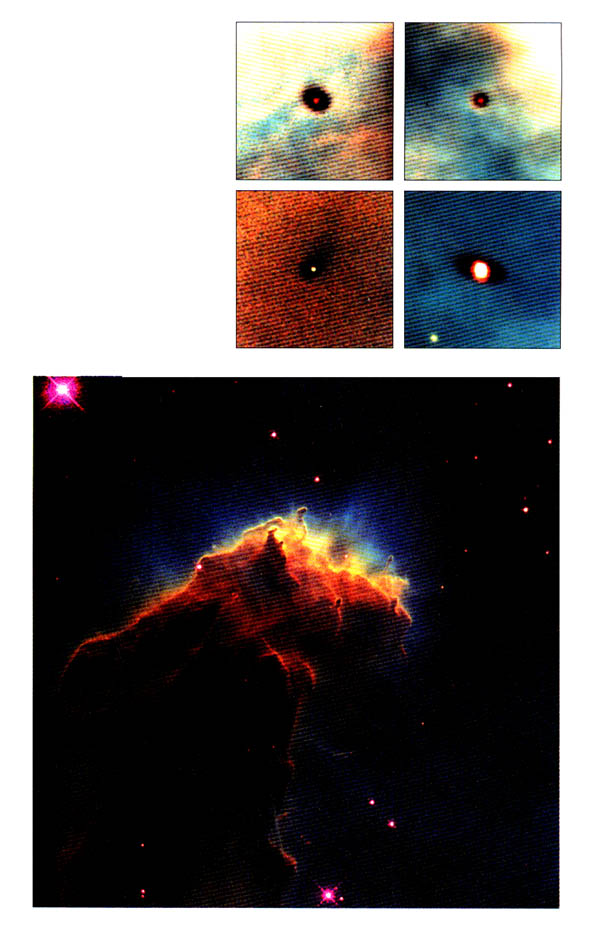
The Hubble Space Telescope has revealed many astronomical phenomena that ground-based telescopes cannot see. The top images show disks of matter around young stars that could give rise to planets. In the image below, stars are forming in the tendrils of gas and dust extending from a gigantic nebula.
men observed that the individual members of a particular species are not identical but can differ in many ways. For example, some will be able to run a little faster, have a different color, or respond to the same circumstance in different ways. (Humans—including any class of high school students—have many such differences.) Both men further observed that many of these differences are inherited and can be passed on to offspring. This conclusion was evident from the experiences of plant and animal breeders.
Darwin and Wallace were both deeply influenced by the realization that, even though most species produce an abundance of offspring, the size of the overall population usually remains about the same. Thus, an oak tree might produce many thousands of acorns each year, but few, if any, will survive to become full-grown trees.
Darwin—who conceived of his ideas in the 1830s but did not publish them until Wallace came to similar conclusions—presented the case for evolution in detail in his 1859 book On the Origin of Species by Natural Selection. Darwin proposed that there will be differences between offspring that survive and reproduce and those that do not. In particular, individuals that have heritable characteristics making them more likely to survive and reproduce in their particular environment will, on average, have a better chance of passing those characteristics on to their own offspring. In this way, as many generations pass, nature would select those individuals best suited to particular environments, a process Darwin called natural selection. Over very long times, Darwin argued, natural selection acting on varying individuals within a population of organisms could account for all of the great variety of organisms we see today, as well as for the species found as fossils.
If the central requirement of natural selection is variation within populations, what is the ultimate source of this variation? This problem plagued Darwin, and he never
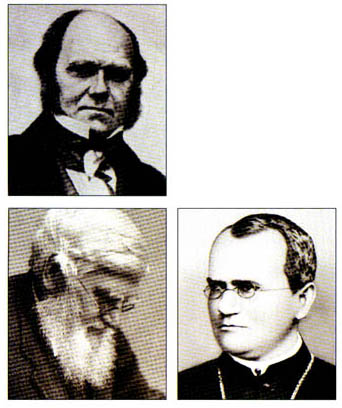
found the answer, although he proposed some hypotheses. Darwin did not know that a contemporary, Gregor Mendel, had provided an important part of the solution. In his classic 1865 paper describing crossbreeding of varieties of peas, Mendel demonstrated that organisms acquire traits through discrete units of heredity which later came to be known as genes. The variation produced through these inherited traits is the raw material on which natural selection acts.
Mendel's paper was all but forgotten until 1890, when it was rediscovered and contributed to a growing wave of interest and research in genetics. But it was not immediately clear how to reconcile new findings about the mechanisms of inheritance with evolution through natural selection. Then, in the 1930s, a group of biologists demonstrated how the results of genetics research could both buttress and extend evolutionary theory. They showed that all variations, both slight and dramatic, arose through changes, or mutations, in genes. If a mutation enabled an organism to survive or reproduce more effectively, that mutation would tend to be preserved and spread in a population through natural selection. Evolution was thus seen to depend both on genetic mutations and on natural selection. Mutations provided abundant genetic variation, and natural selection sorted out the useful changes from the deleterious ones.
Selection by natural processes of favored variants explained many observations on the geography of species differences—why, for example, members of the same bird species might be larger and darker in the northern part of their range, and smaller and paler in the southern part. In this case, differences might be explained by the advantages of large size and dark coloration in forested, cold regions. And, if the species occupied the entire range continuously, genes favoring light color and small size would be able to flow into the northern population, and vice versa—prohibiting their separation into distinct species that are reproductively isolated from one another.
How new species are formed was a mystery that eluded biologists until information about genetics and the geographical distribution of animals and plants could be put together. As a result, it became clear that the most important source of new species is the process of geographical isolation—through which barriers to gene flow can be created. In the earlier example, the interposition of a major mountain barrier, or the origin of an intermediate desert, might create the needed isolation.
Other situations also encourage the formation of new species. Consider fish in a river that, over time, changes course so as to isolate a tributary. Or think of a set of oceanic islands, distant from the mainland and just far enough from one another that interchange among their populations is rare. These are ideal circumstances for creating reproductive barriers and allowing populations of the same species to diverge from one another under the influence of natural selection. After a time, the species become sufficiently different that even when reunited they remain reproductively isolated. They have become so different that they are unable to interbreed.
In the 1950s, the study of evolution entered a new phase. Biologists began to be able to determine the exact molecular structure of the proteins in living things—that is, the actual sequences of the amino acids that make up each protein. Almost immediately, it became clear that certain proteins that serve the same function in different species have very similar amino acid sequences. The protein evidence was completely consistent with the idea of a common evolutionary history for the planet's living things. Even more important, this knowledge provided important clues about the history of evolution that could not be obtained through the fossil record.
The discovery of the structure of DNA by Francis Crick and James Watson in 1953 extended the study of evolution to the most
fundamental level. The sequence of the chemical bases in DNA both specifies the order of amino acids in proteins and determines which proteins are synthesized in which cells. In this way, DNA is the ultimate source of both change and continuity in evolution. The modification of DNA through occasional changes or rearrangements in the base sequences underlies the emergence of new traits, and thus of new species, in evolution. At the same time, all organisms use the same molecular codes to translate DNA base sequences into protein amino acid sequences. This uniformity in the genetic code is powerful evidence for the interrelatedness of living things, suggesting that all organisms presently alive share a common ancestor that can be traced back to the origins of life on earth.
One common misconception among students is that individual organisms change their characteristics in response to the environment. In other words, students often think that the environment acts on individual organisms to generate physical characteristics that can then be passed on genetically to offspring. But selection can work only on the genetic variation that already is present in any new generation, and genetic variation occurs randomly, not in response
to the needs of a population or organism. In this sense, as Francois Jacob has written, evolution is a "tinkerer, not an engineer."2 Evolution does not design new organisms; rather, new organisms emerge from the inherent genetic variation that occurs in organisms.
Genetic variation is random, but natural selection is not. Natural selection tests the combinations of genes represented in the members of a species and allows to proliferate those that confer the greatest ability to survive and reproduce. In this sense, evolution is not the simple product of random chance.
The booklet Science and Creationism: A View from the National Academy of Sciences3 summarizes several compelling lines of evidence that demonstrate beyond any reasonable doubt that evolution occurred as a historical process and continues today. In brief:
-
Fossils found in rocks of increasing age attest to the interrelated lineage of living things, from the single-celled organisms that lived billions of years ago to Homo sapiens. The most recent fossils closely resemble the organisms alive today, whereas increasingly older fossils are progressively different, providing compelling evidence of change through time.
-
Even a casual look at different kinds of organisms reveals striking similarities among species, and anatomists have discovered that these similarities are more than skin deep. All vertebrates, for example, from fish to humans, have a common body plan characterized by a segmented body and a hollow main nerve cord along the back. The best available scientific explanation for these common structures is that all vertebrates are descended from a common ancestor species and that they have diverged through evolution.
-
In the past, evolutionary relationships could be studied only by examining the consequences of genetic information, such as the anatomy, physiology, and embryology of living organisms. But the advent of molecular biology has made it possible to read the history of evolution that is written in every organism's DNA. This information has allowed organisms to be placed into a common evolutionary family tree in a much more detailed way than possible from previous evidence. For example, as described in Chapter 3, comparisons of the differences in DNA sequences among organisms provides evidence for many evolutionary events that cannot be found in the fossil record.
Evolution is the only plausible scientific explanation that accounts for the extensive array of observations summarized above. The concept of evolution through random genetic variation and natural selection makes sense of what would otherwise be a huge body of unconnected observations. It is no longer possible to sustain scientifically the view that the living things we see today did not evolve from earlier forms or that the human species was not produced by the same evolutionary mechanisms that apply to the rest of the living world.
The following two sections of this chapter examine two important themes in evolutionary theory. The first concerns the occurrence of evolution in "real time"—how changes come about and result in new kinds of species. The second is the ecological framework that underlies evolution, which is needed to understand the expansion of biological diversity.
Evolution as a Contemporary Process
Evolution by natural selection is not only a historical process—it still operates today. For example, the continual evolution
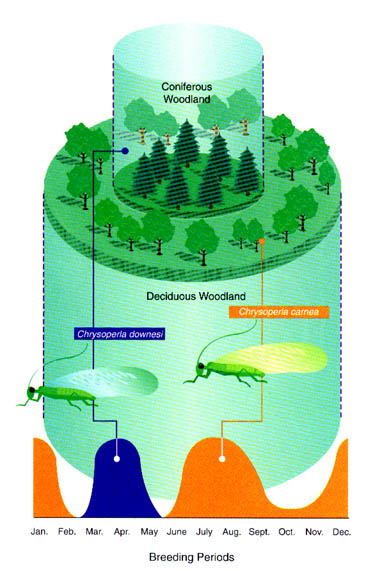
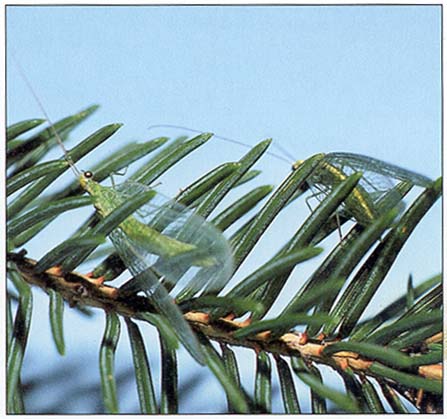
The North American lacewing species Chrysoperla carnea and Chrysoperla downesi separated from a common ancestor species recently in evolutionary time and are very similar. But they are different in color, reflecting their different habitats, and they breed at different times of the year.
of human pathogens has come to pose one of the most serious public health problems now facing human societies. Many strains of bacteria have become increasingly resistant to once-effective antibiotics as natural selection has amplified resistant strains that arose through naturally occurring genetic variation. The microorganisms that cause malaria, gonorrhea, tuberculosis, and many other diseases have demonstrated greatly increased resistance to the antibiotics and other drugs used to treat them in the past. The continued use and overuse of antibiotics has had the effect of selecting for resistant populations because the antibiotics give these strains an advantage over nonresistant strains.4
Similar episodes of rapid evolution are occurring in many different organisms. Rats have developed resistance to the poison warfarin. Many hundreds of insect species and other agricultural pests have evolved resistance to the pesticides used to combat them—and even to chemical defenses genetically engineered into plants. Species of plants have evolved tolerance to toxic metals and have reduced their interbreeding with nearby nontolerant plants—an initial step in the formation of separate species. New species of plants have arisen through the crossbreeding of native plants with plants introduced from elsewhere in the world.
The creation of a new species from a pre-existing species generally requires
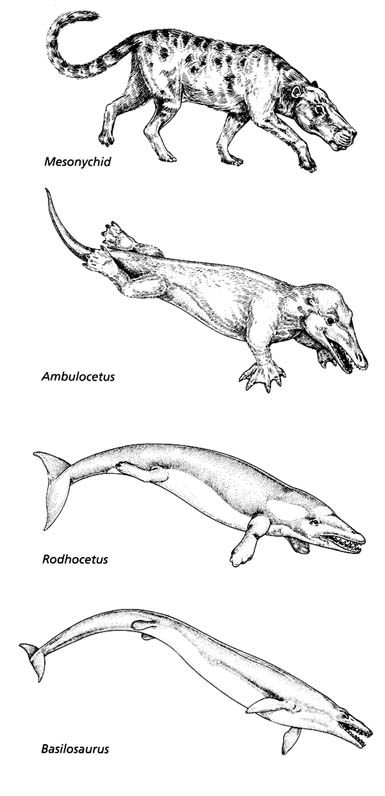
Modern whales evolved from a primitive group of hoofed mammals into species that were progressively more adapted to life in the water.
thousands of years, so over a lifetime a single human usually can witness only a tiny part of the speciation process. Yet even that glimpse of evolution at work powerfully confirms our ideas about the history and mechanisms of evolution. For example, many closely related species have been identified that split from a common ancestor very recently in evolutionary terms. An example is provided by the North American lacewings Chrysoperla carnea and Chrysoperla downesi. The former lives in deciduous woodlands and is pale green in summer and brown in winter. The latter lives among evergreen conifers and is dark green all year round. The two species are genetically and morphologically very similar. Yet they occupy different habitats and breed at different times of the year and so are reproductively isolated from each other.
The fossil record also sheds light on speciation. A particularly dramatic example comes from recently discovered fossil evidence documenting the evolution of whales and dolphins. The fossil record shows that these cetaceans evolved from a primitive group of hoofed mammals called Mesonychids. Some of these mammals crushed and ate turtles, as evidenced by the shape of their teeth. This mammal gave rise to a species with front forelimbs and powerful hind legs with large feet that were adapted for paddling. This animal, known as Ambulocetus , could have moved between sea and land. Its fossilized vertebrae also show that this animal could move its back in a strong up and down motion, which is the method modern cetaceans use to swim and dive. A later fossil in the series from Pakistan shows an animal with smaller functional hind limbs and even greater back flexibility. This species, Rodhocetus, probably did not venture onto land very often, if at all. Finally, Basilosaurus fossils from Egypt and the United States present a recognizable whale, with front flippers for steering and a completely flexible backbone. But this animal still has hind limbs (thought to have been nonfunctional),
|
Ongoing Evolution Among Darwin's Finches A particularly interesting example of contemporary evolution involves the 13 species of finches studied by Darwin on the Galapagos Islands, now known as Darwin's finches. A research group led by Peter and Rosemary Grant of Princeton University has shown that a single year of drought on the islands can drive evolutionary changes in the finches.6 Drought diminishes supplies of easily cracked nuts but permits the survival of plants that produce larger, tougher nuts. Drought thus favors birds with strong, wide beaks that can break these tougher seeds, producing populations of birds with these traits. The Grants have estimated that if droughts occur about 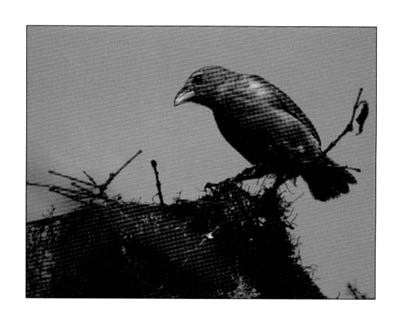 once every 10 years on the islands, a new species of finch might arise in only about 200 years.7 |
which have become further reduced in modern whales.5
Another focus of research has been the evolution of ancient apelike creatures through many intermediate forms into modern humans. Homo sapiens, one of 185 known living species in the primate order, is a member of the hominoids, a category that includes orangutans, gorillas, and chimpanzees. The succession of species that would give rise to humans seems to have separated from the succession that would lead to the apes about 5 to 8 million years ago. The first members of our genus, Homo, had evolved by about 1.5 million years ago. According to recent evidence—based on the sequencing of DNA found in a part of human cells known as mitochondria—it has been proposed that a small group of modern humans evolved in Africa about 150,000 years ago and spread throughout the world, replacing archaic populations of Homo sapiens.
Evolution and Ecology
Animals and plants do not live in isolation, nor do they evolve in isolation. Indeed, much of the pressure toward diversification comes not only from physical factors in the environment but from the presence of other species. Any animal is a potential host for parasites or prey for a carnivore. A plant has other plants as competitors for space and light, can be a host for parasites, and provides food for herbivores. The interactions within the complex communities, or ecosystems, in which organisms live can generate powerful evolutionary forces.
Evolution in natural communities arises from both constraints and opportunities. The constraints come from competitors, primarily among the same species. There are only so many nest holes for bluebirds and so much food for mice. Genetically different individuals that are able to move to a different resource—a new food supply, for example, or a hitherto uninhabited area—are
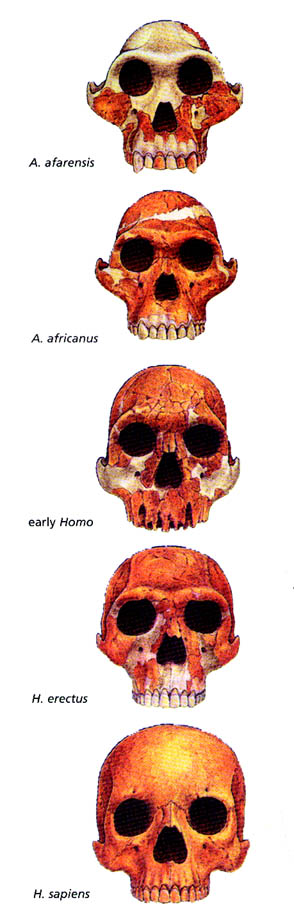
Early hominids had smaller brains and larger faces than species belonging to the genus Homo, including our own species, Homo sapiens. White parts of the skulls are reconstructions, and the skulls are not all on the same scale.
able to exploit that resource free of competition. As a result, the trait that opened up the new opportunity will be favored by natural selection because the individuals possessing it are able to survive and reproduce better than other members of their species in the new environment.
An ecologist would say that the variant had occupied a new niche—a term that defines the "job description" of an organism. (For example, a bluebird would have the niche of insect- and fruit-eater, inhabitant of forest edges and meadows, tree-hole nester, and so on.) One often finds closely related species in the same place and occupying what look like identical niches. However, if the niches were truly identical, one of the species should have a competitive advantage over the other and eventually drive the less fit species to extinction or to a different niche. That leads to a tentative hypothesis: where we find such a situation, careful observation should reveal subtle niche specialization of the apparently competing species.
This hypothesis has been tested by many biologists. For example, in the 1960s Robert MacArthur carefully studied three North American warblers of the same genus that were regularly seen feeding on insects in coniferous trees in the same areas—indeed, often in the same trees. MacArthur's painstaking observations revealed that the three were actually specialists: one fed on insects on the major branches near the trunk; another occupied the mid-regions of branches and ate from different parts of the foliage; and the third fed on insects occupying the finest needles near the periphery of the tree. Although the three warblers occurred together, they were in fact not competitors for the same food resources.
Often, species that are evolving together in the same ecosystem do so through a highly interactive process. For example, natural selection will favor organisms with defenses against predation; in turn, predators experience selection for traits that overcome those defenses. Such coevolutionary competitions are common in nature. Many
|
A Chemical Distress Signal J. H. Tumlinson and colleagues at the U.S. Department of Agriculture's Research Service Laboratories in Gainesville, Florida, have explored a fascinating case that illustrates the intricacy of many ecological relationships. Cotton plants, like many other crops, are attacked by caterpillars. One destructive cotton pest, the army worm, produces a complex series of reactions when it feeds on the plant—a reaction that involves the caterpillar itself, the tissues of the plant, and a third participant, a wasp that preys on the caterpillar. When the caterpillar chews on the cotton plant leaf, a reaction occurs that causes the plant to synthesize and release a class of volatile chemicals that escape into the air and travel rapidly downwind. The chemicals are detected by wasps, who follow the scent 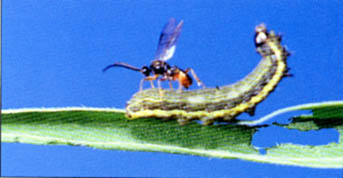 and are able to find the caterpillars and deposit eggs within them. The eggs hatch, and the wasp larvae destroy the caterpillar.8 This complex case of "chemical ecology" required a series of linked coevolutionary events: the response of the plant to a special signal from its predator, and the response of the wasp to a special signal from the host of its prey. |
plants manufacture and store chemicals that deter herbivorous insects; but usually one or more insect species will have evolved biochemical mechanisms for inactivating the deterrent, providing them with a plant they can eat relatively free of competitors.
Another classic example of coevolution involves the introduction of rabbits and the myxomatosis virus into Australia. After rabbits were brought to Australia, they multiplied rapidly and threatened the wool industry because they grazed on the same plants as sheep. To control the rabbit population, a virulent pathogen of rabbits, the myxomatosis virus, also was introduced into Australia. Within a decade, rabbits had become more resistant to the virus, and the virus had evolved into a less virulent form, allowing both the host and pathogen to coexist.9
Conclusion
As the examples in this chapter demonstrate, evolutionary biology provides an extremely active and rich source of new insights into the world. By exploring the history of life on earth and shedding light on how evolution works, evolutionary biology is linking fundamental scientific research to knowledge needed to meet important societal needs, including the preservation of our environment. Few other ideas in science have had such a far-reaching impact on our thinking about ourselves and how we relate to the world.
NOTES
|
1. |
Biological Sciences Curriculum Study. 1978. Biology Teachers' Handbook. 3rd ed. William V. Mayer, ed. New York: John Wiley and Sons. |
|
2. |
Francois Jacob. June 10, 1977. Evolution and tinkering. Science 196:1161-1166. |
|
3. |
National Academy of Sciences. (in press). Science and Creationism: A View from the National Academy of Sciences. Washington, DC: National Academy Press. (See www.nap.edu) |
|
4. |
P. Ewald. 1994. The Evolution of Infectious Disease. New York: Oxford University Press. |
|
5. |
"Evolution, Science, and Society: A White Paper on Behalf of the Field of Evolutionary Biology," Draft, June 4, 1997. |
|
6. |
Jonathan Weiner. 1994. The Beak of the Finch. New York: Alfred A. Knopf. |
|
7. |
Peter R. Grant. 1991. Natural selection and Darwin's finches. Scientific American, October, pp. 82-87. |
|
8. |
James H. Tumlinson, W. Joe Lewis, and Louise E. M. Vet. 1993. How parasitic wasps find their hosts. Scientific American, March, pp. 100-106. |
|
9. |
F. Fenner and F.N. Ratcliffe. 1965. Myxomatosis. Cambridge: Cambridge University Press. |
Dialogue
TEACHING ABOUT THE NATURE OF SCIENCE
In the following vignette, Barbara, Doug, and Karen use a model to continue their discussion of the nature of science and its implications for the teaching of evolution.
********
"Thanks for meeting with me this afternoon," Barbara says. "To begin this demonstration I first need to ask you what you think science is."
"Oh, I had that in college," says Karen. "The scientific method is to identify a question, gather information about it, develop a hypothesis that answers the question, and then do an experiment that either proves or disproves the hypothesis."
"But that was one of my points about evolution," Doug says. "No one was there when evolution happened and we can't do any experiments about what happened in the past. So by your definition, Karen, evolution isn't science."
"Science is a lot more than just supporting or rejecting hypotheses," Barbara replies. "It also involves observation, creativity, and judgment. Here's an activity I use to teach the nature of science."
Barbara takes a cardboard mailing tube about one foot long that has the ends of four ropes extending from it.
As Barbara tugs on the various ropes one at a time, she has Doug and Karen make observations of what happens. After three or four pulls, she asks Karen and Doug to predict what will happen when she pulls on one of the ropes. Both are able to predict that if Barbara pulls rope A, rope B will move. Barbara then asks if there are additional manipulations they would like to see, and she follows their requests.
Barbara then asks Doug and Karen to sketch a model of what is inside the tube that could explain their observations.
When Karen and Doug show their sketches to each other, they realize that they have come up with different models. Barbara asks them if they want to make any changes to their sketches based on the comparison, and both of them make modifications, although their final models are still different.
Barbara then gives them their own cardboard tubes and some string and asks them to build the model they proposed. When their models are built, Barbara holds up her tube and asks Doug and Karen to follow her actions with their own models, to see if the two models behave in the same way as Barbara's tube. But when Barbara pulls string A in her tube, Karen's model does not work the same way. Karen asks if she can make some changes in her model, and once she does her new model seems to work the same way as Barbara's. Doug's model consistently behaves the same way as Barbara's tube.
"Now wait a minute," Karen says. "What do ropes and tubes have to do with science and evolution?"
"You might not know it, but what we just did is much of what science is about. You observed what happened when
I pulled these ropes. Then, based on your initial observations, you made a prediction about what would happen if we manipulated the system in a specific way. How accurate was your prediction?"
"We were right," Doug responds.
"And why were you able to predict what would happen before I pulled the rope?"
"I used what I observed in the first few pulls to help me predict what would happen later."
"Basically what each of you did was to speculate about how my tube was working on the basis of some limited observations. Scientists do that type of thing all the time. They make observations and try to explain what's going on, or sometimes they recognize that more than one explanation fits their data. Then they try out their proposed explanations by making predictions that they test. At first I had you draw a picture of how you thought my tube worked and had you each explain your picture. You got to hear each other's view on how the system worked. Doug, did you change your ideas at all based on what you heard from Karen?"
"Well, yes. I first thought that ropes A and C were the two ends of the same rope and B and D were two ends of another rope. Karen had A and B as ends of the same rope and C and D as ends of another rope, and her explanation seemed to fit better than mine."
"Right. Communication about observations and interpretations is very important among scientists because different scientists may interpret data in different ways. Hearing someone else's views can help a scientist revise his or her interpretation. In essence that was what you were doing when you shared your diagrams. Karen, when your model didn't work, what did you do?"
"All I did was adjust the length of one rope, and then it worked fine."
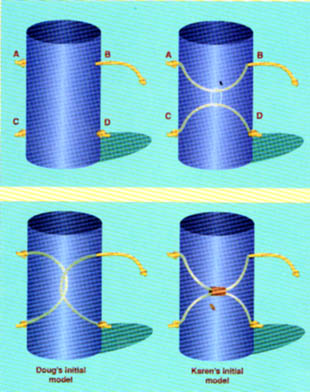
"So as a result of your formal testing of the predictions from your model, you revised your explanation of the system. Your understanding improved. In scientific terms, you revised your model to make it more consistent with your further observations. In science, the validity of any explanation is determined by its coherence with observations in the natural world and by its ability to predict further observations."
"But we still have different models," Karen observes. "How do we know which one is right?"
Doug says: "You told us that, didn't you, Barbara. There can be two possible explanations for the same observation."
"So it's possible for scientists to disagree sometimes," says Karen. "But does that mean that we don't understand evolution because scientists disagree about how evolution takes place?"
"Not at all," Barbara answers, "you both created different models of my tube, but both of your models are fairly accurate. And don't forget there were constraints on
the possible models you could create that would be consistent with the data. Just any explanation would not be acceptable. In evolution, there are some things we know could not have happened, just as we are confident that some things have happened."
"And if different scientists can have different explanations, like Karen and I did, then I guess science also has to involve judgment to some extent," Doug says.
"But I thought scientists were supposed to be totally objective," says Karen.
"Good science always attempts to be objective, but it also relies on the individual insights of scientists. And the questions they choose to ask as well as the methods they choose to use, not to mention the interpretations they may have, can be colored by their individual interests and backgrounds. But scientific explanations are reviewed by other scientists and must be consistent with the natural world and future experiments, so there are checks on subjectivity. What we read in science books is a combination of observations and inferred explanations of those observations that can change with new research."
"Still, I'm wondering," says Karen, "how can we find out which model is right?"
"Let's just open up Barbara's tube," says Doug.
"We could do that," Barbara says. "But let's assume in this analogy that opening the tube is not possible. Sometimes scientists figure out how to open up the natural world and look inside, but sometimes they can't. And not opening up the tube is a good metaphor for how science often works. Science involves coming up with explanations that are based on evidence. With time, additional evidence might require changing the explanations, so that at any time what we have is the best explanation possible for how things work. In the future, with additional data, we may change our original explanation—just like you did, Karen.
"Remember when we were talking this morning about evolution being fact or theory? That conversation is very relevant to what we have been doing with the tubes. As scientists started to notice patterns in nature, they began to speculate about some explanations for these patterns. These explanations are analogous to your initial ideas about how my tube worked. In the terms of science, these initial ideas are called hypotheses. You noticed some patterns in how the ropes were related to each other, and you used these patterns to develop a model to explain the patterns. The model you created is analogous to the beginning of a scientific theory. Except in science, theories are only formalized after many years of testing the predictions that come from the model.
"Because of our human limitations in collecting complete data, theories necessarily contain some judgments about what is important. Judgments aren't a weakness of scientific theory. They are a basic part of how science works."
"I always thought of science as a bunch of absolute facts," says Doug. "I never thought about how knowledge is developed by scientists."
"Creativity and insight are what help make science such a powerful way of understanding the natural world.
"There's another important thing that I try to teach my students with this activity," Barbara continues. "It's important for them to be able to distinguish questions that can be answered by science from those that cannot be answered by science. Here's a list of questions that I use to get them talking. I ask them if a question can be answered by science, cannot be answered by science, or has some parts that belong to science and others that do not. Then I ask the group to select a couple of questions and discuss how they would go about answering them."
Barbara hands Doug and Karen the following list of questions:
Do ghosts haunt old houses at night?
How old is the earth?
Should I follow the advice of my daily horoscope?
Do species change over long periods of time?
Should I exercise regularly?
''Of course, you can make up other questions if something is happening in the news or if it's related to an earlier lesson. And sometimes I include moral or religious questions to make it clear that they lie outside science."
"I can see that these would get students thinking," says Karen. "I guess understanding the nature of science really is relevant to real life."
"That's what this exercise is about."