2
THE MENTOR AS FACULTY ADVISER
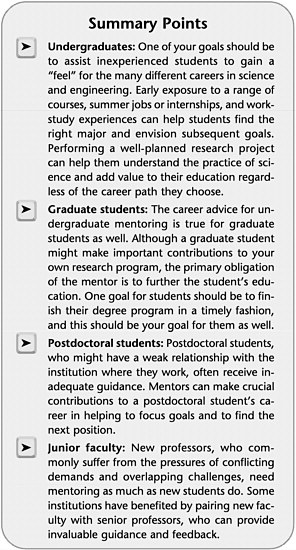
Faculty advisers can be asked to advise a wide range of students or junior colleagues, from predegree undergraduates to postdoctoral students and junior faculty. The details of your advice will vary widely, but a cardinal goal should be to help those you mentor toward greater initiative, independence, and self-reliance. Those who grow accustomed to nurturing support but who have failed to develop independence might be painfully shocked when moving into a position where such support is lacking. Students and junior colleagues "own" an important decision only when it is truly theirs.
Mentoring Undergraduates
When advising undergraduates, you might be asked to help select courses, to suggest work experiences, and to provide guidance as to the many science or engineering careers that are available. Many young students lack sufficient experience to imagine what kind of work they might do as professionals. Don't assume that students know something
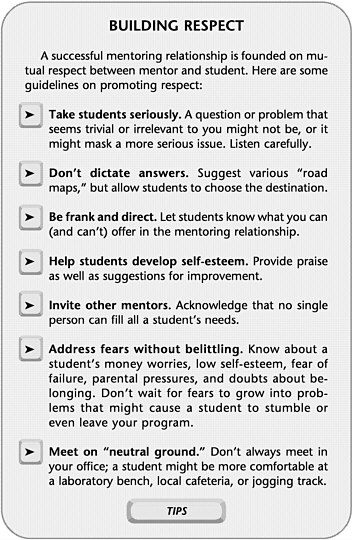
just because it is obvious to you. One of your goals for students is to provide a "map" to the terrain and a "travelers' guide" to the professional universe that they might some day encounter.
Early concerns. Some students, especially if they are the first in their families to attend college, fear that they lack the ability or preparation to become scientists or engineers. Gently probe the student's level of interest and most-satisfying activities. Introduce a student with low self-confidence to another student or a colleague who faced similar challenges. Pay special attention to motivation, which might be more important than background in deciding a student's success or failure. In addition, beware of letting your own assumptions or biases distort your opinion of a student's potential.
An undergraduate might enjoy science and mathematics without knowing how to choose a major. You can help by posing fundamental questions: What have you most enjoyed in life? What are you good at? Do you like abstract problems or hands-on activities? Suggest early exposure to a range of courses, summer jobs or internships, and work-study experiences. Encourage them to explore many options by talking to other students at all levels and to professionals about their careers.
Course work and academic goals. Suppose one of your advisees can't decide whether to major in electrical or chemical engineering. Discussing with students their career goals and discussing the differences between careers might help them decide. In addition, you can suggest colleagues and alumni in those fields, both academic and nonacademic, who would be willing to talk with the student. Suggest that the student undertake an internship or locate a part-time or summer
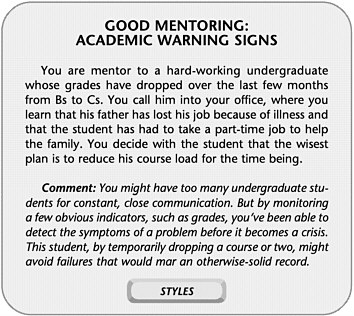
job. The National Science Foundation's Research Experiences for Undergraduates Program offers both summer and in-term paid research experiences. Your institution's research-support office, placement office, or alumni association might be good resources, as are national disciplinary societies and your own personal contacts.
For electives, encourage students to take courses that they enjoy or that can lead to new fields of study. The undergraduate years offer the opportunity for experimentation with fields of knowledge. As their career unfolds, they might work outside their field, outside research, or outside their native country; courses in business, psychology, public policy, or foreign language might open new doors; courses in arts and humanities will provide breadth and perspective. A biology major interested in genetics might take a class in psychology and find
an interest in genetic counseling. A physics major who is exposed to health care might discover a career in radiation physics. On the other hand, students also should learn the importance of focus and depth in some field.
Urge the student to seek practical experience. Eventual hiring decisions are often influenced more by students' accumulated laboratory experiences, computer skills, or industrial training than by the courses they have taken. A reference from someone who has worked with the student in a practical context carries additional weight. A volunteer summer position with a good teacher or laboratory might be worth more than a summer job that pays well but teaches little, even if this involves short-term financial sacrifice.
Undergraduate research. Encourage undergraduate students to perform a research project, whether with you or a colleague, so that they better understand the practice of science. This experience is valuable regardless of the career path chosen. If you are the research adviser, help the student find a well-planned project that interests both of you and that can be completed in a defined period.
Work with the student to set up a clear time line for completion of research. Set high but realistic goals; it is very important to select a project that has a good chance of success. Define your own responsibilities, including regular feedback and evaluation. Make connections between course work and the literature.
For the committed student, such a project can have lasting influence, whether the student goes on to graduate school or directly into the workforce. Do not, however, place undergraduates in research posts without evaluating their fitness and desire to perform the work. And do not assign undergraduates to a pilot program or an untested method.
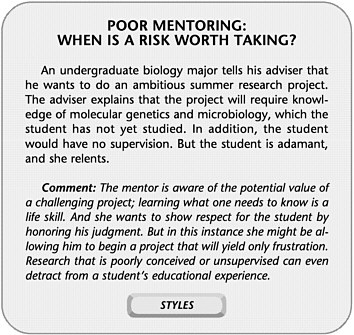
Research that is poorly conceptualized or executed might be worse than no research experience at all. If a student does have a poor research experience, try to explain the reasons; a student who understands the causes of failure is less likely to suffer permanent career damage.
Your broader challenge is to interpret a research experience in the context of the student's total education. The primary purposes of student research are to master techniques, to learn to think critically, to acquire strategies for problem-solving, and to learn the importance of patience and perseverance in the unpredictable context of research.
An excellent source of information and support is the Council on Undergraduate Research (CUR), a national organization founded on the premise that research adds depth
and problem-solving ability to the learning of science. CUR, based at the University of North Carolina in Asheville, supports publications, workshops, formal meetings, consulting services, speaking programs, fellowships, and a home page (see "Internet Resources").
Another resource is Project Kaleidoscope (PKAL), an informal national alliance that seeks to strengthen undergraduate programs in science, mathematics, engineering, and technology. The vision of PKAL is to promote "a thriving community of students and faculty working together in a research-rich environment." The organization, headquartered in Washington, DC, sponsors workshops, seminars, consulting teams, and Internet links (see "Internet Resources").
Contemplating graduate school How can you tell whether a student has what it takes for graduate school? The usual indicators are references, course records, test scores, and success in undergraduate research. But don't be afraid to use your intuition: Do you detect the energy of curiosity and motivation? The truly motivated student will probably find a way to succeed.
On the other hand, the rigorous environment of graduate school is not a good place for hesitant students to avoid the "real world" or to pass time while deciding what to do with their lives. Graduate study requires high levels of commitment and ability.
Mentoring Graduate Students
Many science-related careers do not require a PhD. In such fields as biotechnology, hydrogeology, environmental engineering, science and technology policy analysis, and science
journalism, the bachelor's or master's degree can lead directly to a productive career. It is common for engineers to terminate their studies at the bachelor's or master's level; some engineers add a master's degree after beginning employment.
A doctorate is appropriate for most students who desire research careers, including academic research and industrial research. But a doctorate does not restrict a person to a life at the bench or in academe. For example, of senior scientists and engineers employed in business or industry, one-third are in management.
Choosing a school. If students are ready to make the leap to graduate school, encourage them to use the telephone, visit campuses (and their home pages), talk with current students and faculty, seek out alumni, attend conferences, and read publications by faculty. Personal meetings with professionals and students can bring a feel for the profession and an excellent basis for choosing an appropriate learning environment.
Helping students choose an adviser. At the graduate level, students' choice of a research adviser is one of their most important decisions-and yet some of them exercise less care in this decision than they do in the purchase of a car. Encourage students to shop around carefully, to talk to present and former advisees, and to gain personal impressions through face-to-face interviews. Be sure that a potential student knows your particular mentoring style and finds it congenial.
Students should also be advised to examine the performance of possible mentors: publication record, financial-support base, reputation, success of recent graduates, recognition of student accomplishments (e.g., through coauthorship),
|
A Mathematics Major Who Became an Actuary
"He said, 'You're doing well enough in math; have you considered actuarial science?' I hadn't, so I checked it out in the Jobs Almanac, which said it was a growing field. After some reluctance—I was already pretty far along in engineering—I decided to give it a try.'" Now, just 5 years later, Mr. Greig is one examination away from being a fellow of the Casualty Actuarial Society, the rough equivalent of a PhD in actuarial mathematics. He gained a head start by taking the first two actuarial examinations as an undergraduate; 10 are required for fellowship status. As a result, he was offered a job by the National Council on Compensation Insurance, in Boca Raton, FL, an insurance advisory company. His first assignment was to produce new data on workers' compensation claims needed by insurance companies, actuaries, and legislatures. He is now calculating reserves for the workers' compensation "residual" insurance market. At the same time, he is approaching the end of his studies. "Since I graduated, I've been spending close to 400 hours every 4 months studying for the exams," he says. |
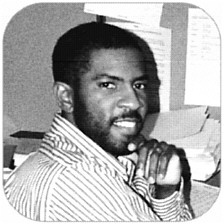 Russell Greig excelled in mathematics as an undergraduate at Florida A&M University. His goals were to use mathematics in a practical way, to work in the "real world," and to earn a good income. He was planning a career in civil engineering when his calculus professor took him aside.
|
"The company gives me 120 hours, the rest I do at night and on weekends. The competition is pretty steep, so you have to do well. If you do, job prospects are excellent and you gain high respect in the profession. At the fellowship level you're at the top and you can pretty much decide where you want to work. I'll probably stay in the South; I'm from the Virgin Islands and I can't take the cold." Mr. Greig encourages students who enjoy applied mathematics to look into the field. "I recommend it to those who enjoy number-crunching, who want to see immediate, practical results from what they're doing. You have to be prepared to pay your dues, but there's plenty of opportunity. There are only about 2,500 casualty actuaries in the world, and the field is still growing. "Math majors have other good choices in applied fields. One is the financial area, where there is demand for people who can quantify financial-risk models and can present clearly what they're doing to others who are not sophisticated in math. In fact, when I'm done with these exams I'm going to take the Chartered Financial Analyst exams, which are like a shortcut to an MBA in finance. This allows you to do more asset-related work. "Another growth area is computer science and programming. I often work with programmers who don't understand the math involved. If you know the math to begin with, you'll be able to write your own ticket. The math is where it begins." |
laboratory organization, and, most important, willingness to spend time with students. Much of this information can be learned directly from the potential mentor and from the mentor's current and past students.
Which students should you accept? You might be approached by more than one student about being an adviser. Bear in mind the responsibilities of saying yes, and examine your other commitments. Handling a large group might be possible with a "secondary mentoring" network, where senior members of your research group act as mentors to junior members.
Remind yourself, and students whom you consider taking on, of the importance of personal chemistry. Do you think you can work productively with this person? Can you imagine recommending this student for a job? If the relationship doesn't feel right for either party, or if communication is poor, think about helping the student find another adviser as soon as possible. You might also consider developing the skills that will allow you to work with a more-diverse group of students.
Choosing a degree program. Many students on the threshold of graduate school are unable to visualize a career path; this makes it difficult to choose a degree program. Remind them that careers evolve slowly, and ask the kinds of basic questions you would ask an undergraduate: What are you good at? What kinds of activities are most satisfying? How much schooling do you need to do that?
Keep in mind that science and engineering degrees can often be combined in interesting ways with such professional degrees as the MBA, JD, and MD. For example, a student might combine degrees in microbiology and law for a career in patent law. A physics major might add a minor in
business, or even Japanese studies, with an eye to a position with a multinational corporation.
The decision to pursue a doctorate might entail some sacrifice. Student A, who moves directly into the job market after a bachelor's or master's degree, might be well ahead in experience and financial gain by the time Student B receives a PhD. Over the course of a career, Student B might reach higher levels of salary and responsibility, but not for some time.
Planning the curriculum. When a new graduate student arrives at your institution, discuss the rules regarding required and elective courses, comprehensive exams, thesis, and teaching. Requirements vary even within an institution. Keep handy your institution's student handbook or course guide for continuing discussions.
Some programs, such as environmental studies and earth sciences, might naturally encompass a wide range of topics. Others are more sharply focused in subject matter, and leave less room for exploration. Where appropriate, encourage students to seek classes that will expand their knowledge base and help develop requirements for such classes. Some students benefit from auditing nontechnical classes, such as business and law, or taking classes in another university through a consortium program ("Course work and academic goals" in the above section on "Mentoring Undergraduates"). In all cases, students should first talk with the instructor and with students who have taken the course to assess whether it will meet their needs.
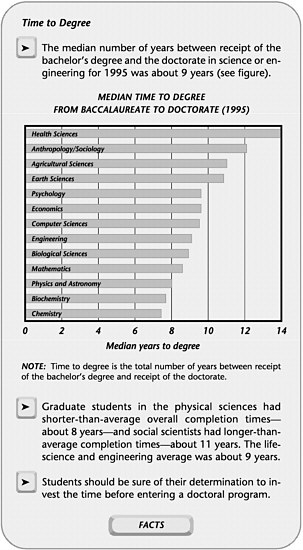
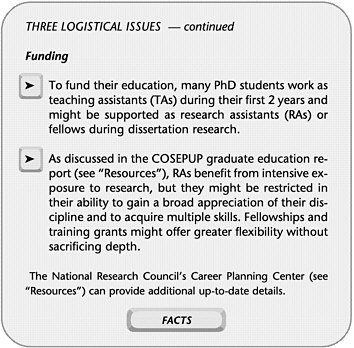
When planning their curriculum, graduate students at all levels should be aware of nonacademic and interdisciplinary career opportunities. As noted in the "Logistical Issues" box, most recent science and engineering PhDs are not
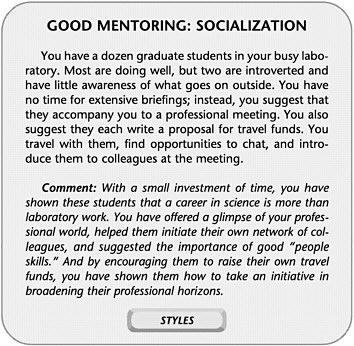
employed in traditional academic positions. Many disciplinary societies profile people with advanced degrees in their publications and Web pages, many of whom have found satisfying alternative careers. An extended discussion of this issue, including a series of profiles, is offered in the COSEPUP publication Careers in Science and Engineering: A Student Planning Guide to Grad School and Beyond (see "Resources"). A few of these profiles are included in this guide.
Choosing a research topic. Urge the student to think through a research topic in advance-to imagine a thesis title, list hypotheses to test and perhaps expected outcomes, and write a full proposal. The title and outcomes might
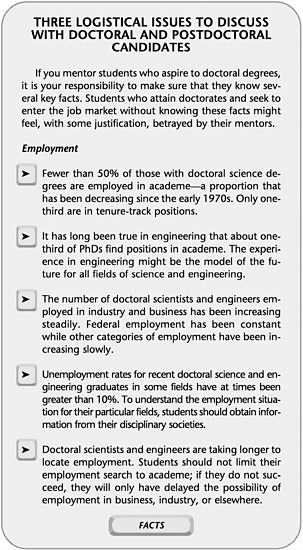
change, but a well-designed planning procedure (perhaps including a public presentation and defense) helps both you and the student toward a common understanding of the project. It also allows other committee members to contribute early in the process. If you approve a topic outside your expertise, recruit a committee member who is an expert.
Discuss with the student whether the project meets these conditions; it should interest you as well as the student, permit the student to learn useful skills, serve as the basis for a thesis no matter what the results, and be designed for completion within a reasonable period. Students who are part of a large group should be able to claim a particular aspect of the work that can be developed further.
Choosing a committee. Both mentor and student should participate in choosing a committee. Be sure the group represents a good mix of ages, fields, analytic approaches, and other qualities. If you as research adviser have a practical bent, a colleague who is a theorist might add good balance. Share with the student any knowledge of personal or political conflicts among potential members, which could disrupt a student's progress and morale.
Some students are tempted to seek members who are unlikely to be critical. You should encourage students to avoid this strategy. The members of a committee should be respected as scholars and have the expertise needed to give thorough exams and supervise research. The student needs committee members who will form the nucleus of a professional network and eventually help the student find employment and a satisfying career path.
Making good progress. Part of the mentor's job is to teach careful planning and use of time. Let students know what their responsibilities are and agree on schedules. If a student falls behind, consider that the cause might be exhaustion, unclear direction, lack of commitment, or dislike for the project or persons involved. Suggest breaking a large task into smaller pieces, "easing" into it by steps, and setting a time limit for each step. Encourage the student to set aside regular time for planning and also for self-improvement (reflective thought, physical exercise, reading for pleasure, and so on).
Students benefit from writing regular progress reports (preferably in the form of research articles) to clarify their own work, to communicate with you, and to sharpen their writing skills. You might choose to have weekly research-group meetings where students take turns presenting pa-
pers and exchanging experiences. Make presentations informal, with time for many questions.
Powerful forces can work against making good progress. You or other faculty might seek to retain students as they become more proficient. That is an unfortunate conflict between your desire to maximize productivity in your own research and your duty as a mentor to support a student's timely progress. Your primary obligation is to the education of the student.
Students, too, can be reluctant to conclude their research, either because they have not found employment or because they don't know what to do next. Urge them to push against those forces. The students' goal should be to finish in a timely fashion, and this should be your goal for them as well.
At the same time, discourage rigid schedules. Remember that every student is unique, and many end up doing things differently—and often much better—than you might have imagined. Some students, through no fault of their own, will require extra time: new parents (fathers as well as mothers), those who work part time, students with disabilities, those who return after an off-campus fellowship or other leave of absence, and so on.
If, after a reasonable period, a student has not shown high aptitude for research, the mentor should advise a nonresearch career. This can be difficult if a student has planned a research career, but if you are convinced that a student's abilities are insufficient or are stronger in another field, the kindest course is to say so.
Abuse of power. Many students, especially in graduate school, are profoundly dependent on their mentors—often for a combination of financial, educational, and emotional sup-
port. This dependence makes it easy for advisers to abuse their power (sometimes unintentionally) and difficult for students to contest an abuse. Advisers might give inadequate credit for students' research or assign work of little or no educational value. They might impair a student's confidence by too much criticism, too little support, or emotional indifference.
Abuses of power can be especially hard to resolve when the person best positioned to help solve the problem is central to the problem. It is best to discuss such issues face to face; when appropriate, committee members, other faculty, or a department chair can mediate. If a colleague or student has raised an abuse-of-power issue with you, consult with other mentors, strive for better communication with students, or ask for help from a third party.
Professional growth. There are many ways to facilitate students' professional growth in addition to one-on-one counseling. One strategy is to create informal cross-disciplinary groups (such as women in mathematics and science). Use monthly meetings (with incentives like free pizza) as forums for discussing such topics as interview strategies, coping with negative reviews, and giving good presentations. Another approach is to organize interdisciplinary seminars with other departments to introduce students (and faculty) to new avenues of inquiry and to colleagues in related disciplines.
Make use of your network of contacts to suggest internships, summer or part-time jobs, and off-campus mentoring. Propose an active role in student chapters of professional societies, where students can gain group skills, learn about career possibilities, and make valuable contacts among both peers and professors. Other suggestions are presented in the section "Mentoring Undergraduates."
Mentoring Postdoctoral Students
Postdoctoral study has become the norm in some fields, such as the life sciences and chemical sciences; for other fields, such as engineering, it is rare. Some students find that a postdoctoral study in a national or industrial laboratory broadens their outlook and job opportunities and allows them to learn a new research culture. Others find themselves in a "holding pattern"-going from postdoctoral position to postdoctoral position without finding a long-term research position-as well as working for low pay and no benefits for many years. Thus, the decision to undertake postdoctoral work should not be made lightly and should be made only after examination of one's career goals and the career opportunities in that field.
Finding a position. Encourage students who want a postdoctoral position to determine the three or four research groups that seem most appropriate to their interests and abilities. Use your own network of contacts and make personal calls to introduce the student. Then suggest that the student call each supervisor, with relevant questions: How many postdoctoral fellows do you have now? What do they do? Where do they go afterward? What support is available? Recommend a face-to-face meeting with the supervisor, as well as with former postdoctoral students of the program and faculty members doing similar work.
The need for postdoctoral mentoring. It can be tempting to suppose that postdoctoral students require little or no mentoring because they have more experience than undergraduate or graduate students. That might not be true for postdoctoral students, any more than it is for junior faculty.
In fact, postdoctoral students, who might have scant supervision, ill-defined goals, and poor access to a community of peers-tend to incur greater risks of isolation and stagnation than graduate students. A good mentoring relationship can be crucial to the success of postdoctoral students as they develop original research ideas and move toward greater independence and maturity.
Helping the student find a second or even third postdoctoral position might not be difficult, but the most-valuable contribution of the mentor is to help the student
find a "real job." That process should occur before the student begins their research with a thorough review of the student's experience and goals. Establish your expectations and "terms of employment." Set a schedule for follow-up reviews at regular intervals. Career goals, which can change appreciably over time, should be a central topic of these discussions. Another important topic is finances; postdoctoral students often enter a postdoctoral position with scant financial resources. Be aware of ethical employment practices, which include giving advance notice of layoffs and regular updates on a postdoctoral student's employment status.
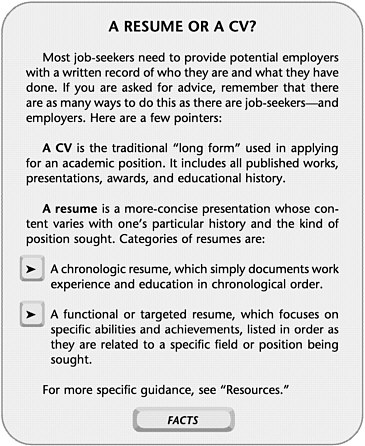
Some of the basic obligations that a mentor has to a postdoctoral student are to help perform research, design a good curriculum vitae, rehearse interviews, prepare manuscripts, plan seminars, raise grant money, and learn about the current job market (see the box "Career Questions"). In addition, a good mentor will maintain sufficiently frequent contact to know about personal or other problems that could hinder progress and will generally make every necessary effort to help the postdoctoral student grow into a mature and productive colleague.
Demonstrating progress. In any field, the broad purpose of the postdoctoral experience is to gain research experience and skills that open new vistas. If you mentor postdoctoral students, make it clear that they should demonstrate independent research thinking, be productive, have their work reflected on their record, and make sure that someone in a position of authority knows what they are doing and can facilitate their next steps.
Some students find it useful to remain with a laboratory after the usual 1-3 years of postdoctoral experience. However, this should be accompanied by clear indica-
tions of progress, such as promotion to research associate (or other position), the addition of responsibilities (such as supervision and teaching), and efforts to obtain independent funding.
A common problem of postdoctoral students is their lack of institutional connections. Mentors can help by making them aware of the nature and location of department offices and by introducing them to other faculty and staff-an obvious step that is often ignored. Encourage the department or institution to include postdoctoral students in their seminars, retreats, and meetings with speakers.
Further comments of relevance to postdoctoral students are offered in the next section, on mentoring junior faculty.
Mentoring Junior Faculty
When a department hires a new assistant professor, it has invested one of its most valuable resources: a tenure-track position. And yet new faculty are often left to fend for themselves amid the turmoil of professional and personal change: new courses to teach, a laboratory empty of both equipment and students, unknown department politics, conflicting demands on one's time, an unfamiliar living environment.
As a result, it is not surprising that faculty retreats and discussions at a number of universities have revealed extensive morale problems among junior faculty, including a sense of isolation and alienation. Those expressing dissatisfaction are not restricted to females and minority-group faculty, who might have few or no role models among senior faculty, but include white males as well.
Although research on this subject is sorely needed, an effective way to increase the likelihood of retaining talented
young faculty might be to provide excellent guidance by senior mentors. Even through relatively simple mechanisms, such as luncheons and workshops with senior faculty, junior faculty can obtain needed guidance on career goals, ethical behavior, housing and financial issues, collaborative relationships, grant-proposal writing, resource people, teaching policies, department politics, personal issues, and criteria for appointments, promotions, tenure, and salary.
Some institutions (for example, Stanford) have initiated mentoring programs that match each new faculty member with a senior mentor. The mentors are encouraged to offer advice, guidance, and, when necessary, intervention with administration or other faculty on behalf of their junior partners. Mentoring pairs might meet at least several times a year to discuss such topics as career options, space allocation, funding, and research. Sometimes a written mentoring agreement is useful in formalizing the expectations of both parties.
Both senior faculty and the department chair can play important roles in setting the tone and agenda for mentoring junior faculty. Be aware that junior faculty members might not have had useful mentoring themselves and so might need extra guidance in helping their own students. In particular, the chair and other leaders should
-
Make clear the expectations and criteria for promotion. Be sure that the new faculty members understand timetables and deadlines, what is required for tenure, and exactly how new faculty are evaluated.
-
Facilitate the acquisition of resources to meet those expectations. Introduce new faculty to the rest of the faculty and to key staff people. Facilitate research by securing a
-
good startup package; send promising graduate students their way. Give new faculty a list of teaching policies and help, if needed, in learning to teach well.
-
Give frequent, accurate feedback. Formally evaluate junior faculty at least once a year-preferably twice. Appoint an ad hoc review committee to meet with the new faculty member. At the meeting, ask about short-term and long-term goals. Discuss the committee's report at a meeting of tenured faculty, and then discuss the evaluations with the new faculty member.
-
Reduce impediments to progress toward promotion. Protect women and minority-group faculty from the demands of "tokenism" when many people will assume that women and minority-group faculty are the only ones who can advise women or minority-group students. Protect new faculty from excessive requests from senior faculty, and from exploitation in group grants or facilities. Facilitate access to nonacademic resources (such as medical care, child care, and housing) and be aware of family and dual-career issues.