
REPORT BRIEF
RESHAPING THE GRADUATE EDUCATION OF SCIENTISTS AND ENGINEERS
COMMITTEE ON SCIENCE, ENGINEERING, AND PUBLIC POLICY
The graduate education of scientists and engineers-an activity of growing importance in an increasingly technological world-must change to reflect developments in science, engineering, the economy, and the broader society. With more than half of new PhDs going to work in nonacademic settings, graduate education needs to impart a broader range of skills. At the same time, the PhD should retain the features, including an original research experience, that have made it a world model.
The result of these changes, writes the Committee on Science, Engineering, and Public Policy in its report Reshaping the Graduate Education of Scientists and Engineers, would be a new kind of PhD, one that emphasizes adaptability and versatility as well as technical proficiency. COSEPUP, a joint committee of the National Academy of Sciences, the National Academy of Engineering, and the Institute of Medicine, recommends that graduate programs provide a broader exposure to experiences desired by both academic and nonacademic employers. Faculty and institutions also
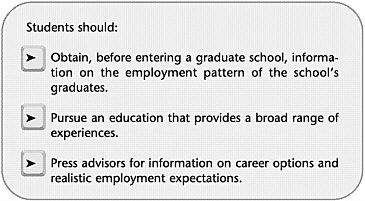
should offer better career information and guidance to students so that they can make well-informed decisions in planning their academic and professional careers. Graduate education should prepare students for an increasingly interdisciplinary, collaborative, and global job market and should not be viewed only as a byproduct of immersion in an intensive research experience. The primary objective of graduate education should be the education of students.
The changing job market. Scientists and engineers with PhDs and other advanced degrees play a central and growing role in American industrial and commercial life. They contribute directly to the national goals of technological, economic, and cultural development-not only as researchers and educators but in a wide variety of other professional roles. And as the country responds to expanded economic competition, urgent public health needs, environmental degradation, new national security challenges, and other pressing issues, a widening variety of professions and organizations are hiring the approximately 25,000 people who receive a PhD each year (up from about 18,000 a decade ago).
But a mismatch between the numbers of new PhDs and traditional research-oriented jobs in academia has led to considerable frustration and disappointment among young scientists and engineers. Fewer than one-third of those who received PhDs in science and engineering in 1983-86 were in tenure track positions or had tenure in 1991. New PhDs are spending more time as postdoctoral fellows while they wait for permanent jobs to become available. Downsizing and restructuring in industry and government also have reduced the number of jobs focused on basic research in those sectors.
Despite the difficulties finding jobs in basic research, hiring in other areas has been vigorous enough to keep the overall unemployment level of PhDs relatively low. An increasing number of doctorate recipients are doing applied research, development, and management in industry, working in government or nonprofit institutions, or teaching in elementary and secondary schools.
A new PhD. COSEPUP found a common theme in its examination of the job market for PhDs. Many future job opportunities will favor students with a greater breadth of academic and career skills than graduate students typically acquire today. The committee therefore recommended a new model of PhD education that incorporates the following changes:
-
More versatility. Graduate programs, especially at the departmental level, should provide options that allow students to gain a wider variety of academic and career skills. Students who intend to seek a career in basic research should have a grounding in the broad fundamentals of their fields and should have some personal familiarity with several subfields. In addition, experiences that supply career skills beyond those gained in the classroom and laboratory, such as off-campus internships, could make graduates more effective in business, government, and academia at all levels. Many institutions have been experimenting with such innovations, providing a rich array of reproducible models.
Employers in all sectors value the requirement for original research that is the hallmark of the PhD. Hybrid degrees that do not involve such research have not been successful in the past. But a student interested in working in nontraditional fields should have the option to design a dissertation
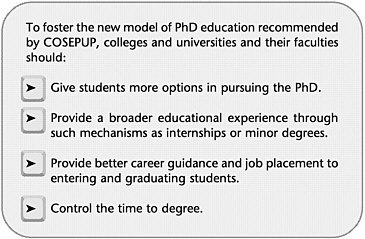
that meets high standards for originality but is more flexible in terms of time required, subject matter treated, and approach taken.
-
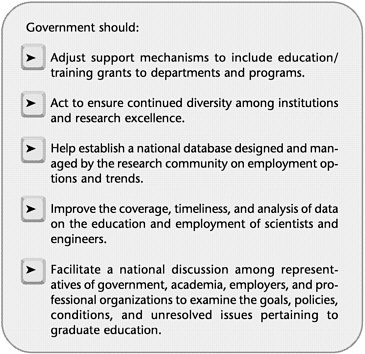
Better career information and guidance. The lack of accurate, timely, and accessible data on employment trends, careers, and sources of student support is a serious flaw in the graduate education system. A national database that covers such issues as financial aid, time to degree, and placement rates-including information gathered and disseminated through the Internet-could help students and their advisers make informed decisions about professional careers.
-
Less time to degree. The median number of years between receipt of a bachelors degree and a PhD in science and engineering has risen to more than 8 years, an increase of about 2 years since 1960. The reasons for this increase are largely unknown, but some of it may be a result of students working as highly specialized research assistants or as teaching assistants in ways that do not directly contribute to their
-
education. Each institution should set its own standards for time to degree and enforce them.
-
Education/training grants. The heavy reliance on research assistantships for graduate student support has tended to make the needs of research projects rather than the students' educational needs paramount. Education/training grants awarded competitively to institutions and departments that emphasize adapt-ability and breadth could help develop and sustain locally developed programs.
COSEPUP saw no reason to recommend limits on enrollments or on the number of foreign students in graduate programs. Greater flexibility and more information in graduate programs will enhance the system's ability to mesh with the job market. And these changes, combined with better precollege education, will attract more American students to graduate education-particularly women and minorities, who remain seriously underrepresented in some fields of science and engineering.
A shift in perspective. In the past, graduate schools typically have seen their mission as producing the next genera-
tion of academic researchers. But scientists and engineers now contribute to national needs in many other ways. To contribute most effectively to the need for highly trained scientists and engineers, graduate schools need to review their missions and consider new approaches. If they do so, graduate education could play an even more important role in society than it has played in the past.
For more information, including an on-line version of the full text of the report, visit the COSEPUP homepage at http://www2.nas.edu/cosepup.


