
A Strategic Framework for Standards-Based Reform
Developing national standards is an important and complex undertaking. Yet, once these standards are developed, they do not immediately influence policy and practice. Research on dissemination and change clearly indicates that actions by many individuals and organizations are needed if meaningful and lasting changes are to occur in a system (Hutchinson & Huberman, 1993). And, the larger the system (e.g., the nation vs. a school), the larger and more coordinated the effort needs to be. The framework provided in this section is intended as an organizing tool for considering how standards-based reforms can be undertaken by a system (Bybee, 1997).
Similar to many models for change and improvement, the Strategic Framework for Standards-Based Reform (see Figure 1) has several different dimensions, and each dimension has particular goals. In the framework, the developer of the standards plays a role, as do other participants in the education system. For example, national organizations such as the National Research Council (NRC) and the National Council of Teachers of Mathematics (NCTM) played a major part in initial dissemination of the national standards, but they do not implement the standards. The framework is intended as an organizer for thinking about what strategies are needed and for clarifying where responsibility and authority lie for making changes in the various components of the educational system. Although the framework is designed as a means of thinking about national standards, it is equally appropriate as a means of thinking about state standards.
Dissemination involves developing a general awareness of the existence of the standards document among those responsible for policy making, programs, and teaching. It includes addressing the questions, "What are the standards?" "Why are they needed?" and "How could they be used to shape policy and practice?'' Interpretation is about increasing understanding of and support for standards. It involves careful analysis, dialogue, and the difficult educational task of challenging current conceptions. Deeper and richer understanding of standards is the goal. Implementation involves changing policies, programs, and practices to be consistent with
FIGURE 1.A Strategic Framework for Standards-Based Reform
|
Dissemination |
Goal: Developing Awareness |
"Getting the word out" |
|
Interpretation |
Goal: Increasing Understanding and Support |
"Getting the idea" |
|
Implementation |
Goal: Changing Policies, Programs, and Practices |
"Getting the job done" |
|
Evaluation |
Goal: Monitoring and Adjusting Policies, Programs, and Practices |
"Getting it right" |
|
Revision |
Goal: Improving the Efficacy and Influence of Standards |
"Doing it all again" |
|
From: Bybee, R.W. (1997). A strategy for standards-based reform of science and mathematics education. Unpublished manuscript. |
||
standards. People modify district and school science and mathematics curriculum, revise criteria for the selection of instructional materials, change teacher credentialing and recertification, and develop new assessments. Enacting new policies, programs, and practices builds new understandings that can feed back into interpretation. In the evaluation dimension, information gathered about impact can contribute directly to improvement. Monitoring of and feedback to various parts of the system result in an evolution of policies, programs, and practices. At some point, as a planned element of the process, revision of standards occurs, incorporating the new knowledge developed through implementation and evaluation and drawing heavily on input and discussion generated in the field by the original documents.
There exists some logical sequence to the dimensions. For example, people need to become aware of standards before they deepen their understanding through interpretation activities. Likewise, implementation without understanding can lead to change that is mechanical, superficial, and-in the extreme--can imperil reform with the dismissal that "it doesn't work." Effective implementation requires interpretation and understanding. Revision without adequate evaluation will not reflect what is learned from the original effort.
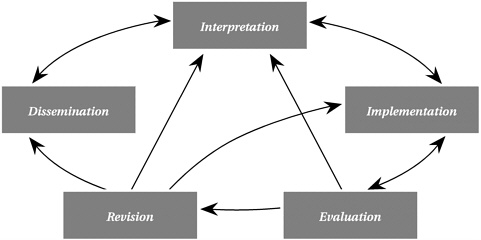
Note, however, that while the framework may seem linear, its dimensions are intertwined. For example, since practice informs understanding, implementation can lead to a new or deeper interpretation of the standards or elements of them. Evaluation and reflection pervade all other dimensions. Figure 2 attempts to capture the simultaneously cyclical, iterative, and nonlinear nature of the framework's dimensions.
The different dimensions of the framework are played out with different audiences, as shown in Figure 3 (Bybee, 1997). These audiences are organized into four categories that reflect each audience's primary role in the system: policy, program, practice, and political and public support.
The framework helps to address the question of how different stakeholders participate in standards-based reforms. Creating a matrix using the different dimensions on the horizontal axis and the possible participants on the vertical axis, activities can be arrayed in the cells. For example, an interpretation activity for colleges
FIGURE 2. Relationships Among the Dimensions of the Strategic Framework
and universities could be the development of an addendum that focuses on the role of inquiry in the NRC Standards. The addendum would help postsecondary faculty and administrators understand the standards more deeply so they could improve the design of their teacher preparation programs. Not all participants need to be engaged in every dimension. Some audiences, such as the general public, might be made aware of the standards with no further engagement. Although many audiences can be involved in many dimensions, the challenge of standards-based reform is to strategically engage the key participants in such a way as to create the most leverage for change in the system.
Although the developers of standards likely have major responsibility for dissemination, they can be assisted by state agencies, special coalitions, or cadres of leaders especially equipped to do so. Responsibility and authority for implementation do not necessarily lie with the organizations that developed standards. The organizations can provide support and expertise, as well as help in networking various implementers, but they are not always positioned to change policies and practices directly. State supervisors, curriculum developers, teacher educators, and classroom teachers assume major responsibility for implementation. Revision again becomes the responsibility of the developers, with substantial input and interaction with others in the system.
In the next section of this report, we use dimensions of the Strategic Framework to describe the strategies that the NCTM has used to support the NCTM Standards and to describe what directions the organization is now taking. The strategies planned and launched by the NRC's Center for Science, Mathematics, and Engineering Education (the Center) in light of NCTM's seven years of prior experience with national standards are described in the following section. Note that NCTM is a professional association of more than 110,000 members, with affiliated groups, an ongoing structure of conferences, and a large publication enterprise. The Center, as a unit of the NRC, works through its boards and committees of volunteers, together with staff, to advise in policy areas. The organizations are different in structure, mission, and scope of activity, and their strategies differ accordingly.
FIGURE 3.Participants in Standards-Based Education
|
Policy |
Governors and State Legislators State Education Departments State and Local School Boards School Districts Schools |
|
Programs |
Colleges and Universities Publishers Curriculum and Assessment Developers School Districts Business and Industry Informal Educators Professional Organizations |
|
Practices |
Teachers Students |
|
Political Support |
Scientists and Engineers Business and Industry Federal, State, and Local Governments Parents General Public Teacher Unions |
|
Adapted from: Bybee, R.W. (1997). A strategy for standards-based reform of science and mathematics education. Unpublished manuscript. |
|


