
RELATIONSHIP OF INTERNAL WAVES TO SPACE WEATHER
Since internal waves find their way into the near space region of the Earth, they are a potential contributor to space weather. This emerging field is still defining itself, but from a practical viewpoint it can be described as those aspects of upper atmospheric and space plasma processes that affect human endeavors. This is, of course, only a subset of the phenomenon that attracts the interest of space scientists, but it includes those processes having some relevance to technological systems as we enter the new millennium.
The two main sources of space weather are the Earth's cool, but dense, lower atmosphere and the Sun's million-degree but tenuous upper atmosphere (Kelley, 1989). It is a tribute to the vast power of the solar atmosphere that even in the near vacuum of its solar wind extension to the Earth's orbit, with a shrug of its mighty shoulders it can turn out the lights in, say, the entire Canadian province of Quebec. To paraphrase some lines from Star Trek: “Spock, if this magnetic storm keeps up much longer I don't think the [magnetic] shields will hold. We're likely to have a power surge at any time . . . !” This exact scenario happened in 1989 when ground-induced currents (GICs) created havoc in Quebec and very nearly throughout the entire eastern seaboard of North America. Solar wind-magnetospheric interactions are also responsible for the “killer electrons” that have wiped out numerous expensive communication satellites at geosynchronous orbit, and solar protons will make Mars missions and life aboard the space station dangerous indeed.
Another important space weather problem involves the effect of the Earth's ionosphere on radio waves traversing it. In this arena, gravity waves radiated by the dense lower atmosphere play a key role. The aurora, another solar wind-magnetospheric interaction effect, certainly creates its own exceedingly disturbed ionosphere, but its location at high latitudes much reduces its impact on humanity. However, severe space weather occurs in the equatorial and low-latitude zones as well, and much of it is initiated by gravity waves.
Two factors dominating the technological effects of low- and temperate-latitude space weather are navigational or positional errors and communication disruptions. In the former case we refer to the Global Positioning System (GPS), which is becoming ever more important in the commercial arena. At present, simple ionospheric models allow climatological corrections to be made for the phase delay associated with the ionospheric plasma content. More sophisticated models are in the offing, and there is some hope that GPS data can eventually mimic the vast array of weather stations on the Earth. If so, both nowcasts and, eventually, forecasts will make coping with global-scale space weather more tractable and perhaps even more predictable. Mesoscale conditions are another matter, however, and it is in this arena that gravity waves play a role.
A night in the life of the ionosphere over the Caribbean is illustrated in Figure 20 by using contour plots of the ionospheric content. The profiles show that the ionosphere over Puerto Rico sometimes bobs up and down in a distinctive wavelike manner.
It has been known for decades that such waves exist, and in fact, these “traveling ionospheric disturbances” provided the first evidence for internal wave interactions with the ionospheric plasma. As these waves buffet our plasma blanket, they easily push it up and down along the direction of the magnetic field lines since there is essentially no resistance in that direction. Winds upward of 100 km per hour blowing in the same direction for an hour or more have a huge impact. Vast rolls of plasma surge in a slow-motion dance across the sky, raising the plasma content in some directions and lowering it in others. The presence or absence of plasma alternately slows down or speeds up the velocity of radio waves from their usual average. Since the GPS depends upon knowing the speed of the radio waves, space weather becomes a vital issue.
As these waves propagate across the sky, regions of differing total electron content crossing the field of view of a geostationary satellite exhibit the same periodicity as waves do in an Earth-fixed reference frame. From a moving platform such as the GPS, however, the frequency is Doppler shifted,
sometimes to higher values. In the example in Figure 21 , waves crossing over the Caribbean created variations in the signal delay from a GPS satellite with about a 20-minute period (Beach et al., 1997). If the relative motion is the opposite, however, the Doppler shift can bring the frequency to zero and the ionospheric effect could exist for a long time. As discussed below, sometimes ionospheric weather causes satellite signals to twinkle just like stars, and space weather can become a problem.
During the day these ionospheric waves usually roll in from the poleward direction in either hemisphere, moving at speeds ranging from several tens to several hundreds of meters per second. Their source is thought to be the auroral zone, where intense heating of the upper atmosphere can occur due to the aurora. This direction is the “path of least resistance” for internal waves since equatorward propagation also means that the bulk of the wave-induced plasma motion is parallel to the magnetic field lines, the near-frictionless direction. This can be understood as follows. When a neutral atom strikes an ion in the direction parallel to the magnetic field, the ion just tags along for the ride. But when a neutral atom strikes an ion in any other direction, it can only circle around the magnetic field. In effect, the magnetic force “stops” the ion, which then must wait for a neutral collision to get another tiny nudge across the magnetic field. The plasma essentially never accelerates to the wind speed and always acts as a break on it, the so-called ion drag effect. The upshot is that during the day, even without a poleward source, the equatorward direction is preferred for two reasons: (1) the aurora is near the poles and is a major source of waves, and (2) this is the path along which there is a minimum in wave damping.
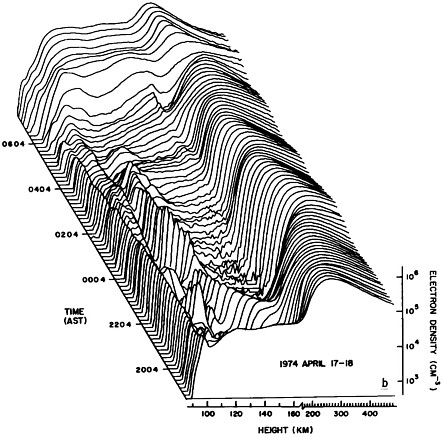
FIGURE 20 Sequential profiles of ionospheric content over Arecibo from sunset to sunrise. Reproduced from Shen et al. (1976) with permission of the American Geophysical Union.
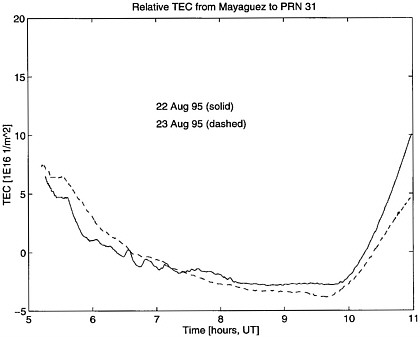
FIGURE 21 Total electron content (TEC) between the Earth and the GPS satellite for a night with and without internal wave activity. Reproduced from Beach et al. (1997) with permission of the American Geophysical Union.
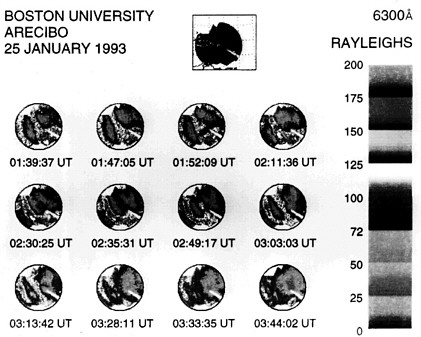
FIGURE 22 Airglow emissions from the ionosphere make huge wavelike oscillations visible from the ground by using sensitive cameras. Reproduced from Mendillo et al. (1997) with permission of the American Geophysical Union.
At night, the physics is more interesting. In azimuthal-of-arrival plots for TIDs, another arrival maximum pops up in the east-west direction. For this case, neither the auroral zone source nor the minimum ion drag seems to be relevant, at least at first glance. However, at night these waves may be photographed by using the modern all-sky imaging methods discussed above, and remote sensing has offered some chance to understand this unusual disturbance (see Figure 22 ). In this case the photons come from an ion chemistry reaction in which an ionospheric electron recombines with an ion-releasing red light. Unfortunately (or perhaps, fortunately), the red light is too faint for human perception or the night sky would look like a continuous sunset. Indeed, in 1993, horizon-to-horizon bands of increased and decreased red emissions were recorded on several nights in January of that year (Mendillo et al., 1997).
These waves were found not only to have the usual properties of gravity waves but to exhibit an electrical component as well (Kelley and Miller, 1997). One wave packet studied simultaneously with the imager and the Arecibo radar had a nearly 1,000-volt potential across the wave fronts, giving rise to the term “electrobuoyancy wave.” We know that steady winds and tides can create electrical potentials in the ionosphere by the dynamo effect, but the electric field measured in this particular wave was larger than this limit, and some examples have been reported that are an order of magnitude larger. What is going on? Plasma physics!
The term “plasma” refers to the fourth state of matter (solid, liquid, gas, plasma) corresponding to the ionized state (see the Encyclopedia Britannica article in the reading list). Most of the universe is plasma, in fact, and for about the last 50 years, physicists and engineers have been learning quite a lot about such media. Space plasma physics applies this discipline to the study of plasmas such as those in the Earth's ionosphere.
Before taking on a plasma physical description of the mid-latitude zone, we move first to a more spectacular space weather system that has inspired much more study and is better understood: the equatorial zone, called by the generic term “equatorial spread F.” Here, towering ionospheric convection storms very similar to thunderstorms erupt after sunset and create palpable havoc with communication systems. In the last, and presumably every, solar cycle, even at the relatively safe frequencies used by the GPS signals traversing the ionosphere will wax and wane by a factor of 100 during many of these storms. In such storms, not only is the plasma moved around but it also becomes highly turbulent in the process. This turbulence creates the degradation of transionospheric satellite signals and extends in scale size from hundreds of kilometers down to 10 cm or smaller, more than 6 orders of magnitude ( Figure 23 ).
The weather first deteriorates on the bottomside of the ionosphere and is often confined there, where it has little effect on satellite systems. But even in this relatively benign form, severe effects occur on high-frequency (HF) systems using the ionosphere as a mirror. During so-called bottomside equatorial spread F conditions, this mirror becomes very distorted and is in motion as well. Over-the-horizon (OTH) radars, for example, can see the equatorial ionosphere from halfway around the world. If any space weather event occurs in the field of view, the resulting radar clutter effectively wipes out any signal source.
Such paths can be affected in two ways. The most severe effects occur when some path intersects the turbulent plasma in such a way that the ray path is perpendicular to the magnetic field. Then the irregularities, which are highly magnetic and field aligned, act like efficient secondary antennas, radiating the signal back at the radar. A huge backscatter cross section results, and even though only a small fraction of the ionosphere has the necessary geometrical relationship, severe clutter arises. On other paths, the plasma builds up phase variations due to the irregular plasma medium along its propagation path. By the time the waves reflect one or two times off the ionosphere and the sea or land surface, amplitude variations build up, creating clutter. The effect is similar to the twinkling of stars in
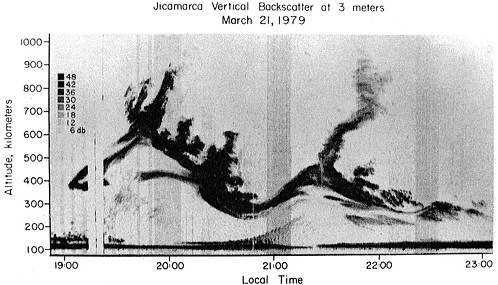
FIGURE 23 A space weather radar map provided by the Jicamarca Radio Observatory near Lima, Peru, shows that turbulence can be generated for hours over height ranges of hundreds of kilometers (Kelley et al., 1981). Reproduced from Kelley (1989) with permission of Academic Press, Inc.
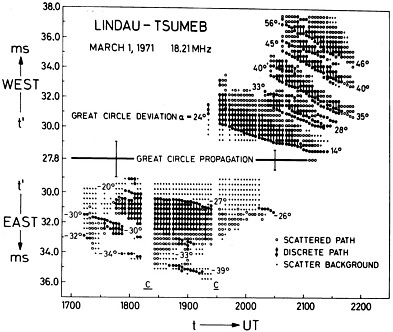
FIGURE 24 Signals sent from Europe to Africa by bouncing off the ionosphere often exhibit long delays due to regular wavelike distortions of the bottom of the ionosphere (Röttger, 1981). Reproduced from Kelley (1989) with permission of Academic Press, Inc.
the Earth's turbulent atmosphere. This space weather effect on OTH systems is essentially identical to the effect of ionospheric turbulence on transionospheric radio wave signals from satellites to the Earth.
To understand the origins of this intense space weather, a classic experiment was performed in the early 1970s using an HF transmitter in Europe and a receiving system in Africa (Röttger, 1981; Figure 24 ). Signals were found not only along the expected great circle path due to a simple mirror reflection, but from numerous large angles east and west of that path as well. Furthermore, these “off great circle paths” were located at periodic spatial separations a few hundred kilometers apart, exactly the separation that would occur if gravity waves created undulations in the bottom of the ionosphere that could bend radio waves back toward the receiver from the side.
This type of lazy undulation of the ionosphere creates the sort of smooth variations in total electron content discussed above in the GPS context and shown earlier in the Arecibo data and the all-sky images. Furthermore, they are now thought by many to provide the conditions needed to create the most severe weather in the Earth 's near-space environment: the towering plume structures characterizing equatorial spread F.
A set of images can be used to show how the process works ( Figure 25 ). After sunset, the dense lower ionosphere disappears and an internal wave begins to make its presence known on the bottom of the ionosphere where some wiggles arise in the east-west direction. With the passage of several tens of minutes these wiggles grow, extracting energy from the gravitational potential of the ionospheric slab, exactly (well, almost exactly) as a child's toy extracts energy from a heavy fluid supported by a light one ( Figure 26 ).
In the ionospheric case, the heavy fluid is the ionospheric plasma and the light “fluid” is the magnetic field, which at the magnetic equator is exactly horizontal. The wiggles get larger and larger due to the fact that they are electrified. Charge builds up on each wall of the growing structure. Eventually, the uplift accelerates, and huge towering ionospheric convective storms evolve, complete with highly turbulent plasma. The regions growing upward consist of turbulent low-density regions, which originally were located well below the peak in density, the so-called bottomside of the ionospheric layer. This process is very nearly identical to that which transports water vapor from the troposphere up to stratospheric heights where tropical cirrus clouds occur: that is, “deep atmospheric convection” brings up high-humidity air just as deep plasma convection brings up low-altitude plasma (Kelley, 1989).
The analogy with tropical convection can be extended even further since the plasma analogue is also electrical in nature. As far as we know, there is no lightning involved, but the towering plumes are definitely electrified. A typical voltage across a developing plume is the order of 2 to 3 keV, which is well below any breakdown condition but still results in huge ionospheric winds with velocities often exceeding 1 km/s. This value is comparable to the highest speeds reported in and around the aurora so
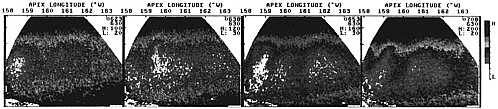
FIGURE 25 Sequence of airglow images looking south from the Haleakala Volcano on Maui shows the increasing influence of growing disturbances on the bottom of the tropical F layer. Reproduced from Tinsely et al. (1997) with permission of the American Geophysical Union.
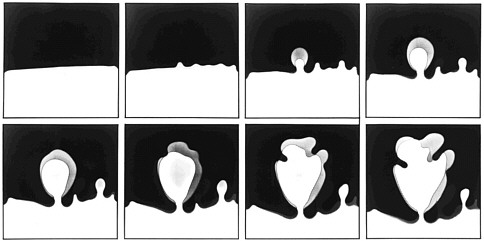
FIGURE 26 Photo sequence of a child's toy showing the growth of disturbances at the interface of a heavy fluid and a light one after the device is flipped over. There are actually two heavy fluids separated by a thin membrane, which accounts for the “shadow” trace.
there is good reason to consider weather in the equatorial zone to be as severe as that in the high-latitude sector.
How does this charging occur? In response to the gravitational force, ions slowly drift eastward in the presence of a northward magnetic field while electrons drift even more slowly to the west. This constitutes a net current. Now suppose there is a weak undulation in the plasma caused by a gravity wave. For the current to be continuous, as it must be according to the conservation of charge principle, an electric field builds up in the eastward direction where the plasma density is low and in the westward direction where the plasma is more dense. The electrical currents driven by these two fields add to the gravitational current where the latter is low and subtract from it where the gravitational current is high due to the undulation. But according to the principle of unintended consequences, these electric fields push the plasma upward in the low-density portion of the undulation and downward in the high-density region. Thus, the initial undulation is made deeper by the electric field, and the low-density region grows upward, with the high density region pushed downward just like the hydrodynamic analogy. The gravity wave has stimulated an instability in the plasma, which quickly takes on a life of its own as if the initial wave did not even exist.
The typical scale for periodic undulations that erupt into high-altitude convective storms is 100 to 400 km, as found by Röttger (1981) in his transequatorial experiments. But one side of the structure often breaks into smaller fingerlike upwellings separated by 50 km. Computer simulations of the physical equations have reproduced many features of these processes over the years, beginning with the pioneering work by the Naval Research Laboratory in the late 1970s (Scannapieco and Ossakow, 1976) and continuing now in India (Huang and Kelley, 1996), Canada, Australia, and several groups in the United States.
In Figure 27 , we see the development of a multiple plume event much like the one illustrated in the radar data. It was initiated by a gravity wave traveling to the west. The plumes erupt after a few tens of minutes and become entrained in the plasma flow, which is usually eastward at the peak of the ionospheric layer.
There are still a few details to clear up in this physics, but the field has entered a serious stage of nowcasting and forecasting development, which should make future effects on communication
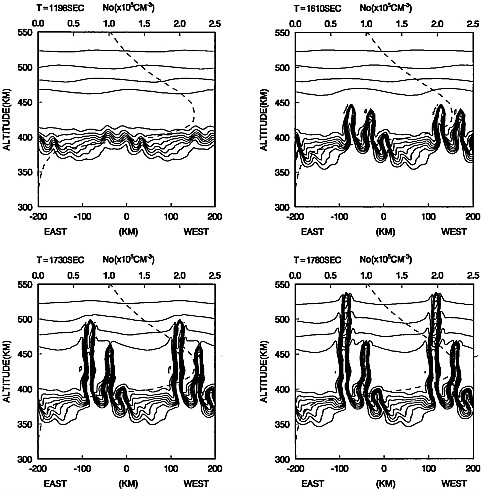
FIGURE 27 Computer simulations of gravity wave seeding of the ionosphere. Reproduced from Huang and Kelley (1996) with permission of the American Geophysical Union.
systems much more predictable. The hope is that by the next solar cycle maximum when GPS and other space-based systems are truly a part of everyday life, military and commercial users will have access to severe space weather information. For example, if the postsunset ionosphere is very high and has detectable wiggles on the bottom edge to the west of your location, you are pretty certain that severe communication disruptions are on the way.
At mid-latitudes our knowledge of the underlying physics is much less but so is the severity of the weather. The gravity wave effects are known to be present and some severe weather has been reported, particularly over Japan (Figure 28) where the powerful middle upper atmospheric (MU) radar system has been trained in the most sensitive orientation (perpendicular to the magnetic field). Some turbulent upwellings of ionospheric plasma have been seen, especially in summer and at solar minimum, which are too far off-equator to be the same Rayleigh-Taylor process discussed above.
These violent ionospheric storms have also been attributed to gravity wave seeding of the so-called Perkins instability in which energy is drawn from the background current system in the ionosphere. Much more work is needed to justify this claim, but the National Science Foundation program called CEDAR (Coupling Energetics and Dynamics of Atmospheric Response) is a beginning.


