
ROBERT BRAINARD COREY
August 19, 1897–April 23, 1971
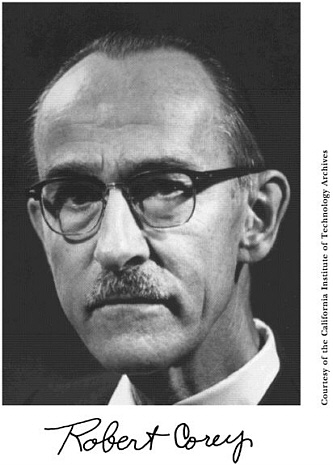
BY RICHARD E. MARSH
ROBERT COREY'S SCIENTIFIC career will always be identified with Linus Pauling. He worked closely with Pauling during the exciting years of the 1940s and early 1950s at the California Institute of Technology, where the basic concepts of structural biology, including the α helix and the β sheet, were being formulated. While it was Pauling who had the intuition and imagination that produced these wonderful concepts, it was Corey who was primarily responsible for proving them correct by carrying out the necessary diffraction experiments. A major product of Corey's work was the development of atomic models to study the arrangements of atoms and configurations of amino acid arrangements in proteins of all types; his name survives as the first initial in the naming of the CPK models, which are still in extensive use.1
PERSONAL HISTORY
Sometime in his youth—I don't know when or why—he was given the nickname "Jim"; his wife and intimate friends continued to call him Jim throughout his life. Professionally he was Bob, and that is the name I shall use.
Bob Corey was born in Springfield, Massachusetts, the first of two sons of Fred Brainard Corey and Caroline
(Heberd) Corey. Both of Bob's parents could trace their genealogies back to the mid-seventeenth century in America and much further back in England. They both graduated from Cornell University, his father in 1892 and his mother in 1893. Fred Corey was a mechanical and electrical engineer, employed for many years by General Electric in Schenectady as a developer of railway equipment. Bob's early education was at the Brown School, a private elementary school in Schenectady. When his father went to work for Union Switch and Signal Company in Pittsburgh, Bob attended high school in Edgewood, Pennsylvania. From there he went to the University of Pittsburgh, where he graduated in 1919 with a bachelor's degree in chemistry. At some period during his youth—I do not know just when—he was stricken with the scourge of the time, poliomyelitis (infantile paralysis). A partially paralyzed left arm, a pronounced limp, and a frail constitution remained with him throughout his life, and probably contributed to his being somewhat more serious and less active socially than most of his contemporaries.
Not surprisingly, Bob's choice for graduate school was Cornell. There he majored in inorganic chemistry with Professor L. M. Dennis, with minors in spectroscopy and physical chemistry. According to A. W. Laubengayer, who also worked with Professor Dennis at the time,
(Jim) and another graduate student, R. W. Moore (Slippy), were collaborating and constructing what undoubtedly was the first all-glass vacuum line, patterned after that initiated by Stock in Germany, in this country. Considering that only 'soft' glass was then available and interchangeable slip joints and stopcocks were unknown, and diffusion pumps had not yet been invented, this project was indeed heroic. Only one with the determination and ingeniousness of Jim would have mastered it. His partner, Slippy, was a confirmed worry-wart and pessimist, despairing each day, and Jim had to rally Slippy to the cause. They finally succeeded in synthesizing and
characterizing GeH4 and Ge2H6 and got a less volatile fraction containing higher hydrides. Their work established that germanium resembles silicon closely in its ability to form an homologous series of hybrid.2
After receiving his Ph.D. in 1924, Bob remained at Cornell as an instructor in analytical chemistry. While there he became fascinated with one of the first GE X-ray spectrometers, which had been used a few years earlier by Ralph W. G. Wyckoff. He succeeded in rehabilitating the instrument; more important, he became interested in the technique of X-ray diffraction and decided to join Wyckoff, who was then at the Rockefeller Institute. In 1928 he moved to Rockefeller as an assistant in biophysics and was promoted to associate in 1930—an eventful year, for it was then that he married Dorothy Gertrude Paddon. Although they had no children, their marriage was a joyous success and lasted until his death.
At the time, Wyckoff had become convinced that "x-ray methods were by then sufficiently developed to permit an attack on organic crystals more vigorous than had previously been feasible, and our work had this direction … The ultimate objective was the examination of crystalline proteins but it seemed advisable first to establish the structures of a number of simple compounds possessing the C-C and C-N bonds that are the backbone of protein molecules."3 During the approximately ten years that Bob Corey was at the Rockefeller, he and Wyckoff were joint authors of eighteen papers describing diffraction studies on compounds ranging from organic chlorostannates to crystalline and fibrous proteins. In 1937 Wyckoff's laboratory at the Rockefeller Institute was dissolved, and Wyckoff moved to the National Institutes of Health in Washington. As a something-less-than-golden parachute, Corey was given a one-year fellowship "to be used in any institution where I could profitably continue my crystal structure studies." He was
also offered "an ample allowance for laboratory expenses and the use of much of the equipment with which I have been working in case it would be of assistance to me." Corey immediately wrote to Linus Pauling at Caltech, who was beginning to apply his great knowledge of structural chemistry to the study of biologic systems. Pauling replied by return mail, "I would be very glad indeed to have you spend the year in Pasadena," offering an appointment as research fellow without stipend, but with the caveat that "so far as I can tell, there would be no possibility for you to be added to the staff at the end of the year." Pauling's alacrity to accept the visitor may well have been influenced by the lure of the equipment that Corey might bring with him, for he added, ''Apparatus which we do not have and which you might well need for your work would include a Weissenberg camera, a simple spectrometer for the rapid measurement of intensities, special apparatus for taking powder photographs, etc. I would recommend that you bring with you apparatus of this type which you think is needed for your own work." Corey accepted the appointment, also by return mail, on May 8, 1937. He and his equipment arrived in Pasadena in September (that Weissenberg camera remained in service at Caltech for approximately forty years). Despite Pauling's caveat, Bob had no apparent problem in securing his future. He was advanced to senior research fellow in chemistry in 1938, research associate in 1946, and professor of structural chemistry in 1949. He became emeritus in 1968. By then his health was worsening, and his appearances at Caltech were rare. He died in the spring of 1971 of atherosclerosis complicated by hypoglycemia.
Bob was a private person. He seemed to dislike social events of all kinds, preferring to be at home with Dorothy listening to Gilbert and Sullivan or perhaps tending to his
lawn. Here he was the direct opposite of Pauling, who enjoyed the limelight and relished both adulation and confrontation. Perhaps this difference in personality is what made the Pauling-Corey duo so effective in advancing—indeed, in establishing—the field of molecular biology. Pauling would give lectures so charming and entertaining that the audience might get a whiff of snake oil; but then a definitive paper would appear, carefully written and with strong supporting evidence supplied by Corey.
Care and attention to details were the essence of Bob Corey. Among the vivid memories I have of my experiences with him was the preparation of our paper on the structure of silk fibroin (1955). After we (or, rather, Bob) had decided on the general layout of the paper, it became my task to prepare each day a single paragraph of material. I would present this paragraph to him at 9:15 in the morning, when he would—in my presence—dissect and usually destroy it, substituting his own words that would say clearly just what I had meant to say all along. It was always my hope that this confrontation would end by 10:00 a.m., for that was the standard coffee hour for the half-dozen or so members of his biological structure group. If we were not finished, I would summarily leave his office. I am sure that my summary exit pained him greatly, but he never complained, nor did he offer to join us; but I can guarantee that every word, every punctuation mark, every nuance of that paper was the result of careful consideration. To the extent that I have any appreciation of the sound and impact of the written word, I owe that appreciation to Bob Corey.
Corey's relationship with Pauling, though scientifically close, was not socially intimate; as far as I am aware, each referred to the other's wife as "Mrs. Pauling" or "Mrs. Corey." He followed similar patterns with, I believe, all of his scientific
associates; while he was deeply caring of their welfare and progress, he was not comfortable in social situations. Surely this reluctance to participate in the casual Pasadena life-style was due in part to his traditional childhood; but I believe it was primarily a result of his frail health. It was physically uncomfortable for him to stand for long periods of time at a cocktail party; it was mentally uncomfortable for him to come up with small talk. Nevertheless, as his early collaborator and lifelong friend Ralph Wyckoff wrote, "Corey was truly remarkable for the spirit he maintained and the amount he accomplished in spite of lifelong physical handicaps."3
Corey was awarded an honorary doctor of science degree by his alma mater, the University of Pittsburgh, in 1964; he was elected to the National Academy of Sciences in 1970.
PROFESSIONAL HISTORY
Bob Corey's earliest publications, resulting from his work in graduate school, described the isolation and identification of numerous hydrides of germanium. They gave clear indications of the care, thought, and attention to details that were the features of Bob Corey's entire scientific career. They also indicated his fondness for designing and building equipment, the importance he placed on the careful use of that equipment, and the satisfaction he found in definitive results. Among other things, these early papers described, in clear words and with careful drawings, the construction of the vacuum line that he had used to generate and separate GeH4, Ge2H6, and higher hydrides. The vacuum line contained, along with a dozen or so collection tubes, a mercury manometer and ten mercury valves—Y-shaped tubes with mercury reservoirs at the bottom; by admitting (through a stopcock) the outside atmosphere to the reservoir the mercury level could be forced up into the
Y, sealing off the two upper arms. This sort of apparatus was used extensively by Alvin Stock in Germany, and Stock in his later years apparently suffered mental damage from exposure to mercury vapor. There is certainly no indication of any similar damage to Bob Corey's intellect.
Although Bob's initial faculty appointment at Cornell was in analytical chemistry, he quickly became attracted to the field of X-ray diffraction. It is not difficult to see the reason for the attraction, since X-ray diffraction required very careful experimentation (in those days) and offered as a reward the possibility of definitive and unassailable results; the number of measurements available in a crystal-structure analysis of a normal compound greatly exceeded the number of parameters necessary to describe the structure. Moreover, Bob surely realized—far earlier than most—that this relatively new technique might play an important role in uncovering some of the mysteries of biologic molecules. But he could not have known how overwhelmingly important that role would be or that his own participation would have such tremendous influence.
Having been introduced to X-ray diffraction by equipment left at Cornell by Ralph Wyckoff, Corey decided to join Wyckoff at the Rockefeller Institute in order to learn more about the technique. It was here that he carried out the first of his many small-molecule crystal structure analyses. It was also here that he and Wyckoff made some preliminary studies of the possibility of investigating very large molecules (proteins) using X-ray diffraction. (Similar studies were being undertaken by Bragg and others.) Accordingly, when Wyckoff's support at the Rockefeller Institute was discontinued, Bob was quick to apply to Linus Pauling for a position at Caltech (and even quicker to accept a one-year appointment), for Pauling was also interested in applying the concepts of structural chemistry to the study of
biological molecules. So the year 1937 was to mark the beginning of a Pauling-Corey collaboration that lasted until Pauling left Caltech in 1964.
Corey's pre-war work at Caltech was on determining the crystal structures of three small biologic molecules—glycine, d,1-alanine, and diketopiperazine (the cyclic anhydride of the dipeptide glycylglycine). These were among the earliest organic molecules to have their complete, three-dimensional structures elucidated; glycine and alanine were the first amino acids, and diketopiperazine the first peptide. The measurements and especially the calculations of the many (approximately 300 in the case of d,1-alanine) diffraction intensities necessary for these studies was a prodigious undertaking, for the only computing aids he had were a slide rule and a mechanical adding machine. The structures of glycine and alanine were derived from Patterson functions, which had been introduced by A. L. Patterson in 1935; that of diketopiperazine was deduced from packing considerations. For diketopiperazine the first model that Corey tested was based on a puckered six-membered ring, as in cyclohexane; only when that model failed was a planar ring tested and found to produce satisfactory agreement between measured and calculated diffraction intensities. While Pauling and perhaps others may already have suspected that the amide grouping in peptides would be planar (because of the double-bond character in the C-N bond), this structure was the first demonstration.4
During World War II Pauling became the head of a gunpowder project and was charged with investigating the stabilities and explosive characteristics of various forms of gunpowder. This project involved extensive administrative interactions with the War Department—reports, requisitions, and the like. Pauling apparently realized that Bob Corey had the necessary mental and emotional discipline to cope
with these details, and Bob became the administrative coordinator of the project. It was a full-time job, and it was not until the war was over that he returned to scientific research.
Before the war Pauling's interest in structural chemistry had been thoroughly eclectic, embracing thermodynamics, quantum mechanics, gas-phase electron diffraction, and crystal structure studies of all kinds—minerals, intermetallic compounds, and organic and inorganic molecules. After the war he concentrated more heavily on biologic systems and assimilated at Caltech a large number of students and postdoctoral people in a number of areas. For the structural part of the program—obviously his favorite—he put Corey in charge, recognizing not only Bob's extensive background in the field but also his skills as an administrator and a facilitator. Bob's first projects were to assemble all the available knowledge on the detailed structures of amino acids and peptides (most of this was based on his own pre-war work) and to plan and oversee further studies in the area. By 1955 the crystal structures of six amino acids and of three dipeptides had been published by various workers at Caltech. No such studies had yet been carried out anywhere else in the world.
In the late 1940s Pauling had come up with the concept that polypeptide chains in proteins—particularly fibrous proteins, such as hair, muscle, and tendon, which gave relatively good diffraction patterns suggesting extended chains—might form regular helical structures but with a non-integral number of amino-acid residues in each turn of the helix. This was a novel concept, since diffraction from crystalline materials had always indicated discrete unit cells, which would require an integral number of residues per turn. With the help of the structural concepts that had arisen from the crystallographic work of Corey and others as Caltech (planar
peptide groups with known interatomic distances, attached to one another through N-H···O hydrogen bonds) Pauling succeeded in constructing a number of helical models, and he and Corey demonstrated that one of these models—the α-helix—was compatible with the diffraction patterns observed for the synthetic polypeptides poly-γ-methyl-L-glutamate and poly-γ-phenyl-L-glutamate. There resulted the watershed group of papers by Pauling and Corey, published in the Proceedings of the National Academy of Sciences, describing the α-helix, a second less compact helix (which has not yet been observed in fibrous proteins), and two extended β-sheet structures, one with parallel and the other with antiparallel arrangements of adjacent polypeptide chains. What was perhaps most remarkable about these papers is that they included coordinates for the atoms of the peptide groups, so that the structures could be accurately reproduced in other laboratories and also so that diffraction intensities could be calculated for comparison with observed patterns. From such calculations the α-helix and the β-sheets were soon shown to be major constituents of many fibrous and globular proteins. More important, the realization had arrived that large biological molecules could be discussed and eventually understood in terms of the exact arrangements of their constituent atoms. The age of molecular biology had arrived.
It is surely worth noting in passing that these seminal papers by Pauling and Corey were written in the most conservative of styles and backed up by extensive evidence and calculations. One finds such phrases as, "We think it is likely that ….," "It is our opinion that ….," "We conclude that there is strong evidence for ….," and the like. That such ground-breaking work would be described so modestly is clear evidence of Bob Corey's hand.
As Corey and others in his group at Caltech were working
on the structures of small molecules such as amino acids and dipeptides, they were making extensive use of molecular models; these models were normally constructed from "Tinker Toys," wooden balls and sticks representing atoms and bonds. But they were of limited use; the sizes of the balls did not correspond to the actual sizes of the atoms, and it was difficult to keep the wooden bonds from twisting so as to create perhaps a nonplanar amide group. The solution to this problem was to construct space-filling models that could incorporate the known structural features: bond lengths and angles, conformations (especially the planar arrangement of the peptide linkage), hydrogen-bond formation, and van der Waals radii. The first such models, designed by Corey in about 1946 and built in Caltech's instrument shop, featured individual wooden atoms with carefully machined surfaces to represent covalent and van der Waals radii; these atoms could be glued together to form planar groups or machined with metal inserts and links where bond rotation was allowed. But these model atoms were very large—the scale was 1.0 inch/Å—and too heavy to be assembled into lengthy polypeptide chains. Subsequently, smaller versions were molded from plastics of various types with the C, N, and O atoms of the peptide grouping cast as a single planar unit. Eventually, hydrogen bonds were simulated by imbedding magnets in the hydrogen and oxygen atoms. These models were vitally important to Corey and Pauling during the early 1950s, when they were testing (successfully, usually) their helices and pleated sheet structures on all sorts of proteins; they were the prototype of the CPK space-filling models, which have served the last generation of structural biologists so well.
During the years 1950–55 the Pauling-Corey group at Caltech studied the structures of a large number of fibrous
proteins: hair, silk, collagen, wool, feather rachis, and others; in most cases they were able to show that the structures they proposed were entirely compatible with X-ray diffraction, infrared dichroism, and other measurements. Along the way they proposed a structure for the nucleic acids. In deriving this structure they assumed a density of 1.62 g cm-3, from which they deduced that the structure should be based on a triple-strand helix. They constructed many models, but could find no satisfactory one in which the purine-pyrimidine groups were at the center of the triple helix. So the model they eventually proposed had the phosphate groups at the center, the three chains attached to one another through O-H···O hydrogen bonds. They were not entirely satisfied with this structure, which they called only promising, and added that "the structure cannot be considered to have been proved to be correct." They were, of course, justified in their doubts; the structure derived almost simultaneously by Watson and Crick was based on a double helix with the phosphate groups on the outside.
During this time Pauling had become increasingly involved in world peace and antinuclear activities; while he maintained keen interest in all areas of structural chemistry and biology and continued to give fascinating lectures on the α-helix and other scientific topics, Corey became the de facto head of the structure program. In addition, Bob found himself in demand as a lecturer—a chore he surely disliked, because of his shy and unassuming personality. In 1955 he even went on tour, giving lectures on "The configuration of polypeptide chains in proteins" throughout the world; he returned exhausted but elated at the warm reception he had received everywhere.
In the late 1950s, with the structural features of fibrous proteins firmly in hand, Corey focused his research in two related areas: more intensive studies on crystalline proteins—lysozyme
in particular—and crystal structure studies of nucleosides and nucleotides in an attempt to confirm the base-pairing scheme proposed by Watson and Crick. An important result of this latter project was the discovery by Karst Hoogsteen of the reversed pairing—the Hoogsteen pairing—of adenine and thymine.5 For the lysozyme project he assembled a large (for the time) research group to prepare crystals of the tetragonal form of the native protein and also crystals in which the novel heavy-atom complexes Ta6Cl14 and Nb6Cl14 were incorporated.6 Over the next several years a tremendous amount of intensity data was collected from these three types of crystals, and eventually a three-dimensional electron density map was obtained; before it could be interpreted, however, the structure of tetragonal lysozyme was reported by another group. 7 By now Bob's health was failing and he was facing retirement; his research group was disbanded and the lysozyme project was terminated.
The failure of the lysozyme project was a tremendous disappointment to Bob. Throughout his career he had envisioned as an ultimate goal the determination of the complete three-dimensional structure of a crystalline protein and he watched with envy the success of the British groups working on myoglobin and haemoglobin. Possibly the attack on lysozyme came too late in his career, when much of his ebbing strength was needed for raising support money and handling personnel problems; by then he was spending little time in the laboratories. Perhaps, too, the efforts were hampered by his need for perfection. The unit-cell dimensions found for crystals of the niobium and tantalum derivatives of lysozyme were always slightly larger than those for the native protein, and Bob feared that the lack of true isomorphism would make the resultant electron density maps unreliable. It is quite possible that, if he had damned these torpedoes—as other protein crystallographers have now
learned to do routinely—and proceeded with confidence and vigor, he would have succeeded in this final project.
Bob Corey's place in scientific history is clear; he was a central figure in the birth of the field of molecular biology. Linus Pauling has often been called the father of this field, but Bob's role was crucial. As Pauling's close associate he carried out many of the key experiments needed to confirm Pauling's theories; and he carried out these experiments with such care and thought that the results could not be doubted. He preferred to remain out of the lime-light, but his presence could always be felt in the precision of the way in which Pauling's ideas were formulated and in the care with which they were presented. The molecular models that he designed are a tangible legacy; his concept of scientific progress—careful experimentation with loving attention to detail—is a less tangible but not less important legacy. He was, as Pauling said, ''a good man, a sincere man, a man with a deep interest in the physical and biological world, a man who found happiness in scientific research."
NOTES
This biographical memoir was originally commissioned to Linus Pauling and E. W. Hughes, but was not completed. I am indebted to Ruth Hughes, Eddie's widow, for material he had collected; to the Caltech archives for letters, references, and the photograph of Corey; and to Ramesh Krishnamurthy, project director for the Ava Helen and Linus Pauling papers at Oregon State University, for early correspondence between Corey and Pauling. I am also indebted to Verner Schomaker for many helpful comments, ideas, and remembrances.
SELECTED BIBLIOGRAPHY
1924 With L. H. Dennis and R. W. Moore. Germanium VII. The hydrides of germanium. J. Am. Chem. Soc. 46:657–74.
1926 With A. W. Laubengayer. Germanium XIII. Modified form of vacuum apparatus for the purification and study of volatile compounds of germanium. J. Phys. Chem. 30:1043–46.
1929 With R. W. G. Wyckoff. The crystal structure of trimethyl ethyl ammonium chlorostannate. Am. J. Sci. 17:239–44.
1932 With R. W. G. Wyckoff. The crystal structure of thiourea. Z. Kristallogr. 81:386–95.
1936 With R. W. G. Wyckoff. X-ray diffraction patterns from reprecipitated connective tissue. Proc. Soc. Exp. Biol. Med. 34:285–87.
With R. W. G. Wyckoff. X-ray diffraction patterns of crystalline tobacco mosaic proteins. J. Biol. Chem. 116:51–55.
1938 The crystal structure of diketopiperazine. J. Am. Chem. Soc. 60:1598–1604.
1939 With G. Albrecht. The crystal structure of glycine. J. Am. Chem. Soc. 61:1087–1103.
1940 Interatomic distances in proteins and related substances. Chem. Rev. 26:227–36.
1950 With D. P. Shoemaker, J. Donohue, and V. Schomaker. The crystal structure of Ls-threonine. J. Am. Chem. Soc. 72:2328–2349.
With J. Donohue. Interatomic distances and bond angles in the polypeptide chain of proteins. J. Am. Chem. Soc. 72:2899–2900.
With L. Pauling. Two hydrogen-bonded spiral configurations of the polypeptide chain. J. Am. Chem. Soc. 72:5349.
1951 With L. Pauling and H. R. Branson. The structure of proteins: Two hydrogen-bonded helical configurations of the polypeptide chain. Proc. Natl. Acad. Sci. U. S. A. 37:205–11.
With L. Pauling. The pleated sheet, a new layer configuration of polypeptide chains. Proc. Natl. Acad. Sci. U. S. A. 37:251–56.
With L. Pauling. Configurations of polypeptide chains with favored orientation around single bonds: Two new pleated sheets. Proc. Natl. Acad. Sci. U. S. A. 37:729–40.
With W. A. Schroeder. Automatic weight-driven time-controlled fraction collector. Anal. Chem. 23:1723–24.
1952 With L. Pauling. The planarity of the amide group in polypeptides. J. Am. Chem. Soc. 74:3964.
With J. Donohue and K. N. Trueblood. An X-ray investigation of air-dried lysozyme chloride crystals: The three-dimensional Patterson function. Acta Crystallogr. 5:701–10.
1953 With L. Pauling. Fundamental dimensions of polypeptide chains. Proc. R. Soc. London, Ser. B 141:10–20.
With L. Pauling. Stable configurations of polypeptide chains. Proc. R. Soc. London, Ser. B 141:21–33.
With L. Pauling. Molecular models of amino acids, peptides and proteins. Rev. Sci. Instrum. 24:621–27.
With L. Pauling. A proposed structure for the nucleic acids. Proc. Natl. Acad. Sci. U. S. A. 39:84–97.
1955 With R. E. Marsh and L. Pauling. An investigation of the structure of silk fibroin. Biochem. Biophys. Acta 16:1–33.
1959 With W. W. Schuelke and L. Casler. Scale models of polypeptide chains with permanent connections between "backbone" atoms . Acta Crystallogr. 12:256–57.
1962 With R. H. Stanford, Jr., and R. E. Marsh. An X-ray investigation of lysozyme chloride crystals containing complex ions of niobium and tantalum. Three-dimensional Fourier plot obtained from data extending to a minimum spacing of 5Å. Nature 196:1176–78.


