
|
|
NATIONAL RESEARCH COUNCIL |
|
|
|
POLAR RESEARCH BOARD |
|
|
|
2101 Constitution Avenue Washington, D.C. 20418 |
|
|
U.S. National Committee for SCAR U S. Committee for IASC |
202/334-3479 202/334-1477 FAX |
|
|
|
Revised Workshop Agenda |
|
|
|
NOAA's Arctic Contaminants Research1 Friday, July 11, 1997 |
|
|
|
Polar Research Board NOAA Building 2, Room 2358 1325 East-West Highway Silver Spring, MD |
|
|
Closed Session: |
|
|
|
8:00 a.m. |
Review workshop tasks and strategy; PRB members and staff only. |
|
|
Open Session: |
|
|
|
8:30 a.m. |
Introduction |
|
|
|
• Welcome, David Clark, PRB chair |
|
|
|
• Workshop structure and goals, Walter Oechel, PRB workshop chair |
|
|
|
• Questions to guide workshop discussions, Walter Oechel |
|
|
8:45 a.m. |
Welcome, Joe Friday, OAR |
|
|
8:50 a.m. |
NOAA and Arctic Contaminants Research, Alan Thomas, OAR |
|
|
|
• NOAA's role and potential |
|
|
|
• The Arctic Research Initiative |
|
|
|
• Expectations for this workshop |
|
|
9:15 a.m. |
The Big Picture: A CENR Perspective on Contaminant Research Priorities , Dr. James Baker |
|
|
9:35 a.m. |
The View from the Line and Program Offices |
|
|
|
Walter Oechel, moderator (5 minutes each) |
|
|
|
• Jawed Hameedi, National Ocean Service |
|
|
|
• Robert Reeves, National Weather Service |
|
|
|
• Teri Rowles, National Marine Fisheries Service |
|
|
|
• Walter Planet, National Environmental Satellite, Data, and Information Service |
|
|
|
• David Johnson, Coastal Ocean Program |
|
The National Research Council is the principal operating agency of the National Academy of Sciences and the National Academy of Engineering to serve government and other organizations. The Polar Research Board is responsible to the National Research Council through the Commission on Geosciences, Environment, and Resources.
|
10:15 a.m. |
Break |
|
10:30 a.m. |
Other Perspectives |
|
|
Bernard Hallet, moderator |
|
|
• Bob Senseney, Department of State |
|
|
• Garry Brass, Arctic Research Commission |
|
|
• Ted DeLaca, University of Alaska-Fairbanks |
|
|
• Other participants |
|
|
Discussion |
|
11:15 a.m. |
Key Research Issues (brainstorming) |
|
|
Walter Oechel, moderator |
|
|
• natural variability of the western Arctic ecosystem |
|
|
• anthropogenic influences on the western Arctic ecosystem |
|
|
- contaminant sources, transport and dispersion, effects on humans and ecosystems |
|
|
- arctic haze, ozone, UV flux |
|
12:00 noon |
Charge to the Small Groups |
|
12:15 p.m. |
Working Lunch (buffet, take food to break-out rooms. Introductions and informal discussions will begin over lunch) |
|
|
Group 1: Room 2358 (Oechel and Elfring) |
|
|
Group 2: Room 3208 (Hallet and Burch) |
|
|
Group 3: Room 2222 (Clark and Cox) |
|
1:15 p.m. |
Small Group Assignments |
|
2:30 p.m. |
Break |
|
2:45 p.m. |
Plenary Discussion, Walter Oechel |
|
|
• Reports from the small groups |
|
|
• Questions and discussion |
|
|
• Strategies for reorienting the Arctic Research Initiative |
|
3:55 p.m. |
Summary, David Clark |
|
4:00 p.m. |
Open session adjourns |
|
Closed Session |
|
|
4:00 p.m. |
PRB members remain for closing discussions |
|
5:00 p.m. |
Closed session adjourns |
NATIONAL ACADEMY OF SCIENCES/NATIONAL RESEARCH COUNCIL COMMISSION ON GEOSCIENCES, ENVIRONMENT, AND RESOURCES POLAR RESEARCH BOARD WORKSHOP ON NOAA'S ARCTIC CONTAMINANTS RESEARCH
THE PURPOSE OF THIS WORKSHOP
At the request of NOAA's Office of Oceanic & Atmospheric Research, the Polar Research Board has planned this workshop to help NOAA develop a vision to guide the Arctic Research Initiative (ARI). The ARI focuses on the health of the Western Arctic and Bering Sea Ecosystem, and within that geographic scope the research focus is on two themes: (1) natural variability and (2) anthropogenic influences. The anthropogenic influences theme contains two categories: (a) arctic haze, ozone, and UV flux and (b) contaminant inputs, fate, and effects. While this workshop will address natural variability to some extent, emphasis will be given to anthropogenic influences, and in particular activities related to Arctic contaminant inputs, fate, and ecosystem effects. Through presentations, brainstorming, and small group discussions we hope to develop a broad list of key research issues, propose a range of more specific research questions, and identify some subset of those as potential priority research questions. This input will help NOAA reorient the ARI so that it better supports the NOAA mission while at the same contributes to a coordinated national and international strategy for addressing the health of the Arctic environment.
This workshop follows a number of contaminant-related activities, including for instance a multi-agency activity, "U.S. Arctic Contaminant Research Planning Workshop," held August 10-13, 1996 in Fairbanks, Alaska, which examined the state of the art of U.S. agency research on arctic contamination issues and suggested overall national research priorities. Today's more focused workshop is designed as a follow-up activity to look specifically on how NOAA — given its mission, capabilities, staff, and resources — could be an effective component of a coordinated national research effort on Arctic contaminants and help NOAA managers ensure that such work supports NOAA's overall mission. In particular, this workshop seeks to identify key research issues to be addressed with funds granted by the Arctic Research Initiative and, if possible, suggest how to reorient that program so it better targets unmet needs.
Participants include members of the Polar Research Board, appropriate NOAA staff, representatives of other key federal agencies, and selected other guests. We expect active participation from all present, especially during the brainstorming and small group assignments. The workshop participants will:
-
explore the range of Arctic contaminants research being conducted under the auspices of current NOAA programs and how such research can contribute to NOAA's mission and goals;
-
discuss other contaminant-related research activities such as the August 1996 workshop and the priorities developed there as well as the recently released report of the Arctic Monitoring and Assessment Program and plans for AMAP phase two, and how the Arctic Research Initiative might build on and contribute to other federal and international activities;
-
suggest key research areas and research questions to better understand natural variability and anthropogenic influences, with emphasis on contaminant sources, transport and dispersion, effects and arctic haze, ozone, and UV flux; and
-
discuss the relative strengths of NOAA's research capabilities and partnerships and suggest how NOAA should orient its Arctic Research Initiative in the future.
Participant List
Dr. Ronald Baird
NOAA/OAR/National Sea Grant
College Program
11716, SSMC-3
1315 East West Hwy
Silver Spring, MD 20910-3226
(301) 713-2448 ext. 163
fax (301) 713-0799
Dr. D. James Baker
Under Secretary
NOAA
14th and Constitution Ave, NW
Washington, D.C. 20230-0001
(202) 482-3436
fax (202) 408-9674
Dr. Alfred M. Beeton
DOC/NOAA/CS
HCHB 5128
14th and Constitution Ave, NW
Washington, DC 20230
(202) 482-2977
fax (202) 482-5231
al.beeton.noaa.gov
Dr. Eddie N. Bernard
NOAA/ERL/Pacific Marine
Environmental Laboratory
7600 Sandpt. Way NE
Bin C15700
Seattle, WA 98115-0070
(206) 526-6800
Dr. Suzanne Bolton
NOAA/NMFS/Office of Science
and Technology
SSMC-3, F, Room 14348
1315 East West Hwy.
Silver Spring,
MD 20910-3226
(301) 713-2367 ext. 163
fax (301) 713-2313
Garry Brass
Arctic Research Commission
4350 North Fairfax
Drive Arlington, VA 22203
(703) 525-0111
fax (703) 525-0114
Ron Britton
DOI/FWS
330 ARLSQ
1849 C Street NW
Washington, DC 20240
(703) 358-2148
Dr. Ernest S. Burch, PRB
3507 Market St., Suite 303
Camp Hill, PA 17011-4322
(717) 975-3590
fax (717) 975-3592
John Calder
NOAA/ERL
1315 East West Hwy.
11461 SSMC-3
Silver Spring, MD 20910-3226
(301) 713-2474
fax (301) 713-4023
Dr. Philip S. Chen, Jr.
National Institutes of Health
Intramural Affairs
1 Center Drive
0151 Shannon Bldg. Room 140
Bethesda, ME) 20892-0151
(301) 496-3561
fax (301) 402-0027
Dr. David L. Clark, Chair PRB
Dept. of Geology and Geophysics
Univ. of Wisconsin
1215 W. Dayton St., (Weeks Hall)
Madison, Wl 53706
(608) 262-4972
fax (608) 262-0693
Dr. Gordon F.N. Cox, PRB
Amoco Eurasia Petroleum Comp.
c/o Amoco Production Comp.
501 Westlake Park Blvd. Rm 3.330
PO Box 3092
Houston, TX 77253-3092
(281) 366-2965
fax (281) 366-2746
Dr. Edward C. DeFabo
The George Washington Univ.
Medical Center
Dept. of Dermatology,
2300 I. St. NW, Room 113
Washington, DC 20037
(202) 994-3975
fax (202) 994-0409
Ted DeLaca
University of Alaska, Fairbanks
Office of Arctic Research
305 Signer's Hall
Fairbanks, AK 99775-7560
(907) 474-7314
fax (907) 474-7225
Jane Dionne
NSF
4201 Wilson Blvd, Room 755S
Arlington, VA 22230
(703) 306-1033
fax (703) 306-0109
Michael J. Dowgiallo
NOAA/Coastal Ocean Program
1315 East West Highway
9716 SSMC-3
Silver Spring, MD 20910-3226
Dr. Sidney Draggan
US EPA
Off. of Research & Development
401 M Street, SW
Mail Code 1103
Washington, DC 20460
(202) 260-4724
fax (202) 260-4852
draggan.sidney@epamail.epa.gov
Dr. Elbert Friday
NOAA/AA/OAR
SSMC-2, W, Room 18130
1325 East-West Hwy.
Silver Spring, MD 20910
(301) 713-2458
Prasad Gogineni
NASA Headquarters
MTPE-YS
300 E. Street SW
Washington, DC 20546
(202) 358-074
fax (202) 358-2770
Robed Grumbine
NOAA/NWS
5200 Auth Rd.
209 WWBG
Camp Springs, MD 20746-4304
(301) 763-8133 ext. 7214
Dr. Bernard Hallet, PRB
Univ. of Washington
Quaternary Research Center
Box 351360
Seattle, WA 98195
(206) 685-2409
fax (206) 543-3836
Joh Haugh
DOI/BLM (WO-210)
1849 C Street NW
Washington, DC 20240
(202) 452-5071
fax (202) 208-5242
Dr. Jawed Hameedi
NOAA/NOS/Office of Resources
Conservation and Assessment
SSMC-4, N, Room 10225
1305 East West Hwy.
Silver Spring, MD 20910-3281
(301) 713-3034 ext. 170
fax (301) 713-4388
Carl Hild
Rural Alaska Community Action
Program, Inc.
PO Box 200908
Anchorage, AK 99520
(907) 279-2511
Fax: (907) 279-6343
Dr. Bob Hofmann
Marine Mammal Commission
4340 East-West Highway
Bethesda, MD 20814
(301) 504-0087
Dr. David Hofmann
NOAA/ERL/Climate Monitoring and
Diagnostics Laboratory
325 Broadway
A334 RL3
Boulder, CO 80303-3328
(303) 497-6966
fax (303) 494-6975
Randy Jacobson
Office of Naval Research
800 North Quincy Street
Code 322HL
Arlington, VA 22217-5000
(703) 696-4121
Dr. Leonard Johnson
University of Alaska
7708 Lake Glen Dr.
Glen Dale, MD 20769-2027
(703) 525-7201
Leslie King
ARCUS
Chair of Environmental Studies
Univ of Northern British Columbia
3333 University Way
Prince George, British Columbia
V2N 4Z9
CANADA
(250) 960-5836
Tom L. Laughlin
NOAA/IA
14th and Constitution Ave, NW
6228 HCHB
Washington, DC 20230-0001
(202) 482-6196
Charles E. Myers
National Science Foundation
Polar Programs
4201 Wilson Blvd.
Arlington, VA 22230
(703) 306-1029
fax (703) 306-0648
Dr. Edward Myers
NOAA/OAR/National
Undersea Research Program
11872, SSMC-3
1315 East West Hwy.
Silver Spring, MD 20910
(301) 713-2427 ext. 171
fax (301) 713-0799
Dr. Walter Oechel, PRB
Global Change Research Group
Dept. of Biology
San Diego State Univ.
San Diego, CA 92182-0057
(619) 594-6613
fax (619) 594-7831
Walter Planet
National Environmental Satellite,
Data, and Information Service
Office of Research & Applications
NOAA
E/RA3, WWB/810
4700 Silver Hill Rd., Stop 9910
Washington, DC 20233-9910
(301) 763-8136
fax (301) 763-8127
Dr. Robert Reeves
NOAA/NWS/Office of Meterology
13228, SSMC-2
1325 East West Hwy.
Silver Spring, MD 20910-3283
(301) 713-1970 ext. 119
fax (301) 589-1321
Dr. Teri Rowles
NOAA/NMFS/Office of Protected
Resources
SSMC-3, F, Room 14564
1315 East West Hwy.
Silver Spring, MD 20910
Bob Senseney
U.S. Department of State
Office of Ocean Affairs
2201 C Street NW, Room 5801
Washington, DC 20520
(202) 647-3262
fax (202) 647-1106
Dr. Donald B. Siniff
Dept of Ecology, Evolution &
Behavior
University of Minnesota
100 Buford Circle, Ecology Bldg.
St. Paul, MN 55108
(612) 625-5732
fax (612) 624-6777
Renee Tatusko
Office of Oceanic & Atmospheric
Research
NOAA
1335 East-West Highway
Suite 4330
Silver Spring, MD 20910
(301) 713-2465
fax (301) 713-1459
Alan R. Thomas
NOAA
Office of Oceanic & Atmospheric
Research
1315 East-West Highway
Silver Spring, MD 20910
(301) 713-2458
fax (301) 713-0163
Ray Vander Hoist
TEES/UAF
(703) 525-7200
Dr. Elizabeth Weatherhead
Univ. of Colorado, Boulder
Air Resources Laboratory
NOAA R/E/ARx1
325 Broadway
Boulder, CO 80303
(303) 497-6653
fax (303) 497-6546
The Arctic Research Initiative
The scope of the Arctic Research Initiative program is broad. The initial focus will be on Health of the Western Arctic/Bering Sea Ecosystem, in particular, on two major scientific areas:
-
Study of the natural variability of the Western Arctic/Bering Sea Ecosystem.
-
Study of anthropogenic influences on the Western Arctic/Bering Sea Ecosystem.
The Arctic Research Initiative includes five major sub-topics:
-
Natural variability of the Western Arctic/Bering Sea ecosystem
-
The Bering Sea Qreen Belt: processes and ecosystem production.
-
Atmosphere-ice processes that influence ecosystem variability.
-
Atmospheric, cloud and boundary layer processes.
-
Anthropogenic influences on the Western Arctic/Bering Sea ecosystem
-
Arctic haze, ozone and UV flux.
-
Contaminant inputs, fate and effects on the ecosystem.
1. The Bering Sea Green Belt: Processes And Ecosystem Production
The Green Belt is a region of sustained high primary production located over the outer shelf and slope of the Bering Sea. Ecosystem production is also focused here as evidenced by large numbers of fish, marine mammals, and birds. This abundance must be the result of primary production. The physical and biological processes accounting for this abundance, however, are poorly defined or unknown. The goal of this research component is to define and understand the physical and biological processes that lead to sustained ecosystem production.
Objectives:
-
Determine the distribution of nutrients and production in the Green Belt region.
-
Determine the biological and physical processes that result in the distributions observed in (1).
-
Ascertain the potential impacts of fishing practices and climate change on distributions and processes and how these changes will likely affect humans.
2. Atmosphere-Ice Processes That Influence Ecosystem Variability
Climate-scale atmospheric phenomena and attendant changes in ice cover are critical elements of the regional ecosystem. It has been determined that the variations in the Northwest Pacific atmosphere influence intra-annual, inter-annual and decadal shifts in wind patterns over the Bering Sea. The impact of these shifts can be enhanced and transferred to the biological domain. Sea ice plays a prominent role in the Bering Sea ecosystem; its variability influences the physical mechanisms of advection and stratification, as well as the extent and timing of biological processes.
Objectives:
-
Quantify the influence of the atmospheric arctic front on basin-scale climate variability.
-
Determine the influence of sea ice on local and large scale oceanographic processes.
-
Ascertain the potential impacts of climate change on atmosphere-ice processes that are critical to ecosystem health.
3. Atmospheric, Cloud And Boundary Layer Processes
An understanding of atmospheric processes in the Arctic, including both large-scale circulations as well
An understanding of atmospheric processes in the Arctic, including both large-scale circulations as well as boundary layer dynamics, will be important to developing integrated models of both horizontal and vertical contaminant transport and exposure pathways. In addition, it is generally accepted that there is a poleward amplification of climate change effects and that the Arctic is likely to be a sensitive indicator region of global change processes. Atmospheric processes constitute important a biotic controls on arctic sea ecosystems and their evolution.
Objectives:
-
Develop and deploy instrumentation suitable for measuring atmospheric processes in the Arctic.
-
Analyze existing data sets to identify the essential physical indicator of climate change.
-
Apply scientific techniques of satellite remote sensing to the region.
-
Advance modeling arctic boundary layer processes (sea-land-ice interface) for numerical model predictions of contaminant transport.
Coordinate this work with NOAA, NSF (SHEBA), NASA, and DOE (ARM) activities.
4. Arctic Haze, Ozone And Uv Flux
Key components of climate and global change in the Arctic include the observed changes in arctic haze, stratospheric ozone and UV flux. These are important to climate forcing, human health and the arctic ecosystem.
Objectives:
1. Arctic Haze:
Assess the meaning of the long-term trends, for example downward trends as observed at Barrow through the following:
-
Establish a climatology and chemical fingerprinting of aerosols in the Western Arctic.
-
Enhance NOAA/University of Alaska collaboration within existing chemical sampling networks.
-
Assess transport from source regions such as Eurasia and the Orient and general changes in meteorological patterns.
-
Expand measurements of chemical and physical properties of aerosols and their precursors at the NOAA Barrow Baseline Observatory to augment present aerosol climate-forcing studies.
-
Investigate residence times and gas-to-particle conversion rates of Arctic aerosols.
-
Determine arctic pollution source attribution g. Determine the ultimate fate of arctic haze
2. Stratospheric Ozone and UV Flux
-
Expand chemical and meteorological stratospheric ozone-related measurements obtained in the POLARIS program.
-
Improve ozone-measuring capabilities by augmenting the data retrieval of the NOAA/University of Alaska Dobson spectrophotometer.
-
Utilize spectral UV data being collected at the NOAA Barrow Observatory and upgrade broadband measurements of UV in order to study the relationship of UV, ozone, and arctic aerosols.
5. Contaminant Inputs, Fate And Effects On The Ecosystem
The Arctic is not a pristine environment. Various contaminants have been and continue to be introduced into the region by a variety of pathways. One essential step in understanding the fate and effects of contaminants is measuring contaminant levels in subsistence or commercial species eaten by top consumers (i.e., humans, marine mammals, birds) that are most likely to be adversely affected by food web biomagnification of contaminants. Contaminants include: radionuclides, metals, organochlorine compounds, and petroleum hydrocarbons.
Objectives:
-
Determine pathways of contaminant accumulation in species that are consumed by top predators, including humans, and determine sub-regional differences in contaminant levels.
-
Assess the biological effects of exposure to contaminants in food and top predator species.
-
Where needed, develop methods and protocols for measuring contaminants or effects.
-
Involve local communities in planning and implementing food sampling strategies.
An overall objective of the Arctic Research Initiative is to provide opportunities for arctic residents to participate in the evaluation and dissemination of research results.
Return to Announcement page.
Background and Geographical Area
There are several reasons why this initiative focuses on the Western Arctic/Bering Sea region, including the importance of the fisheries and marine mammals, the presence of coastal communities, the cultural and economic value of this area, and the need to address issues of sustainable use of resources. In addition, this initiative is in support of the CIFAR research theme of Environmental Monitoring, Assessment, and Numerical Modeling.
The Bering Sea contains a tremendous variety of biological resources, including at least 450 species of fish, crustaceans, and mollusks; 50 species of seabirds; and 25 species of marine mammals. High primary production supporting this ecosystem is found at the retreating ice edge in spring, and along the frontal areas along the shelf. Primary production in the Bering Sea is highly variable seasonally and spatially. The physical environment is dominated through much of the year by sea ice, which is a prominent feature over the Bering Sea shelf during the winter months. The ice edge in the Eastern Bering Sea advances and retreats seasonally over a distance as great as 1,000 km, and there is extraordinary interannual variability in ice cover as well as a trend towards less ice in recent years. The Bering Sea region is of great international interest and attention since it is one of the largest remaining fisheries in the world, heavily utilized by many nations. While the Arctic Research Initiative focuses on the Bering Sea, the surrounding regions of the Western Arctic, which are connected to the Bering Sea through various processes and interactions, are also targets of this initiative. These connections include the large-scale circulation of the atmosphere and the ocean which transport heat, momentum, moisture, sea ice and contaminants into and out of the region. Areas along the Chukchi Sea coast, such as Barrow where there is already a major NOAA research facility, are therefore included in the initiative.
Return to Announcement page
THE NOAA ARCTIC RESEARCH INITIATIVE: HEALTH OF THE WESTERN ARCTIC/BERING SEA ECOSYSTEM
BACKGROUND: OAR received $1 million in FY97 for Arctic research
On November 13-14, 1996:
-
A workshop was held at the University of Alaska Cooperative Institute for Arctic Research (CIFAR) in Fairbanks to determine a programmatic thrust within the NOAA Arctic Research Initiative
-
Participants at the workshop included representative from the University of Alaska Fairbanks, State of Alaska, and NOAA OAR (ERL, Sea Grant, and NURP), NMFS, NOS, and NWS
This Research Initiative focuses on two major scientific themes and five subproject areas:
-
Natural Variability of the Bering Sea/Western Arctic Ecosystem
-
The Bering Sea green belt: shelf-edge processes and ecosystem production
-
Physical processes that control green belt variability
-
Atmospheric, cloud, and boundary-layer processes
-
Anthropogenic influences on the Bering Sea/Western Arctic Ecosystem
-
Arctic haze, ozone, and UV flux
-
Contaminant sources, transport and dispersion, and effects on humans and ecosystems
On December 3, 1996:
-
An Announcement of Opportunity (AO) was advertised through the Arctic Research Consortium of the United States (ARCUS) and the CIFAR Home Page to solicit proposals
-
57 proposals were received by CIFAR with a request for support totaling over $3.5 million
During the week of January 21, 1997:
-
A technical peer review panel took place in Seattle, WA, with members from the University of Washington, University of Alaska, CIFAR, NOAA, and NSF
-
15 proposals were selected for support as follows (see table for more details):
-
6 under green belt biology
-
2 under air-ice-ocean interactions in Bering Sea
-
1 under boundary layer
-
4 under Arctic haze and UV flux
-
2 under contaminants
-
13 proposals have direct connections between NOAA and the University of Alaska Awards for $900K will be made in March 1997, broken down as follows:
-
$250K will go to NOAA laboratories
-
$550K will go to the University of Alaska
-
$100K will go to other institutions
The remaining $100K will be used for a special study on Arctic contaminants by the Polar Research Board (PRB), NOAA support of the Arctic Monitoring and Assessment Program (AMAP), CIFAR planning of this Arctic Research Initiative, and administrative expenses
|
Pro. # |
1st PI |
1st PI |
Address |
CO-PI |
CO-PI |
ADDRESS |
Title |
Theme |
Request |
|
9 |
Napp |
Jeffrey |
NOAA/Alaska Fisheries Science Ctr 7800 Sand Point Way NE Seattle, WA 98116 |
Springer |
Alan |
Institute of Marine Science University of Alaska Fairbanks |
Is Green Belt Production Advected Onto the Southeast Bering Sea Continental Shell? |
1 |
$48,593 |
|
10 |
Schamel |
Doug |
Institute of Arctic Biology University of Alaska Fairbanks |
Tracy |
Diane |
Institute of Arctic Biology University of Alaska Fairbanks |
Monitoring waterbird populations at Cape Espenberg, Alaska: are we witnessing a long-term deline? |
1 |
$17,679 |
|
11 |
Schell |
Donald |
School of Fisheries & Ocean Science Institute of Marine Science PO 7220 University of Alaska Fairbanks Fairbanks, AK 99776-7220 |
|
|
|
A Regional and Roirospective Assessment of Primary Productivity in the Bering Sea |
1 |
$61,344 |
|
12 |
Severin |
Ken |
Institute of Northern Engineering University of Alaska Fairbanks PO Box 755910 Fairbanks, AK 99775-5910 |
Bailey |
Kaven |
AK Fisheries Science Cir Seattle, WA |
Development of Microchemical Techniques for Analysis of Walleye Pollock Otoliths: A Tool for Tracing Fish Stock Structure |
1 |
$75,306 |
|
13 |
Springer |
Alan |
School of Fisheries & Ocean Science Institute of Marine Science PO 7220 University of Alaska Fairbanks Fairbanks, AK 99776-7220 |
Schumacher |
James |
NOAA/PMEL Seattle, WA 98116 |
Seascape Ecology of the Baring Sea: Time Scales of Variability |
1 |
$56,070 |
|
14 |
Megrey |
Bernard |
National Marine Fisheries Service AK Fisheries Conter 7600 Sand Point Way NE Seattle, WA 98115 |
Springer |
Alan |
School of Fisheries & Ocean Science Institute of Marine Science PO 7220 University of Alaska Fairbanks Fairbanks, AK 99775-7220 |
Creation of a Browsable Biophysical Meta-data for Research on the Western Arctic and Baring Sea Ecosystem |
1 |
$11,661 |
|
15 |
Starnnes |
Knut |
Geophysical Institute University of Alaska Fairbanks PO Box 7320 Fairbanks, AK 99775-7320 E-Mail: |
Napp |
Jeff |
AK Fisheries Science Ctr Seattle, WA |
Light and Life in Alaska Coastal Waters: Satellite Remote Sensing of Phytoplankton and the Light Environment in the Bering Sea, Including Comparisons with in Situ Data |
1 |
$94,407 |
|
16 |
Duffy |
Philip |
Climate System Modeling Group University of California Livermore National Laboratory L-256 Livermore, CA 94550 |
|
|
|
Mixing due to Salt Rejection During Sea-Ice Formation: a Modeling Study of an Ice/Ocean Interaction |
2 |
$53,000 |
|
Pro. # |
1st PI |
1st PI |
Address |
CO-PI |
CO-PI |
ADDRESS |
Title |
Theme |
Request |
|
|
17 |
Henrichs |
Susan |
School of Fisheries & Ocean Science Institute of Marine Science PO 7220 University of Alaska Fairbanks Fairbanks, AK 99776-7220 |
|
|
|
Composition of Sinking Organic Matter at the Ice Edge of the Southeast Bering Sea |
2 |
$38,681 |
|
|
18 |
Holland |
David |
Oceans and Climate Division Lamont-Doherty Earth Observatory PO Box 1000 Rt 9W Palisades, NY 10964-8000 |
|
|
|
A Study of Atmosphere-Ice-Ocean-Land Processes that Influence Natural Variability of the Ecosystem in the Western Arctic/Bering Sea using a nested version of the NCAR Climate System Model |
2 |
$39,720 |
|
|
19** |
Jacoby |
Gordon |
Tree-Ring Laboratory Lamont-Doherty Earth Observatory Route 9W Patisaides, New York 10964 E-Mail: diuid@ideo.columble.edu |
Lovellus |
Nikolal |
Botanic Institute RAB Popova 2 197022 S. Pelersburg Russia |
Long-Term Climatic Information from Arctic and Subarctic Tree-Ring by Ciroumpolar Studies |
2 |
$40,000 |
|
|
** This proposal was submitted to the CRDF competion and not directly submitted to this RFP |
||||||||||
|
20 |
Kowalik |
Zygmunt |
School of Fisheries & Ocean Science Institute of Marine Science PO 7220 University of Alaska Fairbanks Fairbanks, AK 99775-7220 |
|
|
|
Dynamical Processes Determining Ecosystem Production at the Pribil of Canyon and Islands |
2 |
$104,569 |
|
|
21 |
Ll |
Shusun |
Geophysical Institute University of Alaska Fairbanks PO Box 7320 Fairbanks, AK 99776-7320 E-Mail: |
Tiltey |
Jeffrey |
Geophysical Institute University of Alaska Fairbanks PO Box 7320 Fairbanks, AK 99776-7320 E-Mail: |
Improving Understanding of Sea Ice Behavior in the Bering Sea |
2 |
$83,609 |
|
|
22 |
McNutt |
Lynn |
Geophysical Institute University of Alaska Fairbanks PO Box 7320 Fairbanks, AK 99775-7320 E-Mail: |
Overland |
James |
National Marine Mammal Laboratory Alaska Fisheries Science Center National Marine Fisheries Service/NOAA 7600 Sand Point Way NE Seattle, WA 98115 |
Defining Biophysical Domains in the Bering Sea Based on Analysis of Synthetic Aperture Radar (SAR) and Advanced Very High Resolution Radiometer (AVHRR) Data |
2 |
$58,262 |
|
|
23 |
Overland |
James |
NOAA Pacific Marine Environmental Laboratory 7600 Sand Point Way NE Seattle, WA 98115 E-Mail: overland@p "Bad Text" l.noaa.gov |
Niebauer |
Joe |
School of Fisheries & Ocean Science Institute of Marine Science PO 7220 University of Alaska Fairbanks Fairbanks, AK 99775-7220 |
Causes of Variability in the Al??u??n Low |
2 |
$89,000 |
|
|
24 |
Proshutinsky |
Andrey |
School of Fisheries & Ocean Science Institute of Marine Science PO 7220 University of Alaska Fairbanks Fairbanks, AK 99775-7220 |
Overland |
James |
NOAA/PMEL Seattle, WA 98116 |
Large-Scale Ice and Oceanographic Changes in the Bering Sea During the Last 50 Years |
2 |
$88,127 |
|
Pro. # |
1st PI |
1st PI |
Address |
CO-PI |
CO-PI |
ADDRESS |
Title |
Theme |
Request |
|
|
25** |
Seelye |
Martin |
University of Washington School of Oceanography Box 357940 Seattle, WA 98195-7940 E-Mail: seelye@ocean.washington.edu |
Rogachav |
Kohstantin |
Pacific Oceanological Institute 43 Bettiskaya Street Viadivostok, 690041 Russia |
A Process Study of Recent Climate Change in the Subarctic Pacific |
2 |
$4,250 |
|
|
** This proposal was submitted to the CRDF competion and not directly submitted to this RFP |
||||||||||
|
26 |
Stabeno |
P.J. |
NOAA/Alaska Fisheries Science Ctr 7600 Sand Point Way NE Seattle, WA 98115 |
Kowallk |
Zygmunt |
Geophysical Institute University of Alaska Fairbanks PO Box 7320 Fairbanks, AK 99775-7320 E-Mail: |
Transfer Processes between Shell and Slope Waters: A Lagranglan Perspective |
2 |
$96,419 |
|
|
27 |
Weingartner |
Tom |
School of Fisheries & Ocean Science Institute of Marine Science PO 7220 University of Alaska Fairbanks Fairbanks, AK 99775-7220 |
Schumacher |
James |
NOAA/PMEL Seattle, WA 98115 |
Estimating Tidal Holograph Parameters on the Bering Sea Shelf from Shipboard Acoustic Doppler Profiler Data |
2 |
$91,221 |
|
|
28 |
Brooks |
Steven |
NOAA Atmospheric Turbulence and Diffusion Division 458 S. Illinois Ave. BOX 2466 Oak Ridge, TN 37831 |
Crawford |
Timothy |
NOAA Atmospheric Turbulence and Diffusion Division 456 S. Illinois Ave. BOX 2456 Oak Ridge, TN 37831 |
Instrumentation for NOAA ATDD Dedicated Arctic Research Aircraft |
3 |
$56,420 |
|
|
29 |
Fianders |
Nicholas |
Institute of Arctic Studies Dartmouth College 324 Murdough Center Hanover, NH 03755 |
|
|
|
Assessing and Corniling Historical Atmospheric and Ice Data for the Bering Sea Region |
3 |
$29,338 |
|
|
30 |
Uttal |
Tanell |
NOAA/ERL/ETL Radar Meteorology & Oceanography |
Bowling |
Sue Ann |
Geophysical Institute University of Alaska Fairbanks PO Box 7320 Fairbanks, AK 99776-7320 E-Mail: |
Utilization of an Unattended 35 Ghz Doppler Radar to Study Vertical Mass Fluxes in Clouds: A Precursor to a Study of the Removal of Arctic Haze Particles by Clouds |
3 |
$50,620 |
|
|
31 |
Wendler |
Gerd |
Geophysical Institute University of Alaska Fairbanks Fairbanks, AK 99775-0800 E-Mail: |
Dutton |
Ellsworth |
Climate Monitoring and Diagnostics Lab ERL/NOAA Boulder, CO |
On the Climate Change in the Western Arctic, with Special Emphasis on Barrow, Alaska |
3 |
$46,000 |
|
Pro. # |
1st PI |
1st PI |
Address |
CO-PI |
CO-PI |
ADDRESS |
Title |
Theme |
Request |
|
|
32 |
Benner |
Richard |
Geophysical Institute University of Alaska Fairbanks Fairbanks, AK 99775-0800 E-Mail: "Bad Text"@aurora.alaska.edu |
Holmann |
David |
NOAA/CMDL 325 Broadway Boulder, CO |
Upgrade of Dobson Ozone Spectrometer in Fairbanks, Alaska |
4 |
$17,214 |
|
|
33 |
Benner |
Rich |
Geophysical Institute University of Alaska Fairbanks PO Box 7320 Fairbanks, AK 99775-7320 E-Mail: |
Shaw |
Glenn |
Geophysical Institute University of Alaska Fairbanks PO Box 7320 Fairbanks, AK 99775-7320 E-Mail: |
Integrated Improvement to Year-Round Arctic Environment Research Bites |
4 |
$68,540 |
|
|
34 |
Bodhaine |
Barry |
NOAA/CMDL R/E/CQ1 325 Broadway Boulder, CO 80303 |
Starnnes |
Knut |
Geophysical Institute University of Alaska Fairbanks PO Box 7320 Fairbanks, AK 99775-7320 |
Establishment of accurate yet reliable, portable and inexpensive measurements of the UV radiation environment in the Arctic |
4 |
$75,000 |
|
|
35 |
Disselkamp |
Robert |
Geophysical Institute University of Alaska Fairbanks PO Box 7320 Fairbanks, AK 99775-7320 E-Mail: |
Fahey |
David |
Aeronomy Laboratory NOAA |
Stratospheric Ozone Changes in the Baring Sea Region In Summer |
4 |
$73,475 |
|
|
36 |
Jaffe |
Daniel |
Geophysical Institute University of Alaska Fairbanks PO Box 7320 Fairbanks, AK 99775-7320 E-Mail: |
Harris |
Joyce |
NOAA/CMDL Barrow, AK |
Identification of Sources and Long Term Trends for Pollutants in the Arctic using Clustered Trajectory Analysis |
4 |
$68,527 |
|
|
37 |
Lowenthal |
Douglas |
Desert Research Institute Atmospheric Sciences Center University & CC System of Nevada PO Box 80220 Reno, NV 89506-0220 |
|
|
|
Elemental and Organic Carbon in Arctic Haze at Barrow, Alaska |
4 |
$79,001 |
|
|
38 |
Rahn |
Kenneth |
The Research Office The University of Rhode Island 70 Lower College Road Kingston, RI 02881 |
|
|
|
Sources and Transport of Anthropogenic Aerosol to the Western Arctic/Bering Sea Ecosystem |
4 |
$79,713 |
|
|
39 |
Shaw |
Glenn |
Geophysical Institute University of Alaska Fairbanks PO Box 7320 Fairbanks, AK 99775-7320 E-Mail: |
|
|
|
Long-term Trends in Arctic Haze In Alaska — A contribution to the FY 97 NOAA Arctic Initiative |
4 |
$84,204 |
|
Pro. # |
1st PI |
1st PI |
Address |
CO-PI |
CO-PI |
ADDRESS |
Title |
Theme |
Request |
|
|
40 |
Shaw |
Glenn |
Geophysical Institute University of Alaska Fairbanks PO Box 7320 Fairbanks, AK 09775-7320 E-Mail: |
Hameedi |
Jawed |
Texas A&M University Dept. of Oceanography Galveston, TX 77551 |
Sources and Residence Times of Arctic Haze Using Concentrations and Activity Ratios of 7Bo, 210Po, and 210Po in Arctic Aerosol-Implications to the Fate of Arctic Atmospheric Pollutants |
4 |
$50,000 |
|
|
41 |
Tsay |
Sl Chen |
NASA Goddard Space Flight Center Laboratory for Atmospheres, Code 913 Greenbelt, MD 20771 E-Mail: tsay@climate.gsic.nese.gov |
|
|
|
Detection and Assessment of Blomass Burning Aerosols over the Western Arctic/Baring Sea Ecosystem |
4 |
$56,000 |
|
|
42 |
Beckmen |
Kimberlee |
Institute of Arctic Biology University of Alaska Fairbanks Fairbanks, AK 99775-0180 |
Krahn |
Margaret |
Environmental Conservation Division Northwest Fisheries Science Center National Marine Fisheries NOAA Seattle, WA 98112 |
Immonotoxicology of Organochlorine Contaminants |
5 |
$70,717 |
|
|
43 |
Bradley |
W. Guy |
Biology Department Eckerd College 4200 54th Avenue, South St. Petersburg, FL 33711 E-Mail: bradlewg@eckatd.edu |
Reynolds |
John |
Marine Science Department Eckerd College 4200 54th Ave. S St. Petersburg, FL 33711 |
Immunological Expression in Selected Arctic marine Mammals |
5 |
$38,175 |
|
|
44 |
Caste??ni |
Michael |
School of Fisheries & Ocean Science Institute of Marine Science PO 7220 University of Alaska Fairbanks Fairbanks, AK 99775-7220 |
|
|
|
Biomedical Responses of Alaskan Marine Mammals to Environment Contaminants |
5 |
$98,836 |
|
|
45 |
Duffy |
Lawrence |
Institute of Arctic Biology University of Alaska Fairbanks Fairbanks, AK 99775-0180 |
Paul |
Senka |
Y-K Delta Health Corp Bathel, AK |
Development of contaminant biomarkers in nearshore subsistence species appropriate western Arctic and subarctic senlinel species: marine mammals and river otters |
5 |
$64,891 |
|
|
46 |
Foster |
Gregory |
George Mason University Department of Chemistry Fairfax, Virginia 22030-4444 |
McConnell |
Laura |
US Dept. Agriculture Beltsville, MD |
Atmospheric Transport and Deposition of Pesticides and PCBs in the Arctic |
5 |
$87,885 |
|
|
47 |
Gibson |
Margie |
Arctic Network PO Box 102252 Anchorege, AK 99510 E-Mail: arcn??@igc.org |
|
|
|
Community Awareness Project Concerning the Health of the Western Arctic/Bering Sea Ecosystem |
5 |
$10,000 |
|
|
Pro. # |
1st PI |
1st PI |
Address |
CO-PI |
CO-PI |
ADDRESS |
Title |
Theme |
Request |
|
48 |
Kelley |
John |
School of Fisheries & Ocean Science Institute of Marine Science PO 7220 University of Alaska Fairbanks Fairbanks, AK 99775-7220 |
Naidu |
Sathy |
School of Fisheries & Ocean Science Institute of Marine Science PO 7220 University of Alaska Fairbanks Fairbanks, AK 99775-7220 |
Heavy Metal and Hydrocarbon Contaminants in Sediments of the Nearshore Beaufort Sea |
5 |
$67,946 |
|
49 |
Kelley |
John |
School of Fisheries & Ocean Science Institute of Marine Science PO 7220 University of Alaska Fairbanks Fairbanks, AK 99776-7220 |
Alexander |
Vera |
School of Fisheries & Ocean Science Institute of Marine Science PO 7220 University of Alaska Fairbanks Fairbanks, AK 99775-7220 |
Monitoring the Arctic Marine and Aquatic Environment: A Workshop |
5 |
$51,088 |
|
50 |
Naidu |
A. Sathy |
School of Fisheries & Ocean Science Institute of Marine Science PO 7220 University of Alaska Fairbanks Fairbanks, AK 99775-7220 |
Kelley |
John |
School of Fisheries & Ocean Science Institute of Marine Science PO 7220 University of Alaska Fairbanks Fairbanks, AK 99775-7220 |
Impact of Heavy Metal Contaminants In Sediments on the Marine Food Chain Organisms of Subsistence Animals off Kive??ine-Point Hope, Eastern Chukchl Sea |
5 |
$78,882 |
|
51 |
O'Hara |
Todd |
North Slope Borough Dept. of Wildlife Management Box 69 Barrow, AK 99723 |
Bandlera |
Stelvio |
Dept. of Pharmaceutical Sciences University of British Columbia Canada V6T 123 |
A Determination of Heavy Metal and Select Organochlorine and Methyisulfone Metabolite Levels and Assessment of Histopathologic and Ultrastructural Changes in Blubber, Liver and Kidney of Subsistence Harvested Potar Bear and Beluga Whale from Arctic Alaska |
5 |
$97,260 |
|
52 |
Phllemon of |
Dimitri |
Ateutian/Pribliol Islands Association 401 E. Fireweed Lane, Suite 201 Anchorage, AK 99503-2111 |
|
|
|
Aleutian/Pribliol Islands Association, Inc. |
5 |
$43,801 |
|
53 |
Siniff |
Donald |
Department of Ecology, Evolution and Behavior University of Minnesota St. Paul, Minnesota |
Estes |
James |
Institute of Marine Science University of California Santa Cruz, California |
Sea Otters (Enhydra Lu??is) as Indicators of Contaminant Cycling in the Nearshore Community of Amctrike Island and Other Islands of the Alsullan Archipelago |
5 |
$89,347 |
|
54 |
Stegeman |
John |
Woods Hole Oceanographic Institution Woods Hole, Massachusetts 02543 |
Moore |
Michael |
Woods Hole Oceanographic Institution Woods Hole, Massachusetts 02543 |
Organic Contaminant Fate and Effects In Subsistence Hunted Western Arctic Beluga and Bowhead Whales |
5 |
$89,443 |
|
55 |
Ford |
M.S. Jesse |
Department of Fisheries and Wildlife Oregon State University Corvallis, Oregon 97331-3803 |
|
|
|
Airborne contributions of organochrorine contaminants to arctic Alaskan ecosystems |
5 |
$51,864 |
|
Pro. # |
1st PI |
1st PI |
Address |
CO-PI |
CO-PI |
ADDRESS |
Title |
Theme |
Request |
|
56 |
Bischof |
Jens |
Department of Oceanography Old Dominion University PO Box 6389 Norfolk, VA 23508-0369 |
Darby |
Dennis |
Department of Oceanography Old Dominion University PO Box 6369 Norfolk, VA 23508-0369 |
The Sources of Conteminated Sea Ice in the Chukchl and Bering Seas |
5 |
$45,285 |
|
57 |
Bonzongo |
Jean-Claude |
University of Alabama Department of Geology Box 870338 Tuscaloosa, AL 35487-0104 |
Lyons |
W. Berry |
University of Alabama Department of Geology Box 870338 Tuscaloosa, AL 35487-0104 |
Determination of Levels and Speciation of Mercury in Waters and Blo?? of the Bering Sea Ecosystem |
5 |
$57,024 |
|
|
|
|
|
|
|
|
|
|
$3,581,830 |
SUMMARY OF NOAA/OFFICE OF OCEANIC AND ATMOSPHERIC RESEARCH PROGRAMS RELATED TO ARCTIC CONTAMINANTS
(1) The NOAA Arctic Research Initiative:
NOAA's Office of Oceanic and Atmospheric Research (OAR) provides management for the NOAA Arctic Research Initiative, which received initial funding in FY97. The NOAA Arctic Research Initiative (ARI) focuses on research in natural variability of and anthropogenic influences of the Western Arctic/Bering Sea ecosystem, including the importance of fisheries and marine mammals, the presence of coastal communities, the cultural and economic value of this area, and the need to address issues of sustainable use of resources. There are five major goals of the initiative: (1) to define and understand the physical and biological processes that lead to sustained ecosystem production of the Bering Sea Green Belt; (2) to define and understand atmosphere-ice processes that influence ecosystem variability; (3) to understand atmospheric processes in the Arctic, including both large-scale circulations as well as boundary-layer dynamics, in order to develop integrated models of both horizontal and vertical contaminant transport and exposure pathways; (4) to assess observed changes in Arctic haze, ozone, and UV flux, which are important to climate forcing, human health, and the Arctic ecosystem; and (5) to understand contaminant inputs, fate, and effects on the ecosystem, including radionuclides, metals, organochlorine compounds, and petroleum hydrocarbons.
(2) OAR/Environmental Research Laboratory (ERL):
See attached summaries provided by the Environmental Technology Laboratory (ETL), Air Resources Laboratory (ARL), Pacific Marine Environmental Laboratory (PMEL), Aeronomy Laboratory (AL), and Climate Monitoring and Diagnostics Laboratory (CMDL).
(3) OAR/National Undersea Research Program (NURP)
NURP capabilities could be very useful in studying contaminants under ice or on the seafloor. For the latter, the advantage of a submersible or ROV is that the investigator can collect sediment or benthos from a specific spot with little disturbance to the sample. In the case of sediment, contaminants may be in layers and the most recent evidence would be in the surface layer which is always disturbed when collected from a surface vessel. Also, one can make sure that your sample is collected from an undisturbed site. This is important because much of the Arctic shelf is very shallow and frequently disturbed by gray whales, walruses, and ice keels. If a time series is of interest, subs and ROVs can return
ERL/ENVIRONMENTAL TECHNOLOGY LABORATORY (ETL) SUMMARY
The four major sources of pollution in the Arctic Ocean Basin are inflow from rivers, direct dumping by ships, dry deposition of atmospheric aerosols, and wet removal of atmospheric aerosols by precipitation. The relative contributions of these processes depend on season and location and at present are largely unknown. NOAA/ETL is a world leader in the development of ground-based remote sensors and recently has developed state-of-the-art radars and lidars for monitoring cloud and aerosol properties in the Arctic. These instruments can be used in combination with micrometeorological techniques (sonic anemometers and fast particle/chemical sensors) and cloud-aerosol/ensemble trajectory models to significantly advance our understanding of the transfer of contaminants from the atmosphere to the ocean (i.e. wet and dry deposition processes). The following pages summarize NOAA/ETL activities that relate to Arctic haze, ozone, and contaminant inputs to the Western Arctic/Bering Sea ecosystem. In addition, the objectives of the Implementing Arrangement which exists between ETL and the Communications Research Laboratory of the Ministry of Posts and Telecommunications of Japan (MPT/CRL) are outlined and highlighted. This Implementing Arrangement is a powerful mechanism for facilitating collaborative efforts between NOAA and Japanese researchers in the Polar regions..
Radar Studies of Wet Deposition
NOAA/ETL has recently deployed a vertically pointing Doppler millimeter-wave radar in Barrow, Alaska and collected data in the winter and spring of 1997. This radar has been designed to be largely unattended and unlike longer wavelength radars is designed to collect detailed microphysical information on non-precipitating clouds, diamond dust and ice fogs which axe ubiquitous in the Arctic. The 1997 NOAA Arctic Initiative is presently supporting a study which will utilize the Doppler and cloud retrieval capabilities of this cloud radar to study vertical transports of water mass in Arctic clouds. In future work this information can be combined with measurements of the concentration of pollutants in the condensed water to obtain a total vertical transport budget for contaminants. Present research efforts are concentrated during the spring transition period during which an dramatic decrease in atmospheric Arctic haze occurs on an annual basis. This study will be a part of a more comprehensive evaluation of the relative effects of chemical reactions, horizontal transports to lower latitudes, and wet/dry deposition of pollutants in removing pollutants from the Arctic atmosphere and depositing them into the Arctic Basin Oceans. This study is being conducted in collaboration with GI/UAF.
Micrometeorological Measurements of Dry Deposition
For dry deposition processes, the simplest method is to use the measured concentration of the contaminant and multiply it by the ''deposition velocity'' to obtain the rate at which either solid or gaseous pollutants are transferred to the surface. The surface can be foliage, snow, ice, bare soil, lakes or open ocean. For example, known atmospheric concentrations of Arctic haze aerosols could be converted to rates of deposition of the chemical constituents to each surface type in the Arctic if the deposition velocities were known. the deposition velocity is a strong function of the surface characteristics and the properties of the pollutants; it must be
determined by direct measurement using micrometeorological techniques (sonic anemometers and fast/particle/chemical sensors). Such direct measurements have not been done in the Arctic although at least one very limited study has been done over snow. ETL, ARL, and the GI/UAF have scientists working in this area who have collaborated in the past.
Lidar Measurements of Arctic Haze
ETL has developed the Depolarization and Backscatter Unattended Lidar (DABUL) which provided research-grade measurements of aerosol particles in an automated all-weather mode. The system is designed to run continuously for periods of months to years with minimal operator intervention. The system was successfully deployed in Barrow, AK in March of 1997. The lidar reveals the vertical structure of the haze particle concentration and sizes which are essential in defining the transports, the details of trajectories and the context of in-situ chemical and particle size measurements. An optional scanning capability improves quantitative accuracy in the vertical structure in deriving the optical characteristics of haze. Scanning also reveals horizontal gradients that can help distinguish between regional and local sources of aerosol at monitoring stations like those in Barrow, AK.
Modeling Studies of Aerosol-Cloud Interactions and Wet Deposition
NOAA/ETL has been investigating aerosol-cloud interactions in the Arctic for a number of years using a coupled dynamical/microphysical/radiative transfer model. the model is a large eddy simulation (LES) model based on the Colorado State University Regional Atmospheric Modeling System (RAMS). It has ben modified to include detailed calculations of aerosol-cloud interactions and ice-phase clouds. It included solute tracking capabilities that enable investigation of wet deposition of contaminants. More recently microphysical models have been coupled to aqueous chemistry models to investigate aqueous-phase production of sulfate and the resultant modification of the aerosol distribution. instead of doing these studies for simple parcel trajectories, an ensemble of trajectories that are produced by the LES model. In this manner realistic in-cloud residence times and liquid water content histories are obtained that are far more representative than those from single parcel runs. Using these tools, we can study 1) incorporation of contaminants into cloud droplets and subsequent wet deposition to the surface (land or sea) by precipitation, 2) the impact of Arctic stratus cloud on trace gases (SO2 and O3), 3) Arctic haze and impacts of visibility, and 4) Cloud processing of aerosol through heterogeneous chemistry and impacts on the optimal properties of these clouds in subsequent cloud cycles.
Lidar Measurements of Ozone, Polar Stratospheric Aerosol and Volcanic Ash
NOAA/ETL has also developed lidar capabilities that pertain to the study of stratospheric ozone and its controlling factors. ETL has conducted long-term lidar studies of volcanic aerosol, especially the El Chicon and Pinatubo eruptions. These transportable lidars could be used for intensive studies of polar stratospheric clouds and their role in ozone depletion. The DABUL lidar described above would be ideal for monitoring, and in the event of a major Alaskan volcanic eruption, the volcanic ash cloud could be studied in the downwind region. ETL also has a transportable ozone lidar tailored to urban air quality research. With appropriate modification, it would be possible to use this instrument to monitor stratospheric ozone in the Arctic, perhaps in cooperation with CMDL or AL.
ETL-GI/UAF-CRL Collaboration Efforts
In January of 1995 NOAA/ETL and the Communication Research Laboratory of the Ministry of Posts and Telecommunications of Japan (MPT/CRL) agreed on an Implementing Arrangement in accordance with the Agreement between the Government of the United States of America and the Government of Japan on Cooperation in Research and Development in Science and Technology. The objective of this agreement is to facilitate the development of new radio and optical methods for research on the polar region, and it was specified that activates would be carried out with the cooperation of the Geophysical Institute-University of Alaska-Fairbanks (GI/UAF). Additionally, in February 1996 NOAA/ETL, MPT/CRL and GI/UAF signed a joint communiqué which recognized the importance of the Arctic atmosphere and agreed to combine their respective and unique expertise in conducting and promoting Arctic research. An present example of this cooperative agreement is NOAA/ETL's role in pursuing a frequency license for MPT/CRL to operate an MST radar in Alaska.
Summary
NOAA/ETL has developed measurement capabilities which have the potential to comprehensively examine the issue of Arctic haze and the transport of contaminants from the atmosphere to the ocean. Both the lidar and the radar described above have been containerized for deployment on ships and have the potential of opening new cost-effective techniques for addressing the problem of transfer of contaminants from the atmosphere to the ocean. The measurement techniques are especially powerful when used in conjunction with the modified CSU/RAMS model. The NOAA/ARI will be able to utilize NOAA/ETL experience in combining state-of-art measurements with models to take full advantage of the observation and theoretical tools that are now available for addressing Arctic contaminant issues in a manner that has not been technologically feasible until recently. The NOAA/ETL focus will be on Arctic haze and the transfer of contaminants from the atmosphere into the Western Arctic/Bering Sea. NOAA/ARI activates can also be leveraged off the existing Implementing Arrangement between NOAA/ETL, MPT/CRL and GI/UAF to entrain powerful University and Japanese research partners for Arctic research issues.
ERL/AIR RESOURCES LABORATORY (ARL) SUMMARY
(1) ARL/Surface Radiation Research Branch: Ozone Depletion Impact on Arctic Surface UV
Rationale:
Biologically active, and potentially damaging, UV radiation in the Arctic is directly connected to the amount of column ozone amount. The "predicted" rate of UV biologically active UV increase due to a decrease in ozone is about 1.3% increase to a 1% decrease in ozone. Therefore, UV increases can be on the order of 50% to 100% for "ozone hole" events the occur during the Arctic springtime.
However, measurements alone are not enough. The various moderating or enhancing effects of clouds, aerosols, and snow cover need to be taken into account if a clear understanding of the ozone-decrease/UV-increase is to be accurately quantified. Before this can be done, accurate measurements are mandatory. The important interagency mission of the ARL U.S. Central UV Calibration Facility (CUCF) is specifically focused on assuring accurate UV measurements in the U.S. Interagency UV Monitoring Network. This network is composed of several institutions (Re: interagency MOU). The NIST is collaborating with the ARL CUCF laboratory to certify that it is conducting its work at the level of NIST's stringent state-of-the-art standards.
What Can ARL Contribute to Arctic Research?
Measurements:
The ARL UV monitoring network in the continental U.S. with its quality assurance overseen by the CUCF and the U.V. field measurement expertise of the ARL Surface Radiation Research Branch located in Boulder, can be extended to the Arctic at stations collocated with either the DOE ARM site or the CMDL site in Barrow, Alaska, and a few other stations in the vicinity of the Bering Sea.
The coverage of the Bering sea can be expanded with the use of satellite observations when it is free of sea ice. The SRRB is currently conducting a study with NASA Goddard on the relationship between surface and satellite observations of UV. Snow cover is a major problem that needs further investigation.
Research:
The ARL SRRB UV scientific investigators already working on the U.S. network data can assess the UV climatology of the Arctic including the impact of ozone depletion, and furthermore, assess the modifying effects of clouds, aerosols, and surface reflectance on increased UV caused by ozone depletion.
(2) ARL/Atmospheric Turbulence and Diffusion Division (ATDD):
ARL/ATDD is currently involved in three major Arctic research efforts and one near-future effort:
-
Land-Atmosphere-Ice Interaction (LAII) Alaskan Landscape Flux Survey (ALFS) Summertime aircraft measurements of the Alaskan north slope tundra (collaborating with San Diego State University)
-
Year-round unmanned research towers/sites on the Alaskan north slope (collaborating with San Diego State University)
-
Surface Heat Budget of the Arctic (SHEBA) in-situ light aircraft measurement program (collaborating with the University of Colorado)
-
ATDD has proposed operating a research aircraft as part of the International Geosphere Biosphere Program Northern Eurasian Study (IGBP/NES) in the Siberian Arctic.
Unique aspects of ATDD's Arctic research include:
-
ATDD operates the only year-round eddy-correlation flux tower sites in the Arctic.
-
ATDD will operate the only shipboard eddy-correlation research aircraft from onboard a research icebreaker within the Arctic ice pack.
-
ATDD is the only group to combine isotopic carbon analysis with concurrent eddy-flux measurements in the Arctic tundra.
RESEARCH PROGRAMS:
Alaskan Landscape Flux Survey (ALFS:)
For the past three years, NOAA/ATDD and San Diego State University (SDSU) have collaborated on this program with summertime operation of an instrumented NOAA/ATDD light aircraft. The aircraft has been used in the investigation of energy balance and trace gas fluxes along one latitudinal and two longitudinal 160 km transects on the North Slope of Alaska. The experiment has consisted of over 150 flights, occurring over a range of weather conditions during both daytime and evening hours (Brooks et all., 1996).
Overall, the east-west and north-south transect carbon dioxide fluxes show uniformity throughout the coastal plain despite north-south gradients in temperatures and vegetation. Significant daytime carbon dioxide sources are the major rivers (Sagavanirktok and Colville) crossed by the east-west transect. This was a clear example where the aircraft measurements have been particularly successful in resolving landscape-level patterns of flux. The overall uniformity and similarities between the three years of flux measurements makes extrapolation to the circumpolar arctic a real possibility.
The results also show that the summertime tundra can be both a sink and a source for atmospheric carbon dioxide depending on location and time of day. While the tundra historically is a sink for carbon dioxide, recent climatic trends may have changed the tundra into an overall source of carbon dioxide. After three years of study we can conclude that there exists a significant possibility that arctic tundra may now be an overall source of carbon dioxide providing a positive feedback to global warming.
Year-round Eddy-Correlation Flux Tower, Current:
In collaboration with San Diego State University Researchers a winter-time flux tower has been assembled in the Prudhoe Bay area. The tower is powered by propane thermo-electric generators and auxiliary wind generators. Extensive design work went into the adaptation of the tower to very cold winter conditions. The tower has been operational since mid-October 1996.
The year-round tower/instrumentation site will be used to determine the following:
-
Surface/atmosphere fluxes
-
Long-term greenhouse gas measurements
-
Soil active layer properties
-
Long-term permafrost change
-
Snow/ice distribution, scouring, and depths
-
Long-term meteorological data
-
Carbon cycle dynamics
Surface HEat Budget of the Arctic (SHEBA), Current:
The SHEBA study will involve low altitude aircraft measurements of surface cover and radiation parameters in the vicinity of the frozen-in SHEBA ship during two daylight periods (Apr. 20-June. 5 and Aug. 20-Sept. 10, 1998). NOAA ATDD Aircraft operations will consist of low and mid-altitude flights with flux, remote sensing and video equipment in box grid patterns over approximately 400 square km of sea ice around the ship. Additional measurement of fluxes downwind of leads will also be conducted.
International Geosphere Biosphere Program Northern Eurasian Study IGBP/NES) Program, Near-future:
The IGBP/NES study will use a NOAA ATDD aircraft to study two north-south transects in Siberia along longitudes 90 and 135 degrees. These transects have been selected to take advantage of intense temperature gradients and the transition between tundra and boreal forest. The study approach will be similar to that of the LAII program. The goal of IGBP/NES is to determine how the terrestrial carbon cycle in Siberia will be affected by global change and what feedbacks might exist. The field campaign is scheduled to begin in 1999.
ERL/AERONOMY LABORATORY (AL) SUMMARY
The Aeronomy Laboratory's (AL) research would primarily be focused with the "Arctic haze, ozone, and UV flux" category of the Arctic Research Initiative.
The next ten years are a vulnerable time for the Arctic ozone layer. The amount of ozone-destroying chlorine and bromine in the stratosphere will be at its peak during the coming decade. The variability of the Arctic says that there is a potential for significant ozone loss occurring sometime during this period. AL research continues to focus on advancing the capability to "forecast" ozone over the coming vulnerable decade. The AL will do this in two primary ways:
-
through theoretical modeling research that targets specific research issues and questions
-
in 1998 and 2002, by leading efforts to provide the United Nations with international "state-of-understanding" scientific assessments of the ozone layer, emphasizing the Arctic region
Aspects of the Arctic region that are highly relevant to the Arctic Research Initiative include:
-
the high variability of temperature and dynamics of the Arctic stratosphere,
-
the role of temperature extremes in the formation of particles that accelerate the chlorine and bromine chemistry that destroys stratospheric ozone
-
the possible influence of future volcanic activity on accelerating the chlorine/bromine chemistry that depletes Arctic ozone
-
the impact of current commercial transpolar subsonic aviation on the Arctic stratosphere, and the potential for impacts from any future expansion of supersonic air travel
ERL/PACIFIC MARINE ENVIRONMENTAL LABORATORY (PMEL) SUMMARY
The Bering Sea ecosystem is among the most productive of high-latitude seas and, as such, produces large biomasses of fish, birds, and mammals. Fish and shellfish constitute almost 10% of the world and 40% of the U.S. fisheries harvest, including pollock, salmon, halibut, and crab. Some Bering Sea fisheries, such as pollock, appear not to be over-exploited, although there have been major changes in abundance over the last 30 years. At present, the biomass of pelagic fish, consisting mostly of pollock, is 7 million metric tons (mmt) down from an early 1980s peak of 13 mmt, but above the 6 mmt level throughout most of the 1970s. Decadal variability in stocks is associated with the influence of a few strong year classes, such as 1978, 1982, and 1989. Populations of several species, however, are at near historical lows, such as king crab and Greenland turbot. We do not know the fragility of the present ecosystem in which abundance of many important species have historically varied over a wide range. Thus, the major resource of Bering Sea ecosystem is subject to both natural variability on decadal and interannual scales and vulnerability to contaminants.
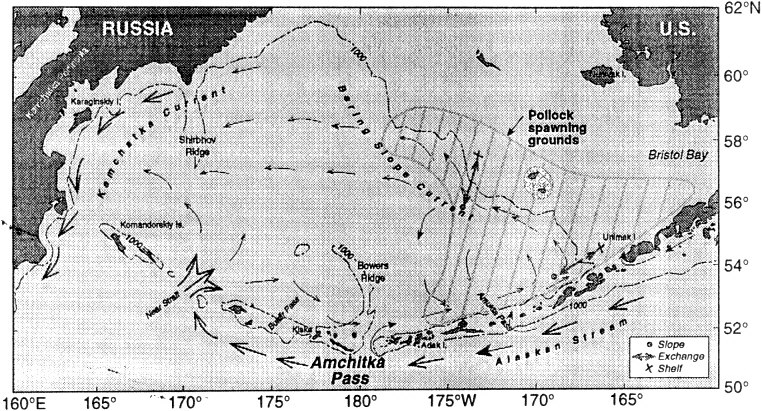
NOAA's Fisheries Oceanography Coordinated Investigations (FOCI), a cooperative effort of the PMEL, the National Marine Fisheries Service (NMFS)/Alaska Fisheries Center (AFSC), and the Coastal Ocean Program (COP), is conducting research on the causes of high productivity in the Bering Sea Greenbelt, located in a region along the continental slope associated with the Bering Slope current (Figure 1). This Greenbelt has shown sustained productivity in the spring and summer and provides a clue for the location of the major pollock spawning area of the Bering Sea. The Greenbelt is fed by waters which flow along the north side of the Aleutian Islands which originate, in part, by flow from the Pacific Ocean through Amchitka Pass. Unfortunately, a quarter century after an underground nuclear blast by the United States, small amounts of radiation contaminants may be leaking into Amchitka Pass (Washington Post, October 31, 1996). As part of the NOAA Arctic Research Initiative, the University of Alaska and PMEL conducted the first major reconnaissance of the accompanying velocity, salinity and temperature fields. This data, along with satellite measurements of ocean color and sea-surface height, will elucidate mechanisms for the prolonged production. Also in 1997, PMEL and COP began a measurement program in the north Aleutian slope current to monitor the flow of water from Amchitka Pass into the Greenbelt region.
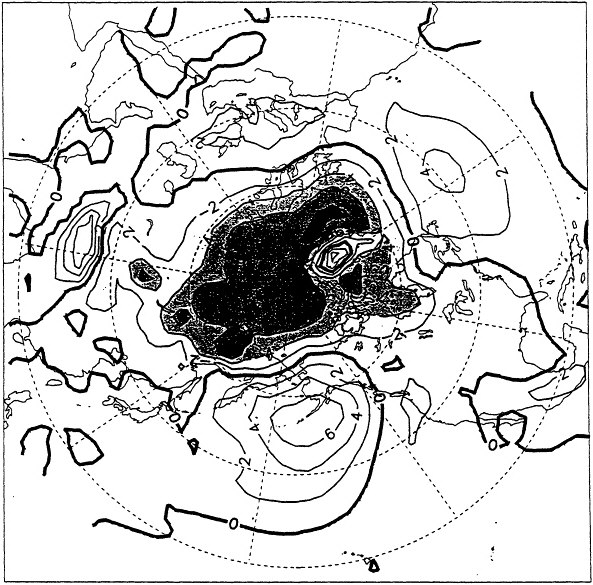
The Bering Sea ecosystem, both physical and biological, displays major natural variability. A major driver of the variability is atmospheric forcing. The Western Arctic appears particularly prone to decadal shifts. Figure 2 shows the change in sea level pressure for the period 1989-1996 minus the sea level pressure for the period 1978-1988. There was a 6 mb decrease in pressure of the Beaufort high pressure region over the Arctic in the 1990s compared to the 1980s and a 6 mb increase in pressure of the Aleutian low pressure region over the southern Bering Sea and north Pacific Ocean. A 6 mb change represents over a 1/3 weakening in these two climatological features. Winds associated with pressure gradients advect sea ice and warm and cold temperatures and effect primary productivity through changes in ocean mixed-layer depths. The weak pressure gradients between the Beaufort high and Aleutian low in the 1990s have brought colder temperatures to Alaska, greater sea-ice extent in the Bering Sea and less sea-ice extent in
the Sea of Okhotsk, similar to the decadal period prior to 1977. It is intriguing that many biological shifts tend to occur with the changes in atmospheric regimes. The NOAA Arctic Research Initiative is pursuing the causality of such connections, which also provides a background for interpreting contaminant effects.
ERL/CLIMATE MONITORING AND DIAGNOSTICS LABORATORY (CMDL) SUMMARY
BARROW OBSERVATORY:
The NOAA/CMDL operates one of its Baseline Observatories at Barrow, Alaska (71.3°N). Records of greenhouse gases, ozone, aerosols and solar radiation extend back to the early seventies, including continuous data on the Arctic haze phenomenon and recent episodes of Arctic ozone depletion. Recently, CMDL has linked with the DOE Atmospheric Radiation Measurement (ARM) program with the North Slope ARM site contiguous with the CMDL site and with collaboration in solar and terrestrial radiation and atmospheric aerosol research. CMDL also measures ozone from the surface and with balloons at Fairbanks in collaboration with UAF Geophysical Institute scientists.
NOAA ARCTIC RESEARCH INITIATIVE:
The NOAA/CMDL is collaborating with University of Alaska investigators (through CIFAR) in three FY1997 research programs:
(I) LONG-TERM TRENDS IN ARCTIC HAZE IN ALASKA:
Aerosol measurements at the NOAA Barrow Observatory, which are being upgraded through the ARM program, will be complemented with aerosol chemical measurements and air trajectory analyses to investigate the causes and track possible future changes in the long-term decrease in Arctic haze that has been observed at this site. In addition, by acquiring chemical information on the aerosol at three other sampling sites in Alaska, information will be derived on the geographic coverage of Arctic haze in the U.S. Arctic region; in particular, testing the working hypothesis that the Brooks Range represents a barrier to Arctic haze reaching into the central portion of Alaska. It is expected that pollution flowing into Alaska from the Orient represents a relatively small contribution in comparison to the Arctic haze transported from Eurasia. This will be investigated.
(ii) MEASUREMENTS OF THE UV RADIATION ENVIRONMENT IN THE ARCTIC
Rare and fragile life forms and the potential for excessive stratospheric ozone loss in the Arctic make the monitoring of actual variations in the biologically sensitive regions of the UV spectrum particularly important in the Alaskan Arctic. Biological effects depend on the spectral distribution, and different biological systems have markedly different action spectral responses. There is a great need to know more about the effects of UV on Arctic ecosystems. Although considerable progress has been made in predicting UV exposure for mid-latitudes, there are great limitations in predicting or modeling ground level UV in polar regions. Ground-based spectral UV measurements are, therefore, crucial for developing reliable algorithms for surface UV exposure in the Arctic from satellite data. In addition to simply measuring the integrated erythemal radiation, the UV exposure including the spectral dependence of the radiation field will
be measured at the Barrow Observatory and correlated with ozone measurements.
(iii) CLIMATE CHANGE IN THE WESTERN ARCTIC:
In recent decades, the climate of the western Arctic has changed. This is indicated in both the temperature and the snow cover records from several high-latitude observatories in that region. At Barrow, for example, the annual accumulation of snow has diminished and the date of snow melt has apparently advanced, while temperatures have increased by about 1.4°C over the past 30 years. The goal of this study is to determine the underlying physical causes of these changes. Preliminary results show that Barrow's climate is being influenced by the transport of heat and moisture into the region from the north Pacific. Neither the decrease in snowfall, nor the non-uniform temperature trends are easily explained as the direct consequence of greenhouse warming predicted by climate models and are more likely a consequence of changing circulation.
SUMMARY OF NOAA/NATIONAL OCEAN SERVICE PROGRAMS RELATED TO ARCTIC CONTAMINANTS
I. Environmental Quality Monitoring and Assessment Network
NOAA's National Status and Trends (NS&T) Program is designed to determine the current status of, and to detect changes in, the environmental quality of estuarine and coastal waters of the United States. The program consists of two primary components: Coastal Monitoring (includes Mussel Watch, Quality Assurance, Specimen Banking, and Historical Trends Analysis) and Bioeffects Assessment (includes Sediment Toxicity Assessment, Application of Biomarkers, Coastal Ecosystem Health Indicators, and Integrated Regional Assessments). The Mussel Watch component of the program monitors levels of contaminants at more than 240 sites nationwide. This activity has continued since 1986. Sediment toxicity assessment studies have been carried out in over 22 estuarine and coastal regions of the United States since 1991. The NS&T suite of chemical contaminants consists of chlorinated pesticides (22), polychlorinated biphenyl congeners (18), polycyclic aromatic hydrocarbons (30), trace elements (12), butyltins (3), and several ancillary parameters. In certain cases, planar PCBs, polychlorinated dibenzo-p-dioxins, and polychlorinated dibenzofurans are also analyzed. Eleven (11) Mussel Watch sites are located in Alaska along the Gulf of Alaska coast. All of them were sampled in 1995; five (5) core sites were sampled again in 1997. The core sites are near Ketchikan, Nahku Bay (near Skagway), Port Valdez (2), and Homer Spit (in lower Cook Inlet). There are no Mussel Watch sites in the Bering, Chukchi or Beaufort seas. Our current plans call for establishing five sites along the Beaufort Sea coast: Barrow, East Harrison Bay, Prodhoe Bay, off Canning Privet, and off Barter Island. Field sampling is scheduled for August 1997. No bioeffect assessment studies have been carried out in Alaska. Contingent upon the need and availability of resources, such studies may be carried out in the future.
II. Radionuclides in the Environment and Biota of the Arctic
With partial funding from the Office of Naval Research and very effective collaborative efforts with different state and Federal agencies, NOS/Office of Resources and Conservation Assessment (ORCA) has obtained and analyzed a large number of sediment and biological samples from the United States Arctic and Russian Far East. Field sampling was carried out during the 1993-95 and included collaborative work with Russian scientists. Particular emphasis was placed in collecting animals or tissues from animals that are used for subsistence, such as anadromous and marine fish, marine mammals, seabirds, and caribou. The samples were analyzed for a variety of alpha-, beta-, and gamma-ray emitting radionuclides that are long-lived and known to have environmental significance. All samples were analyzed by high-level gamma ray spectroscopy. Selected samples were also analyzed for cesium (low level beta counting and high resolution gamma ray spectroscopy) and strontium (low level beta counting of yttrium) after chemical separation purification. A number of samples were also analyzed for plutonium isotopes, americium, and polonium. Thermal Ionization Mass Spectrometry (TIMS) was used to determine the 239Pu and 240Pu atomic ratio in sediments. An important finding to date is that radionuclide activity in marine fauna has extremely low, often undetectable, 137Cs activity; only slightly higher
values are noted for anadromous fish; relatively high values are found in caribou tissues; and 40K values are fairly uniform in all biological samples, except blubber. Even in the case of caribou tissues, measured radioactivity levels are much lower than the level of concern, or screening value for cesium in food items, 370 Bq/kg fresh weight. Assuming that all of the harvested caribou is consumed as food, a radiation dose of 0.0045 mSv per year can be calculated. This value is orders of magnitude lower than the worldwide average background radiation exposure, 2-3 mSv per year. Exposure to radionuclides in humans from consumption of marine foods should be viewed as negligible. Another important finding is that global fallout appears to be the predominant source of measured radionuclide activity in the sediment and biological samples. Seven (7) manuscripts have recently been prepared or are under preparation (as of June 1997) for publication in scientific journals.
III. Participation in the Arctic Monitoring and Assessment Programme (AMAP)
NOS/ORCA has participated in the development of various phases of the AMAP ranging from the conceptualization of the technical scope of the program in 1989 to preparation of ''Arctic Pollution Issues: A State of the Arctic Environment Report'' in 1997. ORCA staff had the lead role in preparing a chapter entitled "Petroleum Pollution" in the State of the Arctic Environment Report. This chapter was prepared in collaboration with Canadian, Russian, and Norwegian scientists. A 188-page summary of the report was distributed in June 1997; the full report will be published and distributed by the AMAP Secretariat at the end of summer 1997. Phase II of AMAP is to begin following a Sept-Oct, 1997 meeting when the scope of the program and priority of program elements will be discussed.
IV. Transportation and Deposition of Pesticides and Pcbs in the Arctic
NOS/ORCA scientists have been concerned about the transport and deposition of persistent organic pollutants, such as chlorinated pesticides and polychlorinated biphenyls (PCBs), in the Arctic since several such chemicals are nearly ubiquitous in the environment and some are found in biological tissues in concentrations that are orders of magnitude higher than in the surrounding media and lower trophic level animals. Scientists from Environment Canada have established a network of stations within the Arctic circle (Alert, northern Ellesmere Island; Tagish, Yukon; and Dunay, Russia) to monitor atmospheric levels of polycyclic aromatic hydrocarbons, organochlorine pesticides, and PCB congeners. Their results show that levels of these pollutants are appreciable and often comparable to levels in more populated and industrialized region of North America and Europe. No such measurements exist in the United States Arctic. Currently, the United States represents a void in the monitoring and assessment of POPs in the Arctic. Our previous proposals for such a study, which have also included measurements in sediment and biota, have not been successful primarily due to institutional constraints. However, this remains an important research element without which the occurrence of persistent organic pollutants in the Arctic ecosystem cannot be adequately explained. Successful implementation of this study will also address data requirements of the international AMAP working group and respond to the U.S.-Russia agreement on responsible stewardship of the Arctic (December 1994).
V. Petroleum Hydrocarbons In The Arctic
Largely as a result of managing the Outer Continental Shelf Environmental Assessment Program (OCSEAP) during the 1974-92 period, and studying the Exxon Valdez oil spill, NOS/ORCA has accumulated an extensive information base and institutional capabilities that are unmatched in addressing environmental issues relating to petroleum hydrocarbons in the Arctic, including transport, fate and effects of spilled oil. Recently, we completed a review of polycyclic aromatic hydrocarbons (PAHs) in the United States Arctic with the purpose of describing their patterns of distribution and diagnosing their sources, i.e., crude oil, peat, wood or fossil fuel combustion.
VI. Scientific Review And Outreach
-
NOS/ORCA has maintained effective liaison with the State of Alaska on matters relating to environmental contaminants for a number of years. Over the years, our field sampling in the Arctic has generally involved collaborative efforts with personnel from the North Slope Borough. Recently, ORCA provided funds to the North Slope Borough for preparing a review of data on environmental contamination in the Arctic region under the jurisdiction of the borough, providing assistance in the collection of biological tissue samples for contaminant analysis, and disseminating the resulting information to local communities.
-
Responding to recent requests from the scientific community and residents of the US Arctic, we are proposing to convene a special session at the joint meeting of the American Society of Limnology and Oceanography and the Ecological Society of America in June 1998. This session, tentatively entitled "Arctic Contamination: An American Perspective," will focus on contaminant levels and sources, contaminant transport pathways and food chain transfers, and adverse biological effects due to environmental contamination, including assessment of ecological and human health risks, as appropriate. For comparative purposes, presentation of data from Canada, Russian Far East, and other Arctic regions will be strongly encouraged.
The above summary is for the NOAA, National Ocean Service activities that directly pertain to the study of environmental contaminants in the Arctic. It does not specifically include capabilities dealing with sea ice analyses and forecasting, data and imagery from high resolution remote sensing, and results of the United States Interagency Arctic Buoy Program that provide useful information on the meteorological conditions and patterns of contaminant transport as mediated by sea ice. Also not included are information management capabilities using desktop microcomputer systems that can produce a wide variety of products, ranging from distribution maps of different environmental parameters to CD-ROMs that can provide unified and integrated data information products derived from numerous widely dispersed sources.
DRAFT SUMMARY OF NOAA/NATIONAL MARINE FISHERIES SERVICE PROGRAMS RELATED TO ARCTIC CONTAMINANTS
The National Marine Fisheries Service (NMFS) has several key programs contributing directed research on 1) contaminant inputs, fate and effects, and 2) the potential impacts of Arctic haze, ozone and UV flux in the Arctic ecosystem. The NMFS is developing a Centers of Expertise for Contaminants which will coordinate the contaminant programs within NMFS so that we can further our research capabilities. Recently, contaminant research in NMFS has largely focussed on fate and effects. The Alaska Fisheries Science Center research focuses on baseline data so that the impacts of atmospheric changes on ecosystem productivity. NMFS performs assessments of the current status of ecosystems as well as assessments of specific species. NMFS programs which are directly related to Arctic contaminants include the Marine Mammal Health and Stranding Response Program, programs in the Northwest Fisheries Science Center-Environmental Conservation Division, the National Marine Analytical Quality Assurance Program, and programs in the Alaska Fisheries Science Center.
These programs contribute to NMFS stewardship role for living marine resources through two of its major efforts, recovering protected species and sustaining healthy living marine resource habitat. A brief description of these programs follows.
The Marine Mammal Health and Stranding Response Program (MMHSRP) was established under Title IV of the Marine Mammal Protection Act as amended in 1992 in order to facilitate the collection and dissemination of reference data on health and health trends in marine mammal populations, to correlate the health of marine mammals with physical, chemical and biological environmental parameters (including contaminants), and to coordinate effective responses to unusual mortality events. The initial focus of the program has been establishing a better understanding of anthropogenic contaminant levels in marine mammals with a considerable emphasis on Alaskan species. The components of the MMHSRP are: The National Marine Mammal Tissue Bank (including the Alaska Marine Mammal Tissue Archival Project), the stranding network (including response to unusual mortality events), the contaminant and health biomonitoring component, the quality assurance component and a National database on strandings, health and contaminants relative to marine mammals.
The Alaska Marine Mammal Tissue Archival Project (AMMTAP) and the biomonitoring components of the MMHSRP have been active in contaminant research in the Arctic since 1987. The AMMTAP was initiated as part of the Outer Continental Shelf Environmental Assessment Program of NOAA and was funded by the Department of Interior's (DOI) Minerals Management Service. The AMMTAP was merged with the MMSHRP after 1992, and the two are managed together with funding from NMFS, the National Institute of Standards and Technology (NIST) and DOI, Biological Resources Division, US Geologic Service. In addition to this partnership, the MMHSRP has other federal, native, state and international partners. A Memorandum of Understanding regarding expansion of the contaminants program is being reviewed by the Departments of Interior and Commerce. AS of 1996, the NMMTB including AMMTAP contained tissues from 252 animals of 16 species. Of these, 192 animals are from the Arctic with the
bowhead whale, ringed seal and beluga whale having the highest numbers. Many of these tissues have been analyzed for metals and chlorinated hydrocarbons. Analytical results from these samples have been published and are being used by management. Future activities will be focussed on understanding fate, transport and biomedical and population effects of marine contaminants and other human activities. The MMHSRP will continue to be a multi-disciplinary and integrated program.
The National Marine Analytical Quality Assurance Program was established in 1995 as an outgrowth of the MMHSRP, involving the collaboration of NMFS with the National Institute of Standards and Technology. The goals of the program are to assess and improve the quality of analytical measurements in the marine environment through interlaboratory comparisons and reference material development and to improve the capabilities to assess trends in marine environmental quality by expanding environmental specimen banking activities. The activities of this program are: 1) collaboration / consultation to identity quality assurance, reference materials and specimen banking related needs in marine environmental research, 2) establishment of cryogenic specimen bank facility in Charleston, 3) production of control material, proficiency testing materials and reference material that are representative of marine matrices for evaluation of the quality of analytical measurements, 4) cooperation in the preparation and certification of NIST standard reference materials for marine environmental measurements, and 5) education and training of scientists on quality assurance and specimen banking procedures. The specimen bank includes fish and sediment samples (National Status and Trends Program) and marine mammal samples (from AMMTAP-1987 and MMHSRP since 1992). Banking and quality assurance will continue to be an integral part of NMFS contaminant studies in the Arctic and nationwide.
The Environmental Conservation Division (ECD) of the Northwest Fisheries Science Center conducts research to define the nature and extent of chemical pollution and natural toxins (marine biotoxins) in the marine environment; their effects upon the health of living marine resources (LMRs), including protected species, and their implications for the safety and quality of seafood products. The ECD is the lead NMFS lab in the National Marine Analytical Quality Assurance Program and the MMHSRP. Because chemical pollution can affect the health and survival of LMRs as well as contaminate fisheries products, its potential impacts are of growing concern for NMFS. Studies undertaken within the ECD to address this complex problem typically follow an interdisciplinary approach. Among the scientific disciplines utilized are analytical chemistry, biochemistry, toxicology, reproductive biology, pathology, fisheries biology and immunology. One of the goals of the fishery contaminants program is to link effects observed in individual fish to potential changes at the population level. The ECD is also involved in long term studies of the effects of environmental contaminant on the survival and fecundity of protected species. Through association with the MMHSRP, the ECD has analyzed tissues from more than 20 marine mammal species for chlorinated hydrocarbons and toxic metals. These analyses are from bowhead whales, ringed seals, beluga whales, Northern fur seals, Steller sea lions and harbor seals of the Alaskan Arctic and Bering Sea. Other studies are focussed on evaluating the biological effects of contaminant exposures. For example, the ECD is collaborating with the University of Alaska, Fairbanks on the potential correlation of contaminants with health indices of Northern fur seals in the Bering Sea.
The Alaska Fisheries Science Center has several programs which are either directly or indirectly involved in research related to contaminants and contaminant effects on ecosystems and special-species and in research evaluating pathways, food webs and productivity. This latter information is of importance as baseline data from which we can evaluate and model the potential impacts of Arctic haze, ozone and UV flux may have on ecosystem productivity. In addition, a better understanding of food webs and productivity will allow us to better evaluate and assess the transport and impacts of contaminants on the ecosystem. The Resource Ecology and Fisheries Management Division conducts research and data collection to support management of eastern Bering Sea fish and crab resources. The Resource Assessment and Conservation Engineering Division conducts fishery surveys to measure the distribution and abundance of important fish and crab stocks in the eastern Bering Sea and Gulf of Alaska. This research has expanded into the Fisheries Oceanography Coordinated Investigation (FOCI) program, a joint project between NMFS and the Pacific Marine Environmental Laboratory to study the biological and physical processes that control the survival and growth of fish in the Gulf of Alaska and the Bering Sea. Studies targeting groundfish, seabirds and marine mammals to understand the food chain links in production and trophic interactions are underway. Additionally, studies to understand primary production and the links to lower trophic levels and food chains are important to contaminant and arctic atmospheric research.
The National Marine Mammal Laboratory of the Alaska Fisheries Science Center has two programs which are related to the issues of contaminants and their impacts on populations. The Alaska Ecosystems Program is primarily responsible for advising managers on the status of Steller sea lions, northern fur seals and harbor seals. The program is charged with performing biological studies and assessments on seals and sea lions taken incidentally from fisheries interactions or directly from subsistence hunts. Information gained includes stock structure, abundance, human induced mortalities, net productivity, and life history data. The Cetacean Assessment and Ecology program has primary responsibility in monitoring the status of several Alaskan cetacean and pinniped species including bowhead, beluga, gray, killer and humpback whales, harbor porpoise and the four species of ice seals. Both of these programs are designed to monitor populations to detect trends in growth and to investigate causes for declines in populations and provide valuable biological data for assessment of the impacts of contaminants on marine mammal populations in the Arctic. Some specific studies have focussed on the levels of contaminants in declining marine mammal populations.
In summary, all of the described NMFS programs are designed to assure the quality of contaminant analyses and to increase our ability to interpret the results from a biological standpoint. In order to adequately understand the fate and impacts of these contaminants, an understanding of their biological as well as physical and environmental context and the possibilities of interactions with other stressors must be addressed. Through NMFS programs, baseline data on contaminant loads and effects and on the biology of specific species and of ecosystems will continue to contribute to studies of contaminant and atmospheric impacts in the Arctic.
U.S. Arctic Contaminant Research Planning Workshop August 10-13, 1996 Fairbanks, Alaska
The question of what research the United States should be doing related to contaminants in the Arctic is one of considerable importance, and it has received attention in many forums. in August 1996, the Environmental Protection Agency and the Office of Naval Research sponsored a workshop, the U.S. Arctic Contaminant Research Planning Workshop, to "understand, assess, integrate, and identify critical research that significantly reduces uncertainty in future risk assessment." The workshop agenda was organized around stressors to the environment and what is know about them in the context of ecological risk assessment. The workshop included presentations on the risk assessment paradigm, radionuclides, hydrocarbons, trace metals, organics, UVB, and acidification. EPA hoped to use the outcome of the workshop to prioritize research funding. The workshop involved approximately 40 people for three days of presentations and discussions.
That EPA/ONR workshop was a broad look at Arctic contaminants, including the full range of problems and looking at the research being done by many agencies, and it attempted to suggest national research priorities. This effort was considered a good starting point from which to proceed for the July 11 workshop on NOAA's Arctic Research Initiative (i.e., can we take the priorities suggested in 1996 and identify those best suited for NOAA's Arctic Research Initiative?) One problem hindering such a refinement is that although various background materials exist from the 1996 EPA/ONR workshop, no final document or proceedings was produced from that event. Thus there are no official conclusions or recommendations.
A copy of the 1996 agenda and one item of particular importance, a series of suggested Priority Research Areas generated by the workshop participants, are included here as reference materials. Please note that the lists of priority research areas are provided here as background information only, with permission from the organizers, to give participants in today's workshop some sense of the purpose and output of the 1996 meeting.
U.S. Arctic Contaminant Research Planning Workshop
To understand, assess, integrate, and identify critical research that significantly reduces uncertainity in future risk assessment
|

|
AGENDA Wedgewood Resort, Fairbanks. Alaska The Boardroom August 10-13 |

|
|
Saturday, August 10, 1996 |
||
|
8:00-10:00PM |
Ice Breaker/Reception |
All participants invited |
|
Sunday, August 11, 1996 |
||
|
9:00 am |
Welcome |
Dr. Robert Huggett, EPA |
|
|
|
Dr. Robert Edson, ONR |
|
9:10 |
Agenda, Process, Outcomes |
Dr. Robert Huggett |
|
9:30 |
Introductions |
All participants |
|
9:45 |
Logistics |
Ron Slotkin, EPA |
|
10:50 |
|
Break |
|
MAIN SESSION |
||
|
Session 1 |
||
|
11:00 |
Ecological Risk Assessment Presentation |
Dr. Robert Huggett |
|
11:45 |
Questions/Discussion |
|
|
12:00 |
Lunch |
|
|
Session 2 |
||
|
1:00 pm |
Radionuclides Presentation |
Dr. John knezovich, LLNL |
|
1:30 |
Questions/Moderated Discussion |
|
|
|
|
• Problem Formulation |
|
|
|
• Current Level of Knowledge |
|
|
|
• Data Caps in Assessment |
|
|
|
• Assess Risk Assessment Issues |
|
|
|
• Other Related Issues |
|
|
|
• Critical Research Needed to Reduce Uncertainity |
|
3:00 |
Break |
|
|
Session 3 |
||
|
3:20 |
Hydrocarbons Presentation |
Dr. Jawed Hameedi, NOAA |
|
3:50 |
Questions/Moderated Discussion |
|
|
|
|
• Problem Formulation |
|
|
|
• Current Level of Knowledge |
|
|
|
• Data Gaps in Assessment |
|
|
|
• Assess Risk Assessment Issues |
|
|
|
• Other Related issues |
|
|
|
• Critical Research Needed to Reduce Uncertainity |
|
5:20 |
Open Forum/Announcements |
|
|
5:45 pm |
Adjourn |
|
|
Day 2 US Arctic Planning Workshop Agenda |
||
|
Monday, August 12, 1996 |
||
|
9:00 am |
Opening & Announcements |
|
|
Session 4 |
||
|
9:15 |
Trace Metals Presentation |
Dr. Kate Mahaffey, EPA, et al |
|
10:00 |
Questions/Moderated Discussion |
|
|
|
|
• Problem Formulation |
|
|
|
• Current Level of Knowledge |
|
|
|
• Data Gaps in Assessment |
|
|
|
• Assess Risk Assessment Issues |
|
|
|
• Other Related Issues |
|
|
|
• Critical Research Needed to Reduce Uncertainity, |
|
10:30 |
Break |
|
|
11:00 |
Discussion continued |
|
|
12:00 |
Lunch |
|
|
Session 5 |
||
|
1:00 pm |
Organics Presentation |
Dr. Paul Becker, NIST |
|
1:30 |
Questions/Moderated Discussion |
|
|
|
|
• Problem Formulation |
|
|
|
• Current Level of Knowledge |
|
|
|
• Data Gaps in Assessment |
|
|
|
• Assess Risk Assessment Issues |
|
|
|
• Other Related Issues |
|
|
|
• Critical Research Needed to Reduce Uncertainity |
|
3:00 |
Break |
|
|
Session 6 |
||
|
3:30 |
UVB Presentation |
Dr: Elizabeth Weatherhead, UCB |
|
|
|
Dr, Ed Defabo, GWU |
|
4:15 |
Questions/Moderated Discussion |
|
|
|
|
• Problem Formulation |
|
|
|
• Current Level of Knowledge |
|
|
|
• Data Caps in Assessment |
|
|
|
• Assess Risk Assessment Issues |
|
|
|
• Other Related Issues |
|
|
|
• Critical Research Needed to Reduce Uncertainity |
|
5:15 |
Open Forum/Announcements |
|
|
5:45 pm |
Adjourn |
|
|
Day 3 US Arctic Planning Workshop Agenda |
||
|
Tuesday, August 1:3, 1996 |
||
|
9:00 am |
Opening & Announcement |
|
|
Session 7 |
||
|
9:15 |
Acidification Presentation |
Dr. Dan Jaffe, UAF |
|
g:45 |
Questions/Moderated Discussion |
|
|
|
|
• Problem Formulation |
|
|
|
• Current Level of Knowledge |
|
|
|
• Data Gaps in Assessment |
|
|
|
• Assess Risk Assessment Issues |
|
|
|
• Other Related Issues |
|
|
|
• Critical Research Needed to Reduce Uncertainity, |
|
10:30 |
Break |
|
|
11:00 |
Discussion continued |
|
|
12:00 |
Lunch |
|
|
CLOSING SESSION |
||
|
1:15 pm |
Review Session Summaries (typed/copied) |
Break out/group |
|
2:30 |
Develop and Review |
All participants |
|
|
Critical Research Needs |
|
|
|
|
• Additions |
|
|
|
• Modifications |
|
4:00 |
Open Forum/Announcements |
|
|
4:15 pm |
Adjourn |
|
Radionuclide Priority. Research Areas
|
Exposure Issue |
Ranking. |
|||
|
|
|
I |
II |
G |
|
1 |
Diet: Quantitative and qualitative assessment of Alaska Native and arctic indigenous diets with respect to quantity and duration of food consumed, including effects of food preparation, transport and handling methods on concentrations of contaminants. |
X |
|
X |
|
2 |
Source identification: Determine past, present and future sources of radionuclides and uncertainties in source terms (e.g., location, magnitude and release rate. Local sources examined should include Amchitka Island nuclear test site, Fort Greeley and Adak. |
X |
|
|
|
3 |
Transport: Consider the effects of the entire transport system (including atmospheric deposition. sediments, rivers, sea ice, coastal currents, and biological vectors) on exposure. Studies should include model development and verification, with field and laboratory studies that include chemistry and biology. |
X |
|
X |
|
4 |
Exposure and dose to different tissue types. Describe physiological redistribution of contaminants at target tissues (e.g., compare bone and gonad calculations with those of muscle and liver). Use contaminant measurements in human tissue (e.g.. hair, blood) as biomarkers of exposure and effect in human populations. targeting sensitive subgroups. |
X |
|
X |
|
5 |
Uptake and effect by primary, and secondary. producers. |
X |
|
|
|
6 |
More accurate estimates bio-accumulation factors. |
X |
|
|
|
7 |
Timing of residue measurement vs. life history considerations. |
|
X |
|
|
|
Effects Issue |
I |
II |
G |
|
1 |
Low level chronic exposure vs acute effects and endpoints (genetic? other?) |
X |
|
|
|
2 |
Information on effects for arctic species. (There is a lack of information on these species.) |
X |
|
|
|
3 |
Data rescue: Are there clearly defined biological impacts/effects from prior studies? There is a lot of data from the 1950s and 1960s on low level effects on human with no follow-up. Follow up previous 90Sr and 137Cs studies. |
X |
|
|
|
4 |
Strategies for sampling. especially large animals and physical conditions of animals. |
X |
|
X |
|
5 |
Differential effect/exposure on 1/2 lives in different systems (e.g., lichens vs forests). |
X |
|
|
|
6 |
Mechanisms for end points (cellular, etc.), e.g., studies on DNA repair mechanisms. |
|
X |
|
|
7 |
Synergistic effects. particularly with UVB |
|
X |
|
Hydrocarbon Priority. Research Areas
|
Exposure Issue |
Ranking |
|||
|
|
|
I |
II |
G |
|
1 |
Effect of food preparation, transport and handling (e.g., engine exhaust) on contaminants. |
X |
|
X |
|
2 |
Source identification: For example, PAHs in sediment from petroleum combustion, and sources of non-petroleum PAHs. |
X |
|
|
|
3 |
Exposure of humans to petroleum byproducts, especially benzene. |
X |
|
|
|
4 |
Effects of oil on prolonging and concentrating exposure of ice algae and epontic communities. (Understand the ecosystem.) |
X |
|
X |
|
5 |
Develop and test bio-markers for exposure in the Arctic. |
X |
|
|
|
6 |
Effect of temperature on body burdens. Routes and pathways of exposure to top-level carnivores. |
X |
|
|
|
7 |
Effects of salinity on PAH concentration and transport (sea ice formation and melting). |
|
X |
|
|
8 |
Transport models: biological, physical. and chemical effects. |
|
X |
|
|
|
Effects Issue |
I |
II |
G |
|
1 |
Effects of oil and gas development on (psychological) stress in individuals and society. |
X |
|
X |
|
2 |
Chronic discharges of oil. Effects of lease development (spills) on subsistence living (# of spills over time). |
X |
|
|
|
3 |
Effects of hydrocarbons on metabolism, osmoregulation, thermoregulation, waxy esters (oil formation), chitin (and enzymes for digestion and rates of passage of chitin). Formation of harmful metabolic byproducts. Bio accumulation/bio-magnification (sub lethal impacts, including immune responses). Chronic effects of exposure (low levels), and ecological consequences other than mortality or fecundity. |
X |
|
|
|
4 |
Effects of wood burning on human health at turn of century. (epidemiolology). |
|
X |
|
Persistent Organic Pollutant Priority Research Areas
|
Exposure Issue |
Ranking |
|||
|
|
|
I |
II |
G |
|
1 |
Source identification. Need further investigation of emission sources. including military bases and refineries as local sources, and byproducts of combustion such as heterocyclic compounds.. |
X |
|
|
|
2 |
Transport: Consider effects of the entire transport system on exposure, e.g., transport by sea ice. |
X |
|
X |
|
3 |
Differences in accumulation pathways for various arctic species. For example: measure stable isotopes to determine trophic level exposures, increase food web sampling in studies, and make measurements on individual fish rather than pooled samples. |
X |
|
|
|
4 |
Analyze existing data on lichens and mosses as indicators of semi-volatiles. |
X |
|
|
|
5 |
Examine and apply emerging (economical) techniques for dioxins, furans, toxaphenes, and coptanar PCBs. |
X |
|
|
|
6 |
Temporal dynamics: seasonal change. |
|
X |
X |
|
|
Effects Issue |
I |
II |
G |
|
1 |
Risk perception and risk communication. Educate populations about risks of eating certain organs relative to specific contaminants, e.g., liver and kidneys. |
X |
|
X |
|
2 |
Effects (including synergistic effects) of PCBs and other persistent organic pollutants on endocrine and genetic systems of arctic mammals. (See article in 6/7/96 issue of Science.) |
X |
|
|
|
3 |
Pathways for turnover/metabolism in different pathways develop models of transport and accumulation |
X |
|
|
|
4 |
Effects of PCB's and byproducts on DNA damage. |
|
X |
|
Acidification Priority Research Areas
|
Exposure Issue |
Ranking |
|||
|
|
|
I |
II |
G |
|
1 |
Source identification: Evaluate local sources and deposition (Pb/Zn mines). |
X |
|
|
|
2 |
Geographic distribution (deposition/local and long range mapping): acid/non acid tundra deposition; deposition of arctic haze; fail-out to open water (effects on surface layer productivity). |
X |
|
|
|
3 |
Investigate exposure from sea ice release and transfer to surface water, especially in Bering Sea. |
X |
|
|
|
|
Effects Issue |
I |
II |
G |
|
1 |
Effects on plants of acid, NOx, etc. — important effects of herbivore consumption/deposition. For example, decline of caribou herds around Prodhoe, Cook Inlet, etc. over past 16 years is likely caused by nutrition deficits. |
X |
|
|
|
2 |
Primary productivity studies — plankton and tundra. |
X |
|
|
|
3 |
Human health. |
X |
|
X |
|
4 |
Effects of acidification on treeline position. Is treeline moving? |
|
X |
|
|
5 |
Nitrogen metabolism in sensitive ecosystems (target aquatic ecosystems). |
|
|
X |
Generic Priority Research Areas
|
Exposure Issue |
Ranking |
|||
|
|
|
I |
II |
G |
|
1 |
Diet: Quantitative and qualitative assessment of Alaska Native and arctic indigenous diets with respect to quantity. and duration of food consumed, including effects of food preparation, transport and handling methods on concentrations of contaminants. Explore more recent approaches to dietary changes. Many other countries have developed different techniques. |
X |
|
X |
|
2 |
Transport: Consider the entire transport system (including atmospheric deposition, sediments, rivers, sea ice, coastal currents, and biological vectors) on exposure. Studies should include model development and verification, with field and laboratory studies that include chemistry and biology. |
X |
|
X |
|
3 |
Exposure and dose to different tissue types: Describe physiological redistribution of contaminants at target tissues (e.g., compare bone and gonad calculations with those of muscle and liver). Use contaminant measurements in human tissue (e.g., hair, blood) as biomarkers of exposure and effect in human populations. targeting sensitive subgroups. |
X |
|
X |
|
4 |
Exposure effects need to be determined for humans and other arctic species. |
|
X |
X |
|
|
Effects Issue |
I |
II |
G |
|
1 |
Examine synergistic effects, particularly with UVB radiation. |
X |
|
X |
|
2 |
Data rescue: Are there clearly defined biological impacts/effects from prior studies?. |
X |
|
X |
|
3 |
Effects psychological stress in individuals and society. |
X |
|
X |
|
4 |
Investigate epidemiological methods used for small populations in the Arctic. |
X |
|
X |
|
5 |
Strategies for sampling, especially large animals and physical conditions of animals. |
X |
|
X |


