Introduction

Parents want to provide their preschool children with a good start in literacy. A school district tells its teachers to change the way they teach reading. Preschool caregivers want to be sure that the children they care for are ready for school. A mother attending a school meeting hears confusing messages about the best way to teach beginning reading. A corporate executive wants the company to support an after-school tutoring program, but is not sure where to start.
This book is for all these people. It is written particularly for parents, who should find the information useful in making judgments about:
-
what kinds of language and literacy experiences to look for in preschool and child care settings,
-
what to look for in initial reading instruction in kindergarten and the early grades,
-
what to ask school boards, principals, elected officials, and other policy makers who make decisions regarding early reading instruction,
-
whether their child is making progress in reading related skills and early reading.
It is also for others who can influence the education and development of young children, especially policy makers, caregivers, and teachers.
Editors’ Note: Two icons appear frequently throughout this book
 Activities that can be done with children
  “For More Information” see page 153
The goal of Starting Out Right is to share, with a broad audience, a wealth of knowledge based on a summary of extensive research. The book focuses on children from birth through the first years of formal schooling, and our hope is that the findings it contains will be widely used to improve their reading and educational prospects. To this end, these pages include practical guidelines, program descriptions, advice on resources, and strategies that can be used in everyday life, including:
-
practical literacy and language activities for parents and their young children and
-
activities and practices for classrooms.
We caution that most of the activities could be used to excess. Consider as an example the statement that “the more you read with your children, the more they will learn to love reading.” In this book we emphasize that reading to young children is important for language and literacy growth—but it can be overdone. After several days of too many hours of reading every day, the reading experience might well start to become distasteful for a child.
The language and literacy activities included in this book illustrate the underlying concepts important for reading that are supported by scientific research. Many of the activities are familiar, and they are here to connect what readers may already know to unfamiliar-sounding concepts such as ”phonological awareness.” Our hope is that, through these activities, the nature of each literacy concept—along with ways to support its development and to look out for problems—will become clear. We expect that the individual activities included will be helpful for most children; however, they are examples rather than comprehensive curricula in themselves. For many activities, we provide a list of resources for obtaining comprehensive curricula on teaching a concept. The glossary on page 147 gives basic definitions of unfamiliar reading terms found throughout the text.
GUIDE TO THIS BOOK
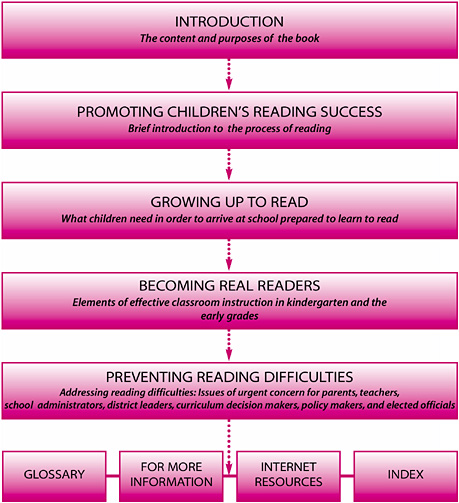
This books consists of five chapters. We know that some readers may only have interest in one particular chapter. For example, the parent of a child about to enter first grade may be most interested in the chapter on Becoming Real Readers.
Although this chapter can certainly be read immediately after this introduction, it is also true that reading the chapter on Growing Up to Read will help in clarifying how your child got to this point. Likewise, we suggest that parents of preschool children should also read about the early grades, to gain perspective on where they are headed. And we suggest that people with an interest in preventing reading difficulties—family and community members, school administrators, district leaders, teachers, curriculum decision makers, volunteer tutors, and elected officials—read the entire book. Please note that we sometimes refer to a parent, when in fact a teacher or early childhood professional may be the adult participating in the activity. And, we sometimes use the word teacher when in practice it might be a parent participating in the activity.