
LARS ONSAGER
November 27, 1903-October 5, 1976
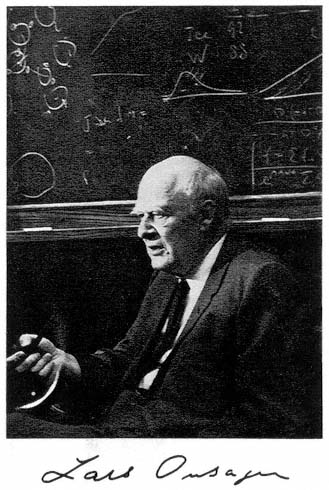
Courtesy, Yale Picture Collection
BY H. CHRISTOPHER LONGUET-HIGGINS AND MICHAEL E. FISHER1
ONE DAY IN 1925 Pieter Debye was sitting in his office at the Eidgenössische Technische Hochschule in Zürich when a visitor from Norway was announced. In came a tall young man, who walked silently across the room, bent over the desk, and said solemnly: ''Professor Debye, your theory of electrolytes is incorrect.'' Whereupon Debye, after begging the stranger to sit down and inviting him to discuss his objections, offered him an assistantship for the following year. The young man's name was Lars Onsager.2
Forty-three years later Onsager was awarded the Nobel Prize in Chemistry for the "discovery of the reciprocal relations bearing his name, which are fundamental for the thermodynamics of irreversible processes." A group of physicists and chemists at Cornell had written of him: "We believe that his work is unique for its penetration, breadth, and influence in the development of theoretical and experimental studies of condensed matter. He is surely one of the outstanding physicists of this century."
NORWAY (1903-1925)
Lars was born in Oslo on 27 November, 1903, to Erling and Ingrid Kirkeby Onsager. Erling was a barrister, and it is said that the family had interests in the steel industry, though Lars was later at pains to deny that his father was "a steel tycoon." His early education was liberal; his friends found him, in later life, extraordinarily well read in classical literature and philosophy and admired his taste in music and the fine arts. He attended high school in Oslo and at an early age familiarized himself with Norwegian literature, including the verse epics he loved to recite to his family and friends in later life, both in the original and in his own English translations.
In 1920 Lars was admitted to the Norges Tekniske Hogskole in Trondheim to study chemical engineering in preparation for a technical career. But his inclinations were mainly intellectual; he had already bought a copy of Whittaker and Watson's classic monograph, Modern Analysis,3 and he worked through most of the (notoriously difficult) examples in his spare time. This early discipline equipped him for some of his most spectacular later achievements, notably his famous solution of the Ising problem in two dimensions.
In other ways as well, Onsager's time as a student at the Norwegian Institute of Technology was prophetic of his later scientific work. As a freshman chemist he was introduced to the current theory of electrolyte solutions, according to which the properties of an electrolyte should be additive, not just over molecules, but even over the constituent ions.
"In spite of some idealization," he declared later, "it sufficed for a great many purposes; it eased many tasks no end, and we were eternally grateful for that. However, very soon the journals rather than the textbooks taught
me about numerous observations which did not quite fit into the picture, and of tentative explanations for the discrepancies. . . . Suspicion centered on the long-range forces between the ions." (1969,1)
This passing reference to "the journals" shows that Onsager was already exercising an independence of mind that later blossomed into a deep scientific originality. When, in 1923, Debye and Hückel published their new theory of electrolyte solutions,4 Onsager was quick to master their ideas and to detect a flaw in their account of electrolytic conduction and diffusion. It was his own ideas about these processes that ultimately led him to the reciprocal relations that now bear his name; but a parallel influence on his thinking was the experimental work of C. N. Riiber5 on the kinetics of tautomerism, which he had already begun to consider in 1924 in the light of the principle of microscopic reversibility. Onsager saw that this principle would supply a sufficient condition for detailed balancing to prevail—for there to be no chemical "circulation" when three or more tautomers were present under equilibrium conditions. The same principle might, he suspected, be brought to bear on the relative rates of other naturally occurring processes.
In his five years at Trondheim, Onsager not only acquired the mathematical skill that he later put to such impressive use and an interest in electrolytes to which his attention was to return continually throughout his life, he also developed a deep appreciation of the relation of theory to experiment and of the duty of a theorist to propose experimental tests of his ideas. It is at least likely that his later interests in ther
mal diffusion (1939,2,3,4; 1940,1), in colloidal solutions (1942,1; 1949,1), and in turbulence (1945,2; 1949,3) were also engendered by his training as a chemical engineer. At any rate, when he finally graduated with a Ch.E. in 1925, a most formidable intellect stepped onto the scientific scene.
ZÜRICH (1926-1928)
It was Onsager's interest in electrolytes that first took him to Zürich in 1925. Debye and his assistant Erich Hückel had put forward a new theory of electrolyte solutions founded on the idea that the electrostatic field of a dissolved ion is screened by an "atmosphere" of opposite net charge, the effective screening distance being inversely proportional to the square root of the ionic strength c, defined as

where ci is the concentration of ion i, and zi is its electric charge in elementary units. The activity coefficient fi of any ion—its thermodynamic activity divided by ci—could then be calculated, for small c, from the equation

in which Ai was a function of the charge zi, the temperature T, and the dielectric constant D of the solvent. The theory was quantitatively successful in accounting for the thermodynamic properties of dilute salt solutions, but Debye and Hückel's extension of their theory to deal with the conductivities of electrolytes ran into difficulties. Their equation

for the molar conductivity Λ appeared to be correct in form, but the calculated value of Λ1, also dependent on T and D, differed considerably from the experimental value.
This was puzzling because the most important physical effects had, it seemed, been allowed for: an "electrophoretic effect" in which the counter-ions in the atmosphere pull the solvent in the wrong direction, making it necessary for the central ion to "swim upstream"; and a ''relaxation effect" in which the ion is held back by the net attraction of the atmosphere itself.
Accepting the general correctness of the physical picture, Onsager himself had explored its implications and in 1923 produced, as he himself put it, 'a modest but firm result':
"The relaxation effect ought to reduce the mobilities of anion and cation in equal proportion. Much to my surprise, the results of Debye and Hückel did not satisfy that relation, nor the requirement that wherever an ion of type A is 10 Å west of a B, there is a B 10 Å east of that A. Clearly something essential had been left out in the derivation of such unsymmetrical results." (1969,1)
By the time he visited Debye in his office in 1925, Onsager had pinpointed the origin of the discrepancy. Debye and Hiickel had evaluated Λ1 by assuming one particular ion to move uniformly in a straight line but allowing the other ions to undergo Brownian motion subject to the fields of their distorted atmospheres. All that was required was to relax the constraint that the central ion move uniformly, and to allow it to move as freely as its neighbors—subject, of course, to their influence and that of the external field. In this way the desired symmetry could be restored, and the calculated value of Λ1 brought into good agreement with experiment.
Debye must have been deeply impressed by this astonishing insight. It is no wonder that he proclaimed his young critic a genius. In April 1926 he demonstrated his sincerity
by taking Onsager on as a research assistant and in 1927 by promoting his ideas at a discussion meeting of the Faraday Society in Oxford. (1927,2)
The Onsager Limiting Law, as it came to be called, was first put forward in the second of a pair of papers in the Physikalische Zeitschrift (1926,1; 1927,1). The evident thoroughness and maturity of these papers doubtless owed much to the influence of Debye himself. Onsager would have been the first to admit that he stood on Debye's shoulders both in his work on electrolytes and in his later investigations of the dielectric constants of polar liquids and solutions of polar molecules. During the next few years the meticulous experimental work of Shedlovsky6 confirmed the Limiting Law to a high degree of accuracy, and Onsager was to continue to develop his theory of electrolytic transport—especially in collaboration with Raymond M. Fuoss—for many years after that. But in the meantime his thoughts were beginning to turn to problems of greater generality and to horizons of wider scope.
JOHNS HOPKINS UNIVERSITY (1928)
In 1928 Onsager emigrated to the United States and was appointed an associate in chemistry at The Johns Hopkins University. The appointment was brief. In the words of Robert H. Cole, who was one of Onsager's associates for more than forty years: "They made the mistake there of assigning Onsager to the basic Chemistry I, II course. He just couldn't think at the level of a freshman. Frankly, he was fired."7
Onsager's difficulties in communicating with weaker intellects were acute and remained so throughout his life. It
may seem strange that a man who could see so deeply into physical reality should have been so conspicuously lacking in imagination when it came to reading other minds, but almost everyone who met him became immediately aware of this disability.
"I won't say he was the world's worst lecturer," Professor Cole continues, "but he was certainly in contention. He was difficult to understand anyway, but he also had the habit of lecturing when his back was to the students and he was writing on the blackboard. To compound matters, he was a big man, and students had to peer round him just to try and see what was being written."
Onsager's problems in communicating with lesser mortals were certainly not due to impatience or arrogance. The theoretical chemist Julian Gibbs, of Brown University, who got to know him some years later describes Onsager as a "very, very friendly man" who would always assume that his listeners were as advanced in their thinking as he was. "He assumed that if he knew it, others in the field automatically knew it," whatever the subject under discussion.
Yet it was not only students who found Onsager difficult to understand; his colleagues had the same difficulty. Oliver Penrose, who worked with him as a postdoctoral associate, recalls a lecture to the Kapitza Club in Cambridge, many years later, at which Onsager was explaining his joint work with Bruria Kaufman on the Ising lattice. He had been warned that non-theoreticians would be present and that he should phrase his talk in not too technical language. He plunged, nevertheless, into the mathematics of spinor algebras. After about twenty minutes, one of the many experimentalists in the audience had the courage to ask him what a spinor was. Onsager replied, thoughtfully: "A spinor—no, a set of spinors—is a set of matrices isomorphic to the orthogonal group." With that he gave the famous Onsager grin,
twinkled his Nordic blue eyes at the bewildered faces around him, and continued the lecture as if nothing had happened.
"In private discussion," wrote Cyril Domb, "it was much easier to communicate with Onsager provided you were courageous enough to persist in questioning when you did not understand. He would drop the level one stage at a time until the gap could be bridged."8
In their introduction to the proceedings of a conference held in his honour in 1962, Shedlovsky and Montroll said in his defense:
"Whether deserved or not, Onsager has the reputation of being verbally obscure, or at least enigmatic. However, those who know him well will testify that he is clarity itself and often responds at great length, if the question presented to him refers to Norse mythology, gardening, the more subtle aspects of Kriegspiel (a form of blindfold chess involving two opponents and a referee) and even encyclopedic facts about organic chemistry."9
And everyone who actually worked with him testified to his unfailing generosity with his time and ideas.
Onsager's interest in Kriegspiel, incidentally, is confirmed by Penrose: "I never played this with him although I did play a game of chess with him once. He was a good player at chess, but very slow. At Kriegspiel he had worked out how to force the win with a king and two bishops—it may even have been king, bishop, and knight—against king alone; something which I had not believed could be done until he showed me." Onsager regarded chess, so he said, as too much like real problem-solving to spend much time on it. When he wanted to unwind from his work he would play solitaire, and bridge was a good relaxation in company.
BROWN UNIVERSITY (1928-1933)
So Onsager had to move. Fortunately, an opening appeared at Brown, where Charles A. Kraus was chairman of the Chemistry Department. The two men were very different—Onsager the young high-powered theorist and Kraus the hard-headed experimentalist. "But Kraus," reports Cole, "knew that Onsager would be good for Brown, and he signed him up as a research instructor. . . . A look at the University catalogues for the Onsager years at Brown reveals that he was listed at the bottom of the page simply as 'Mr. Onsager.' The fact was that he had no Ph.D. He did all his work at Brown that led to his Nobel Prize without the 'advantage' of a Ph.D."
A lesser scientist might have been discouraged by the intellectual isolation in which Onsager must have found himself during those five years. The problems on which he was working and the ideas he was developing can hardly have appealed to his departmental colleagues. Speaking in 1973 of his now classic work on irreversible processes, which appeared in 1931, he said: "It wasn't doubted, but completely ignored." "It was not until after the Second World War," confirms Stig Claesson, commenting on the length of time before the full import of Onsager's ideas was recognized, "that it attracted great attention. The man was really ahead of his time.''10
As chairman of the department Kraus was always after Onsager to do an experiment of some sort rather than spending all his time on theoretical work. One day Onsager told him he had decided to try an experiment on the separation of isotopes by thermal diffusion. "Fine," said Kraus, and was
doubly pleased when Lars told him that the only equipment he would need was a long tube. But his encouragement was quickly withdrawn when Onsager explained that the tube must be made of platinum and would have to stretch from the basement to the third floor of the chemistry building. Kraus never pestered him again about doing an experiment, which "was too bad," writes Julian Gibbs, "because no one succeeded in conducting this experiment until more than a decade later, when it was needed as part of the Manhattan Project for the atomic bomb."11
Onsager's pedagogic endeavours at Brown were hardly more effective than at Johns Hopkins, but they resulted in one major conversion. John F. Ryan, a Brown alumnus, recalling Onsager's "Sadistical Mechanics" course, as it was known, says that in the year he took the course a New Boy was attending it. Early in the second lecture Lars wrote a typically complicated equation on the blackboard, and turned to his audience with a hopeful "You see?" The gloomy silence that followed was broken by the New Boy: "But shouldn't it be 'times unit vector?"' Lars wheeled round to the board, shouted ''Yah! Yah!" scribbled in the unit vector symbol and beamed at the class and the world in general. He had found a disciple who understood him, and the rest of the course was a duet between the two, witnessed with irritated incomprehension by the rest of the students. The New Boy was Ray Fuoss, who took his Ph.D. with Onsager and became his first co-author (1932,1). Together again at Yale, he and Onsager collaborated on many joint papers during the next thirty-five years (1932,1; 1957,3; 1958,1; 1961,2; 1962,1; 1963,1,2; 1964,2; 1965,2).
While he was at Brown struggling to meet the demands of the educational system, Onsager's mind was preoccupied
with the rates of irreversible processes. He had already given much thought to the motion of dissolved ions in electric fields and felt that he could gain a better perspective by generalizing the problem to the case of combined diffusion and electrical conduction. The force on an ion could be represented by the equation

where  and
and  were the gradients of chemical and electrical potential, and ei was the ionic charge. His own theory of transport in electrolytes gave the ionic fluxes Ji as linear combinations of the forces acting on the ions:

and the coefficients Lij invariably formed a symmetric matrix.
It was soon evident, he reports in his Nobel Lecture (1969,1), that this symmetry did not depend on any mathematical approximations in the theory.
''For the relaxation effect I could depend on Newton's principle of action and reaction; for all the complications of hydrodynamics a 'principle of least dissipation' derived by Helmholtz assured the symmetry. Admittedly, I did assume some consistent scheme of Brownian motion kinetics; but even that seemed non-essential."
At this point his thoughts returned to the precise experimental work of Riiber on the mutarotation of sugars.12 Riiber had discovered that galactose existed in at least three tautomeric forms, the interconversion of which
" . . . gave rise to a little problem in mathematics. In analysing it I assumed, as any sensible chemist would, that in the state of equilibrium the reaction 1 → 2 would occur just as often as 2 → 1, and so forth, even though this is
not a necessary condition for equilibrium, which might be maintained by a cyclic reaction—as far as the mathematics goes."
In other words, Onsager felt sure on physical grounds that such equilibrium states must conform to the principle of detailed balancing, and he was able to show that this principle was thermodynamically equivalent to the principle of least dissipation.
"I developed a strong faith in the principle of least dissipation and recognized that it had been used somehow by Helmholtz in his theory of galvanic diffusion cells and by Kelvin in his theory of thermoelectric phenomena."
Kelvin had put forward a quasithermodynamic theory of thermoelectricity that linked the Seebeck effect—the generation of an electric current in a thermocouple—with the Peltier effect, in which a temperature gradient is established in a bimetallic circuit by passing a current through it. Kelvin's theory could not, however, be derived from thermodynamic first principles—nor could Helmholtz's theory of diffusion potentials.
"Some years later in Zürich, in a conversation with P. Scherrer, I found that he had been strongly impressed by the ideas of G. N. Lewis about detailed balancing. This made me put the cart behind the horse. Now I looked for a way to apply the condition of microscopic reversibility to transport processes, and after a while I found a handle on the problem: the natural fluctuations in the distribution of molecules and energy due to the random thermal motion. According to a principle formulated by Boltzmann, the nature of thermal (and chemical) equilibrium is statistical, and the statistics of spontaneous deviation is determined by the associated changes of the thermodynamic master function—that is, the entropy. Here was a firm connection with the thermodynamics, and we connect with the laws of transport as soon as we may assume that a spontaneous deviation from the equilibrium decays according to the same laws as one that has been produced artificially."
In order to exploit this line of thought Onsager had to find some measure (analogous to the excess concentration of a reacting substance) with which to describe the small fluctuations of spatially inhomogeneous systems away from equilibrium and the associated entropy deficiency. With characteristic simplicity and depth of physical insight he chose for his non-equilibrium parameters the displacements αi of certain centres of mass and energy from their equilibrium positions. Thus a small temperature gradient in a solid body could be represented by assigning a small finite value to the vector displacement of the center of energy from its equilibrium position, and the consequent flow of heat would appear as a regression of this displacement towards the value zero. The non-equilibrium state itself would be represented by an ensemble that maximized the entropy S subject to the αi having specified values; the "forces" conjugate to the αi, would be the partial derivatives of S with respect to the displacements:

As soon as a specified fluctuation has begun to regress, one can proceed to define the corresponding set of fluxes by the equation:

where the angle brackets indicate an average over the ensemble representing a fluctuation occurring at time t; τ is a time interval, short compared to the regression time, but long compared to the molecular collision time.
Now the statistical weight of the fluctuation (α1,α2, . . . ) in the equilibrium ensemble is, by Boltzmann's theory, equal to

To this approximation, then,

where now the average is over the equilibrium ensemble and use has been made of the fact that the mean values of the αiare zero in equilibrium. Regarding Ji as a function of the Xi, one may write:

with

It is at this point that the principle of microscopic reversibility becomes relevant. If the dynamical equations of motion of the system are reversible in the time—as they will be if no magnetic field or Coriolis forces are present—then the cross-correlation function <α i(t + τ)aj(t)> between the displacements αi and αj must be symmetrical in τ. It follows directly that Lij = Lji, or, more generally, that in a magnetic field H:

This set of equations is Onsager's famous Reciprocal Relations.
Onsager first announced this result in 1929 (1929,1), but "in view of the very general claims I felt that concepts and conditions ought to be defined with great care, and a complete exposition did not appear until 1931." The claims were general indeed, and the Reciprocal Relations are now often referred to as the Fourth Law of Thermodynamics.
Like the other equations of thermodynamics, they are at the same time mathematically simple and physically deep.
Though they arose in Onsager's mind from his studies of electrolytic conduction, he soon recognized their application to the cross-coefficients for the diffusion of pairs of solutes in the same solution (1932,1) and the varied interactions that can occur between thermal conduction, diffusion, and electrical conduction.
Thermal diffusion was an important special case: the temperature gradients set up by the interdiffusion of two gases have their counterpart in the partial separation that occurs when a temperature gradient is applied to a mixture of gases. At the beginning of World War II Onsager published two important papers on this subject (1939,2 and 1940,1). In a comprehensive review of the experimental evidence several years later, D. G. Miller13 concluded that the reciprocal relations were obeyed, within experimental error, in all the varied physical situations in which they had yet been checked. Eight years later still, they earned their discoverer the Nobel Prize.
Onsager himself set much store by the Principle of Least Dissipation, which—for systems very close to equilibrium—he showed to be mathematically equivalent to the reciprocal relations. The passage of time has perhaps modified this judgment; though the Principle was later generalized by Onsager and Machlup (1953,1,2) and supplied with new theoretical foundations, it does not in fact hold for substantial departures from equilibrium and, in any case, it is the reciprocal relations that are directly accessible to experimental test.
Onsager remained at Brown until 1933, when the economic depression made it necessary for his appointment to be discontinued. It would have been impossible for the Chemistry Department to convince the University that his services as a teacher were indispensable.
In the summer of that year Lars was in Europe and went to visit H. Falkenhagen, the Austrian electrochemist. Falkenhagen was unwell at the time and asked his sister, Gretl (Margarethe Arledter), to entertain Lars. Gretl saw him coming up the stairs—a very handsome young man who, her brother had told her, was "well ahead of his times." They went out to dinner, but Lars was his usual reticent self. After dinner he fell asleep on the patio, then woke up and said: "Are you romantically attached?" They became engaged eight days later—Margarethe at twenty-one and Lars at twenty-nine—and got married on September 7, 1933.
YALE-THE PREWAR YEARS (1933-1939)
In 1933 Onsager was appointed Sterling and Gibbs Fellow at Yale University, where he was to remain for the greater part of his life. Having awarded him a postdoctoral fellowship, the Chemistry Department was embarrassed to discover that he had no Ph.D.
The Reciprocal Relations had been published two years before, but an outline of his results, submitted to his alma mater in Trondheim, had been judged unacceptable for a doctorate as it stood. This setback naturally upset him, and he felt uncomfortable at being addressed as "Dr. Onsager" when he had no such entitlement. His colleagues suggested he try for a Yale Ph.D. Lars had already taken the relevant course work and orals, and as for the thesis, any of his published work would do.
Lars felt, however, that he should write something new. It was soon ready—a thesis entitled Solutions of the Mathieu Equation of Period 4π and Certain Related Functions (1935,1). The chemists were quite out of their depth, and the physicists, too. Eventually the thesis was sent over to the Mathematics Department, where Professor Einar Hille, himself an expert in the subject matter of Whittaker and Watson's
Modern Analysis14 (Lars's favorite text), read it with enjoyment. He suggested to Professor Hill, chairman of chemistry, that if the Chemistry Department felt uneasy at doing so, the Mathematics Department would be happy to recommend the award of the degree. Not wishing to be upstaged, the chemists sponsored the thesis.15
One can see this incident as an illustration of Onsager's pride in his mathematical skill—a skill that, throughout his life, was more evident to his colleagues in theoretical physics than to the vast majority of his fellow chemists. Before publishing new results he always insisted on making sure that there were no mathematical loopholes in any of his arguments, but he never lost his sense of proportion to the extent of cultivating mathematical rigor for its own sake. On a new derivation of Birkhoffs strong ergodic hypothesis he once remarked in exasperation: "To be any more immaculate they will have to begin sterilizing the paper as well as the theorem!"
In 1934 Onsager was appointed an assistant professor in the Chemistry Department at Yale and, in 1935, was awarded his Ph.D. He settled down to family life on Whitney Avenue in New Haven, and in the course of the next few years Gretl bore him four children, Erling Frederick (named after his grandfather), Inger Marie (now Mrs. Kenneth R. Oldham), Hans Tanberg, and Christian Carl. The eldest son and the youngest later graduated from Yale, but none of the children went into science.
At about this time the Onsagers bought a farm in Tilton, New Hampshire, with a farmhouse and about a hundred acres of land. Lars used to grow vegetables with enthusiasm and engaged in carpentry and other practical pursuits. A
scholar to the core, he would regale his guests with the complete life cycles of all the parasites that might attack his delicious lettuces and could name the chemical compound that would deal most effectively with each one of them. He always seemed surprised if anyone else did not know anything that he had found interesting—about horticulture or any other subject: "Why, it's in all the standard textbooks of paleontology." (He had a theory, based on his reading, that the dinosaurs were warm-blooded; so they probably were.)
The family made the most of their country life. Lars was a keen walker and enjoyed swimming and cross-country skiing up to the end of his life. Even when he was an old man, he would not allow people to carry heavy suitcases for him; he could not bear to think that his physical strength might be declining.
His scientific output might have been judged relatively slender, especially during the early years at Yale, but its quality was beyond reproach. He preferred to work alone rather than with graduate students or colleagues, though later he liked to collaborate with postdoctoral fellows. He earned himself the reputation of being something of an individualist. He displayed no ambition to build up a research group of his own and may have disappointed some of his colleagues by making little attempt to bring other theoretical chemists into the department. His lecturing showed no visible signs of improvement—his courses on statistical mechanics (1952,3; 1961,3) were popularly known as "Advanced Norwegian I" and "Advanced Norwegian II." But he made firm friendships both in and outside Yale, and his natural warmth, kindness, and integrity—coupled with a complete absence of malice—won the affection of virtually everyone who got to know him.
His best-known papers of that period were a paper on the Wien effect and one on the dipole moments of molecules in solution. Wien had discovered that weak electrolytes such as
acetic acid, which are only partly dissociated in solution, display at high electric fields a conductivity in excess of the lowfield value.
Onsager (1934,2) saw that this effect must be due to a disturbance by the field of the rate at which associated pairs of ions dissociate into effectively free ions, the rate of reassociation being virtually unaffected by the field. On this bold, simplifying assumption he derived a remarkable formula that implied—correctly—that the effective dissociation constant ought to be shifted by a factor proportional to the absolute value of the field (at high fields), but independent of the concentration. In a much later paper with C. T. Liu (1965,1), he revised the details but not the central message of this work. In the intervening years Onsager's theory of the Wien effect was exploited by Eigen and DeMaeyer in their experimental studies of very fast reactions, particularly in biological systems.16
The paper on dipole moments (1936,1) disturbed a number of chemists because it called into question the Debye formula relating the dielectric constant of a polar substance to the molecular dipole moment. The formula had been widely used for determining dipole moments from the temperature variation of gaseous dielectric constants but was known to fail for polar liquids, presumably because of molecular association or hindered rotation. Onsager suspected that there was a flaw in the underlying theory, since it predicted a ferroelectric Curie point for all polar solutions, whereas no such transition had ever been observed.
Onsager's first account of his own theory took the form of a paper he sent to Debye for publication in the Physikalische Zeitschrift, but Debye found the paper "unreadable" and
turned it down. This rebuff from his old teacher hurt Onsager deeply, and it was not until some years later that he was prevailed upon by J. G. Kirkwood to submit an English version to the Journal of the American Chemical Society ( 1936,1). In his anonymous, third-person, scientific autobiography,17 Onsager concealed his feelings about the incident behind the lighthearted remark that he would not have had ''the heart to throw cold water on the rising tide of enthusiasm for the study of dipole moments" if Kirkwood had not pointed out to him that Jeffries Wyman's recent measurements on polypeptide solutions 18 fitted well with his new ideas. It was, however, many years before Onsager's theory of dielectrics received the attention it deserved. Debye eventually accepted Onsager's amendment to his theory; but it must, to say the least, have been unendurably galling to the great physicist to have yet another of his famous theories taken apart by the extraordinary young man whose scientific career he himself had launched.
The last four papers of the prewar period were all, in their way, indicative of what was to come. A paper on the electrostatic interactions of molecules in crystals (1939,1) pointed the way to his later work on the statistical mechanics of phase transitions in more than one dimension. Two papers on the separation of isotopes by thermal diffusion (1939,2,3) foreshadowed the use of this technique in the Manhattan Project for extracting the fissile isotope 235U from natural uranium, which is mostly 238U. A paper on turbulence in thermal diffusion columns (1939,4) hinted at an interest that was later to lead Onsager to rediscover Kolmogoroff's theory of
isotropic turbulence, put forward in 1941 but unknown in the West until after the War.
YALE-THE MIDDLE YEARS (1940-1947)
The fact that Gretl was an Austrian and Lars not yet an American citizen spared the Onsagers the dislocation of active war service. Perhaps, indeed, the lowered tempo of academic life at Yale made it easier for Lars to concentrate on his own research. Whatever the reason, he was able to find the time to think as hard, or harder, than ever before and to solve a key problem in physics others might well have believed to lie beyond the reach of human intelligence.
The problem was this: Can the fundamental postulates of statistical mechanics account for the distinct phases of matter, and more specifically, do they imply the occurrence of a sharp phase transition in a regular array of particles that interact only with their nearest neighbors in the array?
It was known that, for a one-dimensional crystal, the answer was in the negative: Whatever the (finite) range of interactions, no sharp phase transition was possible. There was, however, a simple model system in which a phase transition was suspected to occur, namely the two-dimensional Ising lattice. (The prospect of deriving from statistical mechanics the thermodynamic properties of any higher-dimensional cooperative assembly was, at that time, too remote to be worth considering.)
The Ising model, which can serve as a model of ferromagnetism, of antiferromagnetism, of gaseous condensation, or of phase separation in fluid mixtures and metallic alloys, looks innocuous enough to the nonspecialist—like the four-color problem in topology (to which, in fact, it is not entirely unrelated). An Ising model is an assembly of particles or ''spins" located at the vertices of an infinite space lattice—in the simplest nontrivial case, a two-dimensional planar square
lattice. Each particle or spin can exist in either of two states, and the total energy of the lattice is additive over neighboring pairs of particles. The energy of any such pair is either +J or -J according as the particles are in the same state or in different states, or as the spins are parallel or antiparallel. (Onsager actually considered the significantly more general problem in which the interaction energy has different magnitudes, J and J', for the two directions—horizontal and vertical—of a square lattice. An essentially one-dimensional system is obtained when J'/J→0.)
Earlier treatments of the "Ising problem"—namely the task of evaluating the partition function and hence the free energy—had been improved by H. A. Bethe and R. E. Peierls, and later by H. A. Kramers and G. H. Wannier, but all of these authors had been forced to employ methods of approximation that could be extended only by the greatest labor and were of an accuracy most difficult to assess, and which-in the final outcome-proved quite inadequate. Kramers and Wannier had, however, discovered one important clue, essentially by symmetry arguments: that if there indeed existed a unique point of phase transition, i.e. a critical point, then the value of the critical temperature must be a rather simple function of J and J'.
"With fascination, Onsager examined their methods and saw that he could add a trick or two, then followed up one encouraging lead after another until he had computed the partition function, which determines the thermodynamic properties. The result was obtained in 1942; he took time to tidy up various details and published it in 1944."19
Onsager, in fact, utilized the transfer matrix method introduced by Kramers and Wannier in which the partition function of a square lattice of m rows, each containing n particles or spins, is expressed as a trace; explicitly one has

where the matrix Km(T) serves to build up the lattice column by column. The matrix elements are the Boltzmann factors for the pair interactions and hence depend simply on the temperature, T, and the interaction energies, J and J'. To obtain the free energy, F(T), per particle of a long lattice, one must take the so-called thermodynamic limit, n→∞, which yields

where λ0.m(T) is the largest eigen-value of Km (T) (and is necessarily unique and positive). In the one-dimensional case (m = 1) the transfer matrix is of size only 2 × 2 and Ising's original exact solution is trivially recaptured. In general, however, Km is a 2m × 2m matrix and, furthermore—to obtain a truly two-dimensional result—one must calculate for m→∞. Indeed, Onsager's work proved that a sharp phase transition occurs only when the lattice becomes infinite in both dimensions.
Onsager has related how he first attacked the problem by solving the two-row case (m = 2) where Km is a 4 × 4 matrix. Then he calculated in detail for m = 3 and m = 4—not a very easy exercise! At that point he felt he had some ideas on how the general result might go. He checked these out on the m = 5 case and they worked. From there he saw how to reduce the eigenvalue problem from that for a 2m × 2m to that for a (2m) × (2m) matrix and he thence found the eigen-values for general m.
Among the "trick or two" Onsager added were results taken from branches of mathematics almost unheard of in the theoretical physics of his day—generalized quaternion algebra and the theory of elliptic functions, as expounded by his unknowing mentors, Whittaker and Watson. Joseph B.
Hubbard, Onsager's postdoctoral associate thirty years later, tells how, on suspecting an error in the treatment of analytic continuation in Modern Analysis, he went to consult Onsager, who dug out his own copy. The book was a wreck, with notes, corrections, and extensions jotted all over it. It had disintegrated into several parts but had never been replaced.
Onsager's solution of the Ising problem was first revealed as a discussion remark following a paper by Gregory Wannier at a meeting of the New York Academy of Sciences on February 18, 1942. It took the world of theoretical physics by storm:
"The partition function for the Ising model of a two-dimensional 'ferromagnetic' has been evaluated in closed form. The results of Kramers and Wannier concerning the 'Curie point' Tc have been confirmed, including their conjecture that the maximum of the specific heat varies linearly with the logarithm of the size of the crystal. For an infinite crystal, the specific heat near T = Tc is proportional to -1n|(T - Tc)|." (1942,2)
As Pippard wrote, in 1961:
"Onsager's exact treatment, which created a sensation when it appeared, showed that the specific heat in fact rose to infinity at the transition point, a phenomenon which profoundly disturbed those who were sure that fluctuations always smoothed over the asperities which were created by approximations in the analysis. This work gave a new impetus to the study of cooperative phenomena, . . . and it is certainly the most important single achievement in this important field."20
The instant recognition of its importance is reflected in a letter Wolfgang Pauli wrote to H. B. G. Casimir immediately after the War. Casimir was concerned at having been cut off for so long from the theoretical physics of the Allied countries, but Pauli reassured him by saying that nothing much of interest had happened anyway, apart from Onsager's so
lution of the Ising problem.21 And in later years, Lev D. Landau, whose own general phenomenological theory of phase transitions was fatally undermined by Onsager's results, told V. L. Pokrovskii that while the work of other theorists of his generation presented no real challenges to him, he could not envisage himself accomplishing Onsager's solution of the Ising model.
The full paper was published in 1944 (1944,1), and two years later at a conference in Cambridge, Onsager reported a slightly less exacting route to the summit using spinor algebras, which he had discovered in collaboration with Bruria Kaufman (1946,1).
But as he once remarked to Joseph Hubbard, "Obsession with partition functions maketh a dull man," and he was soon on the track of the other properties of the two-dimensional Ising ferromagnet. In August 1948 he silenced a conference at Cornell by writing on the blackboard an exact formula for the spontaneous magnetization. During the discussion following a paper by G. S. Rushbrooke at the first postwar I.U.P.A.P. statistical mechanics meeting in Florence, he exhibited the formula again. This intervention is worth quoting in full:
"Mathematically, the composition-temperature curve [coexistence curve] in a solid solution presents the same problem as the degree of order in a ferromagnetic with scalar spin. B. Kaufman and I have recently solved the latter problem (unpublished) for a two-dimensional rectangular net with interaction energies J, J'. If we write sinh (2J/kT) sinh (2J'/kT) = 1/k, then the degree of order for k < 1 is simply  ." (1949,3, p. 261)
In modern terminology one would say that the spontaneous magnetization, or coexistence curve, varies as

with critical exponent  . This contrasts with all previous approximate theories such as those of van der Waals, Curie and Weiss, Bragg and Williams, etc., which inevitably lead to the parabolic law . In reality, three-dimensional magnetic and fluid systems have since been found to be characterized accurately by β
 0.31 to 0.36; but for effectively two-dimensional and layered magnetic materials, experiments yield β0.11 to 0.14—in striking accord with Onsager's formula.22
Onsager never published his derivation of this result, though in 1949 he and Kaufman produced a paper on the short-range order or, more correctly, on the set of pair-correlation functions of the square lattice Ising model (1949,2). It was left to C. N. Yang23 to rederive the result independently. Only twenty years later, at the Battelle Symposium in Gstaad, did Onsager reveal fully that in computing the long-range order he had been led to a general consideration of Töplitz matrices and determinants but did not know how "to fill out the holes in the mathematics—the epsilons and the deltas" (1971,1). By the time he had done this, he found that "the mathematicians" had got there first—although, in fact, the generality and depth of Onsager's results were not matched for many years.
Although Onsager's 1944 result for the critical singularity in the specific heat was rapidly and widely acclaimed, other
aspects of the original paper—in many ways of deeper significance—took longer to be appreciated. Onsager showed that the general ideas of Ornstein and Zernike concerning the propagation of order away from the critical point were quite correct for the square lattice Ising model. Explicitly, he found that the correlation function, G(R,T), for a pair of particles or spins at separation R must decay as e-R /ξ(T) where the correlation length or range of correlation obeys

with critical exponents v = v' = 1 and amplitude ratio D+/D- = 2. From the work of Kaufman and Onsager (1949,2) it further followed that at the critical point itself the correlations decay as:

where, for d = 2 dimensions, one has  .24 It is now realized that these exact results have most profound consequences for the theory of critical fluctuations and, furthermore, lead directly to the concept of the "anomalous dimensions" of operators in quantum field theory.
Again, in the 1944 paper, Onsager obtained (by an ingenious device) an explicit result for the surface tension between two coexisting phases below the transition; this may be written:

a conclusion that also led to extensive reevaluation of theory and experiment.
"In the days of Kepler and Galileo," wrote Montroll, "it was fashionable to announce a new scientific result through the circulation of a cryptogram which gave its author priority and his colleagues headaches. Onsager is one of the few moderns who operates in this tradition."25
The I.U.P.A.P. meeting in Florence provided him with the opportunity of letting off two more fireworks—one on the theory of turbulence and the other on the motion of superfluid helium.26
"To read this nowadays," wrote Pippard in 1961, "in the light of Feynman's later theory of helium, is to see that several of the essential ideas were well known to Onsager, particularly the view that the critical velocity for superfluid flow is conditioned by the quantization of circulation—a view which has received strong support from the experiments of Hall and Vinen. This is perhaps the first important example of what has become a marked characteristic of Onsager in the last ten years—a reluctance to publish anything except fully-polished work, combined with the habit of dropping valuable hints couched in gnomic terms. The obscurity of his utterances is not due to a desire to mislead; rather it is a result of an inability to appreciate the limitations of his hearers. To those who have been able to appreciate what he tries to say, he has been a source of deep stimulation."27
A lesser man than Onsager might have been embittered at the reappearance of his ideas, without acknowledgment, in the published work of other scientists, but he invariably gave his competitors the benefit of the doubt:
"Onsager suggested the existence of such vortices in 1949, R. P. Feynman independently a few years later," he wrote in his anonymous autobiography.
And again, in referring to his theory of the de Haas-Van Alphen effect:
"In 1952 Onsager showed, this time followed independently by E. Lifschitz, how highly significant information about the distribution of electrons . . . in a metal could be extracted from studies of the de Haas-Van Alphen effect . . . . "28
Joseph Hubbard reports that Onsager could not be persuaded to give his opinion of Feynman's theory of liquid helium, but Richard Feynman has given us a vivid account of some personal encounters with Onsager. They met in 1953 at a conference in Japan:
"I had worked out a theory of liquid helium, which was a new field for me so at that meeting I met many of the people in that field for the first time. At a dinner the day before I was to speak, I was seated next to Onsager. He said 'So you think you have a theory of liquid He II?' I said, 'Yes, I do,' to which he simply answered 'hmpf' and said nothing more. I took it to mean he didn't believe my theory could be anything but nonsense.
"The next day at the meeting I presented my paper, in which I claimed to explain everything except, I made clear apologetically, there was the serious flaw that I did not understand adequately the detailed nature of behavior of the thermodynamic functions right at the transition. In the period for questions, Onsager spoke first.
'Mr. Feynman is new in our field, and there is evidently something he doesn't know about it, and we ought to educate him.' I was petrified; this was even worse than the grunt last night—what had I left out—what stupid mistake had he found? He continued, 'So I think we should tell him that the exact behavior of the thermodynamic functions near a transition is not yet adequately understood for any real transition in any substance whatever. Therefore, the fact that he cannot do it for He II is no reflection at all on the value of his contribution to understand the rest of the phenomena.'"

This sketch of Lars Onsager, made by the late Otto R. Frisch, F.R.S., is reproduced by permission of the Biographical Memoirs of Fellows of the Royal Society, London.
Feynman was quick to recognize, behind Onsager's habit of talking in riddles, a kindly and generous man. Later they met on several occasions at scientific gatherings.
''On one occasion when we were standing together, a young man came up to explain his ideas on superconductivity to us both. I didn't understand what the fellow was saying—so I thought it must be nonsense (a bad habit I have). I was surprised to hear Onsager say: 'Yes, that seems to be the solution to the problem.' Did he mean the puzzle of superconductivity was solved—and I didn't even know what the young man said? I guess so."
Feynman thinks the young man may well have been Leon Cooper, but Cooper is unable to recall the incident.
YALE-THE LATER YEARS (1949-1972)
To outward appearances, the year 1949 was Onsager's annus mirabilis. It saw the publication, not only of his third paper on the Ising lattice (1949,2) and his remarks on spontaneous magnetization and quantized vorticity (1949,3, p. 261), but
also a fundamental paper on anisotropic solutions of rodshaped molecules (1949,1). This paper set the theory of liquid crystals on a firm statistical basis (he used elliptic functions again for determining one of the cluster integrals) and made it unnecessary to postulate the existence of mysterious ''biological" forces between the particles in a solution of, say, tobacco mosaic virus.
But he had by no means shot his bolt. In 1951-52 he went to Cambridge as a Fulbright Scholar to work at the Cavendish Laboratory and there produced his beautiful theory of diamagnetism in metals. The de Haas-Van Alphen effect—the periodic variation, with magnetic field, of the magnetic moment of a metallic crystal—had already attracted the attention of theorists, but the current theories gave little insight into its origin.
With customary penetration Onsager went straight to the root of the matter—the geometry of the Fermi surface—and explained the periodicity in terms of quantized electron orbits circumscribing the surface at right angles to the applied field. He gracefully acknowledged the contribution of his experimental colleagues at the Mond:
"Within a few years, D. Shoenberg rose to the challenge and applied intense magnetic fields by a pulse technique, then picked up the fine ripples of the magnetic response as the field changed."
During the same year he gave a seminar in Oxford about his ideas on liquid helium, but on this occasion even the theorists were baffled. Onsager's final comment in reply to a question was: "The results are not bad when you consider the enormity [sic!] of the swindle which I have perpetrated!"29
His interest in superfluids continued, and in 1956 he and Oliver Penrose published an important paper on Bose-
Einstein condensation (1956,1). In it they eschewed the description of a Bose-Einstein liquid as a highly perturbed Bose-Einstein gas and defined the condensed (or superfluid) state as one in which the leading term in the one-particle density matrix is an extensive rather than an intensive property of the system. The concept of long-range order in such a system could be associated with the behavior of the off-diagonal elements of the density matrix; this idea was later taken up and carried still further by C. N. Yang.30 It is a crucial component of the modern understanding of phase transitions, ordering phenomena, and broken symmetries.
By this time the scientific world had at last awoken to the fact that a rare genius was in their midst. Onsager had become an American citizen in 1945 and was elected to the National Academy of Sciences in 1947. In 1953 he was awarded the Rumford Gold Medal of the American Academy of Arts and Sciences, and in the following year Harvard conferred on him his first honorary doctorate of science. (It was just twenty-one years since Gretl had been told by their friends not to mind his eccentricities, he was twenty years ahead of his time.)
Honors and invitations came thick and fast: the Lorentz Medal of the Royal Netherlands Academy of Sciences in 1958; an honorary Dr. Technicae in 1960 from the Norwegian Institute of Technology, his penitent alma mater; and in 1962 no fewer than three more honorary doctorates (one of them from Brown University) and three medals of the American Chemical Society: the Lewis Medal, the Gibbs Medal (Yale had appointed him J. Willard Gibbs Professor of Theoretical Chemistry in 1945), and the Kirkwood Medal, which had been endowed in memory of his old friend and Yale col
league Jack Kirkwood, who died prematurely. The Debye Medal of the American Chemical Society, which followed in 1965, was no less fitting a tribute to his old teacher, Pieter Debye, than to Onsager himself.
Kirkwood and Onsager had been at Yale together for some years, and though both men added lustre to the Sterling Chemical Laboratory, they were a study in contrasts. Kirkwood had a passion for formal rigor but less of a taste for bold simplifying physical assumptions. He was a conscientious teacher and supervisor of research students, a diligent correspondent, and a pillar of the department. Onsager was a hopeless teacher and an appalling correspondent; it is said that he used to take his letters out of the mailbox one by one, glance at them, and tear them up.
When Kirkwood died, Onsager was pressed to write a short note of appreciation for Molecular Physics, but he failed to reply, even when the invitation was renewed a month later. Perhaps, though, he had other reasons for ignoring the request.
Shedlovsky and Montroll31 relate that, at a conference in 1942, there was a sharp exchange between Kirkwood and Onsager—just before the break. Kirkwood had lit his pipe, and Onsager took the last cigarette from a pack and straightened out the tinfoil. Suddenly he laid it on Kirkwood's bald head, and Kirkwood was just about to explode with fury when Onsager grinned and said: "Jack, you forgot the screening effect!" Tempers relaxed in a burst of laughter.
Onsager himself never strayed far from physical reality. On another occasion, when asked by Longsworth how he would explain the electrophoretic effect in "physical terms," he picked up Longsworth, chair and all, and carried him across the room.
Onsager's sense of humor occasionally verged on the mischievous, especially when he felt the urge to deflate a pompous colleague. At the 1948 I.U.P.A.P. meeting in Florence a lecture was delivered by an eminent British physical chemist who had a reputation for making cutting remarks in public, especially about the work of younger scientists. The blackboard was rapidly covered with symbols; Onsager reposed in the front row, apparently asleep. At the end of the talk, the chairman of the session asked for questions or comments. Onsager awoke and raised his hand. The chairman eagerly gave him the floor. Onsager walked to the blackboard and picked up the eraser; silently, with back to the audience and starting at the top left-hand corner, he erased every formula, figure, and comment recorded during the lecture. Having completed his handiwork, he turned to the audience, grinned, and sat down. The chairmen sensed that justice had been done and hastily terminated the discussion.
Another story, which we owe to Sir Denys Wilkinson, concerns a paper that Onsager was asked to referee at the beginning of his year in Cambridge. Months passed, but no report was forthcoming. Eventually, just before he left, Onsager was prevailed upon to return the paper. His report consisted of the single word "Somehow."
It is hardly surprising that the journals eventually stopped asking him to act as a referee. But a personal approach might yield dividends; on rare occasions (we know of at least two), an aspiring young scientist would receive a terse but encouraging letter of reply to a suggestion or idea that caught Onsager's fancy.
Between 1955 and 1965 Onsager's thoughts turned repeatedly to his first scientific problem—the properties of electrolytes. Raymond Fuoss, the New Boy at Brown, had joined the department at Yale in 1945, and the two of them continued to develop the ideas they had first expounded in 1932
(1932,1). The theory became more sophisticated but not obviously better; the real trouble was that the new and important problems were now largely structural rather than merely kinetic.
Onsager realized this and turned his attention to the electrical properties of ice, where the structure and its various defects are of paramount importance. He felt that a full understanding of this fascinating solid might throw light on the structures and properties of biological membranes. His interest in these matters may have been fired by conversations with Max Perutz when he was in Cambridge. At that time, says Perutz,32 "we had several discussions about the possible location and manner of binding of this water [to hemoglobin], but it was only recently that my colleagues and I found where some of it is actually bound." In spite of much theoretical dexterity in collaboration with Dupuis (1962,3) and others (1974,2), he never really hit the biological jackpot. It would have been a miracle if he had.
In the early 1960s two conferences were inspired by Onsager's work: an International Conference, held in his honor, on "Irreversible Thermodynamics and the Statistical Mechanics of Phase Transitions" at Brown University in June 1962 (reported in J. Math. Phys., Feb. 1963) and an International Conference on "Phenomena in the Neighborhood of Critical Points," held at the National Bureau of Standards in Washington in the spring of 1965.
In 1966 he received the Belfer Award at Yeshiva University, and in 1968 he was nominated—not for the first time—for the Nobel Prize. The faculty at Cornell nominated him both for the Physics and the Chemistry prize, mentioning especially his fundamental work on phase transitions; in the
event he was awarded the 1968 Nobel Prize in Chemistry for his discovery of the reciprocal relations—which had failed to secure him a Norwegian Ph.D. Other academies soon followed suit, including the University of Cambridge. In 1970 the Battelle Symposium at Gstaad commemorated the 25th anniversary of his first paper on the two-dimensional Ising lattice (1944,1); and in 1972, on his retirement from Yale, his colleagues presented him with a dedicatory volume to remind him of his achievements and of the esteem in which they held him.
CORAL GABLES (1972-1976)
On his retirement in 1972, Yale offered Onsager an office as emeritus professor but denied him facilities for continuing collaborative research with postdoctoral associates. Specifically, the Provost's office cited a rule that prohibited an emeritus professor from being a "principal investigator" on a research proposal to a granting agency. Onsager resented the blind application of the rule and appealed against the decision but without success. By the time others in the University discovered the situation and protested to President Kingman Brewster, Jr., it was too late. Onsager had, in the meanwhile, accepted an appointment as Distinguished University Professor at the University of Miami, Coral Gables, and joined the University's Center for Theoretical Studies directed by Behram Kursunoglu, where his research was generously funded by national agencies. The Onsagers kept their house in New Haven for some time, however, with the hope of returning.
On his seventieth birthday, the Center for Theoretical Studies arranged in his honor a conference in Miami entitled "Quantum Statistical Mechanics in the Life Sciences." Lars presented a paper on "Life in the Early Days," outlining some of his ideas about the origin of life on earth, a subject which
he had discussed from time to time over the years, with Manfred Eigen.
During the last few years of his life, Onsager took much interest in biophysics and regularly attended the meetings of the Neurosciences Research Program, of which he was an Associate. (He was a regular attender at conferences of all sorts, but his interventions were few and far between; he preferred listening, usually with his eyes closed, to holding forth.) But he never underestimated the task of understanding the brain; of the electroencephalogram he once remarked: "It is like trying to discover how the telephone system works by measuring the fluctuations in the electric power used by the telephone company."
Joseph Hubbard, who first met Onsager at Yale as a postdoctoral fellow in 1971 and accompanied him to Coral Gables, has given us a number of personal glimpses of the last few years. On first setting eyes on his new postdoc, Lars embraced him in Russian style and took him to his office to show him a reprint. There was chaos on every surface, including the floor. Suddenly Lars disappeared, and Hubbard found him underneath the desk, where he had located the reprint (which turned out to be a 400-page thesis) and a two-monthold paycheck. Observing Onsager's contortions, Hubbard thought to himself: "Here's a fellow who scratches his left ear by reaching round the back of his head with his right hand. I wonder how he ties his shoes!"
Lars had a number of strong opinions on the way to do research. "There's a time to soar like an eagle and a time to burrow like a worm. It takes a pretty sharp cookie to know when to shed the feathers and" (long pause) "to begin munching the humus!" (characteristic Onsager giggle).
About a certain Belgian theoretical chemist: "He's a bright fellow. But there are a lot of folks, some quite talented, who arm themselves with methods and then go hunting for vul
nerable problems; but to accept a problem on its own terms and then forge your own weapon—now that's real class!" (Experts, beware!)
In defense of Hubbard, under cross-examination as to why it took so long to get a self-consistent kinetic theory of ion-solvent interactions: "The theory of dielectrics has more booby traps than a gamma function has poles!"
In an argument with Hubbard about crystal acoustics: "If I said what you just said, I wouldn't have any idea what I was talking about!"
To John F. Nagle, while he was a graduate student at Yale, about the three-dimensional Ising problem: "I'm afraid it's one dimension too many." (But Michael J. Stephen, who knew Onsager as a faculty colleague at Yale, says that on being questioned about the problem Onsager once remarked that in his more optimistic moments he thought analytic progress could be made, though he did not expect to see the solution in his lifetime.)
About someone's new, generalized, unified field theory: "I might give it more credence if only he weren't so sure he was right!"
The Royal Society elected Onsager a Foreign Member in 1975.
In the autumn of 1976, Lars went to a conference in Canada on radiation chemistry—a relatively new interest, but touching on some of his early ideas (1974,3). He had not been feeling too well of late; he was having some pain in his breathing (he was a confirmed smoker) and had contracted phlebitis in his legs, but was too embarrassed to complain of these ailments to his friends. His wife was staying at their farm in Tilton, and Lars returned to Miami alone. Hubbard met him on a Friday, and afterwards Onsager went over to the Kursunoglus for dinner. He did not appear at the Center on the Monday nor answer the telephone. On Tuesday morning,
Hubbard went over to the Onsagers' house on Biltmore Drive, expecting it to be open, as Lars liked a swim in his outdoor pool in the mornings. It was locked, but the neighbors turned out to have a spare key. Lars was lying on his back, dressed in shorts for his early morning swim. It appeared to have been a swift and merciful death—his face was that of someone who had fallen asleep.
A service in his memory was held ten days later, on October 15, in the Dwight Memorial Chapel at Yale University, and tributes were paid him by Henry Margenau, Platonia Kirkwood, and Manfred Eigen.
RETROSPECT
Lars Onsager was not altogether of this world, though he had a deep understanding of its fundamental laws. His life was first and foremost a life of the mind; he had little interest in politics or religion and spared little time for academic or public affairs. His political views were conservative; he once said of then-President Nixon: "I think the man is patriotic and, at least, sincere." He was not prepared to dismiss religion—"There might be something to all this"—but his approach to life was generally pragmatic. He wanted to solve concrete problems and was not interested, for example, in the philosophical paradoxes of quantum mechanics.
He was one of those scientists who would have adorned any age; his achievements were the fruits of his own work, carried out in quiet solitude rather than in the hurry and bustle of teams and projects. By his rare but magnificent contributions he silently gave the lie to the corrupting motto "Publish or perish!" and proved that real intellectual progress demands thorough preparation and unremitting attention to detail.
As Behram Kursunoglu wrote two months after Onsager's death: "He will be remembered, always, as a very great man
of science—with profound humanitarian and scientific qualities which deeply enriched the lives and work of those with whom he came into contact . . . ,just as they affected and will affect many generations of scientists throughout the world.''
WE ARE MUCH INDEBTED to friends and colleagues for their help in providing us with recollections of Lars Onsager and evaluations of his work. We would, however, particularly like to thank David Buckingham, Fritz Böttcher, Robert H. Cole, Leon N. Cooper, Cyril Domb, Richard P. Feynman, Joseph Hubbard, Oliver Penrose, Michael Stephen, and Julian Sturtevant for valuable sidelights on Onsager's life, Benjamin Widom for a critical reading of the manuscript, and the Kline Science Library at Yale University for material assistance in the preparation of the bibliography, which we believe to be essentially complete. 33 We are also particularly indebted to Otto Frisch for his drawing of Onsager reproduced here.
APPOINTMENTS
1926-1928 Research Assistant, Eidgenössische Technische Hochschule, Zürich, Switzerland
1928 Associate in Chemistry, Johns Hopkins University
1928-1933 Instructor in Chemistry, Brown University
1933-1934 Sterling and Gibbs Fellow, Yale University
1934-1940 Assistant Professor of Chemistry, Yale University
1940-1945 Associate Professor of Chemistry, Yale University
1945-1973 J. Willard Gibbs Professor of Theoretical Chemistry, Yale University
1951-1952 Fulbright Scholar, Cambridge University
1961 Visiting Professor, University of California, San Diego
1967-1968 Visiting Professor, Rockefeller University
1968 Visiting Professor, University of Göttingen
1970 Visiting Professor, University of Leiden
1972-1976 Distinguished University Professor, University of Miami, Coral Gables
DEGREES
1925 Ch.E., Norges Tekniske Hogskole, Trondheim, Norway
1935 Ph.D., Yale University
HONORARY DEGREES
1954 D.Sc., Harvard University
1960 Dr Technicae, Norges Tekniske Hogskole
1962 D.Sc., Brown University
D.Sc., Rensselaer Polytechnic Institute
Dr Naturwissenschaften, Rheinisch-Westfälisch Technische Hochschule, Aachen
1968 D.Sc., The University of Chicago
1969 D.Sc., Ohio State University
1970 Sc.D., Cambridge University
1971 D.Sc., Oxford University
MEDALS AND PRIZES
1953 Rumford Gold Medal, American Academy of Arts and Sciences
1958 Lorentz Medal, Royal Netherlands Academy of Sciences
1962 G. N. Lewis Medal, American Chemical Society, California Section
J. G. Kirkwood Medal, American Chemical Society, New Haven Section
J. W. Gibbs Medal, American Chemical Society, Chicago Section
1964 T. W. Richards Medal, American Chemical Society, Northeastern Section
1965 P W. Debye Award in Physical Chemistry, American Chemical Society
1966 Belfer Award in Pure Science, Yeshiva University
1968 Nobel Prize in Chemistry President's National Medal of Science
ACADEMIC AFFILIATIONS AND DISTINCTIONS
FELLOW
American Physical Society (1933)
New York Academy of Sciences (1942)
National Academy of Sciences (1947)
American Academy of Arts and Sciences (1953)
MEMBER
American Physical Society (December 1928)
Sigma Xi Fraternity, Brown University Chapter (1929)
Connecticut Academy of Arts and Sciences (1940)
Royal Norwegian Academy of Science (1953)
Royal Swedish Academy of Science (1957)
Norwegian Academy of Technical Science (1958)
Royal Netherlands Academy of Science (1958)
American Philosophical Society (1959)
American Chemical Society (1962)
Deutsche Bunsen Gesellschaft (1969)
FOREIGN MEMBER
Norwegian Academy of Sciences and Letters, Oslo (1938)
Royal Society of Sciences of Uppsala (1963)
Royal Society (1975)
BIBLIOGRAPHY
1926 Zur Theorie der Electrolyte. I. Phys. Z. 27: 388-92.
1927 Zur Theorie der Electrolyte. II. Phys. Z. 28: 277-98.
Report on a revision of the conductivity theory. Trans. Faraday Soc. 23: 341-49, 356.
1928 Activity coefficients and mass-action law in electrolytes. J. Phys. Chem. 32: 1461-66.
1929 Simultane irreversible processor. (Abstract). Beret. 18d. Skand. NatForsk-Møde, Copenhagen, pp. 440-41.
1931 Reciprocal relations in irreversible processes. I. Phys. Rev. 37: 405-26.
Reciprocal relations in irreversible processes. II. Phys. Rev. 38: 2265-279.
1932 With R. M. Fuoss. Irreversible processes in electrolytes. J. Phys. Chem. 36: 2689-778.
Viscosity and particle shape in colloid solutions. (Abstract). Phys. Rev. 40: 1028.
1933 Theories of concentrated electrolytes. Chem. Rev. 13: 73-89.
1934 With N. N. T. Samaras. The surface tension of Debye-Hückel electrolytes. J. Chem. Phys. 2: 528-36.
Deviations from Ohm's law in weak electrolytes. J. Chem. Phys. 2: 599-615.
1935 Solutions of the Mathieu equation of period 4π and certain related functions. Ph.D. thesis, Department of Chemistry, Yale University.
1936 Electric moments of molecules in liquids. J. Am. Chem. Soc. 58: 1486-93.
1938 Initial recombination of ions. Phys. Rev. 54: 554-7.
1939 Electrostatic interaction of molecules. J. Phys. Chem. 43: 189-96.
With W. H. Furry and R. Clark Jones. On the theory of isotope separation by thermal diffusion. Phys. Rev. 55: 1083-95.
Separation of gas (isotope) mixtures by irreversible processes. (Abstract). Phys. Rev. 55: 1136-37.
With W. W. Watson. Turbulence in convection in gases between concentric vertical cylinders. Phys. Rev. 56: 474-77.
1940 Separation of isotopes by thermal diffusion. (Abstract). Phys. Rev. 57: 562.
1942 Anisotropic solutions of colloids. (Abstract). Phys. Rev. 62: 558.
Crystal statistics. (Abstract). Phys. Rev. 62: 559.
1944 Crystal statistics. I. A two-dimensional model with an order-disorder transition. Phys. Rev. 65: 117-49.
1945 Theories and problems of liquid diffusion. Ann. N.Y Acad. Sci. 46: 241-65.
The distribution of energy in turbulence. (Abstract). Phys. Rev. 68: 286.
1947 With B. Kaufman. Transition points. Rep. Int. Conf. on Fundamental Particles and Low Temperatures, Cambridge, July 1946, vol. 2, p. 137. London: The Physical Society.
1948 With J. E. Robinson. De Haas-Van Alphen effect in zinc. (Abstract). Phys. Rev. 74: 1235.
1949 Effects of shape on the interaction of colloidal particles. Ann. N.Y. Acad. Sci. 51: 627-59.
With B. Kaufman. Crystal statistics. III. Short-range order in a binary Ising lattice. Phys. Rev. 76: 1244-52.
Statistical hydrodynamics. Nuovo Cim. Suppl. (9) 6: 279-87; see also 249, 261.
With W W. Watson and A. Zucker. Apparatus for isotope separation by thermal diffusion. Rev. Scient. Instrum. 20: 924-27.
1952 Interpretation of the de Haas-Van Alphen effect. Phil. Mag. (7) 43: 1006-8.
With L. J. Gosting. General theory for the Gouy diffusion method. J. Am. Chem. Soc. 74: 6066-74.
Kinetic theory and statistical mechanics. Lecture notes of a course of the same title given at Yale University by Lars Onsager, compiled by Don E. Harrison, Jr. Unpublished manuscript in Kline Library, Yale University, New Haven.
1953 With S. Machlup. Fluctuations and irreversible processes. Phys. Rev. 91: 1505-12.
With S. Machlup. Fluctuations and irreversible processes. II. Systems with kinetic energy. Phys. Rev. 91: 1512-15.
Diamagnetism in metals. Proc. Int. Conf. Theoretical Physics, Kyoto and Tokyo, September 1953, pp. 669-75. Introductory talk [on liquid helium], pp. 877-80. Tokyo: Science Council of Japan.
1955 With R. M. Fuoss. Conductance of strong electrolytes at finite dilutions. Proc. Natl. Acad. Sci. USA. 41: 274-83.
1956 With O. Penrose. Bose-Einstein condensation and liquid helium. Phys. Rev. 104: 576-84.
1957 With S. K. Kim. Wien effect in simple strong electrolytes. J. Phys. Chem. 61: 198-215.
With S. K. Kim. The relaxation effect in mixed strong electrolytes. J. Phys. Chem. 61: 215-29.
With R. M. Fuoss. Conductance of unassociated electrolytes. J. Phys. Chem. 61: 668-82.
1958 With R. M. Fuoss. The kinetic term in electrolytic conductance. J. Phys. Chem. 62: 1339-40.
With J. L. Lebowitz. Low temperature fluctuations. Proc. Fifth Int. Conf. Low Temperature Physics and Chemistry, Madison, Wisconsin, Aug. 1957, p. 119. Madison: University of Wisconsin Press.
Many-electron wave function. (Abstract). Bull. Am. Phys. Soc., Series 11, 3: 146.
1960 With M. Dupuis and R. Mazo. Surface-specific heat of an isotropic solid at low temperatures. J. Chem. Phys. 33: 1452-61.
With D. R. Whitman, M. Saunders, and H. E. Dubb. Proton magnetic resonance spectrum of propane. J. Chem. Phys. 32: 67-71.
With M. Dupuis. Electrical properties of ice. Re. Scu. Int. Fis. ''Enrico Fermi," Corso X, Varenna, 1959, pp. 294-315. Bologna: Nicolà Zanichelli (Supplement to Nuovo Cimento).
1961 Magnetic flux through a superconducting ring. Phys. Rev. Lett. 7: 50.
With R. M. Fuoss. Thermodynamic potentials of symmetrical electrolytes. Proc. Natl. Acad. Sci. USA 47: 818-25.
Statistical mechanics course. (Lecture notes from L. Onsager's Statistical Mechanics, Yale University, taken by Robert Hill). Unpublished manuscript in Kline Memorial Library, Yale University, New Haven.
1962 With R. M. Fuoss. The conductance of symmetrical electrolytes. I. Potential of total force. J. Phys. Chem. 66: 1722-26.
The electrical properties of ice. Vortex 23: 138-41.
With M. Dupuis. The electrical properties of ice. Electrolytes, Proc. Int. Symp. Trieste, Yugoslavia, 1959, pp. 27-46. Oxford: Pergamon Press.
1963 With R. M. Fuoss. The conductance of symmetrical electrolytes. II. The relaxation field. J. Phys. Chem. 67: 621-28.
With R. M. Fuoss. The conductance of symmetrical electrolytes. III. Electrophoresis. J. Phys. Chem. 67: 628-32.
With L. K. Runnels. Mechanism for self-diffusion in ice. Proc. Natl. Acad. Sci. USA 50: 208-10.
Helium II. Proc. Symp. on the many-body problem, Stevens Institute of Technology, Hoboken, New Jersey, January 28-29, 1957, pp. 457-464. New York: Interscience.
1964 A correction to the Poisson-Boltzmann equation for unsymmetrical electrolytes. J. Am. Chem. Soc. 86: 3421-23.
With R. M. Fuoss. The conductance of symmetrical electrolytes. IV. Hydrodynamic and osmotic terms in the relaxation field. J. Phys. Chem. 68: 1-8.
1965 Electrons in liquids. In: Modern quantum chemistry. Istanbul Lectures 1964, ed. O. Sinanoglu, pt. 2, pp. 123-28. New York: Academic Press.
Electrons in metals. In: Modern quantum chemistry. Istanbul Lectures 1964, ed. O. Sinanoglu, pt. 2, pp. 265-78. New York: Academic Press.
With C. T. Liu. Zur Theorie des Wieneffekts in schwachen Elektrolyten. Z. Phys. Chem. (Leipzig) 228: 428-32.
With R. M. Fuoss and J. F. Skinner. The conductance of symmetrical electrolytes. V. The conductance equation. J. Phys. Chem. 69: 2581-94.
1966 With L. Mittag and M. J. Stephen. Integrals in the theory of electron correlations. Ann. Phys. (Leipzig) 7. Folge 18: 71-77.
1967 Ferroelectricity of ice? Proc. Symp. on Ferroelectricity, Warren, Michigan, Sept. 1966, ed. Edward F. Weller, pp. 16-19. Amsterdam: Elsevier.
Thermodynamics and some molecular aspects of biology. In: The neurosciences. A study program, eds. G. C. Quarton et al., p. 75. New York: The Rockefeller University Press.
1968 With S. W. Provencher. Relaxation effects in associating electrolytes. J. Am. Chem. Soc. 90: 3134-40.
1969 The motion of ions: principles and concepts. Les Prix Nobel en 1968, pp. 169-82. Stockholm: Norstedt & Söner. Also in Science 166:1359-64.
With L. K. Runnels. Diffusion and relaxation phenomena in ice. J. Chem. Phys. 50: 1089-1103.
Protonic semiconductors. In: Physics of ice, Proc. 3rd Int. Symp., Munich, 1968, eds. Nikolaus Riehl et al., pp. 363-68. New York: Plenum Press.
1970 Possible mechanisms of ion transit. Physical principles of biological membranes. In: Proc. Coral Gables Conf., 1968, eds. F. Snell et al., p. 137. New York: Gordon and Breach.
1971 The Ising model in two dimensions. In: Critical phenomena in alloys, magnets and superconductors (Report on the Battelle Symposium), eds. R. E. Mills et al., pp. 3-12. New York: McGraw-Hill.
1974 Interpretation of dynamic and equilibrium properties of water. In: Structure of water and aqueous solutions, Proc. Int. Symp. Marburg, 1973, ed. Werner Luck, pp. 1-7. Weinheim: Verlag Chemie.
(a) Life in the early days, pp. 1-14; (b) with Edmond Drauglis. The effect of wall charge on the capillary rise of electrolytes, pp. 167-200; (c) with Tag Young Moon. Surface specific heat of crystals. I., pp. 227-79. In: Quantum statistical mechanics in the natural sciences, Coral Gables Conf., 1973, eds. S. L. Mintz and S. M. Widmayer. New York: Plenum Press.
With A. M. Stewart. Asymptotic forms for luminescent intensity due to donor-acceptor pair recombination. J. Phys. C. 7: 645-48.
With Mou-Shan Chen, Jill C. Bonner, and J. F. Nagle. Hopping of ions in ice. J. Chem. Phys. 60: 405-19.
1975 With J. McCauley, Jr. Electrons and vortex lines in He II. I. Brownian motion theory of capture and escape. J. Phys. A 8: 203-13.
With J. McCauley, Jr. Electrons and vortex lines in He II. II. Theoretical analysis of capture and release experiments. J. Phys. A 8: 882-90.
1977 With Shoon K. Kim. The integral representation of the relaxation effects in mixed strong electrolytes in the limiting law region. J. Phys. Chem. 81: 1211-12.
With Mou-Shan Chen. The generalized conductance equation. J. Phys. Chem. 81: 2017-21.
With J. B. Hubbard, W. M. van Beek, and M. Mandel. Kinetic polarization deficiency in electrolyte solutions. Proc. Natl. Acad. Sci. USA 74: 401-4.
With J. Hubbard. Dielectric dispersion and dielectric friction in electrolyte solutions. J. Chem. Phys. 67: 4850-57.
1978 With David L. Staebler and Sergio Mascarenhas. Electrical effects during condensation and phase transitions of ice. J. Chem. Phys. 68: 3823-28.


