
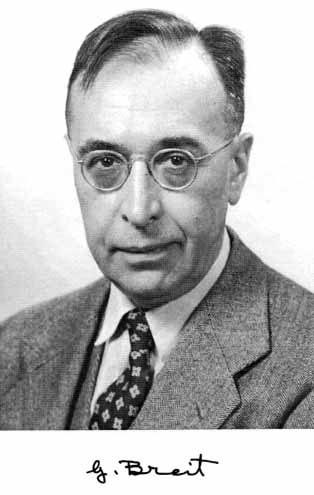
Gregory Breit
July 14, 1899 - September 11, 1981
By Mcallister Hull
For nearly fifty year, Gregory Breit was a leading figure in the development of physics in the twentieth century. John Wheeler in Some Men and Moments in Nuclear Physics wrote, ''Insufficiently appreciated in the 1930's, he is today the most unappreciated physicist in America." This was written in 1979, when Gregory was in physical decline, and he probably never saw it, but if public recognition was slight (but by no means absent), he was appreciated very well (in spite of a difficult personality) by his students, collaborators, and colleagues. The range of his interests and duration of his active career made this cadre a large one.
Trained as an electrical engineer, Breit did his early work in radio, including the definition of the characteristics of early tubes and finite coils. The most important of this work, with Merle Tuve, was the use of radio to demonstrate the existence of the postulated ionosphere by receiving return signals of a pulsed radio beam sent from the earth's surface. Ranging with a pulsed signal is, of course, the principle of radar. He also inspired and worked with the production of high voltages to accelerate charged particles (protons) to use as probes of the nucleus—the first manmade probes in the United States (Cockroft and Walton at Cambridge, England, had a beam of protons and deuterons
first, but at a lower voltage than the Carnegie team). With Tuve and Odd Dahl, he demonstrated the soundness of the betatron principle. Breit's work at Wisconsin included his organizing the infant theory of quantum electrodynamics (and studies of photon-photon interaction), early studies of the nucleon-nucleon interaction, and with Eugene Wigner the theory of nuclear resonances, which continues to be the basis for understanding many nuclear reactions.
During the second world war, Breit recognized very early that it would be sensible not to publish basic studies of nuclear properties, especially those of uranium and plutonium, for he among others understood the military (as well as energy) possibilities of a chain reaction in uranium. This caution resulted in the voluntary withholding from publication of many important papers until after the war. His own war work began with the organization of neutron studies that developed into the laboratory at Los Alamos—under Oppenheimer rather than Breit, who had gone off to the Naval Ordnance Laboratory to study degaussing of ships (for which he invented the magnetic extrapolator) as a defense against magnetic mines, and the Ballistic Research Laboratory of the Army to work on proximity fuses, exterior ballistics, and fire control. After the war, Gregory returned briefly to Wisconsin to take up his studies of nucleon properties and nuclear reactions. He transferred to Yale in 1947, with his advanced graduate students—and one undergraduate (me). At Yale, postdoctoral associates were added to the students who came from Wisconsin, and a few new graduate students joined what came to be called the "Breit group."
In addition to his prolific personal research, Breit led and participated in the work of members of the group. He and the members:
- Studied hyperfine structure of atomic levels; nuclear magnetic moments; the isotope shift; photo-disintegration of the deuteron; polarization of Bremsstrahlung radiation; Coulomb excitation; and semi-classical treatments of quantum mechanical calculations.
- Worked on Coulomb wave functions for calculating nuclear reactions (before high speed computers made the tables unnecessary);
- Initiated some of the first computer-aided calculations of the phenomenological nucleon-nucleon interaction, where it was shown that the strong force is charge independent, has a sharp repulsive core, and exhibits spin dependence;
- Showed that nucleon-nucleon scattering cross-sections could be expanded in phase shifts (and that the phenomenological force could be used to calculate those phase shifts); and
- Invented (theoretically) and studied heavy ion physics extensively.
Personal History
Gregory Breit was born July 14, 1899, in Nikolayev, Russia, some 100 kilometers northeast of Odessa. His parents, Alfred and Alexandra Smirnova Breit Schneider, operated a textbook business until Alexandra died in 1911, and the business was sold. Alfred emigrated to the United States in 1912, leaving Gregory and his sister Lubov in the charge of a governess while Gregory attended the School of Emperor Alexander in Nikolayev. In 1915 Alfred instructed his children to come immediately to the United States, and with their governess they traveled by train to Archangel and then by ship to New York. They landed on July 30, 1915. Their father, now Alfred Breit, assisted them with entry formalities and took them to Baltimore, where he was living.
John Wheeler relates a story told to him by Lubov that
she and Gregory were vacationing on the sea when the call to leave Russia came, and they 'came as they were.' For Gregory this meant dressed in a sailor suit with short pants; he was still wearing it when he enrolled in Johns Hopkins (at age sixteen!). Wheeler attributes some of Gregory's subsequent reticence in personal relationships to the ragging he took at the hands of his classmates for his dress—unlikely, perhaps, as the definitive reason, but a contributing influence? My wife Mary, who was one of the few women Gregory was comfortable with (she was the only person allowed to cut his hair when he became ill), attributes his personality to "middle European genes, especially prominent in Ukrainians" (she is first generation Czech).
There was an older brother, Leo, who had escaped the tsar's army through Turkey and then practiced medicine in Maryland. A deserter sought by the tsar's agents, he gave as little information about himself as possible, which, along with the dropping of "Schneider" from the family name, caused Gregory some difficulties years later when he needed clearance to do war work. Gregory, on the other hand, responded to Russian recruiters in 1918 and attempted to join the Russian Army. He was rejected because he couldn't pass the physical. He had a lifelong hatred of Communist Russia: much stronger than the intense distrust that most of us had.
Gregory was supported by scholarships as he continued his formal education and was awarded three degrees by Johns Hopkins: the A.B. in 1918, the A.M. in 1920, and the Ph.D. in 1921 (when he was twenty-two!). His publications began in 1920 (some with E. O. Hurlburt), and his dissertation (Joseph S. Ames was his advisor) on the distributed capacity of inductive coils was published in 1921. For those, like me initially, who wonder at this apparently trivial topic for a Ph.D. thesis, I suggest you look up the paper (Phys.
Rev. 17:649). It is a masterly piece of applied mathematics (a skill Breit demonstrated for the rest of his professional life). He was a National Research Council fellow at the University of Leiden in 1921-22 and at Harvard University in 1922-23.
Gregory married Marjory Elizabeth McDill on December 30, 1927, in Washington, D.C., and acquired a stepson, Ralph Wycoff, from Marjory's previous marriage. He had no biological children.
Breit knew and worked with the physicists in his field with a degree of comprehensiveness impossible today. At the symposium in his honor at Yale in 1968, over 200 of his colleagues and former students attended from around the world. Among the notable speakers were John Archibald Wheeler, Henry Margenau, Isidor I. Rabi, Victor F. Weisskopf, Hans A. Bethe, Eugene P. Wigner, D. Allan Bromley, Vernon W. Hughes (the latter two organized the symposium), Gerald E. Brown, Raymond G. Herb, and Merle A. Tuve. I also spoke, and had not been in so much fast company since Los Alamos!
Gregory Breit was elected to the National Academy of Sciences in 1939 and to the American Academy of Arts and Sciences in 1951. He was a fellow of the American Physical Society, Physical Society of London, Institute of Radio Engineers, and the American Association for the Advancement of Science. He was a member of the American Mathematical Society, American Geophysical Union, Washington Academy of Science, the Army Ordnance Association, Sigma Xi, and Phi Beta Kappa.
Gregory died in Oregon, where he had gone with Marjory in 1973, finally to retire. When Yale's mandatory retirement policy sent Breit from New Haven in 1968, I had gotten him an appointment as distinguished professor at Oregon State University, where I was chair of physics. However,
one of his former postdoctoral associates, Moti Lal Rustgi, had, through the department and President Meyerson, beat me to it, and he went to State University of New York at Buffalo (as it happened, the same friend nominated me as chair at SUNY Buffalo shortly afterward, so I became Gregory's department chairman!). Marjory wished to spend her last years near her son and daughter-in-law, Ralph and Faith Wykoff, and her grand children, so they moved into a retirement home near Salem. Gregory, as vigorous a man as I had ever known, began to decline in Buffalo, and was not professionally active in Oregon. His death in 1981 called for a two-column obituary in The New York Times.
Noting that I am writing nearly eighty years after Gregory's first publication, the reader will understand that it has been difficult to get recollections from early colleagues. Anne Herb recalls that the late Ray Herb admired Gregory above most of his colleagues at Wisconsin, and that in tapes made before his death Ray had recalled with pleasure Gregory's interest in the work he was doing with accelerators. Norman Heydenburg has "fond memories" of Breit at New York University and Wisconsin where Norm was a postdoctoral fellow. Again, the subject (in part) was accelerators and nuclear physics.
Charles Kittel followed Gregory to Washington during the war, and his work on degaussing influenced his decision to spend his distinguished career in condensed matter physics. He tells as 'folklore' that Gregory and I. I. Rabi came from Russia on the same boat, and thus knew each other long before their collaboration. Glenn T. Seaborg remembers 'many important contacts' with Gregory in 1941 as the Uranium Committee was formed (more on this later). John Wheeler, who has already been quoted here, joined Breit as a National Research Council fellow at New York University when Norm Heydenburg was there. Wheeler es-
pecially remembers Breit's "kindness" in crediting his work with joint authorship on papers (I do not consider it kindness. Breit was more conscientious than most in giving due credit, and equally demanding that it be given by others) and in helping secure a fellowship renewal that made it possible for Wheeler to work with Niels Bohr. This also was typical of Breit. He was always interested in his younger associates, and regularly helped them get positions when they left him—as Norm Heydenburg also remembers. Wheeler, in this context, credits Gregory with "saving" Eugene Wigner for Princeton by getting him an appointment at Wisconsin when Princeton was moving too slowly (Willis Lamb tells me that Wigner always said that Princeton fired him!).
The collaboration between Breit and Wigner was significant for the development of nuclear physics (see below), and Wigner returned to Princeton when it "mustered the resolution and funds" to make him an appropriate offer. Willis Lamb recalls that Breit was a referee of an early paper of his and took the trouble to write directly to Willis with useful comments and encouragement—a rare instance of a referee abandoning the customary anonymity, and again demonstrating Breit's concern for the development of young physicists. For a later generation of associates, Arthur Broyles refers to Breit as "one of the most sincere and conscientious men I have known," and recalls that Gregory interrupted his work to help Arthur decide between opportunities for postdoctoral work. I do not recall a single student or postdoctoral fellow with the group who ever left without a suitable position.
Gregory had a dark side that was the source of legends even from the New York University days. He was formally polite in the European way (the result of his upbringing in the first decades of the century!), and usually apologized—
quite sincerely, I believe—after an outburst of temper. Wheeler recalls no personal incidents during his association with Breit, although he heard of them from others. I experienced only one, very early in our working relationship (I was still an undergraduate). He misinterpreted a comment of mine and when he blew up, I said something like, "I think I'll return when you are feeling better. Please call me." I walked out and back to my office. He duly called, apologized for the outburst (even more contritely when I showed him the source of his misinterpretation), and never raised his voice with me again, although we had our differences many times. We became very close friends over the succeeding years. Others of my colleagues were not so lucky. Gerry Brown, who remembers Breit as a second father, was regularly a target, and I was present when Gregory took the hide off a graduate student who had wished him 'a good talk' at a meeting: of course his talk would be good! There is no point in detailing more examples: they occurred regularly, and were simply a fact of life for his students (and on occasions his colleagues. Allan Bromley recalls mediating a heated 'discussion' between Gregory and Henry Margenau on the occasion of Gregory's seminar. Each thought the other's talk was the 'worst ever heard.' Having just reread them, I fear both were correct!). Wheeler thinks that this irascibility was at least a partial cause of Breit's lack of recognition commensurate with his accomplishments.
Gregory's devotion to his student's intellectual development and personal welfare was equally legendary. He was available at any time for consultation, and if a student was shy, he would be invited in for a chat. Weekly group lunches were remembered by Jack McIntosh as times of terror in anticipation of Gregory's asking someone a difficult question, but we learned a great deal, including how to think on our feet! Frequent "parties" at his home, set up by Marjory
(who also entertained the wives of group members—separately) were opportunities to talk physics in general. Gregory was incredibly well informed. He received hundreds of preprints a month, read most of them, and shared them with the group members according to current interest. Bromley thinks he retained everything he read, including the location (journal reference, page number, location on the page!) of the source. The sessions at Gregory's home also were opportunities for us to meet the great physicists of the time. Jack McIntosh especially remembers Werner Heisenberg, for example (as I do; someone had told him I had been at Los Alamos during the war, so the head of the 'counter project', as we called him then, asked a number of questions, most of which I couldn't answer for security reasons!).
Gregory was equally solicitous of our health. Any ailment was occasion for concern and advice. Gary Herling, one of Breit's later students, recalls being advised that exercising "a few times a week for an hour is better than several hours every few weeks": sound advice according to current practice in the fitness world!
Gregory's recreations were exercise and reading (other than physics, I mean). He had a canoe on Lake Mendota in Madison, as Anne Herb recalls. Gerry Brown has even better reasons to remember that canoe. Gregory once took him and another student out for a paddle. Gregory seemed to wish to use the leverage of the stern position to turn the canoe away from the course, and the other student soon recalled an appointment, and was put ashore. Gerry then determined to keep the course against Breit's pull, and did so. Nothing was said at the end of the afternoon, but twenty-five years later Gregory recalled the trip to Gerry, and remarked "I saw then you had some stuff in you." The canoe didn't make it to New Haven, but, as McIntosh recalls, the
group "was hiked" regularly, with "Mac or Bob (Gluckstern) leading with Breit, and the rest trying to keep up." On one of these occasions, Breit sat down, removed his shoes, and changed his socks, advising the rest of us to do likewise. As usual, he had our physical well being at heart! While Jack failed to take the advice, he recalls the faces at the windows of nearby houses staring out at this extraordinary sight.
Breit's recreational reading included historical fiction, as I know because when I was hospitalized in Buffalo once, he sent over several Hornblower novels. This matched my own tastes, and I have since read all of the series. But we never talked about such things. Physics was always on his mind, and like most driven and creative persons, his specialty provided most of his focus, and the line between work and pleasure was never a clear one.
His students, collaborators, and colleagues over nearly sixty years universally characterize him as a brilliant, informed, dedicated physicist, equally devoted to the subject and to developing and encouraging younger persons for the field. If he was sometimes difficult, the intellectual rewards for working with him were worth putting up with his moods. I, of course, am biased. A bond of affection grew between us that lasted all his life and is still fondly remembered by me.
Professional History
Breit's professional positions began with an appointment as assistant professor at the University of Minnesota (1923-24). He then began an extended association with the Carnegie Institution of Washington as a mathematical physicist (1924-29, with a residency at the Technische Hochschule, Zurich, in 1928) and as a research associate (1929-44). He was professor of physics at New York University (1929-34) and the University of Wisconsin, Madison (1934-47), with a visiting
membership in the Institute for Advanced Study, Princeton (1935-36). During the war, he worked in the Naval Ordnance Laboratory (1940-41) and at the Metallurgical Laboratory, University of Chicago (1942). He was a member of the Applied Physics Laboratory, Johns Hopkins University (1942-43) and was head physicist at the Ballistic Laboratory, Aberdeen Proving Grounds (1943-45). His return to the Madison campus was short-lived, as he accepted a professorship at Yale in 1947. At Yale he was given the first Donner professorship in 1958, and he retired from that position in 1968 (at Yale's mandatory retirement age of sixty-eight!). He went to the State University of New York at Buffalo, from which he retired to private life in Oregon in 1973. His professional honors, in addition to membership and fellowships in a number of societies (already noted), included the award of an honorary doctorate of science by Wisconsin (1954), the Benjamin Franklin Medal in 1964, and the National Medal of Science in 1967. At various times in his career he was associate editor of Physical Review, Proceedings of the National Academy of Sciences, and II Nuovo Cimento.
A discussion of Gregory's research is made difficult by at least two circumstances. He worked in many areas and he returned to most of them over many years. He published, alone and with colleagues, some 320 papers. My list probably is not complete. I've added two references since I started this memoir! Since I may include only twenty-five items in an accompanying bibliography, you can sense the difficulty I have in doing justice to the work of this premier physicist. However, two review volumes deal with Breit's work. Volume 41/1 of the Handbuch der Physik (cited as HP and a number representing the order of the papers as they occur in the volume) was written by Gregory and some of his colleagues and was published in 1959, and a symposium in Breit's honor was held in New Haven on the occasion of his
retirement from Yale. The proceedings of the symposium were published in 1970. The symposium volume Facets of Physics (cited as FP and a chapter number) has the best bibliography of Breit's work that I know. Between these two, one can find most of the items he published, as well as a hint of the breadth of his interests and the influence his work had on others.
The first research Breit published that had an impact beyond the community of physicists came out of his education as an electrical engineer. When he took a position in the Department of Terrestrial Magnetism of the Carnegie Foundation, he invited Merle Tuve to join him in attempting to demonstrate the existence of an ionized layer in the atmosphere, which had been postulated by Kennelly in the United States and Heaviside in the United Kingdom. It was typical of Breit's approach to physics that he worked on the theory of radio wave reflection from charged layers in general as he planned to measure them in the atmosphere. The idea was to measure the delay between the ''ground" wave from a radio transmitter and the "sky" wave reflected from the ionized layer. Since the height of the expected layer was not known, the size of the delay could not be estimated. Breit thought that a parabolic sending antenna would be ideal for the attempt, but funding difficulties soon scotched that idea (cf. Tuve's contribution to the symposium, FP8). Station KDKA, Pittsburgh, the first licensed commercial radio station in the United States, was used in early trials with a special key Breit constructed. When the Naval Research Laboratory transmitter became available, the experimenters turned to it. It was only 13 miles away and had the schedule of a research installation! Evidence of a delay was indeed obtained, but interference made measurement difficult. Breit and Tuve thought of pulsing the transmission with a period so that the delay could be determined
before the next train of waves arrived. Today we recognize that this is the central idea of radar. I was once told that Breit and Tuve noticed occasional spurious signals when they were testing their apparatus. These were finally attributed to planes flying from Washington's airport (of course, their 80m wavelength was useless in locating planes, but it could sense them), and the signals were ignored henceforth! In any event, they got their delay and were able both to prove the existence of the ionized layer and measure its height above the earth's surface. Breit and Tuve published their work in 1926 and with Odd Dahl in 1928. When Breit was given the Fellow Award of the Institute of Radio Engineers (now IEEE) in 1945, the citation read:
For pioneering in the experimental probing of the ionosphere and giving to the world the first publication of the experimental proof of the existence of the ionosphere; and for having initiated at an early date the pulse method of probing by reflection which is the basis of modern radar.
Kittel considers this Breit's most significant work. Only in terms of public impact can one agree.
There were no more publications on the Kennelly-Heaviside layer. As early as 1923, Breit's interest had turned to the emerging field of quantum mechanics. He continued to publish interesting items on topics in radio until 1930, but increasingly his papers were devoted to problems in quantum mechanics. As the papers of Schroedinger, Heisenburg, and Dirac appeared, Breit wrote interpretive comments where he thought they could help and looked for problems with a classical analogue to study. The breadth of his interests began to appear, and it would never again be possible to discuss his work over a year or two as a package, except perhaps for his wartime activity.
The gap in Breit's publication record between 1940 and 1946 does not mean he was inactive! He served on committees on publications that persuaded American physicists to
withhold any papers on properties of uranium, or the new elements beyond, that neutron bombardment could make. Breit early recognized the possibilities for both energy generation and explosive reactions with these isotopes. Papers published in 1946 with submission dates in the early 1940s are the results of this policy. He chaired the fast-neutron project at Chicago until his departure for Washington, when Oppenheimer took over and transferred the program to Los Alamos. Breit had contributed some five reports on isotope separation, neutron diffusion, and chain reactions while at Chicago. At Washington, he worked first on degaussing (to protect merchant ships from magnetic mines), as we have noted, and invented the magnetic extrapolator, allowing two men to accomplish in a day a task that had taken a month before. He wrote three reports on degaussing. At the Army Ordnance Laboratory, he provided fifteen reports on the proximity fuse (a major contribution to antiaircraft success), and thirteen on exterior ballistics and fire control. Both Navy and Army ordnance departments cited Gregory for exceptional and outstanding performance during the war. In 1967 President Johnson awarded him the National Medal of Science for his work in nuclear physics and his wartime work in ordnance.
Gregory's work on the question of ignition of the atmosphere and oceans by runaway reactions initiated by thermonuclear explosions may be considered an extension of his interest in supporting the military in its role of protecting his adopted country. Some work had been done (by Bethe) before the Trinity test of the first nuclear bomb, but the "super" was expected to be a thousand times as powerful—and to involve reactions closer to the constituents of the environment. Edward Teller, according to The New York Times obituary, considered Breit "the most conscientious, meticulous and painstaking of physicists," and hence the
ideal person to undertake this task. Under Breit's direction, we geared up at Yale for the necessary calculations and created a "secret" room to house our work. A few of us were cleared, and Gluckstern and I were made responsible for security and supervision of the work of other participants. There was a vent in the room that Breit considered a possible security leak, so I designed and built a variable pitch audio oscillator to run in the vent when we had conferences (it sounded worse than the wobbling shriek of modern emergency vehicles—for the same reason: one can discriminate against a steady sound, but not a variable one). Our work was essentially applied astrophysics, and Gregory put it all together. Subject to the favorable outcome of some new experiments (which were successful), there would be no runaway reactions from super explosions. As it happens, he was right!
In general, however, we must trace Gregory's interests in a subject over many years. For example, he interested himself in accelerators for forty years. His participation in the invention of the betatron principle has already been noted. He was the first American physicist to realize that to induce nuclear reactions with artificial sources (accelerators) would be superior to the use of naturally radioactive sources pioneered by Rutherford. Breit, with his DTM colleagues, began to look at high voltage applications to particle acceleration in 1928. In 1929 he published his initial ideas on nuclear reactions produced by "artificial" sources of radiation. By 1936, the first proton-proton scattering experiments were published by the DTM group (Breit had moved by then, but he continued to encourage the work) using a voltage multiplier device Breit had begun. At Wisconsin, he inspired the work of Ray Herb and colleagues with Van de Graaff machines (FP7). In 1952, when the founding paper on heavy ion physics was published, the funding proposal that pre-
ceded it discussed the modifications in cyclotron operation that could accommodate the ions (the first experiments in the field were done at Oak Ridge using a cyclotron built on a wartime isotope separation magnet), provided a concept design for a heavy ion linear accelerator, HILAC, (we used matrices to follow the particles through the machine). Two HILACs were built, with design input from Bob Gluckstern, one of the authors of the heavy ion paper. Yale got one of them, and the other went to the Seaborg group at Berkeley for the study of trans-uranic elements. Trans-uranic elements are quite fascinating objects in nuclear physics, and we discussed the possible properties of super heavy ones that would be accessible to head-on heavy ion collisions with uranium, but the topic was introduced for completeness, and to attract the attention of the funding agency reviewers. It was not a central interest of Breit or the rest of us. Bromley (FP4) mentions it in his symposium article, and Breit notes the work of Seaborg's group and the Nobel institute at the end of his Handbuch paper (HP1). However we thought of it, the use of heavy ions in trans-uranic element studies has become an international effort. In addition to the Nobel institute, the Darmstadt group is in the field, and has made number 112! Breit's last direct concern with accelerators came in 1964. We proposed what we called a "meson factory," a linear accelerator designed to produce an intense beam of pi mesons for the study of nuclei. Legend has it that at the meeting with funding agencies, Louis Rosen stood up at the end of the Yale presentation and said, "I want a machine like Yale has proposed." Once again Gluckstern turned our conceptual design into a practical one, and the accelerator was built—at Los Alamos, not New Haven! Yale got priority in the use of the machine for a time, and Vernon Hughes made good use of it. By the time the accelerator was in operation, our theory group had be-
gun to break up, and we never worked on the analysis of experiments. Our throwaway suggestion (I do not wish to imply that we were not serious, but only that the area was not central to our interests) this time was cancer therapy with pi mesons. The localization of energy deposition from particle ionization in matter is a function of particle mass, so that the heavier mesons will do less damage to healthy tissue as they pass through than lighter electrons or massless X rays. A Yale oncologist established the Cancer Research and Treatment Center at the University of New Mexico to pursue this idea, and it was clinically successful. It fell, however, to budget restrictions, but the excellent cancer center continues at UNM. Breit's final publication on accelerators was in 1954.
In 1928 Breit discussed the interpretation of the Dirac equation, and during the next few years developed the theory of two electron interactions, the separation of angles in the two electron problem, and calculated the fine structure of helium using the large-large component approximation to his 16 component equation. After the war, he returned to the two-fermion problem with Gerry Brown, and studied the effect of the finite size of the proton on the fine and hyperfine structure of hydrogen spectra. Over the next several years, this approach was used to obtain first order relativistic corrections to proton-proton scattering analyses. Hughes's review of the Breit interaction (FP5), as it is properly called, reports on measurements, modern extensions to higher orders of approximation, and on the study of the interaction in the fine structure of the positronium atom. The study of the Breit Interaction and its generalizations is "fundamental to atomic physics and modern quantum electrodynamics," says Hughes (FP5). As usual, Breit's pioneering work set the standard for the field.
Gregory began his study of dispersion relations in 1925
with two papers. These were followed by another in 1930 and major review articles in 1932-33. The latter papers essentially summarized the status of quantum electrodynamics then. The choice of dispersion relations was typically perceptive of Breit. Their analytic properties make it possible to obtain many useful results without having to specify details of the theory; optical level crossing, for example, was derived in these papers. It is a major aid in disentangling experimental observations. Analyticity properties were central to the use of dispersion relations in particle physics thirty years later. Breit himself applied them to nuclear processes in 1962.
In 1932 Breit started his work on the isotope effect. The shift of atomic spectra as a function of added neutrons tells us something of the behavior of the extra particle in the nucleus. As Brown notes in his symposium article (FP6), Breit's early work had settled on two effects. If the neutron is buried in the center of the nucleus, its presence pushes protons out because of the near incompressibility of nuclear matter. If the neutron is attached to the surface, it pulls protons out because of the nucleon-nucleon attractive force. Spectroscopists call these effects mass and field, respectively. Breit's work continued through the 1930s, and resumed in 1950, 1952, and 1953 with attempts to use our increasing knowledge of nuclear forces to understand the changes in the nucleus as neutrons are added. Brown's discussion of the problem in 1968 (FP6) summarized work that began when he raised the topic with Breit years earlier. It centered on an attempt to understand changes in the nucleus starting with a self-consistent description with a static potential between nucleons, hence a spiritual continuation of Breit's studies. Brown showed that there is no low-level "breathing mode" excitation in the nuclei studied (calcium and lead)—and hence none in intermediate mass nuclei.
He also showed that density dependence of the effective interaction is important for the isotope shift, and obtained believable information on the compressibility of finite nuclei—worthy extensions of Breit's earlier work.
Much of the work that occupied Breit during his remarkable career involved the scattering or reactions of charged particles—usually both positive (i.e., an interaction in which the repulsive Coulomb force operates). For nonrelativistic energies, the Schroedinger equation applies, and is separable. The problem, therefore, is to obtain solutions of the radial part. These solutions are called Coulomb wave functions (when only the Coulomb force acts). Breit's early interest in proton-proton scattering made it necessary to deal with these functions, and in 1936 he published the first of a long series of papers on the subject with F. L. Yost and Wheeler.
The mathematical difficulty arises because the values of the angular momentum appearing in the equation are integers (in terms of the reduced Planck's constant). The confluent hypergeometric functions defined by Whittaker and Watson (Modern Analysis), which are formal solutions to the Coulomb equation, have divergent expansions when the appropriate indices are integer. They are also not normalized properly for the physics applications. Before modern computers were available, tables of functions were needed, and they were given, even in the earliest papers. We organized the preparation of tables at Yale. For us a computer was a person using a desk calculator to obtain the values of the regular and irregular solutions of the Coulomb wave equation as defined in the original paper. When digital computers became available (large main frames at first), I found programming for them a direct translation of the steps we had set up for our human computers. We programmed in
machine language then, with the only aid an assembly program, and I became proficient in octal arithmetic.
Some ten papers by Breit and colleagues written over the years from 1936 to 1959 were summarized, together with notational references to all known papers of other writers on the subject, in a Handbuch article (HP2). This extended effort was again typical of his approach. Whatever the physics problem needed, even some pure or applied mathematics, it was supplied. He was an excellent mathematician, and I became an adequate one working with him (it was typical of him that he never taught me any mathematics. It was only a tool, and we talked about physics).
In 1936 Breit also published his first paper on proton-proton scattering with E. U. Condon and R. D. Present (obviously there is a connection between the papers on Coulomb functions and the theory of p-p scattering). It is reliably reported that he was so anxious to get results that he would volunteer to help with the experimental runs if the experimentalists would just get on with it! Merle Tuve and Ray Herb tell of these early days at DTM and Wisconsin in papers for the symposium (FP7 and FP8). In the theoretical work, the shift in the phase of the outgoing wave with respect to the incoming one required some consideration, since the Coulomb part of the interaction has an infinite range. However, since the target protons are in a hydrogen atom, the proton charge is screened at sufficient distance. Let the screening distance go to infinity and one has a means of defining the phase shift—with respect to a Coulomb wave rather than a plane one.
In 1941 Breit showed that the most fundamental description of the collision process is the scattering matrix and the phase shifts that define it. This fact was used by Hans Bethe and colleagues in the study of nuclear matter with realistic nucleon-nucleon interactions in 1967 (FP2), as I shall note
later. From the first, however, the delineation of the nucleon-nucleon force was a part of the study. Initially the distance dependence of the force was arbitrary. A square well, given its ease of treatment, was favored. Both phase shifts and the early models of the attractive nuclear forces suggested charge independence of the interaction. The singlet S phase shift for n-p and p-p scattering were nearly the same and the nuclear force models to give them were alike. This result supported the similarity of binding energies of mirror nuclei, already noted. The force was short ranged from the start.
When it became possible after the war to use more sophisticated mathematical forms for the potential, the Yukawa force was introduced (i.e., a descending exponential divided by the distance, with the exponent dependent on the mass of the meson presumed to cause the force). The analyses showed that the current value of the mass was too little to explain nuclear forces; the force was too short ranged. Although the phenomenological mass in these early studies turned out to be a bit large when the pi meson was discovered, our later work accommodated the experimental mass quite handily. As we introduced larger angular momenta, it became necessary to take into account the fact that the neutron-proton interaction contains a tensor part, and this affects both the scattering, matrix form, and the force potential description. The shell model contributed a spin-orbit force, and as the data came from higher and higher energies with more intense beams, experimentalists began to measure double and triple scattering. We, of course, kept up with our formulations. In particular, we looked at one-and two-pion exchanges as determinants of terms in the potential and introduced a hard core of short range to take account of higher order pion interactions we could not safely model (or, perhaps, of quark interactions that we
didn't even think about). By 300 or so MeV, we needed to look at relativistic corrections, where Breit's two-fermion equations provided a basis.
The use of high-speed (for that day) computers was essential to our work; the AEC center at NYU and the IBM laboratory at Poughkeepsie gave us valuable time to run the analyses. Breit never learned to program, but he was instrumental in introducing the use of computers into the work. He understood my wiring of plug boards to run an IBM accounting machine in the Yale business office as a differential analyzer (Metropolis had pioneered this at Los Alamos during the war, and taught me), and even designed an analogue differential analyzer using Navy surplus ball-table integrators that worked, but he was happy to leave the making of stored programs, à la von Neumann, to his younger colleagues. Gradient searches in the multi-dimensional phase shift space produced excellent fits to as many as 2,000 pieces of data, n-p and p-p, by the early 1960s. Our formulation of the scattering matrix was verified. Yale finally got a computing center, and our graduate students became its first consultants. This made it possible for us to make a coup. I was scheduled to talk at one of the annual meetings of the American Physical Society, and an experimental group gave values of measured triple scattering parameters in an abstract for the same session. When I talked, I reported calculated values at their energy and angles that agreed within standard error with the measurements! All the work over more than thirty years by Breit and his colleagues was summarized in a presentation for the Breit symposium (FP1). As the nearly sixty papers reported with Breit's participation attests, and the care with which the work was done suggests, this effort was a major contribution to nuclear and particle physics in this century. It is, perhaps, remarkable that over the thirty years of this study, major character-
istics of the interaction didn't change. The potential remained short ranged, essentially charge independent, and the phase shifts still provide the best representation of the physics. Bethe (FP2) used the phase shifts to derive phenomenological potentials to use in studying the properties of nuclear matter, with satisfactory results—an appropriate justification of Breit's expectation in undertaking the study in the first place.
Breit is, perhaps, remembered in the physics community for his work in nuclear reactions as much as for any other of his areas of interest. In 1936, he and Eugene Wigner published papers on resonance theory, and this work has been a major component of studies since. The obvious difficulty with treating the nucleus is that it is a many-body problem with the interaction between nucleons in a state of developing understanding. Thus, in the thirty years following the Breit-Wigner beginning, they and others have sought models that could capture properties of the nucleus (turning Wigner's black box into grey ones!) and other facets of the total picture that would be useful in organizing experimental data and revealing for the understanding of nuclear structure. Breit's papers, some fourteen between 1936 and 1963, usually dealt with specific problems rather than general formulations, but his treatments were intrinsically consistent with them, and Wigner attributes much of his own R-matrix theory to ''Breit's exploratory work" (FP3). Wigner made use of the short range of the nuclear force by treating the interior of the nucleus as a "black box" and dealing analytically with the exterior—but for particles coming in at low angular momentum (i.e., more or less directly at the target nucleus). He defines a derivative matrix, the R matrix, which has obvious analytic properties. It can utilize the unitary and symmetric nature of the collision matrix readily to give sum rules and has poles that give a resonant struc-
ture. The energies and reduced widths are parameters rather than physical entities; he wished to capture the general behavior rather than detailed levels. He summarized this beautifully in his symposium paper in 1968 (FP3).
Wigner's 1968 summary thus brought forward a few years the treatment that Breit had made a major part of his own summary of the theory of resonance reactions in his monumental Handbuch article (HP1) of 1959; his taste for treating as much of a problem as possible with mathematical elegance attracted him to his old collaborator's approach. He also treated the compound nucleus model, the shell model, stripping and pick-up, direct interactions, selection rules, threshold behavior, the optical model, reviewed then recent self-consistent field calculations with correlations between particle positions utilized, and heavy ion physics. He also dealt with radioactive states, showing as he had noted in 1940 that these states can also be treated by resonance reaction theory. With John S. (Jack) MacIntosh (HP3), he discussed the polarization of nucleons scattered by nuclei of arbitrary spin, which, among other interests, informs the angular distribution of nuclear reactions—particularly pick-up and stripping (Breit had published a paper on angular distribution of reaction products in 1947). Throughout, the central idea of the resonance reaction connects the various models and treatments.
By the 1950s the preparation of particle beams had progressed to the point that one could conceive of stripping all the atomic electrons from nuclei heavier that helium. In addition, octuply charged oxygen 16 has the same charge-to-mass ratio as the deuterium nucleus, so machines designed for accelerating deuterium could be used to produce the same velocity for oxygen. From such considerations came the initiation of heavy ion physics by Breit (the first publication was in 1952 with Gluckstern and me, but we
had presented similar considerations in the "scientific justification" for a linear accelerator proposal a couple of years earlier, and I have no hesitation in claiming that the seminal ideas were Breit's). The principal types of experiment may be classified as (a) transfer reactions, where only the surface of the target nucleus is involved, and a nucleon is transferred from one nucleus to the other (obviously the older terminology of "pick-up" and "stripping" is subsumed by "transfer'') and (b) Coulomb excitation, where closer approaches between target and projectile occur, but the possibility of treating the kinematics of the collisions classically is retained. A third type, head-on collisions, is the basis for trans-uranic element studies, and the suggestion was seminal for that field, but Breit never really pursued that idea after the initial proposal.
Coulomb excitation (an old idea that becomes powerful as a nuclear probe when the projectile is a heavy ion) became a major experimental field, and Breit with colleagues (especially Bob Gluckstern) discussed the theory in great detail over the fifteen years following the first paper—over twenty publications by my nonscientific count, the last occurring in 1967, when he looked at transfer in Coulomb excitation. As Gary Herling points out, this approach "foresaw the coupled-channel, distorted-wave method," and he notes the continuing activity in this most productive field. The rotational levels of the target nucleus are excited, and if one wishes to study a spin reorientation, one has a probe that is otherwise unavailable. Breit summarizes the field of heavy ion theory in HP1 and with Gluckstern treats Coulomb excitation extensively (including reorientation effects) in HP4. Allan Bromley's survey of the experimental data up to 1967 (FP4), with comments on the theoretical analyses, is especially illuminating. While, as I have noted, one of the linear accelerators built as a result of our 1950 proposal
was at Yale, the most productive heavy-ion experiments there were done with the Emperor tandem Van de Graaff that Bromley got for the department and used to good effect.
I have by no means exhausted the areas, even by title, that Gregory initiated or advanced during his remarkable career. Perhaps the breadth and importance of his work has been suggested, however. In terms of the kind of recognition that John Wheeler felt Breit did not get, the fact that he addressed so many topics may have been a disadvantage. This review of his work may serve to redress the oversight that remark implies. Those who did not follow all of his work now have an introduction to it.
<><><><><><><><><><><><><>
A number of Gregory's colleagues and former students responded to my request for recollections. When I quoted or paraphrased their comments, I named them without a footnote. In all such cases the reference is "private communication." Ralph and Faith Wyckoff, Breit's stepson and daughter-in-law, have provided some personal items of Gregory's life that I could have gotten nowhere else. John Wheeler was especially generous with his response, and D. Allan Bromley's recollection extended into Breit's later years with affection. Mrs. H. H. Barschall responded for Heinz, who unfortunately died before he could answer my inquiry; I am grateful for her help. Anne Herb wrote of Ray's regard for Breit's interest in his early work at Wisconsin. Norman Heydenburg gave a look at Breit's early years that no one else is left to give. Charles Kittel recalled the war years when Breit bundled up the graduate students and took them to Washington, and Glenn Seaborg recalls working with Breit on the neutron project. Willis Lamb talked at length over the telephone about his interaction with Breit, both early and later in his own career. My own contemporaries, Jack McIntosh, Gerry Brown, Bob Gluckstern, and Arthur Broyles revived many memories, and Gary Herling, a later student, gave a good account of Breit's work after the Breit group began to dissolve.
The Breit symposium was organized and the proceedings edited by Allan Bromley and Vernon Hughes; I am grateful for both activities. The work of surveying Breit's contributions would have been
much more difficult without the contents of the proceedings and the bibliography they included. I have referred to the papers in the proceedings by "FPx", where the x is the chapter number in Facets of Physics (Academic Press, Inc., New York, N.Y., 1970). The papers in volume 41/1 of Handbuch der Physik (Springer-Verlag, Berlin, 1959) were invaluable, and are referred to as "HPx," the x being the order of the papers as they occur in the volume.
Finally, I should note that the material supplied by the National Academy of Sciences was very helpful. I have never seen a complete vita written by Breit, but the fragments the Academy sent filled in some gaps, especially about reports during the war years. The obituary from The New York Times allowed a quote from Edward Teller that I otherwise would not have known.
Selected Bibliography
Breit published some 320 items in his career. I have not referred directly to any of them in the memoir text; the selection below is intended to note the ones that initiated a study or made a significant advance. I have, in consideration for Academy guidelines, included only the first of the many papers on Coulomb wave functions. They're all listed in the Handbuch article I did with Breit (HP2). The bibliography in the symposium proceedings is the best there is, but there were one or two papers after 1968, and I found two from 1936 that were missed.
1926 With M. A. Tuve. Radio evidence of the existence of the Kennelly-Heaviside layer. J. Wash. Acad. Sci. 16:98.
1928 With M. A. Tuve. The production and application of high voltage in the laboratory. Nature 121:535.
With M. A. Tuve and O. Dahl. Effective heights of the Kennelly-Heaviside layer. Proc. Inst. Radio Eng. 16:1236.
1929 The effect of retardation on the interaction of two electrons. Phys. Rev. 34:553
On the possibility of nuclear disintegration by artificial sources. Phys. Rev. 34:817.
1930 Fine structure of He as a test of the spin interaction of two electrons. Phys. Rev. 36:383.
1932 Quantum theory of dispersion. Parts I-V. Rev. Mod. Phys. 4:504.
Dirac's equation and the spin-spin interactions of two electrons. Phys. Rev. 39:616.
1933 Isotope shift of Ti. Phys. Rev. 44:418.
Quantum theory of dispersion. Parts VI and VII. Rev. Mod. Phys. 5:91.
1936 With F. L. Yost and J. A. Wheeler. Coulomb functions in repulsive fields. Phys. Rev. 49:174.
With E. U. Condon and R. D. Present. Theory of scattering of protons by protons. Phys. Rev. 50:825.
With E. Wigner. Capture of slow neutrons. Phys. Rev. 49:519.
1939 With L. E. Hoisington, S. S. Share, and H. M. Thaxton. The approximate equality of the proton-proton and proton-neutron interactions for the meson potential. Phys. Rev. 55:1103.
1940 The interpretation of resonances in nuclear reactions. Phys. Rev. 58:506.
1948 With A. A. Broyles and M. H. Hull, Jr. Sensitivity of proton-proton scattering to potentials at different distances. Phys. Rev. 73:869.
With G. E. Brown. Effect of nuclear motion on the fine structure of hydrogen. Phys. Rev. 74:1278.
1950 Evidence concerning equality of n-n and p-p forces. Phys. Rev. 80:1110.
1952 With M. H. Hull, Jr., and R. L. Gluckstern. Possibilities of heavy ion bombardment in nuclear studies. Phys. Rev. 87:74.
1953 With M. H. Hull, Jr. Advances in knowledge of nuclear forces. Am. J. Phys. 21:184 (selected as one of the major contributions to the Journal over 30 years).
1956 With M. E. Ebel. Nucleon tunneling in N14 + N14 reactions. Phys. Rev. 103:679.
With R. L. Gluckstern and J. E. Russell. Reorientation effect in Coulomb excitation. Phys. Rev. 103:727.
1957 With V. W. Hughes. Information obtainable on polarization of µ+ and asymmetry of e+ in muonium experiments. Phys. Rev. 106:1203.
1962 With M. H. Hull, Jr., K. E. Lassila, H. M. Ruppel, and F. A. McDonald. Phase parameter representation of neutron-proton scattering from 13.7 to 350 MeV. II. Phys. Rev. 128:830.
With M. H. Hull, Jr., K. E. Lassila, K. D. Pyatt, Jr., and H. M. Ruppel. Phase parameter representation of proton-proton scattering from 9.7 to 345 MeV. II. Phys. Rev. 128:826.
1967 Virtual Coulomb excitation in nucleon transfer. Proc. Natl. Acad. Sci. U. S. A. 57:849.


