
Appendix
Accelerator Facilities for Nuclear Physics in the United States
Tables A.1 and A.2 summarize nuclear physics accelerator facilities currently in operation or under construction in the United States. In addition to the accelerator parameters and performance characteristics, the tables list the primary areas of research that each one addresses. Figure A.1 gives an overview of facilities and their geographical location.
The major new facilities of the nation's nuclear physics program are the Continuous Electron Beam Accelerator Facility (CEBAF) at the Thomas Jefferson National Accelerator Facility, which recently came into operation, and the Relativistic Heavy Ion Collider (RHIC) at Brookhaven National Laboratory, which is scheduled to begin operation in 1999. CEBAF (shown in Figure 7.1) is a superconducting, recirculating linac designed to deliver continuous electron beams of up to 200 µA of current, polarized and unpolarized, simultaneously to three experimental areas. The design energy is 4 GeV, but operational experience with the superconducting cavities indicates that an energy of up to 6 GeV will be possible.
Nearing completion, RHIC (shown in Figure A.2) is the first colliding-beam facility specifically designed to accommodate the requirements of heavy-ion physics at relativistic energies. RHIC will provide heavy-ion collisions for a range of ion species up to gold, with beam energies of 30 to 100 GeV/nucleon for each of the colliding beams.
In addition to these two large nuclear physics facilities, six medium-size user facilities supported by DOE and NSF address different key aspects of nuclear physics, indicated in Figure A.2.
The Bates Linear Accelerator Center at MIT provides high-quality electron
TABLE A.1 National User Facilities
|
|
Beam Characteristics |
|
|
|
|
Facility |
Species |
Energies |
Technology |
Research Areas |
|
Thomas Jefferson National Accelerator Facility (VA) Continuous Electron Beam Accelerator Facility (CEBAF) |
Electrons |
1-6 GeV |
Superconducting accelerator Polarized-electron beams Three simultaneous target stations |
Structure of hadrons Quark-gluon degrees of freedom in nuclei Electromagnetic response of nuclei |
|
Brookhaven National Laboratory (NY) Relativistic Heavy Ion Collider (RHIC) |
Heavy ions, protons |
2 × (30-100) GeV/u 2 × (30-250) GeV |
Colliding beams Polarized-proton beams Superconducting magnets |
Quark-gluon plasma Hot compressed nucleonic matter Spin physics |
|
Massachusetts Institute of Technology Bates Linear Accelerator Center |
Electrons |
0.1-1 GeV |
Polarized-electron beams Electron stretcher/storage ring Internal targets |
Fundamental symmetries and interactions Structure of hadrons and nuclei Spin structure of nucleons and nuclei |
|
Michigan State University National Superconducting Cyclotron Laboratory |
Light to very heavy ions |
10-200 MeV/u |
Superconducting cyclotrons Superconducting magnets Radioactive beams |
Nuclear structure with radioactive beams Liquid-gas phase transition Nuclear astrophysics |
|
Indiana University Cyclotron Facility |
Protons, light ions |
100-500 MeV |
Polarized, stored cooled beams Internal targets |
Nucleon-nucleon/meson interactions Spin structure of nuclei Fundamental symmetries and chirality |
|
Argonne National Laboratory (IL) Argonne Tandem Linac Accelerator System |
Light to very heavy ions |
0.3-20 MeV/u |
Superconducting accelerator Selected radioactive beams |
Nuclear structure at the limits Nuclear astrophysics with radioactive beams Ion trapping and fundamental symmetries |
|
Oak Ridge National Laboratory (TN) Holifield Radioactive Ion Beam Facility |
Light to heavy ions |
0.1-12 MeV/u |
Two-accelerator ISOL facility Radioactive beams |
Nuclear structure with radioactive beams Nuclear astrophysics Decay studies far off stability |
|
Lawrence Berkeley National Laboratory (CA) 88" Cyclotron |
Protons, light to very heavy ions |
1-55 MeV 1-35 MeV/u |
ECR ion sources Rare-isotope beams |
Nuclear structure at the limits Heavy-element research Atom trapping and fundamental symmetries |
beams up to an energy of 1 GeV. The pulsed linac and the isochronous recirculator provide currents in excess of 80 µA at a duty-factor of up to 1 percent. The existing accelerator-recirculator system feeds the recently completed South Hall Ring, which will provide close to 100 percent-duty-factor beams. The 190 m-circumference ring will operate in the energy range up to 1 GeV at peak circulating currents of up to 80 mA, and extracted currents will be up to 50 µA.
Three superconducting cyclotrons have been built at the National Superconducting Cyclotron Laboratory of Michigan State University (MSU/NSCL). Two
of these, the K500 and the K1200, are currently being coupled in a program to upgrade the capabilities of the MSU system. The K500, the world's first superconducting cyclotron, operated from 1982 to 1988 in support of the nuclear physics program at MSU. The K1200 is the world's highest-energy (~ 10 GeV) continuous-wave (CW) cyclotron and has been used in support of the nuclear physics program since 1988. Both the K500 and the K1200 operate at 5T. The upgraded facility will provide intense, high-energy beams of heavy ions for in-flight fragmentation to produce intense secondary radioactive beams.
TABLE A.2 University Accelerators
|
|
Beam Characteristics |
|
|
|
|
Facility |
Species |
Energies |
Technology |
Research Areas |
|
Florida State University Tandem Lilac |
Protons, light to medium heavy ions |
2-10 MeV/u |
Superconducting cavities Polarized lithium beam |
Nuclear structure and decay Spin effects in nucleus-nucleus collisions |
|
State University of New York at Stony Brook Tandem-Linac |
Protons, light to medium heavy ions |
2-10 MeV/u |
Superconducting cavities |
Nuclear structure Heavy-ion reactions Atom trapping and spectroscopy |
|
University of Notre Dame (IN) Accelerator Facility |
Protons, light to medium heavy ions |
2-21 MeV 0.1-8 MeV/u |
Radioactive beams Intense low-energy stable beams |
Nuclear structure and reactions Fundamental symmetries Nuclear astrophysics |
|
Texas A&M University Cyclotron Institute K500 Superconducting Cyclotron |
Protons, light to heavy ions |
2-70 MeV/u |
Intermediate-energy heavy ions Selected radioactive beams |
Nuclear structure and reaction dynamics Nuclear astrophysics with radioactive beams Fundamental symmetries |
|
University of Washington Tandem Linac |
Protons, light to medium heavy ions |
2-16 MeV 2-10 MeV/u |
Superconducting cavities Terminal ion source |
Nuclear reactions with heavy ions Tests of fundamental symmetries |
|
Triangle Universities Nuclear Laboratory (NC) Tandem Accelerator |
Protons, light ions, neutrons, photons |
1-10 MeV/u |
High-resolution light-ion beams Polarized beams |
Fundamental symmetries Inter-nucleon reactions and light nuclei Nuclear astrophysics |
|
University of Wisconsin Tandem Accelerator |
Protons, light ions |
2-12 MeV 1-7 MeV/u |
Polarized beams |
Few-body systems Fundamental symmetries Spin degrees of freedom in nuclei |
|
Yale University (CT), Wright Nuclear Structure Laboratory Tandem Accelerator |
Protons, light to heavy ions |
1-40 MeV 1-15 MeV/u |
High-resolution beams |
Nuclear structure Heavy-ion reactions Nuclear astrophysics |
The Indiana University Cyclotron Facility is active in areas of beam-cooling technologies and polarized proton beams. Two cyclotrons provide protons with energies up to 200 MeV for direct beams, as well as serving as the injector complex for the Cooler Ring. This ring can accelerate protons to an energy of 500 MeV. In addition, the Cooler Ring has a state-of-the-art electron-cooling system capable of providing high-resolution, very dense beams. A new synchrotron injector into the Cooler was recently completed, providing a two-orders-of-magnitude increase in beam intensity. Distinguishing characteristics of the facility include polarized beams in all machines and internal polarized gas-jet targets in the cooler.
ATLAS at Argonne National Laboratory consists of a superconducting linear accelerator, which is injected by either a 9-MV tandem Van de Graaff or a new positive-ion injector (PII) consisting of two ECR ion sources and a superconducting injector linac of novel design. Using the PII, ATLAS routinely accelerates intense beams up to uranium with energies above the Coulomb barriers and with excellent beam properties. The accelerator has a 100 percent duty cycle, can provide very short beam pulses (<150 psec), and is ideal for high-resolution heavy-ion nuclear physics research where nuclear structure effects are particularly important.
The Holifield Radioactive Ion Beam Facility (HRIBF) was recently brought
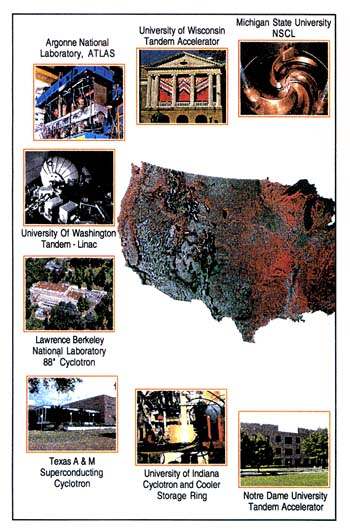
FIGURE A.1
Illustration and geographical distribution of nuclear physics laboratories in the United States. Shown are major national user facilities, as well as the smaller, dedicated university laboratories that, together and in a synergistic relationship, cover the broad range of science that is described.
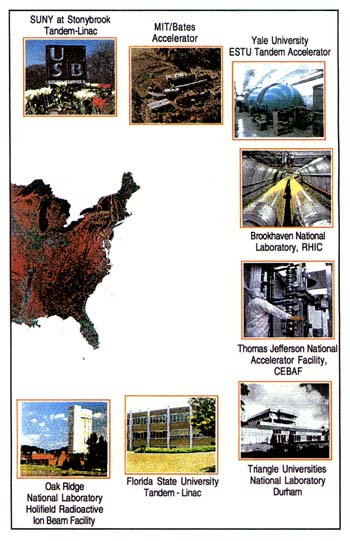
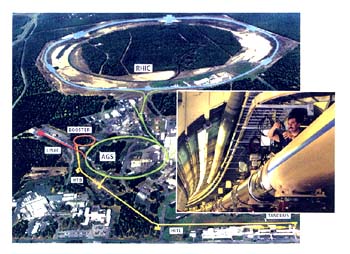
FIGURE A.2
Aerial view of the Relativistic Heavy Ion Collider (RHIC) accelerator complex at Brookhaven National Laboratory on Long Island. The facility will generate two counter-circulating, high-energy beams of heavy (for example, gold) nuclei; these beams will intersect and collide in six interaction regions located uniformly around the rings. The insert shows a recent photo of the tunnel that houses the accelerator, with an array of powerful superconducting magnets needed to bend the high-energy beams. (Courtesy RHIC.)
into operation at Oak Ridge National Laboratory to permit research with precisely controlled beams of radioactive nuclei generated by the ISOL (isotope separator online) technique. Light ions (protons, deuterons, and others) accelerated by the Oak Ridge Isochronous Cyclotron strike an isotope-production target. Radioactive atoms produced in the target are extracted, ionized, mass selected, charge exchanged, preaccelerated, and injected into a 25-MV electrostatic tandem for acceleration to final energies.
The 88'' Cyclotron at Lawrence Berkeley National Laboratory is a variable-energy isochronous cyclotron with spiral-sector focusing. A new ECR source, operating at 14 GHz, and producing high intensities of highly charged ions has revolutionized the acceleration of heavy nuclei. The 88" Cyclotron now provides ion beams of energies up to and above the Coulomb barrier for medium-mass nuclei, as well as lighter ion beams with energies up to 35 MeV/nucleon.
On a considerably smaller scale, university accelerators serve the important function of providing specialized capabilities that cannot be met by the national user facilities. Examples of problems requiring lower beam energies and thus smaller accelerators are studies of fundamental symmetries in light nuclei, nuclear structure far from stability, reactions near the Coulomb barrier, or the study of nuclear reactions that are relevant to astrophysics.
At present, eight small accelerators (also shown in Figure A.1) are supported by NSF and DOE. These are situated on university campuses and serve local faculty and students, but they also are often used by visitors who take advantage of their unique capabilities. In most cases, the capabilities of these machines result from intensive, sometimes even speculative, development work on new instrumentation, such as novel detectors or ion sources. The modest cost of accelerator operation and the availability of the accelerator over long periods of time permit developments that could not be carried out in a cost-effective way on large machines.
The accelerators at Florida State University, the State University of New York at Stony Brook, and the University of Washington consist of tandem electrostatic accelerators coupled to superconducting linear accelerators to augment their energy. At Florida State University, polarized Li ions are produced by laser pumping and are used to study spin effects in elastic and inelastic processes. New capabilities at Stony Brook include the development of a magneto-optical trap for production and trapping of short-lived radioactive nuclei. The accelerator at the University of Washington is equipped with a new ion source in the tandem terminal to provide the intense beams of alpha particles required for weak interaction studies.
The early work on production of radioactive beams at the University of Notre Dame led to systematic studies with 8Li of importance to cosmology. At Texas A&M University, a new beam-analysis system and spectrometer coupled to the K500 Superconducting Cyclotron provides radioactive-beam capabilities for studies of exotic nuclei and astrophysics. The availability of polarized beams
of protons and deuterons at the Triangle Universities Nuclear Laboratory (TUNL) in North Carolina and at the University of Wisconsin is of importance to studies of few-body systems. The technical developments for polarized beams and targets are applied at the larger facilities in a symbiotic relationship between small university accelerators and the large national and international facilities. The large ESTU tandem accelerator at Yale University, which has been used to accelerate heavy ions of mass up to gold, is being augmented with a mass-separator facility in the terminal of the machine for use primarily in the nuclear-structure and nuclear-astrophysics programs.


