
Executive Summary
The space shuttle system has been modified many times since the first launch of space shuttle Columbia in 1981. During the 1980s, major upgrade programs were established to respond to problems and anomalies experienced during the initial flights and the Challenger accident. Additional upgrades were approved in the early 1990s to enable the shuttle to visit the Mir space station and support the International Space Station. In 1996, however, the shuttle program effectively ceased approving new changes to the space shuttle design to concentrate scarce resources on developing potential replacements for the shuttle. The same year, the responsibility for some operational elements of the Space Shuttle Program were transferred to the United Space Alliance (USA) corporation.
During fiscal year 1997, the National Aeronautics and Space Administration (NASA) lifted the “design freeze” and authorized the Space Shuttle Program to dedicate about $100 million of its reserves each year to a new upgrade program. This program funds relatively minor modifications intended to reduce obsolescence, support missions, improve safety, and reduce costs, as well as studies of potential major upgrades. Implementation of any major upgrades, however, will necessarily be held off until a high-level national decision scheduled for the end of the decade is made on whether to phase out the shuttle by the year 2012 or to continue operating it indefinitely.
Information on potential upgrades to the shuttle is collected, organized, and prioritized by the Space Shuttle Program Development Office, which reports to the manager of the Space Shuttle Program. Each candidate upgrade is designated as Phase I, Phase II, Phase III, or Phase IV, depending on when it was approved and its anticipated cost and effect on the space shuttle design (see Table ES-1).
TABLE ES-1 Upgrade Phases
|
Phase |
Main Focus |
Typical Cost |
Status |
|
I |
Improving safety, supporting the International Space Station |
> $100 million |
Either completed or will be by 2000 |
|
II |
Combating obsolescence |
$10 to $50 million |
Some under way; some in study phase |
|
III |
Enhancing shuttle capability (does not change the fundamental shuttle configuration) |
$10s to $100s of millions |
Studies only |
|
IV |
Enhancing shuttle capability (changes the fundamental shuttle configuration) |
> $1 billion |
Studies only |
In addition to the phased upgrades, the USA corporation has limited incentives to initiate and implement cost-saving upgrades.
Choosing Upgrades
NASA uses its limited budget for shuttle upgrades to fund minor upgrades with identifiable short-term benefits and to conduct preparatory studies for major upgrades that may be warranted if the shuttle program is called upon to operate after 2012. In spite of budget uncertainties, technical risks with the development of a reusable launch vehicle (shuttle replacement strategy), and existing national policy restrictions on shuttle use, the committee believes that NASA's approach to upgrade planning is appropriate. Candidate upgrades are proposed to a central office, which prioritizes them with the assistance of tools that are under development. The committee commends NASA for its efforts to develop a formal process for evaluating and prioritizing upgrades.
Prioritizing and Selecting Upgrades
Decision makers in the shuttle program are facing an uncertain future. They do not know how long the nation will want shuttle flights to continue, the number of flights per year that will be required, or the missions (if any) beyond supporting the International Space Station (ISS) the shuttle will be expected to perform. For these reasons, developing an appropriate process for selecting upgrades for implementation has been difficult. Other organizations, such as the U.S. Air Force, have faced similar situations, however, and NASA should evaluate their investment decision processes for upgrades and identify appropriate processes and investment strategies to emulate.
The committee strongly supports NASA's use of program goals to help prioritize upgrades. However, the Space Shuttle Program Development Office should restate the goals of the upgrade program to ensure that they reflect the upgrade program's actual priorities, are feasible, and are clearly understandable by everyone working in the program. NASA should also provide better incentives for the USA corporation (and any future prime contractors for shuttle operations) to propose, fund, and implement upgrades to achieve the shuttle program's goals. Whether or not a shuttle-unique upgrade supports an increased flight rate should not be considered in the prioritization process unless NASA can prepare a viable business plan showing that (1) the shuttle could attract enough additional business to justify the increased flight rate, (2) the Space Shuttle Program would not unfairly compete with commercial launch vehicles, and (3) the shuttle, a national asset, would not be subjected to unnecessary risks.
NASA is taking steps to improve its process for selection of upgrade candidates for implementation. These steps are designed to provide a more visible quantitative comparison approach that should help balance some of the traditional internal and external political and other subjective pressures on the program.
One of the tools that NASA is using to help prioritize candidate upgrades is the quantitative risk assessment system (QRAS), a software tool being developed specifically for assessing risks to the shuttle. The committee believes that this tool has the potential to be very helpful in assessing and comparing the impact of shuttle upgrades on shuttle safety. NASA should continue to increase the scope and capability of the QRAS system so that it provides better models of failures caused by human error, combinations of risks, abort modes, on-orbit hazards, reentry and landing hazards, and software problems. Until these improvements are made, the Space Shuttle Program Development Office should be very cautious in using QRAS to aid in prioritizing upgrades.
NASA is also funding development of the Decision Support System to assist in prioritizing upgrades. The committee believes that when this system is more mature, it will be a valuable tool. However, the current Decision Support System will require significant modifications before it can be a reliable input to the prioritization process. NASA should consider modifications that would place less emphasis on quantitative results and more on a clear, defensible decision process that takes into account all of the available evidence.
Upgrade cost estimates provided by NASA to the committee contained inconsistencies in their scope, assumptions, and basis. For these estimates to be helpful, the agency must ensure that they are as accurate as possible and are calculated consistently. All calculations, comparisons of costs and cost savings, and cost-benefit assessments should be based on fixed-year dollars and should include all of the costs associated with the upgrade, including hidden costs, such as integration costs and the cost of operating and maintaining the upgrade.
Improving Candidate Upgrades
To ensure that NASA can select the best upgrades for the shuttle program, there must be a pool of high quality potential improvements. The shuttle program can take steps to improve the pool of proposed upgrades such as external proposals, early compatibility studies, limits to software changes, and trade-off studies. The Space Shuttle Program Development Office should not consider proposed upgrades as stand-alone proposals, but where appropriate, should look for ways to combine upgrades (or features of upgrades) to efficiently meet future requirements.
Assessments of Proposed Upgrades
From the information presented to the committee, it is clear that a great deal of creative and useful work has been done to design and develop ongoing and proposed upgrades to the space shuttle system. The committee was able to assess the potential of some key upgrades to meet Space Shuttle Program goals, point out areas of technical or programmatic risk, and suggest alternatives. Figure ES-1 shows the locations of selected representative upgrades in the shuttle system.
Phase II Upgrades.
Checkout Launch and Control System
The checkout launch and control system (CLCS) is an upgrade to the launch processing system used to check out, control, and process shuttle flight systems, ground support equipment, and facilities at Kennedy Space Center. The current system is growing obsolete, and the CLCS upgrade will replace it with modern commercial hardware and software. Based on historical precedent, the committee believes that the large and complex CLCS upgrade is likely to experience schedule delays and budget overruns. NASA should audit the requirements, specifications, plans, schedules, development budgets, status, and life cycle costs of the CLCS project. The objective of this audit should not be to cancel the upgrade but to make more accurate estimates of the time and cost required to complete it and to identify potential problems early enough in the project to rectify them.
Protection from Micrometeoroids and Orbital Debris
As part of the Phase II upgrade program, the shuttle orbiters will be modified during 1999 and 2000 to protect the radiators and the leading edge of the wings from meteoroids and orbital debris. Considering the predicted high level of risk from this hazard even after these modifications are made, the space
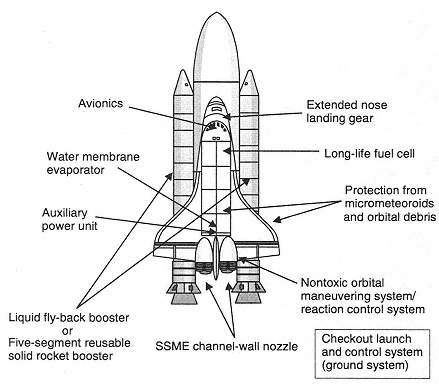
Figure ES-1
Location of assessed upgrades.
shuttle upgrades program should solicit additional upgrade proposals for protecting the shuttle from meteoroids and orbital debris.
Phase III Upgrades
Auxiliary Power Unit
Every shuttle orbiter has three auxiliary power units (APUs) to pressurize the vehicle's hydraulic systems during ascent and reentry. NASA is studying a number of options for replacing the current APUs—which use toxic hydrazine propellant—with an electric system that would be safer and easier to maintain. NASA should continue studying potential modifications to the APUs to determine the costs, benefits, and appropriate scope of each upgrade. The
development of electric power systems worldwide should be monitored for technologies and techniques that could improve an APU upgrade.
Avionics
The orbiter's current avionics system was conceived in the early 1970s but contains hardware that was added during the 1980s and 1990s. The objective of NASA's proposed avionics upgrade is to avoid the growing costs associated with obsolescent components by judiciously replacing hardware and, at the same time, positioning upgrades as components of a modern, functionally partitioned avionics architecture. NASA should continue this strategy and should develop and publish scaleable, long-term requirements and interface definitions for the future architecture.
Channel-Wall Nozzle
The channel-wall nozzle is a proposed replacement for the current space shuttle main engine nozzle. The channel-wall nozzle is a relatively simple design based on a manufacturing process developed in Russia. NASA plans to build the nozzle in Russia (through Rocketdyne's subcontractor Aerojet) to reduce development costs. If NASA decides to implement this upgrade, it should take steps to ensure that channel-wall nozzles are available in the United States, either by stockpiling additional nozzles or developing a channel-wall nozzle manufacturing capability in the United States.
Extended Nose Landing Gear
The proposed extended nose landing gear is a modification intended to reduce loads on the orbiter's landing gear. Based on work performed to date, the proposed upgrade appears to be a good design for reducing shuttle landing loads. However, the existing nose landing gear meets current requirements, so NASA should pursue the upgrade only if future plans require that the shuttle land with heavier payloads than are currently allowable.
Long-Life Fuel Cell
The orbiter's fuel cells provide electric power for the orbiter and water for the crew. Two distinct upgrades—longer-life alkaline fuel cells and proton exchange membrane (PEM) fuel cells—are being considered to replace the current cells. Modified alkaline cells would be similar to the current cells but would require less maintenance. The PEM cells would last longer, produce more power, and be less toxic than either the current or the improved alkaline cells. However, the PEM cell upgrade would involve an expensive and potentially open-ended
technology research program. NASA should explore the costs and benefits of the PEM cell further before deciding on a new fuel cell. Planners of future space missions that could benefit from PEM fuel cells should be closely involved in these studies. These planners could help determine the value of PEM cells for future missions, influence the design of the shuttle's PEM cells so that they will be applicable to future missions, and, perhaps, provide funding.
Nontoxic Orbital Maneuvering System/Reaction Control System
This upgrade would modify the shuttle orbiter's orbital maneuvering and reaction control systems to use nontoxic liquid oxygen and ethanol propellants and would connect both systems to common propellant tanks. NASA believes that the proposed upgrade would reduce hazards on the ground and in orbit, improve ground operations and turnaround times, save money, and increase shuttle performance. Before making any decision on implementation, however, NASA should very carefully study all of the risks inherent in changing to a liquid oxygen/ethanol system and conduct trade-off studies to determine whether modifications to the existing system may be a more cost-effective means of meeting program goals. Commonality with the propulsion (and possibly the life-support) systems of the ISS and other future NASA programs should be considered in the final design.
Water Membrane Evaporator.
The water membrane evaporator (WME) is being considered as a replacement for the orbiter's flash evaporator system (FES), which cools the orbiter during ascent and entry and provides supplemental cooling in orbit. The WME appears to be a simple passive device that can accomplish the FES's cooling function without the corrosion that creates a risk of freon leaks in the FES. However, other options to reduce freon leakage (such as using more corrosion-resistant materials in the FES) could potentially be lower-cost and lower-risk solutions to the problem. NASA should carefully weigh the costs and benefits of all options for dealing with the FES corrosion problem before choosing a solution.
Phase IV Upgrades
NASA is currently evaluating the merits of two new first stage booster concepts: the five-segment reusable solid rocket booster (RSRB), and the liquid fly-back booster (LFBB). To varying degrees, each concept promises improvements in safety, performance, and life cycle cost. Each concept also requires significant system integration, as well as a thorough ground and flight test program. Each will also require large initial investment.
An important consideration in NASA's ongoing space transportation studies is that the existing four-segment RSRB has demonstrated high reliability since its first flight in 1988. It also satisfies NASA's known performance requirements for the Space Station era. These facts, combined with the risks involved in changing to a relatively unproven booster on a manned vehicle with only minimal crew escape capability means that NASA is not likely to, and the committee agrees it should not, enter into any major new booster program without substantial national need for the performance enhancements and long-term safety and cost benefits.
Five-Segment Reusable Solid Rocket Booster
A recent proposal by Thiokol Propulsion, this upgrade would add a fifth segment to the shuttle's RSRB, alter the grain of the solid fuel to provide a safer thrust profile, and modify the RSRB's nozzle and insulation. On its surface, the five-segment RSRB appears to be a relatively straightforward approach to improving the performance of the booster, but it will require substantial integration engineering and testing. Early estimates suggest at least $1 billion development cost. A thorough evaluation of the potential for separate implementation of subsets of the proposal should be included in NASA's ongoing assessment.
Liquid Fly-Back Booster
This NASA generated concept would replace the shuttle's solid rocket boosters with liquid-fueled boosters designed to fly back automatically to the launch site after they have separated from the orbiter. NASA believes that the LFBB would cost $4 to $5 billion to develop but would improve safety, reduce long-term operational costs, enable a higher flight rate, and increase the shuttle's payload capacity. Before proceeding with the LFBB, NASA should initiate a detailed independent assessment of configuration trade-offs, costs, and programmatic and technical risks to determine the best fundamental configurations for a new liquid shuttle booster. Should NASA proceed with this program, they should closely coordinate their efforts with other government and industry transportation initiatives.


