
Effectiveness of Highway Drainage Systems in Preventing Road-Salt Contamination of Groundwater: Preliminary Findings
PETER E. CHURCH AND PAUL J. FRIESZ
A study to determine the relative effectiveness of four highway drainage designs in preventing the contamination of groundwater by road salt is being conducted by the U.S. Geological Survey in cooperation with the Massachusetts Highway Department and FHWA. Four test sites, each representing a specific highway drainage design, are located along a 5-km section of Route 25 in southeastern Massachusetts. The drainage designs being tested are open drainage, closed drainage, closed drainage with snow berm, and full-snow-berm drainage. Preliminary comparisons of the effectiveness of the highway drainage systems are based on computations of chloride loads from road salt in groundwater and chloride loads from road salt discharged through the highway-drainage monitoring stations at each test site. A comparison of monthly chloride loads from November 1990 through May 1992 shows that chloride loads in groundwater at the closed drainage site, the closed drainage site with snow berm, and the full-snowberm site are about 40, 50, and 20 percent, respectively, of the chloride load in groundwater at the open drainage site. The chloride load discharged through the full-snow-berm drainage site, and thus prevented from entering groundwater, is twice that discharged from the closed drainage site and from the closed drainage site with snow berm. Evaluation of the effectiveness of these drainage systems will be refined as additional data are collected and analyzed. Results from this study should also be applicable to the transport of other conservative chemical constituents in highway runoff.
Road-salt contamination of public and private water supplies has become a serious and costly problem, particularly in the northeast and midwest United States. For example, the Massachusetts Highway Department (MHD) received complaints of road-salt contamination from 100 of the 341 municipalities in the state from 1983 through 1990. MHD spent about $1.2 million to investigate and remediate road-salt contamination complaints during this period (1). Nationally, state and local governments spend about $10 million each year to prevent and remediate problems of road-salt contamination (2).
One method that state highway agencies use to reduce road-salt contamination of public water supplies is that of diverting highway runoff from sections of highway that pass near public supplies to less sensitive areas. Four types of highway drainage systems were incorporated into the design of an 11-km, sixlane section of Route 25 in southeastern Massachusetts completed in 1987. Three of these drainage systems —two of which are new, untested designs—divert highway runoff away from adjacent public water supplies. The methods by which the diverted highway runoff is collected (and, correspondingly, the cost of highway construction) differ between drainage systems. The most expensive, and potentially the most effective, drainage system added about $1.6 million/km to construction costs for that section of highway (2). However, the relative effectiveness of the individual drainage systems in preventing road-salt contamination of the public water supplies is not yet known.
An investigation of the relative effectiveness of these highway drainage designs in preventing groundwater from being contaminated by road salt is being conducted by the Water Resources Division of the U.S. Geological Survey (USGS) in cooperation with MHD and FHWA, U.S. Department of Transportation. Four test sites, each representing one of the highway drainage designs, are located along a 5-km section of Route 25 (Figure 1). Data collection for analysis and comparison of the effectiveness of the drainage designs began in November 1990 and is planned to continue through December 1995.
PURPOSE AND SCOPE
The purpose of this paper is to describe the highway drainage systems being tested, discuss the general hydrogeology of the study area, define the methodologies by which the drainage systems are being evaluated, and present preliminary findings of the effectiveness of the highway drainage systems in preventing road-salt contamination of groundwater. These findings are based on computations of chloride loads from road salt in groundwater and chloride loads from road salt discharged through the highway drainage systems from November 1990 through May 1992.
STUDY APPROACH
Networks of observation wells were installed at each test site to enable the comparison of water samples collected from wells upgradient (background) and downgradient (potentially contaminated) from Route 25. Water samples from the wells are analyzed for concentrations of dissolved sodium, calcium, and chloride to determine the amount of road salt entering
U.S. Geological Survey, Water Resources Division, Massachusetts– Rhode Island District, 28 Lord Road, Suite 280, Marlborough, Mass. 01752.
groundwater at each test site. Highway-drainage monitoring stations were installed within the drainage systems to measure continuous records of stage and specific conductance of the runoff. Samples of runoff are analyzed for concentrations of dissolved sodium, calcium, and chloride. Relations between stage and discharge and between specific conductance and chloride concentration are used to determine the amount of chloride discharged through each monitoring station.
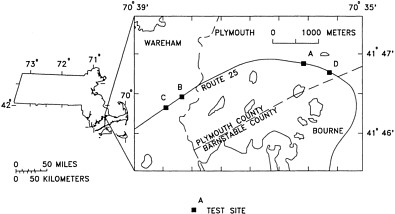
FIGURE 1 Location of study area in southeastern Massachusetts and Test Sites A, B, C, and D along Route 25.
MHD monitors the application of road salt to the highway. Department records indicate the amount of road salt applied to the entire 11-km section of Route 25 along which the test sites are located and are not specific to each test site. Therefore, it is assumed that road-salt application is equal at all test sites.
HIGHWAY DRAINAGE SYSTEMS
The four types of highway drainage system incorporated into the construction of Route 25 each represent a different method of control of runoff from the highway surfaces, shoulders, and median strip. Test sites designated A, B, C, and D, in order of increasing highway runoff control, are representative of each drainage system (Figure 1). Test Sites A and B represent standard drainage designs, whereas Test Sites C and D represent new, untested designs.
The roadway surface at all test sites is crowned to allow highway runoff to flow toward the highway shoulders and the median strip. The top 2.5 cm of the highway pavement is composed of an open-graded friction coarse bituminous concrete, referred to as “popcorn pavement, ” to limit ponding of water on the highway surface. This permeable layer is underlain by a 20-cm-thick layer of consolidated asphalt estimated to be at least 95 percent impervious (L.C. Stevens, Jr., MHD, personal communication, 1990). Rainfall and salt-laden water from melting snow and ice easily penetrate the 2.5-cm-thick popcorn pavement and then flow laterally to the edges of the roadways. The extent to which the water flows onto the shoulders or the median strip is controlled by the drainage systems, as described later. The quantity of salt-laden water percolating through the 20-cm-thick consolidated asphalt is assumed to be small and uniform at all test sites.
Site A represents an open drainage system, where local groundwater is unprotected from contamination by road salt (Figure 2). Runoff collected in catch basins on the pavement surface and drop inlets in the median strip is discharged lo-
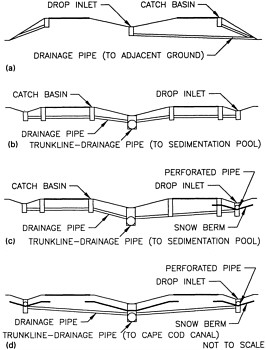
FIGURE 2 Sections of highway drainage designs: a, open drainage; b, closed drainage; c, closed drainage with snow berm; d, full snow berm drainage.
cally. In effect, all highway runoff—whether from direct overland flow, melting of snow plowed from the highway surface, or spray caused by vehicular traffic—is allowed to infiltrate the soil and percolate through the unsaturated zone to the water table.
Site B is a closed drainage system, where catch basins are installed every 90 to 180 m on both edges of both roadways (Figure 2). Highway-surface runoff collected in these catch basins is piped beneath the highway to a trunkline drainage pipe beneath the median strip and is then discharged into a sedimentation pool. Outflow from the pool enters a local stream about 1.6 km upstream of a coastal bay. Additional runoff from the highway shoulders and the median strip can enter the trunkline drainage pipe through drop inlets; however, the bulk of runoff from the shoulders and the median strip (snow plowed from the road surface and spray caused by vehicular traffic) is uncontrolled and is allowed to infiltrate the soil and percolate to the water table.
The highway drainage system at Site C contains elements of two distinct overlapping designs (Figure 2). Site C represents a closed drainage system as described for Site B but also incorporates a 5-cm-thick layer of bituminous concrete buried about 1 m beneath the eastbound roadway shoulder. This snow berm is sprayed with a seal coat during construction to make it 100 percent impervious (L.C. Stevens, Jr., MHD, personal communication, 1990) and is then covered with a 1-m-thick layer of well-sorted permeable sand. The snow berm is shaped as a channel running parallel to the highway. Drop inlets in the center of these channels are sealed to the snow berm about every 90 m along the highway. Perforated pipes on the snow berm are connected to the drop inlets immediately above the snow-berm seal. Highway runoff can enter the drop inlets directly as overland flow and indirectly by percolation through the sand to the snow berm and eventually draining into the drop inlet through the perforated pipe. Highway runoff from the drop inlets is then piped to the trunkline drainage pipe beneath the median strip of the highway. The drainage system at Site C is designed so that highway-surface runoff from both roadways and runoff from the eastbound roadway shoulder is diverted from the site and thus is prevented from percolating through the unsaturated zone to groundwater. Captured highway runoff at Site C enters the same trunkline drainage pipe that passes through Site B.
Site D is a full-snow-berm drainage system, where both highway shoulders and the median strip are underlain by snow berms (Figure 2). Highway-surface runoff is allowed to flow onto the shoulders and the median strip where it either enters drop inlets as overland flow and is channeled directly to the trunkline drainage pipe or percolates to the impervious snow berms. Runoff captured by the snow berms enters drop inlets from below the land surface through perforated pipe and is then directed to the trunkline drainage pipe. This trunkline drainage pipe under the median strip of the highway discharges into the Cape Cod Canal, a coastal waterway about 3 km east of the test site.
HYDROGEOLOGY OF STUDY AREA
The study area is in a rural area of southeastern Massachusetts in the towns of Wareham and Plymouth (Figure 1). This area is part of a coastal outwash plain bounded by till and bedrock hills to the north and west and by saltwater bays of the Atlantic Ocean to the south and east. In general, the test sites selected along Route 25 are underlain by a layer of fine to coarse sand with gravel ranging in thickness from about 9 m at Site D to about 27 m at Site C. A lower unit of fine to coarse sand with silt is present at Sites A, B, and C. The sand with gravel unit at Site D is underlaid by fine to coarse sand with gravel and silt. Considerable small-scale vertical and lateral variations in grain-size distribution, typical of sand and gravel deposits, are present in the upper and lower layers at all test sites.
Few streams drain the area because precipitation infiltrates easily into the sandy soils. Depth to the water table below the highway ranges from 6 m at Site B to 18 m at Site A. Compared with land-surface topography, the water table is relatively flat. The saturated zone is more than 15 m thick at all test sites. Groundwater flow is generally to the south, nearly perpendicular to the highway. Water-table gradients are less than 0.006, and annual ranges in water-table altitudes vary from year to year in response to precipitation but are normally from 0.5 to 1.5 m.
Horizontal hydraulic conductivity of the upper 7.5 m of the saturated zone at each test site was estimated by use of borehole permeability tests (slug tests). Hydraulic conductivities of 67, 33.5, 30.5, and 33.5 m/day were measured at Sites A, B, C, and D, respectively.
Background concentrations of sodium, calcium, and chloride in groundwater and background specific conductance of groundwater were monitored before construction and before operation and salting of Route 25. Typical background concentrations of sodium ranged from 5 to 10 mg/L, calcium from 1 to 5 mg/L, and chloride from 5 to 20 mg/L at Sites A, B, and D. Background concentrations of these constituents were generally higher at Site C, where sodium concentrations ranged from 5 to 20 mg/L, calcium concentrations from 3 to 15 mg/L, and chloride concentrations from 10 to 30 mg/L. Background specific conductance ranged from 40 to 70 μS/cm (25°C) at Sites A, B, and D. At Site C, specific conductance ranged from 50 to 250 μS/cm. Background chemical data at Site C are probably higher than at the other test sites because of the former presence of a pig farm approximately 0.8 km upgradient from the test site, which is now an unpaved lot where many used buses are stored.
METHODOLOGY
Preliminary comparisons of the effectiveness of the highway drainage systems are based on computations of chloride loads from road salt in groundwater and chloride loads from road salt discharged through the highway-drainage monitoring stations. The constituents of road salt—primarily sodium chloride and secondarily calcium chloride—ionize when dissolved in water. Chloride, a nonreactive ion with little affinity for the sands and gravels that make up the surficial and aquifer materials in the study area, is easily transported in groundwater and in highway surface and shoulder runoff. Transport of sodium and calcium, however, is more likely than chloride to be attenuated because of exchange with other ions. Therefore, chloride loads can be used as a measure of road-salt contamination of groundwater and road salt discharged through the drainage systems for comparisons between test sites.
Monitoring Road-Salt Chloride Loads in Groundwater
Water samples are collected from wells upgradient and downgradient from Route 25 to monitor the quantity of chloride from road salt entering groundwater at each test site. Clusters of wells with screens of 5-cm inside diameter and 1.5-m length were installed in a line parallel to the direction of groundwater flow at the four test sites (Figure 3). Well clusters about 60 m upgradient from the median strip of the highway contain three wells, two of which together fully screen the upper 3 m of the aquifer. The third well is screened at about 15 to 18 m below the water table. Well clusters about 60 m downgradient from the median strip of the highway include six wells, five of which together fully screen the upper 7.5 m of the aquifer. The sixth well is screened at about 18 to 21 m below the water table. An additional well was installed about 120 m downgradient from the median strip and is also screened at about 18 to 21 m below the water table at each test site.
Water samples are collected monthly from the two wells screened immediately below the water table upgradient from the highway and from the five wells screened immediately below the water table downgradient from the highway at each test site. These samples are analyzed for dissolved concentrations of sodium, calcium, and chloride. Borehole electromagnetic-induction (EM) logs are taken from the deep wells at each well cluster and the deep wells about 120 m downgradient from the highway concurrently with water sample collection. EM logs are performed to monitor the vertical distribution of salt-contaminated groundwater at the well sites to verify that the zone of aquifer in which the contaminated groundwater is transported is fully screened.
Because hydraulic gradients and hydraulic conductivities of the aquifer differ between test sites and hydraulic gradients change with time, comparison of the amount of road-salt chloride (chloride from road salt only) entering groundwater requires that the mass flux of road-salt chloride through a specific vertical section within the aquifer downgradient from the highway be computed at each test site. Road-salt chloride concentrations are calculated by subtracting chloride concentrations at wells upgradient from the highway (background-chloride concentration) from concentrations at wells downgradient from the highway. The mass flux of road-salt chloride through the aquifer (QCd), in kilograms per day, is then computed as follows:
QCd= K × I × A × Cl × C (1)
where
K = estimated horizontal hydraulic conductivity of aquifer (m/day),
I = water-table gradient (dimensionless),
A = area of vertical section through which groundwater flows (m2),
Cl = road-salt chloride concentration (mg/L), and
C = constant 0.001 (kg-L/m3-mg) (conversion of units m3-mg/day-L to kg/day).
Monthly loads of road-salt chloride transported past the downgradient wells are calculated by summing the daily flux of chloride determined by Equation 1 over 1 month. Monthly chloride loads are then converted to chloride loads, in kilograms per lane-kilometer of highway, for comparison between test sites.
Monitoring Road-Salt Chloride Discharged from Highway Drainage Stations
Highway-drainage monitoring stations were installed in the trunkline drainage pipes of the highway drainage systems at Sites B, C, and D (Figure 4). Design of the monitoring stations was adapted from that of Kilpatrick et al. (3). Each moni-
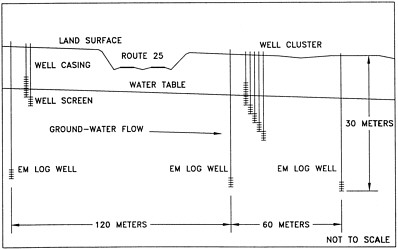
FIGURE 3 Section of well network at test sites.
toring station consists of a calibrated Palmer-Bowlus flume (4) cast into a reinforced-concrete vault. The concrete vaults containing the flumes were installed during highway construction.
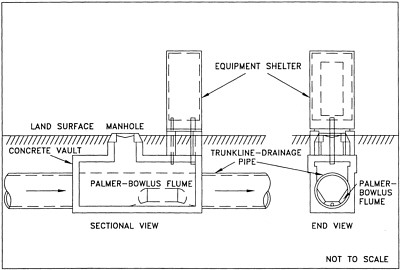
FIGURE 4 Sections of highway-drainage monitoring station.
Instrumentation for monitoring discharge of road salt through the flumes is contained in equipment shelters on top of the concrete vaults. Stage is measured by use of pressure transducers, and specific conductance is measured with USGS Minimonitors. Water samples for analysis of chloride concentrations are collected by automatic water samplers during runoff to establish a relation between chloride concentration and specific conductance. Stage, specific conductance, and the dates and times of water-sample collection are recorded in digital data loggers. The data loggers are programmed to control the frequency of recording and water-sample collection. Stage thresholds are entered whereby recording and sampling frequencies are increased in steps as stage rises and decreased as stage falls. The frequency of baseline data collection is set at 6 hr at all stations; however, stage thresholds and recording and sampling frequencies are set independently for each station on the basis of diameter and slope of the pipe in which the flume is installed. Stage thresholds of 0.03 m and recording and sampling frequencies of 5 and 15 min, respectively, are typical. These stage thresholds and sampling frequencies are adjusted seasonally to account for differences in flow regimes and to ensure the recording of stage and specific-conductance and collection of water samples during runoff and to prevent the collection of voluminous data at times of little or no flow.
Theoretical stage-discharge relations for each highway-drainage monitoring station have been developed by use of the Bernoulli total energy equation, as described by Kilpatrick and Schneider (5). Discharge at each station is determined from the recorded stage data and these theoretical relations. The relation between specific conductance and chloride concentration is used to determine chloride concentrations from recorded specific-conductance data. A chloride load is computed for every stage and specific-conductance measurement. Chloride load (QCTI), in kilograms per time interval since last measurement, is computed as follows:
QCTI = Q × Cl × TI × C (2)
where Q is the discharge of water (m3/sec) and TI is the time interval since last measurement in seconds.
The values calculated in Equation 2 are summed over a monthly period to provide chloride loads, in kilograms per month. Monthly chloride loads are then converted to chloride loads, in kilograms per lane-kilometer of highway, for comparison between test sites.
RESULTS AND DISCUSSION OF RESULTS
Comparison of road-salt chloride loads in groundwater at each test site from November 1990 through May 1992 shows that the various highway drainage systems differ in effectiveness. This interpretation is confirmed by chloride loads discharged through the highway-drainage monitoring stations during the same period.
Road-Salt Chloride Loads in Groundwater
Examination of the computed monthly road-salt chloride loads in groundwater from November 1990 through May 1992 shows that chloride loads differ between test sites (Figure 5). Monthly chloride loads at the open drainage site are generally much higher than those at the other drainage sites throughout the 19-month period. This is particularly apparent in the late winter/early spring of 1991. The chloride loads at the closed
drainage site and the closed drainage site with snow berm appear similar except for an approximate 2-month delay in maximum chloride loads at the closed drainage site. Chloride loads at the full-snow-berm drainage site vary little with time and are generally much lower than those at the other drainage sites.
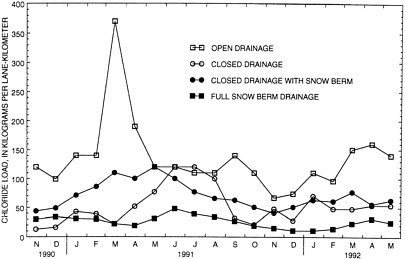
FIGURE 5 Monthly road-salt chloride loads in groundwater at test sites, November 1990 through May 1992.
Monthly and total chloride loads in groundwater at each test site over this 19-month period are given in Table 1. Total chloride loads at the closed drainage site, the closed drainage site with snow berm, and the full-snow-berm drainage site are about 40, 50, and 20 percent, respectively, of the chloride load at the open drainage site.
These relative differences in chloride loads in groundwater are likely to change as more data are collected. Chloride load data from 1991 show that annual plumes of salt-contaminated groundwater develop in response to annual application of road salt to the highway. Maximum loads occurred in March at the open drainage site, in May at the closed drainage site with snow berm, and in June at the closed drainage and full-snow-berm drainage sites. Minimum chloride loads occurred in the late fall and early winter of 1991 at each test site. Because the 1992 chloride loads are only through May and a large amount of road salt was applied in late March, these data do not represent the entire road-salt plumes developed from salt applied during winter 1991–1992.
Data collection is planned to continue through December 1995. Monthly data will be accumulated over the entire data collection period so as to determine the effectiveness of the drainage systems. Comparisons between test sites on an annual or biannual basis can be biased because of the difficulty in matching chloride loads in groundwater at each test site with chloride from road salt applied to the highway in the same winter. Monthly chloride loads in groundwater from November 1990 through May 1992 appear to represent chloride from road salt applied from two winters, 1990–1991 and 1991–1992. However, it is uncertain whether some of this chloride represents the trailing edges of road-salt plumes developed from salt applied in winter 1989–1990. It is also uncertain whether the chloride loads in the late fall and early winter of 1991 represent the trailing edges of the 1990–1991 plumes, the leading edges of the 1991–1992 plumes, or composites of both. Considering that road salt is applied intermittently to this six-lane highway, which is approximately 80 m wide (including shoulders and median strip), over a 5-month period each year, it is reasonable to assume that the leading edge of one year’s plume could combine with the trailing edge of the previous year’s plume. The extent to which these annual road-salt plumes overlap is likely to vary between test sites because of the differing hydraulic conductivities, hydraulic gradients, and unsaturated zone thicknesses between test sites. These differences in aquifer properties result in differing times of travel of road salt through the unsaturated zone and the rates of transport of annual road-salt plumes between test sites. Such overlapping of annual road-salt plumes can be further complicated because the total amount of salt applied and the time at which it is applied varies significantly from year to year. The accumulation of monthly data over several years reduces the bias introduced by the inability to account fully for what portion of a road-salt plume is related to which salting season at each test site because this potential bias would occur only in the first and last years of data collection.
Road-Salt Chloride Discharged from Highway Drainage Stations
Examination of road-salt chloride loads discharged through the highway-drainage monitoring systems from November 1990 through May 1992 shows that most of the chloride captured in the drainage systems is discharged in the winter and spring;
discharge of chloride in the summer and fall is negligible (Figure 6). Chloride discharged from the full-snow-berm drainage site is much greater than that from the close-drainage site and the closed drainage site with snow berm.
TABLE 1 Monthly and Total Chloride Loads in Groundwater at Test Sites, November 1990 Through May 1992 (kg/lane-km)
|
Year/month |
Open drainage |
Closed drainage |
Closed drainage with snow berm |
Full-snow-berm drainage |
|
1990 |
||||
|
November |
120 |
13 |
44 |
30 |
|
December |
99 |
16 |
49 |
34 |
|
1991 |
||||
|
January |
140 |
43 |
71 |
31 |
|
February |
140 |
39 |
86 |
30 |
|
March |
370 |
22 |
110 |
22 |
|
April |
190 |
52 |
100 |
19 |
|
May |
120 |
77 |
120 |
31 |
|
June |
120 |
120 |
100 |
48 |
|
July |
110 |
120 |
77 |
39 |
|
August |
110 |
100 |
66 |
34 |
|
September |
140 |
32 |
63 |
27 |
|
October |
110 |
21 |
51 |
19 |
|
November |
67 |
48 |
41 |
15 |
|
December |
74 |
28 |
51 |
11 |
|
1992 |
||||
|
January |
110 |
70 |
63 |
11 |
|
February |
96 |
48 |
61 |
14 |
|
March |
150 |
48 |
77 |
23 |
|
April |
160 |
54 |
56 |
31 |
|
May |
140 |
54 |
63 |
25 |
|
TOTAL |
2,600 |
1,000 |
1,300 |
490 |
|
[data rounded to two significant figures] |
||||
Monthly and total chloride loads discharged through the highway-drainage monitoring stations at each test site over this 19-month period are presented in Table 2. Total chloride load at the closed drainage site is similar to that at the closed drainage site with snow berm. However, the chloride load at the full-snow-berm drainage site is twice that of the closed drainage and closed drainage with snow berm sites.
Discharge of chloride through the drainage system at the full-snow-berm drainage site was not monitored from May through September 1991 while a related investigation was being conducted at this site. Chloride loads during these 5 months are assumed to fall between the April and October values of 73 and 39 kg/lane-km, respectively; however, these estimated values are not used in the current analysis. Even though road salt was not applied from the middle of March to early December 1991, October and November values of 39 and 25 kg/lane-km were measured. These elevated values, relative to those at the other drainage systems, are probably due to retention and slow release of salt-laden water from the approximately 1-m-thick layer of sand fill overlaying the snow berm.
SUMMARY
Four test sites, each representing a separate highway drainage system designed for a different amount of highway runoff control, were selected and instrumented to determine their relative effectiveness in preventing groundwater from becoming contaminated by road salt. These distinct designs were incorporated into the construction of an 11-km section of Route 25 in southeastern Massachusetts, completed in 1987. Preliminary comparisons of the effectiveness of the highway drainage systems are based on computed chloride loads in groundwater and computed chloride loads discharged through highway-drainage monitoring stations.
The test sites are designated Sites A, B, C, and D in order of increasing highway runoff control. Site A is an open drainage design where highway runoff collected in catch basins on the roadway surface is discharged locally. Sites B, C, and D,
however, contain trunkline drainage pipes beneath the median strip through which captured highway runoff is carried away and discharged into a nearby stream or coastal waterway. These drainage designs differ only in the way in which highway runoff is captured. At Site B, the closed drainage design, highway runoff is collected in catch basins on the roadway surface and is then piped beneath the highway to the trunkline drainage pipe. The drainage design at Site C, closed drainage with snow berm, is similar to that of Site B; however, the eastbound roadway shoulder is underlain with an impervious layer of bituminous concrete (snow berm) from which highway runoff is piped to the trunkline drainage pipe. Both roadway shoulders and the median strip are underlain with snow berms at Site D, a full-snow-berm drainage design. This type of drainage system is designed to capture all highway runoff and pipe it to the trunkline drainage pipe.
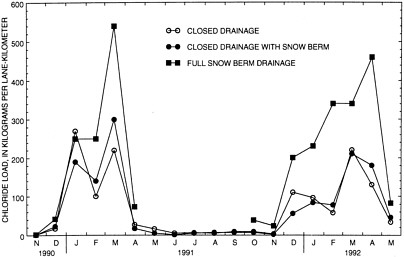
FIGURE 6 Monthly road-salt chloride loads at highway-drainage monitoring stations, November 1990 through May 1992.
TABLE 2 Monthly and Total Chloride Loads Discharged Through Highway-Drainage Systems, November 1990 Through May 1992 (kg/lane-km)
|
Year/month |
Closed drainage |
Closed drainage with snow berm |
Full-snow-berm drainage |
|
|
1990 |
||||
|
November |
1 |
1 |
2 |
|
|
December |
17 |
23 |
42 |
|
|
1991 |
||||
|
January |
270 |
190 |
250 |
|
|
February |
100 |
140 |
250 |
|
|
March |
220 |
300 |
540 |
|
|
April |
27 |
17 |
73 |
|
|
May |
16 |
5 |
-- |
|
|
June |
5 |
1 |
-- |
|
|
July |
6 |
5 |
-- |
|
|
August |
5 |
7 |
-- |
|
|
September |
9 |
7 |
-- |
|
|
October |
9 |
7 |
39 |
|
|
November |
3 |
2 |
24 |
|
|
December |
110 |
56 |
200 |
|
|
1992 |
||||
|
January |
96 |
84 |
230 |
|
|
February |
58 |
78 |
340 |
|
|
March |
220 |
210 |
340 |
|
|
April |
130 |
180 |
460 |
|
|
May |
34 |
46 |
83 |
|
|
TOTAL |
1,300 |
1,400 |
2,900 |
|
|
[data rounded to two significant figures; – denotes no data collected during this period] |
||||
Test sites are on a coastal outwash plain bounded to the north and west by till and bedrock hills and to the south and east by the saltwater bays of the Atlantic Ocean. The study area is directly underlain by a layer of fine to coarse sand with gravel that varies in thickness from 9 to 27 m. Fine to coarse sand with silt is present below this layer. Depth to the water table below the highway ranges from about 6 m at Site B to 18 m at Site A, and annual water-table fluctuations are less than 1.5 m. Estimated hydraulic conductivity of the aquifer ranges from 30.5 m/day at Site C to 67 m/day at Site A. Background concentrations of sodium, calcium, and chloride—the primary constituents of road salt—generally range from 5 to 10 mg/L, 1 to 5 mg/L, and 5 to 20 mg/L, respectively, in groundwater.
Groundwater samples are collected from clusters of wells with 1.5-m-long screens upgradient and downgradient from the highway. The monthly mass flux of road-salt chloride is computed by use of chloride concentrations, water-table gradients, and hydraulic conductivities at each test site. Highway-drainage monitoring stations at Sites B, C, and D consist of Palmer-Bowlus flumes within trunkline drainage pipes from which stage and specific conductance are continuously monitored and recorded. Monthly chloride loads discharged through the highway drainage systems are computed by use of relations between stage and discharge and between specific conductance and chloride concentration.
A comparison of accumulated monthly chloride loads in groundwater from November 1990 through May 1992 shows that chloride loads at the closed drainage site, the closed drainage with snow berm site, and the full-snow-berm drainage site are about 40, 50, and 20 percent, respectively, of the chloride load at the open drainage site. The chloride load discharged through the full-snow-berm drainage site, and thus prevented from entering groundwater, is twice that discharged from the closed drainage site and from the closed drainage with snow berm site.
These preliminary findings show that the effectiveness of the highway drainage systems in preventing road-salt contamination of groundwater varies widely. However, it is premature to use these data for quantitative evaluation of the effectiveness of the drainage systems. The 1992 chloride load data through May at each site do not represent the entire road-salt plumes developed from salt applied during winter 1991–1992, and they do not represent the total discharge of road salt through the highway-drainage monitoring stations. Additionally, difficulties in matching the leading and trailing edges of annual road-salt plumes in groundwater with road salt applied in the same winter at each test site introduces some uncertainties in the analysis that can be reduced by collection of more data. Data collection is planned to continue through 1995 to reduce uncertainties that might occur in the analysis of the effectiveness of the highway drainage systems.
ACKNOWLEDGMENTS
This paper was prepared in cooperation with MHD and FHWA. The authors thank the Research and Materials Section and the District 5, Wareham Office of MHD for providing ongoing logistical support during this study, including drilling and well installation, surveying, and recording of road-salt application. The authors also thank those in the MHD Research and Materials Section and FHWA for their comments and suggestions in the development of the study approach.
REFERENCES
1. Pollock, S. J.Remediating Highway Deicing Salt Contamination of Public and Private Water Supplies in Massachusetts. Proc., Focus Conference on Eastern Regional Groundwater Issues , National Water Well Association, Portland, Maine, 1991, pp. 347–368.
2. Special Report 235: Highway Deicing: Comparing Salt and Calcium Magnesium Acetate. TRB, National Research Council, Washington D.C., 1991, pp. 108–110.
3. Kilpatrick, F. A., W. R. Kaehrle, J. Hardee, E. H. Cordes, and M. N. Landers. Development and Testing of Highway Storm-Sewer Flow Measurement and Recording System Water-Resources Investigation Report 85-4111. U.S. Geological Survey, U.S. Department of the Interior, 1985.
4. Palmer, H. K., and F. D. Bowlus. Adaptation of Venturi Flumes to Flow Measurements in Conduits. Transactions, American Society of Civil Engineers , Vol. 101, 1936, pp. 1195–1216.
5. Kilpatrick, F. A, and V. R. Schneider. Use of Flumes in Measuring Discharge. Techniques of Water-Resources Investigations, Book 3 . U.S. Geological Survey, U.S. Department of the Interior, 1983, Ch. A14.


