




Below is the uncorrected machine-read text of this chapter, intended to provide our own search engines and external engines with highly rich, chapter-representative searchable text of each book. Because it is UNCORRECTED material, please consider the following text as a useful but insufficient proxy for the authoritative book pages.
/ Optical Disks The optical disk is the newest of the storage media, and because of its newness a great amount of confusion exists in terminology, technology, and standards. Many varieties of optical media exist, and it is futile to attempt to make definitive statements as to archival life at the present time. The most positive statement about archival life is that there exists a general belief that many forms of optical disk media will retain data for 10 to 20 years. A look at the natural progression of data systems of recent technology indicates that the useful system life is only about 10 to 20 years. Therefore it is not reasonable to ask that data storage media exist longer than the system capable of playing back the data. The implication is clear. If data are stored on optical disk, the date must be rerecorded in 10 to 20 years to ensure their existence. As a result, the cost and time to rerecord must be considered as a necessary expense of using optical disk as a storage medium. General agreement exists at present that no direct evidence is available to substan- tiate a claim for more than 20 years' life for data recorded on an optical disk {Joseph W. Price, Library of Congress; John C. Davis, National Security Agency; and David H. Davies, 3M Company, presentations to the committee, 1985; see also Price, 1984; Davies, 1985; Davis, 1982~. Optical disk technology is an outgrowth of the home entertainment industry. The early work on optical disk, called videodisk {Table 7-1) in the late 1960s and early 1970s, was directed at producing an inexpensive "pirate-proof" alternative to prerecorded video tapes. The videodisk is the video analog of audio records, since both contain prerecorded information. Videodisks are produced by first using a laser to write on the photosensitive material on a glass master, and then a metal master is made by using injection molding. The video information is impressed on plastic disks, similar to the process used for stamping out high- fidelity records. The videodisk has met with only limited market success because of the availability of low-cost video tape recorders. The latest disk entry in the prerecorded domain is called the compact disk {CD) or the digital audio disk. The CD, which stores ultra-high-fidelity digital 71
72 PRESERVATION OF HISTORICAL RECORDS audio on a 4. 7-in. disk, appears to be meeting with exceptional market acceptance. This acceptance is seen as helping provide a continuing technology base that can generate further applications interest for all the varieties of optical disks. Early in the development of the videodisk, many in and outside of the com- puter industry saw in it the promise for much higher storage densities than with the magnetic disk, and research was initiated into the technology for its use in data storage. The results of this research now are beginning to appear as products in the marketplace. The compact disk read-only memory jCD ROM) plays back com- puter-compatible prerecorded digital data. An optical digital disk for more general computer application is "write-once," wherein the data written by the user can- not be erased. This differs from CD and CD ROM, which are publishing media prerecorded as a final value-added step in manufacture. The next significant event for optical disk will be the introduction of erasable optical disks, which are expected to be available within the next 2 to 3 years Goldberg, 1984J. The erasable optical disk will use a magneto-optical or phase change material for which no estimate of archival life can be made at the present time. When the erasable optical disk appears, the competition between optical and magnetic recording will intensify. The removability {from the disk drive) of the optical media disk will offer a significant advantage in some applications. PERlMANENCE OF OPTICAL DISK MEDIA The optical disk is a new technology with new media processes, new read- write mechanisms, new data analysis methods, and many new companies starting in the business {Fujitani, 1984~. There are four basic markets for optical disks: {a) prerecorded entertainment programs, {b) interactive education and training, {c) document storage, and {d) computer digital data storage. Of these markets, only a very small portion of the document storage and data storage market requires the archival quality desired for 50- to 100-year life. If the optical disk turns out to be archival, it will be a fortuitous result and not the result of market forces. A wide range of application formats is available today {Table 7-1), and in 2 years erasable entries can be added to the Read or Write column. An examination of write-once media options available today Table 7-2) shows that 194,400 possible combinations exist, not all of which affect archival life. Of these possibilities, 10 to 20 working write-once systems have been built; TABLE 7-1 Applications Formats for Optical Disk Read or Write Data Format Common Names Read only Analog video Videodisk Read only Analog data Digital videodisk Read only Digital audio Compact disk (CD) Read only Digital data Compact disk read only memory {CD ROM) Write once Video/image Write once Digital data Optical digital data disk (OD3) NOTE: Erasable optical disk anticipated in 2 years.
OPTICAL DISKS TABLE 7-2 Write-Once Options for Optical Disk {Select One from Each Column) 73 Substrate Active Layer Mechanism Construction Size fin.) Glass Monolayer Bubble former Air sandwich 14 Aluminum Bilayer Hole former Sealed laminate 12 Plastic Trilayer Alloy former Core sandwich 8 Quadrilayer Phase change Flat sheet 5.25 Dye ablate 4.7 Dye bleach Protection Tracking Detection Format Encoding None Nongrooved Absorption change Preformat One for each In contact Grooved track Reflectance change Nonformat User) drive system Off contact Intermittent Optical phase Postformat track change Push-pull Wobble SOURCE: 3M Company (David H. Davies). however, a lack of uniformity among these diverse systems precludes any defini- tive statement as to archival life. A market consolidation must occur within the next few years because this wide diversity is technically interesting but not com- mercially viable. No surprises are expected in the useful life of the write-once disk, which manufacturers project at 10 to 20 years. It will be at least 1 or 2 years before more definitive data are available on its permanence. STANDARDS Although the need for accepted standards is widely recognized, no official standards are available. The industry has made attempts to start the standards process, as shown by the workshop held in June 1983 on Standardization Issues for Optical Digital Data Disk Technology National Bureau of Standards/National Security Agency, 1983~. In addition, the American National Standards Institute ANSI) formed committee X3B 11 on Optical Digital Data Disk in 1984 to formu- late standards. When standards have been established for the write-once formats, archival testing should produce some useful data. The read-only media have existed in a stable format for 10 years. A disk is manufactured from a mastering process in which the format, software, and data can be replicated for mass distribution. Read-only disks are not written serially as in the write-once system but are stamped out singly as a full disk, and the cost per disk is determined by the size of the production run. Sufficient field experience exists for read-only disks to allow an extrapolation of a useful life of 10 to 20 years. PRESERVATION, USE, AND STORAGE The factors of storage that are most harmful to the optical disk are heat and humidity. Humidity causes oxidation of the recording surface, and heat acceler- ates the process. Some of the other factors that cause concern are the adhesion of
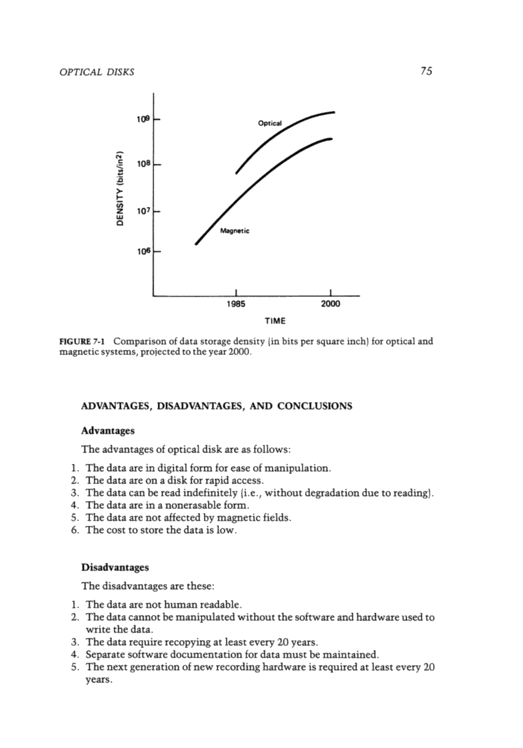
74 PRESERVATION OF HISTORICAL RECORDS various layers one to another, catalytic corrosion, galvanic corrosion, and mechanical stresses. The expected storage conditions for optical disks are typical of a computer room environment with controlled heat and humidity [nominal 20°C, 45 percent RH). In use the optical disk suffers no measurable degradation from continuous reading of the same data, since a much-reduced power {approximately 10 percent of write powers laser beam is used and the reading head has no physical contact with the surface. TRENDS AND PROJECTIONS Large on-line digital data storage systems have existed within the government since the 1960s. Examples are listed in Table 7-3. These data storage systems have a maximum useful life of 10 to 20 years, after which the system is no longer maintainable because parts and service are difficult to obtain and the system figuratively crumbles to dust. The important point of this revelation is that the data may still exist on the media but the equipment to retrieve the data does not exist. The obvious solution is to rerecord the data on a new system before the old system collapses. Here cost becomes an important factor. This situation raises a fundamental question regarding future actions: Is the National Archives ready to become a data processing facility with all its attendant problems? The trend within the next 3 to 5 years for write-once and erasable optical disk systems is toward standardization. Not all existing and proposed formats can be sustained by the marketplace. The particular formats that emerge are not critical; the critical factor is the reduction of market instability. When market stability occurs, the optical disk will begin to approach the maturity of magnetic recording and will begin to validate the promise of 10 to 20 years of useful system life. The projection for storage density, shown in Figure 7-1, indicates that the optical disk will have the density advantage for at least the next 15 years. After that time, the issue will not be storage density but rather system issues such as remov- ability of the media, system reliability, and, most important, cost. Low cost demanded by the consumer market and archival life for long-term data storage are diametrically opposed goals. Only peripheral considerations will be given to the archival qualities of the optical disk. TABLE 7-3 Examples of Typical Digital Data Storage Systems System Time Bits IBM Harvest Tractor Tape System 1962-1976 3 x 10~' IBM Photo Digital Store 1970-1972 2 x 10~2 Ampex Terrabit Memory (TBM) 1972-1982 2 x 10~2 Bragen Automated Tape Library iATL) 1975- 1o~2 IBM 3850 Magnetic Tape Cartridge System 1977- 10~2 SOURCE: National Security Agency John C. Davis).
OPTICAL DISKS 75 109 108 106 't . _ / / / ~ 1 1 1985 2000 TIME FIGURE 7-1 Comparison of data storage density fin bits per square inch) for optical and magnetic systems, projected to the year 2000. ADVANTAGES, DISADVANTAGES, AND CONCLUSIONS Advantages The advantages of optical disk are as follows: 1. The data are in digital form for ease of manipulation. 2. The data are on a disk for rapid access. 3. The data can be read indefinitely {i.e., without degradation due to readingI 4. The data are in a nonerasable form. 5. The data are not affected by magnetic fields. 6. The cost to store the data is low. Disadvantages The disadvantages are these: 1. The data are not human readable. 2. The data cannot be manipulated without the software and hardware used to write the data. 3. The data require recopying at least every 20 years. 4. Separate software documentation for data must be maintained. 5. The next generation of new recording hardware is required at least every 20 years.
76 PRESER VATION OF HIS TOPICAL RE CORDS Conclusions At present, it cannot be proved that the optical disk is archival in either the read-only or the write-once format. The consensus of the optical disk industry is that a useful life of 10 to 20 years can be reasonably assured for the read-only disk and extrapolated to 10 to 20 years for the write-once disk. No hard evidence can be offered for the useful service life of the hardware or archivability of the write-once disk in light of the volatility of the market. If one chooses to use the optical disk, knowledge available today on current optical disk media and systems indicates that the data must be recopied at least every 20 years. REFERENCES Davies, D. 1985. Optical Media Life Considerations. Optical Record. 3M Co., unpublished. Davis, J. C. 1982. Mass storage systems-A current analysis. Digest of Papers From the Fifth IEEE Symposium on Mass Storage Systems, October 26-28. Fujitani, L.1984. Laser Optical Disk, The Coming Revolution in On Line Storage. Communications of the ACM, 27~6) :546. Goldberg, M. 1984. Optical disk hardware performance and availability. Digest of Papers From the Sixth IEEE Symposium on Mass Storage Systems, June 4-7. National Bureau of Standards/National Security Agency. 1983. Proceedings of Workshop on Stan- dardization Issues for Optical Digital Data Disk Technology. National Bureau of Standards Special Publication 500-111. Price, J. 1984. Videodisc and Optical Disk. The Optical Disk Pilot Program at the Library of Con- gress. November-December. Unpublished. SUPPLEMENTARY BIBLIOGRAPHY American Council of Learned Societies.1985. Committee on the Records of Government. Washing- ton, D.C. March. Council on Library Resources.1985. Videodisc and Optical Disk Technologies and Their Application to Libraries. Washington, D.C. National Archives and Records Service. 1984. Strategic Technology Considerations Relative to the Preservation and Storage of Human and Machine Readable Records. Prepared by Subcommittee C of the NARS Advisory Committee on Preservation, July 1984. Unpublished.
OPTICAL DISKS Microfilm reading room at the NationaJArchives. Researchers use microfilm records in lieu of original documents. Ha_
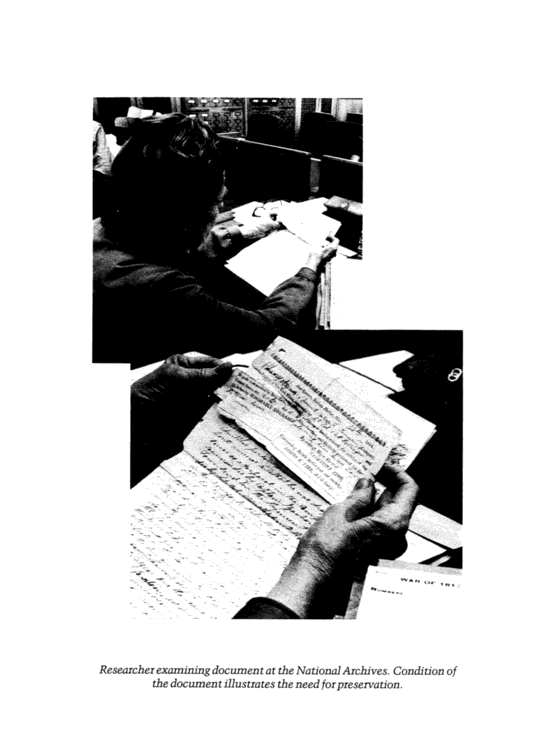
Researcher examining diocument at the National Archives. Condition of the document illustrates the need forpreservation.
