
Questions? Call 888-624-8373

Rights & Permissions

topleft topright

Doctoral Scientists and Engineers in the United States 1995 Profile (1998)
National Research Council (NRC)

Page
31
bottomleft bottomright

The following HTML text is provided to enhance online readability. Many aspects of typography translate only awkwardly to HTML. Please use the page image as the authoritative form to ensure accuracy.


Doctoral Scientists and Engineers in the United States

7

ARTICLES, PAPERS, AND PATENTS

Productivity of science and engineering Ph.D.s can be measured by the numbers of published articles, presented papers, and applications for patents.

Articles

  • Sixty-three percent of science and engineering Ph.D.s had an article published in a refereed journal between April 1990 and April 1995. The mean number of articles published was 4.7 for all science and engineering doctorates (see Table 35 ).

  • Publication of articles varied by field. The mean number of articles ranged from a low of 2.8 for doctorates in psychology to a high of 7.0 for doctorates in biological sciences. Ph.D.s in biological and earth/atmospheric/marine sciences were the most likely to have published at least one article (78 and 77 percent, respectively). Twenty-one percent of doctorates in biological sciences had more than 10 published articles during the five-year period compared to 12 percent for all science and engineering doctorates. The least likely to have published were psychology Ph.D.s (44 percent).

  • By sector, the mean number of articles was 6.7 for science and engineering doctorates employed in educational institutions, 4.4 for those in the nonprofit sector or governmental sector, 2.4 for those in private firms, and 1.1 for the self-employed. Those most likely to have published at least one article were science and engineering doctorates in educational institutions (78 percent) and those least likely were the self-employed (28 percent).

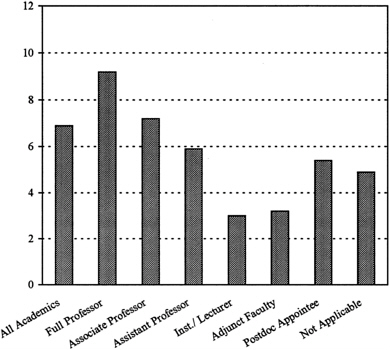
  • For all science and engineering doctorates holding academic positions, the mean number of articles published between April 1990 and April 1995 was 6.9, and 79 percent had published at least one article. Full professors had the highest mean number of published articles (9.2). More than one-quarter had published more than 10 articles. Adjunct faculty and instructors/lecturers had the lowest mean number of articles (3.2 and 3.0, respectively) (see Table 36 ).

  • By contrast, those holding postdoctoral appointments were the most likely to have published at least one article (94 percent). About 77 percent of full professors had published at least one article, compared to 61 percent of instructor/lecturers and 58 percent of adjunct faculty.

Page
31

Below are the first 10 and last 10 pages of uncorrected machine-read text (when available) of this chapter, followed by the top 30 algorithmically extracted key phrases from the chapter as a whole.
Intended to provide our own search engines and external engines with highly rich, chapter-representative searchable text on the opening pages of each chapter. Because it is UNCORRECTED material, please consider the following text as a useful but insufficient proxy for the authoritative book pages.

Do not use for reproduction, copying, pasting, or reading; exclusively for search engines.

OCR for page 31
Doctoral Scientists and Engineers in the United States 7 ARTICLES, PAPERS, AND PATENTS Productivity of science and engineering Ph.D.s can be measured by the numbers of published articles, presented papers, and applications for patents. Articles Sixty-three percent of science and engineering Ph.D.s had an article published in a refereed journal between April 1990 and April 1995. The mean number of articles published was 4.7 for all science and engineering doctorates (see Table 35 ). Publication of articles varied by field. The mean number of articles ranged from a low of 2.8 for doctorates in psychology to a high of 7.0 for doctorates in biological sciences. Ph.D.s in biological and earth/atmospheric/marine sciences were the most likely to have published at least one article (78 and 77 percent, respectively). Twenty-one percent of doctorates in biological sciences had more than 10 published articles during the five-year period compared to 12 percent for all science and engineering doctorates. The least likely to have published were psychology Ph.D.s (44 percent). By sector, the mean number of articles was 6.7 for science and engineering doctorates employed in educational institutions, 4.4 for those in the nonprofit sector or governmental sector, 2.4 for those in private firms, and 1.1 for the self-employed. Those most likely to have published at least one article were science and engineering doctorates in educational institutions (78 percent) and those least likely were the self-employed (28 percent). For all science and engineering doctorates holding academic positions, the mean number of articles published between April 1990 and April 1995 was 6.9, and 79 percent had published at least one article. Full professors had the highest mean number of published articles (9.2). More than one-quarter had published more than 10 articles. Adjunct faculty and instructors/lecturers had the lowest mean number of articles (3.2 and 3.0, respectively) (see Table 36 ). By contrast, those holding postdoctoral appointments were the most likely to have published at least one article (94 percent). About 77 percent of full professors had published at least one article, compared to 61 percent of instructor/lecturers and 58 percent of adjunct faculty.

OCR for page 32
Doctoral Scientists and Engineers in the United States By tenure status, those with tenure had the highest mean number of articles published (8.2). Postdoctoral appointees, who were the most likely to have had at least one article published (94 percent), had a lower mean number of articles (5.4). Those for whom tenure was not applicable had the lowest mean number of articles (5.1) and were the least likely to have published (68 percent). FIGURE 14. Mean number of articles published by science and engineering Ph.D.s between April 1990 and April 1995, by academic position.
OCR for page 33
Doctoral Scientists and Engineers in the United States Papers Seventy-three percent of science and engineering Ph.D.s had authored or co-authored papers for presentation at regional, national, or international conferences between April 1990 and April 1995. The mean number of papers presented was 6.4 overall (see Table 35 ). Variances in the number of papers produced for conferences by field, sector, academic position, and tenure status were similar to those in the number of articles published (see above). An exception was that doctorates in computer and earth/atmospheric/marine sciences were most likely to have authored a conference paper (86 and 85 percent, respectively). Patents The productivity of science and engineering doctorates can also be examined by looking at the number of patent applications on which they were named, the number of patents granted, and the number of patents that were commercialized. Overall, 12 percent said they had been named as an inventor on a patent application between April 1990 and April 1995 (see Table 37 ). The number of times science and engineering doctorates were named as an inventor on a patent varied by field. Almost no social science or psychology Ph.D.s were named as an inventor on a patent application (less than 1 percent for each). Other fields with a low percentage of doctorates named as inventor included mathematical sciences (4 percent), earth/atmospheric/marine sciences (5 percent), health sciences (6 percent), and agricultural/environmental sciences (8 percent). Those fields with a high percentage named on a patent application were chemistry (31 percent) and engineering (25 percent). Of those who had been named as an inventor on a patent application between April 1990 and April 1995, 59 percent had been named on 1 to 2 patent applications, 36 percent on 3 to 10 applications, and 5 percent had been named on 10 or more. However, 30 percent had no patents granted, while 46 percent had 1 to 2 granted, 21 percent had 3 to 10 granted, and 4 percent had 10 or more granted. Ph.D.s in chemistry and physics/astronomy had the highest rates of success in obtaining patents (79 and 78 percent, respectively), followed by engineering doctorates (72 percent). An interesting follow-on question is whether the patents granted resulted in commercialized products or processes or were licensed. Overall, 52 percent of those granted patents said that their patents had been licensed or commercialized. Thirteen percent of all those who had been granted a patent indicated that more than 2 of their patents had been commercialized or licensed.

OCR for page 34
Doctoral Scientists and Engineers in the United States FIGURE 15. Proportion of science and engineering Ph.D.s named as inventors on patent applications between April 1990 and April 1995, by field.

Representative terms from entire chapter:

articles published