| ||||||||||||
| Copyright © 2009. National Academy of Sciences. All rights reserved. Terms of Use and Privacy Statement |
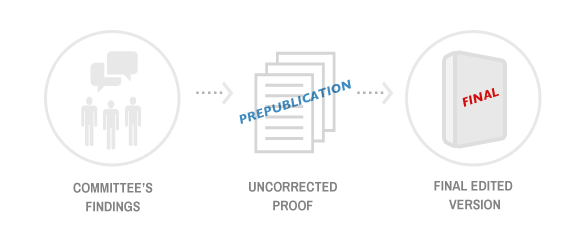
Below are the first 10 and last 10 pages of uncorrected machine-read text (when available) of this chapter, followed by the top 30 algorithmically extracted key phrases from the chapter as a whole.
Intended to provide our own search engines and external engines with highly rich, chapter-representative searchable text on the opening pages of each chapter.
Because it is UNCORRECTED material, please consider the following text as a useful but insufficient proxy for the authoritative book pages.
Do not use for reproduction, copying, pasting, or reading; exclusively for search engines.
OCR for page R1
Global Trends
in Computer
Tech no'Qgy
and Their
Impact on
Export Control
Committee to Study International Developments in
Computer Science and Technology
Computer Science and Technology Board
Commission on Physical Sciences, Mathematics, and Resources
National Research Council
NATIONAL ACADEMY PRESS
Washington, D.C. 1988
OCR for page R2
NOTICE: The project that is the subject of this report was approved by the Governing Board
of the National Research Council, whose members are drawn from the councils of the National
Academy of Sciences, the National Academy of Engineering, and the Institute of Medicine. The
members of the committee responsible for the report were chosen for their special competences
and with regard for appropriate balance.
This report has been reviewed by a group other than the authors according to procedures
approved by a Report Review Committee consisting of members of the National Academy of
Sciences, the National Academy of Engineering, and the Institute of Medicine.
The National Academy of Sciences is a private, nonprofit, self-perpetuating society of
distinguished scholars engaged in scientific and engineering research, dedicated to the furtherance
of science and technology and to their use for the general welfare. Upon the authority of the
charter granted to it by the Congress in 1863, the Academy has a mandate that requires it to
advise the federal government on scientific and technical matters. Dr. Frank Press is president
of the National Academy of Sciences.
The National Academy of Engineering was established in 1964, under the charter of
the National Academy of Sciences, as a parallel organization of outstanding engineers. It is
autonomous in its administration and in the selection of its members, sharing with the National
Academy of Sciences the responsibility for advising the federal government. The National
Academy of Engineering also sponsors engineering programs aimed at meeting national needs,
encourages education and research, and recognizes the superior achievements of engineers. Dr.
Robert M. White is president of the National Academy of Engineering.
The Institute of Medicine was established in 1970 by the National Academy of Sciences
to secure the services of eminent members of appropriate professions in the examination of
policy matters pertaining to the health of the public. The Institute acts under the responsibility
given to the National Academy of Sciences by its congressional charter to be an adviser to the
federal government and, upon its own initiative, to identify issues of medical care, research, and
education. Dr. Samuel O. Thier is president of the Institute of Medicine.
The National Research Council was organized by the National Academy of Sciences in
1916 to associate the broad community of science and technology with the Academy's purposes
of furthering knowledge and advising the federal government. F,unctioning in accordance with
general policies determined by the Academy, the Council has become the principal operating
agency of both the National Academy of Sciences and the National Academy of Engineering in
providing services to the government, the public, and the scientific and engineering communities.
The Council is administered jointly by both Academies and the Institute of Medicine. Dr. Frank
Press and Dr. Robert M. White are chairman and vice ~airman, respectively, of the National
Research Council.
Support for this project was provided by the U.S. Department of State under Grant No.
1751-700306.
Available from:
Computer Science and Technology Board
National Research Council
2101 Constitution Avenue, N.W.
Washington, D.C. 20418
Printed in the United State of America
OCR for page R3
COMMITTEE TO STUDY INTERNATIONAL
DEVELOPMENTS IN COMPUTER SCIENCE AND
TECHNOLOGY
SEYMOUR E. GOODMAN, University of Arizona, Chairman
DUANE A. ADAMS, Carnegie-Mellon University
ISAAC L. AUERBACH, Auerbach Consultants
WARREN DAVIS, Semiconductor Industry Association
JACK J. DONGARRA, Argonne National Laboratory
THOMAS F. CANNON, Digital Equipment Corporation
DAVID C. GOSSARD, Massachusetts Institute of Technology
ANTHONY C. HEARN, The RAND Corporation
JOHN L. HENNESSY, Stanford University
JOHN McCARTHY, Stanford University
WILLIAM K. McHENRY, Georgetown University
JOHN K. OUSTERHOUT, University of California at Berkeley
THEODORE J. RALSTON, Microelectronics and Computer
Technology Corporation (MCC)
JAMES W. STANSBERRY, Stansberry Associates, Inc.
JUDITH THORNTON, University of Washington
CLARK WElSSMAN, Unisys Corporation
TROY L. WILSON, IBM Corporation
MARJORY S. BLUMENTHAL, Staff Director
DAMIAN M. SACCOClO, Staff Officer
MARGARET A. KNEMEYER, Staff Associate
DONNA F. ALLEN, Administrative Secretary
MARGARET A. CHENG, Secretary
OCR for page R4
COMPUTER S CIENCE AND TECHNOLOGY B OARD
JO SEPH F. TRAUB, Columbia University, Chairman
JOHN SEELY BROWN, Xerox Corporation
MICHAEL L. DERTOUZOS, Massachusetts Institute of Technology
SAMUEL H. FULLER, Digital Equipment Corporation
JAMES FREEMAN GILBERT, University of California at San
Diego
WILLIAM A. GODDARD ITT, California Institute of Technology
JOHN E. HOPCROFT, CorneD University
ROBERT E. KAHN, Corporation for National Research Initiatives
SIDNEY KARTN, GA Technologies, Tnc.
LEONARD KLEINROCK, University of California at Los Angeles
DAVID J. KUCK, University of Illinois at Urbana-Champaign
ROBERT LANGRIDGE, University of California at San Francisco
ROBERT W. LUCKY, AT&T Bell Laboratories
RAT RED DY, Carnegie-Mellon University
MARY SHAW, Carnegie-Mellon University
WILLIAM J. SPENCER, Xerox Corporation
{VAN E. SUTHERLAND, Sutherland, Sproull & Associates
VICTOR VYSSOTSKY, Digital Equipment Corporation
SHMUEL WINOGRAD, IBM Corporation
TRYING WLADAWSKY-BERGER, IBM Corporation
MARJORY S. BLUMENTHAL, Staff Director
DAMIAN M. SACCOCTO, Staff Officer
MARGARET A. KNEMEYER, Staff Associate
DONNA F. ALLEN, Administrative Secretary
1V
OCR for page R5
COMMISSION ON PHYSICAL SCIENCES, MATHEMATICS,
AND RESOURCES
NORMAN HACKERMAN, Robert A. Welch Foundation,
Chairman
GEORGE F. CARRIER, Harvard University
HERBERT D. DOAN, The Dow Chemical Company (retired)
PETER S. EAGLESON, Massachusetts Institute of Technology
DEAN E. EASTMAN, IBM, T. J. Watson Research Center
MARYE ANNE FOX, University of Texas
GERHART FRIEDLANDER, Brookhaven National Laboratory
LAWRENCE W. FUNKHOUSER, Chevron Corporation Retired
PHILLIP A. GRIFFITHS, Duke University
CHRISTOPHER F. McKEE, University of California at Berkeley
JACK E. OLIVER, CorneD University
JEREMIAH P. OSTRIKER, Princeton University Observatory
FRANK L. PARKER, Vanderbilt University
DENTS J. PRAGER, MacArthur Foundation
DAVID M. RAUP, University of Chicago
RICHARD ]. REED, University of Washington
ROY F. SCHWTTTERS, Harvard University
ROBERT E. StEVERS, University of Colorado
LEON T. SILVER, California Institute of Technology
LARRY L. SMARR, National Center for Supercomputing
Applications
EDWARD C. STONE, JR., California Institute of Technology
KARL K. TUREKIAN, Yale University
RAPHAEL G. KASPER, Executive Director
MYRON F. UMAN, Associate Executive Director
v
OCR for page R6
OCR for page R7
Preface
and
The Committee to Study International Developments in Com-
puter Science and Technology was established under the auspices
of the Computer Science and Technology Board (CSTB) of the Na-
tional Research Council to evaluate trends in the development and
international diffusion of computer technology and the ramifications
of those trends for export control policy. Committee members were
selected for their expertise in a variety of aspects of computer science
and technology, for their familiarity with international trends in the
field, and for their insights into the East Bloc or Council for Mutual
Economic Assistance (CMEA) environment. Through CSTB, the
committee was asked by the Department of State to assess:
o computer science and technology trends in Western nations
o the status of computer capabilities and trends in East Blocs
countries.
The committee began its deliberations with meetings on Decem-
ber 3 and 4, 1987. It met again in 1988 on March 24 and 25 and on
1 east Bloc countries covered are members of the Council for Mutual Economic
Assistance, which includes members of the Warsaw Pact plus Cuba, Mongolia, and Viet
Nam. Throughout this report West or Western should be taken to include Japan and
other countries in the Far East that are friendly in a military sense to the United
States.
. .
V11
OCR for page R8
. . .
V111
PREFA CE
July 6 and 7. Throughout the course of this study, the committee
communicated extensively via electronic mail and other media. The
full committee and its representatives were briefed by the intelligence
community and the Department of State, and they sought informa-
tion from the Departments of Commerce and Defense. Most of the
material reviewed by the committee was unclassified.
We conducted an assessment of trends in computer science and
technology and, from that assessment, drew conclusions about the
intrinsic controllability of computer technologies and the interplay
among controls, technology development, and prospects for the U.S.
computer industry. Those conclusions formed the basis for a brief set
of recommendations for improving controls on the export of computer
technologies.
The committee focused on the supply of computer technologies.
While we did not study military applications, our evaluation was
intended to illuminate the relative military potential of various com-
puter technologies. Neither did we conduct a comprehensive inquiry
into technology transfer mechanisms or policy options, but we hope
to have provided a technical foundation for more extensive analyses.
Finally, we sought to avoid presupposing any one position regarding
the intentions of the USSR and other CMEA countries.
The report is a true committee effort, having drawn on diverse
inputs from committee members who deliberated as a group on Al
aspects of the material. The report took shape through the efforts
of several individual members who coordinated specific technology
assessments under tight constraints of time and resources. Thomas
Cannon led a team consisting of Jack Dongarra, John Hennessy,
Theodore Ralston, and Troy Wilson to structure the assessment of
hardware technologies; Duane Adams organized the presentation of
manufacturing technologies with assistance from Theodore Ralston;
John Ousterhout worked with Anthony Hearn, Theodore Ralston,
John McCarthy, and Clark Weissman to frame the discussion of
software trends, incorporating an effort led by James Stansberry
to evaluate integrated systems; Clark Weissman structured the as-
sessment of computer network technologies with input from William
McHenry; and William McHenry, working with Judith Thornton,
developer! the discussion of computing in CMEA countries. Isaac
Auerbach, Warren Davis, and David Gossard contributed to individ-
ual sections and served as critics at large as the committee progressed
from early to final drafts of its report.
OCR for page R9
PREFA CE
1X
A report of this size also tends to draw upon a wide array
of additional contributors. In our case, the anonymous reviewers
of the report convened by the National Research Council provided
a number of helpful suggestions. Allen Locke kept us cognizant
of the concerns of the Department of State and assured of their
interest in our project. Others who offered guidance, input, and
suggestions include Bruce Collier, Thomas Greene, Richard Judy,
I,arry Kennedy, Robert Lerner, Oscar Rothenbeucher, Joe! Snyder,
Ross Stapleton, Mitchel WaDerstein, Peter Wolcott, and the Eaton
Corporation. We are grateful to ah of them. Responsibility for the
statements presented in the final report remains, of course, with the
committee.
Seymour Goodman, Chairman
Committee to Study International
Developments in Computer
Science and Technology
OCR for page R10