
8
Supporting Inquiry-Based Teaching and Learning
School principals, district administrators, and teacher leaders (including department chairs) are essential links in the adoption of inquiry as a way of teaching and learning. Extensive research evidence gathered over many years points to the importance of leadership from principals and other building level administrators in improving the quality of teaching and learning in their schools (Fullan, 1991; Prather, 1996). Support, guidance, and leadership are vital if teachers are to make major shifts from a traditional didactic style of teaching to one that emphasizes inquiry.
This support needs to have many dimensions, be on-going, and be tailored to meet the changing needs of the science staff as their teaching changes. Furthermore, it won’t be just the science teachers who will be changing; if inquiry-based teaching is to succeed, students, parents, administrators, and teachers of other subjects will be changing as well.
Support for inquiry-based teaching and learning must encompass several different elements:
-
Understanding what is meant by inquiry-based teaching and learning and knowing the advantages documented for inquiry by research;
-
Understanding the change process that occurs when teachers are learning to teach through inquiry and students are learning to learn through inquiry so that all of their concerns can be anticipated and support can be tailored to meet their evolving needs; and
-
Providing a coordinated support system that maximizes the staff’s opportunity to grow and succeed in teaching through inquiry.
The coordinated support system likewise has a number of dimensions:
-
Professional development
-
Administrative assistance and support
-
Providing instructional materials, kits, and equipment
-
Communication with parents and the public
-
Student assessment procedures aligned with the outcomes of inquiry
-
Promoting inquiry and problem solving in other subject areas
-
Teacher evaluation consistent with inquiry teaching
There is no magic formula or recipe to follow in incorporating inquiry into classrooms and schools. Success requires creativity and sensitivity to a particular context and set of goals.
UNDERSTANDING INQUIRY
Providing leadership and support for inquiry-based teaching and learning requires a working knowledge of the topic. It will be necessary to interpret and, at times, defend the practice with other administrators, parents, and staff members not engaged in inquiry-based teaching. Comparisons of inquiry as it is carried out by scientist and by students — such as the comparison in Chapter 1 — can begin to build a case for teaching and learning through inquiry.
The short history of inquiry presented in Chapter 2 underscores that it is not a new idea or fad. It is a powerful way to engage with the content of many disciples, not just science. In addition, the research evidence described in Chapter 6 documents some of the benefits students will gain from the experience. Not only will they learn the science they need in a deeper way, but the process of developing the abilities of inquiry will help them “learn how to learn,” a valuable tool for all students.
UNDERSTANDING THE CHANGE PROCESS
Teaching and learning through inquiry is a new experience for most faculty members, administrators, parents, and students. It therefore requires a significant change in attitude and behavior on the part of all groups. As indicated in the previous section, inquiry has been a part of education for many years but in a form somewhat different than the specific outcomes described in the Standards. For example, inquiry-based teaching is not the same as teaching the processes of science or the “discovery learning” of 25 years ago because it places more emphasis on helping students develop the cognitive abilities scientists use to build scientific knowledge. Even for many teachers who are using kits or programs that claim to be inquiry-based, the approach to inquiry described in this report and in the Standards, if taken seriously, will be a significant change.
Fortunately, an extensive body of knowledge is available about how change can occur effectively in educational settings (Fullan, l991, 1993).
Much of the recent literature on change recognizes that it is both an individual and an organizational phenomenon. Change affects every educator, administrator, and parent as well as the school or school system of which they are a part. This research also observes that change has a number of inherent features:
-
Change is a process that takes time and persistence. Early in a change, people often feel awkward, frustrated, and clumsy as they try to use new behaviors and coordinate new materials, activities, and relationships. A significant change in teaching often takes several years to master.
-
As individuals progress through a change process, their needs for support and assistance change.
-
Change efforts are effective when the change to be made is clearly defined, assistance and opportunities to collaborate are available, and administrators and policies support the change.
-
Most systems and institutions resist change.
-
Organizations that are continuously improving have ongoing mechanisms for setting goals, taking actions, assessing the results of their actions, and making adjustments.
-
Change is complex because it requires people to communicate with one another about complex topics in organizations that are, for the most part, large and structured (Loucks-Horsley et al., 1998).
Teaching through inquiry requires teachers to think and act in new ways, which takes the form of new skills, behaviors, instructional activities, assessment procedures, and so on. The conventional wisdom has been that changing teachers’ thinking or beliefs will produce new behaviors. Research on teacher change, however, indicates that the process often works the other way around: changes in attitudes or belief patterns often result when teachers use a new practice and see their students benefiting from it (Guskey, 1986). Thus, changes in teaching often result in new attitudes and commitment to the new approach.
In addition, how teachers think and feel about change appears to be developmental. Many studies of individuals who have changed their practice over time — both on their own initiative and when decisions to do so were made by others — have revealed that individuals go through stages in how they feel about the change (Fullan, 1991; Hall and Hord, 1987; Huberman and Miles, 1984). Many educators find the progression of stages of concern a valuable lens for facilitating change in schools (Lieberman and Miller, 1991; Joyce, 1990). Table 8-1 outlines the stages of concern about the use of a teaching practice such as inquiry that calls for a significant change in behavior (Hord et al., 1987).
By being aware of these stages in teachers and others involved in change, administrators and teacher
Table 8-1. Typical Expressions of Concern About an Innovation
|
Stage of Concern |
Expression of Concern |
|
6. Refocusing |
I have some ideas about something that would work even better. |
|
5. Collaboration |
How can I relate what I am doing to what others are doing? |
|
4. Consequence |
How is my use affecting learners? How can I refine it to have more impact? |
|
3. Management |
I seem to be spending all my time getting materials ready. |
|
2. Personal |
How will using it affect me? |
|
1. Informational |
I would like to know more about it. |
|
0. Awareness |
I am not concerned about it. |
|
Adapted from Hord et al., 1987. Taking Charge of Change. Alexandria, VA: ASCD. |
|
leaders can effectively select the types of support that will be the most useful to teachers as they experience this process. It is not a coincidence that this bears some resemblance to the inquiry process itself.
PROVIDING A VARIETY OF SUPPORT FOR STAFF
Changes implemented by individual teachers can succeed and endure only with simultaneous changes in the district, school, or department in which the teacher is working. Research has demonstrated that the ability of individuals in a system to change their teaching behavior is dictated to a large degree by the underlying structures in the organization such as rewards, policies, and the overall culture of the organization (O’Day and Smith, 1993). Effective change thus requires that a school adopt new approaches to support individual teachers. The remainder of this chapter discusses a number of these strategies.
Professional development. As described in Chapter 5, professional development comes in many forms (Loucks-Horsley et al., 1998). If teachers do not have access to such opportunities, administrators can help teachers find them or can create them in the school or in cooperation with other schools. Many of the rich variety of potential learning experiences for teachers will not occur in an organized, formal class.
Every school has a measure of expertise and experience that can be tapped. Even if formal arrangements for assistance include outside help, administrators or teacher leaders can facilitate internal support mechanisms such as the study groups described in
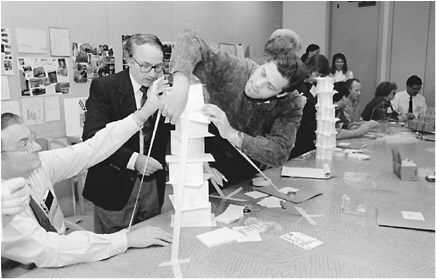
the next section. Fostering “communities of learners” within schools will create a norm of experimentation and evaluation that will apply to many other innovations. (See Teaching Standard F on page 51 and Program Standard E on page 222 of the National Science Education Standards.)
Administrative assistance and support. As teachers pass through the stages of concern described in Table 8-1, administrators need to provide them with professional development experiences appropriate to their progress in constructing a new view of teaching and creating the new behaviors required to practice it. For example, at an early stage of concern, teachers who are beginning to practice new inquiry behaviors will want information about inquiry and its place in the curriculum. Administrators can provide them with reference materials and with access to other teachers, university professors, or scientists who can answer their questions.
When the need for information is coupled with personal concerns (at stage of concern number 4, for example), teachers often express worries about whether the new teaching strategies will be acceptable to the principal, other teachers, and parents. These worries need to be listened to and addressed, understanding that they are a natural part of the change process. One way to address this concern is to encourage small groups

of teachers to form study and support groups that meet on a regular basis (during the school day if at all possible). Small study groups not only provide information; they also provide the mutual support that teachers need as they progress through their concerns. The collegiality provided by this community of learners can also enhance teachers’ growth in learning to use inquiry far more rapidly and deeply than if each teacher were doing it alone.
As the new teaching practices begin, teachers will have many concerns about their effectiveness, the amount of work required, and their acceptance by others. Administrators need to assure teachers that they know and support what the teachers are doing. Other teachers also need to hear that administrators are behind the inquiry-based approach. Public expressions of support can reiterate the importance of inquiry in the context of many competing demands for time and attention.
Availability of instructional materials, kits, and equipment. As personal concerns are resolved, many teachers have concerns about making things work (stage of concern number 3). At this point, teachers have many “how to” questions about finding the time for inquiry activities, covering the content, keeping the students on task, having enough equipment, and so on. For example, is the schedule conducive for inquiry-based teaching? Are the periods or teaching blocks long enough to complete most activities in one day? Do instructional units or courses of study incorporate inquiry as the main teaching and learning strategy?
Traditional textbooks and units are often not conducive to inquiry-based teaching. Success is much more likely when the teachers are using materials that have inquiry “built in.” Administrators need to make an effort to see that teachers have such materials. See Chapter 7 for ways to adapt traditional materials to support inquiry-based learning, should this be impossible. Does the school or district emphasize inquiry-oriented materials when approving textbooks and instructional materials? Are the criteria for selection based on standards (national or state) that have a strong inquiry component? Administrators have an
opportunity, an obligation, and often the authority to influence the procedures and criteria used. Two recent resources from the Center for Science, Mathematics, and Engineering Education will be of help in this matter (NRC, 1999a; NRC, 1999b), as will Appendix B.
Nothing interferes with inquiry-based teaching more than lacking an adequate supply of instructional materials. Administrators need to ensure that teachers have appropriate kits, equipment, and supplies, and that consumable supplies are replaced regularly. Is the storage space adequate and secure? Experienced teachers can help find the answers to some of these questions, as can administrators who pay attention to the problems teachers are having.
Only by working through management questions can a teacher construct an image and an understanding of how inquiry-based teaching will benefit his or her students (stage of concern number five). Teachers at this stage will ask hard questions about the effectiveness of their teaching. They often will seek answers from the research and from careful student assessments to assure themselves that they and the approach they are using are effective. Study groups can seek help from local university researchers or district level science education specialists in addressing these concerns. Small action research projects (Miller and Pine, 1990; Holly, 1991; Calhoun, 1994) and examination of student work (Loucks-Horsley et al., 1998) by members of the group could be both motivating and helpful.
Interpreting inquiry-based teaching and learning for parents and other members of the public. Many administrators have learned the hard way that it is much better to be proactive with the community than reactive. Administrators cannot wait until the letters and phone calls start coming in from parents and other members of the public. They need to introduce and explain inquiry to parents whose students are involved. Newsletters, parent meetings, open houses, phone trees, and special invitations to “science nights” are all ways to inform parents that inquiry-based teaching and learning is being used in their child’s class. Administrators need to know and share the advantages of teaching and learning this way and, at the same time, be open about the pitfalls or adjustments that some students will have to make to succeed. Teachers also can be asked to describe what they will do to help.
Building support with the public cannot stop with parents. Local businesses, government agencies and laboratories, museums, professional societies, and so on will be interested in supporting standards-based reform efforts and often can provide resources of materials, kits, scientists as
consultants, or access to laboratories for field trips. The local media may be interested in a story that features a local innovation consistent with national improvement efforts. By stressing the acquisition of fundamental science knowledge through inquiry, administrators can avoid creating the image that inquiry is about exploring any interesting idea or simply the latest fad on the educational scene.
Student assessment procedures aligned with the outcomes of inquiry. Students and parents quickly judge what is valued by the tests and grading system the teachers and the schools use, and they adjust their behavior accordingly. If the inquiry activities and investigations are simply interludes between memorizing material from the text and other sources, the motivation to acquire inquiry-based abilities will be limited. If a teacher’s tests and those required by the school do not assess the abilities and understanding of inquiry or, for that matter, the deep understanding of science concepts, students and parents may wonder why time is being spent on inquiry.
To avoid these pitfalls, administrators can encourage teachers to communicate clearly to students and parents what they expect students in their classes to know and be able to do and how they will assess and grade them. Teachers should be encouraged to use the kinds of classroom assessments described in Chapter 4, to embed their assessments in instruction, to consider how students’ language development influences assessment results if they teach English language-learners, and to use assessments to inform both their immediate responses to students and their ongoing designs for instruction. Administrators can review the quality of the inquiry used in a class as well as students’ mastery of subject matter. Do teachers include questions on their quizzes (in the grades and courses where this is appropriate) and use hands-on assessment tasks to measure inquiry abilities? Assessments of inquiry are a very useful topic for teacher study groups and for action research projects.
If tests are mandated by the district or state, what is their impact on teachers? If the tests do not measure inquiry, how can the requirement or the nature of the tests be modified? Changing the policies involved is a tall order but well worth the effort. Many administrators and teachers are ready and willing to join in this task.
Until such changes can be made, administrators need to be open about the fact that the tests only measure a portion of the science objectives or standards. And students who achieve a deep understanding of science content through inquiry usually do well on conventional tests (Bransford et al., 1999).
Promoting inquiry and problem solving in other subject areas. Inquiry is not exclusive to science or science teaching. Teachers in other departments at the secondary level and teachers teaching other subject areas at the elementary level can and often do use inquiry-like strategies. Teachers want and need the moral and collegial support of working with other teachers on innovative and, what they consider, risky projects. They also need the sense that they are not out on an “intellectual limb”; that inquiry has its counterparts in other disciplines in addition to science.
Mathematics educators have long advocated problem solving as an overarching process for teaching mathematics. The TIMSS eighth grade video study of mathematics instruction (Stigler et al., 1999) highlighted the value of individuals or small groups of students working through a complex problem independent of the teacher before the teacher, with the help of several students, displays one or more acceptable solution strategies. Innovative social studies instructional materials have incorporated inquiry strategies by providing original source materials for students to use in their investigations and an inductive approach to reaching the big ideas and principles. When the majority of teachers in a school are working on a common goal, the level and amount of professional talk in the building goes up (Little, 1993) and teachers begin to

support each other in a common effort to change the way they teach and their students learn.
Appropriate teacher evaluation procedures. Problems are sure to arise if the formal and informal evaluation of teachers is inconsistent with the essential elements of inquiry. Teachers need to be assured that the innovative strategies they are using are understood, objectively evaluated, and rewarded when executed well. The evaluator must understand inquiry to know what to observe in the classroom. For example, evaluation of inquiry-based teaching requires more than one class period visit. What one day looks like confusion, and maybe even chaos, might be the exploration phase of instruction that will be followed the next day when experiments and ideas come together for most of the students.
Evaluators also need to look for how the teacher uses curriculum materials, interacts with students to increase their understanding, and assesses student work and thinking in ways that influence teaching plans. Teachers can be asked to explain how student work demonstrates growth in student understanding. Talking to students can reveal their understanding of the content and the methods of inquiry they are using. Lesson plans and the instructional model being used can indicate whether students are actively engaged in inquiry.
CONCLUSION
Teaching science through inquiry requires a new way of engaging students in learning. It therefore requires that all educators take on the role of change agents. To foster the changes in teaching required by inquiry-based approaches, administrators and other leaders need to provide a wide array of support — from opportunities to learn, to materials and equipment, to moral support, encouragement, and “running interference.” Without such support, inquiry-based science programs are unlikely to succeed and even less likely to be sustained. With it, all students are much more likely to understand, appreciate, and actively participate in the scientific world.


