
2
Inquiry in the National Science Education Standards
When educators see or hear the word “inquiry,” many think of a particular way of teaching and learning science. Although this is one important application for the word, inquiry in the Standards is far more fundamental. It encompasses not only an ability to engage in inquiry but an understanding of inquiry and of how inquiry results in scientific knowledge.
Because of the importance of inquiry, the content standards describing what all students need to know and be able to do include standards on science as inquiry. These inquiry standards specify the abilities students need in order to inquire and the knowledge that will help them understand inquiry as the way that knowledge is produced. In this way, the Standards seek to build student understanding of how we know what we know and what evidence supports what we know.
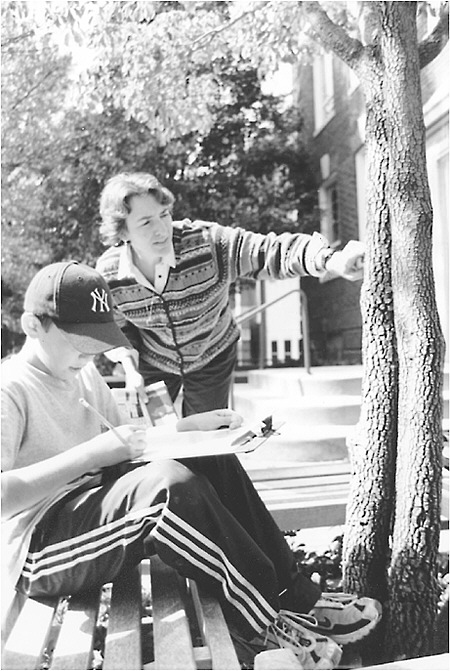
The abilities and understanding of inquiry are neither developed nor used in a vacuum. Inquiry is intimately connected to scientific questions — students must inquire using what they already know and the inquiry process must add to their knowledge. The geologist investigating the cause of the dead cedar forests along the Pacific Coast used his scientific knowledge and inquiry abilities to develop an explanation for the phenomenon. Mrs. Graham’s fifth grade students used their observations and the information they gathered about plants to recognize the factors affecting the growth of trees in their schoolyard and to solve the “three-tree problem.” For both scientist and students, inquiry and subject matter were integral to the activity. Their scientific knowledge deepened as they developed new understandings through observing and manipulating conditions in the natural world.
What is inquiry in education? The Standards note:
Inquiry is a multifaceted activity that involves making observations;
posing questions; examining books and other sources of information to see what is already known; planning investigations; reviewing what is already known in light of experimental evidence; using tools to gather, analyze, and interpret data; proposing answers, explanations, and predictions; and communicating the results. Inquiry requires identification of assumptions, use of critical and logical thinking, and consideration of alternative explanations. (p. 23)
Developing the ability to understand and engage in this kind of activity requires direct experience and continued practice with the processes of inquiry. Students do not come to understand inquiry simply by learning words such as “hypothesis” and “inference” or by memorizing procedures such as “the steps of the scientific method.” They must experience inquiry directly to gain a deep understanding of its characteristics.
Yet experience in itself is not sufficient. Experience and understanding must go together. Teachers need to introduce students to the fundamental elements of inquiry. They must also assist students to reflect on the characteristics of the processes in which they are engaged.
This chapter addresses the several perspectives on inquiry included in the National Science Education Standards. It first provides some historical background to place the role of inquiry in context. It then gives the actual content standards on Science as Inquiry: what should students know and be able to do? A description of a set of elements or features essential to inquiry-oriented teaching and learning sets the stage for a discussion of instructional models that can help teachers structure activities to foster student inquiry. Finally, several myths that misrepresent inquiry in school science programs are described and debunked.
INQUIRY IN SCHOOL SCIENCE: HISTORICAL PERSPECTIVES
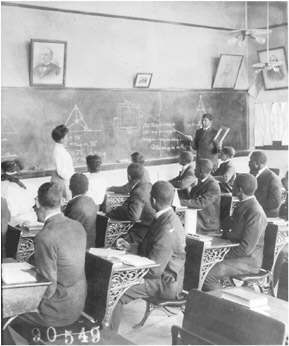
Inquiry has had a role in school science programs for less than a century (Bybee and DeBoer, 1993; DeBoer, 1991). Before 1900, most educators viewed science primarily as a body of knowledge that students were to learn through direct instruction. One criticism of this perspective came in 1909, when John Dewey, in an address to the American Association for the Advancement of Science, contended that science teaching gave too much emphasis to the accumulation of information and not enough to science as a way of thinking and an attitude of mind. Science is more than a body of knowledge to be learned, Dewey said; there is a process or method to learn as well (Dewey, 1910).
By the 1950s and 1960s, the rationale for inquiry as an approach to
School classroom 1906
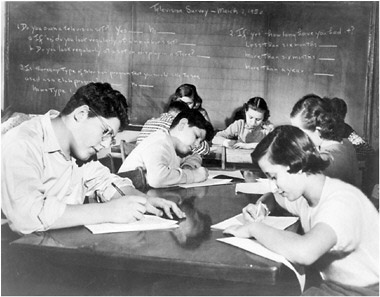
teaching science was becoming increasingly evident. If students were to learn the methods of science, then how better to learn than through active engagement in the process of inquiry itself? The educator Joseph Schwab (1960, 1966) was an influential voice in establishing this view of science education. Schwab argued that science should be viewed as conceptual structures that were revised as the result of new evidence. For example, the geologist described in the previous chapter followed this approach in developing an explanation for the widespread death of trees. Science teaching and learning should reflect this perspective on science, Schwab said.
The implications of Schwab’s ideas were, for their time, profound. His view suggested that teachers should present science as inquiry and that students should use inquiry to learn science subject matter. To achieve these changes, Schwab (1960) recommended that science teachers look first to the laboratory and use these experiences to lead rather than follow the classroom phase of science teaching. That is, students should work in the laboratory before being introduced to the formal explanation of scientific concepts and principles. Evidence should build to explanations and the refinement of explanations.
Schwab also suggested that science teachers consider three possible approaches in their laboratories. First, laboratory manuals or textbook materials could be used to pose questions and describe methods to investigate the questions, thus allowing students to discover relationships they do not already know. Second, instructional materials could be used to pose questions, but the methods
School classroom 1950
and answers could be left open for students to determine on their own. Third, in the most open approach, students could confront phenomena without textbook- or laboratory-based questions. Students could ask questions, gather evidence, and propose scientific explanations based on their own investigations.
Schwab proposed an additional approach, which he referred to as an “enquiry into enquiry.” (Schwab chose to use this variation of the spelling of the word.) In this approach, teachers provide students with readings and reports about scientific research. They discuss the details of the research: the problems, data, role of technology, interpretations of data, and conclusions reached by the scientists. Where possible, students read about alternative explanations, different and perhaps conflicting experiments, debates about assumptions underlying the research and the use of evidence, and other issues of scientific inquiry. Through this approach, students build an understanding of what constitutes scientific knowledge and how scientific knowledge is produced.
The work of Schwab, Dewey, and others, including Bruner and Piaget in the 1950s and 1960s, influenced the nature of curriculum materials developed in those decades and into the early 1970s. Russia’s launch of the Sputnik satellite in 1957 further spurred the development of these materials, many of which were supported by the National Science Foundation and other federal agencies and private foundations. Underlying many of these instructional materials was the commitment to involve students in doing rather than being told or only reading about science. This reform placed as much, if not more, emphasis on learning the processes of science as on mastering the subject matter of science alone. Teaching models were
Space flight July 19, 1946
based on theories of learning that emphasized the central role of students’ own ideas and concrete experiences in creating new and deepened understandings of scientific concepts.
Throughout the country, use, or at least awareness, of these new curriculum materials prompted educators to provide students with more laboratory and other “hands-on” experiences, more opportunities to pursue their own questions, and more focus on understanding larger scientific concepts rather than disconnected facts. Although the effective use of these new materials was not as widespread as anticipated (Weiss, 1978; Harms and Kahl, 1980; Harms and Yager, 1981), this new view of school science did prompt more study and careful thinking about major issues in science education. Furthermore, and of special significance to this volume, the changes of the 1950s, 1960s, and 1970s widely disseminated the idea of helping students to develop the skills of inquiry and an understanding of science as inquiry.
INQUIRY IN THE NATIONAL SCIENCE EDUCATION STANDARDS
The developers of the National Science Education Standards (National Research Council, 1996) had this historical perspective on which to base their work. Studies of teaching and learning in science classrooms had led to two observations. First, most teachers were still using traditional, didactic methods (Stake and Easley, 1978; Harms and Yager, 1981; Weiss, 1987). Examination of science classrooms revealed that many students were mastering disconnected facts in lieu of broader understandings, critical reasoning, and problem-solving skills. Some teachers, however, were using the new curriculum materials, such as those from the Biological Sciences Curriculum Study (BSCS), Science Curriculum Improvement Study (SCIS), Elementary Science Study (ESS), Intermediate Science Curriculum Study (ISCS), and Physical Sciences Study Committee (PSSC). Their students were spending large amounts of time in inquiry-based
activities. They were making observations, manipulating materials, and conducting laboratory investigations. As a result, they were developing cognitive abilities, such as critical thinking and reasoning, as well as learning science content (Bredderman, 1982; Shymansky et al., 1983).
Those developing national standards were committed to including inquiry as both science content and as a way to learn science. Therefore, rather than simply extolling the virtues of “hands-on” or “laboratory-based” teaching as the way to teach “science content and process,” the writers of the Standards treated inquiry as both a learning goal and as a teaching method. The concept of inquiry thus appears in several different places in the Standards.
INQUIRY IN THE CONTENT STANDARDS
The content standards for Science as Inquiry include both abilities and understandings of inquiry (Tables 2-1, 2-2 and 2-3). The general standards for inquiry (Table 2-1) are the same for all three grade spans (K-4, 5-8, 9-12). The more detailed fundamental abilities of inquiry and fundamental understandings about inquiry increase in complexity from kindergarten through grade 12, reflecting the cognitive development of students (Tables 2-2 and 2-3).
Table 2-1. Content Standard for Science as Inquiry
|
As a result of activities in grades K-12, all students should develop
|
Abilities Necessary to Do Scientific Inquiry
Table 2-2 presents the key abilities from the inquiry standards. These “cognitive abilities” go beyond what have been termed science “process” skills, such as observation, inference, and experimentation (Millar and Driver, 1987). Inquiry abilities require students to mesh these processes with scientific knowledge as they use scientific reasoning and critical thinking to develop their understanding of science.
The basis for moving away from the traditional process approach is to encourage students to participate in the evaluation of scientific knowledge. At each of the steps involved in inquiry, students and teachers ought to ask “what counts?” What data do we keep? What data do we discard? What patterns exist in the data? Are these patterns appropriate for this inquiry? What explanations account for the patterns? Is one explanation better than another?
In justifying their decisions, stu-
Table 2-2. Content Standard for Science as Inquiry: Fundamental Abilities Necessary to Do Scientific Inquiry
|
Grades K-4
|
|
Grades 5-8
|
|
Grades 9-12
|
dents ought to draw on evidence and analytical tools to derive a scientific claim. In turn, students should be able to assess both the strengths and weaknesses of their claims. The development and evolution of knowledge claims, and reflection upon those claims, underlie the inquiry abilities presented in Table 2-2.
Note that the abilities from one grade level to the next are very similar but become more complex as the grade level increases. For example, K-4 students “use data to construct a reasonable explanation,” while 5-8 students “recognize and analyze alternative explanations and procedures,” and 9-12 students analyze “alternative models” as well. The abilities are designed to be developmentally appropriate to the grade level span.
Table 2-3. Content Standard for Science as Inquiry: Fundamental Understandings About Scientific Inquiry
|
Grades K-4
|
|
Grades 5-8
|
|
Grades 9-12
|
Appendix A-1, which is taken directly from the Standards, provides more elaboration for these abilities for each grade span.
Understandings About Scientific Inquiry
Table 2-3 presents the fundamental understandings about the nature of scientific inquiry from the Standards. Although in some cases these “understandings” appear parallel to the “abilities” displayed in Table 2-2, they actually represent much more. Understandings of scientific inquiry represent how and why scientific knowledge changes in response to new evidence, logical analysis, and modified explanations debated within a community of scientists. The work of the geologist described in Chapter 1, for example, was guided by his initial question and the evidence-to-explanation nature of scientific inquiry.
As with the abilities of inquiry, the understandings of inquiry are very similar from one grade to the next but increase in complexity. For example, K-4 students understand that “scientists develop explanations using observations (evidence) along with what they already know about the world (scientific knowledge),” while students in grades 5-8 know that “scientific explanations emphasize evidence, have logically consistent arguments, and use scientific principles, models, and theories.” Students in grades 9-12 understand that scientific explanations must abide by the rules of evidence, be open to possible modifications, and satisfy other criteria.
Appendix A-2, taken directly from the Standards, provides more elaboration for these understandings for each grade span.
LEARNING THROUGH INQUIRY AND ITS IMPLICATIONS FOR TEACHING
Having defined inquiry in part as a set of student learning outcomes, the next question becomes: What is teaching through inquiry, and when and how should it be done?
The science teaching standards provide a comprehensive view of science teaching (Table 2-4). These standards apply to the many teaching strategies, including inquiry, that make up an effective teacher’s repertoire. Although the teaching standards refer to inquiry, they are also clear that “inquiry is not the only strategy for teaching science” (p. 23). Nevertheless, inquiry is a central part of the teaching standards. The standards say, for example, that teachers of science “plan an ‘inquiry-based’ science program,” “focus and support inquiries,” and “encourage and model the skills of scientific inquiry.”
Because the teaching standards are so broad, it is helpful for our purposes
Table 2-4. Science Teaching Standards
|
TEACHING STANDARD A: Teachers of science plan an inquiry-based science program for their students. In doing this, teachers
|
|
TEACHING STANDARD B: Teachers of science guide and facilitate learning. In doing this, teachers
|
|
TEACHING STANDARD C: Teachers of science engage in ongoing assessment of their teaching and of student learning. In doing this, teachers
|
|
TEACHING STANDARD D: Teachers of science design and manage learning environments that provide students with the time, space, and resources needed for learning science. In doing this, teachers
|
|
TEACHING STANDARD E: Teachers of science develop communities of science learners that reflect the intellectual rigor of scientific inquiry and the attitudes and social values conducive to science learning. In doing this, teachers
|
|
TEACHING STANDARD F: Teachers of science actively participate in the ongoing planning and development of the school science program. In doing this, teachers
|
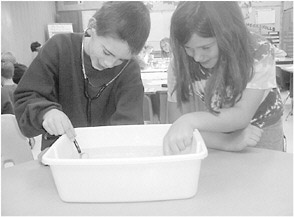
to focus more on inquiry in classrooms: to propose a working definition that distinguishes inquiry-based teaching and learning from inquiry in a general sense and from inquiry as practiced by scientists. The following definition is derived in part from the abilities of inquiry, emphasizing questions, evidence, and explanations within a learning context. Inquiry teaching and learning have five essential features that apply across all grade levels (see Table 2-5).
-
Learners are engaged by scientifically oriented questions. Scientifically oriented questions center on objects, organisms, and events in the natural world; they connect to the science concepts described in the content standards. They are questions that lend themselves to empirical investigation, and lead to gathering and using data to develop explanations for scientific phenomena. Scientists recognize two primary kinds of scientific questions (Malley, 1992). Existence questions probe origins and include many “why” questions. Why do objects fall towards the earth? Why do some rocks contain crystals? Why do humans have chambered hearts? Many “why” questions cannot be addressed by science. There are also causal/functional questions, which probe mechanisms and include most of the “how” questions. How does sunlight help plants to grow? How are crystals formed?
Students often ask “why” questions. In the context of school science, many of these questions can be changed into “how” questions and thus lend themselves to scientific inquiry. Such change narrows and sharpens the inquiry and contributes to its being scientific.
In the classroom, a question robust and fruitful enough to drive an inquiry generates a “need to know” in students, stimulating additional questions of “how” and “why” a phenomenon occurs. The initial question may originate from the learner, the teacher, the instructional materials, the Web, some other source, or some combination. The teacher plays a critical role in guiding the identification of questions, particularly when they come from students. Fruitful inquiries evolve from questions that are meaningful and relevant to students, but they also must be able to be answered by students’ observations and scien-
Table 2-5. Essential Features of Classroom Inquiry
|
|
|
|
|
|
|
|
|
|
 Learners are engaged by scientifically oriented questions.
-
tific knowledge they obtain from reliable sources. The knowledge and procedures students use to answer the questions must be accessible and manageable, as well as appropriate to the students’ developmental level. Skillful teachers help students focus their questions so that they can experience both interesting and productive investigations.
-
An example of a question that meets these criteria for young students is: how do mealworms respond to light? One for older students is: how do genes influence eye color? An example of an unproductive question for younger students is: why do people behave the way they do? This question is too open, lending itself to responses that may or may not have a scientific basis. It would be difficult to gather evidence supporting such proposed answers as, “it is human nature” or “some supernatural force wills people to behave the way they do.” An example of an unproductive question for older students is: what will the global climate be like in 100 years? This question is scientific, but it is also very complex. It requires an answer that will almost assuredly not consider all the evidence and arguments that would go into a prediction. Students might consider individual factors, for example, how would increasing cloud cover influence climate change? Or they might consider causal relationships, for example, what effect would 5 degrees warmer (or cooler) temperatures have on plants? currents? weather?
-
Learners give priority to evidence, which allows them to develop and evaluate explanations that address scientifically oriented questions. As the Standards note, science distinguishes itself from other ways of knowing through use of empirical evidence as the basis for explanations about how the natural world works. Scientists concentrate on getting accurate data from observations of phenomena.
-
They obtain evidence from observations and measurements taken in natural settings such as oceans, or in contrived settings such as laboratories. They use their senses, instruments such as telescopes to enhance their senses, or instruments that measure characteristics that humans cannot sense, such as magnetic fields. In some instances, scientists can control conditions to obtain their evidence; in other instances they cannot control the conditions or control would distort the phenomena, so they gather data over a wide range of naturally occurring conditions and over a long enough period of time so that they can infer what the influence of different factors might be (AAAS, 1989). The accuracy of the evidence gathered is verified by checking measurements, repeating the observations, or gathering different kinds of data related to the same phenomenon. The evidence is subject to questioning and further investigation.
-
The above paragraph explains what counts as evidence in science. In their classroom inquiries, students use evidence to develop explanations for scientific phenomena. They observe plants, animal, and rocks, and carefully describe their characteristics. They take measurements of temperature, distances, and time, and carefully record them. They observe chemical reactions and moon phases and chart their progress. Or they obtain evidence from their teacher, instructional materials, the Web, or elsewhere, to “fuel” their inquiries. As the Standards note, “explanations of how the natural world changes based on myths, personal beliefs, religious values, mystical inspiration, superstition, or authority may be personally useful and socially relevant, but they are not scientific” (p. 201).
-
Learners formulate explanations from evidence to address scientifically oriented questions. Although similar to the previous feature, this aspect of inquiry emphasizes the path from evidence to explanation rather than the criteria for and characteristics of the evidence. Scientific explanations are based on reason. They provide causes for effects and establish relationships based on evidence and logical argument. They must be consistent with experimental and observational evidence about nature. They respect rules of evidence, are open to criticism, and require the use of various cognitive processes generally associated with science — for example, classification, analysis, inference, and prediction, and general processes such as critical reasoning and logic.
Explanations are ways to learn about what is unfamiliar by relating what is observed to what is already known. So, explanations go beyond current knowledge and propose some new understanding. For science, this means building upon the existing knowledge base. For students, this
-
means building new ideas upon their current understandings. In both cases, the result is proposed new knowledge. For example, students may use observational and other evidence to propose an explanation for the phases of the moon; for why plants die under certain conditions and thrive in others; and for the relationship of diet to health.
-
Learners evaluate their explanations in light of alternative explanations, particularly those reflecting scientific understanding. Evaluation, and possible elimination or revision of explanations, is one feature that distinguishes scientific from other forms of inquiry and subsequent explanations. One can ask questions such as: Does the evidence support the proposed explanation? Does the explanation adequately answer the questions? Are there any apparent biases or flaws in the reasoning connecting evidence and explanation? Can other reasonable explanations be derived from the evidence?
Alternative explanations may be reviewed as students engage in dialogues, compare results, or check their results with those proposed by the teacher or instructional materials. An essential component of this characteristic is ensuring that students make the connection between their results and scientific knowledge appropriate to their level of development. That is, student explanations should ultimately be consistent with currently accepted scientific knowledge.
-
Learners communicate and justify their proposed explanations. Scientists communicate their explanations in such a way that their results can be reproduced. This requires clear articulation of the question, procedures, evidence, proposed explanation, and review of alternative explanations. It provides for further skeptical review and the opportunity for other scientists to use the explanation in work on new questions.
Having students share their explanations provides others the opportunity to ask questions, examine evidence, identify faulty reasoning, point out statements that go beyond the evidence, and suggest alternative explanations for the same observations. Sharing explanations can bring into question or fortify the connections students have made among the evidence, existing scientific knowledge, and their proposed explanations. As a result, students can resolve contradictions and solidify an empirically based argument.
Taken as a whole, these essential features introduce students to many important aspects of science while helping them develop a clearer and deeper knowledge of some particular science concepts and processes. The path from formulating scientific questions, to establishing criteria for evidence, to proposing, evaluating,
and then communicating explanations is an important set of experiences for school science programs.
Teaching approaches and instructional materials that make full use of inquiry include all five of these essential features. Each of these essential features can vary, of course. These variations might include the amount of structure a teacher builds into an activity or the extent to which students initiate and design an investigation. For example, every inquiry engages students in scientifically oriented questions. However, in some inquiries students pose the initial question; in others students choose alternatives or

sharpen the initial question; and in others the students are provided the question. Research demonstrates the importance of students’ taking ownership of a task, which argues for engaging students in identifying or sharpening questions for inquiry. But all variations appropriate for the particular learning goal are acceptable, as long as the learning experience centers on scientifically oriented questions that engage students’ thinking.
Sometimes inquiries are labeled as either “full” or “partial.” These labels refer to the proportion of a sequence of learning experiences that is inquiry-based. For example, when a teacher or textbook does not engage students with a question but begins by assigning an experiment, an essential element of inquiry is missing and the inquiry is partial. Likewise, an inquiry is partial if a teacher chooses to demonstrate how something works rather than have students explore it and develop their own questions or explanations. If all five of the essential elements of classroom inquiry are present, the inquiry is said to be full.
Inquiry-based teaching can also vary in the amount of detailed guidance that the teacher provides. Table 2-6 describes variations in the amount of structure, guidance, and coaching the teacher provides for students engaged in inquiry, broken out for each of the five essential features. It could be said that most open form of
inquiry-based teaching and learning occurs when students’ experiences are described by the left-hand column in Table 2-6. However, students rarely have the abilities to begin here. They first have to learn to ask and evaluate questions that can be investigated, what the difference is between evidence and opinion, how to develop a defensible explanation, and so on. A more structured type of teaching develops students’ abilities to inquire. It helps them learn how to determine what counts. The degree to which teachers structure what students do is sometimes referred to as “guided” versus “open” inquiry. (Note that this distinction has roots in the history recounted earlier in the chapter as Schwab’s three approaches to “labora-
Table 2-6. Essential Features of Classroom Inquiry and Their Variations
|
Essential Feature |
Variations |
|
|
|
|
1. Learner engages in scientifically oriented questions |
Learner poses a question |
Learner selects among questions, poses new questions |
Learner sharpens or clarifies question provided by teacher, materials, or other source |
Learner engages in question provided by teacher, materials, or other source |
|
2. Learner gives priority to evidence in responding to questions |
Learner determines what constitutes evidence and collects it |
Learner directed to collect certain data |
Learner given data and asked to analyze |
Learner given data and told how to analyze |
|
3. Learner formulate explanations from evidence |
Learner formulates explanation after summarizing evidence |
Learner guided in process of formulating explanations from evidence |
Learner given possible ways to use evidence to formulate explanation |
Learner provided with evidence and how to use evidence to formulate explanation |
|
4. Learner connects explanations to scientific knowledge |
Learner independently examines other resources and forms the links to explanations |
Learner directed toward areas and sources of scientific knowledge |
Learner given possible connections |
|
|
5. Learner communicates and justifies explanations |
Learner forms reasonable and logical argument to communicate explanations |
Learner coached in development of communication |
Learner provided broad guidelines to use sharpen communication |
Learner given steps and procedures for communication |
|
|
||||

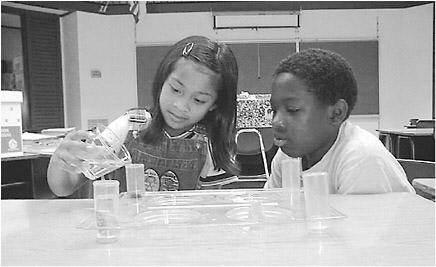
tories” which vary in their degree of structure and guidance by teachers or materials.) Table 2-6 illustrates that inquiry-based learning cannot simply be characterized as one or the other. Instead, the more responsibility learners have for posing and responding to questions, designing investigations, and extracting and communicating their learning, the more “open” the inquiry (that is, the closer to the left column in Table 2-6). The more responsibility the teacher takes, the more guided the inquiry (that is, the closer to the right column on Table 2-6).
Experiences that vary in “openness” are needed to develop the inquiry abilities in Table 2-2. Guided inquiry can best focus learning on the development of particular science concepts. More open inquiry will afford the best opportunities for cognitive development and scientific reasoning. Students should have opportunities to participate in all types of inquiries in the course of their science learning.
How does a teacher decide how much guidance to provide in an inquiry? In making this decision, a key element is the intended learning outcomes. Whether the teacher wants students to learn a particular science concept, acquire certain inquiry abilities, or develop understandings about scientific inquiry (or some combination) influences the nature of the inquiry.
Below are examples of learning experiences designed to incorporate some form of inquiry. (Note the emphasis on series of lessons or learning experiences, rather than single lessons, illustrating that inquiries require time to unfold and for
students to learn.) Each example considers not only the learning outcomes and the teaching strategy but the way the teacher will assess whether students have achieved the intended outcome. Assessment is a critical aspect of inquiry because it sharpens and defines the design of learning experiences. When teachers know what they want students to demonstrate, they can better help them learn to do so.
As one example, consider a series of lessons in which the learning outcome is for students to strengthen all the fundamental abilities of inquiry. In Chapter 1, when Mrs. Graham was presented with an interesting question from her students, she recognized an opportunity for her students to engage in a learning activity where they could complete a full inquiry originating with their question about the trees and culminating in communication of scientific explanations based on evidence. The inquiry incorporated all five essential features, with student engagement described by the left column in Table 2-6. Through her assistance and coaching, Mrs. Graham helped the students learn how to clarify their questions and identify possible explanations that could be tested by scientific investigations. She helped them learn the importance of examining alternative explanations and comparing them with the evidence gathered. She helped students understand the relationship between
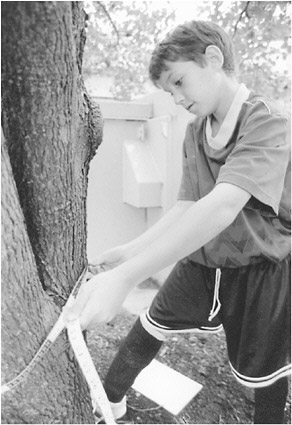
evidence and explanation. As a result, the students not only learned some science subject matter related to the growth of trees, they also developed specific inquiry abilities.
A second example focuses on developing student understandings about scientific inquiry. A high school biology teacher is planning student learning activities for a unit on biological evolution. Several of the classroom investigations and discussions focus on factors leading to adaptation in organisms. Because of the interesting
historical development of these scientific ideas, the teacher decides to take advantage of the opportunity to develop students’ understanding of how scientific inquiry works. The assessment for this learning outcome is for students to be able to describe the place of logic, evidence, criticism, and modification in the account of a scientific discovery. Based on readings about past and current investigations of evolution on the Galapagos Islands (including Darwin’s On the Origin of Species and The Beak of the Finch by Jonathan Weiner), students discuss and answer the following
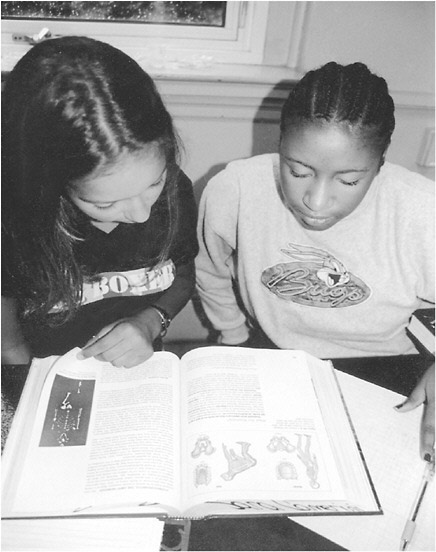
questions: What led to past and current investigation of the finches on the islands? How have investigations differed, and how have they been similar? Have the scientific explanations derived from these investigations been logically consistent? Based on evidence? Open to skeptical review? Built on a knowledge base of other experiments? Following the readings and discussion of the questions, the teacher would have student groups prepare oral reports on the topic “The Role of Inquiry in Science.”
This learning activity does not contain all of the essential features of classroom inquiry, but many features are present. The activity engages students in scientifically oriented questions. It promotes discussion of the priority of evidence in developing scientific explanations. It connects those explanations to accepted scientific knowledge. And it requires students to communicate their understandings of scientific inquiry to others. This activity thus could be an integral part of a sequence of learning opportunities that in total contains all five essential features of inquiry.
As a final example, consider a series of lessons that seeks to have students develop an understanding of the concept of density. One way to determine the best teaching strategy for this particular outcome would be to think about how students might demonstrate that they understand density. One performance assessment for older elementary students might be to provide them with objects of different densities, a scale, and a water-filled flask with volume markings on the side. Students would then be asked to select objects and, using the scale and flask, determine their densities. Given this assessment, what kinds of inquiry learning experiences would help students understand density well enough to be successful? One teaching strategy would be a series of laboratory activities framed by questions requiring the gathering and use of evidence to develop explanations about mass and volume relationships. Students would connect their explanations to scientific explanations provided by the teacher and their text, so all five essential features of classroom inquiry would be incorporated.
PROVIDING COHERENT INQUIRY-BASED INSTRUCTION — INSTRUCTIONAL MODELS
How can the features of inquiry be combined in a series of coherent learning experiences that help students build new understandings over time? Instructional models offer a particularly useful way for teachers to improve their use of inquiry.
Instructional models originated in observations of how people learn. As early as the turn of the century, Herbart’s (1901) ideas about teaching
included starting with students’ interest in the natural world and in interactions with others. The teacher crafted learning experiences that expanded concepts students already knew and explained others they could not be expected to discover. Students then applied the concepts to new situations. Later, Dewey (1910) built upon the idea of reflective experience in which students began with a perplexing situation, formulated a tentative interpretation or hypothesis, tested the hypothesis to arrive at a solution, and acted upon the solution. Dewey’s prior experience as a science teacher explains the obvious connection between reflective thinking and scientific inquiry (Bybee, 1997).
Piaget’s theory of development contributed much to the elaboration of instructional models (Piaget, 1975; Piaget and Inhelder, 1969). In his view, learning begins when individuals experience disequilibrium: a discrepancy between their ideas and ideas they encounter in their environments (that is, what they think they know and what they observe or experience). To bring their understanding back into equilibrium, they must adapt or change their cognitive structure through interaction with the environment.
Piaget’s work was the basis for the learning cycle, an instructional model, proposed by Atkin and Karplus (1962) and used in the SCIS elementary science curriculum. Although the learning cycle has undergone elaboration and modification over time, its phases and normal sequence are typically represented as exploration, invention, and discovery. Exploration refers to relatively unstructured experiences when students gather new information. Invention refers to the formal statement of a new concept — often a definition — in which students interpret newly acquired information by restructuring their prior concepts. Discovery involves applying the new concept to a novel situation.
Research on how people learn (discussed in detail in Chapter 6) suggests a dynamic and interactive view of human learning. Students bring to a learning experience their current explanations, attitudes, and abilities. Through meaningful interactions with their environment, with their teachers, and among themselves, they reorganize, redefine, and replace their initial explanations, attitudes, and abilities. An instructional model incorporates the features of inquiry into a sequence of experiences designed to challenge students’ current conceptions and provide time and opportunities for reconstruction, or learning, to occur (Bybee, 1997).
A number of different instructional models have been developed that can help teachers organize and sequence inquiry-oriented learning experiences for their students. All can incorporate the essential features of inquiry. They
Table 2-7. Common Components Shared by Instructional Models
|
|
|
|
|
|
|
|
|
|
seek to engage students in important scientific questions, give students opportunities to explore and create their own explanations, provide scientific explanations and help students connect these to their own ideas, and create opportunities for students to extend, apply, and evaluate what they have learned. Common components or phases that are shared by instructional models are shown in Table 2-7.
Instructional models have helped teachers and those who support them — in particular, curriculum developers — to design instruction in ways that attend to how learning occurs and afford students opportunities to engage in scientific inquiry. The primary disadvantage of instructional models applies to models in general: by definition, they simplify the world. Teachers and others can be misled into thinking of them as lockstep, prescriptive devices — rather than as general guides for designing instruction that help learning to unfold through inquiry, which must always be adapted to the needs of particular learners, the specific learning goals, and the context for learning.
SOME MYTHS ABOUT INQUIRY-BASED LEARNING AND TEACHING
A number of myths about inquiry-based learning and teaching have at times been wrongly attributed to the National Science Education Standards. These myths threaten to inhibit progress in science education reform either by characterizing inquiry as too difficult to achieve or by neglecting the essential features of inquiry-based learning. Listed below are responses to five of these mistaken beliefs.
Myth 1: All science subject matter should be taught through inquiry. Teaching science effectively requires a variety of approaches and strategies. It is not possible in practice to teach all science subject matter through inquiry, nor is it desirable to do so. Teaching all of science using only one method would be ineffective, and it would probably become boring for students.
Myth 2: True inquiry occurs only when students generate and pursue their own questions. For students to develop the ability to ask questions, they must “practice” asking questions. But if the desired outcome is learning science subject matter, the source of the question is less important that the nature of the question itself. It is important to note, however, that in today’s science classrooms students rarely have opportunities to ask and pursue their own questions. Students will need some of these opportunities to develop advanced inquiry abilities and to understand how scientific knowledge is pursued.
Myth 3: Inquiry teaching occurs easily through use of hands-on or kit-based instructional materials. These materials can increase the probability that students’ thinking will be focused on the right things and learning will occur in the right sequence. However, the use of even the best materials does not guarantee that students are engaged in rich inquiry, nor that they are learning as intended. A skilled teacher remains the key to effective instruction. He or she must pay careful attention to whether and how the materials incorporate the five essential features of inquiry. Using these five features to review materials as well as to assess classroom practice should enhance the kinds and depth of learning.
Myth 4: Student engagement in hands-on activities guarantees that inquiry teaching and learning are occurring. Although participation by students in activities is desirable, it is not sufficient to guarantee their mental engagement in any of the essential features of inquiry.
Myth 5: Inquiry can be taught without attention to subject matter. Some of the rhetoric of the 1960s was used to promote the idea that learning science processes should be the only meaningful outcome of science education. Today, there are educators who still maintain that if students learn the processes of science, they can learn any content they need by applying these processes. But as stated at the beginning of this chapter, student understanding of inquiry does not, and cannot, develop in isolation from science subject matter. Rather, students start from what they know and inquire into things they do not know. If, in some instances, a
teacher’s desired primary outcome is that students learn to conduct an inquiry, science subject matter serves as a means to that end. Scientific knowledge remains important. The abilities and understandings outlined in the Standards extend beyond the processes of science to engage students in a full complement of thinking and learning science.
CONCLUSION
This chapter has provided the definitions of inquiry and inquiry-based teaching that undergird the Standards. Chapter 3 will present a series of classroom vignettes that illustrate how elementary, middle, and high school teachers design different kinds of inquiries to achieve different learning outcomes. Chapter 4 will look at assessment: within the context of good instruction, how can the achievement of different learning outcomes best be assessed? Subsequent chapters then turn to how teachers can be prepared and supported to use these strategies in their classrooms.


