
3
Images of Inquiry in K-12 Classrooms
From the earliest grades, students should experience science in a form that engages them in the active construction of ideas and explanations and enhances their opportunities to develop the abilities of doing science. (National Research Council, 1996, p.121)
Chapter 2 introduced the fundamental concepts that underlie inquiry in science classrooms. It described inquiry not only as a means to learn science content but as a set of skills that students need to master and as a body of understanding that students need to learn. It detailed the five essential elements of classroom inquiry, from engaging with a scientifically oriented question to communicating and justifying explanations (Table 2-5). And it discussed the use of instructional models to organize and sequence inquiry-based experiences.
This chapter looks at the concepts introduced in Chapter 2 in practice. It consists largely of classroom vignettes that show how teachers create learning opportunities to help students achieve science standards that incorporate the essential features of inquiry and are supported by instructional models. In the first vignette, a class of third graders learns basic ideas from the life science standards, several of the abilities of inquiry, and aspects of technological design from a study of earthworms. In the second vignette, a class of eighth graders learn content from the earth and space science standard and strengthen their inquiry abilities through an investigation of the phases of the moon. In the final two vignettes, classes of high school students engage in inquiry-based units involving forces (included in the physical science standards) and
environmental issues (from the life science and science in personal and social perspectives standards).
These vignettes — each of which is a composite of classroom experiences — provide many opportunities to reflect on the complexity inherent in classroom teaching. In each, inquiry serves both as an outcome and as a means of learning. Different teachers pursue multiple outcomes depending on the nature of the lesson and the teacher’s intentions. Analyses of these examples demonstrate how learning outcomes, the essential features of classroom inquiry, and learning models fit together in real classrooms.
The vignettes can be read in any order, depending on a reader’s interest. However, each vignette should be read in the context of the following three questions:
-
What are the outcomes that the teacher is striving to achieve?
-
How are the five essential features of classroom inquiry incorporated into students’ learning experiences?
-
What is the teacher’s instructional model, and what does he or she do to help students achieve the desired outcomes?
Discussions following each vignette address these three questions.
IMAGES OF INQUIRY IN K-4 CLASSROOMS
Ms. Flores’s third-grade class was engaged in a field study in a vacant lot near the school. In teams of three, the students had measured off a square meter and marked it with popsicle sticks and string. The purpose of the study was to recognize the diversity of organisms that occupy the same environment and understand how that environment meets all of their needs.
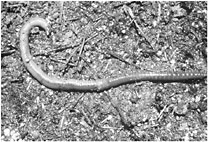
During the investigation several students found earthworms in their square meter and became fascinated with earthworm behavior. Some of the other students wanted to know why they did not find earthworms in their study areas. Others wanted to know why the worms were different sizes. One student suggested that worms “liked” to live near some kind of plants and not others, since when she and her dad went fishing they always dug for worms where there was grass.
Table 3-1. Excerpts from Life Science Standard, K-4
|
As a result of activities in grades K-4, all students should develop understanding of |
|
The characteristics of organisms
Life cycles of organisms
Organisms and their environments
|
The discussion about worms could not have come at a better time, because Mrs. Flores was anticipating a series of lessons to help her students learn some of the basic ideas in the life science standard: characteristics of organisms, life cycles of organisms, and organisms and their environments (Table 3-1). Here was a context for doing so. She contacted a biological supply house and learned that she could order supplies of earthworms with egg cases and immature earthworms. Ms. Flores was delighted because this would enable the children to observe all stages in the worm’s life cycle and some of their habits.
She realized that it would take considerable time for the earthworms to grow, so she decided to include other learning outcomes as well. Her assessments of her students indicated that they needed to work on several of the abilities of inquiry, such as refining a question for investigation and designing an investigation (the abilities of inquiry are listed in Table 2-2 in the previous chapter). She also decided to incorporate some abilities of technological design from the science and technology standard,
since she thought it would be useful for her students to think about designing “homes” for their worms (Table 3-2). And she knew that a full inquiry would allow her to weave in attention to understandings of inquiry. Perhaps she would invite some local scientists into the classroom to point out similarities between what the students were doing and how the scientists worked.
Anticipating the shipment of worms, Ms. Flores suggested to the children that they build a place for the worms to live. They returned to the vacant lot so
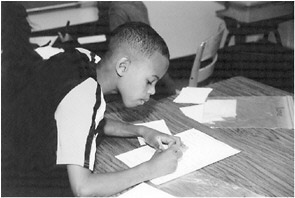
the children could explore where they had originally found worms and study the nature of the soil where they lived. The groups returned to their square meter plots and made notes and drawings of where worms were and were not found. Ms. Flores also asked students to talk to their parents and relatives about where they thought worms lived.
The next day in class the students generated a list of places where they found worms and other places worms might be found. Students suggested looking in wet dirt, under logs, in the roots of plants, and in a compost pile. Ms. Flores then asked them what these places could tell them about how to build a home for worms. In groups of four, the students were asked to design a home for worms using an empty two-liter plastic soda bottle with the top section removed.
The students presented their initial designs before they started building. Students from other groups listened carefully and asked lots of questions since they knew that they could revise their designs after the presentations.
Some students built their worm homes from soil and leaves and put grass on top. Others covered the sides with black paper “so it is like underground.” Others used just soil and placed their bottle sideways. One group punched tiny holes in the side to let air into the soil and to let extra water out.
When the worm shipment arrived, Ms. Flores gave each group a handful of worms and instructed them to observe each worm carefully and draw a picture of it. Drawing provoked many questions, including “What kind of an animal is a worm?” Knowing that children typically have different conceptions of animals, Ms. Flores had them add to their drawings some sentences describing what kind of animal they thought it was and why. Some said snakes; some said insects;
Table 3-2. Excerpts from Science and Technology Standard, K-4
|
As a result of activities in grades K-4, all students should develop: |
|
Abilities of technological design
Understanding about science and technology
Abilities to distinguish between natural objects and objects made by humans
|
some had no idea; some said a worm is a worm.
Next, Ms. Flores asked students what questions they had about worms and recorded their responses on a large chart. The questions included: “How do earthworms have babies?” “Do they like to live in some kinds of soil better than others?” “Do they really like the dark?” “How do they go through the dirt?” “How big can an earthworm get?”
Ms. Flores divided the class into groups and asked each group to choose a question that they would like to investigate and develop a plan for how to do so. The next day the groups reported plans for their investigations, which they had recorded in lab notebooks. Ms. Flores asked the group how they could
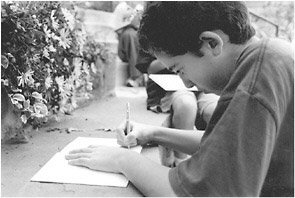
devise tests that she called “fair.” For example, one group wanted to investigate how much water worms like. Ms. Flores asked, “If you wanted to find out if worms like very wet, wet, medium wet, or dry soil conditions, would it be a ‘fair test’ if you put a worm with very wet soil in a bottle, another worm with wet soil in another
bottle, and a third worm with medium wet soil in another bottle, then put one bottle in the sun and the other two in the shade?” “No,” called out a student, “because the bottles in the sun would get hot and worms don’t like hot, that’s why they live underground, and you couldn’t tell whether it was the hot they didn’t like or how wet the soil was.” Ms. Flores used another group’s design for an investigation to assess whether other students understood this idea of a fair test.
Ms. Flores then asked the groups how they would know which place a worm “liked” the best. Students’ answers varied. One said if the worms grew bigger and had babies that was a sign they “liked” a place. Several said that if the worms died it meant they didn’t like something. Another suggested that if they set up an experiment where there were different options for the worms, where the worms crawled would tell you what they liked.
With a better understanding of what evidence to look for and how to prepare a fair test, the students were soon deep into their investigations. One group was studying the question of how earthworms have babies. They were busy examining the egg cases that they found in the soil using hand lenses and making drawings. They compared their drawings to those in books the librarian had brought to class for them and read about other characteristics of earthworms.
Two groups were exploring how the worms reacted to changes in their environment. They were struggling with how to deal with moisture, light, and temperature all at once. Ms. Flores asked some leading questions beginning with “what would happen if?” in the hope that the students would discover the value of studying one variable at a time. She would check on them later.
Another group wanted to know about the eating habits of worms. They decided to put slices of different fruits and vegetables into the soil and count the number of worm holes as evidence of what worms liked best. The two other groups set up a discarded ant farm with glass sides to observe the movement of worms in different kinds of soil.
Through the investigations and discussions of their observations, measurements, and library research, Ms. Flores’s students came to know more about the characteristics of worms, for example how they move, their eating habits, their life cycles, the characteristics of their environments, and their relationship to their environments. Their observations, combined with the research they did in library books, helped them understand why worms were not snakes or insects, but members of a phylum called annelid. They used the drawings and information in their lab notebooks to produce their own books, illustrated with drawings and
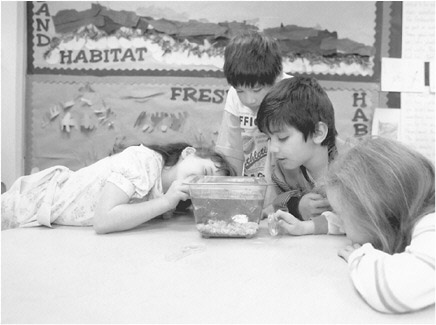
diagrams. They also revisited their designs for worm homes, given the evidence they had gathered over the past several weeks, and talked about how they could redesign them to work better.
During the final days of the study, Ms. Flores focused discussions on the ways of thinking and actions taken during the course of their investigations. The students learned to limit their explanations to ones that they could support with evidence from their own observations. Ms. Flores demonstrated how they could check their explanations against scientific reports in books and with the observations of others. They discussed how conducting a fair test helped them be certain that the answers and explanations they proposed were reasonable. They reviewed how they learned to make observations and measurements using hand lenses, rulers, and balances.
For the final section of their books, Ms. Flores asked the students to write a short explanation of what they would tell another student if that student wanted to study worms. She also asked them to write what they would do differently if they had the project to do over again. Finally, each group assembled their drawings, photographs, data tables, and notes of their observations into books and presented the results of their investigation to the
class. They shared the books with the kindergarten and first-grade students and also took them home for their parents and others to read. Ms. Flores also used their books as a form of assessment and analyzed them for the extent to which students demonstrated understanding of the science concepts and their abilities to think scientifically.
As a culminating activity, Ms. Flores invited two scientists to visit her classroom. To prepare the visiting scientists, she loaned each several of the students’ research report books and she gave them a list of the fundamental concepts for the standard on understanding scientific inquiry. The scientists intrigued the students with their personal stories of investigations that produced evidence similar to observations made by the students. Students were especially interested in the last stage: how the scientists needed to make their results public, which meant that they were often criticized and challenged as part of building a strong base of scientific knowledge.
ANALYSIS OF K-4 IMAGE OF INQUIRY
Learning Outcomes. Ms. Flores sought to help her students achieve several abilities and understandings specified in the National Science Education Standards, including understandings of the characteristics of organisms, their life cycles, and living environments; abilities and understandings of scientific inquiry; and the science and technology standard on technological design. Ms. Flores decided to work especially hard to help her students develop each of the abilities of inquiry — from posing and honing a good question, to conducting a “fair test,” to communicating explanations in different and meaningful ways. Finally, she helped her students understand what scientists do by linking their own inquiries to those of scientists.
In an elementary classroom such as Ms. Flores’, science activities can also help students develop language and mathematics skills — an important concern for young children. In her class, students were developing abilities to communicate their observations in writing and orally, to craft and share their explanations using logical reasoning, and to measure, display, and interpret data. This demonstrates the integrative potential of science activities for elementary school classrooms.
Essential Features of Classroom Inquiry. Ms. Flores’s unit had all of the essential features of classroom inquiry. Her students identified a question of their own interest about earthworms around which to design an investigation. The question derived from their own understanding of the characteristics and environments of
earthworms and their curiosity about these animals, and so the question they chose engaged them thoroughly. As they developed answers to their questions, Ms. Flores helped them understand that they needed evidence and what the nature of that evidence needed to be. They looked for evidence through their careful observations and what they read in scientific books. Learning about fair tests increased the likelihood that their evidence would be sound. As they collected their evidence, they built their cases for explanations that addressed their questions. The group looking for favorable environments, observed how the earthworms behaved in “homes” with varying amounts of moisture, and arrived at their explanation of just the right amount; the group examining eating habits observed the numbers of worm holes in different fruits and vegetables and explained worm “preferences” through those data. Throughout the investigations, students developed their own explanations using the evidence they collected and compared them with published scientific explanations from their text books, library books, and the Web. Finally, the students communicated their learning in a variety of ways, clarifying what they did, what results they achieved, and how they knew the results were correct. This communication also served Ms. Flores as an assessment of her students’ understanding of life cycles and their abilities of inquiry. As third graders, Ms. Flores’s students did not begin with well-developed inquiry abilities. But because Ms. Flores realized that using earthworms would involve an investigation extending over several weeks, she took advantage of the fact that she could pay a great deal of attention to developing her students’ inquiry abilities as they learned the subject matter content. Therefore, her students’ inquiry was relatively open, with as much coaching as necessary to make sure that the class had many choices for research questions, had a variety of designs for their investigations, and clearly communicated their results.
Instructional Model. Ms. Flores’s unit illustrates an interesting and complex sequence of learning activities. Early in the unit, she engaged the students repeatedly in direct, firsthand experience, first almost by accident as they stumbled upon the earthworms in their study of the vacant lot. Later Ms. Flores involved them again in examining the area where they originally found the worms so that they could think about what kind of “home” they would build for their worms.
As Ms. Flores focused the students on the questions they generated and the ideas they had about worms, they began to explore the worms’ characteristics, their environments, and their life cycles. They made observations
over days and weeks; tried out their ideas; proposed explanations; and shared what they were learning with others. Ms. Flores called them together on a regular basis to help them synthesize what they were learning and create explanations. She supplemented their explanations with scientific information in library books.
Towards the end of the unit, Ms. Flores gave her students opportunities to elaborate on what they were learning. The visit from the scientists deepened their understanding of how their investigations resembled those of scientists. Finally, Ms. Flores’s continual questioning and coaching gave both Ms. Flores and the students opportunities to evaluate their progress in an ongoing way. The assignment to speculate on what they would do differently were they to repeat their investigation, with some reasons why, allowed them to reflect back and assess the process and value of their work.
An instructional model must not be used as a “lockstep” device that limits the flexibility of a teacher to facilitate an inquiry that is sensitive to students’ needs and interests. This is illustrated by the impossibility of saying where one stage of the instructional model stopped in Ms. Flores’s unit and the other began: students were engaging, exploring, explaining, elaborating, and evaluating throughout the several weeks they spent studying worms. However, her instructional model helped Ms. Flores lay out the unit initially and monitor and assess her students’ learning and development as it proceeded.
IMAGES OF INQUIRY IN 5-8 CLASSROOMS
Each year Mr. Gilbert looks forward to teaching the solar system unit, especially when they get to the moon (see Table 3-3). From past experience, Mr. Gilbert knew that most middle school students have difficulty finding an explanation for the moon’s phases consistent with their direct observations, which always made the unit challenging as well as exciting. Further, learning about the moon’s phases also provided many opportunities for his students to develop critical inquiry abilities: to use scientific instrumentation to increase and
Table 3-3. Excerpts from Earth and Space Science Standard, 5-8
|
As a result of activities in grades 5-8, all students should develop understanding of |
|
Earth in the solar system
|
evaluate the accuracy of their observations, to design and conduct investigations to test their conjectures, and to think critically and logically about the relationships between evidence and explanations.
Earlier in the solar system unit, Mr. Gilbert emphasized the importance and technique of gathering evidence about the world and recording it in a notebook. For example, when he challenged the students in his science classes several weeks ago to create sun clocks using sun shadows, he encouraged them to record data about the position, size, and orientation of the shadows that they studied, and to note the rate at which the shadows moved. He also asked them to include a detailed description and sketches of the way in which the shadows were observed to change. They had carefully carried out his instructions, recording their results in their science notebooks.
In earlier class sessions, Mr. Gilbert’s students learned how to construct and use several simple tools that helped them make their data and evidence gathering more accurate. One they would use in their study of the moon was a simple sextant constructed from a protractor, a plastic drinking straw, and a string with a metal washer attached to it. They had taped the string with the washer on the end to the bottom of the protractor at the 90° line. Then they taped the straw along the straight edge of the
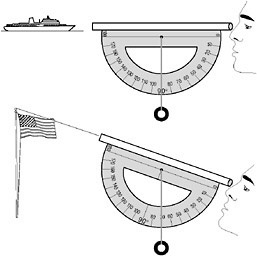
In the illustration above, a simple sextant (as described in the text) is being used to determine the angle of inclination of the top of a flagpole. The student first sights the horizon, a 90° reading on the sextant. Then she sights the top of the flagpole, which gives a 70° reading. To determine the angle of inclination, the student must determine the difference between the sextant reading for the top of the flagpole, 70°, and the reading for the horizon, 90°. Therefore, the angle of inclination of the top of the flagpole from the student’s vantagepoint is 20°. The height of the flagpole can be determined once the distance of the student from the flagpole is measured. When observing celestial objects, the apparent angle of elevation above the horizon is found by determining the difference between 90° (the horizon) and the sextant reading when the object is sighted through the straw. For printed clarity, the protractor above contains only one scale, 180°–0°, unlike a real protractor which will also have a scale from 0°–180°. The difference between 90° and the sextant reading will always be the same on either scale.
protractor (the 0°–180° line). When they located an object on the horizon by sighting through the straw, the weighted string hung straight down the 90° line. As they rotated the straw to observe an object directly overhead, the weighted string hung along the 0°-180° line of the protractor. When the students sighted an object in the sky through the straw, the string would hang straight down and hit the protractor at a point that would indicate at what angle the object appeared above the horizon in the sky. For example, an object overhead would be 90° above the horizon. The students also learned to use a compass to measure an object’s “azimuth” — that is, its distance along the north/ south plane of the horizon, an orientation such as N 30 degrees E. With angular elevation plus azimuth, the students could completely describe an object’s location: azimuth told them what direction to look in and angular elevation told they how high above the horizon to look in that direction. Students had practiced using the sextant and compass by determining the angular elevation and azimuth of trees, the school flagpole, telephone poles, tops of buildings, and airplanes in the sky. Group data had been posted on a class data chart in order to identify outliers (data that don’t fit), as well as to determine the acceptable range of values (error bars) for measurements. Mr. Gilbert found that such inquiry lessons about the use of tools, coupled with a public sharing and discussion of data, was extremely helpful in getting students to evaluate data and to improve the accuracy of obtaining and reporting it.
Introductory Lesson. Today Mr. Gilbert plans to introduce his students to the study of the phases of the moon. He knows from conducting his own observations that tracking the moon’s phases can be challenging because of the possibility of occasional intervening clouds, but he feels that students will be able to learn more deeply from the opportunity to conduct an investigation of this phenomenon firsthand. He has decided to begin this lesson today because the moon is currently two days past new and, for the next two weeks, it will be visible in the afternoon and early evening.
He begins the lesson by asking his students to write down everything they know about the moon, together with the questions that they have about the moon. He then asks them to discuss their lists with a partner, making note of the items that are included on both lists. Following these discussions, Mr. Gilbert asks his students to compile their lists into one class list of what they know about the moon, and another class list of questions they have about the moon. Mr. Gilbert identifies six items on the students’ list that he knows are crucial to their understanding of the moon’s phases:
|
Things We Know About the Moon |
Questions We Have About the Moon |
|
The moon changes shape. The moon is smaller than the earth. People have walked on the moon. |
How can the moon be visible during the day? Why don’t eclipses happen more often? What causes the moon’s phases? |
He asks several students how they know that the three items in the left column are true. Their responses include “Because I saw it on TV,” “My mother told me,” “I read about it in a book that my aunt gave me,” and “my fourth grade teacher showed us a video.” As the discussion proceeds, students recognize that these explanations are shallow compared to what they could learn from observing and collecting data over time about the changing shape of the moon.
Carrying Out the Investigation. Mr. Gilbert then invites the students to undertake a five-week-long investigation of the behavior of the moon, which will help them answer most of the questions they generated. They will begin by observing the moon and gathering evidence about its position, shape, and motion. He asks students to divide up the responsibilities for data gathering among members of their four-person groups, suggesting that during the first week they will all observe, and after that each student will be responsible for one week of observations and data gathering. The assignment is to make at least one observation and data entry of the moon each day and complete a chart on which they will record the date, time, and sky conditions; measure the angular elevation of the moon with their sextant and the moon’s azimuth with a compass; indicate (if observed at night) the constellation the moon is
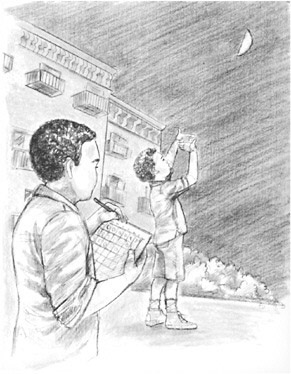
closest to; and sketch the moon’s appearance.
“But what will we do if it is cloudy?” asks one of the students. They discuss this and agree that they will make note of the weather conditions, predict where the moon would have appeared, and what they think it might have looked like. Mr. Gilbert agrees that, if direct observation fails, they should consult other resources, including the newspaper or the Internet, to verify their predictions and to create the most accurate record possible over the next 35 consecutive days.
The next day Mr. Gilbert takes the class outside to make their first observation of the moon and to ensure that they understand how to keep the daily record, including measuring angular elevation and azimuth. Each day afterwards for the next five weeks each group posts its data on a wall chart similar to the one they are using for individual record keeping. The class works on other areas of the
science curriculum as the data-gathering progresses.
On the last day of the five-week observation period, the class returns to the moon unit, beginning a transition from collecting and analyzing data to developing new concepts about the phases of the moon.
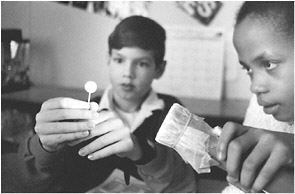
As groups review their observational data on their charts, interesting discussions begin to occur. With some prompting from Mr. Gilbert, students begin talking about models that might account for the data they have collected — an important aspect of doing science. Mr. Gilbert decides to begin with a model that explains the phases of the moon recorded by students. He provides students with a toothpick and a small bead and then invites them to consider this thought experiment: “If you were to put the bead at the end of the toothpick and then hold it up at arm’s length between your eye and the moon, how much of the moon’s surface do you think the bead would cover?” Mr. Gilbert asks the students to draw their predictions. He then asks them to go outside to test their predictions. As he moves from group to group, he asks the students to perform another observation. “Try holding the toothpick and bead out to the side. Now look at the shape of the moon and then look at the shape of sunlight you see on the bead.” They are amazed to discover that the moon’s appearance and the bead’s appearance are the
same. Mr. Gilbert knows that this experience will give students an opportunity to get a sense of what causes the phases of the moon. He also knows that it will help them understand something about the use and limits of models, helping them not only to learn about the moon, but to understand that models are tools that scientists often use to build and test new knowledge.
Constructing a Model. The next day, the end of the observations, Mr. Gilbert asks his students to look closely at their posted charts of the moon’s phases over the past five weeks. Mr. Gilbert asks: “What do you think causes this repeated monthly pattern of moon phases?” He
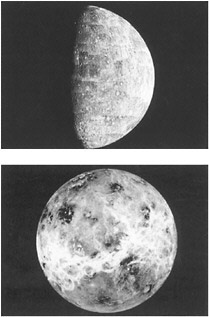
asks the students to work in groups of three and after about 10 minutes, two different explanations emerge. Some of the students suggest that the earth’s shadow covers different amounts of the moon’s surface at different times of the month, resulting in the moon’s pattern of phases. Others propose that as the moon moves through its orbit around the earth, we see different amounts of the side of the moon that is lighted by the sun. Next Mr. Gilbert asks the students to form small groups based upon the different explanations. He asks each group to make a labeled drawing that would support its explanation for why the moon changes shape. Mr. Gilbert can tell from the discussion of their drawings that many of the students are not particularly confident about their explanations. For some, different explanations seem to make sense. Before dismissing them, Mr. Gilbert asks the students to think about how they might use models to test the two different explanations.
The next day, the students design an investigation to test each explanation. Using globes for the earth, tennis balls for the moon, and the light from an overhead projector for the sun, each group is ready to manipulate the materials in a darkened room to explore relationships between the relative positions and motions of the objects and the resulting pattern of phases. The exploration gives stu-
dents opportunities to clarify the question about moon phases, determine what would constitute evidence to support each explanation, model each of the alternative explanations, and then determine which explanation for moon phases is supported by the evidence they personally gathered earlier in the unit.
To assess what they already know before beginning the activity, Mr. Gilbert asks the students what they think their drawings should show. The students agree they should show: 1) the position of the earth and moon when looking down at the North Pole, 2) the source and path of sunlight using arrows and, 3) the shadows for the earth/globe and moon/balls. They also agree that the positions of earth and moon shadows are critical. With these consistent conditions in their drawings, it will be easier to compare findings and explanations for moon phases. Mr. Gilbert encourages them to show the moon in many different positions in its orbit around the earth.
Mr. Gilbert circulates among the groups, checking how they are setting up their materials and listening to the students’ conversations. He also makes sure to look at their drawings. From time to time he asks questions to probe students’ understandings and refocus their thinking about the relationship between evidence and explanation. “What moon shape would you see if the earth, sun, and moon were positioned as you have them now? Where would the moon have to be in your model to result in a quarter moon? Show me where the earth’s shadow would be. What evidence do you have that supports your conclusion or causes you to change your mind?” He asks students to show him the direction in which the moon moves around the earth in their model. Then he asks: “How do you know? What evidence led you to this conclusion?” When needed, Mr. Gilbert reminds students to look at the class data table: “A good model will explain the data.” Listening to student conversations and coaching with questions allows him to assess student progress in understanding the cause of moon phases. It also allows him to assess how well students are using certain inquiry abilities such as thinking critically and logically about the relationship between the evidence they gathered in earlier lessons and explanations.
Mr. Gilbert begins the next class by asking each group to post their model drawings and then invites the rest of the class to examine the results. Then Mr. Gilbert asks each group to describe their conclusions about the different explanations for moon phases. Their observations and interpretations seem to support the explanation that, as the moon moves in its orbit around the earth, the amount of the lighted side of the moon that can be seen from earth changes.
The students agree that comparing the order of phases in their model to the order of moon phases shown on a calendar helps them assess the apparent relationship between the earth, sun, and moon. Mr. Gilbert asks what evidence seems to be most helpful in testing the different explanations. Some of the groups agree that the position of the earth’s shadow during the month is critical evidence. Mr. Gilbert asks them to explain why.
The students explain that the orientation of the earth’s shadow brings it in contact with the moon in various ways during the month. One team points out that, during the first quarter phase of the moon, the earth’s shadow would have to turn a right corner in order to fall on the moon. “That is not the way that light and shadows work.” Based upon such evidence, even the students who proposed the “earth’s shadow” model decide to reject it. To check for understanding, Mr. Gilbert asks, “How would the sequence of moon phases be affected if the moon moved around the earth in the opposite direction?” The investigations raise a problem for several groups. Students are confused because, in some of the drawings, it looks like there should be an eclipse of the moon and an eclipse of the sun every month. “Something must be wrong with our model because we know that doesn’t happen.” “Good observation,” remarks Mr. Gilbert “What modifications would you need to make in your models so that the cycle of moon phases does not produce these eclipses every month? What additional information might help you? What reference materials might you use?” The class decides to consult their textbook and references from the media resource center.
As the class discusses their readings, Mr. Gilbert questions them about the plane of the moon’s orbit around the earth, compared to the plane of earth’s orbit around the sun, and how it changes during the year. The student teams then modify their earth, sun, and moon models and alter their drawings to apply this new information. At this point Mr. Gilbert asks them to step back from their work to reflect on the models of the balls and light source they are using, as they had with the beads on the toothpicks. Again he poses the questions, “What features of the
models work well? What features don’t?” Students respond that the model does not do a good job at explaining the changes in the height of the moon above the horizon, but it does show how the phases of the moon occur.
After this discussion, Mr. Gilbert notes that, historically, models have played a role in understanding the “heavens.” He asks them to recall
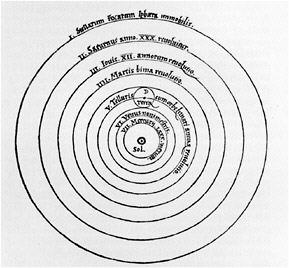
The Copernican Universe
“In the midst of all dwells the sun,” said Copernicus. To him, the universe was systematic, mathematical, knowable, and above all, simple. In this diagram from De revolutionibus the Earth is number v, “Telluris,” counting from the outermost ring of stars. Copernicus was not entirely liberated from Aristotle and Ptolemy, however, for he too believed the orbits to be circular and uniform.
—Bruno, L.C. (1987). The Tradition of Science.
what they remember about the early historical explanations for the motions of bodies in the night sky. Together, Mr. Gilbert and the students recall that, prior to the time of Copernicus and Galileo, the accepted model of the heavens was that all the planets and stars revolved around the earth, which was located in the center of the universe. They discuss how the predictable patterns of stars moving across the night sky were used as evidence to support this early explanation. “What evidence did Galileo uncover that caused him to question the earth-centered explanation?” Mr. Gilbert asks. The students use this question to focus their reading in their reference materials. During the ensuing discussion, Mr. Gilbert asks the students to compare the evidence-to-explanation thinking they used in their testing of the two different explanations for Moon phases to the scientific work that Galileo conducted – in which he observed the phases of the moons of Jupiter and then constructed an explanation to account for the evidence. For Galileo the explanation required placing the sun and not the earth to be at the center of the heavens. From their investigations, readings, and discussions, the students begin to understand how scientific explanations are formulated and evaluated with evidence, and to understand that the scientific community accepts and uses various explanations until they are displaced by better
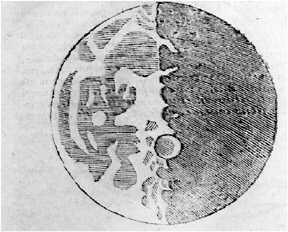
Page from Galileo’s “Starry Messenger”
Galileo’s “Starry Messenger” contained the first telescopic drawings of the moon to be published. Galileo showed the moon to be a solid body with irregular surface features. This drawing correctly shows mountain tops catching the sunlight and casting shadows, the length of which Galileo used to estimate the mountains’ height.
—Bruno, L.C. (1987). The Tradition of Science.
ones. The students recognize that each of their explanations may have seemed plausible until all the evidence was brought into play. Moreover, they were not embarrassed to give up an explanation that did not work when the evidence pointed in another direction. When such displacement occurs, scientific understanding advances.
At this point in the unit, Mr. Gilbert finds it very helpful to assign a take-home exam. Each student is asked to look at all the activities the class has completed thus far. The assignment is to select and then record in a summary table all the evidence that supports or refutes the class’ model of the phases of the moon. “You should consider each and every activity we have completed. Your job is to construct an argument for either the acceptance or rejection of your model. Pay particular attention to the data we gathered during our observations of the moon. What patterns in the data support or refute your model?”
Mr. Gilbert writes the assignment on the board:
-
Part 1: draw and label your model.
-
Part 2: list the evidence that supports your model.
-
Part 3: list the evidence that refutes your model.
-
Part 4: write 1) an explanation using science concepts for the phases of the moon; 2) a list of questions you now have about the motion of the moon.
-
Total: no more than 10 pages. It will be a major part of your grade for the unit.
ANALYSIS OF 5-8 IMAGE OF INQUIRY
This vignette illustrates how a wide variety of learning outcomes can result through different kinds of investigations by students. It also
shows how a sequence of learning experiences that are carefully crafted by a teacher can build and deepen understanding gradually, through motivating and engaging activities.
Learning Outcomes. Mr. Gilbert used students’ study of moon phases to help them learn both science subject matter and inquiry — learning both how to conduct inquiries and what inquiry is. His subject matter outcomes were drawn directly from the earth and space science standards of the National Science Education Standards: the regular and predictable motion of objects in the solar system explains such phenomena as the phases of the moon and eclipses. Mr. Gilbert found he could also use the sequence of instructional activities to help students develop many inquiry abilities. They began by collecting data about the moon’s phases through direct observation, using some tools to increase the precision of their observations, and supplementing direct observation with data from sources such as newspapers and the Internet. Their inquiry also helped them learn to use models to construct explanations for natural phenomena, to evaluate the models they were using for their benefits and shortcomings, and to gather an array of evidence to analyze alternative explanations and determine which best fits the evidence.
Mr. Gilbert’s students also deepened their understanding of scientific inquiry, when they discussed how Galileo’s study of moon’s phases helped people understand the configuration of different bodies in the universe. This opportunity helped them to understand the role that scientific inquiry has played over the centuries — how scientists think and work to formulate and advance scientific knowledge, as well as how profound new understandings have come from investigations of the natural world.
Essential Features of Classroom Inquiry. The sequence of learning activities just described contained all five essential features of classroom inquiry that were displayed on pages 24-27 of Chapter 2. Some of these features appeared several times throughout the sequence of lessons. Mr. Gilbert engaged the learners in scientifically oriented questions about moon phases. Although Mr. Gilbert proposed some of the questions, the students became mentally engaged and took ownership of the problems they posed. Assisted by Mr. Gilbert’s questioning, the students identified two different explanations for what causes moon phases. They produced drawings representing the relative positions and motions of the earth, sun, and moon for each explanation. Mr. Gilbert helped the students to determine what would constitute evidence to support each explanation. The students then manipulated
models to explore each explanation, gathering evidence to either support or reject each in turn. They drew liberally on the scientific literature as their understanding and, consequently, their questions, became more complicated. Each student group presented and defended its findings, resulting in a final class consensus about which explanation for moon phases could logically be supported by evidence.
It is reasonable to assume that all of Mr. Gilbert’s students did not begin the unit of study with fully developed inquiry abilities. Knowing that the sequence of learning activities to help students understand moon phases would require them to use all of the inquiry abilities to some degree, Mr. Gilbert decided to take this opportunity to help his students reflect specifically on how one constructs and evaluates explanations from evidence. His goal was to help his students improve these abilities, becoming more independent and skilled in their use and application to learn science content. He introduced the important idea that although models can be helpful to both their learning and to the development of scientific knowledge, every model has its limits. Evaluating and communicating the advantages and disadvantages of the specific models they used in their study of moon phases reinforced this need to be always critical of their tools and methods, and to take those into account when reflecting on what they learned and the confidence they have in that learning, much like scientists do. Further, Mr. Gilbert took advantage of the interesting historical context to broaden his students’ understanding of scientific inquiry and how scientists have used inquiry to advance our scientific knowledge of nature.
Instructional Sequence. The example just given of Mr. Gilbert and his students illustrates a way of sequencing learning and teaching activities that is consistent with the features of inquiry. The unit evolved from data collection, then using those data for concept development and the evaluation of models and explanations. And when students were asked to deal with eclipse frequency, they applied their knowledge to a new scientific challenge. Early in the sequence Mr. Gilbert helped his students become engaged in thinking about moon phases by probing what they thought they knew about the moon and what they wondered about. Their study proceeded through a long period of observation and data gathering during which they recorded and then explored the patterns they observed in the moon’s behavior. Students created their own explanations of the moon’s phases and then tested their explanations and those of other students using models that they could manipulate and continue to explore.
Table 3-4. Excerpts from Physical Science Standard, 9-12
|
As a result of activities in grades 9-12, all students should develop understanding of |
|
Motion and forces
|
IMAGES OF INQUIRY IN 9-12 CLASSROOMS
The lesson described in the following vignette begins a physics unit on force and motion. According to district curriculum guidelines, by the end of this high school physics unit, students should be able to use Newton’s Laws and explain the forces acting on objects in various states of motion. In addition, the state and district learning outcomes include helping students develop abilities to do scientific inquiry and to understand the nature of scientific inquiry. (See Table 3-4.)
Mr. Hull begins most units with one or more short survey questions to get students to think about the kinds of situations, issues, and ideas they will be investigating for the next few days. Today, at the opening of class, he asked his students: “What do you think about when you hear the word force?” Among the responses were: “gravity is a force,” “pushing, like when I push a car,” “a push or a pull on something,” and “making somebody do something they don’t want to.”
While students continued sharing their initial ideas, Mr. Hull wrote the ideas on the board. As he wrote, he organized the ideas into two categories: kinds of forces, and definitions of force (i.e.,“force is…”). Both of these categories would be important in their unit on Explanation of Motion.
Mr. Hull wanted his students to be able to represent their understanding of forces, so he guided them in crafting their representations. He said: “It sounds like several of you are thinking of force as a push or pull. What are some properties of pushes and pulls?” A student noted, “They are in a certain direction and they have a certain size.” “So a force is a vector,” said another student. Vector representation had been part of an earlier unit on describ-
ing motion, and the students recognized a new context in which the idea applies.
Mr. Hull queried, “It sounds like vectors might be useful for representing force? How would you use them to represent forces?” A student responded, “Well, a longer arrow would represent a bigger force, and the direction of the arrow would represent the direction of the force.”
Mr. Hull waited while the students talked about this representation for a while. He then placed a book on the demonstration table in the front of the room and asked students to use vector arrows to represent the forces on the book, while it remained at rest on the table. He also asked students to pay attention to both the length and direction aspects of the vector representation and to add a label to each force arrow stating what exerts it. While each student drew and labeled his or her own representation of the situation, Mr. Hull walked around the room observing to get some idea of which students were suggesting what forces.
Although there were several variations in the students’ representations, there was one main difference between the representations that he knew would occur. Some students had drawn and labeled an upward force by the table and others had not. From his experience in the workshops run by the local university, he had learned that this difference is evidence that the students have very different conceptions of force. After the students had finished their representations, Mr. Hull drew two books on the front blackboard. On one he drew only a downward arrow. On the other he drew both an upward arrow and a downward arrow. Between the two diagrams he drew a large question mark.
“I noticed one big difference in the diagrams,” he said. “About half the class had an upward force by the table and half did not. That suggests a difference in the ways you are conceptualizing force. Since we are just beginning a unit on force, we’d better resolve this difference. So, why do some of you think we need to include an upward force by the table? And, why do others of you think we should not include an upward force by the table?”
Some students shared their ideas, suggesting that if the table did not exert a force on the book, it would fall. Others said there only needed to be a downward force in order to hold the book to the table. Still others argued that the table could not push or pull anything because it was not alive; it did not have any energy. Mr. Hull recognized that many of the students were thinking that force can be exerted only by active agents, so that passive agents, like tables, cannot exert force.
Mr. Hull asked the students to each pick up a book and hold it in an outstretched hand. He then asked the
class to add a second diagram on their paper, a diagram of the forces acting on the book while the book is at rest on the hand.
In this case, most of the students who did not show an upward force in the first diagram now showed an upward force. A few students still did not show an upward force. When asked why they had not shown such a force, most said that since they had not put in an upward force when the book was on the table, they did not feel they needed to do so here. Mr. Hull pointed out that their attempt to have consistent reasoning across situations was commendable and important in science and in other subjects.
“Is there an upward force on the book?” he asked. Then, to increase the salience of the experience, he asked students to add additional books to their outstretched hands. Nearly all were willing to say there was an upward force by the hand. Still some students were concerned about the need to be consistent across situations, which Mr. Hull acknowledged by noting on the board the “need to have the same explanation across ‘at rest’ situations, if possible.” Consistency in explanations is an important aspect of science that Mr. Hull wanted his students to incorporate into their thinking.
Next, Mr. Hull hung a book from a spring and asked students to draw a third diagram of the book on the spring and the forces that kept the
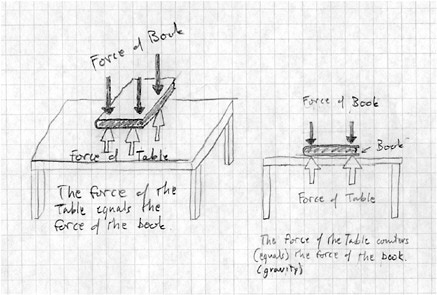
book at rest. Most of the class included an upward force by the spring in their diagrams. A few others argued that because the spring was not alive, it could not “exert” a force.
Mr. Hull asked, “So, how come many of you who said the table does not exert a force are now saying that the spring does exert an upward force? The spring isn’t alive.” The students responded, “The spring moves.” “The spring compresses or extends.”
The teacher asked the students to think about what was similar about the situations in which they were willing to say there was an upward force. They suggested that when the book was on the hand, one could see or feel the muscular activity in order to support the book, and when the book was on the spring one could see the change in the length of the spring. Mr. Hull pointed out that they were responding to evidence for a force by looking at some change in the “thing” that is doing the supporting. He wanted his students to be seeking observational evidence in support of their ideas and inferences.
Mr. Hull: “How about those of you who suggest the table does exert an upward force. In what way does that make sense to you?” While gesturing sideways, one student said, “Whenever anything stays still, if there is a force on one side, there has to be a force on the other side to keep it stopped.” Mr. Hull: “ I see you are talking about horizontal forces, does that also work with vertical forces?” Again, he guided his students to see the consistency across contexts, in this case, explanations of the at-rest condition should be the same whether considering horizontal forces or vertical forces. This gave some rational argument for an upward force.
Mr. Hull asked his students to think about evidence. “What observable evidence do you have that the table exerts an upward force?” A few students suggested the table bent like the spring. Others countered, arguing that the table was a heavy, solid demonstration table, that it was rigid and therefore could not bend. The students suggested the need for a critical experiment. “How could we see whether the table bends at all?” asked the teacher. Not hearing any suggestions, Mr. Hull proposed that they use a “light lever.” Bringing out a light source (in this case a laser pointer), he placed it so that the light hit the shiny table top at a low glancing angle. With the room lights off, one could see where the reflected light hit the far wall. The teacher checked to be sure that the students knew that if the table bends, the light on the wall should move. Although the movement was not readily noticeable with one book placed on the table, as the stack got larger and was taken off and back on, the light could be seen to move.
After exploring ideas about force
through questions, discussion, and observations for much of the class period, the students were ready to summarize their class experience and its implications for the meaning of force. One said: “Since the table bent, like a stiff spring, all things had to deform some to support the book. Deformation was one sort of evidence we could look for when we considered forces.” Another added, “That meant we could give the same explanation [involving an upward force] across several different ‘at rest’ systems.” Another said: “That also meant we didn’t need to worry about whether the supporting object was alive, awake, active, or passive. We could just focus on the observable evidence of deformation, although sometimes we might need more sensitive instruments [like a light lever] to detect the deformation.” Mr. Hull pointed out that that was one of the “rules” of science: “If a simple, consistent explanation would work across several situations, then use the simpler explanation rather than needing to rely on use of different explanations depending on some non-observable characteristic like whether the object was actively or passively supporting the book.” Mr. Hull further validated the work of the students, suggesting “that force could have been defined by incorporating the active/passive distinction, but for reasons like consistency and tying our ideas to observable evidence, the scientists’ conception of force is more like the one our class has derived. Also, we now know that this conception has worked well for scientists for a long time. Like scientists, we will take our present idea of force as tentative and use it until new evidence suggests we might need to revise it.”
The inquiry does not end here. In subsequent lessons focusing on forces on moving objects, students further develop their understanding of force and of the nature and processes of science. The preceding lesson is but one short inquiry allowing students to begin to understand the complex ideas that science has developed related to force and motion.
ANALYSIS OF 9-12 IMAGE OF INQUIRY
This example represents one lesson conducted in a single class period. Nevertheless, it demonstrates how a teacher can seamlessly interweave science subject matter, inquiry abilities, and understandings of scientific inquiry.
Learning Outcomes. Mr. Hull used three learning outcomes from his local school district curriculum and state standards to help him plan what and how to teach. Each of these three outcomes is also found in the National Science Education Standards. First, his lesson provided opportunities for his students to understand and apply the concept from physics of
forces acting on objects in various states of motion. The students’ prior understandings were challenged by questions about objects and forces in different contexts; this caused them to look for evidence to build improved explanations. Second, he helped his students develop abilities to do scientific inquiry, attending, in particular, to determining what constituted evidence of forces acting on objects in various conditions, and building evidence-based explanations that would apply across different contexts. Finally, Mr. Hull shared aspects of the nature of scientific inquiry with the students and drew on their ideas to show how scientists think and work.
Essential Features of Classroom Inquiry. This lesson includes a number of the essential features of classroom inquiry described in Chapter 2. Scientific questions focused students’ thinking about the forces acting on objects in various states of motion. The students gathered observable evidence to develop explanations and gain a deeper understanding of the concept of force. They also questioned proposed explanations, focusing on the search for observable evidence. Mr. Hull guided the building of explanations from the evidence gathered. At the conclusion of the lesson, he helped the students make connections from their experiences to current scientific thinking about forces and motion.
Instructional Model. The example of Mr. Hull and his students illustrates one way of organizing and sequencing learning and teaching activities consistent with inquiry. Through questioning, Mr. Hull actively engaged his students in thinking about the existence of an upward force on an object at rest on a table. He used student-generated drawings to find out more about their current understanding of whether objects, such as a table or hand, can exert an upward force on an object at rest. Mr. Hull drew on the prior knowledge of the students to pose questions that motivated them to explore whether other types of objects, such as springs, can exert an upward force. The students developed explanations about how a stationary object could exert an upward force. Mr. Hull explained how scientists think about forces and helped the students elaborate their explanations across different contexts. The students critiqued their ideas on the basis of evidence. Through class discussion, Mr. Hull was able to evaluate student thinking and use this information to help structure the flow of the lesson.
In this vignette the teacher clearly guided the inquiry. Yet, stimulated by an initial question from the teacher, students asked their own questions, voiced their concerns, and shared their ideas. They also critiqued ideas focusing on the search for evidence.
ANOTHER IMAGE OF INQUIRY IN GRADES 9-12
Every year in the spring, Ms. Idoni’s biology class conducts a full and open inquiry. The inquiry takes several weeks of class during the semester, so students have ample time to conduct their investigation. Ms. Idoni begins the inquiry by taking the students on a field trip to an environment where she is relatively certain their interest will be engaged. All year, students look forward to this experience. It is a tradition with Ms. Idoni and the students have heard that it is hard work, but something they will really find interesting.
Earlier in the school year the students have had many opportunities to learn and practice the inquiry skills they will need to conduct a full inquiry. Ms. Idoni has used a series of “invitations to inquiry” (Mayer, 1978), which are short teaching units designed to give students small samples of the process of inquiry. Each sample has a blank the students are invited to fill, for example, the plan of an investigation, a way to control one factor in an experiment, or the conclusion to be drawn from a set of data. Each “invitation” focuses student learning on one or two abilities of inquiry. Participating in the series of invitations over the year has equipped Ms. Idoni’s students to identify questions that can be investigated, design appropriate investigations, gather data, interpret data, consult sources such as the Web for additional information, and draw definable conclusions — all of which will be called on in the full inquiry they are now beginning.
Before starting inquiry, Ms. Idoni makes plans for how to assess students’ learning on an ongoing basis. She will ask each student to keep a journal through the inquiry. Because she is most interested in emphasizing the development of inquiry abilities, Ms. Idoni will have the students organize their journals according to a slightly modified form of the fundamental abilities as described in the Standards. The categories Ms. Idoni will use are:
-
Questions and scientific ideas that guide the investigation
-
Design of the investigation
-
Technology and mathematics for the investigation
-
Use of evidence to present explanations
-
Alternative explanations
-
Conclusions and defense of explanations
As students record their observations, Ms. Idoni will review their journals and ask more specific questions about scientific concepts that underlie their explanations, how technology helps them, what evidence they are collecting, if they have the best evidence and explanation, what other ideas they have heard, and if they have the strongest conclusions.
Ms. Idoni sets the stage for the field trip by explaining to the students that for most of the year their biology class has studied ideas and conducted laboratories that scientists and educators think that all students should know and experience. Although these experiences provide a foundation, now the approach will be different. They will have the opportunity to study something about the environment that they find interesting. “The field trip will help you decide what question you want to pursue.” This year, Ms. Idoni has decided to take the students to a lake in the city park. When they arrive at the lake, Ms. Idoni asks the students to simply walk around the lake, to observe the lake, and to think about questions that they may be interested in answering. She asks them to record the observations and questions in their journal.
The next day’s activity centers on the students’ observations and questions. Ms. Idoni approaches these discussions with caution. She is sensitive to the balance between sustaining the students’ interest and enthusiasm and the critical elements of a successful scientific inquiry for 10th graders. A critical aspect of successful inquiry is having students reflect on the ideas and scientific concepts that guide the inquiry. Also important is a knowledge base to support the investigation and help students to formulate an appropriate scientific explanation. Students’
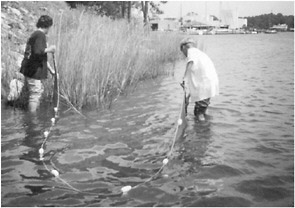
current concepts of the aquatic environment will shape, and may limit, their questions and ultimately their inquiry. So, after an initial class discussion, Ms. Idoni knows she will rely on small groups, brief reports on progress, and cooperative learning for the investigations.
Student questions begin with issues such as: Is the lake water safe to drink? Can people swim in the lake? What kinds of plants and animals live in the lake? How have humans changed the lake? As the discussion continues, it becomes clear to Ms. Idoni that the students are most interested in change and stability in the lake and, in particular, the influence humans have had on this environment. It also is clear that students have ideas about how the lake changes: the temperature changes daily and with seasons; there was more dirt since a recent rain; some small organisms could be seen; and, in some places, there were different
smells associated with the water. Ms. Idoni probes the students about their observations and reminds them to make entries in their journals. What important aspect of the lake do they want to investigate? What kinds of human influences are of most interest? “Pollution” is the term Ms. Idoni hears first and most consistently. She thinks it is essential to clarify the students’ understanding of pollution and in particular the possible sources of human pollution in the city lake. She asks the students to discuss in small groups what they mean by pollution for the city lake.
Over several class periods, they struggle with the issue of normal change, what counts as pollution, and possible human influences. Ms. Idoni lets the students grapple with these issues, which seem to center on one major idea: as living and non-living elements of an ecosystem interact, they change. Any study of changes in an environment, such as the city lake, must begin with an analysis of the patterns of change under normal circumstances. Students realize they have to understand the natural functions of the interactive system before tackling the more complex question of the impact of human actions, in particular, their notion of pollution. At this point Ms. Idoni realizes she already has her final assessment: she will suggest that something has polluted the lake and the students will have to apply what they have learned to this new problem. But, for the time being, she must wait and let the students pursue their questions and investigations.
After hearing the results of small group discussions, Ms. Idoni facilitates a large group review of ideas and helps students identify an overarching question for the class to pursue in the investigation. The class decides on a general question: Is city park lake polluted? If so, how have humans influenced the pollution? The class decides to approach the inquiry by first establishing a baseline of data about city lake and then determine if the lake is polluted. Students realize that many factors affect water quality. With help from Ms. Idoni, they decide
to organize their work, and so themselves, to focus on three kinds of factors: physical, chemical, and biological. The group investigating physical factors is interested in temperature, color, limits of light penetration, and amounts and types of suspended particles. The chemical factors group wants to learn about pH (which they have measured in various classes in past years and suspect might have something to do with a lake’s “condition”), and amounts of oxygen, carbon dioxide, phosphates, and nitrates. The biological group wants to investigate the numbers and kinds of organisms.
Students decide to design the inquiry as follows. Each group will gather data for a period of two months, reporting all results to the other groups on a regular basis. Each group also will report about their ideas and what their library and computer searches suggest about the potential influence of the factors they are studying on the quality of city lake.
Ms. Idoni is very pleased with the way the class investigation is taking shape. Although she knows the students will still struggle with the question of how to determine what counts as pollution, and especially the human influence, she lets this issue remain unresolved. In fact, knowing it will emerge on its own, she doesn’t bring it up.
Ms. Idoni is especially aware of three things. First, she keeps a mental list of the inquiry abilities for grades 9-12 and notes which abilities the students are engaged in as the inquiry progresses. Second, she recognizes that students are using what they have learned of physical and life sciences earlier in the year, especially the fundamental understandings associated with the life science standard on the interdependence of organisms (see Table 3-5). Finally, Ms. Idoni sees that this entire inquiry is providing ample opportunities for all students to understand several parts of the standard on science in personal and social perspectives, especially those associated with natural resources and environmental quality (see Table 3-6).
As the students begin organizing their group investigations, they easily and quickly recognize that the use of various technologies will improve data gathering and mathematics will improve the summary and presentation of data. For example, they decide to set up temperature probes and record data directly into computers, and to use Hach oxygen test kits, a pH meter, a Millipore environmental microbiology kit, and common items that help them gather samples for examination in the science classroom.
Ms. Idoni schedules periodic meetings in which the students share data they have collected and present what they understand about the influence of various factors. With time, students begin to realize that the
Table 3-5. Excerpt from Life Science Standard, 9-12
|
As a result of activities in grades 9-12, all students should develop understanding of: |
|
Interdependence of organisms
Matter, energy, and organization in living systems
|
Table 3-6. Excerpt from Science in Personal and Social Perspectives Standard, 9-12
|
As a result of activities in grades 9-12, all students should develop understanding of |
|
Environmental quality
|
factors interact. In one discussion, for example, the physical factors team suggests that temperature determines the number and kinds of organisms. The chemical factors team reports that the numbers and kinds of organisms influence how much oxygen and carbon dioxide are present. In one highly energized session, the students realize that an investigation of water quality is a search for relationships
among physical, chemical, and biological factors.
In the process of data analysis, student teams review their findings, look at ranges of data and trends over the period of study (it is spring), and determine what is appropriate to consider and how to deal with anomalous data. During their group work, Ms. Idoni moves from group to group and asks questions, such as “What explanation did you expect to develop from the data?” “Where there any surprises in the data?” “How confident do you feel about the accuracy of the data?”
After two months, the groups present their data and their explanation of the specific effect the factors they studied have on the lake and if the effect would count as pollution. As students listen to the different groups, they recognize and analyze alternative explanations and models for understanding stability, change, and the potential of pollution in the city lake. They review what they know, weigh the evidence for different explanations, and examine the logic of the different group presentations. They challenge each others’ findings, elaborating on their own knowledge as they help each other learn more about their particular factors. Slowly, they form the view that all factors have to be considered in any explanation for pollution of the lake.
To Ms. Idoni’s surprise and pleasure, the students decide that they want to synthesize the data and formulate an answer to their guiding question. Their observations and explanations continually expand; they find they have to consider factors they did not originally think were important, such as season, rainfall, and the activities of domestic animals.
As they compile all of the evidence and begin the difficult task of answering their question, they realize they must first address the question: “What counts as pollution?” The students decide that they will use coliform bacteria because of what they learn in their reading. The literature points out that water can look, taste, and smell perfectly clean and yet be unsafe to drink because it contains bacteria. This eventually becomes the students’ operational definition of pollution. They learn that coliform bacteria live longer and are easier to detect in water than bacteria that cause disease. Their presence is considered a real warning signal of sewage pollution. If coliform bacteria are not present in city lake, then, the students reason, the answer to their question is that the lake is free of pollution — at least by their operational definition of human pollution.
Working across groups, the class compiles their respective reports and prepares one major summary of their inquiry. They also include summaries of their respective results. The reports are excellent. Students capably describe procedures, express scientific concepts, review informa-
tion, summarize data, develop charts and data, explain statistical procedures they used, and construct a reasonable and logical argument for their answer to the question, “Is city park lake polluted?” “And, if so, what is the human influence on the pollution?” The class concludes that, even though city park lake experiences variations and changes in many factors, it is not polluted.
For the final assessment, Ms. Idoni presents a new problem and asks each student to prepare a report describing how he or she would investigate the problem. Here is the problem: over several weeks there is a massive fish kill in the lake. Everyone suspects pollution — of some sort. But, no one knows exactly how to investigate the problem. The one thing they have discovered is that coliform bacteria have not been found in the lake. Students are to propose an inquiry that might be used by the City Council to address this problem.
ANALYSIS OF ANOTHER 9-12 IMAGE OF INQUIRY
Ms. Idoni is pleased with the student work and certain that it demonstrates significant learning. Their work has provided opportunities for all students to develop the abilities of scientific inquiry described in the National Science Education Standards — her primary learning goal for the full inquiry. She also realizes that the experiences provided students with the background they need to develop deeper understanding of many science concepts and the connections between science and personal and social issues. Finally, Ms. Idoni uses the experience of doing a full inquiry to review and strengthen students’ understandings about scientific inquiry.
Ms. Idoni thinks the experience is important because it provides students with an understanding of the ways that scientists pursue questions that they identify as important. It also gives students one opportunity to use all of the abilities described for the Science as Inquiry standard in the National Science Education Standards. She knows that for students to develop these abilities, they must actively participate in scientific investigations and use the cognitive and manipulative skills associated with the formulation of scientific explanations.
As she initiates the activity, Ms. Idoni knows that some students will have trouble with variables and controls in experiments. Further, students often have trouble with data that seem anomalous and in proposing explanations based on evidence and logic rather than on their beliefs about the natural world.
Ms. Idoni uses the initial field experience as a way to make the investigation meaningful to students. She understands there are several
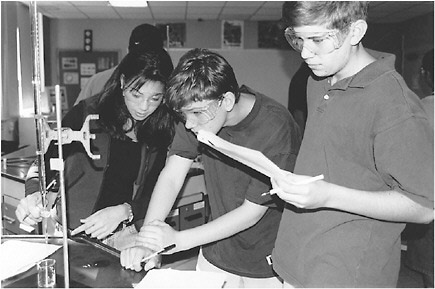
ways that students may find meaningful topics to pursue, for example, current topics in the media, local problems, and personal experiences. She also knows that initially some experiences may not be highly engaging, but active involvement by its very nature has some meaning. Over several years of teaching experience, Ms. Idoni has decided that for a majority of students an initial field trip provides the most meaningful context for beginning the inquiry.
CONCLUSION
Inquiry-based teaching requires careful attention to creating learning environments and experiences where students can confront new ideas, deepen their understandings, and learn to think logically and critically about the world around them. This chapter has suggested some ways to “see” inquiry in classrooms. The next chapter turns to how teachers learn to achieve and assess the wide range of outcomes they strive for in their use of inquiry.


