
Page 23
1 —
The Emergence of the Digital Dilemma
The role of information products and services in the U.S. economy is vast and still growing rapidly. The addition of an ''Information Sector" category to the federal government's new industry classification system is recognition of both the sector's economic importance and the fundamental kinship of publishing (print and software), motion picture and sound recording, radio and television broadcasting, libraries, and information and data processing services.1
The widespread use of computer networks and the global reach of the World Wide Web have added substantially to the information sector's production of an astonishing abundance of information in digital form, as well as offering unprecedented ease of access to it. Creating, publishing, distributing, using, and reusing information have become many times easier and faster in the past decade. The good news is the enrichment that this explosive growth in information brings to society as a whole. The bad news is the enrichment that it can also bring to those who take advantage of the properties of digital information and the Web to copy, distribute, and use information illegally. The Web is an information resource of extraordinary size and depth, yet it is also an information reproduction and dissemination facility of great reach and capability; it is at once one of the world's largest libraries and surely the world's largest copying machine.
1See Murphy (1998).
Page 24
The traditional tool for dealing with use and misuse of information is intellectual property law, the constellation of statutes and case law that govern copyrights, patents, and trade secrets. Part of the case for granting rights in intellectual property (IP) is the belief that protecting IP promotes the development of new products and services, and that erosion of those rights could threaten the economic performance of the information sector and curtail the major benefits it has brought.2 But as this report argues, with this new abundance of information and the ease with which it can be accessed, reproduced, and distributed have come problems that must be seen in all of their complexity, including related economic, social, technical, and philosophical concerns, as well as the accompanying legal and policy challenges. Debates over these issues matter because the outcome will have a significant impact on today's information sector companies and will help determine the character of the digital economy of the future.3
An Enduring Balance Upset?
The task of intellectual property protection has always been difficult, attempting as it does to achieve a finely tuned balance: providing authors and publishers enough control over their work that they are motivated to create and disseminate, while seeking to limit that control so that society as a whole benefits from access to the work. The challenge was elegantly stated some 200 years ago in a legal case in Great Britain:
We must take care to guard against two extremes equally prejudicial; the one, that men of ability who have employed their time for the ser-
2A second argument in support of IP law is the principle that the creator of an information product ought to be entitled to control the dissemination and use of that information, an issue that is considered throughout this report. For the moment, note that the constitutional language granting Congress the authority to create copyright and patent protection mentions only an instrumental purpose: "To promote the progress of science and the useful arts" (U.S. Constitution, Art. 1, Sec. 8, Para. 8).
3Those debates include the Digital Millennium Copyright Act of 1998 (P.L. 105–304), which amends the Copyright Act, title 17 U.S.C., to legislate new rights in copyrighted works, and limitations on those rights, when copyrighted works are used on the Internet or in other digital, electronic environments. Efforts to enact legislation to provide protection for databases that do not qualify for copyright are taking place in the 106th Congress through H.R. 354, the Collections of Information Antipiracy Act, and H.R. 1858, the Consumer and Investor Access to Information Act. In its Treasury and General Government Appropriation Bill for FY2000 (S. 1282), the Senate Appropriations Committee endorsed the creation of an interagency federal office to fight against the infringement of IP rights of U.S. entertainment and computer companies. This action came in response to requests from industry executives such as Bill Gates, chairman and CEO of Microsoft Corporation, and Jack Valenti, chairman and CEO of the Motion Picture Association of America (Rogers, 1999).
Page 25
vice of the community, may not be deprived of their just merits, and the reward of their ingenuity and labour; the other, that the world may not be deprived of improvements, nor the progress of the arts be retarded.4
In more recent times, a U.S. court reiterated the significance of balancing rights and access:
We must remember that the purpose of the copyright law is to create the most efficient and productive balance between protection (incentive) and dissemination of information, to promote learning, culture and development.5
In the two centuries between those two statements, the United States has changed enormously, moving from an agrarian society to one heavily dependent on information and high technology. Yet many of the fundamental concepts of U.S. intellectual property have been in place for those 200 years and have, with some success, weathered substantial changes in technology and society. The first U.S. copyright statute was enacted in 1793 and protected only maps, charts, and books. Yet it has been adapted successfully over the past 200 years, in part by expanding both the set of exclusive rights conferred by copyright and the scope of the subject matter (embracing photographs, sound recordings, motion pictures, software, and more) and by qualifying those rights with exceptions such as the fair use rule. (Box 1.1 defines "fair use" and other key terms.)
During that time, copyright and patent law have had an instrumental role in the promotion and creation of a vast array of informational works, resulting in vibrant markets for IP. But copyright and patent laws have also defined limits on protection in order to facilitate the public interest in and benefit from shared information. Over time, compromises have evolved to balance the interests of the creators and consumers of intellectual work, fulfilling a number of important public policy objectives.
But the carefully crafted balance may be in danger of being upset. The emergence in the past 10 years of a new information infrastructure marked by the proliferation of personal computers, networks that connect them, and the World Wide Web has led to radical changes in how informational works are created and distributed, offering both enormous new opportunities and substantial challenges to the current model of intellectual property.
4Lord Mansfield in Sayre v. Moore, 1785, cited in Kaplan (1967), p. 17.
5Whelan v. Jaslow, 797 F.2d 1222; 21 Fed. R. Evid. Serv. (Callaghan) 571; U.S. Court of Appeals for the Third Circuit, March 3, 1986, Argued, August 4, 1986, Filed.
Page 26
| ||||||||||||||||||||||||||||
Page 27
Scope of the Report
There is a healthy ferment of experimentation and debate going on in attempts to realize the promise of the digital age. This report seeks to explain and demystify the underlying technology trends, explore the range of technological and business tools that may be useful, and recommend a variety of actions that can be taken to help ensure that the benefits of the information infrastructure are realized for rights holders and society as a whole.
This report builds on recent previous studies in the area of intellectual property and digital technology. Perhaps the most visible effort was undertaken by the Information Infrastructure Task Force, which issued the report Intellectual Property and the National Information Infrastructure (IITF, 1995),6 sometimes referred to as the IITF white paper. The IITF white paper presents the detailed legal issues concerning copyright and digital technology, but it does not address business models, protection technologies, or other issues in any particular depth. More recently, the U.S. Copyright Office commissioned a study on the future of copyright in the networked world (Hardy, 1998). That report, which provides good descriptive coverage of the relevant technologies and trends and some discussion of the pertinent economic and legal issues, identified trends but did not provide conclusions and recommendations.
This report of the Committee on Intellectual Property Rights in the Emerging Information Infrastructure does not duplicate the detailed legal analyses of the IITF white paper or the extensive review of technologies in the Hardy report. Instead, it offers a framework for the evaluation and construction of public policy, as well as a variety of specific conclusions and recommendations designed to help legislators, courts, administrators, and the public to understand what is at issue, to formulate questions clearly, and to assess alternatives. The focus on copyright derives from the observation that copyright protects a large variety of the IP frequently encountered by the public and has the highest visibility in the debates over IP and the information infrastructure. The members of the study committee were selected to provide the diverse expertise needed to ensure that stakeholders' wide-ranging perspectives were represented.7
For the most part, this report focuses on circumstances and actions possible in the United States. However, as discussed below, the study committee's conclusions and recommendations need to be considered in
6The Working Group on Intellectual Property Rights, chaired by Bruce A. Lehman, assistant secretary of commerce and commissioner of patents and trademarks, was established within the Information Policy Committee of the Information Infrastructure Task Force.
7See Appendix A for the biographies of study committee members.
Page 28
a worldwide context. One of the consequences of global networks is the inevitable interaction between U.S. law and culture and those of other countries. This can be problematic because laws and IP practice differ widely across countries and are likely to remain different despite efforts at harmonization.
Origins of the Issues
Given the successful growth and adaptation of intellectual property law over the years, any claim that the established balance is in danger of being upset must be clear and convincing about the origins of that danger. The committee identified problems arising from two primary sources: changes in technology and the availability of the digital information infrastructure as a routine part of everyday life. Three technological changes in particular—the increased use of information in digital form, the rapid growth of computer networks, and the creation of the World Wide Web—have fundamentally altered the landscape and lie at the heart of many of the issues presented by the evolving information infrastructure. These changes, coupled with the emergence of the information infrastructure as a part of daily life, present significant legal, social, economic, and policy challenges.
Technology Has Changed: Digital Information, Networks, and the Web
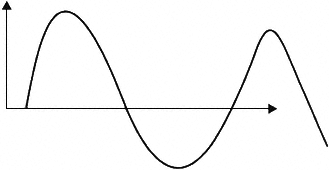
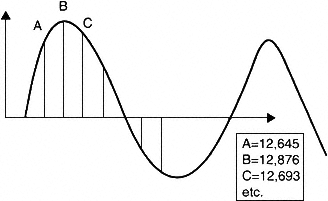
Representing information in digital form, as opposed to the more traditional analog form, means using numbers to capture and convey the information. Music offers a clear example of the difference between the two. Capturing musical sounds requires describing the shape of the vibrations in air that are the sound. Records capture that information in the shape of the groove in the vinyl. CDs, by contrast, capture the same information as a large collection of numbers (see Box 1.2). Digital information has a remarkable breadth of descriptive ability, including text, audio (music, speech), video (still and moving pictures), software, and even shape (e.g., in computer-aided design).
Why Digital Information Matters
When information is represented digitally, access inevitably means making a copy, even if only an ephemeral (temporary) copy. This copying action is deeply rooted in the way computers work: Even an action as simple as examining a document stored on your own disk means copying it, in this case twice—from the disk to the computer's
Page 29
|
(text box continued on next page)
Page 30
(text box continued from previous page)
|
Page 31
memory and then again onto the video display.8 Before you can view a page from the World Wide Web, the remote computer must first send your computer a copy of the page. That copy is kept on your hard disk, copied again into memory, and then displayed on the screen.9 In addition, intermediate copies of the page may have been made by other computers as the page is transported over the network from the remote computer to yours.10
Such copying occurs with all digital information. Use your computer to read a book, look at a picture, watch a movie, or listen to a song, and you inevitably make one or more copies. Contrast this with the use of traditional media: Reading a book does not involve making a copy of it, nor does watching a movie or listening to a song.
This intimate connection between access and copying has considerable significance in the context of intellectual property protection. One of the essential elements of copyright—the right to control reproduction—works as expected in the world of traditional media, where there is an obvious distinction between access and reproduction and where the copyright owner's control of reproduction provides just that. But in the digital world, where no access is possible except by copying, complete control of copying would mean control of access as well.
This intimate connection has consequences for all parties in the digital world. Rights holders may seek to control access to digital information, because access involves reproduction. Readers may find their traditional access to information susceptible to control in unprecedented ways. Policymakers, meanwhile, must consider how to maintain the appropriate balance between control and dissemination.
Digital representation changes both the economics and the character of reproduction. Copying digital information, even on a home computer, is easy and inexpensive: A standard (1.44 megabyte) floppy disk, which holds the equivalent of about 500 pages of text, takes no more than a minute to duplicate and is treated as if it were a piece of paper (e.g., routinely given away). A CD, which holds 650 megabytes (the equivalent of about 220,000 pages, or 44 cartons), can be copied in 15 minutes to a blank compact disk that costs
8The information could be displayed directly from the disk to the screen, but disks are much too slow to make this practical. Main memory is thousands of times faster; hence, several pages of the information are copied there first. This copy is typically ephemeral, disappearing as soon as you view a different page.
9The copy on your disk may disappear from your disk when you exit your Web browser, but it can often easily be saved permanently.
10A primer on the operation of the Internet is given in Appendix C.
Page 32
about $1.00, using equipment now widely available for PCs and costing only a few hundred dollars.11
Copying information has always been possible, but the advent of digital information brings an extraordinary increase in the amount of information that can be easily and inexpensively reproduced. Given the widespread availability of computers, many people now have the ability to casually reproduce vast amounts of information. Consequently, the traditional physical and economic impediments to copyright infringement have been considerably undermined. Its size once meant that a 30-volume encyclopedia could be reproduced only by those with considerable means and motive; now an encyclopedia on a CD can be reproduced in a few minutes on what is fast becoming ordinary technology.
The character of reproduction has changed as well. Although a photocopy often isn't as sharp as the original,12 a digital copy is indistinguishable from the original as are all successive digital copies. For every form of digital information, every copy is as good as the original and can therefore be the source of additional perfect copies, which greatly reduces what was once a natural impediment to copyright infringement. With the traditional form of information, the successively lower quality of each generation of copy offered a natural limitation to redistribution. With digital information there is no such limitation.
Information in digital form is largely liberated from the medium that carries it. When information is sent across networks, there is no need to ship a physical substrate; the information alone flows to the recipient. The liberation of content is also evident when bits are copied across media (disk to tape to CD to floppy) with the greatest of ease. The choice of media may have consequences for the amount of storage or speed of access, but the content of the information and its properties (e.g., the ability to make exact copies) are preserved perfectly across a variety of media.
Information in traditional analog forms (movies, paintings, sculpture) is, by contrast, far more tightly bound to the underlying physical media.
11Text is a particularly compelling example because it puts, relatively speaking, little information on a page. Graphic images contain far more information: a single 5" x 7" color photograph may require 14 megabytes to store digitally (300 bits per inch resolution and 36 bits of color); hence a CD might hold about 46 such photographs. There are also a variety of ways to compress digital information so that it takes up even less space; sometimes this means being able to fit 30 times more information onto a disk than it could hold without compression.
12The difference between a copy and an original depends of course on the quality of the equipment being used. Audio or video tapes copied using standard (i.e., analog) technology, for example, are markedly inferior in quality to digital copies.
Page 33
It is not easily transported without the underlying medium, nor is it so easily extracted for copying (consider copying a sculpture). The point, of course, is comparative: Bits still need to be stored someplace, and even a sculpture can be copied, but the difference is so large—several orders of magnitude and constantly increasing with advancing technology—that the experience from the individual's viewpoint is qualitatively different.
The liberation of content from the medium has unsettling consequences for the protection of IP in digital form. Until very recently, intellectual works have been produced and distributed largely as analog works embedded in a physical artifact (e.g., printed books, movies on video tape). IP law and practice have been worked out in the context of such artifacts, and much of our comfort with IP law is based on the familiar properties of information closely bound to a physical substrate. Digital information changes those properties in substantial ways.
Digital information is plastic, easily searched and indexed, and easily cross-indexed. It is plastic in the sense that it is easily changed. Although a paper book is difficult to alter and hard to search even with a good index, online text can be changed easily, for instance, by adding and rearranging paragraphs. Coupled with digital transmission, plasticity of information confers, along with great advantages, the potential for fraudulent acts such as plagiarism or forgery.13
In addition, although traditional documents are static—a printed book contains the same words from one moment to the next—digital documents can be dynamic, changing from moment to moment or offering different views. For example, articles posted on the Web often undergo revision in response to comments from readers. Short of making a (static) local copy, how does one cite such a thing, if it may say something different tomorrow? Even with a static local copy, who is to say what the document once said at a particular point in time, if there are at least two different versions? The plasticity of digital information could have a significant impact on the nature and value of citations and on scholarly research.
The ease of searching and indexing digital information enormously facilitates the creation of derivative works of unusual forms.14 Consider
13The use of a digital signature (see Appendix E) may be of some assistance by providing a way to ''sign" a digital document. If the document is subsequently altered, there will be a detectable mismatch between the signature and the document. Large-scale use of digital signatures requires a substantial infrastructure that is only now emerging, with the growth of e-commerce.
14A "derivative work" is a work based on one or more preexisting works, such as a translation, musical arrangement, dramatization, fictionalization, motion picture version,
(footnote continued on next page)
Page 34
an online textbook. Someone knowledgeable in the field covered by the textbook may, on reading the text, decide that there is a better order of presentation of the material and might indicate that by establishing a set of hyperlinks that effectively reorganize the book.15 Is the set of links a derivative work?
In a similar vein, a practice on the Web known as "framing" has raised a number of IP-related questions, particularly in the commercial context. Framing refers to one Web page presenting information from another. When both pages are the work of the same author, no issue arises. Questions arise when the framed page is the work of a different author and when the information on that page is presented in less than its entirety (e.g., without advertisements that originally appeared there, or stripped of information identifying the author). In that case have the first author's rights been infringed by the second author's adaptation?
In the music world, the ease of searching, indexing, and reproducing digital information has led to enormous growth in sampling—the reuse of segments of previous works—leading to questions of intellectual property infringement and fair use.
From the early days of the software market to the present, commercial distribution of digital information typically has been through the use of licenses rather than by sale. Packaged software traditionally has had a shrink-wrap license, an agreement that purportedly goes into effect upon opening the (shrink-wrapped) package. More recently, a wide variety of digital information is being marketed on the Web with what are sometimes whimsically called "click-wrap" licenses, an agreement presented on the screen and "agreed to" by the click of a mouse. Negotiated licenses are also used to clarify the terms governing access to large databases.
The difference between selling a work and licensing it is significant. The sale of a physical copy of a work has been the dominant model for transferring IP to the consumer for more than 200 years. Sales involve the complete transfer of ownership rights in the copy. Copyright law explicitly anticipates the sale of intellectual property products and, by the "first-sale rule," constrains a copyright holder's rights in copies of the work that have been sold. For example, the purchaser is free to lend, rent, or resell
(footnote continued from previous page)
sound recording, art reproduction, abridgment, condensation, or any other form in which a work may be recast, transformed, or adapted. A work consisting of editorial revisions, annotations, elaborations, or other modifications, which, as a whole, represent an original work of authorship, is a derivative work.
15This tactic is not new, having been used for some years in educational "course packs" like the electronic field trips offered by the Colonial Williamsburg Foundation.
Page 35
the purchased copy.16 In that sense, copyright law follows IP products into the marketplace and promotes the continued dissemination of information.
Licensing, however, constitutes a limited transfer of rights to use an item on stated terms and conditions. Licenses are governed by contract law and, as such, are essentially a private agreement between two parties. That agreement can involve a wide range of terms and conditions (Box 1.3) and need not incorporate any public policy considerations, beyond some basic limits on what constitutes an enforceable contract.
Contracting has benefits; for example, it may enable distribution of some information products that would otherwise not come to market. But there are also drawbacks, particularly the possibility that the terms of a license may be far more restrictive than the provisions for access normally granted under copyright's first-sale doctrine. To the extent that highly restrictive licensing replaces the sale of copyrighted works, society may be the loser, especially if the public policy goals embodied in copyright law are omitted from contracts.
This issue's significance is underscored by the proposed Uniform Computer Information Transactions Act (UCITA),17 which would validate mass market licenses for information, making the license terms enforceable if the consumer has given some sort of token assent (e.g., by clicking a mouse or installing the software). Such proposals seek to establish more validity for shrink-wrap and click-wrap agreements currently regarded as questionable. There is promise in the potential to reduce the overhead for making things available through licensing (just a mouse click) and reduce uncertainty by establishing whether the agreement is enforceable—additional information products may appear in the marketplace as a result. The peril lies in the possibility noted above that licensing could become a replacement for sale of all manner of copyrighted works, without provision for the public policy goals embodied in copyright law.
Information in digital form is accessible to thousands of people virtually simultaneously, because multiple users of a server can read the same file at their own indi-
16There are certain exceptions for phonorecords and computer programs; see section 109 of the copyright law.
17UCITA is the new name for the proposed Article 2B amendment to the Uniform Commercial Code (UCC). UCITA is no longer intended to be part of the UCC; however, UCITA's drafters seek to have it adopted by all state legislatures as a uniform state law. On July 29, 1999, the National Conference of Commissioners on Uniform State Laws passed UCITA. State commissioners will now send UCITA to state legislatures for approval as a uniform state law (see Chapter 3).
Page 36
|
(text box continued on next page)
Page 37
(text box continued from previous page)
|
vidual pace without interfering with each other. This attribute of course makes digital information much more flexible than traditional media; a single copy of a book, for example, is not accessible to more than one or two people simultaneously.18
18Information that is broadcast (e.g., a movie, television show, radio show) may be viewable by many people simultaneously, but, unlike digital information, no viewer has control
(footnote continued on next page)
Page 38
Digital information can also be accessed remotely by, for example, using a modem that allows one computer to call another over ordinary phone lines. The ability to access information in this manner removes the need for geographical proximity, eliminating another of the familiar limitations of information in traditional forms. As a consequence, digital information presents opportunities for access that are vastly greater than those presented by traditional media.
Why Computer Networks Matter: Economics and Speed of Distribution
Today, computers are routinely connected to networks that enable rapid, inexpensive distribution of information. With speeds that reach a billion characters per second on single links, computer networks are drastically changing the economics of information distribution, lowering another of the natural barriers to violation of intellectual property rights. To profit from a book or video, the publisher or (pirate) must incur the costs of reproducing it and distributing the copies. But copying digital information costs almost nothing, and networks make worldwide distribution very inexpensive and very fast. Consequently, it is easier and less expensive for a content owner to distribute a work, and significantly easier and less expensive for a pirate to engage in illegal commercial copying and distribution.
Computer networks amplify the consequences of copyright violations that were previously tolerable. It usually made little difference, in terms of lost revenue, if someone made a photocopy of a book. Photocopying an entire book is inconvenient and often more costly than buying the book, so not very many photocopies are made and distributed. Digital information has radically altered the economics involved, leading to up—heavals not only in the relationships among authors, publishers, distributors, and others, but perhaps also in the disappearance of some roles and the emergence of others. The beginning of such massive change can be seen in online publication of books, in bookstores, in new forms of contracts between research libraries and publishers of scientific periodicals, and in new kinds of scholarly offerings.
Publishers are understandably concerned and cautious. They and many authors see possible loss of revenue when a single copy of a work can be widely accessed from a digital library at no cost to the user. How
(footnote continued from previous page)
over the timing or sequencing of the presentation (e.g., rewinding to review a scene). Digitized movies can be seen concurrently by many viewers, each of whom has individual control of the scheduling and sequencing of what is shown.
Page 39
many paying subscribers to a technical journal will there be if the articles are easily available from even one online library? Although professional periodicals published on paper seem likely to persist indefinitely, it is not clear how many subscriptions will be purchased and at what price. If the number of subscriptions drops significantly, readers may enjoy the benefits of digital distribution in the short term, only to find fewer publications available in the longer term.19
The speed of digital network distribution has consequences for enforcement as well. When physical copies must be produced and distributed, the process is spread over time and can be interrupted. When information is disseminated by computer networks, it travels to sites around the world in moments. Temporary restraining orders are of little use in forestalling deeds done in minutes.
Why the Web Matters
The World Wide Web is a vast collection of electronic documents formatted using special languages (e.g., Hypertext Markup Language (HTML)). Documents formatted in these languages have a number of properties, the most important of which are that they contain multimedia (text, graphics, audio, video) and they link to other documents (or other digital information, including databases) in a way that makes it effortless for readers to access other information. This vast collection of interconnections is what gives the Web its name and much of its interesting character.
The Internet makes it possible for computers to exchange information, while the Web provides the superstructure in which that information can be organized and published. It is, among other things, a giant (and growing) worldwide bulletin board that can be scanned for information of interest, and on which additional information can be posted.20
This superstructure is the last in the triumvirate of the impacts of digitization. Digital information radically changes the economics and character of reproduction, computer networks radically change the economics and character of distribution, and the Web radically changes the
19Concern over wide-scale access to digital information is not new: The Commission on New Technological Uses of Information (CONTU) hearings raised the issue in 1976. The issue has become real and pressing now as a consequence of the World Wide Web and rapidly growing amounts of information in digital form.
20The Web is of course considerably more interesting and powerful than the bulletin board metaphor conveys. It is also a vehicle for active dissemination of information, a means of connecting people with each other, a "space" in which communities have arisen and grown, and more.
Page 40
economics and character of publication. Reproduction and distribution put information in the hands of those who know they want it, but publication makes people aware of available information. The Web, as a publicly accessible resource, functions as a publication medium for all who have access to the Internet, allowing people to make known the existence of their work and perhaps link it to other relevant works. The Web also makes the mechanics of replication and distribution accessible to the user, who has only to click on a document to have the content delivered to his or her own computer.
One consequence is that anyone can be a publisher, and indeed the astonishing variety of documents, opinions, articles, and works of all sorts on the Web demonstrates that millions of people worldwide are making use of that capability.21 The ability of everyone to publish in turn leads to the possibility of "disintermediation," the reduction of the role of the intermediary, as authors and consumers gain the ability to connect more directly, without traditional intermediaries such as publishers (see Chapter 2 on music and MP3 for further discussion of this issue). The ability of everyone to publish may also shift the publishing bottleneck: Previously the difficulty was in getting work published; in the future, the difficulty may be in getting noticed amid the profusion of works available.
The consequences for traditional publishers are still being worked out. There is both opportunity and upheaval inherent in the new technology. The opportunity comes as publishers use the Web as another medium to advertise and, in some cases, distribute their works. The upheaval comes from the difficulties of publishing information electronically without also losing control over reproduction and distribution (e.g., from copies made by those viewing the information) and from the possibility of fundamental changes in the role of publishers if authors find they can reach their audiences via the Web with considerably less assistance from publishers.
The effect of the digitization of information on the economics of publication appears to be substantial, but not necessarily obvious (Box 1.4). Part of the phenomenon has been described by the observation that "shipping atoms is different from shipping bits" (Negroponte, 1995). To some degree this is true. In the print world, publishers incur substantial costs in manufacturing multiple tangible copies of copyrighted works—whether CDs or books-and shipping them to various points in a distribution chain. Publishers have to pay for storage and display of tangible copies; there also may be costs in remaindering or destroying extra copies if too
21As of February 1999, the Web was estimated to contain 800 million pages, holding some 6 terabytes of text (Lawrence and Giles, 1999). Even with automated tools helping to generate Web pages, 800 million pages require quite a few authors.
Page 41
|
many were printed. Because replicating digital products and shipping them via digital networks is cheap, rapid, and easy, the economics of digital publishing is different.
It is tempting to focus on the reproduction and distribution aspects of digital publishing where it is clear that there are very substantial reductions in the cost of publishing attributable to digitization. But the analysis doesn't end there; there is more to publishing than manufacturing, distribution, and storage. For example, many of the costs of publishing are the
Page 42
same whether the work is published digitally or in print form, including the costs of getting reviewers for the work, editing it, preparing it for publication, and, importantly, promoting the work once it gets published. Digital publishing also involves a number of new costs that may not be readily evident: costly hardware and software, retraining of publishing staff, retooling of the publication process, and an increased investment in the selling and customer support processes. In addition, it is relatively common for publishers to engage in dual publication, with one version of a work in print and one in digital form. This is necessarily more expensive than print publication only.
One final consequence of the Web as a publication medium arises from the routine encounters with international variations in laws and enforcement practices that result from the Web's global reach, an issue explored in more detail below. Sites containing illegal copies of music, for example, are quite popular and are found around the world, raising issues of jurisdiction and presenting great difficulties in enforcement. Files containing unauthorized copies of information can easily be moved from one computer to another elsewhere in the world, where laws are less stringent or enforcement is lax, yet the information remains as accessible (through the Internet) as if the host were down the block. Government activities, such as censorship and taxation, also become more difficult in the global environment of the Web.
The liberation of content from medium represented by digital information challenges many things we have come to assume about publication and copyrighted works, both economically and socially. Among these are the nature and character of publication. In the world of physical artifacts, the act of publication—the offering of a work for general sale—has three important characteristics: It is public, it is irrevocable, and it provides a fixed copy of the work; in the digital world none of these may be true.
In the world of physical artifacts, publication is fundamentally public and irrevocable. Once published in the traditional sense, copies of most works may be accessed from a library or other cultural institutions. Publication is irrevocable in the sense that once a work is published, it is virtually impossible to withdraw it completely from the public. Works may go out of print (no new copies made), but there is no notion of their being explicitly and overtly taken "out of publication" and hence becoming universally unavailable through withdrawing of all or most of the copies in existence.
The act of publication also implies a certain fixity of the work. Multiple physical copies are not easily modified, so those distributed represent an archival snapshot of the work at a particular moment in time.
Page 43
Subsequent editions may be published, but each of them adds to the public record, producing a history of the evolution of the work. There is no plausible notion of being able to revise or expunge earlier versions.
Works in electronic form on the Web may have none of these characteristics. Posting does not make them irrevocably available; they can be removed from scrutiny at the pleasure of the rights holder.22 Nor are they inherently public: Network access can be controlled to permit as restricted a distribution as the rights holder cares to enforce.23 Nor are they fixed: Old versions are routinely overwritten with new ones, obliterating any historical record.
In a variety of circumstances such properties may be desirable and may permit some material (e.g., privately produced reports or business data) to be made available that would not have been published at all in the traditional manner. Restricted distribution of information is an important option. But, as discussed below, the widespread use of restricted distribution may also have undesirable consequences for public access to our intellectual heritage.
The Programmable Computer Makes a Difference
The computer is unique among electronic devices in being a programmable, general-purpose information processor. Any information it receives can be modified in virtually any manner. Other popular consumer electronic devices typically perform one or a few functions that are built into their hardware. A digital audiotape (DAT) player, for example, will play back the information on its tape and can make a first-generation copy, but the player cannot edit the information, redistribute it, or transcribe the words the information contains.24 By contrast, a computer that receives audio information (e.g., an audio file) can play, record (and duplicate), edit, and redistribute (e.g., over the Internet) that information, and, with the right program, transcribe any words found in the signal.
The distinction between special-purpose devices like the DAT player and general-purpose computers has substantial significance for enforce-
22Although viewers might, of course, have made their own copies in the interim, this still does not make publication irrevocable, as the viewers may not make their copies accessible.
23Restricted distribution of information is not new, of course; it has been accomplished previously through both legal and economic means. The issue here is the ease and the precision (specifying who can have access) with which restricted distribution can be accomplished, making it a far more usable option.
24DAT players have a serial copy management system, an electronic mechanism that prevents a DAT player from making a copy of a copy. Hence, although you can copy a CD onto a DAT tape, the DAT player will not allow you to make a copy of that tape.
Page 44
ment of intellectual property rights in the digital world. Although the behavior of special-purpose devices is restricted by design (the hardware of a DAT player, for example, prevents making a second- or higher-generation copy of a tape), it is, by contrast, very difficult to limit the behavior of a computer. A computer's behavior is changed easily by loading in a new program or modifying an existing program; as a result, it is very difficult to enforce limitations on what a computer can do.
The generality and flexibility of a computer's capability are extremely valuable; these attributes are basic to the information revolution and its success and cannot be casually removed. But they are also key factors in many of the current concerns about IP, given that information received by a computer can be manipulated and redistributed without practical limitations.
This issue is likely to grow more pressing in the future as the computer, the Internet, and consumer electronics technologies coverge, and the computer-like capabilities of these devices increase: For example, VCRs are beginning to get computation and storage capabilities that allow them to access and store information from the Web. The increasing presence of computer-like devices may herald significant benefits for users and the U.S. economy as a whole. From an IP perspective, however, it means an increasing proliferation of devices capable of replicating and distributing valuable digital information. It also means that when some type of technical protection is required, implementing a generic system that protects information across multiple-device platforms and applications may become increasingly difficult.
For example, encryption, either in software or specialized hardware, offers only a partial solution to the problem of protecting information, because much of the information distributed digitally must be comprehensible to the viewer.25 Encryption can protect information on the way to and from the consumer and during storage. But documents must at somepoint be read, data in databases displayed, songs listened to, movies viewed, and so on. Simply put, users must be able to get at information, and once they have, making an electronic copy of it is often not difficult. One proposed solution—restricting the user's ability to get at and record "in-the-clear" information—may meet with resistance from users, because capturing and saving the output of a program are frequent and appropriate actions across a wide range of computing.
For some uses of digital information, special-purpose hardware will be appropriate and economical and can be designed so that consumers
25Encryption, which allows owners of digital works to scramble them so that they can only be unscrambled by legitimate users, is discussed in some detail in Chapter 5 and Appendix E.
Page 45
will prefer its convenience over general-purpose computers (such devices have been called "information appliances" (Norman, 1998)). Encrypted cable television is the best known current example: DVDs, portable digital music players (e.g., the Rio), and portable digital book readers (e.g., the Rocket eBook) offer other examples. Each of these devices uses special-purpose hardware that makes it impractical and uneconomical for most people to capture information in ways that permit unauthorized use. For such applications, technical means of protection may be practical. For uses in which unencrypted text must be manipulated in general-purpose computers, however, information owners will have to look to other than technical means to constrain what is done with the information.
Technology has Emerged into Everyday Life, Running Headlong into Intellectual Property
As argued above, three recent technological trends are key to the possible upset of the delicate balance of interests in intellectual property—digital information, networks, and the Web. A second factor challenging the balance arises from the transformation of the digital information infrastructure into a routine part of everyday life. In the United States, computers and the Web have become commonplace in work settings and are fast becoming a routine presence in households; what was once the province of corporations and research laboratories has become a broadly available capability. One important consequence is that ordinary citizens are now faced with questions involving the subtleties of intellectual property law, questions they are ill-prepared to answer.
For example, citizens are routinely finding that they have the means and the opportunity to access and copy vast amounts of digital information, including software, text, and audio and video material, but no clear picture of what is legal or acceptable. As another example, people frequently use more than one computer (e.g., at home and at work), raising the question of whether the one copy of a program they purchased can be installed on both machines. Similarly, is it permissible to reproduce an audio CD to have a copy in the car as well as at home?26 What if only one of them is ever in use at once? The issue here is not what the answers are; it is that everyday life has been intruded on by what can be subtle questions of intellectual property law.
26The 9th Circuit decision in Recording Industry Association of America v. Diamond Multi-media Systems (F.3d (9th Cir. 1999)) gave recognition in passing to the notion of "space-shifting" of music for personal use (i.e., an individual making a copy of a legally owned musical work in order to use the copy in a different place).
Page 46
Additional examples abound in using the Web, where one of the most telling features of the new electronic landscape is the uncertainty that currently pervades it. For example, as pointed out above, merely viewing a Web page may involve making copies of that page. Users rely on a currently implicit understanding that the page wouldn't have been placed on the Web for public access unless the rights holder permitted it to be viewed, giving at least tacit permission for the viewing and the incidental copying that accompanied the viewing. But is this truly the case?
And suppose you want to share that page or ensure you can revisit it later? Given the volatility of the Web, the best way to do this may be to make a copy for your own use—but can you legally do this? Whom do you ask? Who is the author? Is the author living or dead? When did the author die? Who are the heirs, and how do you get in touch with them? Suddenly, an attempt to ensure continued access to a source of information becomes very complex, costly, and daunting. These uncertainties become more acute as Web users become more informed about intellectual property issues and as they become more willing to try to obey the sometimes intricate law.
A second consequence of the emergence of the information infrastructure into everyday life is that individuals find themselves capable of reproducing vast amounts of information, in private, using commonplace, privately owned equipment. A single individual can now do in private what once would have required substantial commercial equipment and perhaps criminal intent. One important consequence is that copyright law is becoming more concerned with regulating private behavior of individuals.
Traditionally, copyright has concerned public actions with public consequences, such as public performance, public display, and dissemination of copies (an inherently public act), and has focused on actions of organizations or individuals (like pirates) whose actions have large-scale public consequences. But with computer and communication equipment becoming commonplace in the home, the potential impact of the private behavior of individuals has grown, and so correspondingly has interest in regulating that behavior.27 This represents an important consequence of information technology's emergence into everyday life and presents another social and policy challenge in managing the IP balance.
27Some of that interest in regulation has resulted in the acceptance of a variety of private-use copies, as, for example, the time-shifting use of VCRs articulated in the Sony Betamax case (Sony Corp. v. Universal Studios Inc. 464 U.S. 417 (1984)), the Audio Home Recording Act's protection of private-use copies of music (embodied in Chapter 10 of the copyright law), and the 9th Circuit decision in RIAA v. Diamond noted above.
Page 47
Intellectual Property Law is Complex
Complying with IP law presents difficulties in part because of its complexity. Intellectual property law is a compendium of general principles (e.g., the exclusive right to reproduction), subtle distinctions (e.g., ''idea" versus "expression"), and numerous special-case exceptions (e.g., the right to play background music, royalty free, at agricultural fairs). Copyright is complex partly because it deals with intangible rights in intangible subject matters, partly because it regulates the activities of a wide variety of industries, and partly because it reflects the results of hard-fought negotiations and industry-specific compromises. Much of the complexity of this law is pertinent only to the specific industry-to-industry dealings it addresses and is irrelevant to the general public. When corporations and lawyers were the ones routinely grappling with copyright laws, the complexity was a burden handled by a relatively specialized audience with appropriate skills and training. Now that the issues have emerged into the mainstream of daily life, the same complexities are being faced by people unprepared for them.
Music offers one illustration of the complexity of copyright laws that consumers routinely encounter. Here, for example, is information posted by the Recording Industry Association of America (RIAA) in an attempt to let people know what they can and cannot do. Even the RIAA admits the complexity:
First, for your personal use, you can make analog copies of music. For instance, you can make analog cassette tape recordings of music from another analog cassette, or from a CD, or from the radio, or basically from any source. Essentially, all copying onto analog media is generally allowed.
Second, again for your personal use, you can make some digital copies of music, depending on the type of digital recorder used. For example, digitally copying music is generally allowed with minidisc recorders, DAT recorders, digital cassette tape recorders, and some (but not all) compact disc recorders (or CD-R recorders). As a general rule for CD-Rs, if the CD-R recorder is a stand-alone machine designed to copy primarily audio, rather than data or video, then the copying is allowed. If the CD-R recorder is a computer component, or a computer peripheral device designed to be a multipurpose recorder (in other words, if it will record data and video, as well as audio), then copying is not allowed.28
The commonsense view of intellectual property often conflicts with what the law actually says, leaving even those who wish to act appropri-
28This information was obtained from the RIAA Web site at <http://www.riaa.com/tech/techht.htm>.
Page 48
ately at a loss to know what to do. The subtle and sometimes difficult concept of "fair use" provides one compelling example. Fair use permits reproduction of limited amounts of copyrighted material for restricted purposes, such as review, analysis, and commentary. An appropriate analysis of fair use requires consideration of four factors (the purpose and character of the use, including whether such use is of a commercial nature or is for nonprofit educational purposes; the nature of the copyrighted work; the amount and substantiality of the portion used in relation to the copyrighted work as a whole; and the effect of the use upon the potential market for or value of the copyrighted work). Even experts are challenged by the assessment of the four factors.
Yet the concept is central to the situations that a thoughtful consumer routinely encounters. What about installing software on two computers, or copying a CD? How does the consumer begin to answer the question of the "nature" of the copyrighted work, or evaluate the impact on the market? If the consumer would have objectively decided that buying a second copy of a CD for the car was not worth the cost, does it follow that making a personal copy is permissible because it would have no market impact?
The subtlety of these considerations sometimes contrasts sharply with consumers' reasoning. A column on software piracy in a trade newspaper elicited this response from a reader:
If I think the publisher's terms are unfair, I treat myself to what I think is fair use. I don't care if it's legal. I care if it's fair. Let's say, for example, that I buy a PC that comes with NT and one that comes with Windows 9..8. . . . I later decide that I want to run NT on the second one and Win98 on the first. . . . No chance [that in this case more licenses would be bought]. . . . I don't care if this violates the terms of the license agreement or the law. It's fair.29
This consumer, having heard of "fair use," attempts to understand it in the ordinary way (i.e., by dissecting the meaning of the individual terms in the phrase, apparently unaware that the phrase is simply a name for a more complex concept), a common behavior for people faced with unfamiliar concepts. The response also demonstrates the frustration in the ordinary consumer's view of the distinction that can arise between law and perceived fairness. The consumer's attitude here may not be admirable, but it is not unusual and will continue to be a problem as long as the subtleties of intellectual property law intrude on everyday life and as long as those subtleties require difficult judgments.
29See Foster (1998), p. 79.
Page 49
These problems are not easily remedied in part because of the pace and continuity of technological change. Answers may arise over time in piecemeal fashion. For example, some software vendors have modified their licenses to indicate whether they permit installing a program on multiple computers owned by a single individual. But there is a considerable lag time between the issue arising and an answer being formulated and accepted. Given that we can expect more technological change, additional issues will always arise. The core problem is not the individual issues, but the complexity of copyright law and the lack of a set of principles that are clear and comprehensible enough for the average person to apply them to the next new issue.
Cyberspace is an Odd New World
This new world of digital technology presents difficulties for law-makers as well, largely because this world of information differs in some important ways from the world we have grown used to inhabiting. Cyber-space is an odd new world, where our ordinary intuitions are not always reliable. It is also an area where legislation is not always easy to craft. For example, cyberspace currently hides virtually all physical cues about a person, making identity difficult to establish (Figure 1.1). The lack of cues matters for a variety of reasons, including enforcement. In the physical world, restricting certain material to adults is enforceable in part because adults are typically easily distinguished from children, for example at newsstands. This is less so in cyberspace.
Cyberspace also blurs cues about social contexts. Certain behaviors—such as performing a play or copying a work under fair use—are accepted in classrooms and libraries because the social good is served by allowing those exemptions to copyright protection. In return, the behavior is limited to those contexts. But if cyberspace blurs the issue of where you "are," it may be more difficult to keep in mind which behaviors are appropriate to their current context.
Cyberspace is also unfamiliar because it permits action at a distance. Computers can be broken into from half a world away, for instance. This leads both to problems of jurisdiction (whose laws apply?) and to problems of social norms—feelings of personal responsibility fade when the victims of the crime are never seen or met and reside thousands of miles away.
Cyberspace is a world in which every (digital) product carries with it the possibility of an almost magical speed, ease, and precision of replication. Imagine a world in which you had a home appliance capable of reproducing every physical good you bought, allowing you to make as many of the item as you wanted. That's the computer in today's world of information goods.
Page 50
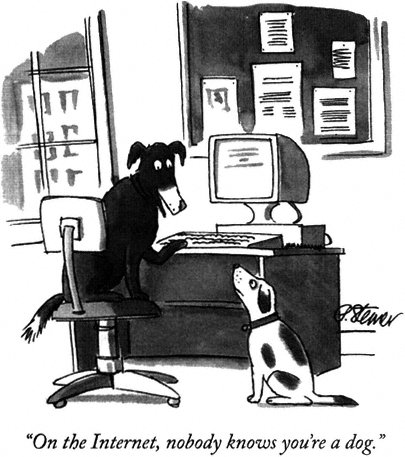
Figure 1.1
"On the Internet, nobody knows you're a dog." Reprinted by permission.
© The New Yorker Collection. 1993. Peter Steiner from cartoonbank.com.
All rights reserved.
Cyberspace poses difficulties for those who understand something about copyright because, for the most part, the status quo of the print world doesn't carry over into the digital world. As noted, it is impossible to make any use of a copyrighted work in digital form without also making a number of temporary copies. Suddenly, the right to control reproduction of works would seem to encompass the right to control even
Page 51
reading and browsing protected works. The disconnect between the print and digital worlds shows up as well in the argument that the first-sale rule doesn't apply in the digital environment, because in that world lending a work necessarily involves making a copy of it, not just redistributing that copy (which is, strictly speaking, all that this rule allows). The disconnect is also evident in the more extensive use of licensing of digital works, rather than sales of copies, even to libraries. To the extent that these licenses restrict the degree to which the information can be shared with others, users can't look to first-sale rights to share digital copies, as first-sale rights accrue only to owners of copies, not to licensees.
In time, the territory may become familiar, and easier means may be found to craft social and legal procedures for it, but for the moment there is substantial challenge in learning how to cope with this odd new world.
What Makes Progress Difficult?
Stakeholders' Interests are Diverse
The debate over intellectual property includes almost everyone, from authors and publishers, to consumers (e.g., the reading, listening, and viewing public), to libraries and educational institutions, to governmental and standards bodies. Each of the stakeholders has a variety of concerns (see the addendum to this chapter) that are at times aligned with those of other stakeholders, and at other times opposed. An individual stake-holder may also play multiple roles with various concerns. At different times, a single individual may be an author, reader, consumer, teacher, or shareholder in publishing or entertainment companies; a member of an editorial board; or an officer of a scholarly society that relies on publishing for revenue. The dominant concern will depend on the part played at the moment.
The questions raised by the growing use of the information infrastructure are also difficult because they raise the possibility of redistribution of economic power. For example, given the ease of reproduction and modification, authors are concerned about losing control over works that they make available in digital form. Publishers are similarly concerned about the ease of reproduction and are attempting to work out models of publication appropriate for the digital world. How, for example, does one charge for content when, once made available, the content can be easily reproduced and further distributed?
One response involves use of the kinds of technical protection mechanisms described in Chapter 5. But some legal and public policy scholars look at the trends toward licensing and the use of technical protection
Page 52
mechanisms and see the possibility of adverse impact on public access to information.
Information consumers are perplexed. They find themselves in a world with both enormous opportunity and considerable complexity, faced at times with difficult questions about how to do the right thing. The massive ambiguity and lack of clarity concerning intellectual property rights make it difficult at times for citizens to honor these rights. There is a strong public policy good in retaining and encouraging the rule of law and respect for law, yet the digital revolution has confused the rules for managing intellectual property to an extent that threatens to upset the long-standing but delicate balance of competing interests.
There is a Variety of Forces at Work
Intellectual property is typically conceived of first and foremost as a legal construct. But as Lessig (1999a,b) has argued, although law may constrain what we may (legally) do, equally powerful constraints arise from forces such as markets, social norms, and the values embedded in hardware and software. Markets put things within or out of our economic reach, social norms urge conformity with group values, and hardware and software encourage some behaviors and make others impossible.
The various forces differ in the explicitness of the values underlying them. Although laws generally result from a process that, in principle, is public and encourages examination of values and motivations, the same cannot be said of technology. The software written to control access to a Web site is a form of private regulation, and the process that created it rarely involves explicit discussion of the values embedded in and enforced by the program. Technical protection services (i.e., hardware and software used to protect IP) may offer content producers and distributors the important ability to manage access to their intellectual property, but those mechanisms may also enforce restrictions on the use of content that do not align with the (limited) rights of authors specified in copyright law. That law explicitly embraces certain public policy goals, but technical protection mechanisms and the policies they enforce may reflect a choice to overlook or to ignore those goals, with little or no opportunity for the public discussion or evaluation that goes into the creation of statutes.
The more general phenomenon here is the potential for substituting one force for another, and the consequences this can have for the degree of public participation in shaping society. To the extent that software is substituted for statute, for example, a form of privately created regulation is being used rather than publicly adopted laws. Such substitution should not be accepted by default, or permitted to go unexamined.
Page 53
Many Threads are Intertwined: Technology, Law, Economics, Psychology and Sociology, and Public Policy
The issues are also complex because of the variety of threads intertwined in them, each thread representing a different perspective from which to analyze the problems and evaluate possible solutions. The committee believes that five threads are particularly important: technology, the law, economics, psychology and sociology, and public policy. Each brings a particular conception of and approach to analyzing the problems. As the committee has attempted to employ the perspective, mind-set, and vocabulary of each of these viewpoints at various points in this report, a brief characterization of each will prove useful in understanding the remainder of the report.
Consider the issue of someone who wishes to duplicate a copyrighted software program for a friend. This issue will be conceived of differently from each of the five perspectives. For a technologist working for the software vendor, the question is how easy or difficult such reproduction would be (e.g., what technical mechanisms are available to inhibit copying and how easily can they be deployed?). The discussion would consider questions of strength of protection, complexity of development, reliability, and so on.
A lawyer would ask whether the action conforms to the law as it is currently written. Reference may be made to recent cases or the legislative history (e.g., the record of congressional debate when the law was being developed), and there may be appeals to analogies and past precedents, but the focus is on the law as it exists, rather than what it might or ought to say.
For the economist the question typically involves costs and benefits, economic efficiency, and trade-offs. For example, in the economic view, protecting intellectual property is worthwhile to the degree that the net total benefits exceed the cost of protection. The benefits are measured in terms of the societal impact of the IP, determined by the production of new IP information, its value and so on, while costs are those incurred by all parties: IP creators, government (e.g., police and courts), and consumers (including time required to cope with protection measures). In this view, additional IP protection or enforcement is appropriate only if it leads to enough new and valuable IP. This contrasts with the legal and property view, which sees protection and enforcement as an issue of property and ownership rights.
A second, sometimes counterintuitive economic concept used in this report is the notion of economic efficiency. Economically efficient production and distribution require that all consumers who are willing to pay the marginal cost of production and distribution be able to obtain the
Page 54
product. In the case of an information good, the costs of producing the first copy (i.e., cost of its original creation) do not vary with the number of users, so economic efficiency is served when all consumers willing to pay the (typically very low) cost of reproduction and distribution have received the product. This is not to the benefit of the individual rights holder, but it is optimal from an economic cost-benefit perspective for society as a whole (though rights holders do of course need sufficient revenues to recover first-copy costs and costs associated with reproduction and distribution, in order to be willing to create and distribute the works to begin with).
The psychological and sociological view concerns individual behavior, grounded in perceptions of fairness and responsibility, fear, shame, guilt, convenience, and pragmatism, and the perception of the individual as beneficiary, victim, or patron in transactions involving intellectual property. This is perhaps the least well understood factor in developing policy, yet it may be one of the most critical because it affects appraisals of the enforceability of different options. Little is known about what the typical individual believes about IP and how he or she perceives the relationship of actions to broader social and economic interests. In addition, little is understood about the social norms surrounding the use of IP.
For the public policy analyst the question concerns what social goal society is trying to accomplish (e.g., is it better for society as a whole for such copying to be allowed or prohibited?). Here one would include a discussion of what the law ought to be in order to support important policy objectives (e.g., promoting national economic competitiveness). The policy analyst uses the knowledge base and techniques of the economist, lawyer, and social scientist and operates in a multidisciplinary manner.
Clearly, the richness of each of these perspectives can only be hinted at here. The important point is the multiplicity of perspectives that are relevant to the issues and the rather different mind-set, vocabulary, and analytic approach that each offers.
The Problems are Global, with Differing Views, Laws, and Enforcement Around the World
For the most part this report focuses on circumstances and possible actions within the United States. The conclusions and recommendations must, however, be considered in a worldwide context. Laws and intellectual property practice differ by country and will likely remain different despite efforts at harmonization. Cultural attitudes toward intellectual property and the premises on which law is founded may also differ. As one example, European IP law incorporates the concept of "moral rights"
Page 55
in a work and gives to the author a stronger degree of control than exists in U.S. law, and one that persists beyond the sale of a copy of the work (see Box 1.5). U.S. law and culture also treat intellectual works as property, but this is not universal either (see Box 1.6).
Attitudes toward intellectual property may also depend on perceptions of national interest: Just as in other domains, where IP is concerned what is in one country's economic interest may be inimical to another's. Those interests may also vary over time. In the 19th century, for example, Charles Dickens' serials were widely republished in U.S. newspapers without payment of royalties to English publishers. The change over time in U.S. attitudes toward the IP laws of other countries is widely ascribed to the change in U.S. status in the 20th century to a major producer of IP content (Warner, 1999.).
National variations in law and enforcement matter for several reasons. First, IP laws and attitudes obviously have consequences that go beyond national borders, as for example, the U.S. ultimatum to China in 1994 threatening to brand it a copyright pirate and initiate a "Special 301" investigation (a government action that can lead to trade sanctions) unless China cracked down on copyright violations leading to pirated software, CDs, and movies intended for sale in the United States.
Second, the existence of networks with international scope makes the issue of international variation a matter the average user can face daily. Even the unsophisticated computer user can access the information resources of countries around the world without leaving the room. As one consequence, practices required or prohibited in one country may be circumvented by actions taken, over the Internet, in another country.
Third, jurisdictional problems arise in enforcement of laws as cyber-space blurs the concept of the location of an action, both internationally and within the United States. For example, in 1994 two operators of a computer bulletin board in Milpitas, California, were arrested for (among other things) distribution of obscene material, on the basis of an indictment made by a grand jury in Tennessee. This, gave rise to the question of what constitutes "Community standards" when the geographical basis for the community is blurred by cyberspace.30
The problems are difficult in part because the influence of international data networks is not easily controlled on a national basis. The Web is inherently international and cannot be divided by national lines. One difficulty comes from trying to determine the origin of an information request. When a Web server (the computer providing information) gets a request for some of its information, that request contains the Internet
30Doyle (1994), p. A12; see also United States v. Thomas, F. App. 0032P (6th Cir. 1996).
Page 56
|
(text box continued on next page)
Page 57
(text box continued from previous page)
|
|
Page 58
address of the requesting computer, and from this the requesting computer's physical location can sometimes be determined.31 But it is not difficult to keep anonymous the requesting computer's identity and location,32 so the server may be unable to determine where the request is coming from and hence could not know whose laws were relevant to the request. Of course, even if the server could reliably determine the source of the request, it is unclear why the server should be used to enforce the laws of another country (see Box 1.7).
Equally daunting problems arise when information is "pushed" across a border. There are simply too many routes and too much data flowing for a nation to police its information borders effectively. As a result, attempts by a country to enforce national laws on "its part" of the Internet are difficult, except perhaps where they concern the rights and responsibilities of its own citizens.33 For better or worse, we are inextricably interconnected and all must deal with the difficulties—and opportunities—that such interconnection brings.
Potential Solutions Have to be Evaluated from a Variety of Perspectives
The multiplicity of forces at work in these issues have to be kept in mind when evaluating solutions. For example, a technical mechanism may seem promising at a first glance, but later turn out to be intolerably awkward for the average user (as were, for example, early attempts at copy protection for software). Similarly, it is easy to suggest changes in the law, but markets can exert powerful forces that defeat the intent of a law (as seen, for example, in the experience of some cities that instituted rent control to preserve low-cost housing, only to discover that this prompted conversions to condominiums, resulting in a reduced stock of rental housing).
The five perspectives outlined above are useful to keep in mind. Suggested solutions should be technologically feasible (e.g., for a software solution, the desired program will require a plausible amount of time and hardware to run). Solutions have to be evaluated with respect to the specifics of the law as it currently exists, the legislative history and intent
31The network address is just that, a network address, not a physical location. Although the two are often correlated, there is no guarantee. The computer in question may be physically somewhere other than its Internet address indicates, particularly in the case of laptops connected to the Internet via a phone line.
32See, for example, <http://www.anonymizer.com>, a site that offers this service.
33As, for example, the Digital Millennium Copyright Act's limitation of liability for Internet service providers.
Page 59
|
(how it got that way), and some understanding of legal context (i.e., how the statute fits into the collection of laws). Solutions have to make economic sense as well. Consideration should be given not only to the costs and benefits but also to who pays the costs and who derives the benefits. Solutions should take account of psychology and sociology; they must
Page 60
ultimately be viewed as fair and pragmatic by the majority of citizens. Finally, solutions should take account of public policy goals, as embodied in, for example, copyright law, antitrust law, and foreign policy.
Given the complexity of the challenges for intellectual property presented by the information infrastructure, and the variety of perspectives that should inform evaluation of any proposed solution, it is certain that any proposed solution will inevitably be imperfect in some manner. The committee believes that it is important, when exploring both the problems and potential remedies, to not just point out that the solution is imperfect; that's a given, and far too easy. The more interesting approach, indeed, the more effective mind-set, is to ask questions such as, Is it good enough? Will it do enough of the task to be worth the cost and effort? How can it be improved? It is in that spirit and mind-set that this report proceeds.
Road Map for the Report
The issues described in this report are difficult and contentious, because the stakes are high and the needs and desires of various stake-holders often are in conflict. A more detailed discussion of the stake-holders and their concerns is the subject of the addendum to this chapter.
Chapter 2 addresses many of the pertinent issues of digital intellectual property within the context of digital music. The digital music phenomenon is worthy of discussion both in itself and for what it may portend for other information industries. This case study also serves as a means of introducing topics (such as technical protection services) in a context that will be familiar to many readers.
Chapters 3, 4, and 5 present detailed discussions of the major issues. Chapter 3 considers implications for public access and archiving of the social and cultural heritage, addressing the major effects the information infrastructure has on intellectual property and society. Chapter 4 includes an analysis of individuals and their understanding and behavior with respect to digital intellectual property and addresses specifically the fair-use/private-use issue. Chapter 4 also addresses the key issue of whether "copy" is still an appropriate basis for the protection of digital intellectual property. Chapter 5 describes the technical means available for protecting intellectual property, explores how business models can be used in collaboration with (or at times in place of) technical protection, describes how we might begin to measure the success of using either or both of these approaches to protection, and discusses the impact of granting patents for information inventions.
Chapter 6 presents the conclusions and recommendations of the study. Although some conclusions and recommendations are quite spe-
Page 61
cific, the majority are not. Part of the difficulty in proposing specific solutions is the inherent complexity of the problems; part of it is the rapid pace of technology evolution. It would be imprudent to base legislation or public policy on any particular technology. Instead, the committee attempts to provide guidance at a more general, strategic level. The committee made a concerted effort to make accessible what one needs to know about technology, law, economics, and sociology. And the committee has attempted to provide a clear, objective, and insightful framework in which to address the issues, to help make fruitful the vigorous debate that must occur among all the stakeholders.
Addendum: The Concerns of Stakeholders
The issues surrounding digital intellectual property addressed in this report derive much of their complexity from the varied nature of the stakeholders and the wide range of their concerns. This addendum provides additional background on the stakeholders to better illuminate IP issues. Given this report's emphasis on IP, other stakeholder concerns relating to digital information production, distribution, and use are not described in detail. Within each of the broad classes of stakeholders, both coinciding and quite different interests are evinced.
Creators of Intellectual Property
The creators of intellectual property are a heterogeneous group. They range from corporate entities driven largely by economic motivations to individual artists and authors who may create for any number of reasons, including economic gain, prestige, or the desire to share what they do with peers and the public. Categories may of course overlap: Individual creators of IP may be employed in corporate or academic organizations that constrain ownership or use of intellectual property as a condition of employment. Some content creators are entrepreneurs, while others are members of the research community.34 Notwithstanding their differences, IP producers have several interests in common: a concern with some control over the disposition and dissemination of their work (whether for economic gain or intellectual credit), a concern with the accurate attribution of authorship, concern with the integrity or fidelity of the work that may be associated with their names and reputations, and
34See "The Research Community" section in this addendum for a discussion of the specific concerns of researchers.
Page 62
concerns about derivative works (which relate to the unauthorized distribution and reproduction or modification of what they create).
Generally, content creators want the ability to continue to use or otherwise benefit from their work and/or protect its integrity in teaching, in communication with their peers, or in the creation of subsequent works—even if they had to relinquish some or most of the rights to the work as a condition of publication.35 The creators of some kinds of work may benefit from cheaper distribution methods that could increase their control over their work, as some have begun to do (see Box 1.8). For writers and others continuing to rely on conventional publishing outlets, author control has been diminishing over time. Prior to the early 1990s, the typical contract, particularly in traditional print media (e.g., periodicals), was for first-time print publication only. A work was generally published for use only in a print format, often only in a single publication, and typically the publication was limited geographically (e.g., the norm was first North American serial rights). This has changed, as authors are increasingly expected to transfer all rights in perpetuity to their works without additional compensation (Karniner, 1997; Manly, 1997), and in some cases, an author's work has been used without the formal transfer of digital rights (Stone, 1998; Phipps, 1998). Where there are few choices among publishers (e.g., specialized journals), publishers are likely to control terms; authors have more negotiating leverage where there is a choice of publishers. (See Box 1.9.)
Much creativity builds on material that already exists, a process protected by three cornerstones of intellectual property law: the public domain, which provides a rich source of materials that can be reexamined, recontextualized, "repurposed," and reinterpreted; fair use (including the rights under fair use that allow a creator to quote for a variety of specified purposes); and limitations on what can be protected by intellectual property rights, in particular, exclusions of ideas, facts, and mathematical algorithms. Increasingly, issues arise in protecting likenesses, characters, imaginary worlds, and, perhaps in the future, factual databases.
Follow-on creation challenges for intellectual property protection are epitomized by digital multimedia works, which bring together visual images, sound recordings, text, programs, and other materials, rarely created completely de novo, or out of original material. Instead, they often weave together elements of previous works in a novel arrangement; some-
35The concept of a continuing connection with creations for which rights have been transferred relates to so-called moral rights—a concept honored in European intellectual property law though relatively new in the United States. See Box 1.5 above in this chapter for a discussion of moral rights.
Page 63
|
Page 64
|
Page 65
times the term "repurposing" is used to describe some of this activity. The work of the creator concerns selection, arrangement, and linkage as much as in the creation of wholly original content. The use of works still under copyright requires authorization from the rights holder, making a wide range of multimedia works economically impractical because of the costs of clearing rights. There are two components to this cost. The first is the overhead cost of determining whether the existing material is copyrighted and who holds the copyright and then negotiating with that entity. The second component is the actual payment that must be made to the rights holder once he or she has been identified and the license negotiated.36 Developments such as rights clearinghouses, stock photo archives, and the like may greatly reduce the overhead costs (the cost of the clearinghouse operations can result in lower royalty rates to the artist). Because a considerable amount of material remains protected by copyright, there is a significant amount of work that cannot readily be reused because the overhead costs of clearing rights so greatly exceeds the amount that would be paid for its use. The inclusion of copyright management information with digital objects may facilitate the tasks of rights clearance and payment.
Distributors
There are many kinds of distributors of intellectual property:
• A wide variety of publishers, including mass media (newspapers, magazines, and so on), entertainment enterprises (film and television distributors, music publishers, and performance organizers), think tanks with their own employees and relationships with creators based elsewhere (e.g., the Brookings Institution, Cato Institute, and the National Bureau of Economic Research), scholarly journal publishers (commercial, nonprofit societies, universities, and so on), and the government (e.g., the U.S. Government Printing Office). Some publishers are content producers as well.
• Aggregators that bring together access to the IP products of others for resale, for example, book and music stores, video rental stores, and catalog merchants of packaged software.
• Services that organize information conveniently for the purpose of offering that package of information to a public audience, ranging from
36The first component is a measure of the inefficiency of the current system of managing IP rights; the second component represents a measure of the real value of the existing content. The unfortunate reality today is that the overhead costs alone in many cases are large enough to discourage projects from being undertaken.
Page 66
such services as Lexis-Nexis, Yahoo, or MSNBC, to libraries (both hard copy or electronic) and link-filled Web sites.
In addition to the general issues that creators of intellectual property are concerned with, content distributors are concerned about the following issues:
• Economic viability. Most distributors are in business: They are concerned about developing a framework that permits them to be economically viable. Digital technology presents additional challenges to the business plans of distributors; if it promotes disintermediation, for example, it is reasonable to expect a change in the number, identity, and size of distributors.
• Legal uncertainty. Many of the legal issues surrounding content in the information infrastructure are unclear, and they are being settled slowly and haphazardly through case law. The international nature of networked access generates additional concerns relating to jurisdiction and conflict of laws that raise questions about international legal consistency and international enforcement of intellectual property rights. This type of uncertainty is very dangerous and discouraging to distributors and is reflected in pricing that incorporates a "risk premium."
In particular, distributors are concerned about the liability that they may incur in distributing intellectual property. The nature of rights associated with intellectual property influences liability. For example, have they been transferred appropriately to enable the intended distribution to proceed lawfully? Distributors are concerned about incurring additional obligations in return for their IP rights. These obligations include permanent access or archiving responsibility, requirements for use tracking, maintenance of the confidentiality of use, censorship, and so on. Finally, distributors may be concerned about liability associated with the content of intellectual property (e.g., the risk of libel or defamation charges).
• The boundaries of fair use. Copyright distributors and certain categories of users differ over what kinds of use are fair uses of digital works, with distributors tending toward a more limited interpretation.
• The boundaries of derivative works. Derivative works may have a substantial effect on the ability of distributors to distribute their content. As one example, "framing" takes a page from one Web site and surrounds it with other content in another Web site, often obliterating the identity of the original site and blocking out advertising that was placed on the original site. This seriously concerns publishers or distributors who mount the original site as well as to those who want the right to "frame."
• Protection of trademarks and related brand and corporate identification.
Page 67
Because content distributors are often the entities providing the ''branding" of the distributed content, they have special interest in protecting their brand. There are stakeholder issues because of the relatively limited availability of Internet domain names as compared to the number of trademarks, as well as the question of whether holders of trademarks have the right to insist on using certain domain names by virtue of the ownership of their trademark.
• Efficient management of the rights process. Content distributors frequently bring together the rights of many parties. Although permissions and licenses may be governed by standard processes designed to cover large numbers of content creators under a variety of circumstances (e.g., publishers' policies, standard contract terms and conditions), efficient processing of payments is the distributors' responsibility.
Publishers have been moving to secure more control over the works they publish, given the severe uncertainty about the impact of digital media on revenue, including the effective value of existing content to which they hold rights, potential losses from experiments with new media, consolidation in media industries, and so on. It is generally understood that few publishers can accept agreements covering only print distribution, because digital distribution is increasingly a standard and essential part of their business. However, to the degree that digital rights are sought solely to protect a future option (not a present product), pricing is difficult. It is difficult for both parties to place a value on future rights or future exploitation, as relatively few works will achieve classic or best-seller status, and discounting of future value is as appropriate for information as for other investments.
Many media distributors have argued that the global exploitation of content and the swiftness with which such exploitation must take place in the marketplace requires that companies obtain broad assignment of rights from authors. They argue that it is simply too costly to find an author in order to obtain subsequent rights. One solution to this concern is the use of rights clearinghouses and the ability of digital networks to facilitate rights management and clearances. This would require the creation of digital-age versions of the American Society for Composers, Authors and Publishers (ASCAP) or Broadcast Music, Inc. (BMI)—clearinghouse-type structures for handling author payments and licenses.37
The concept is quite simple. An author would assign his or her rights to the licensing entity (or designate the licensing entity as an agent), which
37Information about ASCAP is available at <http://www.ascap.com>; information about BMI is at <http://www.bmi.com>.
Page 68
could then grant, in turn, the right to any user—individual or corporate—to use a piece of content for an agreed-upon price, based on the duration and type of use. Technology allows speedy presentation of rights options and price: A page at the clearinghouse's Web site would indicate what an article would cost to purchase for a particular use and allow the user to click on an icon to complete the purchase and receive the content. The system might also allow the user to contact the owner of a work to conduct a direct negotiation.
Two relatively new author-operated models exist in the United States: the Publication Rights Clearinghouse (PRC), a project of the National Writers Union; and the Media Photographers Copyright Agency (MPCA), a project of the American Society of Media Photographers.38 Author-operated models have also been established abroad, including The Electronic Rights Licensing Agency in Canada and the Authors Licensing and Collecting Society in the United Kingdom.
Schools and Libraries
Historically, schools and libraries have played two special roles with regard to public access to intellectual property. They serve as custodians for the cultural record, and they make intensive and integral use of a wide range of intellectual property in the course of teaching and supporting scholarship. Libraries and schools also share a common tradition of concern for free expression, free inquiry, academic freedom, and unfettered discourse, including freedom of research, commentary, and criticism, all based on a foundation of accurate and authentic information. Schools and libraries are at the center of tensions among competing policy goals relating to intellectual property rights, privacy, and free speech—all of which affect who has access to information and under what conditions. Schools and libraries are also vulnerable to changes in long-standing practices and expectations resulting from broad shifts in the production, distribution, access, and use of information occasioned by networking.
Schools care about the following issues:
• Fair use. Educators need to know in direct and simple language under what terms or conditions portions of copyrighted works can be used in classroom presentations, course packs, and electronic reserves. Does fair use differ if the source is digital rather than hard copy or if the
38See <http://www.nwu.org/prc/prchome.htm> for the PRC, and <http://www.mpca.com> for the MPCA.
Page 69
distribution is digital? For example, should copying a paper for distribution to students be viewed differently from posting an electronic copy of the paper on a Web site? Do school licenses constrain student and/or faculty fair use in specific ways? What are the limits of fair use in a context in which course-related information can be distributed to networked students anywhere in the world? Fair use relates both to how educators obtain and share information and how they convey the process and the ethics of using intellectual property—the nature of "fairness."
• Rights management procedures. Educators would like to adapt what they teach to changing circumstances and discovery of relevant materials. It would help them if requirements for clearance of rights were not time and process intensive.
• Educational use of research results. Educators who have produced work protected by copyright (and, in particular, works for which they have transferred copyright to others) want the ability to use those works in their classrooms. Conditions limiting such use have been imposed by some conventional journal publishers. The strict copyright transfer policies of some academic publishers, with few rights retained by authors, have caused a backlash: Scientists in some disciplines have begun to develop their own refereed online publications or to support systems to deposit papers on public servers.
Libraries care about the following issues:39
• Archiving and preservation of the public record and cultural heritage. Libraries have an interest in long-term access to information; part of their mission is to act as agents on behalf of future generations of students and researchers. How is digital archiving to be organized and what rights does the library and archival community have pertaining to the archiving of copyrighted works?40
• Fair use. What is fair use in the sharing of digital resources with other libraries or individuals? What does a "loan" mean in the digital environment—is that concept still appropriate? Who is a member of a library's authorized community in a networked environment? What is fair use in gaining access to protected digital materials?41
• Liability. Will librarians have liability in cases of patron abuse of copyrighted information, carried out on the library's network?
39For an additional discussion, see Henderson (1998), available online at <http://www.ala.org/washoff/copyhb.html>. See also Office of Technology Assessment (1993).
40See Chapter 3 for a discussion.
41See Chapter 4 for a discussion.
Page 70
The Research Community
The research community, associated largely with higher education, has a number of specific concerns that are closely related to those of libraries and schools:42
• Access to information. A very large body of information vital to continued progress in research and development is available in the open research literature. Proposed changes to intellectual property (particularly copyright) law that may strengthen rights holders' control over IP should be evaluated with respect to possible implications for the research community and the nation's research capability. Researchers also value access to information and databases for its educational value and its potential for reuse and development.
• Impact of technology on current models for dissemination of research results. Researchers are prolific producers of IP, which typically is published, sold, and distributed primarily by commercial publishers and professional societies, the business models of which depend heavily on existing copyright law. Technological changes challenge the viability of today's publication system through electronic publishing of journals, pre-published material ("preprints"), and direct posting of articles.
• Web-specific issues. World Wide Web publishing raises questions about who has rights to create links to which Web pages and who owns the links themselves. A number of researchers have produced Web bibliographies—featuring either links to specific works or to sites containing works and other links. (Some collections of links are large, highly structured, and potentially commercially valuable.) Determining who has the rights to such links could have significant effects on all research communities by the effects on fundamental scholarly practices such as quotation and citation. The technology, for example, supports the production of Web articles that link directly to cited material, but the law may or may not support such links. Universities are increasingly claiming IP rights over the course materials that faculty post on a university Web server. As distance education grows in importance (including its financial contribution), arguments over who owns digital course material can be expected to increase. Changes in electronic distribution and in the way academic research is distributed (e.g., posting preprints and finished papers on personal Web sites) mean that an increasing number of publishers now permit authors to retain more rights, including in some cases the right to
42See AAU (1994) (available online at <http://www.arl.org/aau/IPTOC.html> for a discussion of the IP concerns of universities. See Appendix G for a discussion of the specific concerns of cryptography and security researchers.
Page 71
post their paper on their own Web server for free public access, even though this is in direct competition with the published version.
The General Public
Until fairly recently, the general public remained largely untouched by copyright law and the policy debates that shaped it. Copyright issues have instead been resolved primarily by negotiation among representatives of the entities most directly involved—publishers, libraries, educational institutions, entertainment industry, communications, music companies, and the software industries. The recent policy debates have seen a continuation of that historical pattern: Those parties are invested in, familiar with, and equipped to address the issues. By contrast, most citizens have not seen themselves individually as IP producers or rights holders, a characterization that is changing as the Web enables many people to see themselves as suppliers of information (whether or not they regard it as "property" or appreciate the legal rights). To the extent that the interests of the general public have been represented, the burden of advocacy has often fallen on libraries and universities.
Individual citizens, in their role as information consumers, have the following concerns:
• Availability. Individuals want the broadest range of intellectual property to be available with the least impediment to access. Broadness of range includes concern about diversity of views; public concern about the potential for limiting diversity through control of information sources has in the past motivated public policy relating to broadcasting content, and new digital media raise new questions about risks of and antidotes to such control. Impediments to access can include price, procedural difficulty, licensing terms constraining how material can be used, and continuity over time. Historically, public libraries and broadcast media have provided a lot of information without fees; digital media are associated with both fee and no-fee content.
• Quality. Individuals often relate the value and usefulness of intellectual property to its "quality." Quality ranges from the fidelity of a copy relative to an original, to such attributes as accuracy or completeness. Authenticity can be associated with quality: Assurances about the source of content can contribute to authenticity.
• Privacy. Individuals have legitimate concerns, especially in the context of access to networked information, over the privacy of their use of intellectual property. Because accessing networked information involves an interaction between the consumer and a server run by a distributor, there is the potential that consumers may be revealing informa-
Page 72
tion about themselves or what they are reading. Media attention to Amazon.com's publication of the books bought most by employees of different organizations illustrates some of the potential,43 and the flaunting of former U.S. Supreme Court nominee Robert Bork's video rental records led to legislation protecting the privacy of such records.44
• Simplicity and clarity of the legal regime. The actions of individuals are governed by a set of IP laws that they may not understand well and that, even when understood, they may not easily be able to conform to. In certain cases, there is a mismatch between the law and common sense models of information and ownership. The personal use/fair use distinction has been especially problematic in this regard (Chapter 4). Also, individuals should be able to determine whether they incur liability in using intellectual property, yet this is often not easy.45
Discussion of the general public or citizens at large raises questions about the concept of public interest as opposed to private interest, which may be organizational or personal. Public interest is an elusive and abused concept; it is enhanced by private and public action, and it is abstract and therefore harder to measure than the costs and benefits of changes in the treatment of IP on private parties. In a 1998 editorial, the New York Times stated, "What vexes any discussion of copyright is the idea of benefit. It is easy to see what the Disney Corporation will lose when Mickey Mouse goes out of copyright. It is harder to specify what the public will lose if Mickey Mouse does not go out of copyright. The tendency, when thinking about copyright, is to vest the notion of creativity in the owners of copyright" (New York Times, 1998).
The circumstances that gave rise to this situation have changed, however, and the rate of change is increasing. Beginning with the development of inexpensive document copying in the 1950s and 1960s, copyright law emerged as a matter of direct concern to individual citizens. The development of successful tape recording formats in the 1960s and 1970s made the copying and transcription of music and other sound program-
43See Streitfeld (1999).
44The Video and Library Privacy Protection Act of 1988 was enacted on November 5 (P.L. 100–618). For additional information, see Hinds (1988).
45IP, as it affects the average citizen, is moving beyond copyright: Web sites raise trademark issues; content placed on Web sites may involve state law about rights of likeness and publicity; and perhaps most alarming, software authors can unwittingly infringe patents on a regular basis as they learn to program. If copyright is arcane, these other issues are even more obscure to the average citizen, and he or she will surely be incredulous as the lawyers descend with cease and desist orders. Unfortunately, the popular press has not yet recognized these issues in a serious way and drawn public attention to them.
Page 73
ming accessible to consumers. The emergence of videotape recording in the late 1970s and 1980s raised the stakes for individuals still higher. The widespread diffusion of personal computers in the 1980s and 1990s has made the copying of software and other forms of digital material easy even for unsophisticated consumers.
Other Consumers and Producers of Intellectual Property
Governmental Organizations
Government at all levels—federal, regional, state, and local—is a producer, distributor, and consumer of intellectual property. The federal government differs from other producers in its goals, being concerned with universal accessibility of most of its information and being unable to hold copyright in the works that it creates. Government has not traditionally sought to maximize revenue from its IP assets, but that is changing somewhat with the privatization of certain functions, budget pressures that motivate user-fee charges for certain services, and recognition that information has value for which at least some are willing to pay.46
Government agencies are concerned about the following issues:
• Information integrity. Documents published by the government in many instances have an important, authoritative status, ranging from their immediate impact (e.g., interest rate changes, major reports) to their archival role (e.g., legislative histories). These documents must be available in verifiably unmodified form.
• Universality of access. Government addresses all citizens by definition. Networked information is, in principle, vastly more accessible than print information distributed through physical distribution systems such as the depository library program. In addition, the flexibility of electronic information allows it to be much more accessible to citizens with disabilities, for example. It does require access to appropriate equipment and network services, which imply different costs than those of traveling to a library or government office, and raises questions about differentials in citizens' ability to access government information. (See Box 1.10.)
• Rights of access. Repackaging, adding value, and sale of some government information by commercial vendors raises questions about loss of information from the public domain.
46See Chapter 3 for additional discussion.
Page 74
|
Government is also concerned about the role of IP and IP industries in the local, state, regional, and U.S. economies; in international trade; and in reducing piracy, both domestically and abroad.
Private Sector Organizations
Private sector organizations—comprising for-profit companies and not-for-profit organizations—use prodigious quantities of intellectual property in the course of their operations and, consequently, share with other consumers of IP many similar concerns already discussed, such as fair use and information integrity. In addition, private sector organizations, as visible targets for those who conduct IP enforcement programs,
Page 75
are concerned about complying with IP laws in a simple way that can be readily documented (e.g., the purchase and use of site licenses for digital IP).
Journalists
The press has a special role in our society implied by the First Amendment to the Constitution. Journalists have some specific concerns with intellectual property and suffer intensely from the "multiple roles" problem described above. As authors, they are very concerned about control over their work; in particular, the efforts of newspapers and magazines to exercise broad, long-term control over that work—as a condition of publication—and with the incorporation of their own writings into the cultural record. As researchers, they share with educators, libraries, and the research community concerns about the availability of the public record, government information, and factual information; accountability as it is operationalized by the archiving of the cultural record; freedom of speech (including the ability to use copyrighted materials freely for criticism and for news reporting); and fair use.
Standards Organizations
Standards organizations play an important role in the continuing evolution and health of the information infrastructure. They make extensive use of copyright to ensure control over their works, the integrity of these works, and the continuity of access to these works. In this regard, they are much like other producers and distributors of intellectual property. Standards organizations also have some specific concerns related to patents and their interaction with the standards development process; the incorporation of a patented technology into a standard may give an unfair advantage to the patent holder or raise the difficult issue of licensing terms. Standards organizations must also operate under certain expectations of openness of participation and information flow associated with antitrust law.


