
Chapter 3
Standards for Student Performance.
As the name implies, standards-based reform places standards at the heart of the system. The goal is to focus the attention of everyone in the system on what students are expected to learn—the results schooling is expected to achieve—rather than on the resources or effort put into the system. Moreover, standards-based systems are intended to set common learning expectations for all students, regardless of background or where they happen to attend school.
For these reasons, standards-based reform represents a substantial shift from the practice that has prevailed in American education, and particularly the experience in Title I. For much of its existence, the emphasis in Title I was on compliance with rules and procedures, rather than student learning. The program was typically regarded as an add-on to the regular instructional program, and students were often pulled out of their regular classrooms for Title I instruction. This occurred in large part so that administrators could ensure that the resources reached the intended beneficiaries.
To be sure, the program, particularly after the 1988 reauthorization, required schools to demonstrate improvements in student learning. But schools merely had to show that students achieved more than they did before, not that they reached designated levels of academic performance. And, as some commentators noted, students who registered large gains ended up ineligible for the program, thus providing a perverse incentive for schools not to increase student achievement. A standards-based system, by contrast, is aimed not at comparing the performance of poor children with that of other poor children, but at setting a target for all children—poor as well as affluent—and determining whether they are on the way toward reaching it.
The emphasis in the standards movement on all students is also a departure from past practice. As a number of studies have shown, the curriculum, instructional practice, and, above all, the expectations for student achievement differ
sharply among schools. Simply put, the standards are higher in schools with more affluent students. As Puma et. al. (1997) found in their extensive study of the program (then Chapter 1), an A in a high-poverty school was the equivalent of a C in a low-poverty school.
Standards are intended to change that practice by setting out a body of knowledge and skills that are essential for all students to learn and expecting all students to learn it. The explicit intention of the reformers was to set challenging standards for all students.
Content Standards
Findings
Research on standards and standards-based systems specifies two types of standards: content standards and performance standards. Both are required by the Title I statute.
Content standards spell out what students should know and be able to do in core subjects. They indicate, for example, the topics and skills that should be taught at various grade levels or grade spans. At the national level, the mathematics standards developed by the National Council of Teachers of Mathematics and the science standards developed by the National Research Council (NRC) are examples of content standards. For example, the NRC's National Science Education Standards for physical science state that, at grades K-4, “all students should develop an understanding of properties of objects and materials; position and motion of objects; [and] light, heat, electricity, and magnetism.” In grades 5–8, “all students should develop an understanding of properties and changes of properties in matter; motions and forces; [and] transfer of energy.” In grades 9–12, “all students should develop an understanding of structure of atoms; structure and properties of matter; chemical reactions; motions and forces; conservation of energy and increase in disorder; [and] interactions of energy and matter” (National Research Council, 1996:123, 149, 176).
In addition to the standards proposed by national groups, nearly all states have developed content standards in core subjects. These standards vary widely, however. Some states set standards for grade clusters, like the National Science Education Standards, while others set standards for each grade. Some focus on a few big ideas, while others are quite extensive.
The purpose of content standards is to guide instruction by providing a common focus for policy and practice (Ravitch, 1995). At the policy level, they provide guidelines for the development of assessments, instructional materials, and professional development opportunities, thus helping to steer teachers' decisions about what to teach. In addition, the standards documents themselves set common expectations for all classrooms and provide a yardstick for school
and district staffs to use in evaluating and changing their curricula or instructional programs.
Because content standards represent a community's expectations for all children, setting content standards is a political process. In most cases, standards have been set by groups of subject-matter experts, educators, representatives of the public, and public officials, usually meeting in the public eye. The public process is aimed at ensuring that the result earns broad approval.
In practice, though, this public effort at times has been hotly contentious. Different groups come into the process with different goals for students. For example, some want to emphasize students' readiness for the workplace; others place a higher priority on the knowledge and skills young people need for effective citizenship; others stress students' need to understand an increasingly multicultural society.
Largely as a result of these often-raucous debates, the products of these efforts vary widely. Some standards are highly specific, spelling out in detail the content knowledge students should demonstrate, whereas others are more general—or vague, as critics contend. The degree to which the standards are “challenging” also varies, with some states demanding much more of their students than others.
Several organizations have evaluated the state standards, in order to provide some independent determination of the quality of the documents (American Federation of Teachers, 1998; Council for Basic Education, 1998; Fordham Foundation, 1998; Wixson and Dutro, 1998). However, the ratings of these organizations vary, depending on the criteria they use to assess standards. The American Federation of Teachers, for example, focused on clarity and specificity, whereas the Council for Basic Education emphasized “rigor.” As a result, to take one case, Virginia's English standards were rated as “exemplary” by the American Federation of Teachers, yet earned a B-minus from the Council for Basic Education.
The standards also vary in the degree to which they guide policy and practice. On the one hand, standards that are considered general can be assessed in many ways, but it is difficult to make a valid inference about student performance against standards that can be interpreted so broadly. At the same time, as one study of nine states found, state standards that were considered general had little influence on instruction, since teachers can interpret the standards idiosyncratically. Standards that are specific, in contrast, tend to yield similar interpretations by all teachers, and thus can be implemented more easily. However, states varied in the extend to which they provided assistance to local educators to implement standards (Massell et al., 1997). The role of states and districts in helping schools implement standards is considered in Chapter 5.
On the other hand, standards that are too numerous provide little guidance to either assessment designers or local educators, because they contain too many topics and skills for assessment designers to include on assessments or for teachers to teach in a school year. Assessments that attempt to measure an
extensive set of detailed standards either omit standards or measure some with a handful of items, threatening the reliability and validity of the interpretations from the assessment. Teachers face a similar dilemma. An analysis of standards documents by the Mid-Continent Regional Educational Laboratory found that it would take about 15,000 classroom hours to teach adequately the content included in standards documents in 14 subject areas—a length of time that would add 9 or 10 years to a child's school career (Marzano et al., 1999). Faced with such an overwhelming task, teachers are likely to select the standards they choose to teach, and the purpose of standards as a guiding document will get lost.
Teachers also face challenges in districts that have adopted their own sets of standards, in addition to the standards the state has developed. Without a mechanism for determining the alignment of the district standards with the state standards, teachers have to choose whether to focus on one or the other. They are most likely either to choose which standards to teach or to focus on those reflected in a test.
In an aligned system, the state's standards become the core knowledge and skills that students are expected to demonstrate at critical junctures, and the basis for determining school progress. A district's standards would elaborate on the state's standards and provide the basis for professional development to enhance teachers' knowledge and skills in improving student learning.
Recommendations
- Content standards must be clear, parsimonious, and rigorous.
- States and districts should obtain external review for their content standards to ensure that the standards reflect a high level of clarity and rigor and an appropriate level of specificity.
- Content standards must provide clear direction to educators responsible for the design of assessments, professional development, and curriculum materials.
- Content standards must provide clear direction to teachers and administrators about what they need to teach to improve student learning.
Questions to Ask
|
❑ |
Have the standards been reviewed independently for their clarity, rigor, and parsimony? |
|
❑ |
Do the standards provide clear guidance to designers of assessments, professional development programs, and curriculum materials? |
|
❑ |
Do the standards provide clear guidance to teachers? |
Criteria
In determining the quality of their standards, states and districts should examine them across a range of dimensions. The committee recommends using at least the following criteria:
Basis in Content. Standards are most effective as guides for instruction when they focus on the essential knowledge and skills in a subject area. Standards for student attitudes and beliefs are more difficult to build instructional programs around, more difficult to measure, and they may be inappropriate.
Cognitive Complexity. Standards challenge all students when they ask them not only to demonstrate knowledge of fundamental facts in a discipline but also to show that they can use their knowledge to analyze new situations and reason effectively.
Reasonableness. Standards are effective when students, teachers, and parents believe they are attainable with effort. Standards that are far beyond what students should be reasonably expected to achieve—asking fourth graders to analyze Hamlet—invite cynicism and encourage schools to try to get around them.
Focus and Parsimony. Similarly, standards are effective when they are perceived to be attainable within the constraints of classroom capacity. Standards that are too extensive and that cannot possibly be addressed in full are counterproductive.
Clarity. Standards can guide classroom practice if teachers can translate the instructional goals into instructional activities. On the one hand, standards that are vague and that lead to innumerable interpretations are less helpful. On the other hand, standards that are too detailed encourage schools to emphasize breadth at the expense of depth.
Examples
The following two examples of state standards—science standards from Connecticut (Box 3-1) and mathematics standards from North Carolina (Box 3-2)—generally meet the committee's criteria. They have both earned high marks from the three national organizations that review standards, and both provide clear guidance to assessment developers and teachers. Both also represent parsimonious choices about what is important in their respective disciplines. In the case of Connecticut, the example shows how standards were revised from an earlier, longer set, to enable assessment developers to measure student performance against them.
|
BOX 3-1 CONNECTICUT CONTENT STANDARDS IN SCIENCE For grades 5–8, Connecticut has adopted 14 general performance standards in science, which are further defined by 97 more detailed standards. This broad range of content is viewed as important by curriculum experts in the state, and it is consistent with national and state priorities in science. The need for the definition of a more limited domain of content became apparent in the effort to design a state assessment to measure the progress of Connecticut students in science. For several years, Connecticut attempted to measure science achievement against the standards with a mixed-format test, which included a performance task and both multiple-choice and open-ended items, administered to every student. Because of limits on cost and testing time, however, each year's test could thoroughly and authentically assess only a very limited sample of the state's extensive content standards. Furthermore, each year's test assessed a different sample of the state's content, creating tests that were quite variable across years. This assessment design fell short of providing the direction needed by educators in school districts. As one educator stated, “We don't know how to adjust our instruction to help our students' performance because we have no idea what will be on next year's test.” Fluctuations in school district assessment results over time may reflect the variable agreement between different forms of the test and a district's curriculum more than actual differences in science achievement over time. The limited progress in statewide science performance as evidenced by the assessment results may be related to this inclusive definition of content. Reluctant to abandon the mix of item formats and the idea of administering the test to every student, state curriculum and testing officials began to revise the test content in preparation for a new generation of Connecticut assessments. Limiting the content to be tested proved the most arduous task. Recognizing that not all content standards would be tested and that those that would be tested needed to be limited and more clearly defined, science specialists had to make difficult decisions about what are the most essential skills and knowledge Connecticut should expect all students to attain. We provide examples showing how Connecticut officials redefined their content standards in the area of genetics and evolution. Initially, there were six specific standards within that broad category: Educational experiences in Grades 5–8 will assure that students:
|
In the revised version, there are two specific standards, which have been further clarified and limited by the points which follow them: Genetics and Evolution As a result of studying patterns of heredity and historical changes in life forms:
The Connecticut State Department of Education will share with school districts the revised standards. The hope is that school districts will place the highest priority on these standards as they build science curricula, but that the content that has been excluded from the state assessment will continue to be an integral part of science education in the state. They hope further that district-level and school-level assessments will go beyond the state assessment to monitor the progress of students on a wider range of content. Those who care deeply about science education in Connecticut are nervous about the content that will no longer be eligible for the state assessment. Some educators are concerned that what is not tested by the state will not be taught. State officials recognize the trade-offs and compromises. The hope is that this clearer definition of priorities will have a positive impact on science education in Connecticut, and that the resulting progress of students will be evident in the results of the assessment. Source: Initial standards from The Connecticut Framework: K-12 Curricular Goals and Standards, 1998. Revised standards from draft test specifications, forthcoming. Connecticut State Department of Education. Used with permission. |
|
BOX 3-2 North Carolina Content Standards in Mathematics GRADE 4—MATHEMATICS COMPETENCY GOALS AND OBJECTIVES Major Concepts
Computational Skills to Maintain
Number Sense, Numeration, and Numerical Operations Goal 1: The learner will read, write, model, and compute with rational numbers. 1.01 Read and write numbers less than one million using standard and expanded notation. 1.02 Use estimation techniques in determining solutions to problems. 1.03 Model and identify the place value of each digit in a multi-digit numeral to the hundredths place. 1.04 Model, identify, and compare rational numbers (fractions and mixed numbers). 1.05 Identify and compare rational numbers in decimal form (tenths and hundredths) using models and pictures. 1.06 Relate decimals and fractions (tenths and hundredths) to each other using models and pictures. 1.07 Use models and pictures to add and subtract decimals, explaining the processes and recording results. 1.08 Use models and pictures to add and subtract rational numbers with like denominators. 1.09 Find the fractional part of a whole number using models and pictures. 1.10 Model and explain associative and distributive properties. 1.11 Memorize the division facts related to the multiplication facts/tables through 10. 1.12 Identify missing factors in multiplication facts. 1.13 Round rational numbers to the nearest whole number and justify. 1.14 Estimate solutions to problems. |
|
1.15 Multiply 2-or 3-digit numbers by 1-digit numbers or a 2-digit multiple of 10. 1.16 Divide using single-digit divisors, with and without remainders. 1.17 Use order of operations with addition, subtraction, multiplication, and division. 1.18 Solve multi-step problems; determine if there is sufficient data given, then select additional strategies including:
Verify and interpret results with respect to the original problem; use calculators as appropriate. Discuss alternate methods for solution. Spatial Sense, Measurement, and Geometry Goal 2: The learner will demonstrate an understanding and use of the properties and relationships in geometry, and standard units of metric and customary measurement. 2.01 Identify points, lines, and angles (acute, right, and obtuse); identify in the environment. 2.02 Use manipulatives, pictorial representations, and appropriate vocabulary (e.g., sides, angles, and vertices) to identify properties of plane figures; identify in the environment. 2.03 Use manipulatives, pictorial representations, and appropriate vocabulary (e.g., faces, edges, and vertices) to identify properties of polyhedra (solid figures); identify in the environment. 2.04 Identify intersecting, parallel, and perpendicular lines and line segments and their midpoints; identify in the environment. 2.05 Recognize congruent plane figures after geometric transformations such as rotations (turns), reflections (flips), and translations (slides). 2.06 Use designs, models, and computer graphics to illustrate reflections, rotations, and translations of plane figures and record observations. 2.07 Estimate and measure length, capacity, and mass using these additional units: inches, miles, centimeters, and kilometers; milliliters, cups, and pints; kilograms and tons. 2.08 Write and solve meaningful, multi-step problems involving money, elapsed time, and temperature; verify reasonableness of answers. 2.09 Use models to develop the relationship between the total number of square units contained in a rectangle and the length and width of the figure. 2.10 Measure the perimeter of rectangles and triangles. Determine the area of rectangles and squares using grids; find areas of other regular and irregular figures using grids. |
|
Patterns, Relationships, and Functions Goal 3: The learner will demonstrate an understanding of patterns and relationships. 3.01 Identify numerical and geometric patterns by stating their rules; extend the pattern, generalize, and make predictions. 3.02 Identify the pattern by stating the rule, extend the pattern, generalize the rule for the pattern, and make predictions when given a table of number pairs or a set of data. 3.03 Construct and order a table of values to solve problems associated with a given relationship. 3.04 Use non-numeric symbols to represent quantities in expressions, open sentences, and descriptions of relationships. Determine solutions to open sentences. Data, Probability, and Statistics Goal 4: The learner will demonstrate an understanding and use of graphing, probability, and data analysis. 4.01 Interpret and construct stem-and-leaf plots. 4.02 Display data in a variety of ways including circle graphs. Discuss the advantages and disadvantages of each form including ease of creation and purpose of the graph. 4.03 Collect, organize, and display data from surveys, research, and classroom experiments, including data collected over time. Include data from other disciplines such as science, physical education, social studies, and the media. 4.04 Interpret information orally and in writing from charts, tables, tallies, and graphs. 4.05 Use range, median, and mode to describe a set of data. 4.06 Plot points that represent ordered pairs of data from many different sources such as economics, science experiments, and recreational activities. 4.07 Investigate and discuss probabilities by experimenting with devices that generate random outcomes such as coins, number cubes, spinners. 4.08 Use a fraction to describe the probability of an event and report the outcome of an experiment. Source: North Carolina Department of Public Instruction, web site accessed 6/21/99: http://www.dpi.state.nc.us/Curriculum/new_mathematics/grades/grade_4.html. Used with permission. |
Performance Standards
Findings
In addition to content standards, performance standards are also key elements in standards-based systems. Performance standards give meaning to content standards by indicating what students must demonstrate in order to show that they have achieved the standards. As educators often say, performance standards answer the question: How good is good enough?
To provide such an answer, performance standards demand evidence from students' work: essays, mathematical problems, science experiments, and so forth (National Education Goals Panel, 1993). As the Goals Panel report notes, performance standards can be raised over time without affecting the content standards, simply by including work of higher and higher quality.
Performance standards serve an important instructional function (McLaughlin and Shepard, 1995). By illustrating in a vivid way the qualities of exemplary work, the standards can help students, parents, and teachers improve performance by providing models to emulate and guiding classroom strategies. To serve that function, performance standards include examples of student work that meet standards for proficiency; often they include, as a contrast, examples of work that represent levels of performance below proficiency.
Developing such standards first takes shared agreement on what constitutes work at each level of performance. The experience of teachers' scoring writing samples and other performance tasks demonstrates that such agreement is possible. But the development of such standards also takes time, since standards-setters need to collect examples of student work at all levels that are related to the content standards.
As described by Hansche (1998), performance standards consist of four elements. First, performance categories, or levels, identify the various levels of attainment student work reaches. Many states use terms such as “partially proficient,” “proficient,” and “advanced.” Others use “below standard,” “at standard,” and “above standard,” or some version of that system.
The second element of performance standards is a set of performance descriptors, which indicate the kind of knowledge and skills students at each performance category can demonstrate. Performance descriptors are generally specific to a content area; for example, a mathematics descriptor might include the type of problem students can solve (one-step or multi-step) and whether the student can show multiple solutions to the problem.
The third element is perhaps the most critical: exemplars of performance at each level. These exemplars show work by students at each level of performance, and provide concrete illustrations of the knowledge and skills students at a given performance level are able to demonstrate. The exemplars can include
responses to assessment tasks, papers written for classroom assignments, projects, or other examples. They often indicate the circumstances under which the work was produced, so that readers can know whether students had an opportunity to produce their work over a long period of time or to revise it.
The fourth element of performance standards is a set of decision rules that enable assessment designers and policy makers to determine whether students have attained a certain level of performance. Although the exemplars help educators determine whether a particular piece of student work reaches a given level of performance, educators also need to determine whether a collection of work—such as responses in an assessment or a school year's work—attains the desired level of proficiency. See Chapter 4 for a discussion of the problems associated with reporting assessment results in terms of levels of performance.
Recommendations
- Performance standards must include four elements: performance categories, performance descriptors, exemplars of performance in each category, and decision rules that enable educators to determine whether students have reached each category.
- Performance standards for proficiency and above should be attainable by students in a good program with effort over time.
Questions to Ask.
|
❑ |
Do the standards indicate the levels of performance students should attain, descriptions of performance at each level, examples of student work at each level, and decision rules that enable educators to determine whether students have reached a given level? |
|
❑ |
Is there evidence that the standards for proficiency represent a level that all students should be able to attain, with effort, over time? |
|
❑ |
Do the standards include a range of work—such as timed test items, classroom assignments, and long-range projects—to show that students can meet standards in a variety of ways? |
Criteria
Transparency. Effective performance standards describe and model high quality. They include examples of the type of work students have to perform in order to meet the standards.
Continuous Improvement. Performance standards contribute to im-
proved achievement when they encourage everyone to learn more and perform better. Simply getting over a hurdle is not enough.
Reasonableness. The standards for proficiency should be high and challenging for all students, but they should also represent reasonable expectations for what students should know and be able to do. People will aim for standards that represent genuine, believable targets for improvement, but standards that are too far beyond current levels of performance encourage schools to game the system or else foster cynicism. Standards-setters can demonstrate the reasonableness of the standards through existence proof—demonstrating that students have attained the standards—or through evidence that such levels are necessary for success in future education or employment.
Examples
The following examples of performance standards—from the New Standards Performance Standards (Figure 3-1) and the Teachers of English to Students of Other Languages (Figure 3-2)—generally meet the committee's criteria. They show high-quality work, describe the circumstances of the performance, and explain how they exemplify the standards.
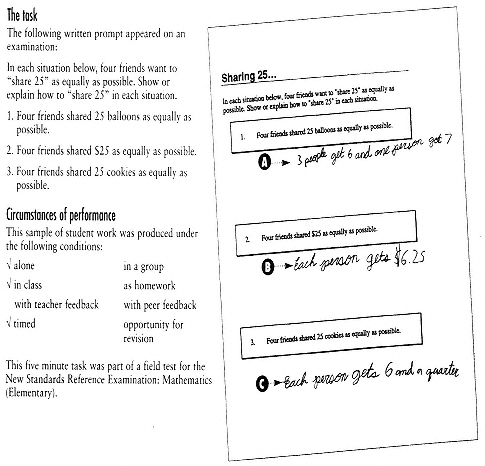
Figure 3-1
A work sample and commentary illustrating the New Standards performance standards for elementary mathematics
Sources: Work sample adapted from Marilyn Burns, Writing in Math Class, 1995, pp. 76-82; copyright 1995 Math Solutions Publications; all rights reserved; used with permission. Commentary from Performance Standards: Volume 1—Elementary School, National Center on Educatin and the Economy, Washington, DC, 1997; used with permission.
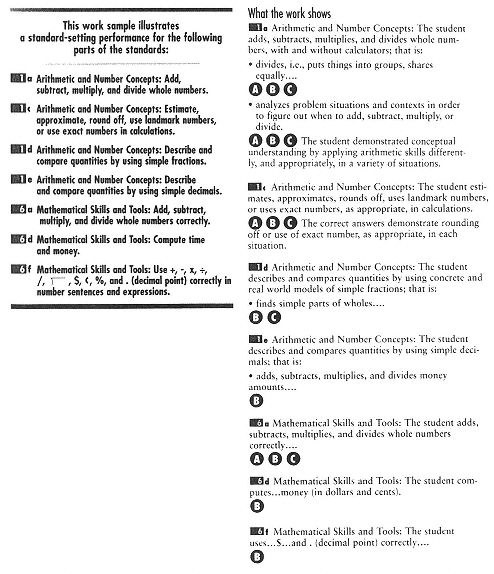
Figure 3-2: Standards and an annotated classroom vignette illustrating English as a second language standards for grades pre-K-3, pages 38-41, is copyrighted by Teachers of English to Speakers of Other Languages, Inc., Alexandria, VA. For more Information about obtaining the material, contact the organization at 703-836-0074 or publ@tesol.edu; http:/www.tesol.edu.
Figure 3-2: Standards and an annotated classroom vignette illustrating English as a second language standards for grades pre-K-3, pages 38-41, is copyrighted by Teachers of English to Speakers of Other Languages, Inc., Alexandria, VA. For more Information about obtaining the material, contact the organization at 703-836-0074 or publ@tesol.edu; http:/www.tesol.edu.
Figure 3-2: Standards and an annotated classroom vignette illustrating English as a second language standards for grades pre-K-3, pages 38-41, is copyrighted by Teachers of English to Speakers of Other Languages, Inc., Alexandria, VA. For more Information about obtaining the material, contact the organization at 703-836-0074 or publ@tesol.edu; http:/www.tesol.edu.
Figure 3-2: Standards and an annotated classroom vignette illustrating English as a second language standards for grades pre-K-3, pages 38-41, is copyrighted by Teachers of English to Speakers of Other Languages, Inc., Alexandria, VA. For more Information about obtaining the material, contact the organization at 703-836-0074 or publ@tesol.edu; http:/www.tesol.edu.


