
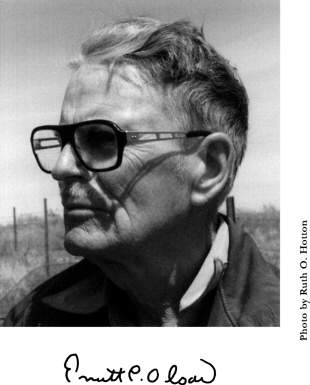
EVERETT C. OLSON
November 6, 1910–November 27, 1993
BY MICHAEL A. BELL
I don't know how a person who is a historian of this sort [a paleontologist] can have any worry about death, because you're just part of a chain which has been going on for at least three and a half billion years. And things live and things die, and when you do, it causes a mess temporarily; a little whirl in your own society, but that's all. And we are a single species; one of probably ten million species that exists on the earth today, and of countless millions that have existed in the past. And we're a small segment in time; a transition from when we weren't to when we won't be, which I hope isn't as sudden as it might be.1
AT THE TIME of this interview, Everett Claire Olson (Ole to his friends) had been retired for six years. He lived another eleven, during most of which he was vigorous and productive. When he died, there was more than “a little whirl.” Death did not cheat Ole; he had a long, fulfilling life. He was a gifted teacher, a good friend, and a generous colleague. Years after his death, I truly miss Ole, my teacher and friend.
Everett C. Olson ranks among the great vertebrate paleontologists of the twentieth century. His extraordinary talents, even disposition, formal training in geology, and life-long fascination with biology enabled his great success as a scientist, teacher, and administrator. He also had a lot of fun.
Beginning in the 1930s and spanning sixty years, Ole's empirical research focused on the early diversification of terrestrial vertebrates of the North American Permian. Fertilized by Ole's interdisciplinary perspective, this research became the seedbed that sprouted ideas concerning long-term dynamics of ecological communities and their effects on evolution. Limitations of the Permian fossil record stimulated his development of novel applications of geological and statistical methods to paleontology. His research anticipated current developments in the use of fossils to address mechanistic issues in biology2 and in morphometrics.3 Cold War-era travel to Moscow to compare Russian fossils with those from North America and South Africa introduced him to taphonomy, which he popularized in Western paleontology. Ole's influence was amplified by his creation of a highly successful interdisciplinary paleozoology program at the University of Chicago.
PERSONAL HISTORY
Ole was the younger of Aimee Hicks Olson and Claire Myron Olson's two sons. He was born on November 6, 1910, in Waupaca, Wisconsin, and grew up in Hinsdale, Illinois, a small rural suburb of Chicago. His childhood was idyllic, both because his parents indulged his passion for natural history and because he excelled at everything. He was an undergraduate and graduate student at the University of Chicago, where he was trained by Alfred S. Romer and where he spent most of his career. Everett Olson and Lila Richardson Baker were married in 1939 and had three children, Claire (b. 1940), George (b. 1943), and Mary Ellen (b. 1946). They raised them in the Chicago area before moving in 1969 to the University of California, Los Angeles. Ole was elected to the National Academy of Sciences in 1980. Although he taught for many years after retirement and con-
tinued to work until a few months before his death, Ole had been in declining health since 1990. After more than two years of treatment for throat cancer, he suffered a massive stroke, from which he never regained consciousness. He died on November 27, 1993, at home, where Lila, his daughter Claire, and Claire's husband Tom McAleer cared for him.
Ole was educated in the Hinsdale public schools, where he graduated as valedictorian in 1928. His enthusiasm for natural history was manifested by age five in caterpillar rearing and butterfly collecting. This interest continued into his teens and was rekindled in his sixties by his departmental colleague G. A. Bartholomew, who was studying lepidopteran physiology. After that, Ole and Lila made regular trips to collect butterflies in the tropics and throughout North America, until declining health in their late seventies precluded it.
Ole took piano lessons briefly before turning with more success to the violin. By the time he left high school, he had played violin in the school orchestra and string quartet, a dance band, and the pit orchestra of a local minstrel show. He also played the piccolo in the school band. He gave up the violin when he entered college, but took piano lessons intermittently over the next twenty-five years. He liked to play songs with paleontological themes at parties.
Despite his size, 5 feet 6 inches and 125 pounds, “Shorty” (to earlier friends) Olson was a superb athlete and earned high school letters in football and basketball and competed in track. His interest in gymnastics started in a backyard gym his father built.
Ole entered the University of Chicago, not far from home, and much later reminisced, “I had not thought when I entered that I would not leave until 1969 ”4 His athletic ability merited an athletic scholarship, and he became cap-
tain of the University of Chicago gymnastics team, which dominated Big Ten competition in those days. He excelled on bars, rings, and mat, amassing a collection of gold medals, including all-around Big Ten champion twice. He was most proud of the Big Ten Athletic-Scholastic medal he won during his senior year, and a plaque in Chicago's Stagg Field House still chronicles his gymnastic feats. Ole loved to shock colleagues by telling them he had attended college on an athletic scholarship.
During his undergraduate years, Ole headed his fraternity and was vice president of the Interfraternity Council, which he later claimed prepared him for university politics. He initially majored in chemistry, but was lured into geology by J. Harlan Bretz, who used the Socratic method. Ole loved to spar with Bretz and later employed this method with excellent effect in his own graduate teaching. He completed the geology program at the University of Chicago with a strong grounding in chemistry. His limited mathematical background was remedied much later when his research required it.
Ole entered the masters program in geology at the University of Chicago in 1932 as the Great Depression deepened and income from his father's dental practice plummeted. He completed his M.A. degree in invertebrate paleontology by commuting 20 miles from Hinsdale to Chicago in a hand-me-down 1928 Model-A Ford and working seven days a week (for $25) in the “evolution” exhibit at the 1933 Chicago World's Fair.
In 1933 Ole was about to take a job teaching high school geology and physical education. A $550 fellowship from the Department of Geology, $300 of which was consumed by tuition, kept him at the University of Chicago to work with Alfred S. Romer, who had established himself as a leading vertebrate paleontologist. Ole earned his fellowship by writ-
ing book reviews (eleven published in 1935) for the Journal of Geology.
Years later, Olson (1990) recounted the accident that led him to Romer and Permian vertebrates:
I had taken his course in Vertebrate Paleontology as a junior in college, and then strayed over into invertebrates. In 1933, when prohibition was on the way out, the Geological Society of America met at the University of Chicago. A big reception and smoker was held under Mitchell Towers. There were two punch bowls, one spiked with ersatz gin, the other pure. Good paleontologists never passed up a bit of stimulation, so by early evening both Romer and I found our inhibitions of student and faculty member relaxed. With my arm around his shoulder I slurred out that I thought I would take a research course with him. He slurred back, “Thash good.”
PROFESSIONAL HISTORY
Since 1892 three vertebrate paleontologists at the University of Chicago had struggled unsuccessfully to move the study of fossil vertebrates from geology, a field in which it had become marginal, into zoology or to establish a separate department.5 Ole was appointed in 1935 as the new vertebrate paleontologist in the Department of Geology, and ultimately secured for vertebrate paleontology and himself a more tenable niche at the university. In 1934, shortly after Ole began work for his Ph.D., Romer left for Harvard University, but he continued to supervise Ole's training. With the search committee prepared to recommend his successor, Romer increased his efforts on behalf of Ole. As Romer's student, but anticipating a third degree in geology from the University of Chicago, Ole, still only a student, was acceptable to the opposing camps. Romer worried that he might be “playing squarely into [geology department chair] Bastin's hands by suggesting Olson, who has exactly the training which Bastin desires, and who, as a local prod-
uct, could be brought directly under the Bastinian thumb.”6 Hotton7 related a story well known to Ole's students:
Paul Miller [the curator of fossil vertebrates at the University of Chicago] told Ole that if he did well on his [Ph.D. dissertation] defense there was a job for him [at the University of Chicago]. The country was still pretty depressed (1935), and Ole said that up to that point he had been confident and serene about his defense, but when Miller spilled the beans he went into the defense a mass of jelly. Jelly or not, he did okay, and the rest is history.
He earned his living mowing lawns and tutoring any high school subject during the summer of 1934, and by spring of 1935, Ole was a member of the University of Chicago faculty.
During World War II, Ole contributed to the war effort by teaching cartography to military personnel in the University of Chicago's Institute of Military Studies. He specialized in Japanese maps and published two books on cartography and use of maps (1943, 1944). After the war, Ole applied these skills to field research in early Permian deposits of north central Texas. These methods helped him locate collecting sites and facilitated their placement into a spacio-temporal framework that would play a crucial role in his paleoecological interpretations. 2
In 1941 Ole was still just “ ‘Shorty,' a bright and popular graduate student who had moved into the faculty.”7 Capitalizing on this popularity, superb political skills, and a predilection for interdisciplinary research, Ole succeeded where three previous vertebrate paleontologists had only limited success. The emergence of neo-Darwinian theory after World War II provided a rationale to emphasize biology in paleontology. In the 1940s University of Chicago President R. M. Hutchins introduced curriculum reform that emphasized interdisciplinary scholarship. Now a major force in the geology department, Ole supported growth of quantitative work
within the department and contacts with other earth sciences, further distancing paleontology from geology. Exploiting the widening intellectual gulf between geology and paleontology and his burgeoning influence in the department, Ole established the Interdivisional Committee on Paleozoology in 1947. After decades of futile effort by others, Ole had finally found a way to free vertebrate paleontology at the University of Chicago from dominance by geology.
Ole thrived in this new interdisciplinary program and the freedom afforded by his growing political power in the university. His research emphasized geological issues, taxonomic description, and systematics of South African and North American Permian vertebrates. He applied concepts and methods from cartography, sedimentology, statistics, functional morphology, global biogeography, and paleoecology (including taphonomy) to these areas. During this time, ideas and Ph.D. students flooded through the paleozoology program.
RESEARCH
Romer had introduced Ole to Permian tetrapods, with which the Walker Museum at the University of Chicago had been well provisioned by his predecessors Bauer, Williston, and Romer, and by Paul Miller, a legendary fossil collector and the museum's curator. Most of Ole's research in systematics and paleoecology concerned vertebrates of this period. Previous collecting in the early Permian of Texas had been productive, but Romer believed higher beds were barren. Thus, Ole's fieldwork emphasized early Permian deposits of north central Texas and adjacent Oklahoma, and he immediately initiated research on early Permian therapsids (mammal-like reptiles) and other tetrapods from North America and South Africa.
Fossils of these two regions, however, were separated by a time gap, which Ole sought to fill. He and Romer had agreed to divide the early Permian vertebrates of Texas; Romer took the older Wichita formation, and Ole got the stratigraphically higher (younger) and possibly barren Clearfork formation to the west. In 1946 Ole shifted his collecting efforts northwestward from proven deposits of the Arroyo member of the Clearfork formation, in which he had worked for ten years, to its younger Vale and Choza members near the end of the early Permian. A tip from a petroleum geologist in 1949 helped him extend his sampling to younger deposits at the base of the late Permian San Angelo formation. However, the time gap between tetrapods of the Clearfork formation and those of South Africa remained.
Between 1951 and 1958 Ole published an important series of papers in Fieldiana Geology, entitled “Fauna of the Vale and Choza: X,” (where X ranged from 1-14), describing vertebrates from near the boundary of the early and late Permian. According to Carroll,8 this series covered animals from a poorly known time between the late Carboniferous diversification of anamniote tetrapods and appearance of long-known synapsids from Russia and South Africa. Ole's morphological descriptions were sometimes superficial but demonstrated the persistence of many Lower Permian taxa and the radiation of the caseids, the first diverse amniote herbivores, and late pelycosaurs. Interestingly, the later San Angelo tetrapods closely resembled the earliest Permian tetrapods from deposits in the Soviet Union. The Soviet fossils were the right age, but they were poorly known in the West.
In 1959 Ole made the first of six visits to Moscow, finally closing the time gap among Permian vertebrates and also drawing the attention of the FBI. His contacts with Soviet paleontologists strongly influenced his research. He was in-
trigued by application of dialectics to evolutionary biology (1968) but was most interested in taphonomy, “the study of the processes of preservation and how they affect information in the fossil record.” 9 He formed a close friendship with Ivan Antonovich Efremov, the leading Soviet taphonomist, who was better known in the West for his science fiction novels (1990). Taphonomy had been developed by German paleontologists earlier this century, but Efremov10, 11 defined the term and formalized the field. Taphonomic papers by Olson and his students R. G. Johnson, J. R. Beerbower, and J. K. Rigby are among the earliest in the American literature (1980), and Efremov considered Ole's fourteenth paper on the Vale and Choza fauna to be “true taphonomy” (1990). Ole was instrumental in stimulating interest in taphonomy in the West.
In addition to documenting the diversification of late Permian tetrapods, Olson's series “Fauna of the Vale and Choza” led to his conceptual breakthrough, the “chronofauna,” a group of animals with morphological and ecological continuity over an appreciable period of geological time (1952). Although members of a chronofauna might go extinct or be added from outside the system, its ecological structure persisted until a major change in the physical environment caused extinction of several species. Ole recognized in his own materials a well-documented moist low-land and freshwater chronofauna, extending from the Carboniferous through the early Permian, and a distinctive, contemporaneous, xeric and hypersaline aquatic chronofauna. In the mid-1970s, Ole groused that the term “chronofauna” had become so well established that younger paleontologists did not associate it with him. While this was an understandable complaint, it was also a measure of his success.
EMERGENCE OF MAJOR CONCEPTUAL CONTRIBUTIONS
Rainger2 analyzed the development of Everett Olson's research career. In 1944, before he had risen to prominence, Ole had become pessimistic and considered leaving research. Only six years later, he was leading a new graduate program in paleozoology and engaged in an active and visible research program. In 1952 he became the editor of Evolution, the leading journal in its field. The cause for this striking reversal of fortune was Ole's de-emphasis of morphology and systematics, the traditional focus of vertebrate paleontology and areas in which Ole's work was not distinguished, in favor of paleoecological studies that reconstructed the physical paleoenvironment and inferred biotic interactions. While his new direction was not novel, the emphasis he gave it and his amalgamation of mathematical, statistical, sedimentological, and mapping techniques created a powerful new approach to analysis of the fossil record.
The skills Ole had acquired in cartography and aerial photography during the war greatly increased the productivity of his fieldwork. Although he continued to recover fragmentary fossils, the increased number of specimens and productive localities permitted new paleoecological insights. The importance assumed by sedimentology in Ole's research was unprecedented in vertebrate paleontology. Sedimentology was relatively young but well represented in the Department of Geology at the University of Chicago. Lawrence L. Sloss, who had recently earned a Ph.D. in that department for work on sedimentology and with whom Ole had shared an apartment prior to 1939, introduced Ole to the subject.2,12 Confronted by unexceptional fossil assemblages but possessing an unconventional array of methods, Ole developed a novel perspective on the evolution of early Permian tetrapods.
Sedimentology was used to infer the environmental conditions under which fossils had been deposited, and aerial photography and cartography were used to reconstruct spacio-temporal relationships among deposits and place them in a paleoecological context. However, the fragmentary condition of his fossils and continuous growth of the species studied impeded identification. Ole addressed this problem using sophisticated statistical methods. Although many species could not be distinguished by any single method, combining paleoecological inferences from sedimentology with statistical analysis of morphology facilitated identification and indicated associations between morphotypes and habitats. Furthermore, it became possible to analyze the relationship between environmental and morphological change. In addressing the problems presented by the confusing geological context and poor fossils of the Clearfork deposits, Ole had developed a research program that became a model for research in paleoecology and attracted numerous graduate students to work with him.
An interesting implication of chronofaunas is that the stable ecological structures they represent seem to demand evolutionary stasis. This implication challenged the neo-Darwinian notion that evolutionary tempos are controlled solely by processes that can be observed in modern populations. Ole's (1960) reservations about neo-Darwinian orthodoxy flowed from his work on chronofaunas and may have contributed to the apprehensions Mayr and Simpson, two leading figures in neo-Darwinian theory, may have had about him (1991).
Despite the important evolutionary implications of Ole's chronofauna concept, his work had no impact on development of punctuated equilibria. 13 It is not clear that Ole even appreciated these implications.14 Rather, his work on chronofaunas primarily influenced community paleoecol-
ogy.9 Perhaps the evolutionary implications of the chronofauna concept were not as well known to invertebrate paleontologists who have been punctuated equilibria's leading proponents.12
INTRODUCTION OF TAPHONOMY TO THE WEST
Ole first visited Soviet museums in 1959 to compare Permian tetrapods from western Russia to those from Texas. This research demonstrated remarkable similarities between fossils of the two regions, but it had another important consequence. He met I. A. Efremov and became familiar with his research in taphonomy. Taphonomic processes generally bias the composition of fossil samples and may cause fossils to occur in deposits that do not correspond to the habitats in which they lived. Taphonomic analysis can both provide insights into the conditions under which fossil assemblages formed and compensate for biases in preservation. Sedimentology had already become important in Ole's research, but he immediately grasped the potential of taphonomy for paleoecology and incorporated it into his work (1962, 1966). Although taphonomy had been used by earlier American paleontologists,2 Ole's use of it generated interest in the West, where it has become a major paleontological subdiscipline.9
MORPHOLOGICAL INTEGRATION
Ole's research on morphological integration (1958) was another important innovation. The computations needed to study shape and the relationships between the sizes of body parts were extremely laborious, and this work had little immediate impact. However, recent improvement in computing capabilities has stimulated development of exciting morphometric methods and renewed interest in morphological integration.3
TEACHING
Throughout his career, Ole expected his graduate students to develop their own research. Although many of his Chicago students worked with Permian tetrapods, he was pleased to see them strike off in their own directions, although they generally retained conceptual connections with his interests. For example, R. L. Miller and P. Jolicoeur emphasized statistics and R. G. Johnson and J. R. Beerbower emphasized paleoecology. While his casual style and hands-off approach helped many develop, it also permitted a slow, painful end to some graduate careers and failure for some of his students to publish their dissertations.
Ole believed strongly that research by others, including his students, was their responsibility, not his. He exercised critical judgement and made constructive comments, but he did not insist on changes in manuscripts. Nick Hotton, an early student of Ole's, summed it up well:15
Ole was very tolerant. He would listen thoughtfully to students' ideas no matter how far out in left field they might seem. I think that sometimes he read more into them than was actually there, but by the time the conversation was over, the student would have a much better notion of what potential his idea had (or lacked). Ole never pushed himself or his ideas on us, but used to let us stagger around in circles until we found our way, but he was always accessible when we needed him.
Much of Ole's research solved “insoluble problems” posed by his students. 12
I met Ole much later (in 1971), but his style was the same. There were no “lab meetings.” Most of our contact with him was during lunch in his outer office. The graduate students drifted in around noon to find Ole reading Science, Ecology, Evolution, or one of several paleontology journals and drinking stale coffee, intently chomping on carrots and celery, or methodically peeling an orange grown
in his yard. While he cut the skin from his orange in a single long spiral peel, we discussed politics, the UCLA basketball game (they rarely lost in those days), puzzles from the Russian geology dictionary he was helping translate, butterflies he had pinned the night before, graduate student morals (“You think living with your girlfriend is hot; we just used to sneak around!”), dismal prospects for academic jobs (“It's not bad; it's normal.”), important recent papers, and developments in his or our research. If talk of student research got serious, we were invited to resume it in Ole's office after lunch. That is how he taught us to be scientists, and most of Ole's students not only appreciated their training but developed a strong personal affection for him. Upon learning of Ole's death, S. P. Applegate wrote, “I think we both have been privileged beyond what words can express to have such a great man not only as a teacher but as a friend.” 16
There were exceptions, however, to the cordial relations Ole enjoyed with most of his students. I noticed some resentment in my dealings with some of them from the University of Chicago, and D. B. Wake 17 commented that he was puzzled by it when he and Ole were both on the faculty there. It seems possible that their research interests were more similar to Ole's than ours were, and perhaps they felt that they toiled in his shadow. However, Beerbower12 believed these problems represented a few specific personality conflicts.
Ole was full of good practical advice to graduate students about field research. He had learned from cowboys in Texas (1990) that if you wanted to prospect for fossils on someone's land, you had to watch the locals, listen to them, and take your time. You had to know how to lean on a barbed wire fence (without getting bloody), spit (without getting wet), recognize the importance of rainfall for rural folks, and
liberally sprinkle one's language with appropriate strings of profanity. Above all, you had to close gates and understand when you were told no. In Texas, “I don't guess you better” meant “No!” (1990). There was no use in arguing. No doubt, Ole's sensitivity to the local pace of life and ways of doing things served him equally well in university politics, dealings with Texas cowboys, and relations with Soviet academicians.
Everett Olson was also a superb classroom teacher. He taught the usual load, even while department chair at UCLA. At UCLA, he taught evolution for non-biology majors, comparative odontology for the biology majors, and a graduate seminar in evolution. His classes were always full. He spent most of the day before a lecture preparing, but carried into class only a few notes on a 3×5 card. His graduate seminar was a tour de force. He spent the afternoon reading all of the assigned papers. He initiated the evening's discussion with a brief monologue on the topic, ending with a question to cue the first student contribution. A pair of students gave a short report based on a set of related papers Ole had assigned, and Ole invited comment. His role in the ensuing exchange was limited to asking leading questions and separating the combatants when the time came to move on. As the evening progressed, the cycle of narrative, student contribution, criticism, and debate continued.
Ole's relations with junior faculty were equally constructive. Separated by two decades, D. B. Wake17 at the University of Chicago in the mid-1960s and B. Van Valkenburgh 18 at UCLA in the mid-1980s, both praised Ole for his kindness and guidance when they arrived as new faculty.
ADMINISTRATION
Ole had major administrative positions at both the University of Chicago and UCLA, and he played important roles
in governance of the professional societies to which he belonged. He was active in administering the Department of Geology at the University of Chicago for years, even before becoming department chair, and he was the driving force to create the graduate paleozoology program described above. He played a crucial role in organizing interdisciplinary groups and establishing a strong relationship between the Field Museum of Natural History and the University of Chicago.5 Ole was brought to UCLA in part to merge the Zoology and Botany departments into the Department of Biology, of which he was the first chair. He believed strongly in his own vision and was decisive and possibly even dictatorial. He enjoyed telling us how he once abrogated the academic freedom of two feuding geologists from whom he had taken courses as an undergraduate. Ole was the president of three professional societies and served as editor of Evolution(1953-58) and the Journal of Geology (1962-67). He was confident in his judgment of people and ideas and was an aggressive and effective administrator.
WORK AND HOME LIFE
Ole struck a healthy balance between his home life and professional activities. His wife Lila had lived a sheltered life and met him shortly after returning from finishing school in Europe. They met on a blind date and decided to get married a few weeks later. The length (some fifty years) and tranquility of their marriage was undoubtedly a consequence of a deep, genuine affection between them and of Lila's generosity and dedication. She shouldered his domestic burden during his annual field trips, welcomed his colleagues and students into their home, and provided a tranquil home environment. The children were told, “Dad is coming home. Don't talk to him until he changes his shoes.”19 He came home on time, often bringing a small
treat for his children, played the piano, and had dinner with the family. On weekends he took the children on outings. They had no idea that his scholarly activities or business trips were anything unusual. Of course, there were problems, but he seemed to take them in stride. He chuckled one day, marveling that his older daughter Claire, made it through her teens without getting pregnant. His son George contracted polio, but he suffered no long-term effects, and his younger daughter Ellen was chronically ill as a child.
CONCLUSION
Everett C. Olson was both extraordinarily talented and fortunate. He grew up in a family that nurtured his curiosity. He was good at everything he tried: athletics, music, academics, and personal relations. The last-minute award of a fellowship and a drunken encounter with Alfred S. Romer set the course of his career, but his long and stellar career at the University of Chicago resulted from extraordinary talent. He had only two academic positions and was offered both without submitting an application. His first appointment, in the depths of the Great Depression, resuited from Romer's departure from the University of Chicago at just the right time. His clever amalgamation of war-time experiences and methods learned from friends led to innovative research. He married a woman who supported his aspirations and shared the joy of achievement and discovery with him. Ole had a very good life. He gave as much as he got, and he loved every moment of it. So did his friends.
I THANK THE LATE Lila Olson and Claire McAleer, Ole's older daughter, for their years of friendship and recollections of their lives with Ole. Many people familiar with Ole's professional activities contributed information for this biography, including particularly his former
graduate students J. R. Beerbower and N. Hotton; his UCLA faculty colleagues C. F. Brunk, M. S. Gordon, J. W. Schopf, and B. Van Valkenburgh; and previously at the University of Chicago, R. C. Lewontin and D. B. Wake; paleontologists R. L. Carroll and R. Reisz. I am especially indebted to R. Rainger, whose papers and suggestions enabled me to place Ole's accomplishments in a broader perspective, and J. R. Beerbower, C. M. Blair, and C. F. Brunk who criticized the manuscript. Beerbower also contributed many fine points, which were too numerous to cite individually in the text. This memoir is contribution 1012 from Ecology and Evolution at the State University of New York at Stony Brook.
NOTES
1. M. Adler. Nevada search for clues of evolution. Morning Edition. National Public Radio, July 16, 1984.
2. R. Rainger. Everett C. Olson and the development of vertebrate paleoecology and taphonomy. Arch. Nat. Hist. 24(1997):373-96.
3. L. Marcus, M. Corti, A. Loy, G. J. P. Naylor, and D. E. Slice, eds. Advances in Morphometrics. New York: Plenum, 1996.
4. E. C. Olson. Autobiographical statement. National Academy of Sciences Archives, Washington, D.C., 1980.
5. R. Rainger. Biology, geology, or neither, or both: vertebrate paleontology at the University of Chicago, 1892-1950. Perspect. Sci. 1(1993):478-519.
6. A. S. Romer. Letter to R. M. Hutchins, cited in 5 above.
7. N. Hotton III. Personal communication, 1995.
8. R. L. Carroll. Personal communication, 1995.
9. A. K. Behrensmeyer and S. M. Kidwell. Taphonomy's contributions to paleobiology. Paleobiol. 11(1985):105-19.
10. I. A. Efremov. Taphonomy: A new branch of paleontology. Pan Am. Geol. 74(1940):81-93.
11. I. A. Efremov. Taphonomy and the geological record. Tr. Paleontol. Inst. Akad. Nauk USSR 24(1950):1-177.
12. J. R. Beerbower. Personal communication, 1997.
13. N. Eldredge and S. J. Gould. Punctuated equilibria: An alternative to phyletic gradualism, in Models in Paleobiology, ed. T. J. M. Schopf, pp. 82-115. San Francisco: Freeman, Cooper, 1972.
14. A. J. Boucot. Evolutionary Paleobiology of Behavior and Coevolution. Amsterdam: Elsevier, 1990.
15. N. Hotton III. Personal communication, 1993.
16. S. P. Applegate. Personal communication, 1994.
17. D. B. Wake. Personal communication, 1995.
18. B. Van Valkenburgh. Personal communication, 1995.
19. C. McAleer. Personal communication, 1997.
SELECTED BIBLIOGRAPHY
1943
With N. R. Maclean. Manual for Instruction in Military Mapping and Aerial Photography New York: Harper Brothers.
1944
Origin of mammals based upon the cranial morphology of the therapsid suborders. Geol. Soc. Am. Spec. Pap. 55:1-136.
With A. Whitmarsh. Foreign Maps. New York: Harper Bros.
1951
Diplocaulus, a study in growth and variationFieldiana Geol. 2:59-154.
With R. L. Miller. Relative growth in paleontological studies. J. Paleontol25:212-23.
With R. L. Miller. A mathematical model applied to a study of the evolution of species Evolution5:325-38.
1952
The evolution of a Permian vertebrate chronofauna. Evolution6:181-96.
1955
Parallelism in the evolution of the Permian reptilian faunas of the Old and New Worlds. Fieldiana Zool. 37:385-401.
1957
Size frequency distribution in samples of extinct organisms. J. Geol65:309-33.
1958
With R. L. Miller. Morphological Integration. Chicago: University of Chicago Press.
Fauna of the Vale and Choza: 14. Summary, review and integration of the geology and faunas. Fieldiana Geol. 10:397-448.
1959
The evolution of mammalian characters. Evolution13:344-53.
1960
Morphology, paleontology and evolution. In Evolution After Darwin. II. The Evolution of Life, ed. S. Tax, pp. 523-45. Chicago: University of Chicago Press.
1961
Jaw mechanisms: rhipidistian, amphibians, reptiles. Am. Zool. 1:205-15.
1962
Late Permian terrestrial vertebrates, U. S. A. and U. S. S. R. Trans. Am. Philos. Soc.52(2):1-224.
1963
Russian viewpoints on evolution. Evolution17:119-20.
1965
Evolution of Life. London: Weidenfeld and Nicolson.
1966
The middle-ear morphological types in amphibians and reptiles. Am. Zool. 6:399-419.
Community evolution and the origin of mammals. Ecology47:291-302.
1968
Dialectics in evolutionary studies. Evolution22:426-36.
1971
Vertebrate Paleozoology. New York: John Wiley.
1975
With J. A. Robinson. Concepts of Evolution. Columbus, Oh.: Charles R. Merrill.
1980
Taphonomy: Its history and role in community evolution. In Fossils in the Making, ed. A. K. Behrensmeyer and A. P. Hill, pp. 5-19. Chicago: University of Chicago Press.
1981
The problem of missing links: today and yesterday. Quart. Rev. Biol. 56:405-42.
1990
The Other Side of the Medal. Blacksburg, McDonald & Woodward.
1991
George Gaylord Simpson, 1902-1984In: Biographical Memoirs, vol. 60, pp. 331-53.Washington, D.C.: National Academy Press.
1995
With M. S. Gordon. Invasions of the Land. New York: Columbia University Press.


