
The Role of NSF in "Big" Ocean Science: 1950-1980
Feenan D. Jennings
Director, Office of University Research, Texas A&M University (ret.)
ABSTRACT
Between 1950 and 1980 the National Science Foundation (NSF) was assigned administrative funding responsibility for three major programs involving ocean sciences. The first of these was the International Geophysical Year (IGY), 1956-1959, which included all of the geosciences. Less than 5 percent of the funds were available to ocean sciences, but this was a big boost in the amount NSF had for oceanography. The second was the International Indian Ocean Expedition (IIOE), 1962-1967, during which almost $13 million was spent, primarily at the nation's academic institutions. The third was the International Decade of Ocean Exploration (IDOE), 1971-1980, during which more than 200 million dollars were spent on oceanographic research, including ship operating costs, at U.S. academic institutions. All of these programs were "big science," in that they involved multiscience, multi-investigator, and multi-institutional projects. The process by which NSF, ocean scientists, and the academic institutions learned how to administer and carry out these large programs is discussed. That they were successful in the learning process is evidenced by the large-scale ocean sciences research programs that are still an integral part of the NSF ocean science program.
The purpose of this paper is to briefly discuss the three programs that marked the beginning and growth of NSF's role in the administration and management of "big science oceanography." The IGY provided the first significant funding for ocean sciences in NSF. Following IGY, IIOE and, subsequently, IDOE each contributed to the growth of funding for ocean sciences in NSF. Both IGY and IIOE raised the level of ocean sciences support by NSF only for the period of these programs. After they were completed the funding level fell back almost to that which existed beforehand. IDOE differed in the fact that the support for large-scale ocean research continued, but not under the IDOE banner.
INTERNATIONAL GEOPHYSICAL YEAR (1956-1959)
The IGY was initially proposed as the Third Polar Year by Lloyd Berkner of Brookhaven National Laboratory and Sidney Chapman of the University of Alaska and was adopted by the International Council of Scientific Unions (ICSU), a non-governmental organization, founded in 1931 to bring together natural scientists in international endeavors. Later in 1952 the program was broadened to include scientific study of the whole Earth. The program was to be "the common study of our planet by all nations for the benefit of all" (Chapman, 1959).
By 1956, 14 scientists were named to coordinate and lead separate parts of the IGY program (Box 1). Dr. G. Laclavére of France had the responsibility for oceanography. He met with working groups of scientists to develop the international program in oceanography. Altogether 67 nations took part in IGY.
At the urging of the National Academy of Sciences (NAS), NSF was selected as the lead agency for planning and managing U.S. participation in the IGY. A special coordinating office was set up in the Office of the Director because the multidisciplinary nature of the program prevented it from fitting in either of the research divisions which, at the time, were the Division for Mathematics, Physical, and Engineering Sciences, and the Division of Biological and Medi
|
BOX 1 For the IGY, fourteen scientists (called reporters) had special duties, namely to coordinate and lead the development of separate parts of the enterprise. Two reporters dealt with parts that affected more than one of the scientific branches.
Source: Chapman (1959). |
cal Sciences. The budget for U.S. participation in the 18 months of field operations totaled $43.5 million. The funds for IGY were entirely "new money"—appropriations over and above those for ongoing NSF programs. The ocean sciences component was a small part of the total IGY funding totaling $2,035,791, but it was far in excess of any previous support for ocean research in NSF's Research Division. Its impact on the ocean sciences budget during 1956 through 1959 is shown in Table 1A.
The oceanographic program was carded out by five U.S. academic institutions: Columbia, Scripps, Texas A&M, University of Washington, and Woods Hole, and by the Department of the Interior and Department of the Navy. The funding during the four years 1956-1959 is shown in Table 1A, by institution and in Table 1B by scientific category. According to Thomas F. Malone (1997), Lloyd Berkner was quoted as noting the IGY was a program "operated by scientists, with consent, cooperation, and aid, but not the direction of the governments."
INTERNATIONAL INDIAN OCEAN EXPEDITION (1962-1967)
Even before the IGY was completed, the International Council of Scientific Unions asked Roger Revelle (Director
TABLE 1A IGY Oceanography Funding by Institution (dollars)
TABLE 1B IGY Oceanography Funding by Scientific Category (dollars)
|
Category |
Number of Awards |
FY 1956 |
FY 1957 |
FY 1958 |
FY 1959 |
|
CO2 |
5 |
112,000 |
174,465 |
90,292 |
|
|
Island Observations |
3 |
132,600 |
234,225 |
56,405 |
7,000 |
|
Currents |
6 |
82,100 |
786,375 |
193,004 |
56,000 |
|
Arctic |
2 |
52,000 |
51,000 |
8,225 |
|
|
SOURCE: Lambert (1998b). |
|||||
of Scripps Institution of Oceanography) to appoint a special Committee on Oceanic Research, (eventually changed to Scientific Committee on Oceanic Research—SCOR) so that oceanographers could play a major role in affairs of ICSU. The 15-member SCOR, at its first meeting in Woods Hole in August 1957, decided to plan an international expedition to the Indian Ocean. The Indian Ocean was the least understood ocean, physically and biologically, although there were indications that it might have a biological productivity higher than either the Atlantic or Pacific. The seasonal reversal of monsoon winds made it an ideal natural laboratory for observing the effects of wind stress on oceanic currents.
On the basis of input from 40 scientists, national and international, invited by SCOR, representing different disciplines in oceanography, a prospectus for exploration of the Indian Ocean was prepared and finalized in August 1960 by a group of three eminent scientists, namely: Roger Revelle, United States; George Deacon, United Kingdom, and Anton Bruun, Denmark (Lambert, 1998a).
In 1961, NSF awarded a grant to the National Academy of Sciences for "Support of Coordinator, IOE" (Lambert,
TABLE 2 International Indian Ocean Expedition Oceanography Funding by U.S. Institutions (thousand dollars)
1998b). From a U.S. perspective, this was the beginning of the International Indian Ocean Expedition. During the first three years of the program, including the 1961 grant, the planning and direction were accomplished by a contract with the National Academy of Sciences. For the remaining four years, 1964-1967, the NSF funded grants on the basis of proposals from the institutions. The overall direction of the program came from the academic scientific community. But within the Foundation, the NSF Coordinating Group on Oceanography (CGO) was established and specifically tasked with the coordination of oceanographic facilities, conversion, construction of ships, and the International Indian Ocean Expedition.
The expenditures for the six years of the IIOE are listed in Table 2, which shows the level of funding for each of the participating institutions. The major participating institutions were: Lamont-Doherty Geological Observatory (LDGO), Woods Hole Oceanographic Institution (WHOI), and Scripps Institution of Oceanography (SIO). The reason for this is not only because these were by far the largest oceanographic institutions, but also because they were also the laboratories with ships large enough to travel to and carry out research in the Indian Ocean. Ship operation costs are included in Table 2.
The IIOE was a very interdisciplinary program, but the major expenditures were for marine geology and geophysics (gravity and magnetics, rock analyses, bathymetry, and sediments), atmospheric circulation and air-sea interaction, oceanic circulation, marine biology, and geochemistry.
The relatively independent nature of the IIOE cruises is highlighted by Edmund (1980) who, in discussing the IIOE geochemical efforts, states, "Data from different cruises could not be contoured together. Hence, the intended division of labor—different areas of the ocean assigned to different groups—led to a database of little use." The same statement does not hold for the extensive work in marine geology and geophysics, which was to prove very useful in the Geological and Geophysical Atlas of the Indian Ocean published in 1975 by the Academy of Sciences and Main Administration of Geodesy and Cartography of the USSR.
INTERNATIONAL DECADE OF OCEAN EXPLORATION (1971-1980)
Origin—The International Decade of Ocean Exploration was carried out during the 10-year period, 1971 to 1980. Unlike IGY and IIOE, which were initiated by the academic scientific community, IDOE was the brainchild of the National Council of Marine Resources and Engineering. The council was established by Congress in the Marine Sciences Act of 1966.
The act instructed the President, through the council, to advance marine initiatives that would contribute to cooperation with other nations and international organizations. The President (Lyndon B. Johnson) stressed the need for cooperation of all maritime nations. According to Ed Wenk (1980), who served as Executive Secretary of the Council during the Johnson and Nixon administrations, Johnson's philosophy went well beyond an abstraction of scientific interchange. It was driven by a quest for a stable, lasting peace, despite the paradox of a growing commitment to Vietnam.
Mindful of the international emphasis of the Marine Sciences Act and the President's pronouncements, the Marine Council under the leadership of Vice-President Humphrey generated, among other marine policy initiatives, an initiative in international marine activities. This was approved in December 1966. This initiative evolved into the IDOE, and in December 1967 the Vice-President recommended it to the President "arguing the case in terms of food for expanding world population, maritime threats to world
order, waterfront deterioration in coastal cities, increased pollution at the shoreline, expanding requirements for sea-bed oil, gas, and minerals, and expanding ocean shipping" (Wenk, 1980). The full blessing of the White House was given in March 1968 in the President's conservation message as an International Decade of Ocean Exploration for the 1970s.
International support for the program by other nations and international marine organizations was actively sought by the Marine Council, with the result that on June 13, 1968, the Intergovernmental Oceanographic Commission (IOC) of the United Nations Educational, Scientific, and Cultural Organization (UNESCO) recommended support for IDOE. United Nation's support for the program was obtained in proposition 3 of the General Assembly Resolution 2467(XXIII) cosponsored by 28 nations. This ensured government-to-government endorsement for the program.
Participation of the U.S. marine scientific community in the planning of the IDOE was not ensured until a contract was signed in July 1968 between the Marine Council and the National Academy of Sciences and National Academy of Engineering to elicit the ideas of scientists and engineers relative to the broad goals developed by the Council. The Academies completed their studies and presented their findings and recommendations in a joint report entitled An Oceanic Quest: The International Decade of Ocean Exploration (NAS, 1969).
The program became official in October 1969 when President Nixon announced five initiatives in marine affairs including a commitment of $25 million for IDOE. The National Science Foundation was given lead responsibility for the program.
Goals and Objectives—The goals of IDOE identified by the Marine Council in its January 1970 report were
-
preserve the ocean environment,
-
improve environmental forecasting,
-
expand seabed assessment activities,
-
develop ocean monitoring systems,
-
improve worldwide data exchange, and
-
increase opportunities for international sharing of responsibilities and costs for ocean exploration.
The NAS (1969) Quest report identified the science and engineering programs, and the resources needed to address the Marine Council goals. The report included a broad statement of the basic objectives as follows:
To achieve more comprehensive knowledge of ocean characteristics and their changes and more profound understanding of oceanic processes for the purpose of more effective utilization of the ocean and its resources.
The report went on to state that the emphasis on utilization was considered of primary importance and that the primary focus of IDOE activities would be on exploration efforts in support of such objectives as:
-
increased net yield from ocean resources,
-
prediction and enhanced control of natural phenomena, and
-
improved quality of the marine environment.
Thus, IDOE investigations should be identifiably relevant to some aspect of ocean utilization.
Distinguishing features of IDOE programs should include (1) ocean investigations involving cooperation among investigators in this country and abroad; (2) long-term and continuing nature requiring the facilities of several groups; (3) programs within the United States to be cooperatively implemented by government agencies (federal and state) and private facilities (academic and industrial); and (4) international cooperation.
In describing the kind of research and exploration needed to address the objectives of the IDOE, the Academy report identified four major topics:
-
geology and non-living resources,
-
biology and living resources,
-
physics and environmental forecasting, and
-
geochemistry and environmental change.
Within these major topical areas, specific programs and studies were described. Most of them required further study and development, but some like the Geochemical Ocean-Section Study (GEOSECS), the Mid-Ocean Dynamics Experiment (MODE), and Climate: Long-range Investigation, Mapping and Prediction (CLIMAP) already were formulated.
Implementation—Responsibility for the planning, management, and funding of IDOE activities was assigned to the National Science Foundation by the g dministration. Funding of $15 million for the first year of the program was included in the fiscal year 1971 federal budget.
IDOE was initially established as an office reporting directly to the assistant director of NSF responsible for national and international programs in company with other programs such as the Office for Oceanographic Facilities and Support and the Office of Polar Programs, as shown in Figure 1. In 1975, another internal reorganization subsumed IDOE within a new Division of Ocean Sciences, one layer more remote from the assistant director level.
Although both the Marine Council report and the NAS (1969) report envisaged significant participation by federal agencies in IDOE, it became evident in the first year of the program that such an arrangement was unworkable. Each of the agencies had its own mission, which did not necessarily coincide with the kinds of projects identified for emphasis by the IDOE program managers.
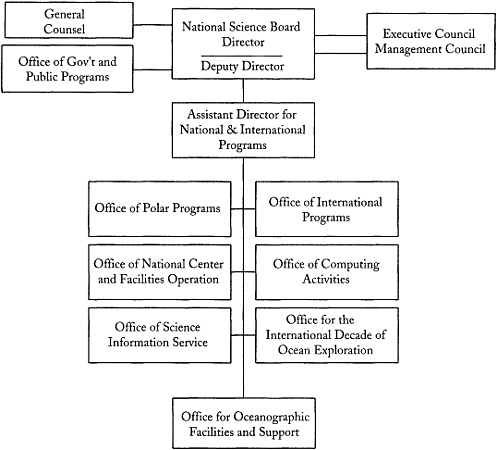
FIGURE 1 Simplified National Science Foundation organizational chart for the period 1969-1975 (see Appendix F for complete chart).
Furthermore, proposals from the agency scientists, most of whom were unfamiliar with the procedures and requirements for submitting research proposals to NSF, did not receive very good reviews from the traditional mail reviews utilized by NSF. Proposals that might have been suitable for gaining support within the agencies were not favorably received by the academic reviewers.
The final obstacle to agency participation in IDOE lay in the fact that even when the agency mission coincided with a particular IDOE project, there remained insurmountable problems resulting from differences in management style, funding procedures, and long-range research objectives. These barriers tended to discourage any significant participation by other federal agencies in the IDOE.
As a result, after the first year of the program, during which half of the IDOE funds were essentially passed through to those agencies having marine responsibilities, agency participation in the program was minimal. The one exception was the North Pacific Experiment (NORPAX), which addressed problems of direct interest to the Office of Naval Research's (ONR' s) oceanographic research mission. NORPAX became a jointly funded program in which ONR and IDOE each supported research carried out by the academic oceanographic institutions. The research was closely coordinated by the program managers from each agency.
International Participation—Another area in which the IDOE was unable to carry out the concepts envisaged by both the Marine Council and the National Academy of Sciences was the extent of international cooperation. While the U.S. marine science community was quickly able to design large research projects responsive to purpose of more effective utilization of the ocean and its resources, other maritime nations were not able to organize themselves quickly enough for meaningful participation.
In each year of the program, the U.S. IDOE submitted its plans and programs to the IOC and received the endorsement of member states. But procedures followed by scientists of the member countries in obtaining financial support from their own governments for the participation were ago
nizingly slow, and in most cases, these governments were unwilling or unable to fund these projects. The IOC itself had very little funding for research and was unable to support the projects, and the U.S. IDOE could not use its funds to support scientists of other nations.
Two notable exceptions to this state of affairs were FAMOUS and POLYMODE. FAMOUS was a joint French-U.S. study of the Mid-Atlantic Ridge, which was in planning stages when IDOE was established and which was carried out during the first few years of the program. POLYMODE was a joint USSR-U.S. study of mid-ocean dynamics in the Central/North Atlantic. This project was carried out during the last half of IDOE and was a truly cooperative effort in planning and execution. Scientists from both countries designed the experiments, planned the logistics, and carded out the research, and the governments of both countries supported the operations.
Focus Areas—Of the four major topics of study identified in the NAS (1969) report, IDOE was prohibited from funding "biology and living resources" during the first year of the program. We in the IDOE office were informed that the prohibition was imposed by the Bureau of the Budget because of arguments regarding fisheries. At the time, we thought the disagreement was between the budget bureau and the Bureau of Commercial Fisheries. However, according to Wenk (1980) the problem lay in the Department of State, which wanted to exclude fisheries from IDOE's scope. The Department of State's traditional roles in multi-and bilateral fishery policy might be endangered. The issue was settled after IDOE's first year, and biology and living resources became an integral part of the program beginning in the second year of IDOE.
Program Development—Although, for reasons stated above, it was not possible to achieve the kind of international and government agency participation envisaged, NSF was very successful in implementing a program with the remaining distinguishing characteristics identified in the NAS (1969) report. We in the IDOE office required IDOE projects to be identifiably relevant to the more effective utilization of the ocean and its resources, the major goal of IDOE. Further, the project had to be large-scale, long-term research, drawing on the expertise and skill of scientists from all applicable disciplines. The result was "big science" projects involving key research scientists from the major U.S. academic institutions and having a duration of three to ten years. Table 3 illustrates some of these features (Jennings and King, 1980). Throughout its 10-year history, IDOE supported 21 major projects, totaling approximately $189 million. This did not include ship operating costs; which were included in budgets of the Office for Oceanographic Facilities and Support.
One other characteristic of IDOE was that all data would have to be submitted to the appropriate national or international data centers. The cost to each project for adhering to this policy was included in the project proposals and funded by IDOE as an integral part of the projects. Safeguards were established to protect the proprietary interests of the researchers. IDOE also provided special funds to the data centers to ensure their capabilities to manage the influx of additional data.
After the first frustrating year of dealing with required pass-through funds to other government agencies and less than satisfactory proposals from academic scientists, which failed to adequately address the goals of the program, IDOE managed to develop an operating philosophy that served the program well for the remainder of the decade.
In order for a project to become part of IDOE it would have to address some aspect of ocean utilization and would have to be comprehensive enough to hold the promise of a significant advance toward solving the problem under study. The importance of the project and its design would need to have the consensus of those individuals most knowledgeable about the issue to be studied. Some of the projects undertaken during the early days of IDOE had already reached this stage of development by the time IDOE was established: GEOSECS, MODE, CLIMAP, and Nazca Plate are examples.
For projects that had not reached this stage of development we were to become dependent on a series of planning workshops, each addressing its own project. The academic scientific leaders wishing to establish an IDOE project were called on to organize a planning workshop and to invite all research scientists who were knowledgeable about the subject and who might ultimately become important research members of the final project. If the workshop was successful, the leader or leaders of the project organized and submitted to IDOE a complex proposal describing the administration of the project, the scientific approach, and the role of each individual investigator in the project including a proposal from each investigator.
We came to refer to the leaders of these projects as the "Heroes" and the philosophy as the "Hero Principle." The Heroes were responsible for all administrative aspects of the project including budgets, logistics, planning, and so forth. In almost every project, the Hero was really an executive committee. For example, in GEOSECS, the executive committee included a scientist from each of five institutions: Lamont, Scripps, Woods Hole, Miami, and Yale. IDOE funds were granted to the home institution of each participating scientist.
The planning workshops were very successful and were carried out without difficulty during the first half of the decade. However, as the program matured, part of the scientific community became concerned that the workshop organizers were inviting participants on the basis of "old boy" networks and excluding some scientists who could make meaningful contributions. Thereafter, it became necessary to publicize, well in advance, our intention to sponsor these
TABLE 3 Major U.S. IDOE Projects
|
Programs/Projects |
Number of Institutions |
Number of Scientific Investigators |
Year Begun |
Expected Year of Completion |
Estimated Total Cost ($M) |
U.S. Agencies Providing Funds |
|
Environmental Forecasting |
||||||
|
NORPAXa |
28 |
45 |
1971 |
1982 |
29.7 |
ONR |
|
CLIMAP |
8 |
22 |
1971 |
1980 |
8.0 |
|
|
MODE |
16 |
45 |
1971 |
1974 |
8.0 |
ONR, NOAA |
|
ISOS |
9 |
16 |
1974 |
1981 |
10.2 |
NSF |
|
POLYMODE |
12 |
35 |
1975 |
1982 |
15.5 |
ONR, NOAA |
|
Environmental Quality |
||||||
|
GEOSECS |
14 |
28 |
1971 |
1980 |
23.5 |
ERDA |
|
Pollutant Baseline |
17 |
30 |
1971 |
1978 |
2.3 |
|
|
Pollutant Transfer |
9 |
10 |
1972 |
1979 |
10.0 |
|
|
Biological Effects |
|
|
|
|
|
|
|
Field (CEPEX) |
5 |
10 |
1973 |
1980 |
6.5 |
|
|
Laboratory |
6 |
8 |
1973 |
1979 |
10.0 |
|
|
SEAREX |
9 |
15 |
1977 |
1983 |
4.6 |
|
|
PRIMA |
5 |
6 |
1978 |
1984 |
2.4 |
|
|
Seabed Assessment |
||||||
|
South Atlantic Margins |
2 |
15 |
1971 |
1975 |
4.0 |
|
|
Nazca Plate |
3 |
25 |
1971 |
1977 |
6.0 |
|
|
FAMOUS |
4 |
10 |
1972 |
1975 |
2.0 |
NSF, ONR, NOAA |
|
Manganese Nodules |
10 |
18 |
1972 |
1977 |
4.0 |
|
|
MANOP |
11 |
21 |
1977 |
1984 |
8.0 |
|
|
Galapagos |
3 |
9 |
1976 |
1979 |
1.4 |
|
|
RISE |
5 |
7 |
1977 |
1980 |
1.3 |
|
|
SEATAR |
7 |
15 |
1975 |
1980 |
5.4 |
|
|
CENOP |
11 |
15 |
1978 |
1982 |
2.8 |
|
|
Living Resources |
||||||
|
CUEA |
13 |
11 |
1972 |
1979 |
16.1 |
|
|
SES |
10 |
11 |
1974 |
1981 |
7.0 |
|
|
a See Appendix H for the definitions of acronyms. |
||||||
workshops. Although there was surely some merit in the concerns expressed by those scientists who felt neglected, I do not believe the early projects themselves failed to address any important significant aspects of the scientific research needed to achieve the objectives of the projects.
Once the projects resulting from the workshops had been identified as appropriate for consideration by IDOE, and the proposals submitted, the well-established NSF peer-review process played a critical role in the final selection of projects for funding. Like most NSF proposals, DOE proposals were subjected to peer review. In the case of IDOE, these were mail reviews, and the mail reviews for each project were then carefully considered by a panel of specialists that made its own recommendations.
One of the major difficulties in reviewing IDOE projects was that traditionally NSF reviewers were accustomed to reviewing only individual projects and the reviews focused on the question of scientific excellence and receiving ratings accordingly. But IDOE projects included all of the tasks necessary to achieve success, and while not all of these tasks were the type to receive excellent ratings, each of them was essential to the success of the project. Mail reviewers were quick to point out the deficiencies in these proposals, to note the routine character of certain tasks, and to give them only fair ratings. In NSF, the administration was accustomed to funding only those individual projects receiving excellent ratings by the reviewers. Early on, we in the IDOE office were able to explain to the NSF chain of command, without too much difficulty, that these routine tasks were essential to the projects even though they did not receive high marks from the reviewers. At the time, we reported directly to the Assistant Director for National and International Programs, whose office understood the problem and fortunately proposals did not receive heavy scrutiny above that level.
Later on, in response to pressure from Congress, a review board was established in each directorate, plus a review board for special items requiring approval by the Foundation's governing body, the National Science Board. The review boards compounded the prospects for delay and
frustrations in the movement of funds to the researchers. Further, they elevated the importance of procedures to the point where administrative form became as important as scientific judgment as criteria for moving grant actions through NSF.
We were still able to move IDOE proposals through the system but with more delays and a great amount of bureaucratic effort. One successful procedure for avoiding the final hurdle of a National Science Board review was to break the IDOE projects into small enough segments to stay below the million-dollar level that would cause it to become a special item. This was done to avoid the additional delay, not because we were concerned about the merits of the projects or about final approval by the Board.
As pressure from congressional scrutiny of NSF management practices continued, the Foundation established a set of guidelines that made it even more difficult for the IDOE program. The new guidelines for the selection of reviewers were excessive in their zeal to avoid all biased judgment. They included a restriction against using reviewers from any university involved in the proposal, even though the reviewers were from different fields or in different parts of the university. Under these conditions, most of the scientists from major institutions were prevented from assisting in the review of large IDOE projects because most of their institutions were participants.
In spite of these bureaucratic hurdles, the decision to give responsibility for IDOE to the National Science Foundation was the right one. The Foundation had in place the review and granting mechanisms and the experience in dealing with the academic research community that would ultimately be responsible for carrying out the work of the program. Aside from the scientific results, which are not the subject of this paper, IDOE provided very important lessons to both NSF and the academic community in organizing, reviewing, and archiving the results of large-scale, cooperative research projects.
In 1977, NSF asked that the National Academy of Sciences and the National Academy of Engineering continue to provide advice and guidance on the nature of programs to follow the IDOE. In response, the Ocean Sciences Board of the Academy appointed a post-IDOE Planning Steering Committee, which organized a series of five planning workshops. These workshops formed the basis for a report issued by the NAS (1979) titled The Continuing Quest: Large Scale Ocean Research for the Future .
The 1979 NAS report concluded that, ''the IDOE was a watershed in the history of Ocean Research. By providing the structure and resources for large-scale, long term coordinated projects, the program gave a powerful impetus to the transformation of marine science from a descriptive effort to one increasingly driven by experimental and theoretical concerns."
The report recommended that a program of cooperative ocean research should follow and evolve from IDOE and that it should be sponsored by NSF as a major component of its overall efforts in fundamental ocean research. It listed 28 principal conclusions and recommendations regarding the future program and identified oceanographic opportunities for the 1980s. The Foundation has followed this advice and continues to fund the type of large-scale, long-term, cooperative projects that were the heart and soul of IDOE.
REFERENCES
Chapman, S. 1959. IGY: Year of Discovery. University of Michigan Press, Ann Arbor.
Edmund, J.M. 1980. GEOSECS is like the Yankees: Everybody hates it and it always wins. Oceanus 23(1).
Jennings, F.D, and L.R. King. 1980. Bureaucracy and science: The IDOE in the National Science Foundation. Oceanus 23(1) 12-19.
Lambert, R.B. 1998a. Management of Large Ocean Programs. Unpublished manuscript.
Lambert, R.B. 1998b. The Emergence of Ocean Science Research in NSF, 1951-1980. Marine Technology Society Journal 32(3):68-73.
Malone, T. 1997. Building on the legacies of the International Geophysical Year. EOS 78(18, May 6).
National Academy of Sciences (NAS). 1969. Oceanic Quest: The International Decade of Ocean Exploration. National Academy Press, Washington, D.C.
National Academy of Sciences (NAS). 1979. The Continuing Quest: Large-Scale Ocean Science for the Future. National Academy Press, Washington, D.C.
Wenk, E., Jr. 1980. Genesis of a marine policy: Th: IDOE. Oceanus 28(1):2-11.


