
International Benchmarking of US Materials Science and Engineering Research Panel Members
ARDEN L. BEMENT, Jr. (Chair), Purdue University, School of Materials and Electrical Engineering, West Lafayette, IN
PETER R. BRIDENBAUGH, Executive Vice President, Automotive, Alcoa Technical Center, Alcoa Center, PA
LEROY L. CHANG, Hong Kong University of Science and Technology, Hong Kong
DANIEL S. CHEMLA, Lawrence Berkeley National Laboratory, University of California, Berkeley, Berkeley, CA
UMA CHOWDHRY, Business Planning and Technology Director, DuPont Specialty Chemicals, Wilmington, DE
ANTHONY G. EVANS, Gordon McKay Professor of Materials Engineering, Harvard University, Physics Department, Cambridge, MA
PAUL HAGENMULLER, Professor, Université de Bordeaux I, Laboratorie de Chimie du Solide du CNRS, France
JAMES W. MITCHELL, Director, Materials, Reliability and Ecology Research, Bell Laboratories, Lucent Technologies, Murray Hill, NJ
DONALD R. PAUL, Melvin H. Gertz Regents Chair in Chemical Engineering, Director, Center for Polymer Research, Department of Chemical Engineering, University of Texas at Austin, Austin, TX
BUDDY D. RATNER, University of Washington, Center for Engineered Biomaterials-UWEB, Seattle, WA
KATHLEEN C. TAYLOR, Head, Physics and Physical Chemistry Department, General Motors Corporation, GM Research and Development Center, Warren, MI
ROBERT M. WHITE, Professor & Head, Department of Electrical & Computer Eng., Carnegie Mellon University, Pittsburgh, PA
MASAHARU YAMAGUCHI, Professor, Kyoto University, Department of Materials Science & Engineering, Japan
Project Staff
DEBORAH D. STINE, Study Director
PATRICK P. SEVCIK, Research Associate
KATE KELLY, Editor
Materials Science and Engineering Benchmarking Guidance Group
MILDRED S. DRESSELHAUS (Chair), Institute Professor of Electrical Engineering and Physics, Massachusetts Institute of Technology, Cambridge, MA
L. E. (SKIP) SCRIVEN, Regent's Professor, Department of Chemical Engineering and Materials Science, University of Minnesota, Minneapolis, MN
WILLIAM F. BRINKMAN, Vice President, Physical Sciences Research, Lucent Technologies, Murray Hill, NJ
GABOR A. SOMORJAI, Professor of Chemistry, Department of Chemistry, University of California at Berkeley, Berkeley, CA
ROBERT A. LAUDISE, Adjunct Chemical Director, Bell Laboratories, Lucent Technologies, Murray Hill, NJ
JAMES C. WILLIAMS, General Manager, Engineering Materials Technology Laboratories, GE Aircraft Engines, Cincinnati, OH
ALBERT NARATH, President, Energy and Environment Sector, Lockheed-Martin Corporation, Albuquerque, NM
PREFACE
In 1993, the Committee on Science, Engineering, and Public Policy (COSEPUP) of the National Academy of Sciences, the National Academy of Engineering, and the Institute of Medicine issued the report Science, Technology, and the Federal Government: National Goals for a New Era. In that report, COSEPUP suggested that the United States adopt the principle of being among the world leaders in all major fields of science so that it can quickly apply and extend advances in science wherever they occur. In addition, the report recommended that the United States maintain clear leadership in fields that are tied to national objectives, that capture the imagination of society, or that have multiplicative effect on other scientific advances. These recommendations were reiterated in another Academy report, Allocating Federal Funds for Science and Technology, by a committee chaired by Frank Press.
To measure international leadership, the reports recommended the establishment of independent panels that would conduct comparative international assessments of scientific accomplishments of particular research fields. COSEPUP indicated that these panels should consist of researchers who work in the specific fields under review (both from the United States and abroad), people who work in closely related fields, and research users who follow the fields closely.
To test the feasibility of that recommendation, COSEPUP is conducting experimental evaluations of three fields: mathematics, materials science, engineering, and immunology. The panel for each field has been asked to address the following three questions:
-
What is the position of the United States in research in the field relative to that in other regions or countries?
-
What key factors influence relative US performance in the field?
-
On the basis of current trends in the United States and abroad, what will be the relative US position in the near term and the longer term?
Panels were asked to develop findings and conclusions, not recommendations.
This document provides the second of these assessments—that of the field of materials science and engineering. The panel found that it is critical that the United States lead the world in materials science and engineering innovations; however, the United States is not the leader in the field as a whole. Rather, it is among the world leaders in all subfields of materials science and engineering research and is the leader in some fields.
The panel found that the key to the nation's leadership is the flexibility of the materials science and engineering research enterprise, its innovation system, and its intellectual diversity. But, the ability of the United States to capitalize on its leadership opportunities could be curtailed because of shifting federal and industry priorities, a potential reduction in access to foreign talent, and deteriorating facilities of natural materials characterization. Of particular concern is the lack of adequate funding to modernize major research facilities in the United States when facilities here are much older than in other countries.
Once all the assessments are completed, COSEPUP will discuss the feasibility and utility of the benchmarking process and make whatever recommendations it deems necessary.
The committee thanks the panel for its hard work. We would also like to acknowledge those who made presentations at the panel meeting:
Steven Wax, Asst. Director for Materials and Processing, Defense Advanced Research Projects Agency
John J. Rush, NIST Center for Neutron Research, National Institutes of Science and Technology
Andrew J. Lovinger, Program Director, Polymers and NSF-wide Coordinator, Advanced Materials & Processing, National Science Foundation
This report has been reviewed by individuals chosen for their diverse perspectives and technical expertise, in accordance with procedures approved by the NRC's Report Review Committee. The purpose of this independent review is to provide candid and critical comments that will assist the authors and COSEPUP in making the published report as sound as possible and to ensure that the report meets institu-
tional standards for objectivity, evidence, and responsiveness to the study charge. The content of the review comments and draft manuscript remain confidential to protect the integrity of the deliberative process. We wish to thank the following individuals for their participation in the review of this report:
John Armor, Principal Research Associate and Group Head/catalysis, Corporate Science Center, Air Products and Chemicals
Dan Drucker, Graduate Research Professor of Engineering Sciences, Emeritus, University of Florida
Merton Flemings, Toyota Professor, Massachusetts Institute of Technology
Lambert Ben Freund, Henry Ledyard Goddard University Professor, Division of Engineering, Brown University
Elsa Garmire, Dean, Thayer School of Engineering, Dartmouth College
William G. Howard, Independent Consultant, Scottsdale, AZ
Venkatesh Narayanamurti, Richard A. Auhll Professor and Dean of Engineering, University of California-Santa Barbara
William Nix, Lee Osterson Professor of Engineering and Professor of Materials Science and Engineering, Stanford University
William Spencer, CEO and Chairman, SEMATECH
Matthew Tirrell, Professor and Head, Department of Chemical Engineering and Materials Science and Director, Biomedical Engineering Institute, University of Minnesota
Jerry Woodall, Charles William Harrison Distinguished Professor of Microelectronics, Purdue University
While the individuals listed above have provided many constructive comments and suggestions, responsibility for the final content of this report rests solely with the authoring committee and COSEPUP.
Finally, the project was aided by the invaluable help of COSEPUP professional staff—Deborah D. Stine, study director, and Patrick P. Sevcik, research associate.
Phillip A. Griffiths
Chair
Committee on Science, Engineering, and Public Policy
Figures, Tables, and Boxes
|
Figure 2.1: |
Inter-Relationships Among Materials Categories |
|||
|
Figure 3.1: |
Materials Science and Engineering PhDs Awarded, 1986-1995 |
|||
|
Figure 3.2: |
Employment Status of PhD Materials Scientists, 1985 |
|||
|
Figure 3.3: |
Metallurgical-Materials Engineering Graduate Students in All Institutions, by Race-Ethnicity and Citizenship, 1993 |
|||
|
Figure 3.4: |
All Engineering Graduate Students in All Institutions, by Race-Ethnicity and Citizenship, 1993 |
|||
|
Figure 3.5: |
All Science Graduate Students in All Institutions, by Race-Ethnicity and Citizenship, 1993 |
|||
|
Figure 3.6: |
Federal R&D Budget by Materials Class, in Millions of US Dollars |
|||
|
Figure 3.7: |
National Science Foundation Division of Materials Research Budget, 1990-1998, in Millions of US Dollars |
|||
|
Figure 3.8: |
National Science Foundation Directorate for Mathematical and Physical Sciences, Average Annualized Award Size, Competitive Research Grants, 1992-1996, in Thousands of US Dollars |
|||
|
Figure 3.9: |
National Science Foundation Division of Materials Research, Permanent Equipment Budget, 1990-1996, in Millions of US Dollars |
|||
|
Figure 4.1: |
Papers Submitted and Accepted for Magnetism and Magnetic Materials Annual Conferences, 1989-1996 |
|||
|
Figure 5.1: |
Scientists and Engineers Admitted to the US on Permanent Visas by Labor Certification, 1990-1994 |
|||
|
Figure 5.2: |
Foreign Citizen Graduate Enrollment in US Science and Engineering Universities, 1983-1993 |
|
Table 2.1: |
Materials Subfields |
|||||
|
Table 3.1: |
Major Scientific Awards for, or Strongly Influenced by, Neutron-Scattering Research |
|||||
|
Table 3.2: |
Research Reactors, US |
|||||
|
Table 3.3: |
Research Reactors, Abroad |
|||||
|
Table 3.4: |
US Spallation Sources |
|||||
|
Table 3.5: |
Spallation Sources Abroad |
|||||
|
Table 3.6: |
Synchrotron Light Source Operations in G7 Countries |
|||||
|
Table 3.7: |
US Employment Status of PhDs, Materials Science and Engineering, 1985-1995 |
|||||
|
Table 3.8: |
US Occupation Status of PhDs, Materials Science and Engineering, 1985-1995 |
|||||
|
Table 3.9: |
Number of Doctorate Recipients by Gender and Subfield |
|||||
|
Table 3.10: |
Percentage of First Degrees in Science and Engineering to Women, G-6 Nations |
|||||
|
Table 3.11: |
Federal R&D Budget for Materials Research by Agency, in Millions of US Dollars |
|||||
|
Table 5.1: |
Decline in US Admissions of Immigrant Scientists and Engineers, FY 1993–FY 1994 |
|||||
|
Box 3.1: |
The Federation of Materials Societies |
|||||
|
Box 3.2: |
International Union of Materials Research Societies |
|||||
|
Box 3.3: |
The MOSIS Service |
|||||
|
Box 3.4: |
A Cure for Composites |
EXECUTIVE SUMMARY
To be leaders in industrial growth and to maintain a vibrant economy, it is critical that the United States lead the world in materials science and engineering innovations. Materials have been central to economic growth and societal advancement since the dawn of history. With the ever strengthening fundamental underpinnings of the fields and the growing interdependence of materials with other emerging technologies, these societal and economic contributions of the field are accelerating.
The Committee on Science, Engineering, and Public Policy (COSEPUP) Panel on International Benchmarking of US Materials Science and Engineering Research examined the leadership status of the United States in materials science and engineering research. Its members determined that the United States is among the world leaders in all subfields of materials science and engineering research and is the leader is some subfields, although not in the field as a whole. A general area of US weakness for most subfields is in materials synthesis and processing. Increasingly, US researchers must rely on specialty materials suppliers in Europe and Japan for bulk crystals and other specialty materials.
The United States is currently the clear leader in biomaterials and the leader in metals and electronic–photonic materials. However, the lead in electronic–photonic materials is endangered because industrial exploratory research has been cut back. The United States is currently one of several leaders in magnetic materials; previously, the United States had been preeminent, and this field needs particular attention in the future. US leadership is likely to be eroded in composites, catalysts, polymers, and biomaterials because of the high priorities given to these
subfields by other countries. Of particular concern is the catalysts subfield, where there are not enough university multidisciplinary centers to conduct cutting-edge research and reduce the development cycle time for commercialization.
The panel also found that
-
The flexibility of the materials science and engineering research enterprise is as much an indicator of its success as is its funding level.
-
A major determinant of the nation's leadership in materials science and engineering leadership is its innovation system—the entrepreneurship ability of its researchers and the influence of its diverse economy.
-
The nation enjoys strength in materials science and engineering through intellectual diversity—its ability to draw intellectually from all of the science and engineering research infrastructure.
-
The ability of the United States to capitalize on its leadership opportunities could be curtailed because of shifting federal and industry priorities, a potential reduction in access to foreign talent, and deteriorating facilities for natural materials characterization. Of particular concern is a lack of adequate funding to modernize major research facilities in the United States—many are much older than are those in other countries—and to plan and build new facilities needed to maintain research leadership.
1
BACKGROUND
In 1993, the Committee on Science, Engineering, and Public Policy (COSEPUP) of the National Academy of Sciences, the National Academy of Engineering, and the Institute of Medicine issued the report Science, Technology, and the Federal Government: National Goals for a New Era. This report recommended that the United States be among the world leaders in all major fields of science to rapidly exploit exciting new concepts discovered elsewhere in the world. The report also says the country should maintain clear leadership in selected fields where achieving national objectives is critical or where public interest is acute. A similar recommendation was made in a later National Research Council report, Allocating Federal Funds for Science and Technology , published in 1995: The United States should ''strive for clear leadership in the most promising areas of science and technology and those deemed most important to our national goals."
Both reports state that quantitative measures, such as dollars spent and number of scientists supported, are inadequate indicators of leadership and that policy decisions about programmatic issues or resource allocation would be better informed by comparative international assessments. Independent, field-specific panels were suggested as the best means to obtain such evaluations. Each panel would consist of researchers in the field, researchers in closely related fields, and research users who follow the field; each panel would include researchers from outside the United States.
In late 1996, COSEPUP began an experimental study of the effectiveness and outcome of such panels. The first panel report entitled
International Benchmarking of US Mathematics Research was released in October 1997. This report—an evaluation of US research in materials science and engineering—was prepared by the second panel. A study of the field of immunology is in progress. Each panel has been asked to address several questions:
-
What is the position of US research in the field relative to that of other regions or countries?
-
What key factors influence relative US performance in the field?
-
On the basis of current trends in the United States and abroad, what will be the relative US position in the near term and in the longer term?
2
INTRODUCTION
2.1 How Important Is It for the United States to Lead in Materials Science and Engineering?
Materials are the substances from which things are or can be made. Materials science and engineering—the study of how to make, use, and adapt substances—has been central to social advancement and economic growth since the dawn of history. There has been an explosion in our understanding and application of materials science and engineering since the end of World War II, and the connection has become stronger between this field and other areas of emerging technology. The result has been an acceleration in the recent past of its contributions to social advancement and economic growth.
Federally-funded research on materials originally focused on defense and nuclear applications, but was expanded in the 1960s to include the space program, the protection of the environment, and the development of new energy systems. Today, research addresses issues in agriculture, health, information and communication, infrastructure and construction, and transportation. The future holds the promise of "intelligent" materials that will enable diverse technologies to respond dynamically to changes in the environment. A new class of materials, nanostructures, is already being used to advance the study of electromagnetics and mechanical properties (OSTP 1993).
Our national defense will continue to depend on providing the most advanced weapons to our military forces. Advanced materials are crucial to the improved performance and reliability of our weapons. Maintaining world leadership in materials essential to the design and manufacture of weapons will have high national priority.
To be leaders in industrial growth and to promote a vibrant economy, it is critical that the United States be among the world's leaders in all the subfields of materials science and engineering research. We need to be able to evaluate, adapt, and integrate materials identified and developed elsewhere in the world for use in new products and processes. Having world-class researchers who are knowledgeable about the frontiers of materials science and engineering is crucial to the rapid commercial assimilation and exploitation of important discoveries. Innovations in materials science abound in nearly all sectors of our economy. In agriculture, advanced natural polymers can be made from renewable resources that biodegrade more rapidly than plastics do. In energy, new materials and processing can be used to reduce energy costs significantly and conserve resources in the generation, transmission, and storage of energy. In protecting the environment, there is an opportunity to develop materials and processes that lead to cycles of infinite reuse. In health, biomaterials can be used to make artificial organs, joints, and heart valves; pacemakers; and lens implants, among others. Improvements in biomaterials could help improve the delivery of health care and reduce costs through the custom design of artificial biologic implants, for example, that will last a lifetime rather than a few years. In information and communications research involving semiconductors, new methods of design and processing could enhance the viability of the US electronics industry and open new marketing opportunities. In infrastructure and construction, the use of new or improved could reduce expensive maintenance of such structures as buildings, highways, bridges, and airport runways, to name a few. In transportation, materials research can help maintain US leadership in the increasingly competitive world aircraft market and reduce imports of oil and automobiles (OSTP 1993).
It is now possible to synthesize new materials atom by atom. The number of possible combinations of atomic assemblies to achieve new structures and properties is seemingly unbounded. But if the United States is to exploit these possibilities, strong national research capabilities by single investigators and multidisciplinary teams are required. Equipment—large-scale research instrumentation—will be required to characterize new materials from their smallest constituents at all scales of assembly. Computational methods are needed to find the best materials for a particular use.
Strengths in materials science and engineering research and education at US universities and colleges support other disciplines of science and engineering. The benefit increases with the growing unification of the field when multidisciplinary research can be done in centralized laboratories. Collaborative research benefits everyone because it helps identify new areas of endeavor and expand existing ones.
2.2 What is Materials Science and Engineering?
The field of materials science and engineering research seeks to explain and control one or more of four basic elements:
-
The properties or phenomena of a material that make it interesting or useful;
-
The performance of a material; that is, the measurement of its usefulness in actual conditions of application;
-
The structure and composition of a material, including the type of atoms that determine its properties and performance and their arrangement; and
-
The synthesis and processing by which the particular arrangements of atoms are achieved (NRC 1989).
For the purposes of this report, the Panel divided materials science and engineering into 9 major subfields:
-
Biomaterials
-
Ceramics
-
Composites
-
Magnetic materials
-
Metals
-
Electronic and optical–photonic materials
-
Superconducting materials
-
Polymers
-
Catalysts
These fields are described in Table 2.1 (modified from OSTP, 1993). The Panel has added the subfield of catalysts to OSTP's original list and combined two of the subfields—electronic and optical–photonic materials. It is important to appreciate that the classifications are arbitrary and overlapping. For example, supertough materials based on abalone shell biomimetrics are both biomaterials and composites. Figure 2.1 illustrates the interrelationships among categories.
2.3 What Key Factors Characterize the Field?
Materials science and engineering is multidisciplinary. Nearly all of science and engineering are involved in some way with some aspect of materials; the field involves internal and external interactions with the science and engineering communities at large. Scientists and engineers in many disciplines, including solid-state physics, chemistry, electronics, biology, and mechanics—not just those with materials science and engineering degrees—provide many of the ideas and motivation for materials science and engineering research.
TABLE 2.1 Materials Subfields
|
Biomaterials and biomolecular materials: Diverse materials compatible with human tissues or that mimic biologic phenomena; materials made from products of biologic origin. Traditional materials include dental fillings and crowns. Advanced materials are made from metals, ceramics, fibers, polymers, and natural biomolecules. Widespread applications are possible: artificial hearts, ultra-tough ceramic tank armor modeled on the molecular structure of abalone shells, biodegradable plastics for packaging, and nanofabricated circuit patterns on silicon for living neurons. |
Metals: Tough, strong structural materials and electrical conductors. Traditional metals include commodity alloys of elements such as iron, nickel, and aluminum. Advanced metals tailored for specialty application include light-weight magnesium alloys; specialty tool steels and nickel-based alloys; refractory alloys; and high-temperature–high-strength intermetallics. |
|
Ceramics: Materials made from nonmetallic inorganic minerals. Ceramics are noted for their light weight, hardness, and resistance to corrosion and high temperatures. Spark plug insulators are a traditional example. Advanced ceramics are used for thermal coatings and in high-temperature engines. |
Superconducting materials: Materials that carry electrical current with no resistance. Some metals and alloys exhibit this characteristic but only at temperatures approaching absolute zero. Advanced varieties, including oxides, organics, and some intermetallics, superconduct at higher temperatures, some exceeding the liquefaction temperature of nitrogen. |
|
Composites: Hybrids of at least 2 materials, usually reinforced ceramics, metals, or organic matrix materials, which are combined to exploit the most useful properties of each. Fiberglass is a traditional composite, composed of glass fibers in an epoxy matrix. Advanced composites have structural and nonstructural applications and often are used in air and land vehicles. |
Polymers: Large molecules consisting of long chains of repeated units. Polymers are noted for unique combinations of properties and have a range of applications, from plastic containers to liquid crystal displays. Plastic wrap is a traditional example. Polyimides are advanced, high-temperature polymers used for electronic packaging and aircraft skins. |
|
Electronic materials: Electronic materials are active materials, such as semiconductors, that transmit signals by way of electrons. Current electronic technology is based on silicon but, newer semiconductors include compound semiconductors, (gallium arsenide), wide-band-gap semiconductors (silicon carbide). These compound semiconductors also are considered optical–photonic materials (see box). This class includes metals, ceramics, and polymers used in electronic wiring, interconnections, and packaging. |
Optical–photonic materials: Materials that transmit light; those used as light sources, such as lasers; and those used to switch and modulate light. Glass is in this category in numerous forms, from window panes to optical fibers. |
|
Magnetic materials: Materials that possess spontaneous magnetization. Their magnetic fields make them useful in motors and generators; the orientation of magnetization can be used to store information. Magnetic materials can be metallic, such as iron and iron–rare earth alloys, or nonmetallic, such as oxides. |
Catalysts: Materials that accelerate chemical reactions without being consumed in the process. Catalysts find wide use for production of chemicals and pharmaceuticals, refining of petroleum, and for control of emissions of the products of combustion (for example, from motor vehicle engines). The benefits of catalytic processes include low process costs, improved productivity, high selectivity to desired product, and reduction of unwanted by-products. |
Nearly all modern industries benefit from developments in materials research. Because there is considerable overlap in the study of materials problems among industries, solutions have enormous economic leverage. Semiconductors, for example, are at the foundation of the electronics industry. The development of new materials also has a large economic multiplying effect because it creates demands for new processing equipment and manufacturing tools.
Research in materials science and engineering is capital intensive and involves increasingly sophisticated characterization instruments and equipment for synthesis, processing, and analysis. The equipment ranges from small, laboratory bench-scale machines that serve a single investigator to synchrotron sources, nuclear reactors, superconducting magnets, and supercomputers that serve large user communities and research groups. The field benefits from the large US installed base of research facilities.
Problems in materials science and engineering research require all forms of research, from small-scale research carried out by a principal investigator and a small team, to large multidisciplinary teams, and regional consortia involving many investigators. Consortia, alliances, and partnerships of industrial, university, and government laboratories are a common mode of exploiting breakthroughs in the field. Equally common are the international collaborations made possible by the explosive growth of the Internet.
Computational research and engineering, involving large-scale supercomputers and computer networks, is gaining importance in solving all manner of materials problems—from the subatomic to the macroscopic scale. Considerable progress has been made recently in simulations of complex materials phenomena based on first principles, such as mesophysical and mesomechanical phenomena. Computational

FIGURE 2.1 Inter-relationships among materials categories.
strategies are emerging to provide physical descriptions of materials over a range of sizes important to a given process. In some instances, the use of these strategies allows the prediction of system performance that is not possible now by direct measurement. The field benefits directly from US strengths in computer science and engineering.
New developments in materials science and engineering can aid rapid paradigm shifts in the development of new technologies in fields that are not directly related to materials research. For example, the
discovery of high-temperature superconductors just a decade ago is leading to important technological developments in medicine, defense, energy, computing, telecommunications, and transportation. These developments will enable important expansions in the global market of the next century.
Because of the increasing severity of the environments in which many advanced materials are used, the time from first synthesis to practical, reliable application can be long, often fifteen years or more. Long-term research is expensive, so sustained public-sector investment in precompetitive research and development is critical for realizing the economic potential of new materials discoveries. Strong user involvement in the early stages of materials synthesis and applications research is critical for facilitating the early adoption of new materials for new or existing applications.
2.4 What Is the International Nature of Materials Science and Engineering?
Materials science and engineering is an international effort that affects an individual nation's economic, industrial, and military strength and the education of its citizens. Because of the importance of materials to economic strength and industrial success, most major US trading partners have targeted materials science and engineering as a growth area and have made major investments to build competency in the field. Materials science and engineering is prominently represented in national public–private sector partnerships for economic development in most European countries and in the Pacific Rim countries, notably Japan. National and multinational companies with strong research and development programs in materials technologies market their products worldwide.
Materials technology is critical to the development of advanced military weapons and is one determinant of military strength. Nations that supply military equipment, such as the US, the United Kingdom, Germany, France, and Russia, have built strong industrial and government laboratories that specialize in military-related materials research, although much of their results find civilian applications as well.
Leadership in the subfields of materials science and engineering can shift unexpectedly. Many prominent researchers in materials science and engineering around the world have received graduate education in US research universities. This facilitates international collaboration and exchange with US investigators. Most new discoveries are immediately communicated around the globe today, and most new materials developments are exploited in many countries simultaneously. Likewise, many new discoveries are now announced simultaneously by researchers in different countries.
2.5 What Are Some Caveats?
Because of the size and industrial strength of the US materials science and engineering research community, it cannot be compared meaningfully with those of other single countries. The only sensible method is to compare the US with regional groups, such as Europe or Asia, for example. To the extent possible, in this report, specific countries are mentioned in connection with particular areas of science and technology.
Because of the enormous breadth of the field, it is necessary to divide materials science and engineering research into subfields, each of which is also extremely broad. The panel adopted the material subfields identified by the White House Office of Science and Technology Policy (OSTP) National Science and Technology Council in its 1993 and 1995 reports, The Federal Research and Development Program in Materials Science and Technology. The reports list biomaterials, ceramics, composites, electronic materials, magnetic materials, metals, optical–photonic materials, polymers, and superconducting materials. The panel added catalysts to this list and combined the electronic and optical–photonic materials research into one category.
Fundamental materials discoveries can occur in many research settings. For example, NITINOL (a memory alloy) was discovered at a government laboratory, high-temperature superconductivity was discovered at an industrial laboratory, and rapidly solidified amorphous metals were first produced at a university. Many such developments occur in all three settings at the same time, leading to synergistic breakthroughs. Centers of excellence abound in all three settings in the United States as well as abroad.
Multidisciplinary research is a common mode for individual investigators as well as for large research teams. In industrial and governmental laboratories, materials research is, for the most part conducted by multidisciplinary teams, often led by scientists or engineers from diverse disciplinary backgrounds. For example, advanced polymer research is commonly led by chemists, and research on electronic materials is commonly led by physicists. Mathematicians often are involved in theoretical studies and in the development of computational models and simulations. At universities, most large science and engineering departments have self-contained research groups that focus on materials-related science, engineering, or both.
In the United States, there has been a strong unification of the field over the past 3 decades, to include the development at most universities of a unified curriculum across the field. At many research universities, the first course in materials is offered to freshmen. There are still many important materials-related courses provided outside materials science and engineering departments, so instruction also has interdisciplinary aspects. Although departments of materials science and engineering are
often found in schools of engineering in the United States, they are commonly found in schools of science or natural history abroad.
2.6 Panel Charge and Rationale
The Panel was asked to conduct a comparative international assessment to answer three questions:
-
What is the position of US research relative to that of other regions or countries?
-
What key factors influence US performance in the field?
-
On the basis of current trends in the United States and abroad, what will be the relative US position in the near term and in the longer term?
The panel was asked only to develop findings and conclusions—not recommendations. The panel focus is on leading-edge exploratory research—intermixing basic and applied research and product development.
The panel responded to the second question first, identifying the determinants of leadership that have influenced US advancement in the field and the establishment of the supporting research infrastructure. Section 3 of the report details the panel's findings.
The panel then assessed current US leadership in the nine subfields. The results of this assessment—the benchmarking results given in Section 4 of the report—are in response to the first charge.
The next step was to assimilate past leadership determinants and current benchmarking results to predict US leadership, thereby to address the third charge. This analysis is given in Section 5 of the report.
The panel next attempted to predict—based on near-term and longer term trends in the determinants of leadership and in corresponding developments around the world—leadership positions of the United States in the subfields of materials science and engineering. That is, would the United States gain, maintain, or lose position with respect to its current state? Section 6 of the report discusses the Panel's predictions for each of the subfields assessed. Tables in Appendix B provide specific analyses by sub-subfield.
The panel's principal findings and conclusions are given in Section 7.
3
DETERMINANTS OF SCIENTIFIC LEADERSHIP
Leadership in materials science and engineering is influenced by several factors, that would be weighted differently in highly developed countries around the world depending on national policy, economics, and available resources (installed research infrastructure, talent base). The Panel focused on 5 determinants as particularly important to US leadership in the various subfields of materials science and engineering:
-
National imperatives: To what extent do national imperatives for defense, infrastructure development, or international competitiveness influence science and technology policy?
-
Innovation: What investment and technology development mechanisms facilitate introduction of new materials and processes into the marketplace?
-
Major facilities: What facilities exist to elucidate atomic and subatomic materials structure and phenomena?
-
Centers: What research centers exist to facilitate interdisciplinary research?
-
Human resources: What infrastructure exists to educate and train scientists and engineers in the various disciplines that support materials science and engineering? Does this infrastructure provide a tiered community of leaders for technology research and development?
-
Funding: Are sources of support balanced and adequate to sustain leadership in the areas of research that support the national imperatives?
Although possession of these elements does not guarantee leadership, without a majority of them, leadership would be difficult to maintain. Based on panel assessments, the United States does currently enjoy a leadership position—or is among the leaders—in a majority of the subfields of materials science and technology. The panel focused on the status and trends of the determinants listed above and found that they have not only made the US position of leadership possible, but they also will be critical for sustaining leadership in the future. Although presenting a balanced, comprehensive, comparative analysis of these determinants for all of the regions of the world would take more time than is available for this study, comparisons are made where they are particularly salient and information is readily available.
3.1 National Imperatives
Several forces coalesced after World War II to bring about what, during the 1950s, was known in the United States as the National Materials Program. The global spread of nuclear weapons capabilities, the growing intensity of intercontinental ballistic missile development, and the space race placed demands on the materials science and engineering communities for advanced materials that would give the United States a strategic edge. Also in the 1950s, leading industrial laboratories had a growing interest in materials research and development and set up well-equipped interdisciplinary laboratories that contributed to economic growth.
The euphoria over developments in synthetic polymers, uses of the transistor, and optical fibers and the emergence of rudimentary composite materials spurred interest in the White House Science Office, the Office of Naval Research (ONR), the National Aeronautics and Space Administration (NASA), the Atomic Energy Commission (AEC), the National Science Foundation (NSF), and the Department of Defense (DOD) for the establishment in 1960 of what became known as the Defense Advanced Research Projects Agency (DARPA) Interdisciplinary Laboratories (IDLs). Later in 1972, the DARPA IDLs were transferred to NSF to become the Materials Research Laboratories (now the Materials Research Science and Engineering Centers). Also, beginning in the 1960s, AEC and NSF invested in major instrumentation facilities at national laboratories and research universities to probe more deeply the atomic and subatomic properties of matter.
The national imperative for materials research and development was sustained until the mid-1980s by the intensifying cold war, the space race, and growing concern over global competitiveness of US manufacturing. Materials have been named on all the various ''critical technologies" lists, in particular those of the Department of Commerce, DOD, and Rand's Critical Technology Institute. Development of the
infrastructure for materials research and development, the increased unification of the field by bringing together materials subdisciplines and by integrating science with engineering and theory with experimentation, is attributable to the momentum created by national imperatives. Thus national imperatives can be credited for much of our current leadership. The major contracts government provides to industry are also, to a large degree, in response to national imperatives. Federally funded programs have contributed to industrial leadership in the semiconductor, civilian aircraft, computer, and optical–electronic industries, among others. Therefore, an understandable concern in the materials research and development community is whether leadership can be sustained in the absence of nationally focused imperatives.
3.2 Innovation
Beauty and elegance can describe a scientific discovery, but its power lies in its effect on our lives. A key factor in its effect is how rapidly and easily ideas can be tested, developed, and extended. The process by which research ideas are developed and funded in the United States—our "innovation system"—is unique. The factors that influence the process—pluralism, partnerships, regulation, and professional societies—are discussed below.
3.2.1 Pluralism
The funding of our innovation system is characterized by many options, whether in academic research or in the entrepreneurial work supported by small and large companies. NSF and DOE also support the work. Programs are funded by mission agencies, such as DARPA, or the defense science offices (ONR, Army Research Office, and Air Force Office of Scientific Research). This variety of sources, with different emphases, creates a spectrum of opportunities. For example, DOD might be interested in giant magnetoresistance for radiation-hard nonvolatile memories; NSF might want to encourage collaboration in this area between universities and the magnetic storage industry. The peer review process that underlies research funding and the extensive networking associated with advisory boards contributes to the high quality of federally funded research.
In addition, large and small industries conduct basic and applied research independently. Industry needs influence funding by the federal government, and history shows that pluralism is an important influence of research leadership. Thus, the direction of research should never be dictated solely by industry.
3.2.2. Partnerships
Collaboration of university and industry researchers is an important aspect of the US innovation system. In other countries, such as
Germany, similar connections exist, and European economic development programs support these relationships. Many Japanese companies support materials research in US universities because of our ready access to new technology. Whereas US industry funds only about 10% of the research carried out in universities, the mobility of individuals between academic and industrial laboratories is especially vital in the transfer of new concepts and technology. Many faculty members have industrial experience, and often they serve as consultants to industry. University faculty also participate in the formation of high-tech companies. These relationships provide university researchers with an understanding of problems that are relevant to industry, and they provide a channel for the transfer of knowledge and new approaches developed in academia with funding from the federal government. There are few true two-way university–industry collaborations, for example, where industry funds the research and influences its direction through joint activities, such as two-way personnel exchanges.
A good example of one industry–university–government collaboration can be found in NSF's Engineering Research Centers. The data storage center at Carnegie-Mellon University in Pittsburgh is actively supported by the US industry, as represented by IBM, Seagate, Quantum, and others. One limiting factor in high-density recording has been the noise associated with thin-film magnetic media. Collaborative studies by industry and Carnegie-Mellon scientists have identified the source of the noise, and these studies have led to the development of a Nickel-Aluminum film underlayer that promotes the growth of low-noise media. The material is being adopted by the industry, and it will provide US companies with a competitive advantage.
Partnerships in general, whether between universities and industry or among companies, have become critical to improving the effectiveness with which industry commercializes research. Some corporations now rely as much on academic research as they do on work conducted in their own laboratories. Many researchers worry that the abandonment of forward-looking exploratory research by some large companies will lead to weakness in materials science and engineering research in the United States. This seems particularly true in cases where materials fabrication and characterization are capital intensive. Direct involvement of materials producer and user communities in the early stages of research and development at universities and national laboratories can be essential to the use of new materials technology in the design and manufacture of new products.
3.2.3 Regulation
Government regulations are another factor in the innovation process. The objectives of safety, and of environmental, occupational, and health protection can add time and expense to the development of
new materials. In general, long lead times—sometimes exceeding 15 years—are required to bring a new material to the marketplace. This delay is caused not only for these objectives but also because of the time needed to develop processing methods, reduce property variations, develop design data bases, and develop standards for the testing and use of new materials. Government regulations also can motivate the need for materials. Examples include catalysts used to control hydrocarbon and nitrogen oxide emissions and on-board sensors required by the Clean Air Act for monitoring automobile emissions.
The materials subfields that are especially affected by regulation are biomaterials, metals, polymers, ceramics, and composites used in safety-critical structures (airframes, nuclear reactors, jet engines). Regulatory barriers that unduly extend lead times to market in these materials subfields can directly affect the US global position.
Environmental control regulations affect research on such materials as polymers, adhesives, and coatings, and in the study of volatile organic compounds, hazardous elements, and biodegradation.
3.2.4 Professional Societies
Another factor in achieving leadership is the information infrastructure provided by professional societies. The US materials science and engineering community has benefited from the diversity of professional societies, which facilitate communication, organize and focus attention on new topics via symposia, produce world-class journals and publications, and sponsor international conferences and workshops that bring researchers together (Box 3.1). Prominent professional societies in many disciplines also have materials-related divisions (the Institute of Electrical and Electronics Engineers [IEEE], the American Physical Society [APS], the American Chemical Society [ACS], the American Institute of Chemical Engineers [AIChE], the American Agricultural Economics Association [AAEA], and the American Society of Mechanical Engineers [ASME]). Many researchers in a variety of disciplines actively pursue materials research. The establishment of scholarly and professional societies in the United States is dynamic. The Materials Research Society (MRS) was established in 1973 to provide professional representation for materials scientists working on electronic, photonic, and other functional materials. MRS now has more than 12,000 members in the United States and in more than 50 other countries; it has been broadly emulated by other nations under a confederation of International Council of Scientific Unions (ICSU) materials societies (Box 3.2). Materials scientists and engineers are also prominently represented in learned societies here and abroad. For example, 2.8% of the members of the National Academy of Sciences (NAS) and 15.5% of the members of the National Academy of Engineering (NAE) can be identified with materials research. They also often enjoy cross-member-
|
BOX 3.1 The Federation of Materials Societies The Federation of Materials Societies (FMS) is an umbrella organization whose member societies and affiliates represent professional societies, universities, and National Research Council organizations involved with materials science, engineering, and technology. FMS constituent societies have more than 700,000 members. Constituent Societies
Affiliates
Represented by Liaison Members
Source: http://www.foms.org/ |
ship in learned societies around the world. Such associations and collaborations greatly facilitate awareness and global exchange of fastbreaking developments in the field.
3.3 Major Facilities
Research on materials depends on the ability to fabricate and characterize materials. To be a leader, one must have access to state-of-the-art facilities. An important component of federal support for basic
|
BOX 3.2 International Union of Materials Research Societies The International Union of Materials Research Societies was established in 1991 as an association of technical groups and societies that have an interest in promoting interdisciplinary materials research. The Union's objectives are as follows:
Current members:
Source: http://mrcemis.ms.nwu.edu/iumrs |
research is the development and maintenance of the major facilities needed to carry out that research. By "major facilities," we mean facilities that have unique research capabilities that are too expensive for any one entity to support. In the case of materials research, these facilities include sources of neutrons, synchrotron radiation, high-energy electrons, and high magnetic fields.
Major facilities serve as an intellectual focus, and science develops as the interplay between experiment and theory. State-of-the-art
facilities attract the world's leading scientists, so excellent facilities often make for award-winning research. Table 3.1 lists awards given to scientists for their work in neutron-scattering research.
3.3.1 Neutron Scattering Facilities
Tables 3.2–3.5 show neutron sources in the US and the rest of the world. As shown in these tables, US sources, if not upgraded, soon will have less capability than found in sources abroad. Many US facilities also are oversubscribed. The National Institute of Standards and Technology (NIST) cold neutron facility receives up to 3 times as many research proposals as it can accommodate, and responses to proposals can take 6 months. The situation is similar at Argonne National Laboratory, where oversubscription is 2–2.5, occasionally as high as 7. The review time for proposals is 6 months at minimum, and some proposals are never considered because peer reviewers rate their quality as too low for inclusion (Personal communication, from Bruce Brown, ANL). It is not clear that Argonne National Laboratory's peer review standards are equivalent to those elsewhere.
3.3.2 Synchrotron Sources
Table 3.6 provides statistics on the synchrotron sources in the United States and other G-7 countries based on a recent report from a DOE advisory committee (DOE, 1997).
Synchrotron radiation (Ultraviolet and X-ray) is used in a variety of techniques (absorption, scattering, spectroscopy, and microscopy) to examine the intricate electronic, atomic, and geometric structures of many materials. Such diverse problems as magnetic phenomena in thin films, the chain structure in polymer blends, and the electronic and bond structure of catalysts are being examined by synchrotron sources. There is some concern within the synchrotron radiation source community that the development of third-generation sources in Europe (such as ESFR and Elettra) will attract users away from second-generation sources in the United States, although such a reduction in demand has not yet occurred. Third-generation sources will not necessarily improve many experiment-limiting factors, such as flux limitations, detector capability, and source stability. Therefore, some argue that useful science can be expected from US synchrotron facilities for some years to come (Hart 1997). Furthermore, in many cases, Americans have access to facilities in Europe.
The DOE report assesses the cost-effectiveness of this research at DOE facilities and makes recommendations on funding priorities for these facilities.
TABLE 3.1 Major Scientific Awards for, or Strongly Influenced by, Neutron-Seattering Research
|
Year |
Name |
Award |
Research Area |
|
1957 |
Clifford Shull (MIT) |
APS Buckley Prize |
Neutron diffraction, magnetic structure |
|
1963 |
Bertram Brockhouse (AECL) |
APS Buckley Prize |
Phonons, magnons |
|
1973 |
John Axe, Gen Shirane (BNL) |
ACA Warren Diffraction Award |
Soft modes, phase transitions |
|
1973 |
Gen Shirane (BNL) |
APS Buckley Prize |
Phonons, soft modes |
|
1974 |
Paul Flory (Cal Tech) |
Nobel Prize, Chemistry |
Polymer structure |
|
1978 |
Henri Benoit (Strasbourg) |
APS High Polymer Prize |
Neutrons, polymer structure |
|
1982 |
Edwards (Cambridge) and Pierre de Gennes (Col. Paris) |
APS High Polymer Prize |
Reptation theory |
|
1984 |
Charles Han (NIST) |
APS Dillon Medal |
Polymer structure and dynamics |
|
1986 |
Muthu Kumar (U. Mass.) |
APS Dillon Medal |
Theory of polymer structure |
|
1987 |
Robert Birgeneau (MIT) |
APS Buckley Prize |
Magnetism |
|
1988 |
Robert Birgeneau (MIT), Paul Horn (IBM) |
ACA Warren Diffraction Award |
Low-dimensional systems |
|
1988 |
Jean Guenet (Saclay) |
APS Dillon Medal |
Gel formation |
|
1989 |
Frank Bates (AT&T) |
APS Dillon Medal |
Block copolymers |
|
1990 |
Pierre de Gennes (Col. Paris) |
Nobel Prize |
Theory of polymers, liquid crystals |
|
1990 |
James Jorgensen (ANL) |
ACA Warren Diffraction Award |
Structure of ceramic superconductors |
|
1990 |
Dieter Richter (KFA) and John Huang (Exxon) |
Max Planck Research Prize |
Dynamics of polymers and microemulsions |
|
1991 |
Ken Schweitzer (Sandia) |
APS Dillon Medal |
Polymer RISM theory |
|
1992 |
Glenn Frederickson (UCSB) |
APS Dillon Medal |
Theory of microsphere polymer structure |
|
1992 |
Phil Pincus (UCSB) |
APS High Polymer Prize |
Theory of complex fluids |
|
1992 |
Alice Gast (Stanford) |
Colburn Award (American Institute of Chemical Engineering) |
Colloids and polymers |
|
1994 |
Schull and Brockhouse |
Nobel Prize, Physics |
Neutron-scattering methods for structures |
|
1996 |
Frank Bates (U. Minn.) |
APS High Polymer Prize |
Structure of copolymers |
|
1996 |
Nitash Balsara (N.Y. Polytech.) |
APS Dillon Prize |
Properties of polymer blocks |
|
1997 |
David Price (ANL) |
ACA Warren Prize |
Structure of disordered systems |
|
Source: Adapted from, Neutron Sources for America's Future: Report of the Basic Energy Sciences Advisory Committee Panel on Neutron Sources, Department of Energy, DOE/ER-0576P, 1993. |
|||
TABLE 3.2 US Research Reactors
|
Facility |
Agency |
Year |
Thermal Flux/Power |
Operation Cost ($ million FY 1996) |
|
HFBR (BNL)a |
DOE |
1965 |
1015/60 MW |
25 (60 MW) |
|
HFIR (ORNL) |
DOE |
1966 |
1015/85 MW |
27 |
|
HFIR upgrade |
|
2001 |
Cold source |
|
|
|
|
|
4 cold instruments |
|
|
NBSR (NIST) |
DOC |
1969 |
4.1014/20 MW |
7 |
|
NBSR upgrade |
|
2000 |
New cold source (X2) |
|
|
|
|
|
5 thermal/cold instruments |
|
|
MURR (U. Mo.) |
|
1965 |
1014/10 MW |
6 |
|
a This facility is closed. Plans are to bring it up to 50% power 30 MW. Source: Presentation by John Rush of NIST to Panel in 8/97. |
||||
3.3.3 Nanofabrication
Of particular interest to those involved in electronic materials is fabrication of nanostructures. For many years, university microelectronic designs have been tested by having MOSIS (the Metal-Oxide Semiconductor Implementation Service) build prototypes (Box 3.3). Although research and development programs for microelectromechan-
TABLE 3.3 Research Reactors Abroad
|
Facility |
Year |
Thermal Flux/Power |
Operation Cost ($ million FY 1996) |
|
ILL (France) |
Refurb. 1995 |
1.2.1015/57 MW |
26 |
|
Orphée (France) |
1980 |
3.1014/15 MW |
~16 |
|
KFA (Germany) |
Refurb. 1994 |
2.1014/23 MW |
~17 |
|
Berlin (Germany) |
Refurb. 1991 |
2.1014/10 MW |
~15 |
|
Riso (Denmark) |
1963 |
1.5.1014/12 MW |
~12 |
|
JRR-3M (Japan) |
1991 |
3.1014/20 MW |
18 |
|
HANARO (Korea) |
1994 |
20 MW |
? |
|
RSG-GAS (Indonesia) |
1990 |
3.1014/30 MW |
? |
|
Under Construction: |
|
|
|
|
FRM-II (Munich) |
|
8.1014/20 MW |
~18, cost ~500M$a |
|
Under Planning: |
|
|
|
|
TRRII (Taiwan) |
|
~3.1014/20 MW |
cost ~300M$a |
|
Australia |
|
~3.1014/20 MW |
cost ~300M$a |
|
IRF (Canada) |
|
~3.1014/20 MW |
cost ~300M$a |
|
a Construction; ?, information unknown. Source: Presentation by John Rush of NIST to Panel in 8/97. |
|||
TABLE 3.4 US Spallation Sources
|
Facility |
Agency |
Year |
Current Energy/ arget |
Operation Cost ($ million FY 1996) |
|
IPNS (ANL) |
DOE |
1981 |
6 kW/U |
10 |
|
LANSCE (LANL) |
DOE |
1985 |
80 kW/W |
11 ? |
|
LANSCE upgrade |
DOE |
2002 |
6 new instruments, 160 kW |
|
|
Under Planning: |
|
|
|
|
|
SNS at ORNL |
|
|
1-2 MW |
cost ~1.3B$a |
|
|
|
|
spallation source |
|
|
a Construction; ?, information unknown. Source: Presentation by John Rush of NIST to Panel in 8/97. |
||||
ical systems (MEMS) exist at the National Center for Manufacturing Sciences (NCMS) and Sandia National Laboratory and are developing elsewhere, there is a growing demand for funding similar facilities for MEMS.
3.3.4 Computing
Computational research and engineering involving large-scale supercomputers and computer networks is of growing importance in solving materials problems at all scales from the subatomic to the macroscopic. Considerable progress has been made in developing models and simulations of complex materials phenomena based on first principles. Models and simulations are finding increasing use in supercomputer performance simulations of large-scale systems. Box 3.4 provides an example. However, important simulation and modeling research can be done even without a supercomputer.
TABLE 3.5 Spallation Sources Abroad
|
Facility |
Year |
Current Energy/Target |
Operation Cost ($ million FY 1996) |
|
ISIS (UK) |
1985 |
160 kW |
~25-30 |
|
KENS (Japan) |
1980 |
3 kW |
6 |
|
SINQ (Switzerland) |
1996 |
800 kW (steady state) |
? |
|
Under Planning: |
|
|
|
|
N-arena (Japan) |
|
600 kW (pulsed) |
cost ~800 M$a |
|
ESS (EEC, site to be determined) |
|
~5 MW |
cost 1B+$ |
|
AUSTRON (Austria) |
|
~200 kW |
cost ~400M$a |
|
a Construction; ?, information unknown. Source: Presentation by John Rush of NIST to Panel in 8/97. |
|||
TABLE 3.6 Synchrotron Light Source Operations in G7 Countries
|
BOX 3.3 The MOSIS Service The Metal-Oxide Semiconductor Implementation Service (MOSIS), based out of the Jet Propulsion Laboratory, is a low-cost prototyping and small-volume production service for custom and semicustom (VLSI) circuit development. Since its start, MOSIS has processed more than 30,000 integrated-circuit designs through several fabricators and technologies. MOSIS collects designs from different sources, so individual designers can purchase small quantities by sharing the cost of fabrication. Instead of paying more than $50,000 for a dedicated run, users can get four packaged parts for a few hundred dollars. These prices dramatically lower the risk of VLSI prototyping. Third-and fourth-year university undergraduates, and sometimes first-year graduate students, can design circuits to send to a MOSIS organization, which makes the ''chips" and sends them back. The small businesses that use MOSIS have complete design security, even though the chip is shared. By subcontracting for fabrication, MOSIS provides designers with a single interface to the US semiconductor industry, an industry known for its variety of interfaces and rapid technological changes. Using MOSIS drastically reduces the risk, time and cost of system development based on custom and semi-custom integrated circuits. Source: Personal communication, B. Crowe, Defense Advanced Research Project Agency, November 1997. |
3.3.5 Smaller Scale Facilities
Large facilities are an important leadership determinant, but the availability of smaller scale facilities also is critical, especially when they can be located near top researchers in that field. Some examples of small-scale facilities are x-ray characterization, surface analytic (ESCA, Auger), scanning probe instruments (STM, STS), crystal growth, and optical characterization. Many international awards, including Nobel prizes in physics and chemistry have been earned by researchers who used small-scale equipment. The plight of research universities in maintaining their facilities and instrumentation has been well documented. There continues to be concern among top university researchers that facilities and equipment for materials research in several foreign universities now outclass those at most universities in the United States. Of particular concern is the need for modern equipment for materials synthesis and processing, where the United States is lagging behind Europe and Japan.
|
BOX 3.4 A Cure for Composites Manufacturing an airplane wing or fuselage is expensive, requiring materials, time, and energy to produce. If a wing or fuselage is flawed, it can exact a high cost. A group at the National Center for Supercomputing Applications (NCSA) at the University of Illinois, Urbana-Champaign, is attempting to reduce costly mistakes by improving one step in most manufacturing processes—composite curing. The curing process is like a baseball game: It can be dull until there is a home run. The bulk of the curing chemical reaction occurs in a relatively short period (146–150 minutes), during which the temperature jumps sharply and so does the degree of cure. Researchers at NCSA use a supercomputer to simulate a curing process called thermosetting to detect causes of common weaknesses, such as delaminations, in fiber–epoxy composites. If they know what causes structural failures in these materials, they can determine how to modify manufacturing to eliminate weaknesses. Composites are put into service in flight vehicles, automobiles, boats, pipelines, buildings, roads, bridges, and dozens of other products. In addition to experimenting with manufacturing and curing processes, researchers are finding ways to improve other qualities of composites to make them strong, lightweight, durable, and inexpensive to produce. Successfully manufacturing a composite requires the correct combination of temperature, pressure, and curing time. To find the best process for each material and service condition, several curing processes are tried and the materials are tested. Curing tests can be simulated on supercomputers in relatively less time than is needed for laboratory tests. Simulations also save on the costly consumption of materials in the laboratory. Physical tests must still be performed, but less often, and their role is trimmed to determining material properties and validating computer simulations. Aside from saving time and money, the simulations allow scientists to use helpful but complex mathematical methods, such as finite-element analysis, that would be almost impossible to use efficiently without parallel processing. Scientists use parallel processing to calculate temperatures, pressures, and displacements in thousands of composite sites simultaneously. Also, the simulations can provide scientists with information, about such things as a composite's internal stresses, that is difficult to obtain from actual tests. In the future, composites will be simulated by virtual reality—an interactive, three-dimensional form of visualization—so that researchers can manipulate the manufacturing environment for optimum results. These simulations will offer the same advantages as those currently in use, but they will offer the advantage of an up-close, hands-on experience. Source: Adapted from A Cure for Composites by Angela Bottum, supercomputing center website, University of Illinois. http://access.ncsa.uiuc.edu/Features/Composites/Composite.htm |
3.4 Centers
Centers have become a key mechanism for supporting materials science and engineering research as they bring together researchers from many disciplines in one location. Several are supported by NSF:
-
Materials Research Science and Engineering Centers (MRSECs),
-
Science and Technology Centers (STCs),
-
Engineering Research Centers (ERCs), and
-
Institute for Mechanics and Materials (IMM).
MRSECs support interdisciplinary and multidisciplinary materials research and education. These centers have strong links to industry and other sectors and their goal is to establish a national network for university-based research. There are several major research areas:
-
Surfaces (dynamics, reactions, catalysis);
-
Structural materials, interfaces, grain boundaries, nanomechanics;
-
Polymeric materials, polymer science;
-
Electronic and optical–photonic materials;
-
Superconductivity, low temperature phenomena;
-
Magnetic materials and structures;
-
Nanophase and nanostructured materials, mesoscopic systems;
-
Phases, phase transformations, order–disorder;
-
Biomolecular materials, self-assembly, colloids;
-
Advanced computation, modeling, materials theory; and
-
Materials design synthesis and processing.
Eleven MRSECs were established in 1994; 13 more were established in 1996.
In addition to direct funding of materials research, universities can enter an NSF-wide competition to establish STCs and ERCs. Past COSEPUP (1996) and NAE (1989) reports have evaluated these activities. These programs are still soliciting new proposals.
Several STCs that focus on materials science and engineering research:
-
Center for Quantized Electronic Structures (Quest),
-
Center for Superconductivity,
-
Advanced Liquid Crystalline Optical Materials (ALCOM), and
-
Center for High Performance Polymeric Adhesives and Composites.
Current ERCs include
-
Center for Particle Science and Technology,
-
Center for Interfacial Engineering,
-
Center for Advanced Electronic Materials Processing, and
-
Center for Plasma Aided Manufacturing.
IMM was established in 1992 by NSF to promote interaction between the mechanics and materials communities by fostering activities of industrial relevance. The institute's office is at the University of California-San Diego but its activities and resources are scattered around the nation and the world. IMM's activities include workshops, short courses, and summer schools; scientific visits; planning meetings; and outreach and educational programs focused on a different theme each year. Recent themes have included scale-dependent mechanical phenomena in materials; aging, deterioration, and accelerated testing of materials; and material behavior in product and structural design.
All of these centers have strong multidisciplinary components, and they aid essential university–university and university–industry interactions at the doctoral and postdoctoral level.
3.5 Human Resources
As materials have taken on a more critical role in communications, transportation, and weapons, for example, the need for highly trained scientists has increased. Figure 3.1 shows the number of doctoral degrees awarded by US institutions for materials science and engineering from 1986 to 1995. However, as noted earlier, although materials science and engineering has grown as a distinct academic discipline, many researchers in the field have degrees in other areas. The chart shows the number of doctorates awarded overall and those awarded to
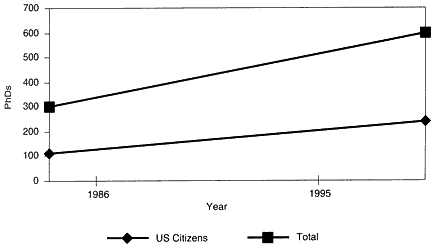
FIGURE 3.1 Materials science and engineering PhDs awarded, 1986–1995.
US citizens. The percentage going to citizens has remained at 40% for the period. Much has been written about dependence on noncitizens and whether it should be of concern. With the growth of high-tech education and industry in the Asian countries from which many of these noncitizens come, it seems probable that opportunities will expand for their return to their own countries, thereby reducing the net supply of trained scientists in the United States.
Tables 3.7 and 3.8 provide information on employment and occupational status, respectively, of PhDs in materials science in the United States. Figure 3.2 shows employment status. More than 60% of graduates consistently go to work in industry.
ASM-International has compiled a listing of materials faculties (ceramics, materials, metallurgy, and polymers) at educational institutions around the world (except for those in the former Soviet republics). Of these faculties, 169 are in North America (126 in the United States, 32 in Mexico, 11 in Canada), 117 are in Western Europe (40 in France, 28 in Great Britain), 27 are in Eastern Europe (not including the former Soviet republics), 84 are in Asia (29 in Japan, 19 in China), and 21 are in South America (dominated by Brazil with 20). The 85 Accreditation Board for Engineering and Technology (ABET) accredited undergraduate programs in the United States are divided into three main groups. Fifty are in the materials engineering group (28 of these are designated materials science and engineering), 22 are in the metallurgy group, and 11 are in the ceramic engineering group. One university has an accredited undergraduate program in welding engineering and there is 1 in plastics engineering. Two-thirds of the materials-related faculties at US institutions offer undergraduate degree programs.
The figures and tables presented here do not tell the complete story about graduates in materials-related programs, however. At the graduate level, some materials research and development programs occur in joint departments; others are department nonspecific. Part of the reason for this is the increasing role of computation in materials science and engineering, which often is carried out in other departments. Many PhD programs with a strong focus on materials are found in departments where materials is not the sole focus. This is particularly true for polymers, biomaterials, composites, catalysts, and electronic materials, among others. For example, there are 16 programs in polymer science in the United States, but most graduate students in polymers study in departments of chemistry and chemical engineering. Electrical engineering departments produce most of the graduates in semiconductor, magnetic, and optical–photonic materials. This makes an accurate accounting of the size and trends in graduate education difficult, but it does provide a picture of the diversity that enriches the field.
Data on women and minorities are shown in Table 3.9 and in Figures 3.3–3.5. Table 3.7 shows that the percentage of women PhDs in
TABLE 3.7 US Employment Status of Materials Science and Engineering PhDs, 1985-1995
|
|
Survey Year |
|||||
|
|
1985 |
1987 |
1989 |
1991 |
1993 |
1995 |
|
Tenured and tenure track faculty |
92 |
95 |
249 |
209 |
337 |
426 |
|
Tenured Faculty |
46 |
52 |
146 |
89 |
173 |
248 |
|
Tenured Track Faculty |
46 |
43 |
103 |
120 |
164 |
178 |
|
Other Academic Positions |
30 |
33 |
40 |
134 |
198 |
269 |
|
Postdoc Appointments—Academic |
2 |
33 |
44 |
17 |
120 |
166 |
|
2 Year College Faculty |
0 |
0 |
0 |
0 |
0 |
0 |
|
Industry |
944 |
1495 |
1443 |
1946 |
2073 |
2592 |
|
Fed & Other Gvt Positions |
23 |
38 |
85 |
121 |
171 |
234 |
|
Self Employed & Others |
115 |
10 |
22 |
97 |
95 |
192 |
|
Postdoc Appointments—Other |
67 |
9 |
11 |
0 |
88 |
82 |
|
Unemployed & Seeking |
0 |
4 |
27 |
34 |
35 |
90 |
|
Elementary & High School Teachers |
0 |
0 |
0 |
0 |
0 |
0 |
|
TOTAL |
1273 |
1717 |
1921 |
2558 |
3117 |
4051 |
|
Tenured and Tenure Track Faculty |
7.2% |
5.5% |
13.0% |
8.2% |
10.8% |
10.5% |
|
Tenured Faculty |
3.6% |
3.0% |
7.6% |
3.5% |
5.6% |
6.1% |
|
Tenured Track Faculty |
3.6% |
2.5% |
5.4% |
4.7% |
5.3% |
4.4% |
|
Other Academic Positions |
2.4% |
1.9% |
2.1% |
5.2% |
6.4% |
6.6% |
|
Postdoc Appointments—Academic |
0.2% |
1.9% |
2.3% |
0.7% |
3.8% |
4.1% |
|
2 Year College Faculty |
0.0% |
0.0% |
0.0% |
0.0% |
0.0% |
0.0% |
|
Industry |
74.2% |
87.1% |
75.1% |
76.1% |
66.5% |
64.0% |
|
Fed & Other Gvt Positions |
1.8% |
2.2% |
4.4% |
4.7% |
5.5% |
5.8% |
|
Self Employed & Others |
9.0% |
0.6% |
1.1% |
3.8% |
3.0% |
4.7% |
|
Postdoc Appointments—Other |
5.3% |
0.5% |
0.6% |
0.0% |
2.8% |
2.0% |
|
Unemployed & Seeking |
0.0% |
0.2% |
1.4% |
1.3% |
1.1% |
2.2% |
|
Elementary and High School Teachers |
0.0% |
0.0% |
0.0% |
0.0% |
0.0% |
|
|
Source: Analysis conducted by the National Research Council's Office of Scientific and Engineering Personnel of data from Survey of Doctorate Recipients (SDR) for this study. |
||||||
materials-related subfields in the physical sciences is greater (17.4%) than is the percentage of women PhDs in materials-related subfields in engineering (15.9%). As a percentage of the total number of women PhDs in the physical sciences and engineering, the percentage of PhDs in materials-related subfields in the physical sciences (6.1%) is lower than is the corresponding percentage (15.3%) in engineering.
Table 3.10 shows that, among the G-7 nations,
-
Italy ranks first for percentage of first degrees to women in the natural sciences;
TABLE 3.8 US Occupational Status of Materials Science and Engineering PhDs, 1985-1995
|
|
Survey Year |
|||||
|
|
1985 |
1987 |
1989 |
1991 |
1993 |
1995 |
|
Total Research |
857 |
1062 |
1200 |
1507 |
2127 |
2379 |
|
Basic Research |
79 |
93 |
206 |
186 |
245 |
229 |
|
Applied Research |
713 |
801 |
793 |
914 |
1209 |
1244 |
|
Development |
65 |
168 |
201 |
407 |
673 |
906 |
|
Research Management |
251 |
250 |
244 |
349 |
N/A |
N/A |
|
Management Other |
26 |
0 |
4 |
29 |
N/A |
N/A |
|
Management |
N/A |
N/A |
N/A |
N/A |
351 |
501 |
|
Teaching |
10 |
39 |
79 |
90 |
187 |
284 |
|
Professional Services |
0 |
0 |
0 |
0 |
5 |
26 |
|
Consulting |
2 |
10 |
0 |
98 |
N/A |
N/A |
|
Computing |
N/A |
N/A |
N/A |
6 |
18 |
111 |
|
Other Work Activities/No Response |
127 |
352 |
367 |
445 |
394 |
660 |
|
Federal Support |
521 |
777 |
994 |
1107 |
970 |
1436 |
|
No Federal Support/No Response |
752 |
936 |
900 |
1417 |
2112 |
2525 |
|
Total |
1273 |
1713 |
1894 |
2524 |
3082 |
3961 |
|
Total Research |
67.3% |
62.0% |
63.4% |
59.7% |
69.0% |
60.1% |
|
Basic Research |
6.2% |
5.4% |
10.9% |
7.4% |
7.9% |
5.8% |
|
Applied Research |
56.0% |
46.8% |
41.9% |
36.2% |
39.2% |
31.4% |
|
Development |
5.1% |
9.8% |
10.6% |
16.1% |
21.8% |
22.9% |
|
Research Management |
19.7% |
14.6% |
12.9% |
13.8% |
N/A |
N/A |
|
Management Other |
2.0% |
0.0% |
0.2% |
1.1% |
N/A |
N/A |
|
Management |
N/A |
N/A |
N/A |
N/A |
11.4% |
12.6% |
|
Teaching |
0.8% |
2.3% |
4.2% |
3.6% |
6.1% |
7.2% |
|
Professional Services |
0.0% |
0.0% |
0.0% |
0.0% |
0.2% |
0.7% |
|
Consulting |
0.2% |
0.6% |
0.0% |
3.9% |
N/A |
N/A |
|
Computing |
N/A |
N/A |
N/A |
0.2% |
0.6% |
2.8% |
|
Other Work Activities/No Response |
10.0% |
20.5% |
19.4% |
17.6% |
12.8% |
16.7% |
|
Federal Support |
40.9% |
45.4% |
52.5% |
43.9% |
31.5% |
36.3% |
|
No Federal Support/No Response |
59.1% |
54.6% |
47.5% |
56.1% |
68.5% |
63.7% |
|
Source: Analysis conducted by the National Research Council's Office of Scientific and Engineering Personnel of data from Survey of Doctorate Recipients (SDR) for this study. |
||||||
-
France ranks first for percentage of first degrees to women in engineering;
-
The United States ranks third for percentage of first degrees to women in the natural sciences as well as in the percentage of first degrees to women in engineering; and
-
Japan ranks last in percentage of first degrees to women in the natural sciences and engineering.
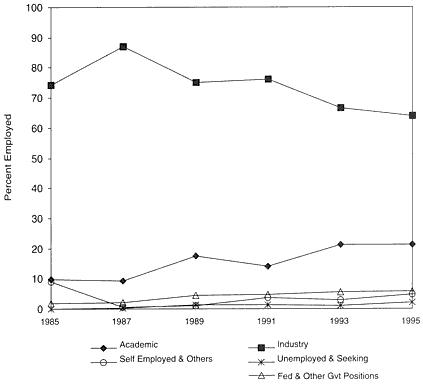
FIGURE 3.2 Employment status of PhD materials scientists, 1985. Source: Analysis conducted by the National Research Council's Office of Scientific and Engineering Personnel.
As shown in Figure 3.3, metallurgical–materials engineering has a significantly lower representation of black, non-Hispanic graduate students than do all engineering (Figure 3.4) and the sciences (Figure 3.5). Metallurgical–materials engineering has a substantially greater representation of noncitizens among graduate students than do all engineering and the sciences. The percentage of foreign students is only 7.1% lower than that of white, non-Hispanic graduate students.
3.6 Funding
Obviously, adequate funding is a necessary element of any research effort. Because the US innovation system has many funding sources and because materials science is a diverse field, it is difficult to determine the amount of funding, much less judge its adequacy. During the Bush Administration, the Federal Coordinating Council for Science, Engineering, and Technology (FCCSET) undertook a broad analysis of federal
TABLE 3.9 Number of Doctorate Recipients by Gender and Subfield
|
|
Number |
|
|
Percentage |
|
|
Field and Subfield |
Total |
Men |
Women |
Men |
Women |
|
Physical Sciences |
6,806 |
5,307 |
1,499 |
78.0 |
22.0 |
|
• Physics |
|
|
|
|
|
|
Polymer |
23 |
20 |
3 |
87.0 |
13.0 |
|
Solid-state and low temperature |
371 |
314 |
57 |
84.6 |
15.4 |
|
• Chemistry |
|
|
|
|
|
|
Polymer |
116 |
88 |
28 |
75.9 |
24.1 |
|
• Earth, atmosphere, and marine |
|
|
|
|
|
|
Minerology and petrology |
19 |
15 |
4 |
78.9 |
21.1 |
|
Totals |
529 |
437 |
92 |
82.6 |
17.4 |
|
Percentage of physical sciences |
7.8 |
8.2 |
6.1 |
|
|
|
Engineering |
6,007 |
5,313 |
694 |
88.4 |
11.6 |
|
• Ceramic sciences |
39 |
34 |
5 |
87.2 |
12.8 |
|
• Materials sciences |
476 |
392 |
84 |
82.4 |
17.6 |
|
• Metallurgical |
73 |
68 |
5 |
93.2 |
6.8 |
|
• Mining and mineral |
19 |
19 |
0 |
100 |
0 |
|
• Polymer and plastics |
58 |
46 |
12 |
79.3 |
20.7 |
|
Totals |
665 |
559 |
106 |
84.1 |
15.9 |
|
Percentage of engineering |
11.1 |
10.5 |
15.3 |
|
|
|
Source: Appendix A, Table A-1 from the NRC Survey of Earned Doctorates. |
|||||
support in several research areas, one of which was materials. The results for all agencies for fiscal years 1992, 1993, and 1994 are shown in Figure 3.6 and Table 3.11. Updated information for NSF's Division of Materials Research is shown in Figure 3.7. The average annualized award size for that division compared with others within NSF's mathematics and physical sciences directorate is shown in Figure 3.8. At
TABLE 3.10 Percentage of First Degrees in Science and Engineering to Women, G-6 Nations
|
Country |
Natural Sciences |
Engineering |
|
Italy |
54 |
8 |
|
United Kingdom |
44 |
26 |
|
United States |
42 |
16 |
|
Germany |
40 |
11 |
|
France |
35 |
19 |
|
Japan |
19 |
4 |
|
Source: Table derived from S&E Indicators, Appendix Table 2-5. |
||
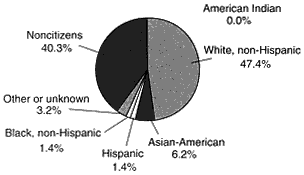
FIGURE 3.3 Metallurgical-materials engineering graduate students in all institutions, by race-ethnicity and citizenship, 1993. Source: National Science Foundation, Women, Minorities, and Persons with Disabilities in Science and Engineering: 1996, NSF 96-311.
about $125,000 each, awards for materials research were exceeded only by physics awards at about $170,000 each. Figure 3.9 shows the budget for permanent equipment, which in 1996, was about $18 million. Approximately 20% of the fiscal year 1998 request from NSF was for facilities.
Materials research and development is defined broadly here to include scientific and engineering research on substances in any form and at any stage of preparation, fabrication, manufacture, recycle, or
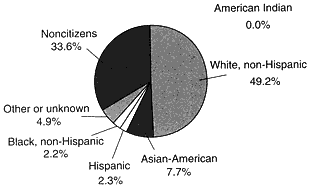
FIGURE 3.4 All engineering graduate students in all institutions, by raceethnicity and citizenship, 1993. Source: National Science Foundation, Women, Minorities, and Persons with Disabilities in Science and Engineering: 1996, NSF 96-311.
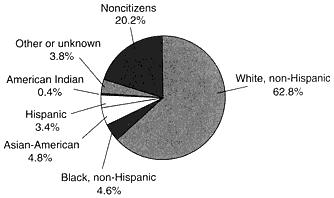
FIGURE 3.5 All science graduate students in all institutions, by race-ethnicity and citizenship, 1993. Source: National Science Foundation, Women, Minorities, and Persons with Disabilities in Science and Engineering: 1996, NSF 96-311.
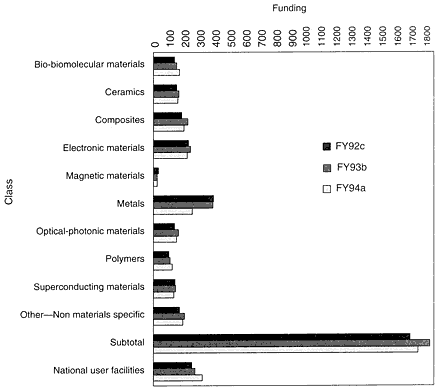
FIGURE 3.6 Federal R&D budget by materials class, in millions of US dollars. Excludes classified research and development and most development activities funded under DOD's specific systems R&D programs. a, President's budget request; b, congressional appropriations; c, actual expenditures
TABLE 3.11 Federal R&D Budget for Materials Research by Agency, in Millions of US Dollars
|
Agency |
Year |
Total Program |
|
Department of Commerce |
FY94a |
56.7 |
|
|
FY93b |
48.4 |
|
|
FY92c |
42.6 |
|
Department of Defensed |
FY94 |
421.7 |
|
|
FY93 |
557.7 |
|
|
FY92 |
530.9 |
|
Department of Energyd |
FY94 |
941.5 |
|
|
FY93 |
914.0 |
|
|
FY92 |
862.5 |
|
Department of the Interior |
FY94 |
21.5 |
|
|
FY93 |
24.9 |
|
|
FY92 |
25.2 |
|
Department of Transportation |
FY94 |
12.7 |
|
|
FY93 |
14.9 |
|
|
FY92 |
11.0 |
|
Environmental Protection Agency |
FY94 |
4.5 |
|
|
FY93 |
4.5 |
|
|
FY92 |
3.5 |
|
Health and Human Services |
FY94 |
92.9 |
|
|
FY93 |
85.9 |
|
|
FY92 |
79.6 |
|
National Aeronautics and Space Administration |
FY94 |
131.1 |
|
|
FY93 |
102.8 |
|
|
FY92 |
76.3 |
|
National Science Foundation |
FY94 |
328.0 |
|
|
FY93 |
303.6 |
|
|
FY92 |
265.6 |
|
United States Department of Agriculture |
FY94 |
45.8 |
|
|
FY93 |
37.4 |
|
|
FY92 |
36.3 |
|
Note: Total program includes construction and operating costs for major national user facilities. a President's budget request. b Congressional appropriations. c Actual expenditures. d Excludes classified research and development and most development activities funded under DOD's specific systems R&D programs. |
||
disposal. Program types vary and include basic research and technology development, device or process development, and the gathering or analysis of data on various materials. The fiscal year 1994 budget contains significant activities in synthesis and processing and in theory, modeling, and simulation. These two components were emphasized in a major National Research Council (1989) study on materials science and
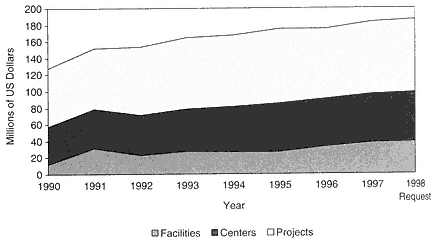
FIGURE 3.7 National Science Foundation Division of Materials Research Budget, 1990–1998, in millions of US dollars. Source: http://www.nsf.gov/mps/dmr/chart1.htm with updated information.
engineering that incorporated considerable input from industry. The FCCSET study concludes that the budget provided adequate funding to achieve breakthroughs in energy, environment, health and safety, information and communication, infrastructure, national security, and transportation. However, this conclusion was reached before more
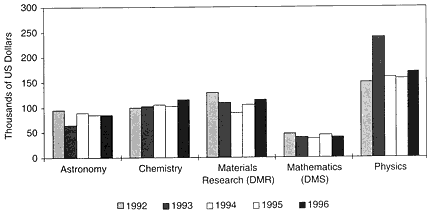
FIGURE 3.8 National Science Foundation Directorate for Mathematical and Physical Sciences, average annualized award size, competitive research grants, 1992–1996, in thousands of US dollars. Includes instrumentation awards and programs such as PFF, NYVPYI, and CARCCR. Source: http://www.nsf.gov/mps/portfoli/maverage.htm.
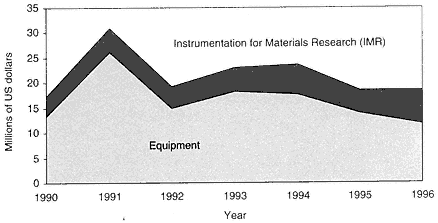
FIGURE 3.9 National Science Foundation Division of Materials Research, permanent equipment budget, 1990–1996, in millions of US dollars. Source: http://www.nsf.gov/mps/dmr/chart1.htm with updated information.
recent drawdowns in federal investment in research and development (OSTP 1995).
The percentage of research and development investment for materials and industrial technology within the European Union increased from 11% in 1984 to 16% in 1987 and has stayed constant. Materials technologies constituted 9.1% of Eureka projects in 1992. Eureka is a cooperative effort in research and development (outside the European Union program) geared toward industrial and applied research and development (NSF 1996).
In general, it is important to note that several successful nations in high-tech industries (e.g. Japan) follow a different paradigm and strategy in allocating research resources.
4
BENCHMARKING RESULTS
4.1 Approach
The approach taken by the Panel to assess the strength of the field of materials research in the United States relative to other countries was as follows:
-
By communicating with colleagues in the United States and abroad, panel members scripted the content of a fictitious international conference covering the nine subfields of materials science and engineering. Panel members asked colleagues to identify 5 or 6 ''hot topics" in each subfield and 8 to 10 of the very best people in the world working in each topical area.
-
The top 3–4 awards and prizes given in each area and their recipients for the past five years were identified.
-
The most significant advances in materials science and engineering research of the past five years were identified.
-
Assessments of the state of research in each topical area in the United States compared with that of other nations were solicited.
-
The leading journals or other periodicals that could be used as references for the assessment were identified.
The information was used to construct tables that characterize the relative position of the United States in each of 9 subfields now and in the future (Appendix B). The first half of each table ranks the current US position relative to the world materials community for each subfield. A scoring system, with 1 representing "forefront", 3 representing
"among world leaders", and 5 representing "behind world leaders", was used. The second half of each table is an assessment of the likely future position of the United States relative to the world materials community. Here 1 represents ''gaining or extending", 3 represents "maintaining", and 5 represents "losing". Although the conference approach does not constitute a systematic assessment and is somewhat subjective, it is the same approach leaders of the field would use to organize world conferences to feature the "best of the best." And in conducting this analysis, panel members relied not only on their own judgment but that of their colleagues.
A report from the United Kingdom (UK 1997) compared by field and country the number of total publications and the relative citation impact. The top 5 countries for the materials science field by total citations are:
-
United States
-
Japan
-
Germany
-
United Kingdom
-
France
The measure used in the United Kingdom report, "relative citation impact", is the country's share of the world's citations in the field, divided by its share of world publications in the field. It can be thought of as a comparison of a country's citation rate for a particular field with the world's citation rate for the field. A relative citation impact greater than 1 shows that the country's rate for the field is higher than the world's. According to the report, it is a measure of both the influence and the visibility of a country's research (as disseminated through publications) and it gives some indication of the quality of the average paper. The top 5 countries by relative citation index are:
-
United States
-
Denmark
-
Netherlands
-
Israel
-
Switzerland
4.2 Assessment of Current Leadership
US research in materials science and engineering is strong, based on assessment of the subfields. Across subfields, US researchers are among the world leaders. Within subfields there are a few topical areas in which the United States is at the forefront and a few topical areas where the US has little presence or is behind the world leaders. (A general example of the latter is in materials synthesis and processing,
where greater scientific emphasis is needed here. Europe is probably ahead in synthesis, and Japan leads in processing. If US universities were to focus research more on "green" processing for sustainable development, US industry could benefit.) For most subfields and topics, however, the United States ranks among world leaders. Comments on the analysis of each of the subfields are found below.
4.2.1 Biomaterials
The subfield of biomaterials involves at least four classes: synthetic or modified natural materials used in medicine and biology; natural materials or artificial materials that emulate natural materials; "smart" materials, such as those that respond to a specific stimulus; and hybrid materials consisting of synthetic and living cellular components.
Much of the research in biomaterials originated in the United States, and the country still maintains an intellectual lead in most areas, particularly basic research. This is suggested by the number of US keynote and plenary speakers at international conferences and by the number of US scientists who receive major awards in the field. The biomaterials industry contributes a positive balance of payments for the United States. The applications of biomaterials also helps the US economy by reducing the cost of health care.
The factors that influence US performance in biomaterials include a strong basic research organization that offers graduate and postdoctoral students opportunities to study, the ethnic diversity in our graduate and postdoctoral student populations, strong journals, a strong medical device industry, venture capital–commercialization potential, and the sheer number of researchers in the field.
The current hot topics are in tissue engineering, protein analogues, molecular architecture, biomimetics (bone-like material), contemporary diagnostic systems, advanced controlled-release systems, and bone materials. The United States is currently at the forefront in tissue engineering, protein analogues, and advanced controlled-release systems. It is among the world leaders in all other areas. The United States is seeing strong competition from Germany and Japan in molecular architecture. There are some areas of biomaterials research in which the United States no longer is the clear leader: hydrogels, proteins at interfaces, artificial hearts, surface molecular engineering sensors, and diagnostics.
4.2.2 Ceramics
Most consumers think of "ceramics" as freezer-to-oven cookware— this wide application for glass ceramics is possible because of the materials' low expansion coefficient and ability to withstand a range of temperatures without cracking.
There have been only a few applications for tailored ceramics based on their thermostructural and electromechanical properties because of their relatively high cost and underdeveloped design and reliability protocols. The most significant application has been as electronic substrates (mostly alumina), as well as some commercialization of SiC and Si3N4. The latter are being used as wear components in the industrial sector and as valves and bearings primarily in aerospace applications. Further implementation is expected to be controlled primarily by the success of initiatives that reduce the manufacturing cost. Although research funding in this area is declining worldwide, new areas of activity are providing important opportunities for basic research that should be exploited if the United States is to remain in the forefront. Four of these are as follows:
-
The use of Microeclectromechanical systems (MEMS) based mini-heat engines, made from SiC, as small high-power-density energy sources constitute an exciting initiative. For example, gas turbine engines, rocket engines, and coolers about a centimeter in diameter and a few millimeters thick that should produce power and pump heat in the 10–100 W range could be made using MEMS technology. Ceramics appear to be perfect for this implementation because the small component size mitigates the weakest-link nature of ceramics' mechanical strength.
-
Recently discovered single-crystal ferroelectrics offer a completely new range of options as actuators and capacitors and in robotics.
-
High thermal conductivity, low-expansion dielectrics, such as AlN, needed for heat dissipation in power electronics, are being developed by industry with minimal basic research.
-
High-performance films and coatings for thermal protection (ZrO2 alloys), lubrication and durability (diamondlike coatings, TiN), and implants (hydroxyapetite), among other uses, are being exploited by US industry. An invigorated academic effort is needed in films and coatings.
The United States and Japan share leadership in ceramics: Japan dominates in manufacturing technology, and the United States leads in basic research. There are also strong research activities in Germany.
In the field of functional–electronic ceramics, the United States is among the world leaders in all areas other than integrated micromagnetics; Japan is the clear leader there. Current forefront areas include microwave dielectrics, sol-gel-derived materials, self-assembled materials, thin-film synthesis, three dimensional microporous silicates, multilayer ferrite processing, and integrated micromagnetics on silicon.
Although US research in ceramics is in a world leadership position, the companies that capitalize on that research are Japanese-owned.
This question is the subject of another COSEPUP study to be released later this year.
4.2.3 Composites
The United States has been a leader in the development of polymer, metal, and ceramic matrix composites over the past 30 years. Vigorous efforts in France and Japan have matched those here, in some cases. There also have been several important discoveries in the United Kingdom. The activity has mostly found application in aerospace and has been supported almost exclusively by the Department of Defense (DOD) and the National Aeronautics and Space Administration (NASA). More recently, there has been significant activity in the automotive and energy sectors, with Department of Energy (DOE) support. Federal support for this research at universities has essentially stopped, because of changing DOD, DOE, and NASA priorities. The remaining, relatively small academic efforts in academia are supported largely by industry, are very applied, and have short-term goals. Thus, continued leadership in this field is uncertain.
In polymer composites, a new approach to design and manufacturing that cuts costs has begun to replace the "black aluminum" approach. The "black aluminum" method, used for decades to design polymer composites, is a design protocol that treats composites as if they were metals, using the same types of data and the same design rules. The problem with this approach is that the real advantages that could accrue to using composites are negated at the outset. This has been done for decades because of conservatism. Only now are new design approaches that take advantage of the attributes of composites (and as anisotropy, integrated structures) being implemented. The new method uses low-temperature-curing polymers for matrices. Electron beams achieve homogeneous curing. This combination produces fewer distortions and enables the manufacturing of large integral components. There are significant opportunities for new basic research as the technology progresses in industry. These include the development of low-temperature-curing polymers with greater toughness and higher glass transition temperatures and design-and-testing protocols explicitly relevant to large integral components along with included subelements.
Ceramic matrix composites are important for the aerospace and energy sectors. Industry activity is appreciable; federal support comes primarily from NASA and DOE. There are exciting new developments in all-oxide composites that could survive high temperatures in aggressive environments. The basic research needed to support the development and use of these materials includes studies of oxide–oxide bonding, creep, internal friction, and delamination. The issues are addressed in the new National Materials Advisory Board report, Advanced Fibers for High Temperature Ceramic Composites (NRC 1997).
Major shifts in emphasis are occurring in research on metal matrix composites because of new applications in the aerospace, communications, electronics, and automotive industries. These applications are primarily based on aluminum alloys reinforced with SiC or Al2O3, as particles, whiskers, or fibers. These materials have become less expensive to produce, they are fairly rigid (an advantage when combined with acceptable toughness and ductility), and have high fatigue thresholds. They are useful in electronic applications because of their low thermal expansion coefficients and high thermal conductivity. The effort to develop in titanium matrix composites reinforced with SiC fibers has nearly stopped in the United States because of the great expense involved. Research continues in Japan, China, and the United Kingdom.
With the much-diminished DOD emphasis on structural materials, basic research on composites has decreased dramatically in the past 2 years. This is happening as new applications are emerging and new opportunities have arisen for basic research. The exception is in smart materials and systems. Here, the polymer composite is a host for sensors and actuators that enable shape changes to be accomplished with rapid response times. A major effort is continuing in this area in the United States.
Current hot topics in research include smart composites that incorporate sensors and actuators, polymer matrices for ambient curing (for example with electron beams), the manufacture of large integrated components, high-temperature oxide materials, the tailored use of preferred crystallographic textures, and particle-reinforced alloys. In this last area, there is an opportunity to extend the crack-arresting concepts that have been applied to metal matrix composites to other materials, particularly titanium alloys, and to elucidate at a fundamental level how improved fatigue performance can be achieved by reinforcement.
4.2.4 Magnetic Materials
Research on magnetism and magnetic materials, which in the US has been strongly influenced by applications, has declined since the 1970s. There were major breakthroughs in hard and soft magnetic materials (Allied developed soft amorphous materials and General Motors and Sumitomo developed neodymium–iron–boron permanent magnets), but markets were not large enough to support a large research community. In Europe and Japan, on the other hand, basic research in dilute magnetic alloys and critical phenomena sustained an interest in magnetism and led to investment in the necessary support facilities, such as neutron sources and high magnetic fields. Two of the hot areas of recording today, giant magnetoresistance and spin-dependent tunneling, were discovered in France.
In the 1980s a "killer application" developed in the United States— digital magnetic recording for computer systems. This is now more than a $50 billion industry. The technology was developed mainly at IBM, and US companies such as IBM, Seagate, and Quantum are the market leaders.
Although magnetic studies largely disappeared from US universities in the 1970s, there has been a concerted effort over the past 2 decades to rebuild interest. There are now several centers for magnetic materials study as part of engineering schools, and basic research efforts are small but growing. One measure of US participation in magnetic materials research is the annual conference on Magnetism and Magnetic Materials. Figure 4.1 shows that, since 1989, the United States has contributed a consistent and respectable percentage of papers to this conference.
Giant magnetoresistance is being used as the reading element in high-density recording heads through a structure known as a spin valve, which consists of two thin magnetic films with different coercivites separated by a very thin (20Å) conductor. The application of spin valve heads requires a fundamental understanding of the magnetic interactions within and between the films. Thus, the area of magnetic interfaces is also hot. How these materials behave with temperature and their corrosion resistance are active areas of research.
Large magnetoresistance effects have been observed in manganeseoxide perovskites. The effect is so large, it is called "colossal" magnetoresistance. Although the recording community does not believe these materials will compete with spin valves, their structural similarities to high-temperature superconductors has generated interest in the United States and abroad.
The recent discovery of giant magnetostriction in a new class of materials–shape memory alloys that are magnetic—promises to produce another hot area. Researchers at the University of Minnesota and the University of Maryland have observed magnetostriction of 1.2% in single crystal, prestressed NiMnGa. These materials could replace piezoelectrics in many applications where a more robust material and larger strain is required. They already appear superior to the rare-earth-containing materials such as Terfenol.
The current forefront topics in magnetic materials are nanostructures, colossal magnetoresistance, magnetic multilayers including magnetic properties of thin layers (first-principles calculations and micromagnetics), magnetic coupling between layers (anisotropic exchange and biquadratic exchange), and transport (giant magnetoresistance and tunneling). Disk storage has become the driver for research in the United States, and university centers are being developed. Although the United States is at the forefront in the device area, solid basic research is being done at centers elsewhere.
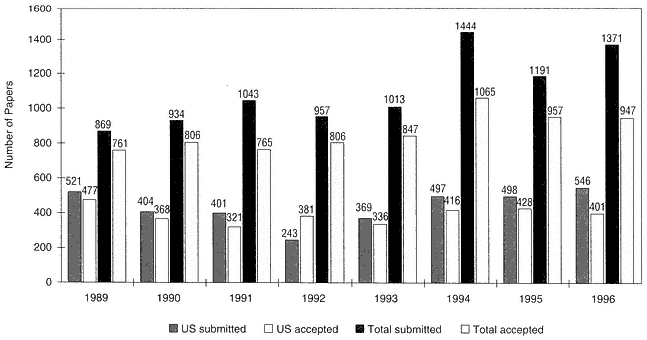
4.2.5 Metals
The performance of almost any product is limited by the materials of which it is made, and in many products, space vehicles, for example, the value of overcoming performance barriers is quite high. In automobiles, the value of improved performance is less well understood, but is currently motivated by energy efficiency targets while constrained by cost. These considerations become important as more of the drive for improved materials performance comes from industry sectors other than defense.
The cost and time required to develop and deploy new materials are a major problem regardless of the application or industry. Product development times have been and will continue to be dramatically shortened, but the time it takes to develop new materials development has not been reduced significantly, and this creates a barrier to achieving optimum final product performance. One key to solving the cost and time constraints for materials development is computational materials science and engineering. Modeling, simulation, and experimentation are used to study
-
Materials synthesis;
-
Microstructure evolution (precipitation, recrystallization, phase transformation, defect structures, grain boundaries);
-
Plastic deformation behavior;
-
Materials performance and properties (strength, ductility, fracture toughness, formability, fatigue, corrosion/durability);
-
Complex processing methods (chemical, thermal, and mechanical processing of materials)*; and
-
Component and assembly performance.
This list of topics is sometimes called the structure–process–product continuum. The research aims at quantitative explanations of the relationships between processing and structure, between structure and properties, and between materials properties and product performance. Yet another way to describe this is the integration of dimensional scales—from atomic clusters to final products—and the integration of models of materials behavior, materials processing, and materials product performance to allow concurrent design of products, materials (composition and structure), and manufacturing processes.
The current hot topics in this subfield are surface treatments, net shape processes, intermetallics and other high-temperature alloys, theory and modeling, magnetoresistance, hydrogen-absorbing materials, bulk amorphous materials, quasicrystalline materials, nanostructured materials, and cellular metals. The United States is especially strong in intermetallics, theory and modeling, and advanced processing of metallic alloys to net shape.
The United States is in a leadership position in most of these subfields; however, there is significant capability in the United Kingdom, Germany, France, and Japan. There are also significant resources in Eastern Europe and Russia, but they are not necessarily well-funded and they are not as well known. The United States is lagging in research on hydrogen-absorbing materials; Germany and Japan have a strong position. Battery development for applications in computers and motor vehicles is a pull for electrode research and development. Bulk glass-forming alloys have been studied in the United States, but intensive work also is going on in Japan. The United States is at the forefront of theory and modeling of metals. The topical areas of current activity in theory and modeling include atomic bonding, crystal structure, microstructure evolution phase diagrams, and phase transformations. Good work is going on in Europe, Japan, and the United States on quantitative explanations and modeling of the plastic deformation of metals.
4.2.6 Electronic and Optical-Photonic Materials
Electronic materials encompass a broad field, with semiconductors obviously at the center. However, metals, dielectrics, ceramics and polymers also are in this group. In terms of functional applications, which are process intensive, these materials are found in even more diverse areas: lithography, interconnect, packaging, display and storage materials. Generally the United States is the world leader in most of these subfields and a close competitor in others.
In the display subfield, the United States is behind Japan in liquid crystals and widegap III-V compounds (GaN). In liquid crystals, the United States is unlikely to catch up to Japan. In the case of flat-panel displays, for example, because US industry has less than 10% of the market (most displays come from Japan with a growing number from Korea and Taiwan), future industrial research and development is likely to be limited. In widegap III-V compounds, the United States has made a major investment to try to close this lead, and the lead in Japan is expected to diminish over time.
Semiconductors have been an important subject of US materials science and engineering since the invention of the transistor and the subsequent progress made in the quality and purity of silicon and germanium. The US also led in developing compound semiconductors (GaAs) for optical, electronic and communication applications, although
these materials were first formally recognized in Germany.* As the synthesizing and processing technologies of basic materials matured, improvements were incremental and manufacturers profit margins declined. Materials suppliers consolidated and they have moved offshore, mostly to Far East Asia.
With the approach of the anticipated limit for conventional technologies in the silicon-based electronics industry, great emphasis was placed on clever design and processing and on advanced lithography. Attention also was paid to more innovative considerations in the use of silicon on insulators, silicon–germanium alloys, low-loss dielectrics, and high-conductivity metal interconnects. Again, the United States and Japan lead the field in these areas.
One exciting development in recent years is in the area of nanostructures. This started with the epitaxial and vapor phase growth of semiconductor quantum layers and now includes many material systems: self-organized particles, clusters, and tubes; caged ensembles; porous solids and surfaces; and colloidal crystallites. With feature sizes of just nanometers, these materials exhibit unusual electronic and optical properties that offer enormous opportunities in materials research and technological applications. Most of the systems were developed in the United States, which has largely maintained its leadership despite worldwide growth in research. A word of caution is called for, however. Many of the central research laboratories of the large industrial corporations initiated and carried out studies in these subfields. The redirection from basic to applied research and technology, although accelerating the US innovation process, is shifting future exploratory research to universities.
Optical–photonics materials research will provide many opportunities for exploring the most fundamental aspects of materials. Examining optical phenomena, such as imaging, holographic storage, electro–optic and photorefractive effects, optical fiber nonlinearities, and complete modeling of optical–electronic integrated circuits are subjects of great interest. Just as past exploratory materials research uncovered soliton and other phenomena, the current basic research being devoted around the globe to the fabrication and theoretical modeling of photonic bandgap materials should yield exciting and unexpected results.
Wavelength-selectable, blue-green, all-solid-state, and microlasers are internationally hot topics. Recent breakthroughs in photonic
bandgap and lattice engineering, and in atomic layer epitaxy, provide unprecedented possibilities for leaps in device and component research. These materials-processing methods also should contribute to even more rapid progress in electronic–photonic integration. Much also is expected from MEM research, which will continue to provide a powerful tool for miniaturization of mechanical systems.
Organic materials have become the subject of exciting optical–photonic research. Organic lasers, organic light-emitting diodes, all-organic transistors, and plastic fibers are receiving global attention within small, focused research groups and also from larger development organizations. The United States and others are equivalent in these areas. The United States has established a substantial lead in another area—the fabrication of complex, optically functional surfaces, components, and devices using elastomers as starting materials. Polymeric replicas, patterned with microstructures on their surfaces, are fabricated and used to construct lenses, mirrors diffraction gratings, and photothermal detectors. The clear lead of the United States in this new area is not expected to persist.
US competitiveness in photonics and microelectronics has been well served by the establishment of academic centers. Strong support for these facilities through the National Science Foundation is vital. US industrial–academic partnerships also are needed to advance the research required to win the global competition in optical networking.
The United States is currently among the leaders or at the forefront in optical–photonic and electronic materials. Forefront topics include wide direct-gap and wide indirect-gap semiconductors, wafer bonding, oxide confinement in vertical cavity surface emitting lasers, interconnects (copper and low-K dielectrics), engineered optical materials (periodically poled nonlinear optical materials and engineered organic and polymeric materials for nonlinear optics), nanostructured materials, magnetoresistive materials, holographic storage materials, photonic bandgap materials, and packaging.
More information is available in a recent report from the NRC Committee on Optical Science and Engineering (COSE) entitled Harnessing Light: Optical Science and Engineering for the 21st Century (NRC, 1998). This report discusses the state of the optics industry and of research and education in optics, and identifies actions that could enhance the field's contribution to society and facilitate its technical development.
4.2.7 Superconducting Materials
US scientists are in a strong leadership position in nearly all subtopical areas of superconducting materials, but they do not dominate in any. The United States has been at the forefront in elucidating fundamental physical properties and in developing the theory for Hi
temperature superconductors (HTSCs), although theory thus far has been unable to account for all verified experimental observations. In establishing the electronic structure of complex cuprate superconducting compounds, the United States is sharing its forefront position with Japan and Germany. The discovery of new superconducting materials around the world has involved as much luck as it has deliberate science-based research. Leadership in this area could shift rapidly when the next important compound is discovered. The United States has enjoyed leadership in the development of magnetic phase diagrams of HTSCs and in the modeling flux pinning and critical phenomena. However, Europe also has shown particular strength in statistical mechanical modeling and in the development of direct imaging techniques for delineating flux line patterns. A relative decline in the fraction of peer-reviewed papers in this field by US investigators is an indicator of the growing competition in basic research world wide.
On the technological front, the United States and Japan appear to be neck-and-neck in most important development areas, especially in bulk superconducting cables, thin-film devices, instrumentation, and power equipment. In technologically important areas, however, it is difficult to assess the degree of US leadership; many advanced developments are being conducted as joint ventures between US companies and their partners in Europe and Japan. Also, many such important cutting-edge developments are closely held.
Early successes in Japan with melt texturing and powder-in-tube processing are now being matched and perhaps exceeded in the United States, but these methods could be replaced by new approaches. For example, a major development in the US is the processing of long-length conductors based on the deposition of highly-textured YBCO on textured metal substrates. Leadership in this area could shift rapidly to the research who successfully replaces plasma laser deposition or evaporation with a low-cost, high-rate process involving metallorganic or chemical vapor deposition. This is an area in which industrial effort dominates in Japan; US industry developments are strongly coupled to work at the national laboratories.
Leadership in the development of rare-earth HTSCs for levitation or energy storage applications is currently shared by the United States and Japan, with Japan in front based on successes with the Nd-123 system. Japan has targeted this area to replace low-temperature superconducting magnets with trapped-field magnets for levitated-train designs.
Electronic application of thin-film superconductors has enjoyed considerable success in the United States because of the strong interest in the use of HTSCs for radio frequency and microwave filters for communications. US leadership in this area has been largely aided by DOD investments in the development of HTSCs for military communications, sensing, and computing.
Research challenges are in the development of phase-pure materials, processing issues, magnetic phase diagrams, electric current transport, and the modeling of transport and critical phenomena. A continuing challenge is the development of a successful comprehensive theory for high-temperature superconductivity.
4.2.8 Polymers
In general, research in polymers is at an exciting stage, and the United States enjoys a strong world position in many areas. The field of polymers is broad and its foundations span from basic chemistry for synthesis to mechanical engineering for processing. Most early research, except some done in academic laboratories in Europe, was done by industry. The field continues to be dominated by chemists and chemical engineers and has only recently been brought under the umbrella of ''materials" within the United States. This trend offers a great opportunity for multi-disciplinary research and education.
Polymer research is done in many US universities, both within stand-alone departments and degree programs and by individual investigators who are often found in departments of chemistry or chemical engineering. Academic research in the United States compares well with the rest of the world, despite some powerful research institutions abroad: The Max Planck Institute in Mainz, Germany, for example, enjoys generous long-term funding. Many universities in Japan have strong centers of long standing, for example, at the University of Kyoto. Others are rapidly developing in China, Korea, Taiwan, and Brazil. University-based polymer research in the US scaled to commercial activity is small in comparison with many other university thrust areas.
Leadership of the United States in polymer research is tied to developments in industry and the great economic importance of polymers. Several US companies have had centers of excellence in polymer research, and many products currently on the market were discovered and developed in these laboratories. These laboratories were the envy of the world, and they have been widely emulated. Industrial polymer research is still strong in the United States, but trends of downsizing and a shorter term focus are taking their toll on the rate of innovation; perhaps more so here than abroad.
Among the hot topics is the revolution in the polyolefin industry with the advent of metallocene catalysts that permit unprecedented control of molecular structure and size. Large investments are being made in new manufacturing as a result of this research. The activity is global, but the United States is in a strong leadership position. There is strong research in multicomponent polymer systems around the world, and the United States is a leader. Much of the work is being done with strong university–industry interactions because of the important commercial value of such products. Other forefront topics are biosyn-
thesis, free-radical polymerization, multicomponent systems such as ceramic–organic copolymers, and three-dimensional polymer dendrimers. Major growth areas for polymer applications are separation media, barrier coatings, and packaging; biomedical uses, such as drug delivery and implants; and electronic–photonic applications, such as displays and resists.
4.2.9 Catalysts
Catalysts are central to petroleum refining and chemical processing. They also are used widely in environmental protection technology. In the United States, the value of fuels and chemicals derived from catalysis is nearly 20% of the gross national product (CMR 1997). The annual global market for catalysts is $8 billion (Rothman 1997).
There have been 3 advances in this field of great significance in the past decade: the development of shape-selective catalysts, the development of metallocene catalysts for polymerization, and the application of catalysts for automobile emission control. Shape-selective catalysis in microporous solids is established for many industrial processes in the chemical and petroleum sectors, and the search continues worldwide for new catalysts and applications. The remarkable advances in metallocene catalysts research in the United States now used for the precise control of polymer properties in US industry are spilling over to university-based activities worldwide. The area of environmental catalysis has matured in the past 20 years. New environmental regulations adopted here and in Europe during the past decade have created a need for focused research to support technology development. Catalysis work at industrial laboratories remains strong and significant, although somewhat reduced. The area most affected is basic catalysis research at corporate research centers. For example, there have been significant losses in the petroleum sector; corporate laboratories have been closed and basic catalysis research activities have not been transferred to other divisions of these companies.
Numerous technical societies feature catalysis-related topics among their symposia, and stand-alone societies meet regularly worldwide. The North American Catalysis Society draws about 900 participants at its biannual meeting. About 40% of the papers submitted are from abroad; the European catalysis meetings typically have less than 10% US content. The base for all these meetings is work from university and industrial laboratories.
Several "catalysis centers" have been organized at US universities, although they are not large activities and many have shrunk during the past two decades. The university base for catalyst research has become more diffused as the large university centers have declined in size and as small research groups have been formed at several other universities. Catalyst research, which is generally found in university chemistry and
chemical engineering departments, has not benefited as significantly as have other areas of materials science by the migration of researchers from industry to university. Catalysis research is currently more prevalent in chemical engineering departments than it is in chemistry departments in the United States. In some cases, meaningful catalysis research is difficult to conduct in universities because of the laboratory requirements.
The United States is, and will likely continue to be, among the world leaders in industrial practice—particularly in the area of selective alkane oxidation. Although strong and viable, the US industry is small, but it is also small in the rest of the world. Support for catalyst research by companies is not nationally driven; many companies are multinational. Companies locate the catalysts they need wherever they are found in the world. Published reviews of progress in catalytic technology in Japan and Europe provide detailed information of catalytic processes developed in these areas (Roth, 1990).
Catalysis has been an area targeted for growth in most countries outside the United States because of its importance to the industrial sector. European centers of catalysis have grown in recent years. For example, in 1996, the United Kingdom formed an institute to bring its chemical industry closer to academic research (EPSCoR 1996). Similar ventures are occurring in the Netherlands and across Europe. In Germany, funding for catalysis research is associated with the need to sustain development in the chemical industry. In Japan, it has been identified as the motor for green technologies, and increased funding is going to universities. Links between universities and industrial laboratories outside the United States have become stronger than in past years.
Forefront topics in catalysis are selective oxidation, solid acid–base catalysis, novel catalyst characterization techniques, environmental catalysis (for emissions control, waste minimization, reduction of by-products, and evaluation of alternative feedstocks), asymmetric catalysis, and combinatorial catalysis.
5
PROJECTION OF LEADERSHIP DETERMINANTS
This section addresses the questions: "What are the current trends in materials science research in the United States and abroad, and what will the US position be in the near-and long-term future?"
5.1 Overview
Current and future opportunities for materials science and engineering are enormous for several reasons:
-
Knowledge of materials and how to tailor their performance economically will be an enabling element for many technologies important to the US economy.
-
US research instrumentation and computation facilities are robust.
-
There has been a resurgence of interest in processing and synthesis research. This is facilitating the establishment of high-yield, "right-first-time" manufacturing processes, and it has increased the number of pathways for creating new materials.
-
The implementation of computational methods is leading to rapid growth in our understanding of complex phenomena and to a reduction in lead time from concept to scientific feasibility.
-
The unification of the field and the growth in multidisciplinary collaborations are increasing the productivity and quality of research.
-
Graduate education in materials science and engineering is becoming more diverse. It appeals to students with bachelors' degrees in
-
many science and engineering disciplines, and it provides an array of career opportunities.
No country is in a better position than is the United States to take advantage of these factors. However, several developments could curtail our ability to fully capitalize on our strengths:
-
There has been a dramatic change in the Department of Defense (DOD) basic research funding strategy toward areas of strictly military relevance. The generic (dual use) materials research formerly funded by DOD has not shifted to other sources of federal funding. The consequence is a major (~50%) reduction in funds for nonmilitary basic materials research at the universities. This could weaken US leadership in such areas as metals, composites, and ceramics, research areas for which DOD had been a primary federal supporter (Figure 3.9).
-
The United States could become less attractive for foreign students and researchers, because of the increasing strength and funding opportunities for materials research and development elsewhere. Having fewer foreign participants could slow research capability; for decades, many prominent materials researchers have come to the United States from abroad.
-
A traditional US strength has been the availability of diverse facilities at universities conducting leading-edge materials research. With the decline in federal funding, particularly from DOD, for instrumentation and facilities, complex university laboratories, such as those required for next-generation electronic materials and device structures are having difficulty.
-
The elimination of central research laboratories and longer term innovation research by many high-tech companies has made technology transition from universities more difficult. Greater efforts and new pathways are needed to ensure the realization of engineering benefit from new materials concepts developed at universities.
-
Shortening the cycle between material invention and engineering application is crucial to continued economic competitiveness in the areas of technology that depend on new materials. However, even though there are considerable opportunities, research funding in this area is limited. Other countries are pursuing this opportunity more aggressively than is the United States: There is a growing partnership between industry, university, and government laboratories to exploit new materials concepts more rapidly, for example, at the National Center for Scientific Research in France.
5.2 Recruitment of Talented Researchers
Talented researchers are needed at all levels in materials research. From the 1950s through the 1980s, US institutions attracted the world's
best scientists as principle investigators because of the presence of outstanding researchers with whom these individuals could work, a superior economy, and outstanding research facilities. More recently, there has been considerable global leveling in research capability, and the United States has lost appeal among highly talented scientists in the industrialized world. As shown in Figures 5.1 and 5.2 and Table 5.1, the number of scientists and engineers coming to the United States declined by 26% from 1993 to 1994 (NSF 1997). More current data are needed to determine whether this was a one-time occurrence attributable to immigration from the former USSR before 1994, or a long-term trend.
Although the attraction of talented scientists from less well developed countries will continue, foreign nationals working as materials scientists within the United States are now being heavily recruited by their native countries. Europe, Korea, and Taiwan are enticing scientists working in the United States to return home, and these countries also have begun to attract American researchers. This loss of talent is somewhat offset by the globalization of research and development, permitting US corporations to hire outstanding young scientists at offshore research and development locations. Driven by economic factors and global competitiveness, the trend toward establishing US research facilities abroad is expected to continue. Reciprocal establishment of foreign research facilities within the continental United States has occurred, and continues to be dynamic, but the magnitude of researchers involved may still be overwhelming the system.
There are at least 5 issues that affect the future ability of materials programs to attract high quality graduate students.
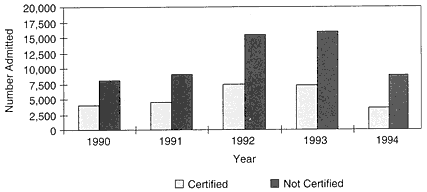
FIGURE 5.1 Scientists and engineers admitted to the US on permanent visas by labor certification, 1990–1994. Source: NSF, 1997.
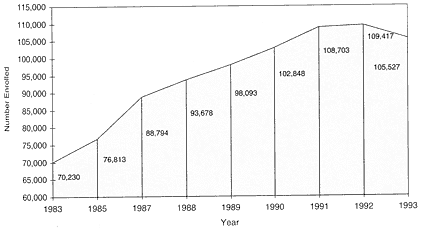
FIGURE 5.2 Foreign citizen graduate enrollment in US science and engineering universities, 1983–1993. Source: NSF, 1996.
First, there is a continuing need to recruit students from other engineering or science fields. For example, science and engineering research in electronic and optical materials has benefited greatly from interdisciplinary work. Recruitment will be facilitated by a broader national recognition and acceptance of materials science and engineering as a distinct academic discipline. This acceptance seems less prevalent here than it is in some other countries.
Second, foreign countries—Korea, Taiwan, China, India, Singapore, Hong Kong—have been the source of graduate students for US programs in many fields, particularly materials science and engineering. Most of these countries have been investing heavily to improve their own
TABLE 5.1 Decline in US Admissions of Immigrant Scientists and Engineers, FY 93–FY 94
|
Occupation |
FY 1993 |
FY 1994 |
Percentage change |
|
Engineers |
14,497 |
10,793 |
-26 |
|
Natural scientists |
3,901 |
3,104 |
-20 |
|
Mathematical scientists and computer specialists |
4,157 |
2,781 |
-33 |
|
Social scientists |
979 |
725 |
-26 |
|
TOTAL |
23,534 |
17,403 |
-26 |
|
Source: NSF 1997. |
|||
academic programs, especially in the various subfields of materials deemed important for the health of their national economies. The recent economic upheaval in Asian countries is likely to affect the flow of students to the United States—although how or to what extent is not clear. Moreover, not all countries in Asia are at the same stage of industrial development, so the drain of bright young people from some of these countries, such as Korea and Singapore, could soon abate. Thus, the number of students in developing countries who seek graduate education abroad might not decrease as quickly as projected, but the mix could change.
The United States should be concerned, however, about the degree to which it can continue to compete to attract bright young people from abroad. For example, Korea recently began to accept postdoctoral fellows from China. Japan has been encouraging its universities to accept postdoctoral fellows and PhD students from other Asian countries. The same is true for Europe, where there are programs among European Community countries at the postdoctoral and professional levels. One can expect increasing competition for talented students by all developed countries around the world, and the expected demographic decrease in the number of young people in developed countries will make the competition for the brightest even tougher. The greater the degree to which the United States continues to make efforts to make its society active, open, and attractive, the better its chances of attracting a significant fraction of talent pool.
As other countries become more successful in retaining or repatriating their top scientists and engineers, there will be a need to replace them by attracting more US students into PhD programs in materials science and engineering.
Third, the supply of graduate students is directly related to the economy. Few US students pursue graduate education without financial support, so a decline in research funding results in fewer students' pursuing graduate degrees. Moreover, a strong job market for those with bachelor's and master's degrees, particularly for people with an interest in materials, decreases the pool of PhD candidates. These effects are now acting in concert in the United States.
Fourth, materials science and engineering researchers, particularly in industry, must keep constantly up with new developments and research opportunities in the field. Graduate fellowships and educational programs conducted either on-site or "beamed" to industry via satellite from universities are a critical element of leadership.
Fifth, attracting more women and minorities into graduate programs in materials science and engineering is not only essential to achieving greater diversity in academia, government, and industry leadership, but it is also an important means of offsetting our current dependence on foreign sources of PhD talent. The field should be able to
benefit from the variety of undergraduate preparations that might attract a greater diversity of talent into graduate materials programs.
5.3 Funding
Whereas US industry and government are shifting funds toward short-term research, many other countries, notably Japan, are increasing long-term and basic research funding. Many US companies have eliminated corporate or central research laboratories to more closely align research and development with immediate business opportunities.
Materials research in universities has been sponsored mainly by the federal government. The mission-oriented agencies (principally DOD and the DOE) have provided the most support for a range of fundamental materials research. In particular, DOD has supported about 60% of academic research in the field. The National Science Foundation funding for basic materials research continues to be available (Figures 3.6–3.8) but the recent shift in DOD funding has placed more emphasis on topics of strict military relevance. The consequence will be a curtailment of federal funding for new dual-use materials concepts and small-group research efforts formerly supported by DOD. Some of these new concepts are essential to DOD and to nondefense sectors of the US economy.
A rebalancing of the overall federal research and development funding strategy could be needed to enable materials research in all areas to continue: Otherwise, important developments in key subfields could lag behind in world competition. Many university researchers have had positive experiences with industrial research collaborations.
Although some academic researchers have turned to industry for financial support, in many cases, industry-funded research is of shorter duration and, compared with federal grants, has a specific, short-term focus. Some research projects are conducted under contract terms that capture intellectual properties, protect confidentiality, restrict publication, and require detailed planning and reporting of progress. These conditions rarely attract top graduate talent to the research effort.
The areas in which industrial research collaborations can be most valuable are materials synthesis and processing, where special equipment not generally found in universities is required to achieve process control and to evaluate sequencing protocols and scaling parameters.
5.4 Infrastructure
The quality of the basic research infrastructure and the development of new technology from research strongly influence the long-term health of materials research. The position of the US research enterprise will be determined by the elevation or decline of this infrastructure, which, in this context, is defined broadly to include tangible (facilities)
and intangible (supporting policies and services) elements. Several trends for the elements of this infrastructure have been identified:
-
The university structure in which the materials science and engineering organization resides strongly influences the fortunes of the discipline. The high quality of academic leadership in materials science and engineering and the excellence of the scientific research enterprise have placed the discipline in a position of strength at most of the top research universities in the United States. The prominence of materials science in nonacademic institutions (industry and government agencies) is also well established here and abroad.
-
Maintaining the high scientific and engineering quality of management of materials research organizations within industry and government agencies is critical to the US competitive position. These organizations contribute to the knowledge base through basic research in technologically relevant areas.
-
The most advanced information and communication networks available are being used in materials science research. Internet and video conferencing, electronic journals, international distance learning, and distant collaborative research are commonplace. The convergence of voice, data and video systems have made possible the routine use of real-time 3-D imaging and other supercomputing aids for modeling and simulation of materials structures, interfaces, phenomena, and behavior during processing.
-
Sophisticated characterization instruments and processing facilities are essential for advancement in materials research. US facilities have instrumentation that is on par with the best in the world. However, rapid advances in design and capabilities of instrumentation can create obsolescence in 5–8 years.
-
The integration and overall quality of the characterization services that support US universities and industrial organizations has lost substantial ground to organizations in Japan and Europe. Fortunately, characterization facilities at US national laboratories are among the best. Also, an increasing number of high-quality commercial laboratories are becoming accessible to academic and industrial researchers.
-
Small-scale equipment for materials synthesis and processing in most US universities is not keeping pace with similar equipment at some universities abroad. Capabilities in US industry for supplying bulk single crystals and other specialty research materials also have declined. As a result, US researchers are becoming increasingly dependent on foreign sources.
-
Forward-looking intellectual property policies, administrative support, and access to patent expertise are improving for US academic researchers in materials science. These policies are generally more flexible and advanced here than they are abroad. The anticipated
-
continuing liberalization of rules that permit academic researchers to commercialize their inventions is a positive step toward decreasing the time from invention to market. Another positive step is the growing assistance from the universities in finding industrial commercialization partners.
-
A supportive public (and thus legislature) is a valued element of the intangible infrastructure. Educating the public about the importance of materials should receive increasing attention. Innovative, attention grabbing methods are needed to convey that everything is made of something, whether a natural or synthetic material. Highlighting materials research contributions to major national initiatives is valuable in sustaining public support for the field.
-
Federal laboratories and the national laboratories of DOE are critical in providing unique facilities for research, they have instrumentation no single university could afford to put in place. An important complement is the availability of world-class scientists who engage in long-term fundamental research, provide assistance through research collaborations with the user community, and provide advanced instrumentation design and methods. Although the US has enjoyed a research and funding environment that allows for the installation and operation of a diverse range of facilities to support leading-edge research in materials, this position is not assured forever. There are two major challenges that must be addressed with a systematic policy.
-
Requirements for fabrication and processing facilities will change as research emphases evolve. For example, even though the microelectromagnetic systems (MEMS) field has become active, very few sites are equipped to fabricate MEMS devices, especially in support of the science and engineering research communities. Therefore, most of the materials community is excluded from research opportunities in this field. There are other examples in films, coatings, composites, and integrated sensors. Greater attention is needed to making the best fabrication and processing facilities available to top research teams. In some subfields, this problem has been addressed by collocating fabrication facilities and research teams, such as the nanofabrication facility at Cornell University. In other instances, flexible foundries, such as the Jet Propulsion Laboratory's Metal-Oxide Semiconductor implementation Service, have been made available to top researchers around the country.
-
Large central facilities, such as neutron and synchrotron sources, electron microscopy centers, and analytical facilities, many of them at DOE laboratories, must be continuously upgraded and maintained. Funding trends and changing priorities for federal agencies and
-
NSF raise concerns about whether large-scale facilities can keep pace. In some areas, such as neutron scattering, US facilities have not kept up with foreign competition.
5.5 Cooperative Government–Industrial–Academic Research
Maintaining a competitive advantage in materials science depends on strong collaborations between government, industry, and academia. As industrial research focuses even more on materials technologies with short-term (2–3 year) technology–product impact, execution of longer term (5–10 year) basic and innovative exploratory research at universities and national laboratories will require even closer interactions. Basic research in these areas is a vital aspect of knowledge-based materials science, as verified by the continued university hiring of researchers with industrial experience. Collaborative research is accomplished in several foreign countries by individuals with joint academic–commercial appointments and through publicly supported research institutes linked to universities (similar to many US national laboratories) that serve industry's need for longer term research.
One challenge is also a major opportunity for a government–university–industry initiative: There is a 15-year cycle time in many cases from the scientific feasibility of a new material to its engineering implementation. There is a need for continuity of support and a general recognition of the time it takes to go from observation to hypothesis to experimentation to discovery to implementation. A reduction in this schedule could be realized through modeling and simulation, as applied to fabrication, processing yields, performance, and reliability. There are clearly defined, mutually supportive roles for academia, government, and industry where they can work together. For example, the US semiconductor industry has set up a 15-year road map, and such initiatives are in place in other countries. The DOE advanced-supercomputer initiative is a similar effort to develop new computer methods for the simulation of nuclear weapons.
Industry interest for cooperative programs is strong, but direct industry financing seems impossible to organize. Federal funding by explicit policies does not address this issue, nor is such activity subsumed into ERCs, STCs; and MURIs (see earlier discussion on centers) for which materials research and development is complementary to principal scientific and technology goals. Center programs are needed to put this capability in place in the United States. Without better organized government–industry–university efforts in this area, new materials will be more effectively exploited by other countries.
A novel approach that deserves more widespread use is the establishment of virtual industrial–academic institutes or centers for materials technology development. Some models already exist outside the materials field—in manufacturing, food processing, and biotechnology—
6
LIKELY FUTURE POSITIONS
6.1 Introduction
The likely future position of materials science and engineering in the United States based on the ''world congress" assessment, is that our current position among the world leaders is likely to slip in some areas. The reasons vary, but some common elements include the globalization of research and the growth of economies.
The United States can be expected to continue supporting materials science, and new topics involving nanostructure materials and intelligent materials are among several exciting emerging areas of study. In addition, the United States will never want to lose its current strength in aerospace and defense, which are important not only to US security but for the stability of the post-cold-war world. The combination of global threats and economic opportunities can be expected to continue to drive US materials science and technology. Therefore, the panel finds that US leadership position in materials science and engineering should continue.
6.2 Biomaterials
Our strength relative to other countries in basic and applied biomaterials research is likely to erode in the near-and longer term for several reasons. Our lead in basic research is being contested by huge investments in Europe and Japan in biomaterials, both in academia and in industry. The potential market for biomaterials is larger outside the United States than it is within. There is a concern that our lead in applied areas is being jeopardized because of inconsistent and excessively conservative government regulatory policy and because of the
litigious climate of our culture in general, which inhibits development and innovation. Although the United States is currently among the world leaders in contemporary diagnostic systems, we are rapidly losing ground to other nations.
6.3 Ceramics
In ceramics used for their thermal, electric, and mechanical characteristics, the United States and Japan share leadership. The Japanese manufacturing advantage is having an effect on engineering and research strengths, and the relative US position is in decline. However, emerging US research strengths in electromechanical systems and coatings would appear to redress the balance on the research side. Japan and Germany continue to be highly competitive in engineering of ceramics.
In areas concerned with functional–electronic ceramics, work on such topics as self-assembly materials and multilayer ferrite processing, where the United States is at the forefront, should be targeted. Areas where we are among the world leaders and where we should maintain our position in the future include three dimensional nanoporous silicates, microwave dielectrics, and electrophoretic preparation of thin films. The United States is not expected to seriously challenge the Japanese leadership position in integrated micromagnetics.
6.4 Composites
Basic research into composites at US universities is coming to a standstill as a result of the Department of Defense decision to strictly curtail university research funding in metal, polymer, and ceramic matrix composites. If this situation long persists, the US could forfeit its leadership role in composites. Academic research is at a nadir, but important new developments in industry are spurring implementation, especially in transportation and construction applications.
6.5 Magnetic Materials
The US is catching up with the leaders in international research on magnetic materials and magnetism. University research in the magnetic materials area has begun to increase. More basic research on magnetic materials and magnetism is needed to increase the prospects for advances by the United States in this area. The vitality of magnetic recording and the phenomenon of colossal magnetoresistance are starting to produce a renaissance in fundamental magnetism research in the United States.
6.6 Metals
In all probability, the US lead will remain, but that is not a certainty. For 5 decades, investments in materials research and develop-
ment have been driven largely by national security needs. This has yielded a wealth of basic knowledge and new products. Because the United States is the only remaining "superpower", this driving force should remain, but it will diminish in proportion to perceived threats to our national security. This will shift some of the burden for materials development to nondefense industries, such as transportation. The value of new materials to various industries varies widely—and so does support for materials research and development. Another force that will affect the US position is the consolidation and globalization of all industries from aerospace companies to automotive suppliers. For these businesses, the issues of US competitiveness and research and development leadership are much less important, because their playing field is the world and they will seek knowledge wherever it is to be found.
6.7 Electronic and Optical-Photonic Materials
Research in electronics will continue to focus on materials and processes, and it will be conducted globally through international collaborations among industrial organizations. Industry partnerships with academia and government continue to be encouraged by the US Semiconductor Industry Association, which serves as a vehicle for forming other organizations—SEMATECH (the Semiconductor Research Corporation) and MARCO (the Microelectronics Advanced Research Corporation). Such partnerships, along with focused centers at universities, will continue to be vitally important to our leadership in the now-global semiconductor industry.
As semiconductor technology approaches the 100 nm generation, unprecedented new materials and processing technology will be required. The United States and others will make these advances more or less equally, if not as partners. A global forecast for 2012 for technology-driven research directions in this industry for the United States is provided in the National Technology Roadmap for Semiconductors (SIA, 1997). Some of the expected materials and process-related research includes silicon-germanium devices, new gate dielectric and gate electrode materials to replace SiO2, copper interconnection to replace aluminum, new low-dielectric constant materials for interlayer dielectrics, diffusion barrier materials and processing approaches for copper interconnection, and the replacement of polysilicon gates with high-conductivity gates having low or no depletion. New processing, characterization, and metrology methods will be required to achieve surface smoothness of ±2 Å RMS, gate dielectrics of 10 Å, and unprecedented cleanliness control.
The United States should continue its leadership position in compound semiconductors (GaAs, GaAlAs) and wide-band-gap semiconductors (SiC) for power devices and microwave transmitters. These technologies, which will continue to find expanding applications for cellular
telephone and satellite communication systems, are now and should continue to be well funded by industry and the government. Europe should continue to share leadership with the United States in electrical power distribution and motor control applications of power transistors.
In the field of nanotechnology, the United States has traditionally been leading in exploratory nanostructures, including quantum wires and dots. It shares the lead with Europe and Russia in mesoscopic physics.
Although continuing to provide leadership in basic research, the United States has conceded commercial leadership in wide-band-gap photonics to Europe and Japan, and the Japanese currently enjoy a commanding lead in GaN technology and the commercialization of photon-pumped, phosphor-coated ultraviolet emitters for displays. There are many excellent US university capabilities in wide-band-gap photonics, but much of the federal funding for this research is short-term oriented and lacks focus or a coherent long-term strategy to regain leadership in this important field. The Japanese are expected to dominate flat panel display technologies well into the future; US developments in thin-film electroluminescent displays on floppy polymer films could provide an important position in this display market for the United States.
Research support in II-VI (ZnSe) wide-band-gap lasers is being shifted in US universities to nitride research. The Japanese continue to make major strides in improving the longevity and external efficiency of II-VI lasers and LED's. The Japanese lead in short wave length solid state laser communications and in related technologies. The United States leads in longer wave length lasers.
6.8 Superconducting Materials
The current strong position of the United States in superconducting materials is not assured. Many early startup companies that showed promise are not yet profitable. Also, there is still less industrial research here than there is in Japan. Still, some small US companies maintain world leadership in the design, manufacture, and characterization of long-length conductors, although the shift in US corporate research away from longer term basic studies presents a question for the future: "Will the private sector benefit commercially from new concepts and advances occurring at universities and national laboratories?" This field could be one by which the success or failure of government–university–industry partnerships will be judged in the future.
The shift in funding and research priorities among government agencies is affecting federal spending for basic research in favor of advanced developments. The Department of Defense still maintains a program in high-temperature superconductor applications, but total funding for basic research is declining and is increasingly in competition
with other funding priorities. Momentum favors relative improvements in the US leadership position in some areas (magnetic properties, flux transport measurements and imaging, thin-film processing, and cable development), but without continued strong federal investment in basic and applied research, that position will change.
On the bright side, dramatic advances in high-temperature superconductors have renewed interest in conventional superconductors for advanced applications, such as SQUIDS, energy storage, instrumentation, and telecommunications. With the improvements to and cost reductions projected for cryocoolers, the market potential for superconductor materials and related technologies should grow. The United States is well poised with strong processing and manufacturing capabilities and a growing talent pool to capture a substantial segment of these markets.
6.9 Polymers
The United States has given less attention and funding than have many other countries to polymer research. Overseas education, research, and infrastructure have had infusions of funding that could change their relative positions, and the United States could lose ground in relative terms if not in absolute terms.
The economic importance of synthetic polymers is evidenced by their wide use in plastics, fibers, adhesives, and paints. These materials are a large fraction of the "chemical" category in which the United States has a strong positive trade balance. Sustaining this balance will require the United States to maintain world leadership in polymer research. Environmental and life cycle responsibility is a driver for polymer research and development in Europe and is becoming more so in the United States.
6.10 Catalysts
The leading position of the United States relative to the rest of the world in the subfield of catalysts is likely to lose ground as a result of the targeted funding aimed at growing capabilities in other countries. This area could stagnate in the United States without stronger, better equipped research centers where researchers can work together with common goals. The Catalyst Technology Roadmap Report (Sandia 1997) cites as "the three most important areas of application of catalyst technology in which improvement of catalytic processes would make the most significant progress selective oxidation, alkane activation, and byproduct and waste minimization."
In industrial practice, the United States will remain a world leader for production of chemicals through catalytic reactions in the most energy-efficient, safe, and environmentally compatible way. University-
based research will continue to suffer relative to industry laboratories unless better equipment becomes available.
As emerging markets in Asia and Eastern Europe develop and grow, the demand for basic chemicals and polymers (often made catalytically) will grow at double-digit rates. US industry will benefit from this growth because the technology to produce these materials often is not accessible to developing nations, and the expense required to build large-scale manufacturing plants is prohibitive. It is important to continue to invest in research on catalysts and catalysis to promote continued growth of US companies in export markets.
Inventions that use new catalysts or new engineering process concepts that facilitate economic development of small-scale manufacturing plants will allow US companies to invest in new places overseas to serve local markets and speed growth of developing nations. The economies of scale that result from large-volume manufacturing plants support Western economies and allow a cost of manufacture that provides an attractive return on the investment required to build large-volume plants. US companies will continue to seek ways to develop small-scale manufacturing. For example, the concept of "a plant on an IC chip" could some day allow attractive investments by US companies in local bulk chemical and polymer facilities in developing regions of the world.
These points simply argue for continued investment in catalysis research in a way that encourages innovation and allows US industry the flexibility to participate in the growth of emerging markets. Innovation can be encouraged by collaborative research across disciplines and between the public and private sector. Attracting more chemistry students into catalysis research aimed at discovering new science, while simultaneously strengthening links to technology and applications in the engineering area, would benefit the field. A well-funded national institute for catalysis research could serve as the focal point for such collaboration.
7
SUMMARY AND CONCLUSIONS
The report summary and conclusions are provided below. Overall, the analysis was limited by a paucity of field-specific and international data. Nonetheless, the members of the Panel have confidence in the conclusions provided below.
7.1 The United States Is Among the World's Leaders in All Subfields, and It Is the Leader in Some.
The United States is currently among world leaders in all of the subfields of materials science and engineering, and currently it enjoys a clear lead in biomaterials. The United States is expected to maintain its lead in metals and electronic–photonic materials because of their large US industrial base. However, the lead in electronic–photonic materials is endangered because of cutbacks in exploratory research. Our earlier preeminence in magnetic materials is now shared with Europe and Japan. This will require particular attention in the future.
Erosion of US leadership is expected in the subfields of composites, catalysts, polymers, and biomaterials because of the high priority being given to these subfields by other countries. Current US weakness in materials synthesis and processing relative to Europe and Japan is especially highlighted in the panel's assessment. In the subfield of catalysts especially, university multidisciplinary research centers with close industry collaborations are needed to conduct cutting-edge research and to reduce the development cycle time for commercialization. Finally, sustaining current federal research support in functional ceramics and superconducting materials is considered important to maintain US leadership in these subfields.
7.2 The Flexibility of the Enterprise is as Much a Key Indicator of Leadership as is the Amount of Funding.
Funding is important in supporting leadership in materials science and engineering, but a balance among all determinants is required to sustain leadership. Several factors provide opportunities to do this. These include the availability of many options for funding research and entrepreneurial developments through our national innovation processes, a robust infrastructure of research instrumentation and computational facilities, growing opportunities for diversifying the US talent base, and continuing improvements in research quality and productivity through greater unification of the field and growth in multidisciplinary collaborations. Of these opportunities, talent diversity needs much greater effort if it is to be realized.
7.3 The Innovation System Is a Major Determinant of US Leadership.
The keys to US leadership in the subfields of materials science and engineering have been the entrepreneurial ability of its researchers and the influence of its diverse economy. The rapid exploitation of new developments is facilitated by the extensive networks and collaborations among leading US researchers that extend to all sectors of our economy and throughout the world. The mobility of graduate and postdoctoral entrepreneurs from the academic world to the private sector is stimulated by the availability of venture capital for small start-up companies. Federal programs that encourage research consortia and partnerships in the private sector and that fund precompetitive research at small and medium-size companies provide additional impetus to the development of innovative materials technology.
Flexibility confers agility among US researchers who have been competitive in emerging materials topics—some of which have become "hot" only in recent years. Thorough research can take time, however, and bringing a new material into the marketplace can take more time. The short-term focus of the US innovation system presents the danger of blocking the development of important materials concepts.
7.4 The United States Enjoys Strength through Intellectual and Human Diversity.
Because materials science and engineering draws from the research infrastructure of most of the physical science and engineering disciplines, it has a high level of intellectual diversity. Intellectual and human diversity are intertwined. As with many science and engineering fields, diversity in educating women and underrepresented minorities in materials science and engineering is now considered inadequate in the United States. However, the disciplines should be especially attractive
for diverse representation because of the scope of preparation and technological applications. It is particularly important to attract more domestic students into graduate study even as we continue to recruit the best and brightest from abroad. The ratio of foreign to domestic students at most research universities continues to be high.
7.5 Shifting Federal and Industry Funding Priorities, a Potential Reduction in Access to Foreign Talent, and Deteriorating Materials Research Facilities Could Curtail US Ability to Capitalize on Leadership Opportunities.
US leadership in the various subfields of materials science and engineering is not assured for the future. In contrast to opportunities of leadership, there are current developments that could curtail the ability of the US to capitalize on these opportunities. These include shifting materials research and development priorities in the Department of Defense, which have created research gaps in some materials subfields (e.g., ceramics and composite materials, electronic and optical materials), potential decreases in the supply of foreign graduate students, elimination of central research laboratories by major high-tech companies, and lack of attention to research into methods for shortening the implementation cycle for advanced materials.
The US education system—undergraduate and graduate—has achieved excellence that is acknowledged throughout the world, and we continue to attract top talent from other countries, especially those that lack adequate graduate research systems for training research leaders. There is a concern that improvements in graduate education programs in developing countries will not only meet their own needs for building stronger indigenous research, but will attract home the top researchers and students who currently reside in the United States.
One area of special concern is the lack of adequate funding to modernize major research facilities in the United States. Some US facilities are a generation older than are those in other countries, and there are fewer improvements or new facilities being planned for sources of neutrons, synchrotron radiation, and high-energy particle beams (electrons and protons).
Also important to top US researchers is the need to modernize smaller scale research equipment at universities for materials synthesis, processing, and characterization. The concern is that in some subfields such equipment at foreign universities now outclasses what is available at most US universities.
8
REFERENCES
Armor, J. N. Global Overview of Catalysis: United States of America . Applied Catalysis A: General 139 (1996) 217-228.
Armor, J. N. New Catalytic Technology Commercialized in the USA during the 1980s. Applied Catalysis, 78 (1991) 141-173.
Chauvel, A., Delmon, B. and Holderich, W. F. New Catalytic Processes Developed in Europe during the 1980s. Applied Catalysis A: General 115 (1994) 173-217.
CMR (Chemical Market Reporter). April 28, 1997, 251(17): SR20-SR21.
COSEPUP (Committee on Science, Engineering, and Public Policy). Science, Technology, and the Federal Government: National Goals for a New Era. Washington D.C.: National Academy Press, 1993.
COSEPUP (Committee on Science, Engineering, and Public Policy). International Benchmarking of US Mathematics Research. Washington D.C.: National Academy Press, 1997.
COSEPUP (Committee on Science, Engineering, and Public Policy). An Assessment of the National Science Foundation's Science and Technology Centers Program. Washington D.C.: National Academy Press, 1994.
CORE (Committee on Optical Science and Engineering). Harnessing Light: Optical Science and Engineering for the 21st Century. Washington D.C.: National Academy Press, 1998.
DOE (Department of Energy). Neutron Sources for America's Future: Report of the Basic Energy Sciences Advisory Committee Panel on Neutron Sources, DOE/ER-0576P, 1993.
DOE (Department of Energy). Report of the Basic Energy Sciences Advisory Committee Panel on DOE Synchotron Radiation Source and Science, November 1977.
Michael Hart, NSLS Chairman, Synchrotron Radiation News, Vol. 9, No. 5, p. 2.
Misono, M. and Nojiri, N. Recent Progress in Catalytic Technology in Japan. Applied Catalysis, 64 (1990) 1-30.
NAE (National Academy of Engineering). Assessment of the National Science Foundation's Engineering Research Centers Program. Washington D.C.: National Academy Press, 1989.
Nojiri, N. and Iwamoto, M. Global Overview of Catalysis: Japan. Applied Catalysis A:
General 139 (1996) 419-428.
NRC (National Research Council). Materials Science and Engineering for the 1990's. Washington D.C.: National Academy Press, 1989.
NRC (National Research Council). Allocating Federal Funds for Science and Technology. Washington D.C.: National Academy Press, 1995.
NRC (National Research Council). Advanced Fibers for High Temperature Ceramic Composites. Washington D.C.: National Academy Press, 1997.
NRC (National Research Council). Summary Report 1995: Doctorate Recipients from United States Universities . Washington D.C.: National Academy Press, 1997.
NSF (National Science Foundation). Human Resources for Science & Technology: The European Region. NSF 96-316, p. 21-22. Arlington, VA: National Science Foundation, 1996.
NSF (National Science Foundation). Science and Engineering Indicators 1996. NSB 96-21. Washington, D.C.: US Government Printing Office, 1996.
NSF (National Science Foundation). Data Brief, vol. 1997, no. 6. Arlington, VA: National Science Foundation, June 8, 1997.
NSTC (National Science and Technology Council). The Federal Research and Development Program in Materials Science and Technology. 1995.
OSTP (Office of Science and Technology Policy). Advanced Materials and Processing: Fiscal Year 1993 Program.
OSTP (Office of Science and Technology Policy). Advanced Materials and Processing: Fiscal Year 1995 Program.
Roth, J. F. Industrial Catalysis: Poised for a New Generation of Major Innovations. Applied Catalysis 64, 1-30 (1990).
Rothman, David. Chemical Week. October 15, 1997, p.41.
Sandia (Sandia National Laboratory). Catalyst Technology Roadmap Report. SAND97-1424*UC-1404, June 1997.
SIA (Semiconductor Industry Association). The National Technology Roadmap for Semiconductors: Technology Needs, 1997.
UK (United Kingdom Office of Science and Technology). The Quality of the UK Science Base. London, UK: Department of Trade and Industry, March 1997.
APPENDIX A
PANEL AND STAFF BIOGRAPHICAL INFORMATION
Panel
Arden L. Bement, Jr., is the Basil S. Turner Distinguished Professor of Engineering and director of the Midwest Superconductivity Consortium at Purdue University. Before this appointment in December 1992, he was vice president for science and technology at TRW, Inc. He joined TRW in 1980 as vice president for technical resources. Dr. Bement began his professional career in 1954 as a research metallurgist and reactor project engineer with the General Electric Company at the Hanford Atomic Products Operation, Richland, Washington. In 1965 he joined Battelle Memorial Institute as manager of the Metallurgy Research Department. Three years later, he became manager of the Fuels and Materials Department. In 1970, Dr. Bement joined the faculty of the Massachusetts Institute of Technology as professor of nuclear materials, and in 1976 became director of the Materials Science Office of the Defense Advanced Projects Agency. In 1979, he was appointed deputy undersecretary of defense for research and engineering. In 1990 the US Senate confirmed Dr. Bement as a member of the National Science Board for a term that expired in 1994. Dr. Bement is a member of the National Academy of Engineering, is a recipient of the Distinguished Civilian Service Medal of the Department of Defense, and holds an honorary doctorate of engineering from Cleveland State University. He received an EMet from the Colorado School of Mines, an MS from the University of Idaho, and a PhD from the University of Michigan. Dr. Bement has served on many advisory committees and boards for government agencies and nonprofit organizations.
Peter R. Bridenbaugh is retired executive vice president of the Aluminum Company of America (Alcoa). He also served as Alcoa's chief technical officer and vice president for research and development. Dr. Bridenbaugh holds a BS (1962) and an MS (1966) from Lehigh University, and a PhD (1968) from the Massachusetts Institute of Technology. He is a member of the American Society of Metals, the American Institute of Mining and Metallurgical Engineers, the American Society for Engineering Education, the Industrial Research Institute, and Sigma Xi.
Leroy L. Chang is dean of science and professor of physics at the Hong Kong University of Science and Technology. He was with IBM's Thomas J. Watson Research Center from 1963 to 1968 and again from 1969 to 1992. From 1985 to 1992, he was manager of quantum structures. In 1968–1969 he was an associate professor of electrical engineering at the Massachusetts Institute of Technology. He received the International Prize for New Materials (1985) from the American Physical Society, the David Sarnoff Award (1990) from the Institute of Electrical and Electronic Engineers, and the Stuart Ballantine Medal (1993) from the Franklin Institute. He is a member of the National Academy of Sciences and the National Academy of Engineering and also a member of the Chinese Academy of Sciences.
Daniel S. Chemla has been director of the Materials Science Division at the Lawrence Berkeley National Laboratory and professor in the Department of Physics at the University of California, Berkeley, since 1991. He was with AT&T Bell Laboratories as head of the Quantum Physics and Electronics Research Department from 1983 to 1990; from 1981 to 1983 he was a member of the technical staff, both in the Electronic Research Laboratory. Dr. Chemla has held the positions of department head and group leader with the Centre National d'Etudes des Telecommunications in Bageaux, France (1974–1981). He received a degree as Ingenieur Civil des Telecommunications (1965) from the Ecole Superieure National des Telecommunications in Paris. He holds the Diplome d'Etudes Approfondies, Physique des Solides (1967), and a PhD (1972) from the University of Paris. He is co-recipient of the 1988 R. W. Wood prize from the Optical Society of America. He received the 1995 Quantum electronics Award of the Institute of Electrical and Electronics Engineers/Laser and Electro-Optical Society, and the 1995 Humboldt Research Award. Dr. Chemla is a fellow of the Physical Society of America, the IEEE-Laser and Electro-Optical Society, and the Optical Society of America. He is a member of the National Academy of Sciences.
Uma Chowdhry is business planning and technology director for DuPont's Specialty Chemicals Businesses. Her career since receiving a
PhD in materials science and engineering from the Massachusetts Institute of Technology in 1976 has been with DuPont. She has served in various technology management positions. She managed groups working on ceramic materials for electronic applications, superconductors, and catalysts for various heterogeneously catalyzed chemical processes. In 1995, she was appointed business director for a $400 million chemical intermediates business that commercialized two new technologies involving large-scale catalytic processes. Dr. Chowdhry's technical background is in ceramics processing and in heterogeneous catalysis; her current work is in management of technology for technology-based businesses. In 1996, she was elected membership in the National Academy of Engineering.
Anthony G. Evans is Gordon McKay Professor of Materials Engineering at Harvard University's Division of Applied Sciences (1994–present). Concurrently (1985–present), he is Alcoa Professor and codirector of the High Performance Composites Center in the Materials Department at the University of California, Santa Barbara. Previous to this he was Alcoa Professor and chair of the Materials Department. From 1978 to 1985 he was a professor in the Department of Materials Science and Mineral Engineering at the University of California, Berkeley. Dr. Evans holds a BSc (1964) and PhD (1967), both in metallurgy, from Imperial College in London. He is chair of the Defense Sciences Research Council, a vice president of the American Chemical Society, and a member of the National Materials Advisory Board. He is the recipient of many honors and awards and is a member of the National Academy of Engineering.
Paul Hagenmuller is professor emeritus at the University of Bordeaux (1994) and honorary director of the CNRS Solid State Chemistry Laboratory (1986), which he created in the 1960s. He is editor of many scientific journals and author or co-author of several hundred publications. He is a recipient of two von Humboldt prizes (1997 and 1990), the Gauss-Weber Medal from the University of Gottingen (1997), the Henri Moissan International Prize (1997), and a host of other honors and awards. Dr. Hagenmuller is a member or honorary member of the New York Academy of Sciences; European Academy of Arts, Sciences, and Humanities; the European Academy; the International Academy of Ceramics; and the Materials Research Society of India, among others. He also holds several honorary professorships and degrees. Among his many military decorations is the Croix de Guerre with Palms (1949).
James W. Mitchell is director of materials, reliability and ecology research at Bell Laboratories, Lucent Technologies (1995–present). He has been with AT&T Bell Laboratories since 1970 as a member of the
technical staff (1970–1972), supervisor of the Inorganic Analysis Group (1972–1975), head of the Analytical Chemistry Research (1975–1994), research fellow (1985), and head of the Process and Chemical Engineering Research Department (1994–1995). Dr. Mitchell received a BS in chemistry (1965) from the Agricultural & Technology State University of North Carolina in Greensboro and a PhD in analytical chemistry (1970) from Iowa State University in Ames. He received the Percy L. Julian Industrial Research Award (1981) from the National Organization for the Professional Advancement of Black Chemists and Chemical Engineers; the US Black Engineer of the Year Award (1993) from the Council of Engineering Deans of Historically Black Colleges and Universities; the Iowa State University, George Washington Carver Visiting Professorship Award (1994); and the AT&T Bell Laboratories Research Fellow Award (1985), among others. Dr. Mitchell is a fellow of the American Institute of Chemists, a member of the New York Academy of Sciences, the American Chemical Society, the National Organization for the Professional Advancement of Black Chemists and Chemical Engineers, and of the National Academy of Engineering.
Donald R. Paul holds the Melvin H. Gertz Regents Chair in Chemical Engineering and is director of the Texas Materials Institute at the University of Texas at Austin. His research involves structure–property relationships and processing of polymers; his current work deals with polymer blends and membranes. Dr. Paul received a BS in chemical engineering from North Carolina State University and an MS and a PhD in chemical engineering from the University of Wisconsin. He is editor of Industrial & Engineering Chemistry Research (published by the American Chemical Society) and serves on the editorial boards of the Journal of Applied Polymer Science, Polymer Engineering and Science, Polymer, the Journal of Membrane Science, the Journal of Polymer Science–Polymer Physics, and Polymer Contents. He has received numerous awards for teaching and research, including in 1988 his election to the National Academy of Engineering.
Buddy D. Ratner is professor of bioengineering and chemical engineering at the University of Washington. He received a PhD (1972) in polymer chemistry from the Polytechnic Institute of Brooklyn. From 1985 to 1996 he directed the National Institutes of Health-funded National ESCA and Surface Analysis Center for Biomedical Problems. In 1996, he assumed the directorship of the University of Washington's engineered biomaterials research center, which is funded by NSF. He is the coeditor of the journal Plasmas and Polymers, a past president of the Society for Biomaterials, and author of more than 250 scholarly works. Dr. Ratner is a fellow of the American Institute of Medical and Biological Engineering, the American Vacuum Society, and the Society
for Biomaterials. His research interests include biomaterials, polymers, biocompatibility, surface analysis of organic materials, self assembly, and rf–plasma thin-film deposition.
Kathleen C. Taylor is head of the Physics and Physical Chemistry Department of the General Motors Global Research and Development Center. She is responsible for management of research and development in materials science with primary responsibility for 85 PhD, MS, and BS engineers and scientists involved in research programs in exhaust emission control, catalysis, surface chemistry, air pollution control, advanced batteries, fuel cells, corrosion, protective and wear-resistant coatings, light metals, magnetic and optical materials, and chemical and magnetic field sensors. Dr. Taylor was elected to the National Academy of Engineering in 1995, and she is a member of the American Chemical Society, the Materials Research Society, and a fellow of the American Association for the Advancement of Science and the Society of Automotive Engineers International.
Robert M. White is university professor and head of the Department of Electrical and Computer Engineering at Carnegie-Mellon University. Before joining CMU in 1993, he served during the Bush Administration as the first undersecretary of commerce for technology. Before going to Washington, he spent 6 years with Control Data Corporation, first as vice president of research for CDC's Data Storage Products Group and then as the corporation's chief technical officer and as a member of the CDC Management Board. Dr. White's early career was spent in teaching and research. He was an assistant professor of physics at Stanford University and was principal scientist at Xerox's Palo Alto Research Center for 13 years. He is the author of 4 books and more than 100 technical publications on condensed-matter physics and magnetic recording. White received a BS (1960) in physics from Massachusetts Institute of Technology and his PhD (1964), also in physics, from Stanford. He is a member of the National Academy of Engineering and a fellow of the American Physical Society, the Institute of Electrical and Electronics Engineers, and the American Association for the Advancement of Science. In 1980, he received the Alexander von Humboldt Prize from Germany, and in 1993 the IEEE Award for Contributions to Public Service. He is a director of SGS-Thomson Microelectronics, Zilog, and Ontrack Data International.
Masaharu Yamaguchi is professor in the Department of Materials Science and Engineering at Kyoto University, Japan (1987–present). From 1973 to 1987 he was with Osaka University as an associate professor in the Department of Materials Science and Engineering. From 1965 to 1973 he was a research associate in the Department of Metal-
lurgy. Dr. Yamaguchi received his BSc (1963), MSc (1965), and PhD (1969) from Osaka University. He also is Editor of Intermetallics for Elsevier Science Publishers. Dr. Yamaguchi received the Meritorious Activity Medal (1983) and the Tanigawa-Harris Medal (1995), both from the Japan Institute of Metals.
Staff
Deborah D. Stine is the study director and associate director of the Committee on Science, Engineering, and Public Policy (COSEPUP). She has worked on various projects throughout the National Academy of Sciences complex since 1989. She received a National Research Council group award for her first study for COSEPUP on policy implications of greenhouse warming, and a Commission on Life Sciences staff citation for her work in risk assessment and management. Other studies have addressed graduate education, responsible conduct of research, careers in science and engineering, environmental remediation, the national biological survey, and corporate environmental stewardship. Dr. Stine holds a bachelor's degree in mechanical and environmental engineering from the University of California, Irvine; a master's degree in business administration; and a PhD in public administration, specializing in policy analysis, from the American University. Before coming to the academy, she was a mathematician for the US Air Force, an air-pollution engineer for the state of Texas, and an air-issues manager for the Chemical Manufacturers Association.
Lawrence E. McCray is executive director of the Committee on Science, Engineering, and Public Policy (COSEPUP). He held positions in the Environmental Protection Agency, the US Regulatory Council, and the Office of Management and Budget before coming to the National Academy of Sciences in 1981. He has directed academy studies in carcinogenic risk assessment, export controls, nuclear winter, and federal science budgeting. A Fulbright scholar in 1968, Dr. McCray received the Schattschneider Award in 1972 from the American Political Science Association for the best dissertation in American government and politics. In 1987, he received the National Research Council staff award. Dr. McCray joined COSEPUP in 1988 as executive director and since 1994 has served concurrently as the director of the National Research Council Policy Division.
Patrick P. Sevcik is a research associate with the Committee on Science, Engineering, and Public Policy (COSEPUP). He works on a variety of projects for COSEPUP, the Policy Division (PD), and the PD Office of Special Projects, assisting Deborah Stine and Lawrence McCray. Before coming to the National Research Council in 1993, he was an assistant program officer with the International Republican
Institute from 1990 to 1993, working on democracy development, primarily in central and eastern Europe. Mr. Sevcik has held positions at the White House in the Office of Political Affairs (1989–1990) and on Capitol Hill (1987–1988) in the office of Rep. John DioGuardi (R-NY). During that time, he also held concurrent positions in several Slovak–American organizations. He holds a BA in international affairs, with an emphasis on Soviet and Eastern European studies, from the George Washington University. He has also studied Russian language and culture at the Leningrad Polytechnic Institute in Leningrad. Mr. Sevcik will begin an MS program in health sciences management and policy at New York Medical College in June 1998.
|
Relative Position of Subfield: Biomaterials |
|||||||||||
|
|
Current Position |
Likely Future Position |
|
||||||||
|
Sub-Subfield |
1 |
2 |
3 |
4 |
5 |
1 |
2 |
3 |
4 |
5 |
Comments |
|
|
Forefront |
|
Among world leaders |
|
Behind world leaders |
Gaining/Extending |
|
Maintaining |
|
Losing |
|
|
Tissue engineering |
• |
|
|
|
|
• |
|
|
|
|
Clear US leadership; tremendous worldwide interest. |
|
Molecular architecture |
|
|
• |
|
|
|
|
• |
|
|
Strong US competition from Germany and Japan. |
|
Protein analogs |
• |
|
|
|
|
• |
|
|
|
|
US dominates, driven by a basic-science approach. |
|
Biomimetics |
|
|
• |
|
|
|
|
• |
|
|
Strong players in North America, UK, Japan. |
|
Contemporary diagnostic systems |
|
|
• |
|
|
|
|
|
• |
|
Large European Community investments in biosensors research could lower US ranking. |
|
Advanced controlled-release systems |
|
• |
|
|
|
|
• |
|
|
|
US leads; extremely high worldwide interest could change this. |
|
Bone biomaterials |
|
|
• |
|
|
|
|
• |
|
|
Important developments in Europe and Japan. |
|
Relative Position of Subfield: Ceramics |
|||||||||||
|
|
Current Position |
Likely Future Position |
|
||||||||
|
Sub-Subfield |
1 |
2 |
3 |
4 |
5 |
1 |
2 |
3 |
4 |
5 |
Comments |
|
|
Forefront |
|
Among world leaders |
|
Behind world leaders |
Gaining/Extending |
|
Maintaining |
|
Losing |
|
|
Sol-gel-derived materials |
• |
|
|
|
|
|
|
• |
|
|
Area advanced by US for production of monolithic glass. |
|
Self-assembled materials |
• |
|
|
|
|
• |
|
|
|
|
US leads in fundamental advances, technologic innovation. |
|
Integrated micromagnetics |
|
|
|
|
• |
• |
|
|
|
|
Japan leading in power systems on-a-chip applications; US and others ahead in development of new materials. |
|
Multilayer ferrite processing |
• |
|
|
|
|
• |
|
|
|
|
Being advanced primarily by US industry. |
|
3D Nanoporous silicates |
|
|
• |
|
|
|
|
• |
|
|
New synthesis approach deserves greater scrutiny |
|
Microwave dielectrics |
|
|
• |
|
|
|
|
• |
|
|
Worldwide attention focused on producing low- high-dielectric-constant materials. |
|
Electrophoretic thin-film preparation |
|
|
• |
|
|
|
|
• |
|
|
Area ripe for basic, applied materials research. |
|
|
Current Position |
Likely Future Position |
|
||||||||
|
Sub-Subfield |
1 |
2 |
3 |
4 |
5 |
1 |
2 |
3 |
4 |
5 |
Comments |
|
|
Forefront |
|
Among world leaders |
|
Behind world leaders |
Gaining/Extending |
|
Maintaining |
|
Losing |
|
|
MEMS Heat engines |
• |
|
|
|
|
|
• |
|
|
|
MEMS heat engines made from SiC are a new US discovery. An exciting technology, and US enjoys a major lead. Investments in MEMS fabrication facilities, foundries needed to exploit opportunities. |
|
Single-crystal high-authority ferroelectrics |
|
|
• |
|
|
|
|
|
• |
|
Single-crystal-oxide ferroelectrics discovered in US provide unprecedented large strains in concert with large forces (high authority). Exploitation by DOD has begun. Broad-based effort needed to establish commercial technology that benefits from discovery. |
|
AIN–Diamond heat dissipation for power electronics |
|
|
• |
|
|
|
|
|
• |
|
High-thermal-conductivity dielectrics, especially AIN, SiC, diamond are crucial for power electronics. Production capacity dominated by Japan; an unstable situation for the US. |
|
|
Current Position |
Likely Future Position |
|
||||||||
|
Sub-Subfield |
1 |
2 |
3 |
4 |
5 |
1 |
2 |
3 |
4 |
5 |
Comments |
|
|
Forefront |
|
Among world leaders |
|
Behind world leaders |
Gaining/Extending |
|
Maintaining |
|
Losing |
|
|
Films, coatings (thermal barrier coatings, diamondlike carbon, hydroxyapetite) |
|
|
• |
|
|
|
|
|
• |
|
Ceramic films and coatings are increasingly important for thermal protection, wear resistance, corrosion protection. US leads; major efforts in the European Union, Japan. |
|
Relative Position of Subfield: Composites |
|||||||||||
|
|
Current Position |
Likely Future Position |
|
||||||||
|
Sub-Subfield |
1 |
2 |
3 |
4 |
5 |
1 |
2 |
3 |
4 |
5 |
Comments |
|
|
Forefront |
|
Among world leaders |
|
Behind world leaders |
Gaining/Extending |
|
Maintaining |
|
Losing |
|
|
Polymer matrix composites |
|
• |
|
|
|
|
|
|
• |
|
Implementation slow, because of cost. Cost reduction efforts continue, worldwide. Industry activity: US, Japan, France equally engaged. |
|
(a) Large integrated structures |
|
• |
|
|
|
|
|
• |
|
|
Use of lower temperature curing matrices and electron beams allows manufacture of large integrated structures needed to reduce cost. Little basic research in US in support; France more progressive. |
|
(b) Ambient-temperature curing (electron beams) |
|
|
• |
|
|
|
|
|
• |
|
Enabling for integrated structures: France active. |
|
(c) Design, testing protocols |
|
|
• |
|
|
|
|
|
• |
|
New test methods and design practices needed to support cost reduction strategies. Minimal US activity other than NASA–ARL. |
|
|
Current Position |
Likely Future Position |
|
||||||||
|
Sub-Subfield |
1 |
2 |
3 |
4 |
5 |
1 |
2 |
3 |
4 |
5 |
Comments |
|
|
Forefront |
|
Among world leaders |
|
Behind world leaders |
Gaining/Extending |
|
Maintaining |
|
Losing |
|
|
Ceramic matrix composites |
|
• |
|
|
|
|
|
• |
• |
|
Implementation in energy, aerospace sectors imminent. Research funding at US universities has essentially ceased. France and Japan have major initiatives. |
|
(a) Oxide composites |
|
• |
|
|
|
|
|
• |
|
|
Recent emphasis. Most long-life applications required oxides; technology immature. US has slim leadership position. |
|
(b) Nonoxide composites, fibers |
|
|
• |
|
|
|
|
|
• |
|
Japan and Germany more proactive. Stress oxidation remains a problem for many applications. Little academic activity on this topic. Japan has new program. |
|
Metal matrix composites |
|
• |
|
|
|
|
|
• |
|
|
New applications for particle-reinforce Al alloys led resurgence of US interest in these composites. Minimal research backup. |
|
|
Current Position |
Likely Future Position |
|
||||||||
|
Sub-Subfield |
1 |
2 |
3 |
4 |
5 |
1 |
2 |
3 |
4 |
5 |
Comments |
|
|
Forefront |
|
Among world leaders |
|
Behind world leaders |
Gaining/Extending |
|
Maintaining |
|
Losing |
|
|
(a) Particle-reinforced alloys |
|
• |
|
|
|
|
|
|
• |
|
Some research on Al2O3–Al materials; research on SiC–Ti has ceased. US remains ahead. |
|
(b) Continuous fiber |
|
• |
|
|
|
|
|
|
|
• |
|
|
Relative Position of Subfield: Magnetic Materials |
|||||||||||
|
|
Current Position |
Likely Future Position |
|
||||||||
|
Sub-Subfield |
1 |
2 |
3 |
4 |
5 |
1 |
2 |
3 |
4 |
5 |
Comments |
|
|
Forefront |
|
Among world leaders |
|
Behind world leaders |
Gaining/Extending |
|
Maintaining |
|
Losing |
|
|
Thin-film micromagnetics of |
|
|
• |
|
|
|
|
• |
|
|
CMU, NRL. Germany |
|
Interlayer magnetic coupling |
• |
|
|
|
|
|
|
• |
|
|
NIST, IBM |
|
Giant magnetoresistance (spin valves) |
• |
|
|
|
|
|
|
• |
|
|
IBM |
|
Spin-dependent tunneling |
|
|
• |
|
|
• |
|
|
|
|
MIT, CMU. Japan |
|
Magnetic nanostructures |
• |
|
|
|
|
|
|
• |
|
|
Stanford, UCSD |
|
Colossal magnetoresistance |
|
• |
|
|
|
|
|
• |
|
|
Univ. of Maryland, many others |
|
Relative Position of Subfield: Metals |
|||||||||||
|
|
Current Position |
Likely Future Position |
|
||||||||
|
Sub-Subfield |
1 |
2 |
3 |
4 |
5 |
1 |
2 |
3 |
4 |
5 |
Comments |
|
|
Forefront |
|
Among world leaders |
|
Behind world leaders |
Gaining/Extending |
|
Maintaining |
|
Losing |
|
|
High-temperature structural intermetallics |
|
• |
|
|
|
|
• |
|
|
|
US among leaders in basic experimental work; at forefront in studies for real structural applications. |
|
Amorphous (bulk), quasicrystalline, nanostructured materials (high-strength materials) |
|
|
• |
|
|
|
|
• |
|
|
Bulk-glass-forming alloys were discovered in the US. Intensive study is going on in Japan. |
|
Theory, modeling of atomic bonding, crystal structure, interfaces, phase diagrams, phase transformations, properties |
• |
|
|
|
|
• |
|
|
|
|
Ab-initio calculations and non-ab-initio modeling excellent in US. Leadership at US national laboratories and universities. |
|
GMR, related materials |
• |
|
|
|
|
• |
|
|
|
|
Excellent studies for applications. |
|
Hydrogen-absorbing materials applications for batteries, hydrogen storage |
|
|
|
• |
|
|
|
|
• |
|
Recent intensive studies in Germany, Japan. |
|
Advanced processing of materials to net shape (metallic alloys) |
• |
|
|
|
|
• |
|
|
|
|
Excellent work in US superalloys industry (jet engine disks). |
|
|
Current Position |
Likely Future Position |
|
||||||||
|
Sub-Subfield |
1 |
2 |
3 |
4 |
5 |
1 |
2 |
3 |
4 |
5 |
Comments |
|
|
Forefront |
|
Among world leaders |
|
Behind world leaders |
Gaining/Extending |
|
Maintaining |
|
Losing |
|
|
Quantitative understanding and models of plastic deformation (polycrystalline materials) |
|
|
• |
|
|
|
|
• |
|
|
Good work in Europe, US in national laboratories, universities, industry. |
|
Quantitative understanding of structure evolution, plastic deformation of polycrystalline metallic alloys |
|
• |
|
|
|
|
• |
|
|
|
Strong US and European capabilities and programs. |
|
Integration of models of structure evolution, plastic deformation, composition, processing (concurrent product–process design) |
|
• |
|
|
|
|
• |
|
|
|
Good, but generally under–funded, programs in Europe, US. Strong capabilities at national laboratories, universities, and some companies in US, Europe. |
|
Integration of dimensional scales from atomic clusters to test coupons to final products |
|
|
• |
|
|
|
• |
|
|
|
No clear leader in this relatively new area. |
|
Net shape, novel processing of metallic alloys |
|
• |
|
|
|
• |
|
|
|
|
Will continue to be a major interest of global industries; no clear leader. |
|
|
Current Position |
Likely Future Position |
|
||||||||
|
Sub-Subfield |
1 |
2 |
3 |
4 |
5 |
1 |
2 |
3 |
4 |
5 |
Comments |
|
|
Forefront |
|
Among world leaders |
|
Behind world leaders |
Gaining/Extending |
|
Maintaining |
|
Losing |
|
|
Next generation of high-temperature alloys |
• |
|
|
|
|
|
|
• |
|
|
Effects of recent massive changes in global aerospace, defense industries not yet known |
|
Surface treatments to enhance structural performance |
|
|
• |
|
|
|
|
• |
|
|
Coatings, etc., widely used; quantitative knowledge of effect on structural performance is weak. |
|
Relative Position of Subfield: Electronic and Optical-Photonic Materials |
|||||||||||
|
|
Current Position |
Likely Future Position |
|
||||||||
|
Sub-Subfield |
1 |
2 |
3 |
4 |
5 |
1 |
2 |
3 |
4 |
5 |
Comments |
|
|
Forefront |
|
Among world leaders |
|
Behind world leaders |
Gaining/Extending |
|
Maintaining |
|
Losing |
|
|
Deep UV, electron lithography |
|
• |
|
|
|
|
• |
|
|
|
US industry leads; rest of the world nearly equal. Key to further miniaturization in innovation a strong US area. |
|
Systems-on-a-chip |
• |
|
|
|
|
|
• |
|
|
|
Simulation, modeling extremely critical. US occupies preeminent position. |
|
Copper metalization |
|
• |
|
|
|
|
|
• |
|
|
Processing R&D vigorous world-wide. |
|
Submicrometer plasma processing |
• |
|
|
|
|
• |
|
|
|
|
US, Japanese industries collaborate. |
|
Holographic storage materials |
|
• |
|
|
|
|
• |
|
|
|
US industry, academia lead the world |
|
Organic transistors |
|
|
• |
|
|
• |
|
|
|
|
European industry, universities strong; US leads in materials, processing. |
|
Photonic band-gap materials |
|
• |
|
|
|
• |
|
|
|
|
US universities, industry lead. |
|
|
Current Position |
Likely Future Position |
|
||||||||
|
Sub-Subfield |
1 |
2 |
3 |
4 |
5 |
1 |
2 |
3 |
4 |
5 |
Comments |
|
|
Forefront |
|
Among world leaders |
|
Behind world leaders |
Gaining/Extending |
|
Maintaining |
|
Losing |
|
|
Organic lasers, LEDs |
|
|
• |
|
|
• |
|
|
|
|
US, European industry nearly equal; Japan expanding involvement. |
|
Blue-green lasers (gallium nitride materials) |
|
|
|
|
• |
|
|
• |
|
|
Japanese industry lead; US industry competitive. |
|
Semiconductor processing |
|
|
• |
|
|
|
|
• |
|
|
Comparable in industrialized countries; US, Japan lead. |
|
Interconnects |
|
|
• |
|
|
|
|
• |
|
|
Activities mainly in industry. This area needs, and soon could have, important innovations. |
|
Magnetic Storage |
|
• |
|
|
|
|
|
• |
|
|
US, Japan share leadership in GMR. |
|
Widegap Lasers and Display |
• |
|
|
|
|
|
|
• |
|
|
Japan started in widegap display, led in gallium nitride; other countries, including US, gaining. Japan is the clear leader in liquid crystal display. |
|
|
Current Position |
Likely Future Position |
|
||||||||
|
Sub-Subfield |
1 |
2 |
3 |
4 |
5 |
1 |
2 |
3 |
4 |
5 |
Comments |
|
|
Forefront |
|
Among world leaders |
|
Behind world leaders |
Gaining/Extending |
|
Maintaining |
|
Losing |
|
|
Nanomaterials |
• |
|
|
|
|
|
|
• |
|
|
Frontier with a promising future. US started, maintained lead; Europe, Japan investing heavily. |
|
Semiconductor equipment |
|
• |
|
|
|
|
• |
|
|
|
US has advanced recently. Sematech contributed to success. |
|
Wireless |
|
|
|
• |
|
|
• |
|
|
|
Strong capabilities in Europe. |
|
Fibers |
• |
|
|
|
|
|
|
• |
|
|
US does well in advancing research. |
|
Relative Position of Subfield: Superconducting Materials |
|||||||||||
|
|
Current Position |
Likely Future Position |
|
||||||||
|
Sub-Subfield |
1 |
2 |
3 |
4 |
5 |
1 |
2 |
3 |
4 |
5 |
Comments |
|
|
Forefront |
|
Among world leaders |
|
Behind world leaders |
Gaining/Extending |
|
Maintaining |
|
Losing |
|
|
High-temperature superconductors (general) |
|
• |
|
|
|
|
|
• |
|
|
Leadership between US and Japan |
|
High-temperature superconductor snythesis |
|
|
• |
|
|
|
|
• |
|
|
Leadership distributed globally. Could change with next compound discovered. |
|
Processing of highly textured, dense bulk forms for wire, energy storage |
|
|
• |
|
|
|
• |
|
|
|
Strong programs at ANL, LANL, and ORNL, US and Japan co-leaders. Japan is especially strong in energy storage. |
|
Magnetic phase diagrams, properties |
• |
|
|
|
|
|
• |
|
|
|
Strong capabilities at US universities, national laboratories. |
|
Statistical mechanical modeling of transport and critical phenomenon |
|
• |
|
|
|
|
• |
|
|
|
US strong but not dominant; strong European capabilities. |
|
Experimental measurement of flux transport mechanisms |
|
• |
|
|
|
|
• |
|
|
|
Strong US university, national laboratory capabilities. |
|
Modeling of optical, electronic properties |
|
|
• |
|
|
|
|
• |
|
|
US leads fundamental research. |
|
|
Current Position |
Likely Future Position |
|
||||||||
|
Sub-Subfield |
1 |
2 |
3 |
4 |
5 |
1 |
2 |
3 |
4 |
5 |
Comments |
|
|
Forefront |
|
Among world leaders |
|
Behind world leaders |
Gaining/Extending |
|
Maintaining |
|
Losing |
|
|
Physical properties (other than magnetic) |
|
• |
|
|
|
|
|
• |
|
|
Strong leadership at US universities. |
|
Development of fluxoid imaging technologies |
|
• |
|
|
|
|
• |
|
|
|
Strong capabilities at US universities, industry, and national laboratories. Leading capabilities in Europe. |
|
Thin-film deposition processes |
|
• |
|
|
|
|
|
|
• |
|
US leads; Japan could overtake. |
|
Epitaxial, patterning techniques |
• |
|
|
|
|
|
• |
|
|
|
US leads in surface, interface science. |
|
Relative Position of Subfield: Polymers |
|||||||||||||
|
|
Current Position |
Likely Future Position |
|
||||||||||
|
Sub-Subfield |
1 |
2 |
3 |
4 |
5 |
1 |
2 |
3 |
4 |
5 |
Comments |
||
|
|
Forefront |
|
Among world leaders |
|
Behind world leaders |
Gaining/Extending |
|
Maintaining |
|
Losing |
|
||
|
1. Controlled polymerization |
|
• |
|
|
|
|
|
• |
|
|
US leads in most areas; other countries have important programs, especially in (a) and (b) |
||
|
(a) Metallocene polymerization of olefins |
|
|
|
|
|
|
|
|
|
|
|
||
|
(b) Living free radical polymerization |
|
|
|
|
|
|
|
|
|
|
|
||
|
(c) Atom transfer radical polymerization |
|
|
|
|
|
|
|
|
|
|
|
||
|
(d) Dendrimer polymerization |
|
|
|
|
|
|
|
|
|
|
|
||
|
(e) Biologic synthesis |
|
|
|
|
|
|
|
|
|
|
|
||
|
(f) Supercritical CO2 as a polymerization medium |
|
|
|
|
|
|
|
|
|
|
|
||
|
2. Multicomponent systems |
|
• |
|
|
|
|
|
• |
|
|
US has strong position; many other countries investing heavily. |
||
|
(a) Blends or alloys |
|
|
|
|
|
|
|
|
|
|
|
||
|
(b) Block, graft copolymers |
|
|
|
|
|
|
|
|
|
|
|
||
|
(c) Nanocomposites |
|
|
|
|
|
|
|
|
|
|
|
||
|
(d) Macrocomposites |
|
|
|
|
|
|
|
|
|
|
|
||
|
(e) Thin-film laminates |
|
|
|
|
|
|
|
|
|
|
|
||
|
(f) Interfaces |
|
|
|
|
|
|
|
|
|
|
|
||
|
|
Current Position |
Likely Future Position |
|
||||||||
|
Sub-Subfield |
1 |
2 |
3 |
4 |
5 |
1 |
2 |
3 |
4 |
5 |
Comments |
|
|
Forefront |
|
Among world leaders |
|
Behind world leaders |
Gaining/Extending |
|
Maintaining |
|
Losing |
|
|
3. Biomedical polymers |
• |
|
|
|
|
|
• |
|
|
|
US is preeminent. |
|
(a) Implants |
|
|
|
|
|
|
|
|
|
|
|
|
(b) Drug delivery |
|
|
|
|
|
|
|
|
|
|
|
|
4. Electronic-Photonic |
|
• |
|
|
|
|
• |
|
|
|
|
|
(a) Conducting polymers |
|
|
|
|
|
|
|
|
|
|
|
|
(b) Polymers for display devices |
|
|
|
|
|
|
|
|
|
|
|
|
(c) Resist materials |
|
|
|
|
|
|
|
|
|
|
|
|
(d) Electroluminescent |
|
|
|
|
|
|
|
|
|
|
|
|
5. Separation media |
|
• |
|
|
|
|
• |
|
|
|
US position strong; Europe, Asia have strong efforts in membranes. |
|
(a) Membranes |
|
|
|
|
|
|
|
|
|
|
|
|
(b) Molecular recognition |
|
|
|
|
|
|
|
|
|
|
|
|
(c) Barrier materials |
|
|
|
|
|
|
|
|
|
|
|
|
(d) Modified atmosphere packaging |
|
|
|
|
|
|
|
|
|
|
|
|
(e) Coatings |
|
|
|
|
|
|
|
|
|
|
|
|
6. Theory, modeling |
|
• |
|
|
|
|
|
• |
|
|
US is very strong; strong efforts also in Europe. |
|
(a) Molecular simulation |
|
|
|
|
|
|
|
|
|
|
|
|
(b) Monte Carlo techniques |
|
|
|
|
|
|
|
|
|
|
|
|
(c) Conformation |
|
|
|
|
|
|
|
|
|
|
|
|
(d) Scaling theory |
|
|
|
|
|
|
|
|
|
|
|
|
Relative Position of Subfield: Catalysts |
|||||||||||
|
|
Current Position |
Likely Future Position |
|
||||||||
|
Sub-Subfield |
1 |
2 |
3 |
4 |
5 |
1 |
2 |
3 |
4 |
5 |
Comments |
|
|
Forefront |
|
Among world leaders |
|
Behind world leaders |
Gaining/Extending |
|
Maintaining |
|
Losing |
|
|
Catalysis |
|
|
• |
|
|
|
|
|
• |
|
Shape-selective catalysis, metallocene catalysis for polymerization, and application of catalysts for emissions control (automobile) economically critical in US. |
|
Selective oxidation |
|
|
|
• |
|
|
|
|
• |
|
Selective oxidation is a growing area; applications from small to heavy chemical synthesis (30–40 million tons annually). Industry leaders in US and Europe. |
|
Solid acid-base catalysis |
|
|
• |
|
|
|
|
|
|
• |
Industrial activity highly competitive, secretive, largely focused in US. |
|
Environmental catalysis |
|
|
• |
|
|
|
|
|
|
• |
Environmental progress requires highly sophisticated industrial work. Advances made concert with applications. Strong capabilities in US, Europe, Japan. |
|
|
Current Position |
Likely Future Position |
|
||||||||
|
Sub-Subfield |
1 |
2 |
3 |
4 |
5 |
1 |
2 |
3 |
4 |
5 |
Comments |
|
|
Forefront |
|
Among world leaders |
|
Behind world leaders |
Gaining/Extending |
|
Maintaining |
|
Losing |
|
|
Catalyst characterization |
|
|
• |
|
|
|
|
• |
|
|
This area has benefited from advances in atomic resolution microscopy, necessarily equipment dependent. Utility of work depends on strong links to applications. |
|
Combinatorial catalysis |
• |
|
|
|
|
|
|
• |
|
|
Still in its infancy; US is strong. |
|
Asymmetric catalysis |
|
|
|
• |
|
|
|
|
• |
|
Highly specialized field of great importance limited-quantity manufacturing of products (significantly below the commodity level)— pharmaceuticals, agricultural chemicals. Industry leaders in US, Europe, Japan. |
APPENDIX C
HOT TOPICS LIST
Biomaterials
-
Tissue engineering
-
Molecular architecture
-
Protein analogs
-
Biomimetics
-
Contemporary diagnostic systems
-
Advanced controlled-release systems
-
Bone materials
Ceramics
-
Sol-gel-derived materials
-
Self-assembled materials
-
Integrated micromagnetics
-
Multilayer ferrite processing
-
Three-dimensional nanoporous silicates
-
Microwave dielectrics
-
Electrophoretic preparation of thin films
-
MEMS heat engines
-
Single-crystal high-authority ferroelectrics
-
AIN/Diamond heat dissipation for power electronics
-
Films and coatings (thermal barrier coatings, diamondlike carbon, hydroxyapetite)
-
Carbon Nanotubes
Composites
-
Polymer matrix composites
-
Large integrated structures
-
Ambient temperature curing (electron beams)
-
Design and testing protocols
-
Ceramic matrix composites
-
Oxide composites
-
Nonoxide composites and fibers
-
Metal matrix composites
-
Particle-reinforced alloys
-
Continuous fiber
Magnetic Materials
-
Micromagnetics of thin films
-
Interlayer magnetic coupling
-
Giant magnetoresistance (spin valves)
-
Spin-dependent tunneling
-
Magnetic nanostructures
-
Colossal magnetoresistance
Metals
-
High-temperature structural intermetallics
-
Amorphous (bulk), quasicrystalline, and nanostructured materials (high-strength materials)
-
Theory and modeling of atomic bonding, crystal structure interfaces, phase diagrams, phase transformations, and properties
-
Giant Magnetoresistance and related materials
-
Hydrogen-absorbing materials applications for batteries and hydrogen storage
-
Advanced processing of materials to net shape (metallic alloys)
-
Quantitative understanding and modeling of plastic deformation (polycrystalline materials)
-
Quantitative understanding of structure evolution and plastic deformation of polycrystalline metallic alloys
-
Integrated of models of structure evolution, plastic deformation, composition, and processing (concurrent product–process design)
-
Integrated of dimensional scales from atomic clusters to test coupons to final products
-
Net shape, or novel processing of metallic alloys
-
Next generation of high temperature alloys
-
Surface treatments to enhance structural performance
Electronic and Optical–Photonic Materials
-
Deep ultraviolet and electron lithography
-
Systems-on-a-chip
-
Copper metalization and other interconnects
-
Sub-micron plasma processing
-
Semiconductor equipment
-
Holographic storage materials
-
Organic transistors, organic lasers, and LEDs
-
Photonic band-gap materials
-
Blue-green lasers (gallium nitride materials)
-
Semiconductor processing
-
Interconnects
-
Magnetic storage
-
Widegap lasers and display
-
Nanomaterials
-
Semiconductor Equipment
-
Wireless
-
Fibers
Superconducting Materials
-
High-temperature superconductors
-
High-temperature superconductor synthesis
-
Processing of highly textured, dense bulk forms for wire and energy storage
-
Magnetic phase diagrams and properties
-
Statistical mechanical modeling of transport and critical phenomena
-
Experimental measurement of flux transport mechanisms
-
Modeling of optical and electronic properties
-
Physical properties (other than magnetic)
-
Development of fluxoid imaging technology
-
Thin-film deposition processes
-
Epitaxial and patterning techniques
Polymers
-
Controlled polymerization
-
Metallocene polymerization of olefins
-
Living free-radical polymerization
-
Atom transfer radical polymerization
-
Dendrimer polymerization
-
Biologic synthesis
-
Supercritical CO2 as a polymerization medium
-
Multicomponent systems
-
Blends or alloys
-
Block and graft copolymers
-
Nanocomposites
-
Macrocomposites
-
Thin-film laminates
-
Interfaces
-
Biomedical polymers
-
Implants
-
Drug delivery
-
Electronic–Photonic
-
Conducting polymers
-
Polymers for display devices
-
Resist materials
-
Electroluminescent
-
Separation media
-
Membranes
-
Molecular recognition
-
Barrier materials
-
Modified-atmosphere packaging
-
Coatings
-
Theory and modeling
-
Molecular simulation
-
Monte Carlo techniques
-
Conformations
-
Scaling theory
-
Processing
-
Rheology
-
Flow instabilities
-
Computer modeling
-
New processes
Catalysts
-
Selective oxidation
-
Solid acid–base catalysis
-
Environmental catalysis
-
Catalyst characterization
-
Combinatorial catalysis
-
Asymmetric catalysts


