
4
Older IT Workers and Possible Age-Related Discrimination
4.1 INTRODUCTION
Prompted by competing concerns and testimony from employers and displaced workers, Congress asked this committee to examine the existence and extent of age discrimination among information technology workers. As noted earlier in this report, employers describe profound worker shortages and thousands of open positions left unfilled for lengthy periods of time. Employers observe that their high costs of recruiting and retaining IT workers would make excluding workers because they are associated with a particular demographic category self-defeating and would constitute irrational business behavior.
In contrast, Congress and this committee have heard testimony from individuals who believe that age discrimination against older workers is widespread. For example, the committee received through electronic channels a substantial number of comments that involved age discrimination from individuals who believe older workers are more likely to be laid off than younger workers and then, once without a job, older workers are less likely to find new employment as well. As one (54-year-old) IT worker wrote, “I believe age discrimination is rampant. Several years ago I became unemployed and was only able to get interviews if I deleted the first 15 years of my experience from a resume.”
Against this backdrop, the committee examined data from a variety of sources, reviewed some studies done on the topic of age discrimination, and took testimony at each of the sites visited.
The Age Discrimination in Employment Act (ADEA) of 1967 makes it unlawful for an employer to fail or refuse to hire, or to discharge, any individual at least 40 years of age or otherwise discriminate against any individual with respect to his or her compensation, terms, conditions, or privileges of employment, because of the individual 's age; or to advertise for employment indicating any preference or specification based on age. All claims under the statute, not just those involving discriminatory discharge, are subject to the age-40-and-above requirement. (In addition, many states have antidiscrimination laws that cover age discrimination, and in many cases, these laws extend protection to a broader class of individuals than those over 40.)
However, the ADEA does allow employers to take actions that would otherwise be prohibited when age is a bona fide occupational qualification that is reasonably necessary to the normal operation of the particular business, or where the differentiation is based on reasonable factors other than age. In addition, actions motivated by legitimate business reasons that also have disproportionate adverse effects on older workers do not necessarily constitute illegal age discrimination. Such business reasons may include the desire to reduce labor costs, to increase operating flexibility, or to seek workers with experience in new technologies.
Few employers today would state as a matter of company policy, “I won't hire you because your age is over 40.” But one key purpose of the ADEA is to prevent employers from taking adverse actions against older workers based on stereotypes of what older workers are like. Thus, it is a violation of the ADEA to act on the assumption that an older worker would not fit into a workplace, would be slow to learn new skills or to understand the projects being developed, would not accept salaries at the level that characterize those of entry-level positions, or would not like the pace of the workplace, because of his or her age. Employers may not be aware that acting on such assumptions violates the law, but reliance on them as a factor in hiring or promotion decisions amounts to treating workers differently because of age.
As a rule, the courts grant employers reasonably broad latitude in defining job requirements as long as there is a plausible business case that those requirements are relevant, and the employer's legal responsibility is to refrain from disparately applying them. Historically, factors such as the number of years of experience, the salary level, the working hours, and the currency of an applicant's skills are all examples of requirements that the courts have found legitimate.
Given a statutory standard of the types of employer behavior that constitute employment discrimination, there are, in general, two theories1 of how a given set of situation-specific facts and circumstances can establish that the employer's challenged actions were taken for reasons of age: disparate treatment and disparate impact.
To prevail under an analysis based on disparate treatment, the plaintiff must show that an adverse employment action (failure to hire, demotion, termination, etc.) was the result of the employer's deliberately discriminating against the plaintiff on the basis of age. In other words, the burden of proof is on the plaintiff to show that the employer 's challenged actions were taken for reasons of age. The classic example of evidence of disparate treatment would be an employer that refuses to hire someone, saying “Although you are fully qualified, you are too old for this job.” However, as discussed above, the Supreme Court has ruled that actions that have negative effects on older workers do not constitute disparate treatment if they are motivated by factors that are only indirectly related to age.2
To prevail under an analysis based on disparate impact, the plaintiff must first show that the effects of a facially neutral policy or practice disparately disadvantage members of a protected class. If disparate impact is thus shown, the employer must show that the employer 's challenged employment actions were justified on the grounds of business necessity. Although it is widely used in cases of racial and sexual discrimination, the circuit courts are divided on the extent to which disparate impact may be used to demonstrate violations of the ADEA.3 The Supreme Court has
|
1 |
In legal terms, a “theory” is used to establish how a particular factual situation does or does not meet a given legal standard. |
|
2 |
Hazen Paper v. Biggins (91-1600), 507 U.S. Supreme Court 604 (1993). In this case, the Supreme Court held unanimously that firing someone because his pension is about to vest is not age discrimination, even though age and pension vesting status are correlated positively with each other. Moreover, the opinion makes clear that even closer correlations would be subject to the same analysis. |
|
3 |
Five circuit courts have rejected the applicability of evidence of disparate impact to cases of age discrimination: the First (Mullin v. Raytheon Co., 164 F.3d 696, 703 (1st Cir. 1999)), the Third (DiBiase v. SmithKline Beecham Corp., 48 F.3d 719, 732-34 (3d Cir.), cert. denied (1995)), the Seventh (Salvato v. Illinois Dep't of Human Rights, 155 F.3d 922, 926 (7th Cir. 1998)), the Tenth (Ellis v. United Airlines, Inc., 73 F.3d 999, 1008-09 (10th Cir.), cert. denied, 116 S. Ct. 2500 (1996)), and the D.C. circuit courts. Four circuit courts continue to recognize its applicability: the Second (District Council 37 v. New York City Dep't of Parks & Recreation, 113 F.3d 347, 351 (2d Cir. 1997)), the Eighth (Lewis v. Aerospace Comm. Credit Union, 114 F.3d 745, 750 (8th Cir. 1997), cert. denied, 118 S. Ct. 1392 (1998)), and the Ninth (Mangold v. California Pub. Util. Comm'n, 67 F.3d 1470, 1474 (9th Cir. 1995)). The Fourth Circuit Court appears to assume that evidence of disparate impact is available to age plaintiffs but has provided no supporting analysis. The same can be said for the Court of Appeals for the District of Columbia. See, e.g., Koger v. Reno, 98 F.3d 631 (DC Cir. 1996). Two circuit courts have questioned the viability of a disparate impact claim under the ADEA but have not ruled explicitly on the matter: the Sixth (Gantt v. Wilson Sporting Goods Co., 143 F.3d 1042, 1048 (6th Cir. 1998)) and the Eleventh (Turlington v. Atlanta Gas Light Co., 135 F.3d 1428 (11th Cir. 1998)). The Fifth Circuit Court has not addressed the issue—but its decision in Rhodes v. Guiberson Oil Tools, 75 F.3d 989 (5th Cir. 1996), in which it emphasizes the differences between Title VII and the ADEA, suggests that it would find the theory unavailable to those alleging age discrimination. Most recently, following a ninth circuit court decision upholding evidence of disparate impact, the employer has appealed the circuit court decision to the Supreme Court. It is possible that the Supreme Court will rule decisively on the matter of disparate impact in the future. |
not ruled on the use of disparate impact theory in age cases. However, it has held that “[o]lder persons, . . . , unlike those who suffer discrimination on the basis of race or gender, have not been subjected to a ‘history of purposeful unequal treatment. ' Old age also does not define a discrete and insular minority because all persons, if they live out their normal life spans, will experience it . . . . [A]ge is not a suspect classification under the Equal Protection Clause.”4 This debate over the courtroom viability of disparate impact theory in age cases calls into question the use of statistics alone to determine the existence (or absence) of age discrimination as defined by the ADEA.
Note that the distinction between disparate treatment and disparate impact cases can be quite subtle. If the employer says, “I won't hire older workers because they are likely to have higher salary histories and be disgruntled when they take a pay cut, even if they say they won 't be,” the case would be brought to court as a disparate treatment case. If the employer says, “I won't hire people who would be taking a pay cut to come here,” and it turns out that older workers disproportionately have high salary histories, the case would be brought to court as a disparate impact case.
Finally, it is possible to bring a disparate treatment claim without the “smoking gun” of a facially discriminatory policy or an employer admission that it used age as the basis for a decision. The Supreme Court has upheld the principle that intentional discrimination in individual cases (another phrase meaning disparate treatment) can be proven by circumstantial evidence, and in a recent case, the Supreme Court held that “in appropriate circumstances, the trier of fact can reasonably infer from the falsity of the explanation that the employer is dissembling to cover up a discriminatory purpose.”5 In addition, another well-established approach to establishing disparate treatment, called “pattern and practice,” allows proof of intentional discrimination by statistics (combined with anecdotal evidence) showing that discrimination is the employer's ordinary practice.
|
4 |
Kimel v. Florida Bd. of Regents, 139 F.3d 1426 (11th Cir. 1998), aff'd, 120 S.Ct. 631 (2000). |
|
5 |
Reeves v. Sanderson Plumbing Products, Inc. (99-536), 197 F.3d 688, reversed (2000). |
This section reviews the available empirical data on the experiences of older IT workers. The committee emphasizes at the outset, however, that the data available to study the prevalence of age discrimination in the IT workforce are few and are insufficient to establish either the presence or absence of age discrimination in the IT sector. Nevertheless, the data may offer some explanation for the perceptions of age discrimination by some IT workers.
The Equal Employment Opportunity Commission (EEOC) collects data on the incidence of discrimination (Table 4.1). For the most part, charges of discrimination filed by employees with the EEOC concern race and sex rather than age, and as the figures note, the rate of filing has decreased. Unfortunately for this report, no explicit data are available on the fraction of these reports that involve the IT sector or the sectors in which IT-intensive firms are found.
In addition, whether EEOC data overstate or understate the extent of age discrimination is unclear. Workers who have been terminated or job applicants who have not been called for interviews or hired may be more willing to attribute such actions to unfair or discriminatory behavior on the part of the employer than to take responsibility for personal actions, skill deficiencies, or other traits that may have prompted such action. Human resources managers often assert that such events happen, and they reported to the committee that allegations of discrimination may
TABLE 4.1 EEOC Complaints Filed Between FY1995 and FY1999
|
FY1995 |
FY1996 |
FY1997 |
FY1998 |
FY1999 |
|
|
Total charges filed |
87,529 |
77,990 |
80,680 |
79,591 |
77,444 |
|
Age-related charges filed (% of total filed) |
17,416 (19.9) |
15,719 (20.2) |
15,785 (19.6) |
15,191 (19.1) |
14,141 (18.3) |
|
Number of age-related charges resolved in a manner favorable to complainant (% of age-related filed) |
2,153 (12.6) |
1,590 (9.0) |
2,130 (11.7) |
1,957 (12.2) |
2,675 (17.3) |
|
SOURCE: Equal Employment Opportunity Commission (see <http://www.eeoc.gov/stats/adea.html>). |
|||||
well reflect managerial or interpersonal problems. Thus, such behavior on the part of workers or applicants would tend to overstate the incidence of age discrimination. This belief is bolstered by the fact that the overwhelming majority of cases brought to the EEOC are dismissed by the agency without substantiating the complainants' claims. For example, Table 4.1 illustrates that from 1996 to 1999, 87 percent of all age-related cases brought before the agency were judged not to be meritorious to the claimant.
At the same time, workers (or job applicants) who have been the subject of adverse actions may not know that they have been targets of age discrimination even when the adverse action has been taken because of age. For example, an individual is often not told why she or he was not hired and most likely does not know who was hired instead, so comparison of ages, qualifications, and experience becomes difficult. Or, rather than recognizing discrimination, the person internalizes the dismissal or lack of promotion and blames it on himself or herself. Such behavior would tend to lead to underestimates of the incidence of age discrimination. Note also that some employers are now requiring employees to agree in advance to mandatory arbitration of discrimination claims as a condition of employment. Such agreements, if implemented (and upheld in court when challenged) on a large scale, would make EEOC filing rates even weaker indicators of the incidence of discrimination.
For these reasons, it is impossible to obtain an objective measure of the prevalence of age discrimination in IT employment from EEOC data.
Because of difficulties in interpreting data regarding claims of discrimination (such as that from the EEOC), the committee turned to data from the Bureau of Labor Statistics (BLS) on the labor market experiences of older and younger IT workers. The committee sought to determine whether the labor market outcomes of older workers in IT relative to younger workers in IT were substantively different than the relative outcomes of older versus younger workers in the rest of the labor market. To the extent that there are relative differences (and that those differences are negative for older workers), it provides some evidence that could indicate age discrimination. To the extent that the experiences of older workers in IT are similar to those of older workers in other sectors of the economy, it is evidence that older workers are treated no differently in IT than in other occupations. However, neither circumstance establishes the presence or absence of age discrimination.
Based on this analysis of the available data from the BLS, the following appears to describe the IT workforce:
-
The Category 1 IT workforce is younger than that in other occupations with workers of comparable educational attainment.
Figure 4.1 shows the age distribution of IT workers relative to workers in other professional specialty occupations in 1999. The IT workforce is somewhat younger: while 46 percent of those in professional specialty occupations overall are under the age of 40, 58 percent of IT workers are under the age of 40.
The age distribution alone cannot inform the question on the extent of age discrimination since one cannot determine whether the smaller proportion of older workers is due to employment decisions of employers (and if so, whether the decisions are legally justified or not) or to the decisions by workers themselves. For example, the age distribution may be the result of a legally permissible “work environment” among some employers that is not compatible with the needs or preferences of many older workers.
Another possible explanation is that the IT industry is a relatively young field, so that one would not expect to find as many older workers in IT as in more established engineering fields. Indeed, a number of IT job categories—Web master, Web designer, Java programmer, to name a
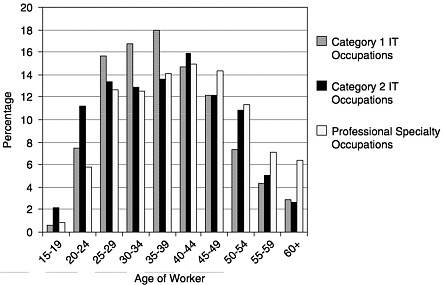
FIGURE 4.1 Age distribution of category 1 IT, category 2 IT, and professional specialty workers, 1999. SOURCE: U.S. Department of Labor, Bureau of Labor Statistics, Current Population Survey, March 1999, special tabulation.
few—did not even exist when older workers first entered the IT workforce or during much of their careers. Alternatively, older workers may—as a class—be less familiar with newer technologies than younger ones, who may well have “grown up” around technology. Workers born in 1960 and before used their first computer as adults. Workers born in 1980 and forward have used this tool and other related technology throughout their entire lives. In addition, the rapidly growing IT industry is attracting more recent college graduates, who tend to be younger, thus decreasing the age of the workers in the industry.
-
Older Category 1 IT workers (those 40 years and older) are more likely to lose their jobs than younger IT workers.6
As indicated in Figure 4.2, older workers are at greater risk for losing Category 1 IT jobs than are younger workers. This difference becomes even more pronounced when compared to the fact that in the rest of the economy older workers are less likely to lose their jobs than are younger workers and is consistent with actions that have a disproportionate adverse impact on older IT workers and that are discriminatory against these workers.
However, this difference is also consistent with IT employers ending projects or product lines that rely on older technologies and skills (e.g., FORTRAN and COBOL) and beginning to invest in projects or product lines requiring newer programming approaches (e.g., object-oriented languages such as C++). And they are consistent with actions taken by employers motivated by the reduction of labor costs. For example, an employer that terminated more experienced (hence older), higher-salaried workers and hired less experienced (hence younger), lower paid workers would not necessarily be violating the statutes prohibiting age discrimination.
Without more information about the skills, qualifications, and job duties of the workers, it is impossible to distinguish these competing explanations.7
|
6 |
Based on Farber, Henry, “A Note on Job Loss Among IT Workers,” unpublished manuscript, Department of Economics, Princeton University, May 18, 2000. Note that all statistics from Farber control for the education, race, and sex of the worker as well. |
|
7 |
The committee notes that estimates of the displacement rates are a reasonably good approximation unless employment in the occupation was changing rapidly over the 1990s. In particular, the estimate of the relevant pool of potentially displaced workers (the denominator in the displacement rate) is based on the number of workers employed as of the survey date (up to 3 years after displacement). In the IT sector, which has experienced rapid employment growth, this estimate of the denominator is likely to be too large, thus generating an estimate of the displacement rate that is too small. |
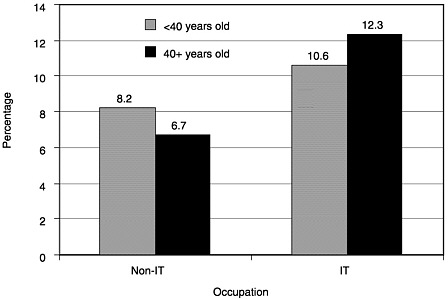
FIGURE 4.2 Percentage of workers who lost a job (but were not fired) within the last 3 years due to a business decision of the employer as of 1994, 1996, and 1998. A “displaced worker” is one who had 3 or more years of tenure on a job before losing or leaving it because of employer closings or moves, insufficient work, or the abolishment of the position. SOURCE: Data from U.S. Department of Labor, Current Population Survey: Displaced Workers Supplement, 1994, 1996, 1998. Also based on Farber, Henry, “A Note on Job Loss Among IT Workers,” unpublished manuscript, Department of Economics, Princeton University, May 18, 2000.
-
Older Category 1 IT workers are just as likely to find new jobs as are younger IT workers. In addition, the length of time it takes for them to find new jobs is similar to that for younger Category 1 IT workers.
About 82 percent of older displaced Category 1 IT workers find a new job within 3 years of being displaced compared to about 84 percent of younger Category 1 IT workers (see Figure 4.3); the older Category 1 IT workers fare better than comparable older workers in non-IT occupations (Farber 2000). In addition, although older displaced Category 1 IT workers take about 2.6 more weeks to find a new job than do younger displaced Category 1 IT workers, their length of unemployment is about the same as that of older displaced workers in the rest of the economy (Figure 4.4). Thus, the fact that it takes older Category 1 IT workers longer to find new employment is not unique to the IT sector.
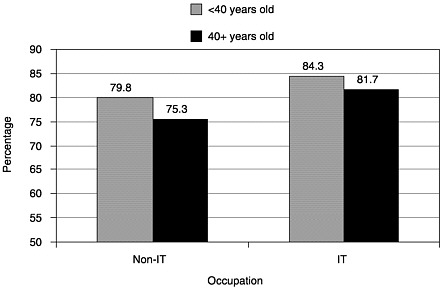
FIGURE 4.3 Percentage of workers ever employed within 3 years of displacement, as of 1994, 1996, and 1998. SOURCE: Data from U.S. Department of Labor, Current Population Survey: Displaced Workers Supplement, 1994, 1996, 1998. Also based on Farber, Henry, “A Note on Job Loss Among IT Workers,” unpublished manuscript, Department of Economics, Princeton University, May 18, 2000.
However, there are some data suggesting that older displaced Category 1 IT workers find new jobs relatively quickly by being willing to take new jobs that do not pay as well as their previous jobs.8 In particular, younger male displaced Category 1 IT workers experience a 6.6 percent wage gain on their new job; in contrast, older male displaced Category 1 IT workers experience a 13.7 percent wage loss on their new job—a difference between older and younger workers of 20 percentage points (Figure 4.5)
Note that the greater wage rate loss among older Category 1 IT workers than among younger workers is not entirely explained by the fact that older workers typically lose more after a job displacement because they were more highly paid to begin with due to seniority. One can see this by comparing the relative experience of older and younger workers in the IT
|
8 |
However, Farber does not find that older IT workers are more likely than younger workers to take a part-time job, nor are they more likely to take a non-IT job, once displaced, than younger workers (Farber, Henry, 2000, “A Note on Job Loss Among IT Workers”). |
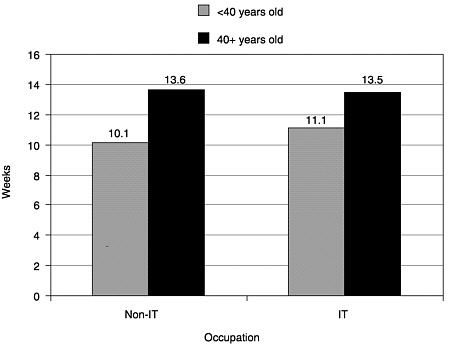
FIGURE 4.4 For displaced workers, mean number of weeks unemployed before finding a job, as of 1994, 1996, and 1998. SOURCE: U.S. Department of Labor, Current Population Survey: Displaced Workers Supplement, 1994, 1996, 1998.
sector to the relative experience of older and younger workers in other sectors.
It is important to emphasize, however, that this pattern is only suggestive because the sample sizes are so small that the differences are within the “margin of error.” That said, the magnitude of the differences is large enough to warrant further investigation. However, without more information on the qualifications and skills of the workers one cannot distinguish an explanation of discrimination from an explanation that the older workers do not have the up-to-date skills demanded by their new employers. (More discussion of the point regarding more experienced workers and keeping skills up to date is contained in Chapter 7.)
Finally, younger displaced Category 1 IT workers experience gains of about 6.6 percent as compared to losses of 5.7 percent for younger displaced non-IT workers (a difference of 12 percent in favor of IT workers), while older IT workers lose almost 14 percent as compared to almost 20
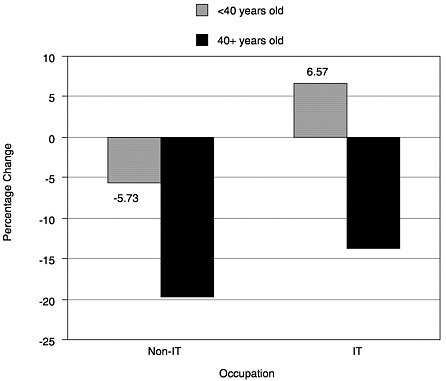
FIGURE 4.5 Mean percentage change in wages for displaced workers who found new jobs, as of 1994, 1996, and 1998. SOURCE: U.S. Department of Labor, Current Population Survey: Displaced Workers Supplement, 1994, 1996, 1998.
percent for older displaced non-IT workers (a difference of 6 percent in favor of IT workers). These differences are consistent with the tight labor market in IT, which should result in wage gains or smaller wage losses for Category 1 IT workers since IT employers have to pay more to hire displaced IT workers.
Because it is essential to account for differences in skills between workers when investigating discrimination (of any kind), many experts turn to experiments, called “audit studies,” in which pairs of equally qualified individuals, who differ only by one characteristic (such as age),
are sent for a job interview.9 In 1994, the American Association of Retired People (AARP) conducted just such a study in which employers were presented with pairs of resumes containing equal qualifications, one-third of which were for an information systems manager.10 The resumes—one for a 57-year-old and one for a 32-year-old—were mailed to a random sample of 775 large firms and employment agencies nationwide.11 On average, younger applicants received a more favorable response, with older applicants receiving a less favorable employer response about 25 percent of the time when a position was vacant. However, the study also notes that highly successful companies (e.g., companies on Financial World's list of 200 best growth companies) were significantly less likely to select younger workers disproportionately than less successful companies.12
While this AARP study contains some evidence of potential age discrimination in the IT sector, it was conducted 6 years ago and may be dated. In particular, it was conducted during a much slacker labor market —a situation that may facilitate a variety of discriminatory practices. Further, the study did not report results separately for the IT resumes such that the committee cannot determine whether they hold for the IT sector specifically.13
|
9 |
Although audit studies are widely accepted as a method for documenting discrimination, see Heckman (Heckman, James J. 1998. “Detecting Discrimination, ” Journal of Economic Perspectives 12(no. 2, Spring):101-116) for a critique of such studies. |
|
10 |
Bendick, M., C. Jackson, and J. Romero. 1996. “Employment Discrimination Against Older Workers: An Experimental Study of Hiring Practices,” Journal of Aging & Social Policy 8(1):25-46. |
|
11 |
Resumes for both parties indicated 10 years of experience in the IT field as the most recent work experience. To cover for the age differential prior to that, the older applicant was given work as a high school math teacher. Ages were not explicitly stated but rather implied by date of college graduation. |
|
12 |
This result is consistent with the work of Edelman et al., who found that the size of a company correlates positively with the rate at which the company creates EEO grievance procedures, the likelihood of establishing an EEO recruitment program, and the rate at which EEO offices and antidiscrimination rules are created. See Edelman, Lauren B., Christopher Uggen, and Howard S. Erlanger, 1999, “The Endogeneity of Legal Regulation: Grievance Procedures as Rational Myth,” American Journal of Sociology 105:406-454; Edelman, Lauren B., and Stephen Petterson, 1999, “Symbols and Substance in Organizational Response to Civil Rights Law,” Research in Social Stratification and Mobility 17:107-136; and Edelman, Lauren B., 1992, “Legal Ambiguity and Symbolic Structures: Organizational Mediation of Civil Rights Law,” American Journal of Sociology 97:1531-1576. |
|
13 |
In addition, an April 2000 study by Hirsch et al., based largely on data from the Current Population Survey, indicates that older workers “. . . face substantial entry barriers in occupations with steep wage profiles, pension benefits, and computer usage.” However, this study does not look specifically at employment among IT workers and thus does not provide detailed insight into this matter. See Hirsch, Barry, David A. Macpherson, and Melissa Hardy. 2000. “Labor Market Transitions Among Older Workers: Job Opportunities, Skills, and Working Conditions,” Industrial and Labor Relations Review 53(3):401-418. |
Based on the available empirical data as well as testimony to the committee, it appears that some older IT workers' experiences with displacement and possibly with post-displacement income differ from those of younger workers. The IT workforce is younger than that in other occupations with workers of comparable educational attainment. In addition, the data also suggest that older IT workers (those 40 years and older) are more likely to lose their jobs than younger IT workers. On the other hand, older IT workers are just as likely to find new jobs as are younger IT workers, and the length of time it takes for them to find new jobs is similar to that for younger IT workers.
Much more problematic is the causality of these differences. The data available are insufficient to establish either the presence or the absence of age discrimination. In particular, the data do not permit the committee to determine whether these differences are the result of illegal age discrimination on the part of employers, legal conduct by employers that may be perceived as age discrimination, personal choices made by individual employees, or the ramifications of a rapidly changing industry. As a result, the committee cannot determine whether illegal age discrimination occurs either more or less in IT than in any other industry.
Audit studies provide a basis for further investigation on these points—but the 1994 audit study by the AARP is dated and may not reflect the hiring practices of employers in today's economy. Thus, more studies of this kind are needed to provide more definitive and up-to-date evidence on whether there is discriminatory behavior on the part of employers or whether perceptions of illegal discriminatory behavior are the result of other factors whose existence may be entirely legal.
The committee emphasizes that the analysis based on data from the BLS and presented in Section 4.3 gives overall averages for all Category 1 IT workers working for all employers in the United States. Such averages may well mask broad variations in the experiences of older IT workers compared to younger ones that may occur in different kinds of IT employers (e.g., those in the IT-producing sector and other IT-intensive firms, or large employers with formal procedures in place to guard against age discrimination versus small ones that may lack such procedures). For example, as noted above, the AARP study found that highly successful (and hence, perhaps, larger) companies were less likely than less successful companies to treat older workers differently from younger workers, suggesting that age discrimination is less likely to occur in the former. The possibility of such variations suggests that generalizations to the entire universe of the IT field are dangerous to make.
Although the current data are inconclusive, the committee acknowl-
edges that, if it does exist, the discriminatory treatment of older workers is a significant issue for policymakers to address. This argument is not based on the idea—advanced by some—that the numbers of older U.S. workers who have been victims of age discrimination could have a significant effect on the tightness in the IT labor market in the long term. For, as noted in Box 4.1 given the number of vacancies in the IT workforce today and the number of jobs expected to be added to the Category 1 IT workforce yearly, elimination of all potential age discrimination in the IT workforce likely would not have a significant impact on tightness in the IT workforce in the long term, although it could have a small, but important, one-time effect. Rather, the argument is based on the fact that as a society we cannot afford to underutilize valuable resources, and differential treatment of older IT workers may be depriving IT employers of a valuable source of talent as well as creating perceptions of age discrimination in the industry.
Finally, older IT workers are in the minority today. But as the current IT cohort ages, those proportions will likely change. The implications for age discrimination will depend on cohort-specific labor market and recruitment issues that are difficult to predict. But given that older workers may become more important in IT work in the future than they are now, it may be in the long-term interest of IT firms and other employers of IT workers to begin to address the cultural and wage-structure concerns of older workers.
The data available to the committee are insufficient to establish either the presence or the absence of age discrimination. These data do not permit the committee to determine whether differences between older and younger IT workers are the result of illegal age discrimination on the part of employers, legal conduct by employers that may be perceived as age discrimination, personal choices made by individual employees, or the ramifications of a rapidly changing industry. As a result, the committee cannot determine whether illegal age discrimination exists to a greater or lesser extent among employers of Category 1 IT workers as compared to employers of professionals in other occupations.
In addition, it should be noted that the committee was not constituted as a jury or a court to examine individual cases that may or may not have demonstrated evidence of disparate treatment; as a result it did not consider specific instances of illegal age discrimination. However, it would be naïve to assert that age discrimination never occurs, and many employers recognize that some managers and hiring teams operate from inaccurate assumptions and stereotypes about older people. At the same time,
|
BOX 4.1 Impact of Age Discrimination on Tightness in the IT Labor Market The following calculation is a “back-of-the-envelope” calculation that provides approximate magnitudes; it is not meant to be mistaken for a rigorous analysis.
This number would increase yearly by 1/15 × 15,200, or 1,010 per year. Conclusions Even under the assumptions above that overstate the case for age discrimination, addressing all age discrimination issues in IT would not have any significant impact on tightness in the IT workforce in the long term. The fundamental reason is that the number of jobs expected to be added to the Category 1 IT workforce yearly is much larger than any plausible estimate of the number of age discrimination incidents against older IT workers. However, given the number of vacancies in the IT workforce today, elimination of all currently existing age discrimination in the IT workforce could have a small but important one-time effect on tightness in the workforce.
|


